Feeds:
Posts
Comments

Archive for the ‘Opponents’ Category

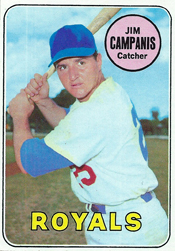
Jim Campanis was ready to leave the Dodgers and Al Campanis was ready to make it happen.

On Dec. 15, 1968, Jim, a catcher, was traded by the Dodgers to the Royals for cash. The Royals also agreed to loan two players to the Dodgers’ minor-league club in Spokane.

The deal was made by Jim’s father, Al, the Dodgers’ director of player personnel.

Jim had been in the Dodgers’ system since 1962, no longer was prominent in their plans and had said during the 1968 season his best chance for an extended shot at the big leagues probably was with another organization.

Al, longtime Dodgers scouting director, took over the duties of general manager in November 1968 and did his son a favor by sending him to the Royals, who were entering the American League as an expansion team in 1969 and seeking experienced players.

However, because the transaction was the first made by Al in his new role and because it featured his son, it created a media sensation.

The Los Angeles Times headline blared, “Campanis Peddles Son, Jim, to KC,” and The Sporting News featured a headline of, “No Room For Sentiment _ A Daddy Sells His Son.”

The trade was “further evidence supporting the premise that baseball and sentiment are not synonymous,” the Los Angeles newspaper reported.

All in the family

Al Campanis was born in 1916 in Kos, a Greek island in the Aegean Sea, and came to New York City with his family as a youth. After graduating from New York University, he joined the Dodgers as an infield prospect in 1940 and played briefly for the big-league club in 1943. Al was the second baseman for the Dodgers’ minor-league club at Montreal in 1946 when Jackie Robinson was the shortstop.

Al became Dodgers scouting director in 1960 and two years later, in 1962, when his son, Jim, was graduating high school, the Dodgers were one of the clubs in pursuit of the prospect. According to The Sporting News, when Dodgers owner Walter O’Malley asked whether the club was likely to sign Jim, Al responded, “I think I have a good chance. I’m pretty close to his mother.”

O’Malley approved a $10,000 bonus offer and Jim accepted.

Jim made his major-league debut with the Dodgers on Sept. 20, 1966.

Cardinals connections

In 1967, Jim began the season as a backup to Dodgers starting catcher John Roseboro. On April 24, 1967, Jim got his first big-league hit, a double down the left-field line against Cardinals reliever Joe Hoerner in the 13th inning at Los Angeles. The hit sparked a comeback by the Dodgers, who erased a 5-4 deficit and won, 6-5. Boxscore

“The kid saved our necks,” Dodgers manager Walter Alston said to the St. Louis Post-Dispatch.

Four months later, on Aug. 9, 1967, Jim was a central figure in a bizarre ending to a game against the Cardinals at St. Louis.

In the eighth inning, batting for Don Drysdale, Jim hit a solo home run high over the Busch Stadium wall in left against Larry Jaster, tying the score at 2-2, and stayed in the game as the catcher.

In the 11th, after the Cardinals loaded the bases with none out against Phil Regan, Eddie Bressoud popped out to first baseman Wes Parker. Mike Shannon, the runner on third, bluffed an advance toward the plate. Parker should have held the ball and run toward Shannon until he retreated to third. Instead, Parker lobbed a throw to Campanis.

“I was off balance … I didn’t trust myself to get set,” Parker said.

Said Alston: “Instead of throwing the ball like an old woman, he should have put something on it.”

The ball bounced in front of the plate, skidded between the legs of Campanis and rolled away. Shannon hesitated before making a dash to the dish and scored the winning run. Boxscore

“The catcher should not have let such an easy roller get away from him,” Alston scolded.

New roles

Campanis batted .161 for the 1967 Dodgers. Before the 1968 season, the Dodgers dealt Roseboro to the Twins and acquired Tom Haller from the Giants to be the starting catcher. Campanis spent most of the 1968 season in the minor leagues. At 24, he acknowledged he was looking ahead to the November 1968 National League expansion draft when the Padres and Expos would stock their rosters with players from existing franchises.

“Although I would like to play on a winner like the Dodgers, I would just be happy to be in the big leagues with any club,” Jim told The Sporting News in May 1968.

Asked whether his father being Dodgers scouting director was a help or hindrance, Jim replied, “I know it’s slowed me down. I know a couple of times I feel I should have gone to a higher classification, but didn’t because I don’t think they wanted it to look like they were showing favoritism.”

In June 1968, Dodgers general manager Buzzie Bavasi left to become president of the Padres. The Dodgers promoted farm director Fresco Thompson to replace him. Five months later, Thompson, 66, died. O’Malley gave Al Campanis the title of player personnel director and assigned him the same responsibilities of a general manager.

Jim wasn’t chosen in the expansion draft, but Royals director of player procurement Charlie Metro rated him a prospect and contacted Al to propose a deal.

“I said this was a very difficult situation for me to be involved in,” Al responded.

Al discussed it with O’Malley and they agreed the trade should be made because it would give Jim “an opportunity to go to a club he can play for regularly,” Al told the Los Angeles Times.

Jim was playing winter ball in the Dominican Republic for a team managed by Cardinals second baseman Julian Javier when Al called and told him of the trade. “He was pleased,” Al said. “He has been told he’ll get a shot at being the first-string catcher.”

The transaction was the first one Al made in his new role, according to The Sporting News. “If it means the boy is going to get a chance, this is one time I won’t mind too badly if the Dodgers made a bad deal,” Al said.

Controversial comments

Jim made the 1969 Royals’ Opening Day roster as the backup to catcher Ellie Rodriguez. In the franchise’s first regular-season game, April 8, 1969, versus the Twins at Kansas City, Jim batted for pitcher Tom Burgmeier in the sixth inning and delivered a RBI-single. Boxscore

Jim played for the Royals in 1969 and 1970 and ended his major-league career with the 1973 Pirates. He batted .147 in six big-league seasons.

Al remained the top executive of Dodgers baseball operations until April 1987 when he resigned under pressure for making insensitive racial comments during an interview with Ted Koppel of the ABC News show “Nightline.”

Read Full Post »

(Updated Aug. 26, 2024)

Carl Hubbell and Mel Ott forever are linked as teammates, friends, road roommates, Hall of Famers and, tragically, by a bizarre twist of fate.

On Nov. 21, 1988, Hubbell, 85, died in a Scottsdale, Ariz., hospital from injuries suffered in a car accident two days earlier.

Hubbell’s death occurred 30 years to the day Ott died under eerily similar circumstances. On Nov. 21, 1958, Ott, 49, died in a New Orleans hospital from injuries suffered in a car accident.

Hubbell was the ace pitcher and Ott the home run slugger who spent their entire major-league playing careers with the Giants.

Ott, 17, debuted with the Giants in 1926 and Hubbell, 25, joined them in 1928. They roomed together on road trips from the time Hubbell arrived with the Giants until he pitched his last game in 1943, according to the Associated Press. Both men had low-key personalities and friendly demeanors and genuinely liked one another.

Hubbell was elected to the National Baseball Hall of Fame in 1947 and Ott was inducted four years later in 1951.

When Ott died, Hubbell told the New York Daily News, “I’m heartsick. Mel was one of my closest friends.”

Perfect pitch

Hubbell was born in Carthage, Mo., and grew up on a cotton and pecan farm near Meeker, Okla.

In 1924, when he turned 21, Hubbell signed with a minor-league club in Oklahoma and taught himself to throw a “reverse curve” or “fadeaway.”

When right-handers Christy Mathewson of the Giants and Grover Cleveland Alexander of the Cardinals threw the “reverse curve,” it broke in to right-handed batters and away from left-handed ones. In his memoir, “Baseball As I Have Known It,” journalist Fred Lieb wrote, “Sometimes when (Mathewson) threw it, it didn’t curve but suddenly plunged, as does a tennis ball rolled across and off a dining room table.” As a left-hander, Hubbell’s version broke in to left-handed batters and away from right-handed ones.

In 1925, when Hubbell was tossing the pitch in warmups, the catcher said, “That’s the screwiest thing I ever saw,” and the “reverse curve” became known as a screwball, according to The Sporting News.

Hubbell’s success with the pitch attracted the interest of major-league scouts and in August 1925 the Tigers acquired him from the Oklahoma City club in the Western League.

The Tigers invited Hubbell to spring training in 1926 and 1927 but returned him to the minor leagues both times. According to the Associated Press, a Tigers coach, believing Hubbell would hurt his arm throwing a screwball, told him, “Don’t fool with that. Forget it.”

“So I forget it,” said Hubbell, “and Detroit forgot me.”

The Tigers sold Hubbell’s contract to a minor-league club in Beaumont, Texas, in April 1928. Giants scout Dick Kinsella liked what he saw from Hubbell there and on July 12, 1928, the Giants purchased his contract. Two weeks later, Hubbell made his big-league debut.

Big winner

Hubbell’s most celebrated performance came in the 1934 All-Star Game when he struck out five future Hall of Famers, Babe Ruth, Lou Gehrig, Jimmie Foxx, Al Simmons and Joe Cronin, in succession. Boxscore

“My style of pitching was to make the other team hit the ball, but on the ground,” Hubbell told writer John P. Carmichael. “It was as big a surprise to me to strike out all those fellows as it probably was to them.”

The all-star feat got the glory, but in games that counted in the standings Hubbell’s most impressive outing occurred against the Cardinals.

On July 2, 1933, in the opener of a doubleheader at the Polo Grounds in New York, Hubbell pitched an 18-inning shutout in a 1-0 victory over the Cardinals.

Hubbell held the Cardinals to six hits, didn’t walk a batter and struck out 12. He retired 20 batters in a row from the seventh inning to the 13th and only one Cardinals runner reached third.

Cardinals starter Tex Carleton nearly matched Hubbell, pitching 16 scoreless innings before he was relieved by Jesse Haines. In the 18th, with Giants runners on first and third, two outs, Hughie Critz “shot a single past Haines’ left ear,” scoring Jo-Jo Moore, the St. Louis Star-Times reported. When Moore touched the plate, “a deafening roar went up and straw hats, torn programs and other debris rained upon the turf,” according to the New York Daily News. Boxscore

Hubbell pitched 16 seasons (1928-43) for the Giants and had a record of 253-154 with a 2.98 ERA. He twice won the National League Most Valuable Player Award (1933 and 1936), pitched in three World Series (1933, 1936 and 1937) and was a nine-time all-star.

Hubbell earned 21 wins or more in five consecutive seasons (1933-37) and in 1933 he led the league in wins (23), ERA (1.66), shutouts (10) and innings (308.2). He won 24 consecutive regular-season decisions over a two-year period (1936-37). Flagstaff Film clip of Hubbell vs. Cardinals on July 21, 1938.

Throwing the screwball eventually took a physical toll on him. When Hubbell’s left arm was at rest, his palm faced out instead of in. “I couldn’t get over Hubbell’s hand,” writer Roger Angell observed. “It was like meeting a gladiator who bore scars inflicted at the Colosseum.”

Eye for talent

Following his retirement as a player after the 1943 season, Hubbell became Giants farm director and rebuilt their sagging minor-league system. Among the prospects the Giants developed under Hubbell were Willie Mays, Orlando Cepeda, Willie McCovey, Juan Marichal and Gaylord Perry.

Hubbell made all decisions on which prospects the Giants would draft and which of the organization’s minor-league players got promotions, the San Francisco Examiner reported.

He was Giants farm director for 34 years until a stroke forced him to give up the job in 1977 at age 74. The stroke “left him unable to walk for a while and caused slurred speech,” according to the Arizona Republic. Hubbell had a second stroke in 1984, but continued to do scouting for the Giants in Arizona.

Hubbell lived in an apartment in Mesa, Ariz., not far from the Giants’ spring training base. “I get along all right,” Hubbell said to the New York Daily News in 1987. “When I can get to the car, I go to the post office, the bank, different places you have to go. There’s nothing wrong with the car. Only me.”

He ate breakfast at the counter of a Mesa restaurant every other morning and that’s where he was headed on Nov. 19, 1988, when he lost control of his car and hit a metal pole after suffering an apparent stroke, according to police reports.

Hubbell, who was alone in the car, was taken by helicopter to a hospital in Scottsdale, Ariz. He died of head and chest injuries two days later. He was survived by two sons and two grandchildren. His wife, Lucille, whom he married in 1930, died in 1967.

In citing his “consistency of excellence” as a pitcher, the New York Times noted, “Hubbell’s businesslike demeanor on and off the pitching mound contrasted with more colorful, eccentric pitchers of his era, like Lefty Gomez of the Yankees and Dizzy Dean of the Cardinals. Hubbell won respect and attention solely from on-field performances.”

Read Full Post »

Willie McCovey made the Cardinals pay for disrespecting an elder.

On June 15, 1979, with the score tied at 6-6, a Giants runner on second and two outs in the bottom of the 13th inning, the Cardinals opted to give an intentional walk to Jack Clark and take their chances with McCovey, who was 41 years old and in the twilight of a Hall of Fame career.

McCovey foiled the strategy, hitting the first pitch from Darold Knowles over the fence at Candlestick Park and lifting the Giants to a 9-6 walkoff victory.

McCovey hit 521 home runs, including 41 against the Cardinals, in a 22-year career in the big leagues with the Giants, Padres and Athletics.

One of his most impressive feats came in June 1979 when he silenced skeptics by hitting three home runs in less than 24 hours in a pair of wins against the Cardinals.

Still in the game

At spring training in 1979, critics clamored for the Giants to start Mike Ivie at first base instead of McCovey. Ivie was 26 and batted .308 for the Giants in 1978. McCovey hit .228 for the 1978 Giants and appeared to some to be finished as a ballplayer.

Ivie opened the 1979 season as the Giants’ first baseman but after two months his batting average was .244 and manager Joe Altobelli began playing McCovey more.

When the Cardinals came to San Francisco for a three-game series on June 15, 1979, McCovey was in the lineup as the cleanup batter and first baseman for the Friday night opener.

McCovey led off the fourth inning and lined a 3-and-0 pitch from starter Pete Vuckovich over the wall in left-center for a home run, giving the Giants a 2-1 lead.

The Giants led, 6-5, until the Cardinals got a run in the eighth.

McCovey nearly delivered a game-winning hit in the 11th. With one out and runners on second and first, McCovey hit a line drive to right-center. Rob Andrews, the runner on second, took off, thinking the ball was a hit, but right fielder George Hendrick was positioned to make the catch and throw to second before Andrews could get back, completing a double play.

“They had no business playing me the way they did,” McCovey said to United Press International. “Since when doesn’t the right fielder play me on the line? They did the wrong thing and got lucky.”

Big Mac attack

In the 13th, the Giants had Larry Herndon on first base, one out, when Andrews hit a bouncer to third baseman Ken Oberkfell, who was thinking he could turn a double play, but the ball struck Oberkfell in the chest and he was only able to get the out at first.

“I got caught between hops,” Oberkfell said to the St. Louis Post-Dispatch

With Herndon on second, two outs, Clark was at the plate and McCovey was on deck. Clark, the future Cardinal, was a right-handed batter facing Knowles, a left-hander. After the count went to 2-and-0, Knowles was instructed to walk Clark intentionally.

McCovey batted left-handed and the Cardinals figured Knowles had a better chance of retiring him than he did Clark. McCovey had produced two hits in 14 career at-bats versus Knowles.

The strategy backfired. Knowles’ first pitch to McCovey was a mistake, “a hanging slider,” he said, and McCovey uncoiled his 6-foot-4 frame and crushed a towering drive over the fence in right-center for the sixth walkoff home run of his career.

“I knew it was gone the second I hit it,” McCovey said.

Knowles, disgusted, flung his glove into the air as McCovey circled the bases. Boxscore

Experience matters

The long game required a quick turnaround for the players, who returned to Candlestick Park the next morning, June 16, 1979, for a Saturday afternoon start time.

McCovey was back in the cleanup spot and in the third inning he hit a two-run home run against starter Silvio Martinez, extending the Giants’ lead to 3-0 and propelling them to a 6-1 triumph. Boxscore

“Willie McCovey is one of the chosen people,” Altobelli said to the San Francisco Examiner. “He’s a living legend.”

The home run was the sixth in McCovey’s last eight games.

“You can’t judge a guy on age,” McCovey said. “Guys over 35 can still do it, but for some reason you have to keep proving it. Our society is geared to youth and people are brainwashed that you have to be young to do anything.”

McCovey finished with 15 home runs in 1979 and he returned for a final season in 1980, enabling him to play in four decades during a big-league career started in 1959.

McCovey hit 421 of his career home runs against right-handers and he had success against several Cardinals, including Bob Gibson (.290 batting average against, seven home runs), Nelson Briles (.353, seven home runs) and Ray Washburn (.366, three home runs).

Read Full Post »

Tigers catcher Bill Freehan was a central character in one of the most controversial plays in Cardinals history.

In the 1968 World Series, the defending champion Cardinals won three of the first four games against the Tigers. Freehan was the goat. He went hitless in the first four games, made two errors and was tormented by Cardinals baserunners, especially Lou Brock, who swiped seven bases.

Things changed in Game 5 at Tiger Stadium on Oct. 7, 1968.

In the third inning, Brock was at first when Freehan called for a pitchout and nailed the speedster at second. “That was the first lucky guess I’ve made all Series,” Freehan told Milton Gross of the New York Post.

The big play came two innings later.

The Cardinals led 3-2 in the fifth and were threatening to knock out starter Mickey Lolich. With Brock at second, Julian Javier lined a single to left. Willie Horton, a left fielder not known for his defense, unleashed a strong, accurate throw to the plate. (Lolich told the Associated Press, “As fast as Brock is, I didn’t even figure there would be a throw.”) The peg took one clean hop directly to Freehan, who stood, blocking the plate, “like the towering Washington monument,” wrote Milt Richman, columnist for United Press International.

Brock tried to score standing, collided with Freehan and was called out by umpire Doug Harvey, igniting an animated protest from the Cardinals.

The momentum _and the Series _ shifted to the Tigers with that play. “It was the biggest play of the game,” Brock said to the Associated Press. “It was the turning point. We had the makings of a big inning, and instead of one run, one man on and one out, there were two outs and no runs.”

Detroit rallied to win, 5-3, and send the Series back to St. Louis, but the debate raged about whether Brock was safe or out. Brock said his foot touched the plate before Freehan tagged him. Freehan said Brock came up short of the plate. Others thought Brock stepped on Freehan’s planted foot and bounced off and around the plate. Video

Columnist Milton Gross reported this exchange:

Freehan: “Harvey told me if Lou had slid, he would have been safe. He just never touched the plate.”

Brock: “I was safe. I touched the center of the plate right between Freehan’s legs. Freehan came up behind me as we were arguing after the play and tagged me.”

Freehan: “I was surprised he didn’t slide. There I was, set. With my left foot planted where it was, he’d have had to slide through it or touch the plate with his hand simply because I was between him and the plate. When he hit me on the left side, he just spun away from the plate. The reason I tagged him a second time was I saw him coming back _ like a reflex, you know?”

Brock: “If I slid, he would have had a good chance of blocking me out. He was standing wide-legged, his feet four or five feet apart, one up the third-base line, the other at the corner of the plate. If you slide, he gets down on one knee and you don’t get in.” Boxscore

The on-deck batter, Curt Flood, gestured for Brock to slide, but “I didn’t have time to look at anyone,” Brock said to the St. Louis Post-Dispatch. “The play was in front of me and I had to look at the catcher.”

Flood said Brock was safe because “half of Brock’s foot was on the plate.”

In his World Series column for the Post-Dispatch, Cardinals pitcher Bob Gibson said he thought Brock was safe and did right by not sliding. “When the catcher is blocking the plate, you can slide and never get to it,” Gibson said.

Years later, in his book “Stranger to the Game,” Gibson saw the play differently. “In my heart, I wish Lou had slid,” Gibson said.

The Tigers won Game 6. Facing Gibson in Game 7, Detroit broke a scoreless tie in the seventh, with Freehan’s double driving in Jim Northrup after Northrup lined a two-run triple that was misjudged by Flood in center.

In the ninth, Cardinals catcher Tim McCarver fouled out to Freehan to end the game, won by Detroit, 4-1, giving the Tigers their first World Series championship in 23 years. Boxscore

Though the Cardinals had 11 stolen bases in 16 attempts against Freehan in the Series and he batted .083 (2-for-24), he is remembered most for his block of home plate in Game 5.

Brock, interviewed in 2012 by Mike Stone of CBS Detroit, still insisted he was safe on that play.

“I did not have a great jump, but I thought I could make it,” Brock told Stone. “But Willie Horton made the throw of his life. I never thought Horton could make that throw. The next thing I know I was going to collide with Bill Freehan _ and we know who would have won that. I was safe, but the umpire called me out, so I was out.”

Previously: Should Curt Flood have caught Jim Northrup’s drive?

Read Full Post »

For Wayne Krenchicki, who usually didn’t do well against Cardinals pitching, a game-winning hit, even a crummy one, was a special achievement.

Krenchicki played eight years in the major leagues as an infielder for the Orioles (1979-81), Reds (1982-83 and 1984-85), Tigers (1983) and Expos (1986).

A left-handed hitter, he had a career batting average of .266, though he hit .169 lifetime against the Cardinals.

Right spot

On May 23, 1983, the reigning World Series champion Cardinals looked to end a three-game losing streak when they faced the Reds at Cincinnati. Cardinals starter Joaquin Andujar was matched against Joe Price. Krenchicki played third base and batted seventh.

In the sixth inning, with the Cardinals ahead, 1-0, Johnny Bench drew a one-out walk from Andujar and Ron Oester doubled to right, moving Bench to third. Cardinals manager Whitey Herzog ordered an intentional walk to Paul Householder, loading the bases for Krenchicki.

The Cardinals were hoping for an inning-ending double play from Krenchicki, who was batting .167 for the season. Krenchicki was seeking a sacrifice fly. “I wanted to hit in the air to the outfield,” Krenchicki said to the Cincinnati Enquirer. “All I wanted was the one run.”

Andujar got ahead in the count, 1-and-2, and threw a slider “right in on my fists,” Krenchicki told the Dayton Journal-Herald.

Krenchicki swung and looped a floater to the opposite field. The ball fell softly inside the left-field foul line, barely fair, for a bloop double, scoring Bench and Oester and giving the Reds the lead.

“It was just crummy enough that I knew nobody would catch it,” Krenchicki said to the St. Louis Post-Dispatch.

“Yeah, I’d agree with that,” Herzog said to United Press International. “It hit right in the middle of the chalk line.”

Andujar yelled at Krenchicki, “You throw the ball harder than you hit it.”

Bill Scherrer relieved Price, held the Cardinals hitless over the last three innings and the Reds won, 2-1. Boxscore

Cardinals connection

A month later, the Reds traded Krenchicki to the Tigers and reacquired him after the 1983 season. Krenchicki played two more years with the Reds before he was dealt to the Expos in March 1986 for pitcher Norm Charlton, who became one of the Nasty Boy relievers who helped give the Reds their swagger in their World Series championship season in 1990.

Krenchicki, a Trenton, N.J., native, was a standout shortstop at the University of Miami and played for the Hurricanes when they made their first appearance in the College World Series in 1974. Krenchicki, a first-round draft choice of the Orioles in January 1976, was inducted into the University of Miami Sports Hall of Fame in 1990.

Krenchicki’s last season as a professional player was 1988 when he played for three minor-league teams, including the Cardinals’ Class AAA affiliate, the Louisville Redbirds. Playing for manager Mike Jorgensen, Krenchicki hit .195 in 18 games for Louisville before he was released on June 17, 1988.

After his playing career, Krenchicki spent 20 years (1991-2010) as a minor-league manager, primarily with independent teams not affiliated with major-league organizations. He managed the Newark Bears to the Atlantic League championship in 2007.

Read Full Post »

(Updated May 1, 2022)

The punishing rushes of Green Bay Packers fullback Jim Taylor shredded a daring defense of the St. Louis football Cardinals.

Taylor was a bruising rusher for the championship Packers teams of the 1960s. Paired in a backfield with “Golden Boy” halfback Paul Hornung, Taylor was a powerful force who twice led the NFL in rushing touchdowns and was elected to the Pro Football Hall of Fame.

In 1962, Taylor topped the NFL in rushing yards with 1,474 in 14 games. He faced the St. Louis Cardinals for the first time that season and his rushing and pass-catching skills were key to enabling the Packers to overcome a challenging defensive scheme.

Game plan

The Cardinals and Packers each had 1-0 records entering their game on Sept. 23, 1962, at Milwaukee County Stadium. The Packers were the reigning NFL champions and the Cardinals were looking to establish themselves as contenders.

Cardinals head coach Wally Lemm and his staff devised a plan to apply pressure on Packers quarterback Bart Starr by having St. Louis defensive players use stunting maneuvers and blitzing schemes.

The stunting meant two or more Cardinals defenders would alter their usual paths to the quarterback in an effort to confuse the Packers’ offensive linemen.

The blitzing freed a defensive back or linebacker to leave his usual post and become an extra pass rusher. New York Giants linebacker Donald “Red Dog” Ettinger is credited with being the first to use the technique from 1948-50 and blitzes came to be known as “red dogging.” In 1960, Cardinals assistant coach Chuck Drulis designed a blitz using safety Larry Wilson and named it “wildcat.”

Pressuring Pack

The blitzing and stunting of Cardinals defenders confused the Packers in the first half of their 1962 game. Starr “was under considerable pressure from the Cardinals’ determined rush, including red-dogging defensive halfbacks,” the Green Bay Press-Gazette reported.

Packers offensive tackle Forrest Gregg said the Cardinals “were doing a lot of jumping around in there and we weren’t picking them up.”

Said Packers coach Vince Lombardi: “Their defense upset us in the beginning. We had a hell of a time trying to find them. They did a lot of stunting in there … It was new to us. We hadn’t seen it before this year.”

Lombardi and his staff tried to make adjustments during the first half, but were unsuccessful in communicating effectively during the helter-skelter pace of the game. The best the Packers could do was hold on until they could regroup in the locker room at halftime. “We had to put it on the (chalk) board,” Lombardi said.

The Packers’ defense, led by linemen Willie Davis and Henry Jordan, stopped the Cardinals, and Green Bay led, 3-0, at halftime on Hornung’s field goal.

Fast learners

Using the chalkboard to illustrate what needed to be done to counter the Cardinals’ aggressive blitzing and stunting, Lombardi and his staff instructed their offensive linemen to block in assigned areas rather than man against man, and they told Starr to turn Taylor loose to rumble and mix in short passes to Taylor and tight end Ron Kramer.

The adjustments worked. Taylor, 6 feet and 215 pounds, pounded the Cardinals with runs up the middle and put the Packers in position to score a pair of touchdowns.

“In three years, nobody has run through our middle as the Packers did,” defensive tackle Frank Fuller, who played for the Cardinals from 1960-62, told the St. Louis Post-Dispatch.

Taylor “turned the tide with his powerful smashes in the second half,” the Green Bay Press-Gazette reported. Taylor “punished the Cardinals’ defense with his hard hitting … His thrusts up the middle helped the (Packers) loosen up the Cardinals’ defense and thus make their passing work.”

Taylor finished with 122 yards rushing on 23 carries and also had four catches for 40 yards. Hornung had a three-yard touchdown run in the third quarter, Starr connected with Max McGee on a 19-yard scoring strike in the fourth quarter and the Packers won, 17-0. Boxscore

“We adjusted between halves,” Lombardi said. “In the second half, we zone blocked and area blocked. The boys picked them up real well.”

Said Taylor: “We just got to zone blocking in the second half and they changed their defense. They weren’t red-dogging so much and the red dogs were not real hard to pick up.”

One of a kind

Lemm praised the Packers as “the best-balanced team in football. Father Time is the only thing that’s going to beat the Packers.”

Regarding Taylor, Lemm said to the Post-Dispatch, “He has a great ability to slide out and get moving. He takes a pitchout quick with that sliding ability.”

Lemm added, “The blocks Hornung throws for Taylor are really something.”

The Cardinals totaled 16 yards rushing and their top receiver, Sonny Randle, had one catch for five yards. Halfback John David Crow had nine yards on nine carries.

“We don’t have a Taylor,” Lemm lamented.

The 1962 Packers repeated as NFL champions and Taylor also played for league champions in 1965 and 1966. The Cardinals finished 4-9-1 in 1962.

Taylor played two more regular-season games against the Cardinals in his career. On Oct. 20, 1963, he rushed for 67 yards and two touchdowns in a 30-7 Packers victory. On Dec. 12, 1967, in his final NFL season with the Saints, the former Louisiana State standout had 34 yards rushing in a game the Cardinals won, 31-20.

Read Full Post »

« Newer Posts - Older Posts »