Feeds:
Posts
Comments

Archive for the ‘Opponents’ Category

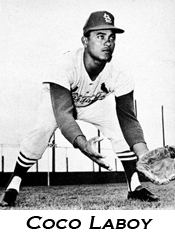
The National League expansion draft enabled third baseman Coco Laboy to get out from under control of the Cardinals and earn a chance to play in the big leagues.

On Oct. 14, 1968, Laboy was selected by the Expos in the sixth and final round of the draft.

Laboy, 28, had been in the Cardinals’ system for six seasons, including the last four at the Class AAA level. Though he hit for average and with power and fielded well, he never got the call to play for the Cardinals.

Given an opportunity by the Expos, Laboy delivered, becoming a popular and productive player in the franchise’s inaugural year.

Stay or go?

After the 1968 season, the National League expanded from 10 teams to 12 with the addition of the Expos in Montreal and the Padres in San Diego.

To help stock their rosters, the newcomers were permitted to draft a total of 60 players, 30 for each expansion club, from the existing National League franchises. The draft consisted of six rounds, and the Expos and Padres were allowed to each select five players per round from the major-league and minor-league rosters of the other clubs.

Each National League team could protect 15 players. A team could protect three more players each time one was taken from its list of unprotected.

The 15 players protected by the two-time defending National League champion Cardinals were pitchers Nelson Briles, Steve Carlton, Bob Gibson, Jerry Reuss and Ray Washburn; catchers Tim McCarver and Ted Simmons; infielders Orlando Cepeda, Joe Hague, Julian Javier, Dal Maxvill and Mike Shannon; and outfielders Lou Brock, Curt Flood and Vada Pinson, according to Bob Broeg of the St. Louis Post-Dispatch.

The Cardinals wavered until the last minute before protecting Washburn instead of newly acquired pitcher Dave Giusti, the Post-Dispatch reported.

When the Padres chose Giusti in the first round, the Cardinals added pitchers Joe Hoerner and Mike Torrez and infielder Steve Huntz to the protected list.

Joining Giusti and Laboy among the players drafted from the Cardinals were pitcher Clay Kirby (second round) and infielder Jerry DaVanon (third round) by the Padres and pitchers Jerry Robertson (fourth round) and Larry Jaster (fifth round) by the Expos.

Laboy batted .292 with 44 doubles and 100 RBI for the Tulsa Oilers in 1968. “He’s been a fine Triple-A hitter,” said Cardinals general manager Bing Devine, “but he’s been in our minor-league system a long time without having been brought up. Frankly, we were glad to see him get a chance in the big leagues.”

Going nowhere

Jose Laboy was born in Ponce, Puerto Rico, the same hometown of Orlando Cepeda. Laboy told the Montreal Gazette people called him Coco for as long as he could remember, but he didn’t know why.

At 18, he signed with the Giants and played for four seasons (1959-62) in their farm system. He batted .305 with 83 RBI for the Class C Fresno Giants in 1960, but in 1962 Laboy suffered a serious back injury on a slide into second base, was limited to 13 games and got released after the season. “The doctors told me I’d never play again,” Laboy said to The Sporting News.

Laboy played winter ball in Puerto Rico, proved he was healthy and signed with the Cardinals in February 1963. The Cardinals assigned him to the Class A Winnipeg Goldeyes and he batted .292 with 21 home runs that season.

In 1964, Laboy was sent to the Class A Raleigh Cardinals, who were managed by George Kissell. Laboy thrived, batting .340 with 24 home runs, but an incident late in the season tarnished him.

On Aug. 20, 1964, in a game at Rocky Mount, N.C., Laboy became convinced pitcher Carl Middledorf was throwing at him and others. In the fifth inning, Laboy bunted along the first-base line. As Middledorf fielded the ball, Laboy charged at him with a bat. Laboy hit Middledorf twice with the bat, striking him in the back and chest, and a brawl ensued, the Rocky Mount Telegram reported.

Middledorf was not badly hurt and continued pitching until the eighth inning, according to the Rocky Mount newspaper.

Police arrested Laboy, took him to headquarters and charged him with assault with a deadly weapon. Laboy was released on $150 bail, appeared in court the next morning and entered a guilty plea. Judge Tom Matthews sentenced Laboy to 30 days on a road crew, suspended the sentence and fined him $20.25. The Carolina League suspended Laboy for three days and fined him $25.

Oh, Canada

While playing winter ball in Puerto Rico, Laboy’s teammate for three years was Phillies second baseman Tony Taylor.

“I knew when I first saw him that he could make the major leagues,” Taylor said to Sports Illustrated.

Taylor shared his insights with Phillies manager Gene Mauch. When Mauch became Expos manager, he remembered Taylor’s recommendation of Laboy.

“Several times when I was managing the Phillies I talked to Tony Taylor about Laboy,” Mauch said. “Before we went to the draft meetings, I talked to Tony again.”

Taylor said Laboy “is a good ballplayer and a smart one. He is the kind of player Mauch likes.”

At Expos spring training camp in West Palm Beach, Fla., in 1969, Mauch and his staff showed unwavering confidence in Laboy, even though he struggled while trying to impress.

The Expos went into their inaugural season with Laboy as their third baseman. In the season opener on April 8, 1969, against the Mets at New York, the Expos led, 8-6, in the eighth when Laboy hit a three-run home run against Ron Taylor, the former Cardinal. Laboy’s home run proved the difference in an 11-10 Expos triumph. Boxscore

A week later, on April 14, 1969, the Expos played their first home game, facing the Cardinals at Jarry Park. In the seventh, with the score tied at 7-7, Laboy hit a double against Gary Waslewski and scored on pitcher Dan McGinn’s single to left. “I never ran harder,” said Laboy, whose run provided the winning margin in an 8-7 Expos victory. Boxscore

Laboy acknowledged getting special pleasure from beating the Cardinals. “They never gave me a chance,” he said. “I wanted especially to beat them today.”

Fun while it lasted

Laboy’s magical beginning to his major-league career continued throughout the first month. He batted .377 with 14 RBI in 20 April games.

“Every day he does something that just tickles me,” Mauch said. “Sometimes I want to kiss him.”

Asked to explain why Laboy was performing so well, Mauch said, “Character. Coco’s got that. He just tries so damn hard to do what you want _ and he’s doing it.”

Laboy finished his rookie season with a .258 batting mark, 18 home runs and 83 RBI.

The next season was a different story. Laboy hit .199 in 1970, was replaced by Bob Bailey at third base in 1971, and spent three seasons as a reserve before the Expos released him in September 1973 at age 33.

Read Full Post »

After losing their way while trying to navigate a path to the top of the 1958 National League standings, the Cardinals embarked on an odyssey of cultural awakening and confidence building.

In the fall of 1958, the Cardinals traveled to Japan for a goodwill tour and a series of 16 exhibition games against Japanese all-star teams. Along the way, the Cardinals also played exhibition games in Hawaii, Guam, Philippines, Okinawa Island and South Korea.

The Cardinals began the journey from St. Louis on Oct. 9, 1958, and completed the trip with their return on Nov. 18, 1958.

During their adventure, the Cardinals won nearly every game, providing a boost to their self-esteem after finishing the regular season at 72-82, 20 wins fewer than the National League champion Braves.

In addition, the Cardinals were exposed to a world they never knew.

Palaces and diamonds

The Cardinals took 20 players, along with manager Solly Hemus and coaches Johnny Keane and Harry Walker, on the excursion.

They had eight pitchers _ Bob Blaylock, Ernie Broglio, Jim Brosnan, Larry Jackson, Sam Jones, Vinegar Bend Mizell, Phil Paine and Bill Wight.

Brosnan agreed to write columns for the St. Louis Post-Dispatch during the trip.

The 12 Cardinals position players were Ruben Amaro, Don Blasingame, Ken Boyer, Joe Cunningham, Alex Grammas, Gene Green, Ray Katt, Wally Moon, Stan Musial, Bobby Gene Smith, Hal Smith and Lee Tate.

As the Cardinals boarded a plane at Lambert Field in St. Louis, “Musial was the last man up the ramp,” the Post-Dispatch reported. “Musial had the biggest camera kit of all the big camera kits. When the trip is finished, Hemus will know what every Cardinal can do with a 35-millimeter.”

The Cardinals arrived in Honolulu on Oct. 10 and were welcomed by “a hula dancing troupe and a high school band,” the Associated Press reported. The team was taken to Iolana Palace and met with Hawaii Governor William Quinn, a graduate of St. Louis University. Musial was presented a key to the city by Honolulu Mayor Neal Blaisdell.

The Cardinals won all three exhibition games in Hawaii against local teams whose rosters were supplemented by visiting big-league players Lew Burdette, Bob Turley and Eddie Mathews, who were paid to participate.

On the way to the Japanese mainland from Hawaii, the Cardinals stopped at Guam, Manila and Okinawa Island and won an exhibition game against locals or military clubs at each site.

Play to win

The Cardinals arrived in Tokyo on Oct. 20, 1958.

“Dressed in bright maroon coats, white shirts, light gray ties with black and white stripes, light gray trousers and black shoes, they were given a rousing welcome by more than 1,500 fans, most of them flag-waving children,” the Associated Press reported.

From the airport, the Cardinals were driven through Tokyo in 13 decorated open cars and presented with large floral bouquets by kimono-clad women. The team also was greeted by a group of American children, residents of Yokohama, dressed in Cardinals uniforms.

The Cardinals prepared to play 16 games throughout Japan, plus one in Seoul, South Korea.

“We’re going to win all 16 games during our Japan visit,” Hemus said. “My boys are going to hit at least 25 home runs in Japan. No one wants to lose even goodwill games. We came to Japan to win every game we can.”

On Oct. 23, 20,000 people streamed into Tokyo’s Komazawa Stadium to watch the Cardinals conduct their first workout. “I never saw so many people watch a mere workout,” Hemus said.

Altering slightly his prediction of a sweep, Hemus said, “If we lose more than two games to the Japanese all-stars, I’m going to be mighty disappointed.”

Clubhouse chronicler

Broadcaster Joe Garagiola accompanied the Cardinals on the trip and his broadcasts were carried by Cardinals flagship radio station KMOX.

Readers of the Post-Dispatch were treated to Brosnan’s insightful, clever prose. Some examples:

_ “At Chunichi Stadium in Nagoya, the Japanese proved they can hit a hanging curveball as far as anyone. I threw one in the ninth and this fellow, Yomauchi, parked it in the center field seats, 410 feet away.”

_ “An amazingly industrious people, the Japanese are handicapped by lack of land, but utilize every foot-acre, each tillable clod of black earth. In the bottomlands, the rice is planted, the garden plots are stuffed with huge cabbages and turnips, and the slopes sport timber and orchards. Even the mountains look hand-formed.”

_ “They say it goes to 35-below at Sapporo in December. At the Sapporo Grand Hotel, a grand hotel, under a sheet, two blankets and a quilt three inches thick, I burrowed in for the winter. Which lasted for nine hours; then we suited up for another game.”

_ “To get to the Hotel Fujiya from Tokyo, we had to take a narrow road, just wide enough for an English bicycle, down which Japanese buses go careening madly in order to keep on schedule. Arriving in a downpour, after a three-hour ride, everyone was struck by the beauty of the bar.”

_ “The hotel’s rooms are not numbered, as from 100 to 1,000, but given individual names, such as Chrysanthemum, Cape Jasmine and Nandina Japonica. Try to remember that at 3 in the morning after a bottle of sake.”

Lost in translation

To the delight of Hemus, the Cardinals won 14 of the 16 games against the Japanese all-stars, plus the exhibition in Seoul versus the South Korean all-stars.

On the way back, several Cardinals departed in San Francisco and headed from there to their homes. The rest of the party went on to St. Louis and emerged from the plane “looking like gypsies traveling first class,” with luggage laden with souvenirs, the Post-Dispatch reported.

The trip was a success, but it didn’t help the Cardinals compete any better in the National League. They lost 15 of their first 20 games in 1959 and finished the season next-to-last at 71-83.

Read Full Post »

In a game featuring an inordinate number of big plays, Philadelphia Eagles flanker Tommy McDonald produced one nearly every time he touched the football.

On Dec. 16, 1962, McDonald made four catches, three for touchdowns, in a game versus the St. Louis Cardinals at Busch Stadium. In a NFL career filled with achievements, it was McDonald’s best performance against the Cardinals.

McDonald was one of the NFL’s most amazing players. At 5 feet 9, 175 pounds, he was a prolific pass catcher who regularly produced touchdowns.

Walking tall

McDonald was born in Roy, New Mexico, and his father was a farmer and electrician who set up a spotlight outside the barn “so his sons could play basketball after milking the cows each night,” according to The Daily Oklahoman.

A multi-sport athlete in high school, McDonald was recruited by the University of Oklahoma and was a running back for coach Bud Wilkinson on three consecutive unbeaten teams from 1954-56. McDonald scored 17 touchdowns, 16 rushing and one receiving, for the 1955 national champions. McDonald’s success at Oklahoma earned him election to the College Football Hall of Fame.

“There are worlds of people with potential physical abilities greater than McDonald’s,” Wilkinson said to Sports Illustrated. “About his only real advantages are quickness and extraordinary determination.”

The Eagles selected McDonald in the third round of the 1957 NFL draft and converted him to a receiver.

McDonald was undersized but tough. On Oct. 4, 1959, a week after he broke his jaw and had it wired shut, McDonald played against the New York Giants and scored four touchdowns _ three on receptions and the other on a punt return.

As a teen, McDonald lost the tip of his left thumb in a motorbike accident, the New York Times reported, but he was as sure-handed as any receiver in the NFL.

McDonald also benefitted from learning the proper way to go down after being tackled by much larger defensive players. “I fall like 175 pounds of spaghetti,” McDonald said.

“He has the balance of a gymnast,” Sports Illustrated observed, and as teammate Tom Brookshier said, “The little rat is strong as a bull.”

Good chemistry

Quarterback Norm Van Brocklin, traded by the Rams to the Eagles in 1958, mentored McDonald “in the art of running pass patterns,” the Times reported, and McDonald became Van Brocklin’s favorite receiver.

McDonald led the NFL in touchdown receptions (nine) in 1958.

In the 1960 NFL championship game against the Packers, McDonald caught three passes from Van Brocklin for 90 yards and a touchdown in a 17-13 Eagles victory.

“If I had to pick one guy to throw the ball to with the game on the line, I’d pick McDonald,” Van Brocklin told Ray Didinger, author of “The Eagles Encyclopedia.”

Van Brocklin retired after the 1960 season and his protege, Sonny Jurgensen, took over as Eagles quarterback. Jurgensen and McDonald were friends and clicked on the field. McDonald led the NFL in receiving yards (1,144) in 1961.

Jurgensen, McDonald and Van Brocklin all would be elected to the Pro Football Hall of Fame. “I wound up with two great quarterbacks _ Van Brocklin and Jurgensen,” McDonald told The Daily Oklahoman. “You couldn’t go in a chemistry lab and mix up two better arms.”
Thrill ride

The Eagles and Cardinals each entered the 1962 season finale with a 3-9-1 record. Played on a sunny St. Louis Sunday with a temperature of 40 degrees and before a crowd of 14,989, the game quickly became what the Philadelphia Daily News described as “a spectator’s dream but a coach’s nightmare.”

Among the highlights:

_ McDonald made four catches for 162 yards. Three of those grabs were for touchdowns of 56, 60 and 40 yards, the latter “a remarkable diving catch,” the Philadelphia Inquirer reported.

_ Jurgensen threw for 419 yards and five touchdowns. He did most of that damage from a shotgun formation designed to buy time against the Cardinals’ blitzes, according to the Inquirer.

_ Timmy Brown, the Eagles’ halfback, rushed for 50 yards and caught five passes for 199 yards, including touchdown receptions of 60 and 82 yards.

_ John David Crow, the Cardinals’ running back, rushed for three touchdowns and snared a 16-yard touchdown toss from quarterback Charley Johnson.

_ Johnson threw for 386 yards and two touchdowns and also ran for a score.

_ Sonny Randle, a Cardinals split end, made three catches for 134 yards and a touchdown.

_ Taz Anderson, a Cardinals flanker, totaled 175 yards on eight receptions.

The Cardinals led, 31-28, at halftime and won, 45-35. Game summary and Video

“I’ve never seen a shoddier defensive show by two teams,” said Eagles head coach Nick Skorich.

Cardinals head coach Wally Lemm said, “It seemed both teams wanted to give the game away, didn’t it?”

The teams combined for 1,087 yards _ 589 for the Cardinals; 498 for the Eagles.

“The defensive indolence gave the illusion of offensive excellence,” the Philadelphia Daily News concluded.

Finding the end zone

McDonald six times made three touchdown catches in a game _ five times for the Eagles and the other for the Rams.

He played 12 years in the NFL for the Eagles (1957-63), Cowboys (1964), Rams (1965-66), Falcons (1967) and Browns (1968). His last regular-season game was for the Browns against the Cardinals on Dec. 14, 1968.

McDonald finished his NFL career with 495 catches for 8,410 yards and 84 touchdowns. When he retired, his 84 touchdown receptions were the second-most in NFL history, behind the 99 for the Packers’ Don Hutson. McDonald was inducted into the Pro Football Hall of Fame in 1998.

“I think catching passes is judgment, mostly,” McDonald said. “I’ve got good vision, good peripheral vision. I think sometimes I can see things the defensive back doesn’t see.”


Read Full Post »

Billy O’Dell was a left-handed pitcher who had success in the National League but the Cardinals’ Tim McCarver caused him trouble, hitting two grand slams against him.

O’Dell is best known as a starter for the 1962 National League champion Giants. He was 19-14 for them and led the staff in starts (39), complete games (20), innings pitched (280.2) and strikeouts (195).

Three years later, in February 1965, the Giants dealt O’Dell to the Braves, who converted him into a closer.

Fit to be tied

On Aug. 16, 1965, the Braves led the Cardinals, 8-4, in the eighth inning at St. Louis. Braves reliever Phil Niekro yielded consecutive singles to Bill White, Phil Gagliano and Ted Savage, loading the bases with no outs. Manager Bobby Bragan brought in O’Dell to face McCarver, a left-handed batter.

O’Dell entered the game with a 1.80 ERA and a string of 28 consecutive innings without allowing an earned run, but McCarver hit O’Dell’s first pitch into the right-field pavilion for a grand slam, tying the score at 8-8.

“That’s about the only real hit I’ve ever got off O’Dell,” McCarver said to the St. Louis Post-Dispatch.

In the ninth, Eddie Mathews poked a two-run single to center against Hal Woodeshick and the Braves won, 10-8. “Woodeshick jammed me good with that pitch,” said Mathews. O’Dell retired the Cardinals in the bottom half of the ninth and got the win. Boxscore

Against all odds

Two years later, on June 14, 1967, O’Dell was with the Pirates and he got the start against the Cardinals’ Bob Gibson at Pittsburgh.

In the first inning, the Cardinals loaded the bases with two outs, bringing up McCarver. O’Dell’s first pitch to him was a strike. The second was an inside fastball and McCarver lifted a high fly to right. Roberto Clemente moved toward the foul line, looking to make a catch, but the ball carried and dropped over the screen, just inside the foul pole, for a grand slam.

“Giving Bob Gibson a 4-0 lead before he even throws a ball is like matching Green Bay with Slippery Rock” in football, The Pittsburgh Press reported.

The Cardinals won, 7-4, and O’Dell took the loss. Boxscore

McCarver hit six grand slams in his major-league career. Four came against right-handers Larry Bearnarth of the Mets, Gary Wagner of the Phillies, Fred Gladding of the Astros and Rick Baldwin of the Mets and two were hit against O’Dell, who usually was effective versus left-handed hitters, limiting them to a .222 batting average in a 13-season career in the major leagues.

O’Dell yielded four grand slams as a big-leaguer _ the two to McCarver and the others to right-handed batters Ray Boone of the Tigers and Gene Oliver of the Braves.

Win some, lose some

O’Dell had a 10-8 record and 4.04 ERA in 42 career appearances versus the Cardinals. He pitched two shutouts against them. The first was May 28, 1960, in an 8-0 victory at St. Louis. O’Dell was backed by Willie Mays, who hit a pair of two-run home runs. Boxscore

O’Dell’s second shutout of the Cardinals was May 10, 1962, a 6-0 victory at St. Louis. Gibson started for the Cardinals and gave up a three-run home run to Willie McCovey. The win gave O’Dell a 5-0 record. Boxscore

A month later, on June 10, 1962, Curt Flood of the Cardinals got his first walkoff home run in the big leagues and it came against O’Dell in the opener of a doubleheader at St. Louis.

O’Dell started for the Giants and took a 5-4 lead into the ninth. After Bobby Gene Smith led off with a single, Dal Maxvill made his first big-league appearance, batting for pitcher Bobby Shantz, and popped out. Flood followed with a two-run home run, lifting the Cardinals to a 6-5 triumph. Boxscore

“It was like David against the Giants as Curt Flood, all 155 pounds of him, sent a slingshot home run into the left-field bleachers,” the Post-Dispatch reported.

Said Flood: “I had decided to swing at the first pitch that looked like a strike. O’Dell didn’t seem as sharp as he had been. He had us swinging at a lot of bad balls.”

Flood batted .309 (21-for-68) versus O’Dell in his career. McCarver hit .333 (8-for-24) against him.

O’Dell never pitched in the minor leagues. He was a standout at Clemson University, joined the Orioles after signing with them on June 8, 1954, and was mentored by pitching coach Harry Brecheen, the former Cardinals left-hander. After entering military service in 1955, O’Dell rejoined the Orioles in September 1956.

O’Dell had a career record of 105-100 with a 3.29 ERA for the Orioles, Giants, Braves and Pirates.

Read Full Post »

(Updated Feb. 21, 2021)

The 1943 Cardinals figured they had plenty of quality left-handed pitching. What they needed most was cash.

In September 1943, the Cardinals traded a top left-handed pitching prospect, Preacher Roe, to the Pirates for pitcher Johnny Podgajny, outfielder Johnny Wyrostek and “a big bundle of cash,” The Sporting News reported.

The Cardinals received “in the neighborhood of $25,000,” according to the Pittsburgh Press. They needed the money to offset financial losses in their minor-league system, The Sporting News reported.

Roe was well-regarded, but the Cardinals were stocked with left-handed pitchers such as Al Brazle, Harry Brecheen, Max Lanier and Ernie White and had another, Howie Pollet, in military service.

Several clubs made bids for Roe, but the Pirates won out because they offered the Cardinals the best combination of cash and players.

Name game

Elwin Roe was born in Ash Flat, Ark., and his father, Charles Roe, was a physician who played and coached semipro baseball.

When Elwin was 3 years old, he told an uncle he thought he should have a new name.

“What do you think it should be?” the uncle asked.

“Preacher,” replied the boy, who admired a local minister and his wife who took Roe for rides in their horse-driven buggy.

From then on, he was known as Preacher Roe, United Press reported.

Roe showed skill as a ballplayer and his father initially steered him toward being an outfielder. “I wanted to pitch,” Roe said, “but Dad wouldn’t let me until I was 16. I think that saved my arm and gave me the strength to throw my fast one.”

Roe eventually enrolled at Harding College in Searcy, Ark., and became a pitcher, posting a 24-4 career record there. In 1938, he struck out 27 in a 13-inning game for Harding. “It shows he has grasped the general idea of the fundamentals of pitching,” the St. Louis Post-Dispatch proclaimed.

Speedy trial

Roe attracted the attention of the Yankees, Tigers, Red Sox, Indians and Cardinals, according to the St. Louis Star-Times.

Columnist Red Smith described him as “an angular, drawling splinter of gristle.” In his book “The Era,” Roger Kahn called Roe “a left-handed stringbean, all bones and angles and Adam’s apple.”

On July 25, 1938, Cardinals scout Frank Rickey, brother of club executive Branch Rickey, convinced Roe to sign with the Cardinals for $5,000. “It’s understood he rejected offers from the Yankees and Tigers,” the Post-Dispatch reported.

Roe, 22, was placed on the big-league roster, joined the Cardinals in New York and spent the next few weeks watching and learning.

On Aug. 19, 1938, Cardinals manager Frankie Frisch gave Roe the start in an exhibition game against the semipro Belleville Stags at Athletic Park in Belleville, Ill. Roe pitched a three-hitter, striking out 11 and issuing no walks, in a 4-1 Cardinals victory.

Three days later, on Aug. 22, 1938, Roe made his major-league debut, pitching 2.2 innings of relief and yielding four runs to the Reds at St. Louis. Boxscore

That was Roe’s lone major-league appearance for the Cardinals.

Pirates prize

After the 1938 season, the Cardinals sent Roe to the minor leagues and he spent the next five years (1939-43) pitching for their farm clubs without getting another chance to return to the big leagues.

In 1943, Roe, 27, had his best minor-league season, posting a 15-7 record and 2.37 ERA for the Columbus (Ohio) Redbirds.

“The Preacher has speed, a fine curveball that he can operate on more than one speed and he flanks these orthodox offerings with a dandy screwball,” The Sporting News reported.

On Sept. 15, 1943, the Pirates obtained Roe from the Cardinals. Frisch, fired by the Cardinals in September 1938, was the Pirates’ manager and recommended they acquire Roe.

The Pirates got “one of the gems of the year,” the Pittsburgh Press reported. “Scouts believe he can’t miss in the majors this time.”

“In getting one of the real prize packages of the minors, Preacher Roe, the Pirates strengthened their pitching staff for next season,” the Pittsburgh Post-Gazette declared.

Big chance

Roe reported to spring training in 1944 at Muncie, Ind., where the Pirates were based because of wartime travel restrictions, and fulfilled expectations. Frisch gave the rookie the Opening Day start against the Cardinals in St. Louis on April 18, 1944.

“Frisch knows nothing would give the Preacher more pleasure than to show the Cardinals they made a mistake by letting him get away,” the Pittsburgh Press reported.

Roe limited the two-time defending National League champions to one hit in the first five innings. He also got the Pirates’ first hit, a single in the third. According to the Post-Dispatch, Roe “happened to meet a pitch with a feeble swing very much on the push side and the ball looped to center field.”

The Cardinals scored in the sixth and eighth innings and won, 2-0, behind Max Lanier’s two-hitter. Roe pitched a complete game, yielding seven hits, walking three and striking out two.

Roe’s father attended the game and Frisch told the physician, “Your boy certainly did a fine job this afternoon, but the breaks did not go his way.” Boxscore

Down, not out

Roe was 13-11 with a 3.11 ERA for the Pirates, who finished second to the champion Cardinals in 1944. He followed that with a 14-13 mark in 1945.

In February 1946, Roe was coaching a team in a high school basketball game in Arkansas when he was slugged by a referee during an argument. Roe’s head hit the floor and he fractured his skull. When he was able to pitch again, he no longer could throw a fastball with consistent effectiveness.

After posting records of 3-8 in 1946 and 4-15 in 1947, the Pirates soured on Roe. Again, the Rickeys played a pivotal role in Roe’s career. Branch Rickey, who’d left the Cardinals to join the Dodgers, acquired Roe after the 1947 season.

Determined to revive his career with the Dodgers, Roe began throwing a spitball and the illegal pitch worked wonders for him. He’d use ruses while on the mound to make batters think he was wetting the ball even when he wasn’t.

“I had a wet one and three fake wet ones,” Roe said, according to the Los Angeles Times. “You don’t have to throw it … Just make them think you’re going to throw it.”

Roe threw the best spitball of any pitcher he’d seen, the Cardinals’ Stan Musial told the Post-Dispatch.

“I’d never let the Preacher get two strikes on me because that’s when he liked to throw the spitter,” Musial said. “So I’d swing at the first good pitch and I did all right against him.”

Roe achieved a 28-20 career mark against the Cardinals, even though he couldn’t fool Musial, who hit .387 with 12 home runs against him. Asked about his strategy for pitching to Musial, Roe said, “I throw him four wide ones, then try to pick him off first base.”

Among Roe’s best seasons with the Dodgers: 1951 (22-3), 1952 (11-2) and 1953 (11-3). He earned World Series wins for the Dodgers against the Yankees in 1949 and 1952.

Roe finished his 12-year major-league career with a 127-84 record and 3.43 ERA.

Read Full Post »

In establishing a franchise home run record, George Harper helped the pennant chances of the Cardinals and hampered the hopes of the team that traded him to St. Louis.

On Sept. 20, 1928, Harper became the first Cardinals player to hit three home runs in a game, carrying them to an 8-5 victory over the Giants in the first game of a doubleheader at the Polo Grounds in New York.

Though the Giants won the second game, 7-4, the split enabled the first-place Cardinals (89-56) to maintain a two-game lead over the Giants (87-58) with nine to play.

Harper delighted in excelling against his former club and he displayed his feelings with a bit of showmanship.

Good wood

George Washington Harper was born in Kentucky and grew up on a tobacco farm. He began his professional baseball career with a minor-league team in Paris, Texas, when he was 21, according to the Society for American Baseball Research.

An outfielder who batted left-handed, Harper debuted in the major leagues with the Tigers in 1916 and played three seasons for them. When the Tigers sent him back to the minors, Harper quit baseball and bought a sawmill near Stephens, Ark.

While operating the sawmill, Harper learned about wood and he decided a persimmon baseball bat would be stronger and more durable than one made of ash. Using his persimmon bats, Harper launched a baseball comeback in the minor leagues in 1920 and returned to the majors in 1922 with the Reds.

A good hitter with a strong throwing arm, Harper played for the Reds (1922-24), Phillies (1924-26) and Giants (1927-28). Standing 5 feet 8 and weighing 167 pounds, he packed power in his frame, hitting 18 home runs for the 1925 Phillies.

In 1928, Giants manager John McGraw was looking to create an outfield spot for teenage slugger Mel Ott and Harper was the player the club decided to move. On May 10, 1928, a month before he turned 36, Harper was traded by the Giants to the Cardinals for catcher Bob O’Farrell, who won the National League Most Valuable Player Award in 1926 and was player-manager in 1927.

New York Daily News columnist Paul Gallico said McGraw sent Harper “down the river to St. Louis” and “if you have ever been to St. Louis in July or August, you can appreciate just how sore George would be at John.”

The Cardinals were keenly aware of Harper’s hitting ability because he batted .455 with five home runs and 18 RBI against them in 1927.

Harper became the primary right fielder for the 1928 Cardinals and joined an outfield of Chick Hafey in left and Taylor Douthit in center.

Playful mood

The Giants trailed the Cardinals by two games entering the Thursday afternoon doubleheader and were seeking a sweep to move into a first-place tie. Game 1 matched two aces, left-hander Bill Sherdel (18-9, 3.07 ERA) for the Cardinals and right-hander Larry Benton (24-7, 2.51) for the Giants, and 50,000 packed the Polo Grounds to see them.

In the second inning, Harper hit “a cheap homer into the lower right-field stands” for a 1-0 Cardinals lead, the Daily News reported.

Harper faced Benton with two on in the sixth and worked the count to 3-and-2. According to the Daily News, Benton, a St. Louis native, “grooved the next one” and Harper hit “a legitimate homer” into the upper deck in right, giving the Cardinals a 5-0 lead.

As Harper completed his trot around the bases, “he leaped onto home plate with both feet, looked over into the Giants’ dugout straight at John McGraw, pursed up his lips and blew,” Gallico reported.

McGraw, a tough, feisty character, didn’t react to Harper’s antics. “In his younger days,” Gallico wrote,” I am afraid John would have emerged from his hutch and punched George in the nose.”

Encore effort

The Giants battled back, scoring three runs in the bottom of the sixth. The Cardinals added a run in the seventh and the Giants countered with two in their half of the inning, cutting the St. Louis lead to 6-5.

In the eighth, Hafey led off with a home run against reliever Jack Scott, stretching the Cardinals’ lead to 7-5. Harper came up next and hit his third home run of the game “just inside the line in the upper stands” in right, according to the Daily News.

As he completed his trip around the bases, “I blush to relate that George repeated the act as he dug his cleats once more into the (plate)” and blew toward McGraw, Gallico reported.

According to the St. Louis Star-Times, Harper gave McGraw “an ironical smile” as he crossed the plate.

“I like a guy like that,” Gallico wrote. “I’m not so hot on those repressed heroes who pretend they don’t enjoy putting it over on the other fellow. George may never have a moment like that again and I am not one to blame him for enjoying it to the fullest.”

Seeking a fourth

According to The Sporting News, Harper also “saved his team with two sensational running catches that prevented three New York runs.”

In the ninth, the Cardinals loaded the bases, bringing Harper to the plate against Dutch Henry with a chance for a fourth home run to tie the major-league record held by Bobby Lowe (1894 Boston) and Ed Delahanty (1896 Philadelphia).

The fans in the Polo Grounds “were cheering for him to do this,” the St. Louis Post-Dispatch reported, but Harper struck out looking.

The crowd jeered Cy Rigler’s “questionable third strike” call, the Post-Dispatch reported, and Harper argued so vigorously with the umpire that teammate Rabbit Maranville “had to drag him away from trouble and toward the bench,” according to the Associated Press. Boxscore

The Cardinals (95-59) went on to win the 1928 pennant, finishing with two more wins than the Giants (93-61). Harper played a big role, batting .388 with six home runs against the Giants and .305 with 17 home runs overall in 99 games for the Cardinals.

On Dec. 8, 1928, two months after the Yankees swept the Cardinals in the World Series, Harper’s contract was sold to the Braves and he finished his big-league career with them in 1929.

Read Full Post »

« Newer Posts - Older Posts »