Feeds:
Posts
Comments

Archive for the ‘Opponents’ Category

The career paths of pitcher Curt Davis and outfielder Ernie Koy intersected in two prominent ways for the Cardinals.

The first occurred on Aug. 24, 1938, when Davis pitched a one-hitter for the Cardinals against the Dodgers. Koy produced the only hit, a bunt single.
Two years later, on June 12, 1940, Davis and Koy were part of a blockbuster trade between the Cardinals and Dodgers. The Cardinals sent Davis and slugger Joe Medwick to the Dodgers for Koy, third baseman Bert Haas, pitchers Carl Doyle and Sam Nahem, and $125,000.

It was the second time Davis was part of a major Cardinals trade. On April 16, 1938, the Cardinals dealt pitcher Dizzy Dean to the Cubs for Davis, pitcher Clyde Shoun, outfielder Tuck Stainback and $185,000.

Though Davis wasn’t the caliber of future Hall of Famers Medwick and Dean, he was a successful starting pitcher who achieved 11 double-digit win seasons after getting a late start to his major-league career.

Late bloomer

Davis was born in Greenfield, Mo., and moved with his family to a farm near Salem, Ore., when he was 3. As a young adult, Davis held a variety of jobs, including picking apples, lumberjacking and driving a truck at a logger camp, according to a biography by the Society for American Baseball Research.

A right-handed pitcher, Davis played semipro baseball and signed his first minor-league contract when he was 24. He made his major-league debut with the 1934 Phillies at age 30 and had an impressive rookie season, with 19 wins and a 2.95 ERA for a seventh-place club.

Davis had 16 wins for the 1935 Phillies, was traded to Cubs for slugger Chuck Klein in May 1936, and won 11 for the Cubs in 1936 and 10 in 1937. When the Cubs had a chance to get the sore-armed Dean on the eve of the 1938 season, they jumped at the chance. Cardinals fans were disappointed to see Dean depart and took out their frustrations on Davis, whom they viewed as an inadequate replacement for the colorful ace.

Tough to handle

Davis, 34, took a 9-6 record and 4.48 ERA into his start against the Dodgers at Sportsman’s Park in St. Louis. He’d started two days earlier, Aug. 22, 1938, against the Reds and yielded five runs and eight hits in 3.2 innings.

The Cardinals and Dodgers both had losing records and the Wednesday game on a sweltering afternoon drew a paid crowd of 1,403. Another 1,183 boys and girls were admitted for free, putting the total attendance at 2,586.

With one out in the second inning, Koy, a rookie, pushed a drag bunt between the first-base line and the pitcher’s mound. As Koy, a former running back for the University of Texas football team, barreled toward the bag, first baseman Johnny Mize fielded the slow roller and tossed the ball to Davis, who was covering first.

“I hesitated an instant on my way over to first to let Mize get the ball out of his glove,” Davis said to the St. Louis Star-Times. “For a split second, I was afraid the throw would go behind me.”

The throw was on target, but Davis fumbled the ball as Koy streaked across the base and was called safe by umpire George Magerkurth.

Davis disagreed with the call, telling the Star-Times, “I thought I had Koy beat … Just as I caught the ball, I felt a thud behind me and naturally I thought it was an out.”

According to the Brooklyn Daily Eagle, “Davis never did get his hands on the throw,” and both the New York Daily News and The Sporting News reported Davis mishandled the ball.

Magerkurth said Koy beat Mize’s throw to the bag and would have been safe even if Davis caught the ball cleanly, so the official scorer ruled the play a hit and not an error.

High quality

Medwick led off the bottom half of the second with a home run against Luke Hamlin, giving the Cardinals a 1-0 lead. It was all the support Davis needed.

The Dodgers’ only other baserunner, Cookie Lavagetto, drew a walk with one out in the fifth and was picked off first by Davis.

The Cardinals got a two-run double from Stu Martin in the fifth, a RBI-single by Davis in the seventh and a final run driven in by Lynn Myers in the eighth, winning, 5-0, in a game played in 1:40.

Davis’ line: nine innings, one hit, one walk, four strikeouts and 28 batters faced. Boxscore

Two months earlier, on June 15, 1938, the Reds’ Johnny Vander Meer pitched a no-hitter against the Dodgers and walked eight. Davis’ gem on one day’s rest “was a far better pitching performance than the no-hit game,” the Daily Eagle declared.

That’s a winner

Davis finished with a 12-8 record and 3.63 ERA for the 1938 Cardinals. In 1939, he was 22-16 for the Cardinals.

The Cardinals got off to a dismal start in 1940 and by June the club was looking to deal veteran players for cash. Davis was 0-4 with a 5.17 ERA and Medwick was sulking and losing fan support when the Dodgers offered to take them.

Davis pitched the last seven seasons (1940-46) of his career with the Dodgers and was 66-54 for them. In 1941, when the Dodgers won the National League pennant, Davis was 13-7 with a 2.97 ERA.

In 13 seasons in the major leagues, Davis had a 158-131 record.

Read Full Post »

An umpire’s ruling and an official scorer’s decision prevented the Cardinals from achieving a no-hitter against the Mets.

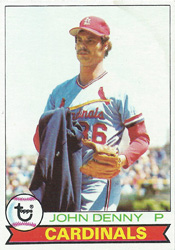
On Aug. 12, 1978, John Denny and Roy Thomas combined to pitch a one-hitter in a 5-1 Cardinals victory over the Mets at New York.

John Stearns had the lone hit, an infield single leading off the seventh inning.

Stearns would have been out on the play, but umpire Paul Pryor said first baseman Roger Freed took his foot off the bag too soon while catching a throw from second baseman Mike Tyson.

Pryor called Stearns safe and official scorer Red Foley of the New York Daily News credited Stearns with a single. If Stearns was safe because of Freed’s misstep, the play should have been scored an error, not a hit, the Cardinals argued.

Pitching and fielding

The game matched starting pitchers John Denny of the Cardinals against Kevin Kobel of the Mets. Denny was making his first appearance in two weeks after recovering from “a bad back, a bad left leg and a bad cold,” the St. Louis Post-Dispatch reported.

Kobel was a left-hander and Cardinals manager Ken Boyer decided to give his first baseman, left-handed batter Keith Hernandez, a break in the Saturday afternoon game. Backup first baseman Roger Freed started in place of Hernandez.

The Cardinals scored a run in the first and three in the second against Kobel. Denny limited the Mets to a walk in the first three innings.

In the bottom of the fourth, with one out, Denny walked Lee Mazzilli, who moved to second on a groundout by Willie Montanez. Stearns followed with a grounder to shortstop Garry Templeton, “who lobbed a throw to first,” according to the Post-Dispatch. The ball eluded Freed, Mazzilli scored from second and Templeton was charged with a two-base error.

Playing footsie

The Mets remained hitless entering the seventh against a tiring Denny. Boyer told the Post-Dispatch he planned to lift Denny after the inning, even if the no-hitter was intact. “After the fifth inning, I was losing it rapidly,” Denny said.

Stearns led off the Mets’ half of the seventh with a slow bouncer toward second. Tyson charged, grabbed the ball barehanded and, though off-balance. fired an accurate throw to Freed at first base.

As Stearns reached first, Pryor pointed toward the bag and the fielder, indicating Freed had pulled away too quickly after snaring Tyson’s toss.

“He pulled his foot off the base,” Pryor said to the Post-Dispatch. “Tyson made a hell of a play and, if he (Freed) had caught the ball with his foot on the bag, Stearns would have been out.”

Freed disagreed with the umpire and said, “He blew the play … We had him by a step and a half.”

Stearns and Mets first-base coach Denny Sommers said Pryor made the correct call.

Judgment call

As soon as Pryor declared Stearns safe, Foley scored the play a single.

Tyson disagreed, saying, “If he’s safe, then it’s got to be an error.”

Home plate umpire Ed Vargo told the Post-Dispatch, “It’s got to be an error.”

In Foley’s judgment, though, no error was made because the play was difficult and the fielders executed as best they could.

“It was a tough play for (Tyson) and he had to make a hell of a play just to make it close,” Foley said to the Post-Dispatch. “I’d like to give this guy a no-hitter, but I can’t.”

Denny got the next batter, Steve Henderson, to hit into a double play and Joel Youngblood grounded out to Templeton, ending the inning. Denny was done after yielding one unearned run, one disputed hit and three walks in seven innings.

The Cardinals scored another run in the eighth and Boyer put in Hernandez, who would win the first of 11 consecutive Gold Glove awards that year, as a defensive replacement for Freed. Thomas relieved Denny, allowed no hits and a walk in two innings, and closed out a 5-1 Cardinals victory.

Denny shrugged off any concern about missing a chance to be part of a no-hitter. “The idea is to win the game,” he said. Boxscore

Read Full Post »

Yellow baseballs couldn’t help a Cardinals club from feeling blue about a season coming apart at the seams.

On Aug. 2, 1938, in the first game of a doubleheader between the Cardinals and Dodgers at Ebbets Field in Brooklyn, yellow baseballs were used in a major-league game for the first time.

To the Cardinals, the color of the baseball didn’t make any difference in helping their hitting or pitching. The Dodgers beat the Cardinals, 6-2, using yellow baseballs in the opener, and in the second game, when standard white baseballs were brought back into play, the Dodgers won again, 9-3.

Afterward, Cardinals manager Frankie Frisch suggested his players should try using red baseballs. “Maybe it would make them mad,” seeing red, Frisch said to the St. Louis Post-Dispatch.

The losses dropped the Cardinals’ record to 38-54 and intensified speculation about Frisch’s job security. Two months later, Frisch was fired and the Cardinals went on to finish with a 71-80 mark, their fewest wins in a season since 1924.

Higher visibility

Frederick H. Rahr, a color engineer from New York, developed the yellow baseball after he witnessed Tigers catcher Mickey Cochrane get beaned by a pitch at Yankees Stadium in 1937. Rahr determined a yellow baseball would make the game safer to play because it would be easier to see than a white baseball.

“It is intended primarily to stop beanball accidents,” Rahr told The Sporting News.

Rahr convinced the baseball coaches at Columbia University and Fordham to use his yellow baseball in a game in April 1938. Dodgers executive Larry MacPhail took notice and got permission from National League president Ford Frick to try the yellow baseball in a regular-season game.

The yellow ball with red stitches was a delight for sportswriters, who described it in their game reports as a “stitched lemon,” a “golden globe,” “canary yellow” and having “a dandelion hue.”

Play ball

Played on a bright Tuesday afternoon, the game with the yellow baseball seemed like any other game.

“I didn’t see much difference,” plate umpire George Barr said to The Sporting News.

Said Cardinals outfielder Joe Medwick, the reigning National League batting champion: “When you’re hitting, the ball rides, no matter if it’s red, white or blue.”

The majority of spectators liked the yellow baseball and said they could follow it well, the New York Times reported. Most of the Cardinals and Dodgers were OK with it, too.

“I saw it all right,” Dodgers coach Babe Ruth told the Brooklyn Daily Eagle. “I hit three of them out of the park in batting practice.”

Other positive reviews:

_ Don Gutteridge, Cardinals third baseman: “I’d like to hit against it all the time.”

_ Leo Durocher, Dodgers shortstop; “It suited me all right. I couldn’t find any fault with it.”

_ Merv Shea, Dodgers catcher: “It’s much easier to follow on a low pitch because the cover of the ball doesn’t reflect the glare of the sun.”

The biggest complaint concerned the dye used to make the baseballs yellow.

“The dye came off on my fingers and the ball was a bit too slippery for my knuckleball,” said Dodgers starter Freddie Fitzsimmons.

Fitzsimmons kept wiping the dye from his hand onto his jersey and pants and “the entire side of his uniform was stained” yellow, according to United Press.

Among the other criticisms:

_ Turk Stainback, Dodgers outfielder: “I noticed the dye came off the ball and onto the bat after it was hit.”

_ Frenchy Bordagaray, Cardinals outfielder: “The yellow ball is too hard to autograph.”

“The yellow cover soiled easily and the umpires were kept busy tossing in new spheres,” the St. Louis Star-Times noted.

Johnny Mize of the Cardinals socked one of the yellow baseballs over the fence in the seventh for the only home run of the game. Boxscore

In the second game, the Cardinals’ frustrations poured out when umpire Bill Stewart started to signal Durocher out at the plate, changed his mind and called him safe. Cardinals catcher Mickey Owen shoved Stewart, threw the white baseball high into the air and was ejected, the Post-Dispatch reported. Frisch came onto the field and “took to kicking dirt over home plate as often as Stewart would brush the plate off” and also was ejected. Boxscore

Keeping with tradition

In an editorial, The Sporting News, urged more use of the yellow baseballs.

“Though the ball cannot be regarded as a complete success at present … enough favorable evidence was adduced to warrant a continuation of the experiment,” The Sporting News wrote. “Anything that contributes to greater safety in the game merits a thorough trial.”

After the 1938 season, baseball officials approved teams using yellow baseballs in games as long as both teams were in agreement, but the experiments were done only a couple of more times in 1939.

In 1973, at the request of Athletics owner Charlie Finley, major-league officials allowed the use of orange baseballs in an exhibition game between the Athletics and Indians in Arizona, but the idea didn’t catch on.

Read Full Post »

(Updated Nov. 14, 2021)

Wayne Garrett, who had some of his best games against the Cardinals, finished his major-league playing days with them, producing a sustained stretch of solid hitting for St. Louis and positioning himself to earn an opportunity to extend his career in Japan.

On July 21, 1978, the Cardinals purchased Garrett’s contract in a waiver deal with the Expos. The Cardinals envisioned Garrett, a left-handed batter, for a pinch-hitting role, but he performed well when given the chance to substitute for slumping third baseman Ken Reitz and ended up being used in a platoon with Reitz the remainder of the season.

Playing almost exclusively against right-handed pitchers, Garrett batted .333 for the 1978 Cardinals, generating 21 hits in 63 at-bats. He hit .389 (7-for-18) with runners in scoring position.

The Cardinals were impressed and wanted Garrett, 30, to return in 1979 as a utility player, but when he and the club couldn’t agree on contract terms, Garrett departed as a free agent.

Cards connections

In 1965, Garrett was selected by the Braves in the sixth round of major-league baseball’s first amateur draft. During his stint in the Braves’ system, Garrett caught the attention of Mets scout Bob Scheffing, who recommended him to management. In December 1968, the Mets took Garrett in the Rule 5 draft and he opened the 1969 season with the major-league club.

Garrett made his big-league debut for the Mets on April 12, 1969, against the Cardinals at New York. Batting third and playing second base, Garrett had a single and walk against Dave Giusti, who pitched a shutout in a 1-0 Cardinals victory. Boxscore

The next day, April 13, Garrett again got the start at second base and had a double and walk against Bob Gibson, who pitched the Cardinals to a 3-1 triumph. Boxscore

Garrett eventually was shifted to third base and platooned there with Ed Charles.

On July 2, 1969, Garrett had his first four-hit game in the majors. He was 4-for-6 with four RBI, a walk and a run scored in the Mets’ 6-4 victory over the Cardinals in 14 innings at St. Louis. Garrett drove in two runs against Giusti with a double and a single, added a RBI-single against Chuck Taylor in the eighth and drew a bases-loaded walk from Ron Willis in the 14th. Boxscore

Garrett started 63 games at third and 34 games at second for the 1969 Mets, who supplanted the Cardinals as National League champions, and batted .218. The rookie got into two games in the 1969 World Series against the Orioles.

Big hits

In the book “After the Mircale,” Garrett told teammate Art Shamsky that at spring training in 1970, Mets manager Gil Hodges wanted to know who taught him to swing down on the ball. Garrett told him it was Charlie Lau, a manager in the Braves’ farm system who later became a respected hitting coach in the majors.

“So Gil said, ‘I don’t want you hitting down anymore. I want you swinging on a little upward plane,’ ” Garrett recalled.

Garrett made the change and began hitting more consistently.

On Sept. 1, 1970, Garrett had another four-hit game for the Mets against the Cardinals. He was 4-for-5 with a walk against Gibson and scored twice in a 4-3 Mets victory in 12 innings at St. Louis.

In the 12th, with the score tied at 3-3, Garrett led off with a single against Gibson. With Cleon Jones up next, the Mets signaled for a hit-and-run, but Jones swung and missed at a high fastball. Garrett swiped second and continued on to third when catcher Ted Simmons’ throw clanked off the glove of Milt Ramirez for an error on the shortstop. Jones followed with a sacrifice fly, driving in Garrett with the go-ahead run. Boxscore

Garrett hit .333 versus Gibson in his career, with 22 hits in 66 at-bats and 10 walks, and had a .421 on-base percentage against the Cardinals ace.

In 1973, Garrett had his best big-league season, batting .256 with 16 home runs and 58 RBI as the third baseman for the Mets, who won their second National League pennant. Facing the Athletics in the World Series, Garrett hit solo home runs against Vida Blue in Game 2 and Catfish Hunter in Game 3. Batting leadoff in all seven games of the World Series, Garrett produced five hits, five walks and was hit by a pitch, but he struck out 11 times and batted .167.

The Mets traded Garrett to the Expos in July 1976 and he platooned at second base with Pete Mackanin the remainder of the season. In 1977, Garrett was plagued by shoulder and leg injuries and was a backup to Larry Parrish at third and Dave Cash at second.

Packing a wallop

By July 1978, Garrett seldom played for the Expos. He was batting .174 for the season when the Cardinals acquired him in a transaction that attracted little attention.

Soon, Cardinals manager Ken Boyer decided to start Garrett against right-handed pitching because Reitz batted .183 overall in June and .226 in July.

On Aug. 13, 1978, Garrett was 3-for-4 with a walk, RBI and run scored in a 6-1 Cardinals triumph over the Mets at New York. Boxscore

A couple of weeks later, on Aug. 31 at St. Louis, Garrett batted for pitcher Aurelio Lopez and hit a ninth-inning grand slam against Reds reliever Doug Bair, though Cincinnati won, 11-6. The ball Garrett hit landed 20 rows deep in the bleacher seats beyond the right-field wall, the St. Louis Post-Dispatch reported. Boxscore

It was Garrett’s second major-league grand slam. The first occurred on Sept. 29, 1976, against former Mets teammate Tom Seaver in a 7-2 Expos victory at New York.

Overseas adventure

Garrett played his final big-league game on Sept. 26, 1978, going 2-for-4 in a 3-1 Cardinals win over the Mets at New York. Boxscore

“We got to make some decisions on him,” Boyer said. “He’s looking for a long-term contract, like three years, and we want to see whether we should enter into that kind of deal with him.”

The Cardinals decided to pursue free-agent Pete Rose rather than invest in a multi-year deal for a utility player. Garrett became a free agent and drew interest from the Brewers, but his best offer came from Japan.

Adrian Garrett, Wayne’s brother, went to Japan in 1977 after eight seasons as a utility player in the major leagues with the Braves, Cubs, Athletics and Angels. Adrian hit 35 home runs for the Hiroshima Toyo Carp in 1977 and 40 home runs for them in 1978.

Wayne Garrett followed his brother’s career path, signed with the Chunichi Dragons in the Japan Central League and played for them in 1979 and 1980.

Read Full Post »

(Updated Dec. 21, 2024)

At 5-foot-8, Aaron Miles lacked size, not stature, as a Cardinals contributor.

On July 20, 2008, Miles stunned the Padres with a walkoff grand slam in the ninth inning, carrying the Cardinals to a 9-5 victory at St. Louis.

The grand slam was the second of Miles’ big-league career, but his first walkoff home run at any level. “That’s a feeling I never would have expected to get _ a walkoff home run,” Miles told the St. Louis Post-Dispatch.

Cardinals manager Tony La Russa summarized Miles’ achievement in two words: “Fantasy Island.”

Unforced error

The grand slam turned despair into joy for the Cardinals.

In the eighth inning, Troy Glaus hit a three-run home run against Heath Bell, giving the Cardinals a 5-3 lead, but the Padres rallied for two runs in the top of the ninth against Jason Isringhausen and Brad Thompson, tying the score at 5-5.

Padres manager Bud Black sent Bryan Corey to pitch the bottom of the ninth and he got the leadoff batter, Jason LaRue, to ground out to third.

Corey, pitching for his fifth team in his fifth big-league season, walked the next batter, Albert Pujols, on four pitches.

Thompson, the pitcher, came up next and third-base coach Jose Oquendo met him at the plate and instructed him to bunt. Padres catcher Luke Carlin noticed Pujols stretching his lead at first base in anticipation of a Thompson bunt.

As first baseman Adrian Gonzalez moved in toward the plate to be in position to field a bunt, second baseman Edgar Gonzalez started to move toward the first-base bag,

When Thompson didn’t offer at Corey’s first pitch, Carlin snapped a throw toward first base, but the ball arrived before Edgar Gonzalez did and sailed into right field. Pujols raced to third on the two-base error.

“Luke Carlin was throwing to a bag that had no one there,” analyst Mark Grant said on the Padres’ television broadcast.

“It was just a stupid play by me to throw the ball,” Carlin told the Associated Press. “I tried to be overaggressive and unfortunately it hurt us.”

Mighty mite

With Pujols in scoring position, La Russa called on catcher Yadier Molina to bat for Thompson with the count at 1-and-0. Molina ran from the bullpen to the dugout, grabbed a bat and went to the plate.

The Padres, looking to set up a possible forceout at any base, elected to intentionally walk Molina as well as the next batter, Skip Schumaker, loading the bases with one out. Schumaker had hit into 11 double plays for the season, but the Padres decided to take their chances with Miles.

A switch-hitter, Miles stood in from the left side against Corey, a right-hander. Miles was batting .327 against right-handers for the season.

The first pitch was called a ball and Miles swung at the second delivery and fouled it off. The third pitch missed the strike zone, making the count 2-and-1.

Corey’s fourth pitch was in Miles’ wheelhouse and he swung, driving the ball over the right-field fence and into the Cardinals’ bullpen, where it was snared on the fly by joyous teammate Ryan Franklin.

After he connected, Miles dropped his bat at the plate, watched the ball soar and pumped his fist as he headed up the first-base line. Cardinals players poured out of the dugout to mob him at the plate. Video

“Of all the ways you look for Aaron Miles to maybe beat you, that’s not the first thing to come to mind,” said surprised Padres TV play-by-play broadcaster Matt Vasgersian. Boxscore

Rare feat

The home run was the third of the season for Miles. He would finish with four for the season and 19 in a nine-year career in the major leagues. His other grand slam was hit right-handed for the Rockies against Marlins left-hander Al Leiter in the fourth inning of an 8-1 Colorado victory on May 8, 2005, at Miami.

The walkoff home run by Miles gave the Cardinals their first four-game sweep of the Padres since 1990 and moved St. Louis 14 games above .500 for the season. It was the 10th walkoff grand slam all-time by a Cardinals batter and the first since Gary Bennett did it against the Cubs on Aug. 27, 2006.

Cardinals with walkoff grand slams before Miles did it were Pepper Martin (1936), Joe Cunningham (1957), Carl Taylor (1970), Joe Hague (1971), Roger Freed (1979), Darrell Porter (1984), Tommy Herr (1987), David Eckstein (2005) and Bennett (2006).

Since then, Cardinals with walkoff grand slams are Matt Carpenter (2017), Paul Goldschmidt (2022) and Nolan Arenado (2024).

Miles hit 14 of his 19 major-league homers from the left side. Overall, he hit eight homers for the Cardinals, eight for the Rockies and three for the Dodgers.

Read Full Post »

A midsummer evening in Atlanta got too hot to handle for the Cardinals.

On July 20, 1993, a fire erupted in an unoccupied club-level suite at Atlanta-Fulton County Stadium before a game between the Cardinals and Braves.

Smoke poured through the press box and into the concourses, burning debris fell onto field-level seats and five suites were destroyed, according to multiple published reports.

The fire burned for 25 minutes before it was extinguished. One firefighter was taken to a hospital suffering from heat exhaustion and as many as 10 others were treated on the scene for heat-related issues, the Associated Press reported. No fans, stadium personnel or team personnel were injured.

Eleven fire engines, with water-pumping equipment, and six fire trucks responded and about 3,000 spectators were evacuated while firefighters battled the blaze.

After it was determined the stadium structure was sound, spectators were allowed back in and the game began two hours after its scheduled starting time. A section of 10,000 seats were declared unavailable. The fire started from a Sterno can used to heat food, the St. Louis Post-Dispatch reported.

Smoke no joke

Most Cardinals players and staff ran to the outfield as the fire raged. KMOX broadcaster Mike Shannon and engineer Colin Jarrette, though, were in a radio booth and too close for comfort to the fire.

“Colin and I had to inhale the smoke when it broke out,” Shannon said to the Post-Dispatch. “We could see the fire 200 or so feet from us. Then the smoke got in behind us and trapped us in. The smoke came through the rafters and hallway behind us. We couldn’t see anything. The security guards yelled at us to get out.”

Shannon was able to escape the booth unassisted, but the smoke hampered Jarrette.

“The guards came up and had to escort Colin out,” Shannon said. “They put a towel around his head. I wasn’t frightened that I wouldn’t make it out. There was only about 15 feet from where we were to get out the back, but it was a thick, black, nasty smoke.”

The game was supposed to be shown on the Cardinals’ television network, but the telecast was canceled because several cables got burned by fire. KMOX did carry the game on the Cardinals’ radio network, though it was difficult for the broadcast team to work in the damaged radio booth.

“We really never should have done that game,” said broadcaster Jack Buck, who was on the field when the fire started. “Everything was covered with soot. It was dirty. It was filthy.”

Said Jarrette: “There was a lot of smoke damage. There were ashes settled all over the equipment.”

Shannon wore a surgical mask for parts of the game; Buck didn’t, and the next day, “I was spitting up black stuff all day long,” Buck said.

Boom, boom

When the fire started at 5:55 p.m., 90 minutes before game time, the Braves were taking batting practice and the Cardinals were doing stretching and warmups on the field. An explosive sound sent players and staff from both teams scurrying to the outfield as the suite burned above the third-base line.

“We were trying to get as far away as possible,” Cardinals manager Joe Torre said. “I was just afraid that after the explosion there would be some glass flying.”

Braves player Otis Nixon told the Associated Press, “It was like a 60-yard dash to the outfield. I never saw (manager) Bobby Cox run so fast.”

Fire department officials determined the loud sound was a girder breaking, the Post-Dispatch reported.

Show must go on

The game matched starting pitchers Tom Glavine of the Braves and Rene Arocha of the Cardinals. The Cardinals scored three runs in the fourth and two in the fifth and led 5-0 until the Braves rallied in the sixth against Arocha on a three-run home run by Jeff Blauser and a two-run home run by Fred McGriff, tying the score at 5-5. McGriff was playing in his first game for the Braves since being acquired from the Padres in a trade.

“You throw it belt-high here and a lot of bad things can happen,” said Torre.

In the eighth, the Braves scored three times against reliever Rheal Cormier and won, 8-5. Boxscore

The Cardinals were held scoreless over the final 4.2 innings by four relievers _ Steve Bedrosian, Greg McMichael, Mark Wohlers and Mike Stanton.

“I hope this is an omen that the Braves will get hot,” Braves owner Ted Turner, who attended the game with wife Jane Fonda, said to the Atlanta Constitution.

Read Full Post »

« Newer Posts - Older Posts »