Feeds:
Posts
Comments

Archive for the ‘Opponents’ Category

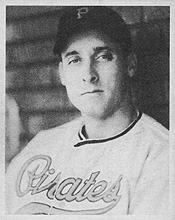
Johnny Rizzo, once a top prospect in the St. Louis system, had his best big-league game against the Cardinals, setting a record that lasted nearly 80 years.

Playing for the Pirates, Rizzo produced nine RBI versus the Cardinals in the second game of a doubleheader on May 30, 1939. That was the single-game record by a Cardinals opponent until Scooter Gennett of the Reds had 10 RBI against St. Louis on June 6, 2017.
Rizzo, a left fielder, achieved his feat with two home runs, two doubles and a single at Sportsman’s Park in St. Louis. He had gone hitless in four at-bats in the opener.

No vacancy

Rizzo, a right-handed batter, played five seasons (1933-37) in the Cardinals organization. He batted better than .300 each year, but never got called up to St. Louis.

In 1937, the Cardinals’ Columbus (Ohio) farm club had two top outfielders: Rizzo and Enos Slaughter.

Rizzo batted .358 with 209 hits in 150 games for Columbus. He had 38 doubles, 18 triples and 21 home runs.

Slaughter batted a league-leading .382 with 245 hits in 154 games for Columbus. He had 42 doubles, 13 triples and 26 home runs.

Both clearly were ready to play in the big leagues in 1938.

The Cardinals had two outfield mainstays: Joe Medwick in left and Terry Moore in center. That left one spot, right field, for either Slaughter or Rizzo. Cardinals executive Branch Rickey opted for Slaughter, rating him a better all-around player than Rizzo.

In October 1937, the Cardinals traded Rizzo to the Pirates for catcher Tom Padden, outfielder Bud Hafey and minor-league first baseman Bernard Cobb. Rizzo “was sought by several other clubs, notably the Cubs, but Rickey saw something in the Pittsburgh (offer) that appealed to him,” The Sporting News reported.

Rizzo had a better rookie season than Slaughter in 1938. Rizzo batted .301 with 23 home runs and 111 RBI for the Pirates. Slaughter batted .276 with eight home runs and 58 RBI for the Cardinals.

Pirates power

A year later, Rizzo was in a slump and his batting average was at .239 heading into the second game of the Memorial Day doubleheader against the Cardinals. A day earlier, Rizzo had hit into a triple play.

Facing starter Clyde Shoun, Rizzo had a RBI-single in the first, popped out to shortstop in the third and hit a three-run home run in the fifth. Rizzo added a single off Mort Cooper in the fifth.

With the score tied at 7-7 in the eighth, the Pirates had runners on second and third, none out, and Arky Vaughan at the plate. The Cardinals opted to give an intentional walk to Vaughan, loading the bases, and pitch to Rizzo.

Rizzo ripped a double off Curt Davis, clearing the bases and giving the Pirates a 10-7 lead. “The ball was hit with such force that it bounded off the wall, away from Joe Medwick and Pepper Martin,” The Pittsburgh Press reported.

In the ninth, Rizzo hit a two-run home run off Bob Bowman, capping a 5-for-6 performance in a 14-8 Pirates victory. Boxscore

Rizzo finished the 1939 season with a .261 batting average, six home runs and 55 RBI. He spent three more seasons (1940-42) in the big leagues with four teams: Pirates, Reds, Phillies and Dodgers.

Previously: Cards rookie Enos Slaughter set torrid extra-hit pace

Read Full Post »

When Jimmy Piersall made his Mets debut in St. Louis, the league and the opponent were new to him, but the ballpark was quite familiar.

On May 24, 1963, a day after he was acquired by the Mets from the Senators in a deal that paired one of the game’s most mercurial characters with baseball’s most inept team, Piersall played against the Cardinals in his first National League game.

Piersall, batting leadoff and playing center field, was 1-for-4 with a walk against Bob Gibson at Busch Stadium. Piersall’s single drove in a run, but the Cardinals prevailed, 10-4.

Ten years earlier, while in the American League with the Red Sox, Piersall had his most productive game. He had six hits in six at-bats against the Browns in the opener of a doubleheader at Busch Stadium. Boxscore

Piersall, whose struggles with mental illness were detailed in the book and movie, “Fear Strikes Out,” was known as much for on-field antics and feuds with umpires as he was for his sterling outfield play.

When he joined the Mets and their rougish manager, Casey Stengel, in St. Louis, it was a match that attracted attention.

That’s entertainment

The Mets had released first baseman Gil Hodges so that he could become manager of the Senators. Piersall was sent to the Mets in return.

The Mets had opened the 1963 season with Duke Snider, 36, in center field. Snider soon was moved to a corner outfield spot and Jim Hickman, 26, took over in center. Hickman, too, was better at playing right or left. Piersall, 33, was a defensive upgrade.

“Piersall can play center field beautifully, which I hate to say has not been done for us,” Stengel said to The Sporting News.

The Mets were terrible. They had finished 40-120 in their inaugural season, 1962, and they were 16-25 when they got Piersall. Some suspected the move was made to keep fans and media interested in a team that couldn’t compete.

“I know he will be an attraction with the club and with the fans,” Stengel said.

Piersall understood that.

When he arrived at Busch Stadium and met with reporters, Piersall said, “Baseball is like show business. If I don’t hurt the club, I might do anything to entertain the fans. What’s wrong with that?”

Regarding his relationship with Stengel, Piersall told the Associated Press, “I only hope New York is ready for both Casey and me. Casey is one of my biggest boosters, but he baffles me. Case is beautiful, but I don’t always know what he’s talking about.”

As for his new team, Piersall said, “The Mets and their fans are helping to save baseball and they are keeping the writers in business and it is better than being in Russia.”

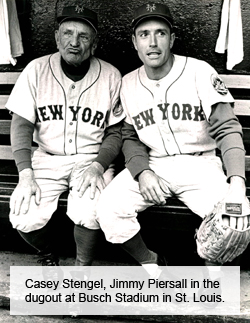
When photographers gathered to take photos of Piersall and Stengel together in the dugout, Piersall said to his manager, “I better not pose with you, Case, because I’m prettier than you are.”

Making an impression

In the Friday night opener at St. Louis, Piersall went 0-for-3 with a walk in his first four plate appearances against Gibson. In the eighth, with the Cardinals ahead, 8-3, Piersall singled, scoring Choo Choo Coleman. Boxscore

Asked his impressions of Gibson, Piersall said, “Gibson put one pitch right on the very edge of the plate for a strike. I turned to the catcher (Gene Oliver) and remarked, ‘If they keep on doing that in this league, I’ll starve to death.’ ”

Piersall started in center again the next day, May 25, and was 0-for-4 against Ray Sadecki and Harry Fanok.

On Sunday, May 26, Piersall started in the opener of a doubleheader and had three hits _ two singles and a double _ off Cardinals starter Curt Simmons. Piersall also successfully disputed an umpire’s call.

Ed Sudol ruled a ball hit to right by George Altman was trapped, not caught, by Hickman.

Piersall “sprinted from his center field post all the way to first base to exchange a few not too pleasantries with Sudol,” the Associated Press reported.

Crew chief Stan Landes overruled Sudol and called Altman out. Boxscore

Piersall didn’t start the second game. The Mets, suspecting the Cardinals were stealing signs, sent Piersall to the bullpen to watch the Cardinals’ first-base coach. “I couldn’t spot anything,” Piersall said.

In a letter to The Sporting News, a Cardinals fan, John T. Copeland of Piedmont, Mo., wrote, “Piersall hardly saw enough of the game to know the score, much less to discover any sign stealing. He was in arguments with fans during the entire game. I hope the Cards never have to hire a Piersall-type clown to draw crowds.”

Fun while it lasted

Two weeks later, on June 9, the Cardinals were in New York for a Sunday doubleheader with the Mets.

In the opener, the Mets led, 3-2, in the sixth when Piersall hit a two-run double off Simmons. Boxscore

Piersall didn’t start the second game, but he again made his presence known.

Between innings, while Mets catcher Norm Sherry was putting on his gear, Piersall went out to warm up the pitcher. Piersall piled dirt onto the plate before returning to the dugout. As umpire Ed Vargo dusted the dish, Piersall mocked him, making dusting motions with his cap and a towel, the St. Louis Post-Dispatch noted.

Piersall appeared in 40 games for the Mets and batted .194. On June 23, he hit a home run, the 100th of his big-league career, off the Phillies’ Dallas Green and backpedaled around the bases. Released in late July, Piersall returned to the American League with the Angels.

Previously: Cards were victims of historic homers by Gil Hodges

Read Full Post »

The first home run Roger Maris hit in St. Louis as a Cardinal was worth the wait.

On June 10, 1967, two months into his first Cardinals season, Maris hit a walkoff three-run home run in the 11th inning at Busch Stadium, giving St. Louis a 5-2 victory over the Dodgers.

The home run was Maris’ third for the Cardinals _ the first two occurred at New York and at Pittsburgh _ but was his first in his home ballpark since being acquired by St. Louis from the Yankees in December 1966.

Maris, who six years earlier had established a major-league single-season record with 61 home runs for the Yankees, no longer was a consistent power hitter, but he was a key member of a Cardinals club that would win the World Series championship.

His first Busch Stadium home run enabled the Cardinals to continue a hot streak that one week later would propel them into first place in the National League.

Stormy night

The Cardinals were 3.5 games behind the front-running Reds entering their Saturday night game against the defending NL champion Dodgers. Maris, batting .291, was held out of the starting lineup by manager Red Schoendienst. The Dodgers were starting a left-hander, Jim Brewer, and Maris did much better against right-handers.

Tornado warnings were issued in the St. Louis area that evening and a severe thunderstorm struck downtown St. Louis, delaying the start of the game 64 minutes and creating treacherous conditions in the outfield.

The Dodgers scored twice in the first inning off their nemesis, Larry Jaster, who had pitched five shutouts against them the previous year.

Brewer, primarily a reliever, held the Cardinals scoreless for six innings. “He told me he was tiring a little going into the seventh,” Dodgers manager Walter Alston said to the Pasadena Independent Star-News, “but you couldn’t take him out the way he was going.”

Curt Flood led off the Cardinals’ half of the seventh with a walk and Bobby Tolan lined a home run over the right-field wall, tying the score at 2-2.

Maris entered the game in the ninth as a pinch-hitter for Jaster and popped out to second baseman Ron Hunt. Maris stayed in the game, replacing Alex Johnson in right field, and Joe Hoerner relieved Jaster.

Extra innings

Phil Regan, who came in for Brewer in the eighth, held the Cardinals scoreless for three innings.

In the 11th, Alston brought in Bob Miller to pitch. Miller, a St. Louis native, had made his major-league debut in 1957 with the Cardinals and pitched for them in four seasons.

Tim McCarver led off the 11th against Miller with a double. Dal Maxvill attempted to advance McCarver with a bunt, but Miller fielded the ball and threw out McCarver at third.

With Maxvill at first and one out, Tolan singled.

That brought Maris to the plate against the right-hander.

Easy swing

Maris swung at a 2-and-2 pitch.

“I was just trying to avoid making an out,” Maris said. “I didn’t swing hard. I just wanted to meet the ball.”

Said Dodgers catcher John Roseboro: “That’s the way it looked when he swung. He just dropped his bat in front of the ball.”

Joe Hendrickson of the Pasadena newspaper wrote, “The ball sailed like a rocket over the fence and into the seats.”

Said Maris: “That was my most satisfying hit since coming to St. Louis.” Boxscore

The victory was part of a stretch in which the Cardinals won 15 of 17 and surged to the top of the NL standings.

“This Cardinals team reminds me of my Yankees days,” Maris told United Press International. “The Yankees at one time played for the big hit. The atmosphere is also something like we had in New York. In those days, we’d get some runs behind, but we knew we were going to win it.”

Previously: With last homer, Roger Maris helped Cards clinch title


Read Full Post »

As might be expected of two Hall of Fame pitchers, Jim Bunning and Bob Gibson engaged in a couple of classics when facing one another.

Bunning and Gibson were matched against each other as starters six times.

In those encounters, Bunning got 1 win, 2 losses and 3 no-decisions. Gibson got 2 wins, 2 losses and 2 no-decisions.

In the two most memorable Bunning vs. Gibson duels, Roberto Clemente and Dick Allen played key roles.

Seeking support

Bunning pitched in the major leagues for the Tigers (1955-63), Phillies (1964-67 and 1970-71), Pirates (1968-69) and Dodgers (1969). He had a 224-184 record, with 118 wins in the American League and 106 in the National League.

The right-hander’s record against the Cardinals was 5-11, but his teams were shut out in five of those losses and were held to one run in each of two others.

Bunning and Gibson faced one another on June 26, 1964, and Sept. 10, 1965, without either getting a decision.

On May 18, 1966, the Phillies beat the Cardinals, 4-3, at Philadelphia. Gibson, who allowed four runs in 6.1 innings, was the losing pitcher. Ray Culp, who pitched four scoreless innings in relief of Bunning, got the win. Bunning gave up three runs in five innings. Boxscore

Three weeks later, on June 11, 1966, Gibson pitched a shutout against the Phillies in a 2-0 Cardinals victory at Philadelphia. Bunning yielded two runs in seven innings and took the loss. Boxscore

Heated rivalry

The final two career matchups of Bunning vs. Gibson were the best.

The Pirates were in St. Louis to play the Cardinals in a doubleheader on a sweltering Sunday afternoon, July 13, 1969. Bunning, in his second season with the Pirates after being traded by the Phillies, was pitted against Gibson in Game 1.

Larry Shepard, the Pirates’ manager, pitched 10 minutes of batting practice in the 95-degree heat. In the second inning, Shepard, 50, experienced chest pains and was rushed to a hospital. Coach Bill Virdon took over as acting manager. Several fans were overcome by heat and given treatment, The Pittsburgh Press reported.

Bunning, 37, and Gibson, 33, dueled impressively in the oppressive conditions.

In the sixth inning, Gibson got his 2,000th career strikeout. It came against Roberto Clemente, the fellow future Hall of Famer, who two years earlier had hit a smash that struck Gibson and broke his leg.

Neither Bunning nor Gibson yielded a run through seven innings.

In the eighth, Matty Alou, who had reached on a bunt single, was on first with two outs. Next up was slugger Willie Stargell, who had struck out three times on outside pitches from Gibson.

“So I decided that I couldn’t do any worse looking for a fastball away,” Stargell said to the St. Louis Post-Dispatch.

Stargell slapped a single to left, advancing Alou to second.

The next batter, Clemente, slashed a Gibson delivery over the right-field wall for a three-run home run.

“Gibby gave Roberto a high pitch to hit after getting him out with low-and-away pitches,” said Pirates pitching coach Vern Law. “Gibby was bound to get tired in that heat. When a pitcher gets tired, he gets his pitches high.”

A wilting Bunning pitched a scoreless bottom half of the eighth. In the ninth, Virdon replaced him with Bob Moose, who preserved the 3-0 victory for Bunning and the Pirates. Boxscore

“I had good off-speed stuff, especially my change of pace,” Bunning said. “Everybody knows that control is the name of the game.”

Power game

The final career matchup of Bunning vs. Gibson occurred on May 23, 1970, a rainy Saturday night in Philadelphia.

Bunning had been reacquired by the Phillies in October 1969, but Dick Allen had the attention of fans and media. Allen, the slugger acquired by the Cardinals from the Phillies after the 1969 season, was playing his first games in Philadelphia since the trade. A controversial player with the Phillies, Allen had drawn a mix of boos and cheers in the first two games of the series.

Two weeks earlier, on May 11, 1970, Allen had hit a three-run home run off Bunning in the ninth inning at St. Louis, breaking a scoreless tie and giving pitcher Steve Carlton and the Cardinals a 3-0 victory. Boxscore

During a rain delay before Bunning and Gibson squared off in Philadelphia, Cardinals player Leron Lee put on Allen’s jersey and glasses, wrapped a towel over his head and ran across the field to the Phillies’ dugout to shake hands with infielder Tony Taylor.

“Don’t blame me if you get shot,” Allen told Lee.

The fans, thinking Allen was making a friendly gesture to a former teammate, cheered. Frank Lucchesi, Phillies manager, playfully pushed Lee out of the dugout, the Philadelphia Inquirer reported.

In the third inning, with Lee on second base, Allen crushed a Bunning fastball well beyond the 410-foot sign in center for a home run and a 2-0 Cardinals lead.

Two innings later, Allen hit a Bunning curve onto the roof in left for a solo home run, extending the Cardinals’ lead to 3-0.

“He hit that second one one-handed,” Bunning said admiringly.

Said Cardinals third baseman Mike Shannon: “Watching Richie hit is like watching a stick of dynamite go off.”

Gibson, meanwhile, dominated the Phillies. He struck out 16 and got the win in a 3-1 Cardinals triumph. Boxscore

“That’s the hardest I’ve thrown since 1968,” Gibson said.

Allen Lewis of the Inquirer wrote, “It was difficult to tell which balls were traveling faster _ the ones Rich Allen hit or the ones Bob Gibson threw.”

Gibson struck out 17 in Game 1 of the 1968 World Series against the Tigers. His 16 strikeouts against the Phillies were the most he achieved in a regular-season game. “I get keyed up with Richie playing here,” Gibson said. “Tonight, I had something extra and I got just about every pitch where I wanted.”


Read Full Post »

(Updated April 18, 2020)

Don Young began his professional baseball career in the Cardinals system, played for George Kissell, departed and was brought back by Stan Musial.

Though he had two stints in the Cardinals organization, Young never played for St. Louis.

Instead, he played for the Cubs, made his debut in a legendary game and became a central character in one of their most notorious defeats.

Teen hopeful

Young was 17 when he signed with the Cardinals as an amateur free agent out of Aurora High School in Colorado in June 1963.

An outfielder, he was assigned to a Class A club in Brunswick, Ga., managed by Kissell, the respected instructor. Young batted .280 in 16 games for Brunswick and was sent to another Cardinals Class A team in Billings, Mont., where he hit .257 in 58 games.

After spring training in 1964, Young was placed on waivers, claimed by the Cubs and began to re-establish himself. In 1965, Young batted .273 with 25 doubles and 16 home runs for the Class AA Dallas-Fort Worth Spurs.

At 19, he was rewarded with a promotion to the Cubs in September 1965.

Big-league welcome

Young made his major-league debut as the starting center fielder and leadoff batter for the Cubs in Los Angeles against the Dodgers on Sept. 9.

The Dodgers pitcher that night: Sandy Koufax.

The result: a perfect game.

Koufax retired 27 batters in a row and struck out 14. Young popped out twice and struck out. The Dodgers, held to one hit by Cubs starter Bob Hendley, won, 1-0. Boxscore

The next night, in San Francisco, Young, described by the Chicago Tribune as “perhaps the Cubs’ top outfield farm prospect,” got his first big-league hit, a solo home run off the Giants’ Ron Herbel. Boxscore

Lou Klein, Cubs manager and former Cardinals infielder, started Young in five games versus the Dodgers and Giants, drawing criticism from Braves manager Bobby Bragan for using a rookie in the pennant stretch against contenders.

Overmatched, Young batted .057 (2-for-35) in his September stint with the Cubs.

Musial maneuvers

Young was back in the minor leagues in 1966 and 1967.

Meanwhile, the Cardinals were trying to figure out what to do with Ted Savage.

Savage, acquired by the Cardinals from the Pirates after the 1964 season, spent most of the next two years in the minor leagues.

After Musial became Cardinals general manager in January 1967, he promised Savage he would try to keep him in the major leagues.

Savage earned a spot as a utility player on the Opening Day roster of the 1967 Cardinals, but seldom played. In May, Savage was ticketed for a return to the minors, but indicated he wouldn’t report, according to the St. Louis Post-Dispatch.

Determined to fulfill his vow, Musial looked for a big-league team for Savage.

Brief return

On May 13, 1967, the Cardinals traded Savage and outfielder John Kindl to the Cubs for Young and catcher Jim Procopio.

The Chicago Tribune noted Young was “once rated a potential Cubs center fielder” but “still was struggling in the minors.”

The Cardinals assigned Young to their Class AAA Tulsa team. Young played in 12 games for manager Warren Spahn, batted .147 and was sent back to the Cubs on Aug. 1, 1967.

Young spent the 1968 season with the Lodi (Calif.) Crushers, a Class A club.

Though he wasn’t on their 40-man roster, the Cubs invited Young, 23, to attend their 1969 spring training camp. It was there he received an unexpected opportunity.

Rebuilding project

Adolfo Phillips, projected to be the starting center fielder for the 1969 Cubs, broke his hand at spring training. Cubs manager Leo Durocher considered giving the job to a prospect, Oscar Gamble, but the 19-year-old had only a year of minor-league experience.

With his options limited, Durocher turned to Young.

Young “conceivably could be ready for the big time,” Jerome Holtzman of The Sporting News wrote.

“He hasn’t been a strong hitter,” Holtzman opined. “He is, however, a beautiful center fielder … and could very well become a Gold Glove winner _ if he can hit enough to stay.”

Young worked with Klein, his former manager who had become a batting instructor, and Cubs coach Pete Reiser on his hitting. Durocher also wanted Young to become more aggressive.

“He could have a great future, but it’s up to him,” Durocher said. “I can’t do it for him. I don’t care what he hits. I want to see more enthusiasm from him.”

Blame game

Young was the Opening Day center fielder for the 1969 Cubs.

The Cubs won 11 of their first 12 games and Durocher stayed with Young. In June, Phillips was traded to the Expos, solidifying Young’s hold on the job.

On July 8, 1969, the first-place Cubs opened a key series with the second-place Mets at New York.

The Cubs led, 3-1, in the ninth inning of the opener, but the Mets rallied for a 4-3 victory when Young was unable to catch two fly balls that fell for doubles. Cubs third baseman Ron Santo blamed the loss on Young. Boxscore

“He was just thinking of himself,” Santo said. “He had a bad day at the bat, so he’s got his head down. He is worrying about his batting average and not the team … He can keep his head down and he can keep right on going, out of sight, for all I care.”

The next day, Santo apologized: “What I said about Donnie, I didn’t mean. I said it because I was upset.”

In his book, “Thanks for Listening,” Cubs broadcaster Jack Brickhouse said later in the day, “I was sitting on the team bus waiting to go to the park. I was sitting behind Young. Santo got on and sat on the armrest of Young’s seat and put his arm around the kid and apologized once more.”

The damage, though, was done. When the Cubs returned to Chicago, Santo was booed at Wrigley Field. The Mets eventually surged ahead of the crumbling Cubs, clinched the division title and went on to win the National League pennant and World Series crown.

“Let’s face it,” Brickhouse said in his book, “the Cubs were a ragtag team in the stretch, wandering aimlessly, with assorted regulars physically exhausted as the result of failure to get a day off here and there when their lead was commanding.”

“That had to be Leo’s responsibility,” Brickhouse said of Durocher, “and he added fuel to the fire with the tensions he created by nitpicking controversies with certain of his players and certain members of the media.”

Young finished the 1969 season, his last in the big leagues, with a .239 batting average in 101 games.

Read Full Post »

(Updated May 9, 2020)

A passed ball was the key to enabling the Cardinals to achieve one of their most amazing comebacks.

Trailing by nine runs, the Cardinals rallied to beat the defending National League champion Braves on May 9, 1992, at St. Louis.

The comeback represented the largest deficit overcome by the Cardinals since they rallied from being down 11-0 and beat the Giants, 14-12, on June 15, 1952, at New York.

The Cardinals totaled 15 hits and five walks against Braves pitchers John Smoltz, Juan Berenguer and Marvin Freeman, but still may have come up short if not for a mistake by catcher Damon Berryhill.

Makings of a blowout

Smoltz was matched against Cardinals starter Rheal Cormier in the Saturday night game at Busch Stadium.

It quickly became a mismatch.

Smoltz held the Cardinals hitless the first three innings.

The Braves scored eight runs off Cormier and another run off Juan Agosto and led 9-0 entering the bottom half of the fourth.

“You’d think with a 9-0 lead and a no-hitter going that we’re going to win,” Braves manager Bobby Cox said to the St. Louis Post-Dispatch.

Said Cardinals catcher Tom Pagnozzi: “When we were down 9-0, I turned to (umpire Bruce) Froemming and said, ‘This is ugly.’ ”

Staying alive

The Cardinals scored three times in the fourth, but the Braves came back with two runs in the fifth off Bob McClure for an 11-3 lead.

With that kind of support, Smoltz, one of the Braves’ best pitchers, usually would take control of a game. However, he gave up two more runs to the Cardinals in the fifth, making the score 11-5.

“When it was 11-5, I thought there still was time,” Pagnozzi said.

Felix Jose led off the St. Louis half of the seventh with a double against Smoltz. After Pedro Guerrero grounded out and Brian Jordan popped out, Todd Zeile singled, driving in Jose and cutting the Braves’ lead to 11-6.

Cox replaced Smoltz with Berenguer.

Big break

An intimidating, hard thrower, Berenguer struck out the first batter he faced, Pagnozzi, but the third strike eluded Berryhill for a passed ball, allowing Pagnozzi to reach first and Zeile to move to second.

Instead of being out of the inning and heading to the eighth with an 11-6 lead, the Braves still needed a third out.

“I just blew it,” said Berryhill. “It’s something that should never happen. I kept it alive for them.”

The next batter, Luis Alicea, walked, loading the bases.

Cardinals manager Joe Torre sent Gerald Perry to pinch-hit for pitcher Cris Carpenter. Perry, a former Brave, ripped a bases-clearing double, making the score 11-9.

Ray Lankford popped out, ending the inning, but momentum had swung toward the Cardinals.

“When we got those three runs, we thought we had a chance,” Perry said.

Awesome Alicea

In the eighth, Berenguer walked Ozzie Smith. Jose followed with a home run, tying the score at 11-11.

“I knew they had no chance after Felix’s homer,” Zeile told the Atlanta Constitution.

Cox replaced Berenguer with Freeman.

Guerrero grounded out, Jordan doubled and Zeile struck out.

With two outs and Jordan at second, the Braves opted to intentionally walk Pagnozzi and pitch to Alicea, the St. Louis second baseman who was batting .115 overall and was hitless with runners in scoring position.

Alicea thwarted the strategy with a single to left, but Ron Gant made a strong throw home. Jordan, racing for the plate, tried to score standing, stepped on Berryhill’s foot, and fell to the ground after crossing the plate. Froemming called him safe, giving the Cardinals a 12-11 lead.

Some thought Jordan’s foot never touched the plate, but Berryhill said, “I don’t know if I tagged him. I just know he stepped on my foot.”

Cox told the Atlanta Constitution, “He was out.”

Jordan told the Associated Press, “I was looking to run over him, but he stepped back. He had his foot on the plate, but I kicked it or stepped on it. I scored.”

To the Atlanta Constitution on whether he touched the plate, Jordan said, “I touched it according to the umpire and that is all that mattered.”

Defying the odds

Cardinals closer Lee Smith retired the Braves in order in the ninth, sealing the win.

The Braves scored all of their runs against left-handers: Cormier, Agosto and McClure. They were held scoreless by right-handers Carpenter, Mike Perez and Smith.

“This is the best (comeback) I’ve ever witnessed,” Perry said.

Said Cox: “The odds on you losing a nine-run lead are about 500-to-1.” Boxscore and Video

Previously: How Braves rallied from 9 down to beat Cardinals

Read Full Post »

« Newer Posts - Older Posts »