Feeds:
Posts
Comments

Archive for the ‘Opponents’ Category

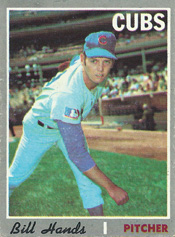
Bill Hands, whose effective starting pitching helped transform the Cubs from losers to contenders under manager Leo Durocher, was a familiar opponent of the Cardinals in the late 1960s and early 1970s. His best performance against the Cardinals came on a day when the behavior of the Wrigley Field Bleacher Bums got out of hand.

Hands pitched 11 seasons (1965-75) in the major leagues and had a career record of 111-110 with a 3.35 ERA.
A right-hander, Hands was best in a three-year stretch for the Cubs when he was 16-10 in 1968, 20-14 in 1969 and 18-15 in 1970.

Against the Cardinals, Hands was 14-12 with a 2.58 ERA in his career. He had more wins (14), innings pitched (205.2) and appearances (38) against the Cardinals than he did versus any other opponent.

After posting losing records in 13 of 14 seasons from 1953-66, the Cubs had 87 wins in 1967 and 84 in 1968. By 1969, they were a threat to the reign of the Cardinals, who had won consecutive National League pennants in 1967 and 1968.

Fired up

On June 28, 1969, the Cubs were in first place in the East Division at 46-26 entering a Saturday game with the Cardinals at Chicago. St. Louis was 35-37, 11 games behind the Cubs. Looking to put a dagger into the Cardinals’ title hopes, the Cubs started Hands against Dave Giusti.

The left field stands at Wrigley Field filled quickly with Cubs fans. Known as Bleacher Bums, the group was whipped into a frenzy by the early-season success of their hometown team and by the sight of the archrival Cardinals.

As Cardinals players appeared in the outfield to shag flies and play catch before the game, “bleacher fans showered the Redbirds players with flashlight batteries, quarters, paper cups, dry ice and other debris in pregame practice,” the St. Louis Post-Dispatch reported.

Cage match

Cardinals center fielder Curt Flood told the Chicago Tribune, “They were throwing steel ball bearings at me. If I turn and catch one in the eye, it’s bye-bye career. I can start carrying a lunch pail to work.”

Cardinals pitcher Mudcat Grant said he was hit in the mouth by a hard rubber ball thrown from the left-field bleachers. Someone also flung a hard hat at him. Teammate Bob Gibson picked up the hard hat and “played the conductor’s role in leading the Bleacher Bums as they jeered the Cardinals with chants,” the Post-Dispatch reported.

According to the Tribune, bleacher fans claimed Grant retaliated by hitting three of them with baseballs he threw into the stands.

“I just lobbed the ball,” Grant said to the Post-Dispatch. “They weren’t lobbing those nails and flashlight batteries and that helmet at me.”

Grant said he “scared” the fans by throwing two baseballs hard against the ivy-covered wall.

“You ought to put a cage over them,” Grant said.

The Bleacher Bums also taunted left fielder Lou Brock, a former Cub, with calls of “bush leaguer.”

“The thing that really bothers me about it is that they are showing you people (reporters) up,” Brock said. “You have glorified them and they show their gratitude by behaving like that. It’s not right.”

Bearing down

Once the game began, Hands became the story. He held the Cardinals to one hit _ a Tim McCarver single _ through five innings.

In the sixth, with the Cubs ahead, 1-0, Flood led off with a single to left. Brock stretched his hitting streak to 13 games with a double into the left-field corner, scoring Flood.

“Both the pitches they hit in that inning were mistakes,” Hands said. “Brock hit a fastball down the middle and Flood got a hanging slider.”

Reminding himself to bear down, Hands struck out Vada Pinson and Joe Torre _ “I got Pinson on a fastball on the corner and Torre missed a slider,” Hands said _ before McCarver flied out.

The Cubs went ahead, 2-1, when Willie Smith hit a home run off Giusti in the bottom half of the inning and they added a run in the seventh.

Hands retired the Cardinals in order in the last three innings, sealing the 3-1 win and finishing with a three-hitter. Boxscore

Koufax impressed

It was the third consecutive complete game pitched by Hands.

“I knew Hands was a good pitcher, but I didn’t know he was that good,” said Sandy Koufax, the retired Dodgers ace who was broadcasting the game for NBC. “He really showed me something today.”

Said Cardinals manager Red Schoendienst: “He threw a good slider about 85 percent of the time to our right-handed batters. He had marvelous control of it _ low and away.”

The loss dropped the Cardinals 12 games behind the Cubs. “They’re far enough behind us that they’ve got to win almost every one of the (13) games left between us,” said Cubs shortstop Don Kessinger.

Though the Cardinals didn’t catch them, the Cubs couldn’t hold onto the division lead. The Mets would finish in first place at 100-62. The Cubs (92-70) placed second and the Cardinals (87-75) were fourth.

Previously: How Mike Shannon put brakes on Cubs title hopes

Read Full Post »

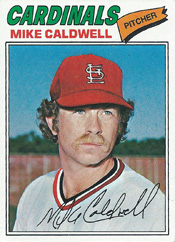
In his spring training stint with the Cardinals, Mike Caldwell appeared to be a pitcher whose career was in decline. Shelled early and often, Caldwell showed no signs of developing into what he would become: a 20-game winner who would torment the Cardinals in the World Series.

Caldwell’s five-month stint as a Cardinal is a tale of a late bloomer who was in the wrong organization at the wrong time.

In March 1977, Caldwell, 28, was considered a leading candidate to fill a role in the Cardinals’ bullpen. Instead, he was traded before he got a chance to appear in a regular-season game for St. Louis.

Giant troubles

Caldwell, a left-hander, made his major-league debut with the 1971 Padres. He had a 13-25 record in three seasons with the Padres before he was traded to the Giants for slugger Willie McCovey.

In 1974, his first year with the Giants, Caldwell had a breakout season, posting a 14-5 record and 2.95 ERA.

After the season, Caldwell had surgery to remove bone spurs in his left elbow. When he returned, he struggled. “I lost some movement on my best pitch, the sinker, and I tightened up some and came sidearm at times,” Caldwell told the St. Louis Post-Dispatch.

By 1976, Caldwell was having troubles in the Giants clubhouse as well as on the mound. “I didn’t get along with a couple of the coaches and they took it personally,” Caldwell said.

The Giants’ pitching coach was the former catcher, Buck Rodgers.

Caldwell reached a low point on April 28, 1976, when Doug Clarey hit a home run, the lone hit of his big-league career, against him in the 16th inning, lifting the Cardinals to a 4-2 victory.

Caldwell finished 1-7 with a 4.86 ERA for the 1976 Giants. “I lost my confidence, tried too hard _ overthrew, I guess you’d say _ and I didn’t do very well,” Caldwell said.

Hope rekindled

On Oct. 26, 1976, the Giants traded Caldwell, pitcher John D’Acquisto and catcher Dave Rader to the Cardinals for pitcher John Curtis, outfielder Willie Crawford and utility player Vic Harris.

“I’m just glad to get away from a bad situation,” Caldwell said of leaving the Giants.

The Cardinals slotted Caldwell for the bullpen. “It’s common knowledge that the problem with the Cardinals last year was that middle relief and late relief, except for Al Hrabosky, couldn’t get the other clubs out,” said St. Louis manager Vern Rapp.

Said Caldwell: “I have no illusions. I’ve got to prove I’m good enough to make the staff.”

Bad audition

On March 12, in the Cardinals’ 1977 spring training opener against the Mets, Caldwell pitched two innings and gave up four runs. Three days later, Caldwell pitched an inning against the Dodgers and yielded three runs.

The Cardinals didn’t pitch him much after that.

On March 29, 1977, the Cardinals traded Caldwell to the Reds for pitcher Pat Darcy. In eight spring training innings, Caldwell yielded nine earned runs.

“Rapp called me in and told me, ‘Don’t get mad. You’re going to a contender,’ ” Caldwell said. “I wasn’t mad about that. I just thought he should’ve had some respect for me as a pitcher. That’s all I wanted: Throw me out there to see what I can do.”

Right fit

The Reds weren’t too impressed with Caldwell either. Three months after they acquired him, the Reds dealt Caldwell to the Brewers.

In 1978, Caldwell got a break when the Brewers named George Bamberger their manager. Under Bamberger, who had been a pitching coach for the Orioles, Caldwell fulfilled his potential. He was 22-9 with a 2.36 ERA and 23 complete games for the 1978 Brewers.

“Lots of people had given up on me,” Caldwell said to The Sporting News, noting he was traded by four clubs, including the Cardinals. “Maybe the people who gave up on me were responsible in an indirect way for my coming back. I knew I could pitch and I hope those who gave up on me will say now, ‘Well, he had the guts to battle back and win.’ ”

The third-base coach for Bamberger’s Brewers was Buck Rodgers, with whom Caldwell had feuded in his last season with the Giants. In 1980, Rodgers replaced Bamberger as Brewers manager.

Old wounds

Early in the 1982 season, Caldwell had a run-in with Rodgers aboard a plane, The Sporting News reported. In June 1982, Rodgers was fired and replaced by hitting coach Harvey Kuenn. Rodgers said disgruntled players had “tried to stab me in the back.”

Kuenn led the Brewers to the 1982 American League pennant and a matchup against St. Louis in the World Series.

Five years after he’d been dealt by the Cardinals, Caldwell would be facing them on baseball’s biggest stage.

Series drama

Caldwell, nicknamed “Mr. Warmth” by teammate Gorman Thomas because of his sometimes grumpy nature, was Kuenn’s choice to start Game 1.

Caldwell responded with a three-hit shutout in a 10-0 Brewers victory. Boxscore

Cardinals first baseman Keith Hernandez said he thought Caldwell was throwing a spitter, an illegal pitch. “He might have been throwing me screwballs, but I never saw a screwball drop like that,” Hernandez said.

Caldwell said he threw “natural sinkers.” Regarding the spitball accusation, Caldwell replied, “I look at it as a compliment. If the ball drops so much that they’re accusing me of throwing a spitter, I’ve got pretty good stuff.”

With the Series deadlocked at 2-2, Caldwell started Game 5 and again was the winning pitcher. He yielded 14 hits and two walks in 8.1 innings, but the Cardinals stranded 12 and the Brewers won, 6-4. Boxscore

The Cardinals won Game 6, setting up a deciding Game 7.

Clinging to a 4-3 lead in the eighth, the Cardinals had runners on first and second, two outs, when Kuenn lifted Moose Haas and replaced him with Caldwell. Darrell Porter and Steve Braun responded with RBI-singles, stretching the lead to 6-3, before Caldwell got Willie McGee to ground out.

Bruce Sutter set down the Brewers in order in the ninth, clinching the championship for the Cardinals. Boxscore


Read Full Post »

Though relief pitcher Clay Carroll was successful in his lone season with St. Louis, his most significant Cardinals connection came as an opponent.

clay_carrollOn May 30, 1969, in what The Sporting News described as a storybook feat, Carroll hit the only home run of his big-league career. The improbable shot was struck against Bob Gibson in the 10th inning and it carried the Reds to a 4-3 victory over the Cardinals.

Eight years later, Carroll was traded to the Cardinals and excelled for them as a consistently reliable reliever.

Heavy lumber

Carroll’s home run against Gibson occurred in the opener of a series between the Reds and Cardinals at St. Louis. With the Cardinals ahead, 3-0, in the seventh inning, Johnny Bench tied the score with a three-run home run _ his first career hit against Gibson.

Carroll relieved Wayne Granger in the eighth and the game became a duel between Carroll and Gibson.

After Gibson retired the first two batters in the 10th, Carroll stepped to the plate with a bat he borrowed from teammate Alex Johnson, a former Cardinal. Johnson’s bats, Carroll explained to the St. Louis Post-Dispatch, “have a lot more wood in them than the one I had been using.” Johnson’s bats “normally are about as heavy as any in baseball _ some weighing as much as 40 ounces,” the Cincinnati Enquirer reported.

With the count 3-and-2, Carroll swung at a high fastball and lifted a fly ball to left. “I don’t want to brag, but when I hit the ball I knew it was gone,” Carroll said to United Press International. “Did you see it take off?”

The ball hit the top of the fence at Busch Stadium and bounced over the wall, giving the Reds a 4-3 lead.

“I was just swinging, trying to get on,” said Carroll. “Usually when I face Gibson, I just chop at the ball. That’s about all you can do against him.”

Said Reds manager Dave Bristol: “You should have seen the smile on Carroll’s face when he returned to the dugout. It looked like a cut watermelon.”

In the bottom half of the 10th, Carroll got Joe Hague to fly out before walking Lou Brock. Curt Flood grounded out, moving Brock into scoring position at second, before Vada Pinson, Carroll’s former Reds teammate, lined out to shortstop, ending the game.

Carroll pitched three hitless innings to earn the win. Boxscore

Championship caliber

Carroll was an important contributor to Reds teams that won pennants in 1970, 1972 and 1975. In 14 World Series appearances for the Reds, Carroll was 2-1 with a save and a 1.33 ERA over 20.1 innings. He was the winning pitcher in Game 7 of the 1975 World Series, shutting out the Red Sox for two innings.

Dealt by the Reds to the White Sox in December 1975, Carroll produced a 4-4 record, six saves and a 2.56 ERA for Chicago in 1976.

On March 23, 1977, the Cardinals acquired Carroll, 35, from the White Sox for pitcher Lerrin LaGrow. The Cardinals projected Carroll to set up closer Al Hrabosky.

“This is obviously what we’ve been after _ consistency and experience from a right-handed reliever, a guy who’s been under fire in championship play,” said manager Vern Rapp. “We had nobody on our staff who fit those qualifications.”

Said Carroll: “I want to work as often as possible because the more I work the more consistent I am. I like the Cardinals, especially because they’re an aggressive team at bat and on the bases.”

Carroll reported to camp at 215 pounds, according to the Post-Dispatch. Rapp wanted him to be at 200 pounds when the season began. He instructed Carroll to run extra laps each day during spring training.

A master at locating his pitches, Carroll delivered for the 1977 Cardinals. “When Carroll wasn’t saving games, he at least was dousing huge blazes to keep the Cardinals in the games,” The Sporting News reported. “The tighter the situation, the more (Carroll) seemed to enjoy it.”

Noting how Carroll got batters to swing at pitches out of the zone, Bristol said, “Carroll would rather eat a green fly at home plate than throw a strike.”

Carroll was 4-2 with four saves and a 2.50 ERA in 51 appearances for the Cardinals before they traded him back to the White Sox on Aug. 31, 1977.

3-for-1

The trade created “a lot of eyebrow raising” because Carroll had been the Cardinals’ most consistent reliever, The Sporting News reported.

The Cardinals were 10 games out of first place with about a month remaining in the season when the deal was made. The White Sox wanted Carroll because they were in contention for a division title, two games behind the first-place Royals.

St. Louis got three players in the deal: pitchers Silvio Martinez and Dave Hamilton and outfielder Nyls Nyman.

Carroll was disappointed to leave the Cardinals. “I thought I did a good job,” he said. “I guess they’re planning to go with a younger pitching staff next year.”

Read Full Post »

(Updated May 3, 2026)

Given a choice of facing Del Ennis or Stan Musial with runners in scoring position and the game on the line, Warren Spahn did what no other big-league pitcher had done before him: He opted to pitch to Musial.

warren_spahnIt was the only time in Musial’s illustrious 22-year Cardinals career that a pitcher intentionally walked a batter in order to get to him.

It happened on Aug. 17, 1957, when the Cardinals and Braves played at Milwaukee’s County Stadium.

Pennant race

The slumping Cardinals, who had lost nine in a row, were fighting to remain in the 1957 National League pennant race when they went to Milwaukee for a four-game series in August. The Braves, riding a 10-game winning streak, were in first place, 7.5 games ahead of the Cardinals.

St. Louis won the series opener, 6-2, behind the slugging of Ennis, who hit a three-run home run off Juan Pizarro.

Game 2 of the series matched Larry Jackson of the Cardinals against Lew Burdette. The Cardinals jumped ahead with three runs in the first, but the Braves came back with two in the sixth and one in the eighth, tying the score at 3-3.

Managerial moves

Don McMahon, a rookie, relieved Burdette in the ninth. After Eddie Kasko grounded out, Jackson hit a broken-bat pop fly to right that fell safely in front of Bob Hazle for a single. The next batter, Ken Boyer, reached base when shortstop Felix Mantilla booted a grounder for an error.

With Wally Moon at the plate, McMahon’s first pitch eluded catcher Del Crandall for a passed ball. Jackson advanced to third on the play and Boyer to second.

Braves manager Fred Haney lifted McMahon and brought in Spahn, a left-hander, to face Moon, a left-handed batter, with the count at 1-and-0.

Two nights earlier, on Aug. 15, Spahn started against the Reds at Cincinnati and pitched a complete game in an 8-1 Braves victory. With one day of rest, the Braves ace was making his fourth and final relief appearance of the season.

Unforgettable ploy

Cardinals manager Fred Hutchinson countered by bringing in Ennis, who batted from the right side, to replace Moon.

Ennis, batting .275 with 17 home runs, was a threat, but he was no Musial. At 36, Musial was batting .333 and would finish the year at .351, earning his seventh National League batting crown.

With first base open, Spahn issued an intentional walk to Ennis, loading the bases with one out and bringing Musial, a left-handed batter, to the plate.

In his autobiography “Stan Musial: The Man’s Own Story,” Musial said the sight of Spahn walking Ennis to face him is one “I’ll never forget.”

Musial rapped a groundball to the second baseman, friend and former teammate Red Schoendienst, who fielded the ball and flipped it to Mantilla for the force of Ennis at second. Mantilla’s relay throw to first baseman Frank Torre was in time to retire Musial, completing the inning-ending double play.

“He’s the only pitcher ever to walk a batter to face me,” Musial said in his book.

Musial told writer Roger Kahn, “Spahnie knew everything about his profession, and he was smart enough to change before he had to … He began tinkering with a screwball, and as the fastball began to go, he’d come at you with the screwgie. Then came the slider.”

In Jim Brosnan’s book “Great Baseball Pitchers,” he said of Spahn, “His carefully controlled motion gave no hint of the type of pitch he was delivering. Batters had to wait, watch for the spin and break of the screwball. Yet they had to be ready also for the fastball … Spahn exercised tight control on each of his deliveries. Most pitchers work for years just to be able to throw the ball consistently into the strike zone. Spahn worked just on the edges (of) the strike zone.”

Spahn said, “The plate is 17 inches wide. I try to avoid the foot in the middle. I pitch to the two-and-a-half inches on each side.”

Back and forth

Even after Spahn got Musial to ground into the double play, the drama wasn’t over. Braves center fielder Hank Aaron had a large role to play in the outcome.

In the 11th, with Spahn pitching, Don Blasingame led off and stretched a single into a double. Kasko grounded out to second, advancing Blasingame to third.

Larry Jackson was due up next, but Hutchinson sent Walker Cooper, 42, to bat for the pitcher. Cooper lifted a sacrifice fly to left, scoring Blasingame and giving the Cardinals a 4-3 lead.

Billy Muffett, a rookie, was Hutchinson’s choice to pitch the bottom half of the inning. Muffett retired the first batter, Schoendienst, on a pop-up.

The next batter, Frank Torre, hit a low line drive to left. Ennis lumbered in, got a glove on the ball and dropped it. Torre, credited with a single, was replaced by pinch-runner Hawk Taylor.

Eddie Mathews followed with a single to center and Taylor advanced to third.

That brought Aaron to the plate.

Hank hammers

Aaron was angry. In the ninth, Jackson moved Aaron off the plate with a high, tight pitch. Aaron, in comments to the Associated Press, accused Jackson of “trying to stick one in my ear.”

“It’s on purpose,” Aaron said. “I can tell when they’re throwing at me.

“If that’s the only way they can win a ballgame, they ought to get other jobs. I don’t mind being brushed back … but I don’t like them balls aimed at my head. We don’t knock Stan Musial down, so why do they do it to me?”

Aaron hit Muffett’s first pitch into right-center for a two-run double, giving the Braves a 5-4 victory and making a winner of Spahn. Boxscore

The Braves went on to clinch the pennant Sept. 23 on Aaron’s 11th-inning walkoff home run against Muffett. Boxscore

Previously: Del Ennis provided power in Cardinals lineup

Read Full Post »

(Updated July 29, 2018)

Brian Jordan produced his most important hit for the Cardinals against one of the all-time best relief pitchers.

brian_jordanFacing Trevor Hoffman in the ninth inning of Game 3 of the 1996 National League Division Series, Jordan hit a two-run home run, breaking a 5-5 tie and lifting the Cardinals to their first postseason series championship in nine years.

With 42 saves and nine wins, Hoffman had factored in 55 percent of the 92 regular-season victories achieved by the 1996 Padres.

In 2018, Hoffman was elected to the National Baseball Hall of Fame. His 601 saves rank second all-time behind the 652 by Mariano Rivera of the Yankees.

In a career filled with successes, one of Hoffman’s most glaring stumbles was in his first postseason against the Cardinals.

Key catch

After winning the first two games at St. Louis, the Cardinals were in position to clinch the best-of-five NL Division Series with a victory against the Padres at San Diego on Oct. 5, 1996.

The Padres led 4-1 after five innings, but the Cardinals rallied for three runs in the sixth and one in the seventh, taking a 5-4 lead.

In the eighth, Ken Caminiti hit a home run against Cardinals reliever Rick Honeycutt, tying the score. The Padres had a runner on second with two outs when Jody Reed hit a line drive to right-center. Jordan, the right fielder, dived and made an inning-ending catch. Video

“I think that was the most important play of the ballgame,” Jordan told the St. Louis Post-Dispatch. “If that ball gets by me, they’re going to score.”

Bruce Bochy, the Padres’ manager, brought in Hoffman to pitch the ninth. Hoffman got Ozzie Smith to line out to left before Ron Gant drew a walk. “I was high in the zone to Gant,” Hoffman told the San Diego Union-Tribune. “That wasn’t necessarily where I wanted to be.”

Up next was Jordan.

Delivering a dagger

Jordan led the 1996 Cardinals in RBI, with 104. He hit .367 with runners on base.

As a result of his diving catch the previous inning, Jordan’s neck and left shoulder stiffened when he got back to the dugout, but a quick massage from trainer Gene Gieselmann got Jordan ready to face Hoffman.

After working the count to 3-and-2, Jordan lined a pitch foul down the left-field line.

Jordan expected the next delivery to be a fastball, but Hoffman threw a slider.

Hoffman: “I hung it right over the middle.”

Jordan: “He threw me a slider up and I kept my hands back.”

Hoffman: “It wasn’t a high hanger. Brian had to go down and get it.”

Jordan: “If I miss that, I’m throwing my hat and my helmet down.”

Timing it right, Jordan swung and lofted the ball over the left-field wall. Boxscore

TV broadcaster Bob Costas described the home run as “a dagger through the heart” of the Padres. Video

Bernie Miklasz, Post-Dispatch columnist, rated Jordan’s jolt “the biggest St. Louis home run” since Jack Clark’s pennant-clinching shot against the Dodgers in the ninth inning of Game 6 of the 1985 NL Championship Series.

“I’ve always wanted to play in pressure situations,” Jordan said. “… To see that ball come down, over the fence, it was satisfying.”

Said Hoffman: “On 3-and-2, he’s looking to drive the ball and I gave him a pitch to do it … It was the right pitch in that situation. Unfortunately, the execution wasn’t quite there and I got bit in the butt.”

Previously: Cardinals dealt Trevor Hoffman first defeat

Previously: How Tony Gwynn tormented Dennis Eckersley

Previously: Why Jack Clark got chance to put Cards in World Series

Read Full Post »

(Updated July 30, 2017)

In a career filled with consistent hitting versus the Cardinals, Jeff Bagwell reached a personal pinnacle when he hit for the cycle against them.

jeff_bagwellBagwell, a first baseman, produced 449 home runs and 1,529 RBI in 15 years (1991-2005) with the Astros.

He was elected to the National Baseball Hall of Fame in balloting by the Baseball Writers Association of America on Jan. 18, 2017, and inducted on July 30, 2017.

Championship contenders

Many of Bagwell’s most meaningful games came against the Cardinals, who developed into the Astros’ most intense division rival.

In nine of the last 10 seasons of Bagwell’s career, 1996-2005, either the Astros or Cardinals finished in first place in the National League Central Division. In 2001, the Cardinals and Astros tied for first with 93-69 records. In 2004 and 2005, when the Cardinals won division titles, the Astros qualified for the postseason as a wild card and faced St. Louis in the NL Championship Series. The Cardinals prevailed in 2004; Houston won in 2005.

Bagwell, a right-handed batter, had more regular-season career hits (223) versus the Cardinals than he did against any other foe.

In 192 regular-season games facing St. Louis, Bagwell hit .319, with 38 home runs, 139 RBI and a .422 on-base percentage.

In 2000, when the Cardinals were division champions, Bagwell hit .463 (19-for-41) against them, with seven home runs and 18 RBI in 11 games.

His best single-game performance versus the Cardinals came the next year.

Liftoff in Houston

The Cardinals had won four in a row, holding opponents to three runs or fewer, heading into a series opener against the Astros on July 18, 2001, at Houston.

In the first inning, Bagwell hit a run-scoring single off starter Mike Matthews. He flied out to center in the third.

The Cardinals scored six times in the fifth and led, 8-6.

Sparked by Bagwell, the Astros rallied for eight runs in the bottom half of the inning.

Bagwell led off the fifth with a double against Luther Hackman. After the Astros scored five times, Bagwell capped the inning with a three-run home run off Gene Stechschulte.

Coming through

That meant Bagwell needed a triple to complete the cycle for the only time in his big-league career. He’d tripled just once (at Chicago) at that point in the season.

In the seventh, with Craig Biggio on third base and one out, Bagwell faced Andy Benes. “My only concern was getting that run home (from third),” Bagwell told the Houston Chronicle.

Bagwell lined a deep shot to right-center field.

“That’s probably the only place you can hit a triple in this park, for a right-hander,” Biggio said.

Bagwell rounded second _ “I was kind of laboring. I wasn’t going very fast,” he said _ and beat the throw to third.

“It worked out where I got a triple and got the cycle,” said Bagwell, “but a base hit up the middle would have been nice, too.” Boxscore

Bagwell became the fourth Houston player _ and the first since Andujar Cedeno on Aug. 25, 1992, versus the Cardinals Boxscore _ to hit for the cycle. The other Astros to do so were Cesar Cedeno and Bob Watson.

“I’m jealous,” Astros outfielder Moises Alou said to the Associated Press. “I’ve never even hit for the cycle when I played softball.’

Bagwell, who drew a walk while facing Dave Veres in the eighth, finished the game 4-for-5 with five RBI and four runs scored.

“It’s cool,” Bagwell said, “but it’s not something I put much stock in.”

Previously: Could Craig Biggio have made Hall of Fame as Cardinal?

Read Full Post »

« Newer Posts - Older Posts »