Feeds:
Posts
Comments

Archive for the ‘Opponents’ Category

(Updated July 12, 2019)

Steve Trachsel played a prominent role in two record-setting home run performances by the Cardinals. He was the starter the last time the Cardinals hit seven home runs in a game. Two years later, he yielded the home run to Mark McGwire that broke Roger Maris’ single-season big-league mark.
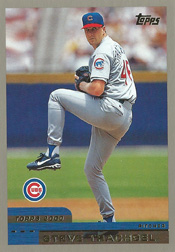
steve_trachselThe Cardinals’ team record for most home runs in a game is seven. They’ve done that twice.

The first time was May 7, 1940, in the Cardinals’ 18-2 victory over the Dodgers at St. Louis. Joe Medwick, Johnny Mize, Don Padgett, Eddie Lake and Stu Martin each hit a home run off starter Hugh Casey. Mize and Lake also each hit a home run off Max Macon. Boxscore

Fifty-six years later, the Cardinals did it again. On July 12, 1996, Gary Gaetti and Ron Gant each hit two home runs and John Mabry, Ray Lankford and Brian Jordan had one apiece in the Cardinals’ 13-3 victory over the Cubs at Chicago. Boxscore

All-star foe

The 1996 performance at Wrigley Field was surprising.

The Cardinals entered the game with the fewest home runs (71) in the National League, according to the Arlington Heights (Ill.) Daily Herald.

Trachsel, the Cubs’ starter, was considered an emerging ace.

Three days earlier, Trachsel had pitched a perfect inning for the National League in the All-Star Game, retiring Sandy Alomar, Cal Ripken and Alex Rodriguez.

Trachsel’s career record against the Cardinals then was 5-1.

“I know how good that young man is,” Cardinals manager Tony La Russa told the St. Louis Post-Dispatch. “I wouldn’t have bet a dime we’d hit one (home run), much less seven.”

Redbirds rip

Trachsel yielded four of the Cardinals’ seven home runs. In the third inning, Mabry hit a two-run shot and Gaetti followed with a solo home run. In the fifth, Lankford and Gant hit solo back-to-back shots, knocking Trachsel out of the game.

“They hit high pitches, low pitches, off-speed stuff, fastballs,” Trachsel said to the Chicago Sun-Times.

Said Cubs manager Jim Riggleman: “Even the elite have bad days.”

Rodney Myers relieved Trachsel and gave up the third home run of the fifth inning, a two-run shot by Gaetti, who was playing in his second career game at Wrigley Field.

“We haven’t been hitting like this,” Gaetti said to the Associated Press. “This ballpark is conducive to this, though.”

The sixth and seventh Cardinals home runs were a three-run shot by Jordan off Tanyon Sturtze in the sixth and a solo shot by Gant off Terry Adams in the eighth. Video

No. 62

Trachsel was the Cubs starter again on Sept. 8, 1998, against the Cardinals at St. Louis. In the fourth inning, McGwire hit his 62nd home run of the season, surpassing Maris’ total of 61 with the 1961 Yankees and linking Trachsel to one of baseball’s treasured records. Video

Lankford and Gant also hit home runs off Trachsel in a 6-3 Cardinals triumph. Boxscore

Trachsel yielded 28 home runs in 28 career starts vs. the Cardinals. Lankford hit four career home runs off Trachsel and McGwire hit three.
Read Full Post »

(Updated May 25, 2020)

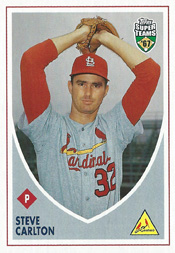
On May 21, 1970, Steve Carlton, a future Phillie, and Dick Allen, a former Phillie, delivered dramatic performances for the Cardinals against the Phillies, but it wasn’t enough to produce a win.

steve_carlton5Carlton struck out 16 Phillies and Allen sparked a Cardinals comeback with a ninth-inning home run, but the Phillies won, 4-3, at Connie Mack Stadium in Philadelphia.
The unusual occurrences didn’t end with the game’s conclusion. A few hours after their loss, the Cardinals were roused from their rooms when a fire broke out in the hotel. The Cardinals were unharmed and the fire quickly was extinguished.

For Carlton, the game was the third in his Cardinals career in which he struck out 16 or more. Each time, he didn’t win. Carlton struck out 19 and took the loss in a 4-3 Mets victory over the Cardinals on Sept. 15, 1969. He struck out 16 and took the loss in a 3-1 Phillies victory over the Cardinals on Sept. 20, 1967.

“It’s getting to be a phobia,” Carlton said to United Press International. “I get all these strikeouts, but I start thinking that one mistake can kill you.”

Allen returns

Before the game, the focus was Allen, not Carlton. Allen was playing at Philadelphia for the first time since the Phillies sent him to the Cardinals seven months earlier in the deal involving Curt Flood and Tim McCarver.

Allen, the Cardinals’ first baseman, “was welcomed by a chorus of boos mingled with cheers” when he appeared on the field, the Associated Press reported.

According to the Philadelphia Daily News, “Nobody came to sit on their hands or be neutral. There was electricity in the air.”

In the sixth inning, the Phillies snapped a scoreless tie with three runs against Carlton. Larry Hisle hit a RBI-triple and Don Money produced a two-run home run. “I hung a slider to Money,” Carlton said to the St. Louis Post-Dispatch.

Otherwise, Carlton was dominant. “My fastball was good and I was keeping it low and away all night,” Carlton said. “I kept hitting the corners.”

With the Phillies ahead 3-0, Phil Gagliano, batting for Carlton, led off the ninth with a routine groundball to Money at third base. The ball took a bad hop and struck Money in the eye. Gagliano was credited with a single. Experiencing double vision, Money was taken to a hospital and diagnosed with “a fracture of the orbit, the thin bone around the eye,” The Sporting News reported.

After the next two Cardinals batters made outs against starter Woodie Fryman, Allen, hitless in the game, came to the plate.

Redbirds rally

Fryman threw a slider, down and in, and Allen ripped it for a two-run home run into the left-field stands, turning the jeers into cheers.

“There aren’t many smarter hitters in this game,” Fryman said. “He goes up there with an idea.

“He’s got tremendously fast feet. He really knows how to use them to open up on an inside pitch.”

According to Philadelphia Daily News columnist Stan Hochman. Phillies broadcaster and former outfielder Richie Ashburn suggested pitchers should pitch to Allen “the way porcupines make love _ carefully.”

“I’m not going to pitch him outside because he’s liable to hit that right back at you,” Fryman said, “and I wouldn’t want to challenge that.”

Following Allen’s home run, Joe Torre walked and Vic Davalillo ran for him. Carl Taylor singled, moving Davalillo to second. Bill Wilson relieved Fryman and yielded a single to Joe Hague, scoring Davalillo with the tying run. The Cardinals loaded the bases, but the threat died when Mike Shannon, facing former teammate Joe Hoerner, popped out to third.

In the bottom of the ninth, Tony Taylor hit a two-out, RBI-single off Sal Campisi, giving the Phillies the victory. Boxscore and radio broadcast

Wakeup call

Early on the morning of May 22, a fire erupted on the 15th floor of the hotel where the Cardinals stayed. Smoke “shot up to several higher floors,” including the floors where most of the Cardinals had rooms, The Sporting News reported.

Shannon and Cardinals coach Billy Muffett awakened many of their teammates “by kicking against their doors,” according to The Sporting News.

“Our floor was full of smoke,” said Muffett, “and when I tried to go out an exit door, I had to turn back because of the heavy smoke.”

Some of the Cardinals gathered in the lobby until certain the fire was put out.

In his book “Red: A Baseball Life,” Cardinals manager Red Schoendienst said, “I was asleep and the sirens woke me up. I could see the red lights flickering in my window. That was all I needed to get me going. I threw on a pair of pants and a shirt and hightailed it downstairs.

“We were lucky nobody was hurt … Our clothes smelled liked smoke for a long time after that.”

It was that kind of night.


Read Full Post »

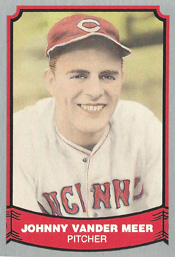
Flummoxed by the introduction of a dead baseball, the defending World Series champion Cardinals struggled to score a run at the start of the 1943 season. Desperate, Stan Musial broke the scoreless streak by attempting to steal home.

johnny_vandermeerThe 1943 Cardinals established a major-league record by going scoreless for the first 26 innings of the season.
The record stood for 73 years until the 2016 Padres began the season by failing to score in the first 30 innings. Jon Jay, a former Cardinals outfielder, snapped the Padres’ futility streak with a RBI-single in the fourth inning against the Rockies at Denver on April 8, 2016.

Musial’s mad dash

In 1943, the Cardinals started the season at Cincinnati. The Reds won the opener, 1-0, in 11 innings and also won, 1-0, again the next day in 10 innings.

After going scoreless in the first five innings of Game 3, the Cardinals had the bases loaded with one out in the sixth. Musial broke from third, attempting to steal home, and was trapped in a rundown.

When Musial dashed for the plate, third baseman Bert Haas tossed the ball to catcher Ray Mueller, who dropped it. Musial scored on the error for the Cardinals’ first run of the season. The Cardinals scored again in the eighth and won, 2-1.

Foul ball

After Reds general manager Warren Giles sent a telegram to National League president Ford Frick, complaining about the ball, an official with manufacturer A.G. Spalding admitted the ball produced by the company “did not measure up to specifications in resiliency,” The Sporting News reported.

According to Giles, the Spalding official said that the “rubber cement they were forced to use had affected the rebound of the 1943 baseball adversely.” Tests showed the resiliency of the 1943 balls were 25 percent less than in 1942.

In his book “Stan Musial: The Man’s Own Story,” Musial explained, “Because rubber was a war-priority item, the Spalding Company … decided to use re-processed rubber or, as it’s more accurately known, balata.”

Irate, Giles fumed to The Sporting News: “Asking big leaguers to play with the sort of a ball with which we are opening the season would be like asking our soldiers, sailors and Marines to win the war with blanks instead of real ammunition.”

Frick instructed NL teams to use leftover 1942 baseballs until Spalding could issue revamped 1943 balls.

Said Cardinals manager Billy Southworth of the dead balls: “It robs the game of the great hitting and great fielding plays which cause baseball to appeal to the public.”

Here is the look at the Cardinals’ first three games of the 1943 season:

Opening duel

In a matchup of aces Johnny Vander Meer of the Reds and Mort Cooper of the Cardinals, Vander Meer prevailed in the 1-0 Reds victory on April 21.

Vander Meer yielded two hits and five walks in 11 innings. Singles by Whitey Kurowski in the first inning and Frank Demaree in the third accounted for the St. Louis hits.

The Cardinals put three runners on base in the first but couldn’t score.

In the 11th, Lonny Frey led off for the Reds with a single against Cooper and advanced to second on Mike McCormick’s sacrifice bunt. Max Marshall drove in Frey with a single.

Cooper pitched 10.1 innings and gave up six hits and two walks. Boxscore

Choke up, fellas

In Game 2 on April 22, Ray Starr held the Cardinals to five hits in 10 innings. The Reds won, 1-0, when Frey scored from third on a Haas single off starter Ernie White with two outs in the 10th.

Musial had tripled with one out in the fourth, but was stranded.

“When I tripled off Ray Starr,” said Musial, “the ball sounded like a nickel rocket.”

Said Southworth to the Cardinals: “You’ll have to choke your bats, fellas, as they used to do in the old days, and bunt more often.” Boxscore

No RBI

In Game 3, on April 24, both of the Cardinals’ runs in their 2-1 victory were unearned.

The first came when Musial escaped the rundown after Mueller dropped the ball.

The second came in the eighth when Musial scored from third on a passed ball by Mueller. Boxscore

With better baseballs, the 1943 Cardinals’ offense came to life. They scored 679 runs (second only to the Dodgers in the NL) and won their second consecutive pennant, posting a 105-49 record.

Previously: How a B-17 nearly clipped Cardinals in World Series

Read Full Post »

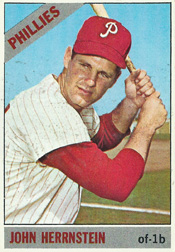
Before the final home opener at the first Busch Stadium was postponed because of rain, fans booed Cardinals newcomers and cheered some familiar players on the opposing team.

john_herrnsteinThe next night, when the rescheduled opener was played before a sparse gathering, the Phillies beat the Cardinals in 12 innings. Frustrated, St. Louis manager Red Schoendienst complained about having to play April games at night in cold weather.
It all made for an inglorious farewell opener for the grand ballpark on St. Louis’ Grand Boulevard.

Changes at home

Busch Stadium I had been the Cardinals’ home since 1920. Located at 2911 North Grand Boulevard, it was called Sportsman’s Park until Anheuser-Busch bought the Cardinals in 1953 and changed the  ballpark’s name.

A new ballpark, Busch Stadium II, was a key part of plans to revive downtown St. Louis. The Cardinals had hoped to open the 1966 season in Busch Stadium II, but labor strikes had delayed steel and masonry work.

The Cardinals would relocate to Busch Stadium II in May 1966, but Busch Stadium I remained their home when the season began.

Tough crowd

The Phillies and Cardinals were scheduled to open on a Tuesday night, April 12, 1966, at St. Louis.

Six months earlier, the Cardinals had upset many fans by trading three-quarters of their starting infield. Third baseman Ken Boyer was dealt to the Mets. First baseman Bill White and shortstop Dick Groat were sent to the Phillies.

In the pregame introductions of players before the 1966 season opener at Busch Stadium I, Phillies players White and Groat “drew the longest and loudest cheers,” The Sporting News reported.

Three Cardinals _ outfielder Alex Johnson, third baseman Charlie Smith and first baseman George Kernek _ were greeted by boos, according to The Sporting News.

Johnson was the key player acquired by the Cardinals in the deal for White and Groat. Smith came over from the Mets to replace Boyer at third. Kernek, a rookie promoted from the Cardinals’ farm system, was the replacement for White at first base.

Duel of aces

Starting at 8 pm Central time with a temperature of 44 degrees and winds reaching 20 mph, the opening game started as a duel between aces Bob Gibson of the Cardinals and Jim Bunning of the Phillies.

Gibson retired the Phillies in order in the first, striking out Johnny Briggs and Richie Allen and getting White on a groundout to third.

Bunning was just as good. He struck out Lou Brock and Curt Flood and got Julian Javier on a groundout to second.

As soon as the first inning ended, a downpour halted play. After a delay of 50 minutes, the game was called off, United Press International reported.

The postponement, “with a crowd of 25,000 expected, cost the club at least $50,000,” The Sporting News estimated.

Try again

The game the next night, Wednesday, April 13, became the Cardinals’ official season opener. It drew 8,219 spectators on a 40-degree evening. Curt Simmons of the Cardinals and Chris Short of the Phillies were the starters.

The Cardinals tied the score, 2-2, in the eighth on Flood’s second RBI of the game.

In the 12th, with two outs and none on, Allen singled off Dennis Aust and stole second. White was walked intentionally. John Herrnstein, pinch-hitting for former Cardinals pitcher Roger Craig, singled to center, scoring Allen and giving the Phillies a 3-2 lead.

Ray Culp, who replaced Craig in the bottom of the 12th, struck out Pat Corrales, Brock and Javier, earning the save and sealing the win for Craig and the Phillies. Boxscore

“By April 18 or so, they could play night games, but they should forget about them the first week (of the season),” Schoendienst said. “It’s usually too cold at night and there’s always the risk of incurring arm injuries.”

Previously: Bob Gibson and his final Opening Day with Cardinals

Previously: George Kernek: Cardinals’ choice to replace Bill White

Previously: Why Cardinals traded Ken Boyer to Mets

Read Full Post »

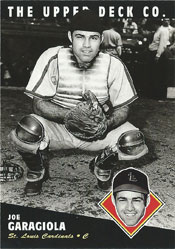
Joe Garagiola, a St. Louis native who began his big-league career with the Cardinals, hit his most dramatic home run against his hometown team.

joe_garagiola2Pinch-hitting with two outs in the ninth inning of the second game of a Memorial Day doubleheader, Garagiola hit a three-run walkoff home run that erased a 3-1 deficit and lifted the Pirates to a 4-3 victory over the Cardinals on May 30, 1952.
Garagiola was better known as a broadcaster than as a player, but he had several significant performances during a nine-year playing career in the majors as a catcher with the Cardinals, Pirates, Cubs and Giants.

His most important contribution as a player was his performance for the Cardinals as a 20-year-old rookie against the Red Sox in the 1946 World Series. Garagiola batted .316 (6-for-19), scored twice and had four RBI. He caught 42.2 innings without an error for the Cardinals, who won the championship in seven games.

A left-handed batter, Garagiola hit 42 big-league home runs. In addition to the walkoff home run to beat the Cardinals, he hit two grand slams for St. Louis.

Here is a look at those three home runs:

First base open

The 1952 Pirates were a dreadful team. After the Cardinals beat them, 3-2, in the first game of the May 30, 1952, doubleheader at Pittsburgh, the Pirates’ record was 8-33.

In the second game, starting pitchers Cloyd Boyer of the Cardinals and rookie Ron Kline of the Pirates each pitched eight scoreless innings. Clem Koshorek singled to lead off the bottom of the first for the Pirates. Boyer held Pittsburgh hitless from then through the eighth.

The Cardinals scored three in the top of the ninth, breaking the scoreless tie.

In the bottom of the ninth, Koshorek led off with a bunt single. After Bobby Del Greco popped out, Gus Bell doubled, moving Koshorek to third.

Cardinals manager Eddie Stanky replaced Boyer with Gerry Staley. A starter, Staley was making his first relief appearance of the 1952 season. He issued an intentional walk to the first batter he faced, cleanup hitter Ralph Kiner, loading the bases. A rookie, Brandy Davis, ran for Kiner.

When Jack Merson grounded out, pitcher to first, Koshorek scored, with Bell advancing to third and Davis to second.

Garagiola, who had caught the first game, was sent by manager Billy Meyer to pinch-hit for catcher Clyde McCullough. Meyer wanted a left-handed batter, Garagiola, to face the right-handed Staley.

With two outs and first base open, Stanky could have had Staley issue an intentional walk to Garagiola. On deck was George Strickland, a right-handed batter who hit .177 for the 1952 Pirates.

Instead, the Cardinals pitched to Garagiola, who ended the game with his first home run of the season. Boxscore

Trash talking

Four years earlier, playing in his first game of the season, Garagiola broke a 5-5 tie in the seventh inning with a grand slam off reliever Harry Gumbert, lifting the Cardinals to a 13-7 victory over the Reds at Cincinnati on April 30, 1948.

Garagiola hit a line drive off Gumbert, 38, a former Cardinal, that carried over the right field screen at Crosley Field, according to the Associated Press.

As he rounded the bases, Garagiola was razzed by players in the Reds dugout. Garagiola challenged one of the Reds on his way to bench, The Sporting News reported.

Said baseball commissioner Happy Chandler, who witnessed the incident: “I told manager Eddie Dyer that he’d better have a talk with Garagiola and see that it didn’t happen again.”

Garagiola was 3-for-4 with a walk, two runs scored and four RBI in the game. His teammate, Stan Musial, was 5-for-6 with three runs scored and four RBI. Boxscore

Sizzling in Cincinnati

Two years later, Garagiola hit the second and last grand slam of his big-league career. Again, it occurred in Cincinnati.

On May 28, 1950, in the first inning of the second game of a doubleheader, the Cardinals led, 1-0, and had Red Schoendienst on third and Enos Slaughter on second, one out, when Reds starter Ewell Blackwell issued an intentional walk to Bill Howerton, loading the bases for Garagiola.

The grand slam hit by Garagiola was his first home run of the season, giving the Cardinals a 5-0 lead. Garagiola went 3-for-4 with a run scored and four RBI in a 7-2 Cardinals triumph. Boxscore

Four days later, on June 1, Garagiola separated his shoulder when he tripped over the legs of the Dodgers’ Jackie Robinson on a play at first base.


Read Full Post »

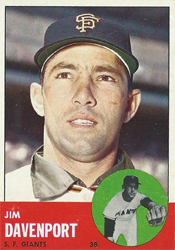
Though known more for his skills with a glove than with a bat, Jim Davenport of the Giants delivered two standout hitting performances against a pair of Cardinals aces, future Hall of Famers Bob Gibson and Steve Carlton.

jim_davenportIn a 1961 game versus Gibson, Davenport had three doubles and two walks in five plate appearances. In a 1968 game against Carlton, Davenport produced four singles in four at-bats.

Davenport also broke Cardinals third baseman Ken Boyer’s streak of winning National League Gold Glove awards. Boyer got the award in four consecutive seasons (1958-61) before Davenport won it in 1962. Boyer earned his fifth and final Gold Glove the next year.

Reliable player

Though not of the caliber of teammates Willie Mays, Willie McCovey and Orlando Cepeda, or of third base counterparts such as Boyer and Ron Santo of the Cubs, Davenport was a dependable fielder (he three times led NL third basemen in fielding percentage) and clutch hitter (career .285 batting average with runners in scoring position).

He had some of his biggest successes against the Cardinals.

A career .258 hitter for the Giants from 1958-70, Davenport batted .273 versus St. Louis, with 32 doubles.

Here is a look at three of Davenport’s best games against the Cardinals:

On base 5 times

Davenport, batting second, ahead of McCovey, Mays and Cepeda, was 3-for-3 (all doubles), two walks and three runs scored versus Gibson on Aug. 26, 1961, at St. Louis.

Gibson, hitting better than he pitched, had four RBI with a two-run double and two sacrifice flies in an 8-5 Cardinals victory. Gibson got the win even though he yielded 10 hits and six walks in 8.1. innings.

Davenport doubled in the first and third innings and walked in the fourth and seventh.

In the ninth, with the Cardinals ahead, 8-3, Davenport doubled with one out and McCovey followed with a 410-foot home run to right-center, getting the Giants within three at 8-5.

After Gibson walked Mays, Ed Bauta relieved and retired Cepeda and Hobie Landrith, earning a save and preserving the Cardinals’ sixth victory in a row. Boxscore

Davenport had a career .245 batting mark (12-for-49) against Gibson, with five doubles and seven walks.

Hard-hitting shortstop

Batting sixth and playing shortstop, Davenport was 4-for-4 with three doubles, a single, a sacrifice bunt, a RBI and a run scored for the Giants in their 10-5 victory in 10 innings at St. Louis on May 5, 1965.

Davenport had two doubles and a single off starter Tracy Stallard.

In the 10th, with the score tied at 5-5, Davenport doubled against Ray Washburn, sparking a five-run inning for the Giants. Davenport scored the go-ahead run when second baseman Phil Gagliano bobbled Ed Bailey’s grounder and threw wildly to home plate. Boxscore

Jim Ray Hart had replaced Davenport as the everyday third baseman for the 1965 Giants. Davenport started at shortstop that season in 32 games, second to Dick Schofield.

“Davenport isn’t just adequate at short _ he’s good there,” Giants manager Herman Franks told The Sporting News.

Tough on left-handers

Batting second, Davenport was 4-for-4 against Carlton in the Giants’ 3-0 victory at St. Louis on July 18, 1968.

Davenport singled off Carlton in the first, third, fifth and seventh innings. He grounded out facing Ron Willis in the ninth. Boxscore

A lifetime .299 hitter versus left-handers, Davenport batted .364 (8-for-22) in his career against Carlton. All the hits were singles.

The loss snapped a six-game winning streak for the front-running Cardinals, but they still were 13 ahead of the fourth-place Giants.

Before the game, Franks told United Press International, “I’ll resign if the Giants don’t finish first.”

The Giants finished second, nine behind the champion Cardinals.

Clyde King, a former instructor and manager in the Cardinals’ system, replaced Franks as manager of the 1969 Giants.

Previously: The story of Bob Gibson, Gaylord Perry and a slam

Previously: Clyde King mentored young Cardinals of 1960s

Read Full Post »

« Newer Posts - Older Posts »