Feeds:
Posts
Comments

Archive for the ‘Opponents’ Category

Sunday night baseball, a standard feature on today’s major-league schedule, was a radical idea, born of necessity, when the Cardinals first experienced it in 1963.

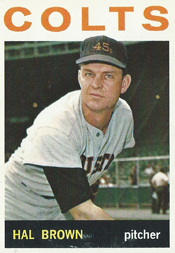
hal_brownAt that time, the Houston Colt .45s, in their second National League season, played their home games at an outdoor ballpark. In the summer, the oppressive Texas heat and humidity made day baseball uncomfortable, if not impractical, for fans and players.

“Rivals agreed that it’s too hot to play on Sunday afternoons,” United Press International reported.

The 1963 Colt .45s became the first big-league club to schedule Sunday night home games. The first was against the Giants on June 9. The second was played against the Cardinals on June 30. The winning pitcher in both was a 38-year-old knuckleball specialist, Hal Brown, a World War II combat veteran who had served as a gunner on U.S. Army Air Force bombers.

Need to be stingy

Brown, winding down his career with the weakest-hitting team in the National League, knew his best chance to win was to pitch a shutout for the Colt .45s.

The 1963 Colt .45s would rank last in the 10-team NL in runs (464), RBI (420) and home runs (62).

Brown earned five wins for the 1963 Colt .45s. He pitched complete-game shutouts _ two versus the Cardinals, including the Sunday night game, and one against the Phillies _ for three of those wins. In the other two, he pitched 6.1 innings of scoreless relief versus the Giants and held the Mets to three runs in a rain-shortened seven-inning start.

Thus, in his wins for the 1963 Colt .45s, Brown had an ERA of 0.66, yielding three runs in 49.1 innings.

Overall, Brown was 5-11 with a 3.31 ERA in 26 games, including 20 starts, for the 1963 Colt .45s. Brown yielded three runs or fewer in seven of his losses, with the Colt .45s scoring a total of five runs in those defeats.

Richards connection

Brown debuted in the major leagues with the 1951 White Sox. He also pitched for the Red Sox and Orioles before joining the Yankees in September 1962.

On April 21, 1963, the Yankees sent Brown to the Colt .45s for $25,000. Paul Richards, general manager of the Colt .45s, had been Brown’s manager with the White Sox and for most of his time with the Orioles. It was Richards who encouraged Brown to use the knuckleball.

“I don’t want a big knuckler,” Brown said to The Sporting News. “I want it to look just good enough to swing at. When you’re 38, you would rather get them out on one pitch than strike them out on three.”

Night moves

In the inaugural big-league Sunday night game, Brown relieved injured starter Turk Farrell with two outs in the third inning. Brown pitched the rest of the way, yielding one hit _ a Willie Mays single _ and retiring the last 17 Giants batters in a row for his first NL win in a 3-0 Colt .45s victory. Boxscore

Outside the ballpark, protesters opposed Sunday night baseball, according to the book “Colt .45s: A Six-Gun Salute.”

“It’s just plain wrong and ought not to be,” Baptist minister O.A. Taylor said of Sunday night games. “If they get by with this, they’ll start scheduling games on Sunday morning.”

Three weeks later, Brown got the start against the Cardinals in the second Sunday night game.

Brown pitched a complete-game seven hitter in a 1-0 Colt .45s victory. Houston scored in the fourth off starter Lew Burdette on John Bateman’s RBI-single.

Brown held the Cardinals to six singles and a triple, striking out six and walking one. He escaped several jams, including:

_ In the first inning, the Cardinals loaded the bases with two outs before Brown retired George Altman.

_ In the second, Curt Flood reached second with none out, but was caught attempting to steal third.

_ Altman tripled leading off the seventh. He was unable to advance on groundouts by Flood and Tim McCarver. Carl Sawatski flied out, ending the inning and stranding Altman at third.

_ In the eighth, the Cardinals had runners on first and third with one out. Brown retired Charlie James and Ken Boyer without allowing the runner from third to score.

“It was a weird but wonderful triumph,” wrote Mickey Herskowitz in The Sporting News.

Said Brown: “It’s a pretty good feeling to know you have to pitch a shutout to win and then to do it.” Boxscore

Brown shut out the Cardinals for the second time on Aug. 24, 1963, a Saturday night in Houston. He limited the Cardinals to four singles _ three by Flood and one by Altman _ in a 4-0 Colt .45s victory.

Stan Musial, making his final visit to Houston as a player and honored in ceremonies before the game, was 0-for-3 against Brown that night. Boxscore

Previously: From the start, Cardinals vs. Houston rivalry was special

Previously: Reds-Cardinals: Easter night to remember

Read Full Post »

Fed up with contract hassles and uneasy with the prospect of playing for manager Eddie Dyer, Walker Cooper, the best catcher in the National League, wanted out of St. Louis. Seeing a surplus of suitors causing Cooper’s market value to skyrocket, Cardinals owner Sam Breadon was willing to accommodate him.

walker_cooper2On Jan. 5, 1946, the Cardinals sent Cooper to the Giants for $175,000.

The cash amount was the third-largest paid by a club to acquire a player, according to media reports at that time.

(In 1934, the Red Sox sent $250,000 and shortstop Lyn Lary to the Senators for shortstop Joe Cronin. In 1938, the Cubs gave $185,000, plus pitchers Curt Davis and Clyde Shoun and outfielder Tuck Stainback, to the Cardinals for pitcher Dizzy Dean.)

“I decided Cooper wasn’t satisfied here and would do better elsewhere,” Breadon said. “But get me right: Walker was a great player here and I consider him the greatest catcher in the majors since Bill Dickey of the Yankees was a young man.”

In the short term, the trade didn’t hurt the Cardinals. Without Cooper, they won the 1946 World Series championship.

In the long run, losing Cooper was a factor in the erosion of the Cardinals, who went 18 years before winning another World Series crown.

3-time all-star

Along with his brother Mort, a starting pitcher, Walker Cooper was a key player on Cardinals clubs that won three consecutive NL pennants and two World Series titles from 1942-44.

He was named an all-star catcher in each of those three seasons. His numbers:

_ 1942: Batted .281 with 32 doubles and 65 RBI. Ranked second among NL catchers in assists (62) and runners caught attempting to steal (58 percent). Batted .286 in the World Series.

_ 1943: Batted .318 with 30 doubles and 81 RBI. Caught 48 percent of runners attempting to steal. Batted .294 in the World Series.

_ 1944: Batted .317 with 25 doubles and 72 RBI. Caught 43 percent of runners attempting to steal. Batted .318 in the World Series.

Cooper also was touted for game-calling skills. “He’s the best fellow handling young pitchers I have ever seen,” said Coaker Triplett, a Cardinals outfielder from 1941-43.

Feuding with front office

The relationship between Cooper and the Cardinals soured in 1945.

In spring training, Mort Cooper demanded a $15,000 contract. Breadon refused. In protest, Mort Cooper and Walker Cooper left camp and threatened to boycott the Cardinals’ opening series against the Cubs.

The brothers gave in and were with the club on Opening Day. Soon after, Walker Cooper was inducted into the Navy after playing four April games for the 1945 Cardinals. A month later, Mort Cooper was traded to the Braves.

While serving his Navy stint in 1945, Walker Cooper remained miffed at Cardinals management for the contract dispute and for dealing his brother.

Trade me

In October 1945, Walker Cooper called Breadon and requested a trade, the Cardinals owner told The Sporting News.

Cooper confirmed to the Associated Press he had asked to be traded.

A month later, Cardinals manager Billy Southworth resigned and joined the Braves. Breadon replaced Southworth with Dyer. Cooper again contacted the Cardinals and “said he would rather not play under Dyer,” Breadon said.

Cooper’s problem with Dyer occurred when both were with the Cardinals’ Houston farm club during spring training in 1939. Cooper apparently clashed with Dyer, who had replaced Ira Smith as manager. Cooper was shipped to the Cardinals’ Asheville, N.C., affiliate.

“(Dyer) said there had been differences with Cooper in Houston, but he believed they could be ironed out,” Breadon said. “He felt a player didn’t have to like him personally if he played good ball for his team.”

Said Dyer: “I have always been able to get along with any ballplayer and I could have gotten along with Cooper, whom I consider the best catcher in baseball.”

In his book “Stan Musial: The Man’s Own Story,” Musial said, “Breadon said Coop didn’t want to play for Dyer, but the boss gave (Dyer) no chance to talk to the catcher. The truth is, Mr. Breadon was annoyed at the Cooper boys for squabbling over salaries.”

Money talks

At the baseball winter meetings in December 1945, at least five clubs inquired about Cooper, with the Giants, Braves and Phillies making the most lucrative offers.

The Cardinals asked the Giants for $150,000 and three players. A few weeks later, the trade came together when the Giants offered to increase the cash amount to $175,000 if the Cardinals would drop their demand for players.

The transaction was announced three days before Cooper turned 31. It “kicked up more commotion among Polo Grounds customers than any deal since Frank Frisch was traded for Rogers Hornsby in 1926,” wrote The Sporting News.

Cooper was released from the Navy on April 2, 1946, and debuted with the Giants about two weeks later.

Looking back

His first season with New York was a dud. Cooper hit .268 with 46 RBI for a 1946 Giants team that finished in last place at 61-93. The 1946 Cardinals, using a platoon of Joe Garagiola and Del Rice at catcher, finished in first place at 98-58.

Cooper did better for the 1947 Giants, hitting .305 with 35 homers and 122 RBI.

After stints with the Reds, Braves, Pirates and Cubs, Cooper finished his career as a backup catcher for the 1956-57 Cardinals.

Neither Garagiola nor Rice performed at the level Cooper had for St. Louis.

In his book “Musial: From Stash to Stan the Man,” author James N. Giglio wrote, “Both Musial and (Enos) Slaughter rightly contended that the loss of Cooper cost the Redbirds several pennants.”

In choosing his all-time NL all-star team, Musial picked Dodgers catcher Roy Campanella “in a photo finish with Walker Cooper.”

Comparing the Cooper deal with the 1941 trade of St. Louis slugger Johnny Mize to the Giants, Musial said, “Big Coop’s sale by the Cardinals probably was even worse than the loss of Johnny Mize.”

Read Full Post »

(Updated Jan. 6, 2016)

Born in the same town and on the same day in November as Stan Musial, Ken Griffey Jr. entered this world with a powerful Cardinals connection. He strengthened that special bond by joining Musial as an outfielder in the National Baseball Hall of Fame.

ken_griffey_jrGriffey, on the ballot for the first time, was elected to the Cooperstown, N.Y., shrine on Jan. 6, 2016. He got 99.3 percent of the votes from members of the Baseball Writers Association of America.

Like Musial, Griffey was born in Donora, Pa., on Nov. 21. Musial’s birth year was 1920 and Griffey’s was 1969 _ the same year Musial was elected to the Hall of Fame with 93.2 percent of the vote in his first year of eligibility.

Musial and Griffey each batted left-handed and each played 22 years in the majors. Musial spent his entire career with the Cardinals from 1941 through 1963, with a year off in 1945 for military service. Griffey played for the Mariners, Reds and White Sox from 1989-2010.

Key career statistics for each:

Musial: 3,630 hits, 475 home runs, 1,951 RBI, 725 doubles, 6,134 total bases, .331 batting average and .417 on-base percentage.

Griffey: 2,781 hits, 630 home runs, 1,836 RBI, 524 doubles, 5,271 total bases, .284 batting average and .370 on-base percentage.

In 74 career games versus the Cardinals, all with the Reds, Griffey produced 74 hits, 22 home runs and 51 RBI.

He batted .289 with a .382 on-base percentage against St. Louis.

In chronological order, here are four of Griffey’s most memorable performances versus the Cardinals:

What a walkoff

On Aug. 20, 2001, Griffey hit an 11th-inning walkoff inside-the-park home run against reliever Andy Benes, breaking a 4-4 tie and carrying the Reds to a 5-4 victory at Cincinnati. The Cardinals had an 11-game winning streak snapped and the Reds ended an eight-game losing skid.

With one out and no one on in the 11th, Griffey hit a drive to left-center field. Outfielders Jim Edmonds and Kerry Robinson raced toward the ball. Edmonds leaped against the wall, but the ball eluded him, caromed off his foot and rolled along the warning track toward the left-field corner. Robinson gave chase.

Griffey circled the bases and scored. “It probably was one of the most bizarre games I’ve ever been in,” Griffey said to the St. Louis Post-Dispatch. Boxscore and Video

Four-hit game

Three nights later, Griffey came close to hitting for the cycle against the Cardinals on Aug. 23, 2001, at Cincinnati.

Griffey was 4-for-5 with two RBI and two runs scored in a 12-2 Reds victory. He had two doubles and a single versus Bud Smith and a home run against Benes.

In the fourth inning, Griffey nearly turned his second double into a triple.

According to The Cincinnati Post, Griffey’s drive “hit off the base of the wall in center and Griffey, gimpy hamstring and all, never hesitated coming around second.”

Edmonds threw to the relay man, second baseman Fernando Vina, who fired the ball to third baseman Albert Pujols.

“The relay throw to third got him by no more than a few inches, keeping Griffey from his cycle,” The Post reported.

In his postgame remarks to the Post-Dispatch, Cardinals manager Tony La Russa said of Griffey, “We sure didn’t pitch him very tough.” Boxscore

Milestone home run

After a visit from Musial, Griffey hit his 500th career home run on June 20, 2004, Father’s Day, in St. Louis.

Musial, who played on the same high school baseball team in Donora with Buddy Griffey, grandfather of Ken Griffey Jr., met with the Reds outfielder near the clubhouse before the game.

Musial then went home to watch the game on television. Attending the game at the stadium were Griffey’s mother, Birdie, and father, Ken Griffey Sr., who was the right fielder for the Reds’ World Series championship clubs in 1975 and 1976.

Birdie had told her son this would be the day he would hit his milestone home run.

Leading off the sixth inning, Griffey launched a 2-and-2 pitch from Matt Morris over the right field wall, becoming the 20th player to achieve 500 home runs.

“I started smiling when I rounded second base,” Griffey told the Dayton Daily News. “I saw my dad sitting behind third base … He’s the person I wanted to be. He was my hero and he taught me everything.”

Recalling his mother’s prediction, Griffey said, “When I hit it, the first reaction was, ‘My mom is always right.’ ”

A delighted Musial told the Post-Dispatch, “I was rooting for him. It was great. The Griffeys are a nice family.” Boxscore and Video

The ball was caught by Mark Crummley, 19, a student at Southern Illinois University. Wearing a Pujols jersey, Crummley offered to give the ball to Griffey without compensation. He was taken to the Reds clubhouse, met Griffey and was given souvenirs, including the jersey Griffey wore at the end of the game.

Griffey was the second player to hit his 500th home run at Busch Memorial Stadium since the ballpark opened in 1966. The other was the Cardinals’ Mark McGwire off Andy Ashby of the Padres on Aug. 5, 1999.

New park, familiar result

On June 5, 2006, in his first game at the new Busch Stadium, Griffey lifted the Reds to an 8-7 comeback victory over the Cardinals.

Griffey was 3-for-5 with four RBI and two runs scored. He had a solo home run and a double off starter Jeff Suppan, but the most damaging hit came against closer Jason Isringhausen in the ninth.

With one out and the Cardinals ahead, 7-5, the Reds had runners on second and third. Though first base was open, Isringhausen worked to Griffey, with Adam Dunn on deck.

“It was a pretty good position to hit, knowing that I couldn’t hit into a double play,” Griffey said.

With the count full, Isringhausen grooved a fastball that Griffey hit for a three-run home run.

“I just settled down and got a pitch not in the zone he wanted,” Griffey said.

Said Isringhausen: “Bad night, bad location … I’ve never had this bad of command in my career.” Boxscore


Read Full Post »

In a quest to bolster their starting rotation for the 2006 season, the Cardinals pursued A.J. Burnett and Javier Vazquez. Only after both efforts failed did the Cardinals turn to one of their own, Matt Morris. Too late. Mike Matheny had helped woo Morris to the Giants.

matt_morris2Rejecting the Cardinals’ request to accept a hometown discount, Morris, a free agent, signed with the Giants on Dec. 13, 2005.

Matheny played a significant role in advising Morris.

“I would not discount the presence of Mike Matheny as a factor in Matt’s decision,” Barry Axelrod, Morris’ agent, told the San Francisco Chronicle. “It was not the overwhelming factor, but a factor.”

Slap in the face

As the Cardinals’ starting catcher from 2000 through 2004, Matheny caught Morris each of those seasons, including 2001 when the right-hander led the National League with 22 wins.

“Matt has a tremendous confidence with Mike and they’ve had a good experience together in the past,” Axelrod said.

Matheny became a free agent after the 2004 season. He wanted to remain with St. Louis and the Cardinals wanted to keep him. The Giants, though, made the best financial offer and Matheny accepted.

Morris, who had a 101-62 record and 3.61 ERA in eight seasons with the Cardinals, faced a situation similar to what Matheny had experienced. The Cardinals offered to keep him, but the Giants proposed a more lucrative deal.

“Early on, Matt and I talked and I knew he was going to have some decisions to make,” Matheny said to Joe Strauss of the St. Louis Post-Dispatch. “… It didn’t sound like (the Cardinals) were putting him high on their priority list. I know that’s a slap in the face. I’ve been in that same situation.”

Second-half fade

Morris, 31, was part of a 2005 Cardinals starting rotation that included Chris Carpenter, Jason Marquis, Mark Mulder and Jeff Suppan. In 31 starts for the 2005 Cardinals, Morris was 14-10 with a 4.11 ERA. He placed second on the club in strikeouts (117) but also gave up the second-most hits (209) while pitching the fifth-most innings (192.2).

After posting a 10-2 record and 3.10 ERA before the 2005 all-star break, Morris was 4-8 with a 5.32 ERA in the season’s second half. In five September starts, Morris was 0-4 with a 4.08 ERA.

Morris did start and win the Cardinals’ clincher in the 2005 NL Division Series versus the Padres. However, he was 0-1 with a 5.06 ERA in the NL Championship Series against the Astros.

Bidding game

The Cardinals’ top priority after the 2005 season was to sign A.J. Burnett, 28, who became a free agent after posting 12 wins with 198 strikeouts for the 2005 Marlins. The finalists for Burnett were the Blue Jays and Cardinals. “The Cardinals are still in this thing,” Darek Braunecker, Burnett’s agent, told the Post-Dispatch on Dec. 1, 2005.

“When I saw them going after A.J. that hard, we got it in our mind that I wasn’t going to be in their plans,” Morris said of the Cardinals. “We started exploring some other options.”

The Cardinals offered Burnett a contract with an annual value of $10 million, but wouldn’t guarantee a fifth year, the Post-Dispatch reported. Burnett accepted the Blue Jays’ offer of a five-year contract for $55 million.

Next, the Cardinals talked with the Diamondbacks about a trade for Javier Vazquez, 29, who had 11 wins with 192 strikeouts for Arizona in 2005. The proposed deal fell apart when the Diamondbacks wouldn’t agree to pay a portion of Vazquez’s salary over the next two years, according to the Post-Dispatch.

Matt matters

Morris suddenly had the Cardinals’ full attention.

“Our interest in maintaining a strong rotation brings us to Matt,” Cardinals general manager Walt Jocketty said.

The Cardinals offered Morris a two-year contract with a club option for a third. The deal would pay Morris $13 million over two years and another $7 million if the option was used for a third, according to the Post-Dispatch.

“I hope Matt would sign for less here than somewhere else,” Jocketty said. “He may not, but we’d like to have him back.”

Feeling wanted

Morris, though, was receiving interest from several teams, most especially the Rangers and Giants.

He informed the Cardinals they were out of the running. “I don’t think they were serious about signing me,” Morris said to Rick Hummel of the Post-Dispatch.

Admitting that “it’s hard to let go,” Morris added, “I think St. Louis (with its offer) made the decision a little easier.”

Morris rejected a three-year, $25 million offer from the Rangers and accepted a three-year, $27 million contract from the Giants.

At a news conference, Morris said, “I had a great run with St. Louis. They’re a class organization and they treated me great throughout my years there.”

Said Matheny of Morris: “He’s intense. He’s one of those guys you know you’re going to get everything he’s got.”

Morris, though, wasn’t the pitcher for the Giants that he had been for the Cardinals. He was 10-15 with a 4.98 ERA in 2006 and 10-11 with a 4.89 ERA in 2007 before finishing his career with the 2008 Pirates.

After losing out on Burnett, Vazquez and Morris, the Cardinals signed Sidney Ponson, who had been released by the Orioles, to join a projected 2006 starting rotation with Carpenter, Marquis, Mulder and Suppan.


Read Full Post »

(Updated March 18, 2022)

Seeking a replacement for Ozzie Smith, the Cardinals needed a shortstop who possessed exceptional fielding skills, self-confidence and diplomacy. They chose Royce Clayton.

royce_claytonOn Dec. 14, 1995, the Cardinals traded pitchers Allen Watson, Rich DeLucia and Doug Creek to the Giants for Clayton and minor-league second baseman Chris Wimmer.

The Cardinals figured they no longer could count on Smith to be their shortstop. Smith, who turned 41 in December 1995, had been limited to 41 starts during the 1995 season because of a shoulder injury.

Two free-agent shortstops _ Greg Gagne and Walt Weiss _ had been pursued by the Cardinals, but were reluctant to succeed Smith. The Cardinals also had talked with the Athletics about a trade for shortstop Mike Bordick, the St. Louis Post-Dispatch reported.

In early December 1995, the Cardinals intensified their efforts to obtain Clayton.

Heir apparent

Clayton, who turned 26 three weeks after the Cardinals acquired him, was “one of the top two or three shortstops in our league,” Cardinals general manager Walt Jocketty said.

“The Ozzie Smith Era didn’t end officially, but it might as well have,” Post-Dispatch writer Rick Hummel surmised in his report about the trade.

Jocketty said the starting shortstop would be determined during spring training. “It seemed clear, though, that the Cardinals did not acquire Clayton to be a backup,” Hummel wrote.

Post-Dispatch columnist Bernie Miklasz concluded the Cardinals “made a good trade” and urged them to declare Clayton the starter.

“The Cardinals didn’t send three pitchers to San Francisco so they could park Clayton in the dugout,” Miklasz wrote. “He’s taking over, so be straight with the fans, be straight with Ozzie. Clayton is the shortstop. That’s the obvious reality. Adults can handle it, and Ozzie will have to deal with it.”

Smith, though, had no plans to retire or accept a shift to second base. He also didn’t want to relinquish the starting shortstop spot.

Asked about manager Tony La Russa’s statement that an “open competition” would be held for the shortstop job, Smith told Hummel, “”What I’ve done over 18 years speaks for itself. But they seem to have made decisions already. Baseball is a challenge and adversity also is part of the challenge. True champions have a way of dealing with adversity. And I look at myself that way. We’ll deal with this head-on and see what happens.”

Said Clayton after the trade: “I have the utmost respect for Ozzie. I feel honored asked to be coming in after Ozzie. If he decides to stick around, it can be nothing but a positive situation.”

Ozzie fan

In 1982, when Clayton was 12, his father took him to see Smith play for the Cardinals at Dodger Stadium.

“When we left the game that night, I told my dad I wanted to play shortstop like Ozzie,” Clayton said. “God blessed me. Now, playing in the same uniform with him is like a dream.”

Clayton debuted with the Giants in 1991 and became their everyday shortstop in 1992, replacing a former Cardinal, Jose Uribe.

With the 1995 Giants, Clayton led NL shortstops in games (136), putouts (223) and assists (411). He produced 29 doubles, 58 RBI and 24 stolen bases. His batting average, though, was .244 and his on-base percentage was a measly .298. He struck out a team-high 109 times.

“Clayton is a phenomenal defensive shortstop _ maybe the best in San Francisco Giants history _ but his bat may never come around,” wrote Tim Keown of the San Francisco Chronicle.

Clayton said his 1995 batting average was low because he was under orders to focus on RBI. Keown conceded “Clayton may also benefit from a breakup with (Giants) hitting coach Bobby Bonds. The relationship hasn’t done much for either man’s career.”

Said Giants manager Dusty Baker of Clayton: “He’s going to a great manager in Tony and an outstanding batting instructor in George Hendrick. I hope the city of St. Louis gives Royce a chance to be Royce. It’s hard to follow a superstar. A lot of times, they expect to see a reincarnation of Ozzie.”

Tony tabs Clayton

As Baker predicted, Clayton clicked with Hendrick at Cardinals training camp in spring 1996. “I’ve learned more from George in spring training than I have in my whole career,” Clayton told Cardinals Magazine. “It’s really unbelievable.”

Hendrick said, “Royce is a very intelligent young man and those kinds of guys are normally very easy to work with. I don’t try to change anybody. I just try to alert them to how pitchers are getting them out and give them an approach as to what the pitchers are trying to do to them.”

At the end of spring training, Smith thought he had performed better than Clayton, but Smith was held out of the Opening Day lineup because of a hamstring injury.

La Russa started Clayton in the first six games of the 1996 season, all on the road, and gave Smith the start in the Cardinals’ home opener. Still hampered by a sore hamstring, Smith went on the 15-day disabled list after that game.

By the time Smith was activated, Clayton was established as the shortstop.

Clayton started in 111 games for the 1996 Cardinals, made 15 errors and had a fielding percentage of .972. He hit .277 with 33 stolen bases.

Smith started in 50 games for the 1996 Cardinals, made eight errors and had a fielding percentage of .969. He hit .282 with seven stolen bases.

All three pitchers acquired by the Giants in the deal for Clayton struggled in 1996. Their numbers: Watson (8-12, 4.61 ERA in 29 games), DeLucia (3-6, 5.84 ERA in 56 games) and Creek (0-2, 6.52 ERA in 63 games).

Smith retired after the 1996 season and was inducted into the National Baseball Hall of Fame in 2002.

In 1997, Clayton had a stellar season for the Cardinals. He was named an all-star, led NL shortstops in assists and hit .266 with 39 doubles, 61 RBI and 30 steals.

On July 31, 1998, Clayton and pitcher Todd Stottlemyre were traded by the Cardinals to the Rangers for third baseman Fernando Tatis, pitcher Darren Oliver and outfielder Mark Little. In three seasons with St. Louis, Clayton batted .262 with 372 hits in 373 games.


Read Full Post »

Heading into the 1985 winter meetings, the Cardinals were willing to trade ace Joaquin Andujar for either a left-handed starting pitcher or a first-string catcher. They found a club willing to give them both.

joaquin_andujar8On Dec. 10, 1985, the defending National League champion Cardinals dealt Andujar to the Athletics for catcher Mike Heath and pitcher Tim Conroy.

Heath, 30, was acquired to replace Darrell Porter, who had been released. Conroy, 25, was expected to compete for a spot in the Cardinals’ 1986 rotation alongside John Tudor, Danny Cox, Bob Forsch and Kurt Kepshire.

Neither Heath nor Conroy worked out the way the Cardinals had hoped and Andujar never achieved with the Athletics the success he had with St. Louis.

Behind the numbers

Though Andujar, 32, had an impressive regular season for the 1985 Cardinals _ 21-12 record with 10 complete games and 269.2 innings pitched _ his performance in the second half and in the postseason triggered concern.

For example:

_ Andujar was 1-3 with a 5.30 ERA in six September starts in 1985 and 0-2 with a 7.88 ERA in two regular-season October starts.

_ In the NL Championship Series against the Dodgers, Andujar was 0-1 with a 6.97 ERA in two starts. In the World Series versus the Royals, he made two appearances and was 0-1 with a 9.00 ERA.

_ He had a meltdown in Game 7 of the World Series, getting into a confrontation with home plate umpire Don Denkinger and being ejected. Peter Ueberroth, commissioner of baseball, suspended Andujar for the first 10 games of the 1986 season. Video at the 1:38 mark

Look the other way

At home in the Dominican Republic, Andujar told Braves shortstop Rafael Ramirez that people from Anheuser-Busch, the brewery that owned the Cardinals, called him and said he’d never pitch for the club again, columnist Peter Gammons reported in The Sporting News.

Dal Maxvill, Cardinals general manager, denied being told to trade Andujar. “There has not been interference from above,” Maxvill said to The Sporting News.

In comments about Andujar to St. Louis reporter Rick Hummel, Maxvill added, “I know he’s kind of crazy and I know he’s unusual, but you have to look the other way when the performance is there.”

In his 1987 book “White Rat: A Life in Baseball,” Cardinals manager Whitey Herzog admitted, “It’s been reported that Maxvill and I were ordered to trade Joaquin and I won’t deny that. I will say, though, that he might well have been traded anyway. The other players were tired of his griping and his bitching. It had gotten to the point where he was dividing the clubhouse.”

No deal

The White Sox approached the Cardinals and proposed a deal of left-handed starter Britt Burns for Andujar and pitcher Ricky Horton. Burns was 18-11 for the 1985 White Sox. The Cardinals, however, “backed off because they were concerned about a hip injury of which Burns complains,” Hummel reported.

The Cardinals approached the Red Sox and offered Andujar, Horton, Kepshire and reliever Jeff Lahti for left-handed starter Bruce Hurst, who was 11-13 for Boston in 1985.

The Red Sox rejected the offer because they were given “an immediate take-it-or-leave-it deadline” by the Cardinals and they “were afraid of taking on Andujar” and his problems, Gammons reported.

Headcases OK

The Athletics were seeking a proven winner for their rotation. They offered their starting catcher, Heath, and one selection from a pool of pitchers. The Cardinals chose Conroy.

To the Athletics, Andujar’s pitching trumped his image.

“There’s nothing wrong with a headcase or two _ as long as you don’t have eight,” Sandy Alderson, Athletics general manager, told the Sacramento Bee. “This was not a multi-headcase deal.”

To the San Jose Mercury News, Alderson said, “Flamboyance is not criminal.”

Herzog had advice for Athletics pitching coach Wes Stock, who had been Herzog’s teammate with the Orioles. “Whitey told me Joaquin still needs to be coddled,” Stock said. “He told me not to forget that.”

Asked his reaction to the trade, Andujar told St. Louis radio station KMOX, “I feel surprised. Like I always said, I wanted to die in St. Louis … I leave my heart in St. Louis.”

Unhappy Heath

Heath hit .250 with 13 home runs and 55 RBI for the 1985 Athletics. He caught 38 percent of runners attempting to steal.

According to The Sporting News, Heath asked to be traded. He feuded with Oakland management after being told he’d play only versus left-handed pitching in 1986.

“I felt I was an everyday player and I felt I would not be happy,” Heath said.

In a parting shot at the Athletics, Heath added, “When Mike Heath steps on the field, his No. 1 objective is to win. No. 2 is to win and No. 3 is to win. With the A’s, No. 1 was being compatible and No. 2 was winning.”

Change for Conroy

Conroy was 0-1 with a 4.26 ERA in 16 games for the 1985 Athletics. At Class AAA Tacoma that season, Conroy was 11-3 in 22 starts.

A first-round selection of the Athletics in the 1978 draft, Conroy made his major-league debut at age 18. In five seasons with the Athletics, Conroy was 10-19 with a 4.37 ERA.

“We probably pushed him too quickly,” Alderson said.

Conroy “had to get out of our organization … The mental strain had become too great,” Stock told the San Francisco Chronicle.

Said Herzog: “We’ve liked Conroy for a long time … We feel he was rushed in Oakland and was under too much pressure to succeed.”

The results

Heath hit .205 with four home runs and 25 RBI for the 1986 Cardinals. He caught 33 percent of runners attempting to steal.

On Aug. 10, 1986, the Cardinals traded Heath to the Tigers for pitcher Ken Hill and first baseman Mike Laga.

Conroy was 5-11 with a 5.23 ERA in 25 appearances for the 1986 Cardinals. He was 3-2 with a 5.53 ERA for St. Louis in 1987, his last big-league season. In two years with the Cardinals, Conroy was 8-13 with a 5.31 ERA.

Andujar was 12-7 with a 3.82 ERA in 28 appearances for the 1986 Athletics. He was 3-5 with a 6.08 ERA for Oakland in 1987. In two seasons with the Athletics, Andujar was 15-12 with a 4.46 ERA.

Previously: How Hub Kittle got Joaquin Andujar to Cardinals

Read Full Post »

« Newer Posts - Older Posts »