Feeds:
Posts
Comments

Archive for the ‘Opponents’ Category

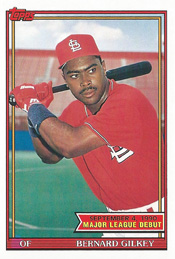
As a Cardinals rookie who had been in the major leagues for less than a month, Bernard Gilkey prevented perfection by delivering a nearly flawless performance of his own against the Phillies.

bernard_gilkey2On Sept. 25, 1990, at Philadelphia, Gilkey led the Cardinals to an unlikely 1-0 triumph.

Playing on the day after his 24th birthday, Gilkey tripled to lead off the first inning and doubled with two outs in the ninth. In between those two hits, Phillies starter Terry Mulholland retired 26 Cardinals in a row.

“That was as close to being perfect as anyone can be without being perfect,” Phillies manager Nick Leyva said to Calkins Newspapers.

Said Cardinals manager Joe Torre to the St. Louis Post-Dispatch: “You can’t pitch any better than that.”

Game of inches

Gilkey, a St. Louis native, had made his big-league debut with the Cardinals on Sept. 4, 1990, in his hometown against the Mets. With Class AAA Louisville in 1990, Gilkey had hit .295 with 147 hits in 132 games and 45 stolen bases.

He struggled early after his call-up to the Cardinals, hitting .212 entering the game against Mulholland and the Phillies.

Playing left field and batting in the leadoff spot, Gilkey opened the game by drilling a 2-and-2 pitch from Mulholland toward the right side of the second base bag. The second baseman, Randy Ready, dived to his right.

“The second baseman came within a whisker of catching the ball,” Torre told the Post-Dispatch.

The ball eluded Ready, skidding across the artificial turf and into the outfield. Center fielder Sil Campusano had shaded Gilkey to hit toward left field. The ball took a path into the gap between Campusano and right fielder Dale Murphy, rolling to the wall.

Gilkey raced to third with a triple.

“If (Gilkey) hits the ball two inches the other way, Randy Ready probably gets it,” Leyva said to the Philadelphia Daily News.

The next batter, Geronimo Pena, lifted a sacrifice fly to center, scoring Gilkey.

Terrific throw

After stinging the Phillies with his speed and hitting, Gilkey hurt them with his throwing.

In the bottom half of the first, Campusano was on second base when Murphy hit a single to left field. Gilkey fielded the ball and fired a strike to catcher Ray Stephens, whose sweep tag nailed Campusano before he could reach home plate.

“I have a pretty good arm and I charge the ball well,” Gilkey said to the Associated Press. “I figured I had a shot at him.”

Special pitching

Relying on a mix of sliders, sinkers and fastballs, Mulholland retired the Cardinals in order until Gilkey hit a double to right-center with two outs in the ninth.

“We only hit two balls hard,” said Torre.

The Phillies, though, couldn’t produce a run off starter Joe Magrane and relievers Mike Perez and Ken Dayley.

Magrane scattered eight hits over seven innings before he tired.

“Mulholland was cruising along so easily I didn’t have a chance to even get a drink of water,” Magrane said to the Post-Dispatch.

Perez and Dayley each worked an inning and each yielded a hit.

The Phillies had 10 hits and two walks, but stranded 11 base runners.

Several Phillies said Mulholland pitched better that night against the Cardinals than he had a month earlier, on Aug. 15, 1990, when he had a no-hitter versus the Giants.

“I pitched well enough to lose,” Mulholland said. “Gilkey hit the ball where we didn’t have anybody.”

Said Gilkey: “Mulholland is a real good pitcher. He spots the ball well and is always around the plate. I know I have to be ready, so I’m up there to hack.” Boxscore

Previously: How Bernard Gilkey spoiled Frank Castillo’s big moment

Read Full Post »

With complete-game wins in his first three big-league starts, Larry Jaster transformed from a perceived disappointment to a promising starter for the Cardinals.

larry_jaster2In September 1965, Jaster was called up to the Cardinals from Class AA Tulsa. The defending World Series champions were out of pennant contention and assessing how to reshape the roster for 1966.

Jaster, a left-hander, impressed the Cardinals and their opponents by showing command of his pitches, stamina, adaptability and the know-how to win.

Jaster, 21, had progressed significantly from spring training, when the Cardinals questioned his commitment to becoming a complete pitcher.

Bonus baby

In 1962, Jaster was a high school senior in Midland, Mich., with a reputation as a talented baseball pitcher and football quarterback. The Tigers were keen on signing him to a professional baseball contract. Duffy Daugherty, football coach at Michigan State, wanted Jaster for his program.

The Cardinals, on the recommendation of scout Mo Mozzali, made the best financial offer: a $50,000 signing bonus. Jaster accepted.

Jaster was underwhelming in his first three seasons in the Cardinals’ system, though he did reach the Class AAA level with Jacksonville in 1964.

At spring training in 1965, Jaster arrived 10 pounds overweight and didn’t pitch effectively enough. When the Cardinals reassigned him to the minor-league camp, Jaster was told by farm director Chief Bender to report to Class AA Tulsa rather than Class AAA Jacksonville.

Jaster objected angrily. “We really had it out,” Bender said to The Sporting News.

According to Bender, the argument included this exchange:

Jaster: “I might as well quit. Give me my release.”

Bender: “Give us back that big bonus and you can have your release.”

After conferring with his wife, Jaster reported to Tulsa. He started poorly, though, and his future with the Cardinals appeared shaky.

Career changer

Desperate to reverse his career spiral, Jaster accepted the guidance of Tulsa manager Vern Rapp and pitching coach Billy Muffett.

“I was told to concentrate on getting the off-speed pitches over the plate and I even surprised myself,” said Jaster, who developed consistent command of a curve and change-up.

When Bender visited Jaster at Tulsa in June 1965, “Larry admitted to me then that being sent to Tulsa was the best thing that ever happened to him,” the farm director said.

Jaster struck out 219 in 210 innings with Tulsa, earning 11 wins and posting a 3.09 ERA. That got him a September look from the Cardinals.

September sensation

On Sept. 17, 1965, Jaster made his big-league debut, pitching an inning of shutout relief for the Cardinals against the Dodgers at St. Louis. Boxscore

Five days later, on Sept. 22, manager Red Schoendienst started Jaster against the Astros in the Cardinals’ 1965 home finale. Jaster responded by pitching a complete-game four-hitter for his first big-league win in a 4-1 Cardinals victory. Boxscore

The Cardinals then embarked on a season-ending road trip to Los Angeles, San Francisco and Houston.

Pennant pressure

Jaster’s next start came on Sept. 28 against the Giants at Candlestick Park. The Giants and Dodgers entered the day tied for first place in the National League at 92-64, with six games remaining.

Admitting he was nervous to be starting a game with pennant implications, Jaster struck out the first two batters he faced, Jim Davenport and Willie McCovey, and that “helped my confidence,” he told the Associated Press.

Though he wasn’t as sharp as he was in his first start _ Jaster told the Oakland Tribune he was having trouble that night with his curve and change-up _ the rookie frustrated the Giants.

Jaster yielded 10 hits and walked two, but the Giants stranded 11 and the Cardinals prevailed, 9-1, on a complete-game win from the left-hander. Jaster also contributed a two-run single off reliever Dick Estelle, scoring Julian Javier and Tim McCarver.

Praise from Mays

The Giants’ run came on a home run by Willie Mays, his 51st of the season. It was a 410-foot blast to straightaway center field. It barely eluded a leaping Curt Flood, who got a hand on the ball as it sailed over the fence.

Jaster described the pitch hit by Mays as “a high fastball that I got too far over the plate.”

In the ninth, the Giants had two runners on base with two outs and Mays at the plate. Jaster retired Mays on a pop out to third baseman Ken Boyer.

“He’s going to be a good pitcher,” Mays said of Jaster. “He throws strikes and isn’t afraid to get the ball over.”

Said McCarver: “Larry wasn’t hitting the spots like he will, but that good, sneaky fastball was right where he wanted it.” Boxscore

The loss dropped the Giants a game behind the Dodgers, who beat the Reds, 2-1, in 12 innings that day. The Dodgers went on to clinch the pennant, finishing two games ahead of the Giants.

Good command

In his final start, on Oct. 2, in the Cardinals’ penultimate game of 1965, Jaster pitched a complete-game seven-hitter versus the Astros in a 6-3 St. Louis triumph. Houston led, 3-0, after three, but Jaster shut out the Astros over the final six innings. Boxscore

“I used to be a thrower,” said Jaster. “Now I can get the ball where I want it.”

Said Schoendienst: “He’s not overpowering, but he has a pretty good fastball and curve. Most important, he throws strikes. Any time you throw strikes, you have a chance.”

Jaster finished 3-0 with a 1.61 ERA for the 1965 Cardinals.

With the 1966 Cardinals, Jaster had his best season, posting an 11-5 record and 3.26 ERA, including five shutouts against the NL champion Dodgers.

In four years with the Cardinals, Jaster was 32-25 with a 3.17 ERA. He departed the Cardinals when chosen by the Expos in the expansion draft after the 1968 season.

Previously: Hot starts by Kyle Lohse remind Cards of Larry Jaster


Read Full Post »

(Updated Dec. 7, 2024)

Randy Flores was the winning pitcher in a Cardinals pennant clincher.

randy_floresOn Oct. 19, 2006, Flores pitched a flawless eighth inning, setting the stage for Yadier Molina and Adam Wainwright to lift the Cardinals to a 3-1 win in Game 7 of the National League Championship Series versus the Mets at New York.

Nine years later, Flores, who earned an undergraduate degree in finance and a master’s degree in administration from the University of Southern California, played another prominent role for the Cardinals when he was chosen by general manager John Mozeliak to be scouting director, starting the job on Sept. 1, 2015.

Trusted by Tony

The winner-take-all game to determine the 2006 National League championship was as intense as a New York subway ride at rush hour. In the eighth inning, with the score tied at 1-1 and most of the 56,357 spectators howling for the Mets to take the lead, Cardinals starter Jeff Suppan walked leadoff batter Carlos Beltran.

Next up was Carlos Delgado, a left-handed slugger who’d been walked three times in the game by Suppan.

Cardinals manager Tony La Russa replaced Suppan with Flores, a left-hander.

Delgado had hit three home runs against the Cardinals in the series.

Flores struck him out on a slider in the dirt.

Rough vs. righties

Another power hitter, David Wright, was up next. A right-handed batter, Wright had driven in the Mets’ run in the first with one of their two hits in the game against Suppan.

The matchup with Flores favored Wright. Right-handed batters hit .329 versus Flores during the season.

La Russa could have brought in a right-hander to face Wright, but he didn’t because Shawn Green, a left-handed batter, was on deck. Rookie Tyler Johnson was the lone remaining left-hander in the bullpen.

Preferring to stick with his veteran, La Russa gambled and let Flores face Wright.

Flores struck him out on a slider.

Complete the job

Beltran, who had 18 stolen bases during the season and one during the series, hadn’t budged off first base.

Like Delgado and Wright, Green had the proven ability to drive in Beltran with an extra-base hit. Acquired by the Mets from the Diamondbacks in August, Green had produced 31 doubles and 15 home runs during the season.

Flores got Green to ground out to first baseman Albert Pujols, ending the inning and emboldening the Cardinals with his shutdown performance.

In the ninth, Yadier Molina slammed a two-run home run off reliever Aaron Heilman _ “I was running, but I couldn’t feel my feet,” Molina told Sports Illustrated of his trek around the bases _ that gave the Cardinals a 3-1 lead and positioned Flores for the win.

Facing Adam Wainwright in the bottom of the ninth, the Mets loaded the bases with two outs before the rookie struck out Beltran on three pitches, the final one a jaw-dropping curve. Boxscore and Video at about 30-second mark

(Recalling that curve to Beltran, Wainwright said in an interview with the 2016 Cardinals Yearbook, “Before making that pitch, I said to myself that I was going to throw a backdoor breaking ball strike that painted the outside corner … When (the umpire) called it strike three, it was like, ‘Oh my gosh! It worked.’ Exactly what I wanted to happen had happened, and it was sheer elation and surprise.”)

Said Flores to the St. Louis Post-Dispatch about earning the win: “The best moment possible, winning Game 7 of the NLCS _ unless you’re talking about Game 7 of the World Series.”

The win was the personal highlight of an outstanding 2006 postseason for Flores. Overall, he pitched 5.2 scoreless innings against the Padres, Mets and Tigers.

Signed by the Cardinals as a free agent in November 2003 after spending the season in the Rockies minor-league system, Flores played five years (2004-08) with St. Louis and was 9-2 with a 4.35 ERA and three saves in 237 appearances.


Read Full Post »

In a span of three days, Bob Gibson experienced the emotional swing of being honored for his Cardinals achievements before ending his career on a downturn. bob_gibson20

The Cardinals designated Sept. 1, 1975, as Bob Gibson Day. Gibson, 39, was feted in an hour-long ceremony before the Cubs played the Cardinals in front of 48,435 spectators on a Labor Day afternoon at St. Louis.

Two days later, Sept. 3, Gibson yielded a grand slam and took the loss in his final Cardinals appearance.

Nervous ace

Before reporting to spring training, Gibson had said 1975 would be his last year as a player. He began the season in the starting rotation but was shifted to the bullpen during the summer.

The Gibson Day event was an opportunity to salute the Cardinals’ all-time best pitcher. Gibson was the ace on 1960s Cardinals clubs that won three National League pennants and two World Series titles. He is the franchise’s career leader in wins (251), shutouts (56), strikeouts (3,117), complete games (255), innings pitched (3,884.1) and games started (482).

In a ceremony at home plate, the Cardinals declared Gibson’s uniform No. 45 would join the No. 6 of Stan Musial and the No. 17 of Dizzy Dean as the only numbers retired by the franchise. Club owner Gussie Busch presented Gibson with a $32,250 luxury motor home.

Gibson told onlookers, including former teammates Musial and Bill White, “I’m more nervous than I was before a World Series game.”

Then it was Gibson’s turn to address the crowd.

In the book “Gibson’s Last Stand,” author Doug Feldmann wrote, “At first, Gibson was too moved to speak when he approached the microphone down on the field. Several times he stepped toward it again, but had to pause with every attempt, as each standing ovation was louder than the one a moment earlier.”

When he was ready, Gibson told the crowd, “One thing that I’ve always been proud of is the fact that I’ve never intentionally cheated anyone out of what they paid their money to come and see. Most of all, I’m proud of the fact that whatever I did, I did it my way.”

Reflecting on his future as a retired player, Gibson said, “It’s going to be a new life, a strange life for me. I just hope I can be half as successful as I have been in baseball.”

To cap the festivities, Busch got behind the wheel of the motor home and drove Gibson, his mother and his two daughters around the perimeter of the field as the stadium organist played “Auld Lang Syne.” Said Busch to Gibson: “I bet you never had a chauffeur like this before.”

Inspired, the Cardinals went out and beat the Cubs, 6-3, behind Lou Brock (three hits, three steals, two runs) and the pitching of Bob Forsch and Al Hrabosky. The victory moved the second-place Cardinals to within three games of the Pirates in the NL East Division. Boxscore

Tough to take

On Sept. 3, in the finale of the series, the Cubs led, 6-1, before the Cardinals rallied for five runs in the sixth, tying the score at 6-6.

Sensing an opportunity to give his fading star another shot at glory, Cardinals manager Red Schoendienst called on Gibson to relieve starter Ron Reed and hold the Cubs in the seventh.

The move backfired.

The Cubs loaded the bases on a Champ Summers infield single and walks to Jose Cardenal and Andre Thornton. With two outs, Gibson uncorked a wild pitch and Gene Hiser, running for Summers, raced home from third, giving the Cubs a 7-6 lead. Gibson issued an intentional walk to Jerry Morales, reloading the bases.

Pete LaCock, a pinch-hitter, batted next. LaCock, who had lost the starting first base job to Thornton, was best-known as the son of game-show host Peter Marshall of “Hollywood Squares.”

With the count 3-and-2, LaCock stunned Gibson by drilling a fastball over the right-field wall for a home run _ the lone grand slam of his big-league career.

Dejected, Gibson retired the next batter, Don Kessinger, on a groundout and walked off the mound for the final time. Boxscore

“I had reached my absolute limit in humiliation,” Gibson said in his book “Stranger to the Game.” “I said to myself, ‘That’s it. I’m out of here.’ ”

Gibson remained idle while the Cardinals fell out of contention.

On Sept. 15, two weeks after his special day, Gibson said goodbye to his teammates and headed home with 10 games remaining in the season, knowing he’d never pitch again.

Previously: Bob Gibson and his final Opening Day with Cardinals

Previously: How Ron Reed replaced Bob Gibson in Cards rotation

Previously: How Bob Gibson achieved career win No. 250

Read Full Post »

(Updated April 6, 2026)

Five facts that may surprise you about Cardinals center fielder Curt Flood:

curt_flood7No. 1: Cardinals foe

Flood made his major-league debut against the Cardinals.

On Sept. 9, 1956, at St. Louis, Flood, 18, was a pinch-runner for Smoky Burgess, the stocky Reds catcher who hit a double in the eighth inning off Cardinals starter Murry Dickson.

Flood was stranded when Bob Thurman popped out to third, ending the inning. Boxscore

As a September call-up, Flood played in five games for the 1956 Reds and three for the 1957 Reds. The Cardinals were the foe in three of those eight games.

Flood and outfielder Joe Taylor were traded by the Reds to the Cardinals for pitchers Willard Schmidt, Ted Wieand and Marty Kutyna on Dec. 5, 1957.

It was the first trade made by Cardinals general manager Bing Devine and it was one of his best. Devine credited Cardinals manager Fred Hutchinson with encouraging him to make the deal.

In his book “October 1964,” author David Halberstam wrote, “Devine was uneasy because it was his first deal and because he had not only never seen (Flood) but he had no sense of him either. But (Hutchinson) seemed confident of Flood’s ability and Devine had a good deal of faith in Hutchinson’s ability to judge talent.”

No. 2: Cardinals infielder

Flood, who won seven consecutive Gold Glove awards as a Cardinals center fielder from 1963-69, played two games at third base and one at second for St. Louis.

In all three instances, Flood shifted from the outfield to the infield late in games. The breakdown:

_ On July 6, 1958, Flood started in center field against the Giants at San Francisco. In the ninth, Ken Boyer moved from third base to shortstop and Flood replaced Boyer at third. Flood didn’t field any chances in the inning. Boxscore

_ On May 10, 1959, at St. Louis against the Cubs, Flood moved from center field to second base in the 10th, replacing Don Blasingame, who had been lifted for a pinch-runner the previous inning. Flood played two innings at second base and didn’t field any chances. Boxscore

_ On June 21, 1960, Flood started in center field versus the Pirates at Pittsburgh. In the eighth, Boyer was ejected and Flood replaced him at third base. Flood had one ball hit to him at third _ by Burgess, then with the Pirates _ and fielded it cleanly. Boxscore

In the book “Redbirds Revisited,” Flood said to authors David Craft and Tom Owens, “There was a time when I was with Cincinnati … when they were hoping to teach me to play the infield (but) I had trouble making the double play, trouble throwing toward shortstop.”

No. 3: Tough and durable

At 5 feet 9 and 165 pounds, Flood was an iron man. He played in 150 or more games in a season seven times.

Flood ranks eighth all-time in games played (1,738) as a Cardinal. Just ahead of him is Red Schoendienst (1,795).

No. 4: Hit man

Flood ranks 10th all-time in most hits (1,853) by a Cardinal, just two behind Ken Boyer (1,855).

No. 5: Hitting the best

Flood often was at his best when facing the best.

Here are his career batting marks against some Hall of Fame pitchers:

_ .394 (13-for-33) vs. Don Sutton.

_ .326 (29-for-89) with a home run vs. Warren Spahn.

_ .319 (44-for-138) with two home runs vs. Don Drysdale.

_ .296 (32-for-108) with two home runs vs. Sandy Koufax.

_ .286 (34-for-119) with four home runs vs. Juan Marichal.

_ .286 (14-for-49) with two home runs vs. Ferguson Jenkins.

On May 3, 1968, at San Francisco, before a crowd that included his mother and other relatives, Flood hit two home runs in a game against Marichal. Flood hit a solo home run in the first and a two-run shot in the fifth “Curt hit a good pitch (fastball) the first time, but I hung a slider on the second home run,” Marichal told the St. Louis Post-Dispatch. Boxscore

Postscript

Flood was an integral member of a Cardinals franchise that won two World Series championships and three National League pennants in the 1960s.

In 12 seasons with the Cardinals, Flood was a three-time all-star who hit .293 with 1,853 hits in 1,738 games, including two consecutive seasons (1963-64) with 200 or more hits. When the Cardinals traded him to the Phillies after the 1969 season, Flood refused to report and challenged baseball’s reserve clause, paving the way for free agency.


Read Full Post »

(Updated Dec. 21, 2024)

Having already worked one grand slam miracle as an Angel, David Eckstein performed another for the Cardinals.

david_eckstein2On Aug. 7, 2005, Eckstein hit a walkoff grand slam in the bottom of the ninth inning against Chris Reitsma, lifting the Cardinals to a 5-3 victory over the Braves.

“Every once in a while, you get a miracle like this,” Cardinals manager Tony La Russa told the St. Louis Post-Dispatch.

Eckstein, 5-foot-6 and slightly built, appeared better suited for singles than slugging.

However, the feat wasn’t a first for Eckstein. Three years earlier, on April 28, 2002, Eckstein hit a walkoff grand slam for the Angels against Pedro Borbon of the Blue Jays. It was one of three grand slams Eckstein hit for the Angels that season.

Eckstein’s grand slam for the Cardinals against the Braves was the fourth and last of his big-league career.

Subs deliver

The Braves scored a run in the top of the ninth against Jason Isringhausen, extending their lead from 2-1 to 3-1.

Reitsma, a right-hander who had yielded one run over his last 11 appearances and had converted nine consecutive save opportunities, was the choice of Braves manager Bobby Cox to pitch the bottom of the ninth.

Each of the first three Cardinals batters _ Abraham Nunez, So Taguchi and Hector Luna _ singled with two strikes, loading the bases with none out.

Nunez, subbing for injured Scott Rolen, hit a groundball single to center and Taguchi, subbing for injured Larry Walker, followed with a low liner up the middle.

Luna, pinch-hitting for catcher Mike Mahoney, who was subbing for injured Yadier Molina, slapped a grounder that deflected off Reitsma’s glove toward second baseman Marcus Giles. As Taguchi dashed in front of him, Giles tried to scoop the ball and swipe Taguchi with a tag, but he couldn’t get a handle on the ball and all the runners were safe on what was ruled an infield hit.

“If I let that go, maybe we turn two,” Reitsma said to the Associated Press. “You just react in that situation and it hit the top of my glove.”

Said Cox: “We butchered a double-play ball. You tell your pitchers not to touch a ball like that because it’s a routine double play.”

With the bases loaded and none out, La Russa called for Scott Seabol to bat for pitcher Ray King. Seabol, who hadn’t produced a hit for the Cardinals since June 21, popped out to third baseman Wilson Betemit.

Mighty mite

Next up was Eckstein, who had hit four home runs on the season and 21 since entering the major leagues in 2001.

After taking the first pitch from Reitsma for a ball, Eckstein swung at the next and drove the ball over the left-field fence and into the seats. Video

“I was trying to go down and away with a sinker for a double play,” Reitsma told the Atlanta Journal-Constitution. “I just left it down the middle.”

Said Eckstein of his home run swing: “That’s probably all I’ve got right there.” Boxscore

After being mobbed by his teammates at the plate, Eckstein doffed his helmet to the crowd of 47,714 who had turned out on what the Cardinals promoted as Transplant Awareness Day. Eckstein’s father was scheduled to become the fourth family member to receive a kidney transplant.

Walkoff winners

The seven previous walkoff grand slams hit by Cardinals:

_ Pepper Martin hit a grand slam off George Jeffcoat of the Dodgers, breaking a 7-7 tie in the ninth inning and giving the Cardinals an 11-7 victory on July 14, 1936, at St. Louis. Boxscore

_ Joe Cunningham hit a grand slam off Ruben Gomez of the Giants, breaking a 3-3 tie in the ninth and giving the Cardinals a 7-3 victory on July 30, 1957, at St. Louis. Boxscore

_ Carl Taylor hit a grand slam off Ron Herbel of the Padres, erasing a 10-7 San Diego lead in the ninth and giving the Cardinals an 11-10 victory on Aug. 11, 1970, at St. Louis. Boxscore

_ Joe Hague hit a grand slam off Mike Marshall of the Expos, breaking a 6-6 tie in the 10th and giving the Cardinals a 10-6 victory on Sept. 24, 1971, at St. Louis. Boxscore

_ Roger Freed hit a grand slam off Joe Sambito of the Astros, erasing a 6-3 Houston lead in the 11th and giving the Cardinals a 7-6 victory on May 1, 1979, at St. Louis. Boxscore

_ Darrell Porter hit a grand slam off Bob Lacey of the Giants, breaking a 4-4 tie in the 11th and giving the Cardinals an 8-4 victory on July 18, 1984, at St. Louis. Boxscore

_ Tommy Herr hit a grand slam off Jesse Orosco of the Mets, breaking an 8-8 tie in the 10th and giving the Cardinals a 12-8 victory on April 18, 1987, at St. Louis. Boxscore

Since Eckstein’s walkoff grand slam, five other Cardinals achieved the feat:

_ Gary Bennett hit a grand slam off Bob Howry of the Cubs, breaking a 6-6 tie in the ninth and giving the Cardinals a 10-6 victory on Aug. 27, 2006, at St. Louis. Boxscore

_ Aaron Miles hit a grand slam off Bryan Corey of the Padres, breaking a 5-5 tie in the ninth and giving the Cardinals a 9-5 victory on July 20, 2008, at St. Louis. Boxscore

_ Matt Carpenter hit a grand slam against J.P. Howell of the Blue Jays, breaking a 4-4 tie in the 11th and giving the Cardinals an 8-4 victory in the first game of a doubleheader on April 27, 2017, at St. Louis. Boxscore

_ Paul Goldschmidt hit a grand slam against Ryan Borucki with two outs in the 10th for a 7-3 Cardinals victory over the Blue Jays on May 23, 2022, at St. Louis. Boxscore

_ Nolan Arenado hit a curve from Trevor Megill of the Brewers for a grand slam with one out in the 10th inning for a 10-6 Cardinals triumph at St. Louis. Boxscore

Read Full Post »

« Newer Posts - Older Posts »