Feeds:
Posts
Comments

Archive for the ‘Opponents’ Category

(Updated Jan. 8, 2025)

In an unusual play that involved a Penguin, a Bull and Vince Coleman establishing a major-league rookie record, the Cardinals stole four bases on one pitch in a game against their archrivals, the Cubs.

vince_coleman2On Aug. 1, 1985, at Wrigley Field in Chicago, Cardinals speedsters Coleman and Willie McGee turned a double-steal attempt into a successful quadruple steal.

In the first inning, Coleman was on second base and McGee on first with none out and Tommy Herr at-bat, facing Scott Sanderson.

Coleman entered the game with 72 steals, tying him with Juan Samuel of the 1984 Phillies for the big-league single-season record for a rookie.

Dead duck

On a pitch to Herr, Coleman and McGee took off for third and second. Catcher Jody Davis threw to third baseman Ron “Penguin” Cey in an attempt to nab Coleman.

Coleman slid across the bag, “way deep in foul territory, almost in back of the coach’s box,” Cubs manager Jim Frey told the Arlington Heights (Ill.) Daily Herald.

Slow to react, Cey didn’t rush to tag Coleman. “He would have been a dead duck had there not been a brain-dead Penguin on the scene,” wrote Mike Lucas, covering the game for the Madison (Wis.) Capital Times.

Seeking an escape route, Coleman got up and scampered down the third-base line, with Cey in pursuit.

“When Ron went after him … (Coleman) ran out of the base line,” Frey said.

Knowing he had no chance to catch Coleman, Cey tossed the ball to Davis. Coleman applied the brakes and headed back toward Cey. Davis ran toward Coleman, then lobbed the ball to Cey.

No one at home

When Coleman looked back, he saw Davis near him and no Cubs player protecting the plate. Sanderson had gone over to cover third. First baseman Leon “Bull” Durham, the former Cardinal, should have covered the plate but instead stood frozen along the first-base line, watching the rundown.

Coleman whirled around, slipped past Davis and sped toward the plate. Cey, clutching the ball, gave chase.

Wrote Lucas, “Cey’s only option was to chase down Coleman from behind (but) he couldn’t chase down (actor) Gary Coleman, let alone Vince Coleman.”

Coleman crossed the dish and McGee dashed uncontested from second base to third. The official scorer credited each with two stolen bases on the play.

Wrote Rick Hummel for The Sporting News, “One pitch, four stolen bases _ sounds something like (Hall of Famer) Cool Papa Bell flicking off a light switch and jumping in bed before it was dark.”

Said Coleman to the Associated Press, “I’ve never seen a play like that before. I couldn’t get back to third, so my reaction was to go to the next base.”

Record setter

In so doing, Coleman had 74 steals for the season, breaking the rookie record.

“Just another day’s work, but I am honored about the record,” Coleman said. “I’m looking for more records. No goals. I just let my ability dictate my future.” Boxscore

Coleman achieved 110 stolen bases in 1985 and was named winner of the NL Rookie of the Year Award. He also topped more than 100 steals in 1986 (107) and 1987 (109) and led the NL in stolen bases for six consecutive years (1985-90) with the Cardinals.

“If you played against me, you hated me, because I’m bringing it to the table every day,” Coleman told Jerry Crasnick for Memories and Dreams magazine. “It was like trying to guard Michael Jordan one-on-one. You could only try to contain him, and you could only try to contain me. You can’t stop me, because it’s me against you, and there’s nothing you can do once you let that ball go.”

McGee contributed a career-high 56 steals in 1985 and was selected winner of the NL Most Valuable Player Award, batting a league-high .353 with 216 hits.

In an article for the 1985 World Series program, Cardinals manager Whitey Herzog said to Rick Hummel, “The whole key to what Willie hits is how many strikes he swings at. Ever since he came to the big leagues, the question is would he ever stop swinging at bad balls.”

The 1985 Cardinals had 314 steals. No other team in the major leagues that season had more than 182.

Read Full Post »

(Updated Nov. 28, 2024)

A playful blonde in a flaming red dress gave an unexpected mix of sex appeal and comedy to the first regular-season night game played by the Cardinals.

kitty_burkeOn a sultry evening in Cincinnati, July 31, 1935, Kitty Burke, 25, a nightclub entertainer, emerged from an overflow crowd at Crosley Field during a game between the Cardinals and Reds, grabbed a bat and stood at the plate, expecting a delivery from St. Louis pitcher Paul Dean.

Amazingly, with the approval of the plate umpire and with the commissioner of baseball watching from the stands, Dean tossed a soft pitch, Burke swung at it and connected with a groundball to the pitcher.

Satisfied, she departed back into the crowd and the game resumed.

Night baseball

Two months earlier, regular-season night baseball had debuted in the major leagues with a game between the Phillies and Reds at Crosley Field.

The Cardinals, who wouldn’t have lights at their home field, Sportsman’s Park, until 1940, were the defending World Series champions in 1935 with a lineup of colorful Gashouse Gang characters such as Dizzy Dean, Pepper Martin, Joe Medwick, Frankie Frisch and Leo Durocher. That made the Cardinals-Reds night game at Cincinnati a big draw, even on a Wednesday.

(In the book “Voices From Cooperstown,” Stan Musial told author Anthony J. Connor, “I always thought I would’ve enjoyed playing in that Gashouse era, although I didn’t have the same color as a guy like Pepper Martin.”)

Crosley Field in 1935 seated 26,060. Thousands more than that turned out for the Cardinals-Reds game and were admitted. Many were in a partying mood.

Out of control

“A big part of the overflow came into the park shortly before game time on special trains from Dayton, Ohio _ and to say that a good many of these excursionists were feeling their oats is putting it mildly,” The Sporting News reported. “They had been hitting it up on the train and were out for a high time. When they found no seats for themselves at the park, they just leaped the field-box fences and made for the foul lines.”

Fans initially stood along both foul lines and in territory behind the plate. When some fans who were seated in box seats had their view of the playing field obstructed by those standing in foul territory, they left their seats and joined those on the grass. Eventually, the crowd swelled so much that spectators “completely encircled Crosley Field,” the Associated Press reported.

Wrote The Sporting News: “Fans were standing right against the base lines and so close behind the catcher that it was impossible for any player to catch a foul ball.”

Official attendance was listed as 30,000. The Sporting News estimated the crowd at 30,450. Among those in attendance were baseball commissioner Kenesaw Mountain Landis and Reds president Powel Crosley, who stood together for most of the game “because they couldn’t see the field while seated in box seats,” The Sporting News reported.

In the fourth inning, “irate fans stormed the field, holding up the game for 10 minutes” because of mixups in the seating arrangements, according to International News Service.

The Associated Press reported, “Players were forced to shoulder their way through to the plate. The heat _ on Cincinnati’s hottest day of the year _ added to police troubles, a number of fans being ejected from the park for disorderly conduct.”

Sizing up the boozy crowd, third-base umpire Cy Rigler ordered beer sales stopped in the fourth inning.

Kitty takes the stage

From her perch in a field-level seat, Kitty Burke was one of the patrons unable to see the playing field. Described by United Press as “a pretty young blonde wearing a flaming red dress,” Burke attracted attention when she left her seat and joined those standing near the field.

“I had a very good box seat and I figured I was entitled to see the game,” said Burke, “but it seems they oversold the park and about the sixth inning everybody started crowding in front of me … I just joined the crowd, which swarmed down on the field, and found places along the first-base line.”

The Cardinals had taken a 2-1 lead, with one of the runs being scored by Medwick. According to Burke, “The St. Louis players had been crowded out of their dugout by the mob and we were lined up behind them on the field.”

In the eighth inning, Burke found herself within shouting distance of Medwick and the two exchanged good-natured taunts.

Burke: “Medwick, you can’t hit anything.”

Medwick: “You can’t hit anything yourself.”

Burke: “I’d like to show you sometime.”

Medwick: “You can’t hit anything with an elephant.”

(Said Burke to United Press: “I think what he meant was you can’t hit an elephant.”)

Burke: “I’ll show you.”

Babe helps a babe

Burke looked toward the plate and saw a Reds player, Babe Herman.

Said Burke to United Press: “I yelled, ‘Hey, Babe, lend me your bat.’ ”

Herman said, “OK, Sis,” and handed the bat to the lady in red.

“Babe always is accommodating to his public,” The Sporting News slyly noted.

Said Burke: “So I took the bat up to the plate and made up my mind I was going to sock one if I had to stay there all night. (Dean) was on the mound when I came up, but was looking toward the outfield. You should have seen the dumb expression on his face when he turned around and saw me. He didn’t know what to do.”

The plate umpire, Bill Stewart, did nothing to stop Burke.

“The umpire was a good egg and yelled. ‘Play ball!’ ” Burke said.

Said The Sporting News: “How Stewart let her get away with it is beyond explanation. She would have had no chance pulling that on Bill Klem or some of the other umpires.”

Dean plays along

Dean, younger brother of Dizzy, was nicknamed Daffy. Burke yelled to him, “Hey, you hick, why don’t you go home and milk the cows?”

Said Burke: “That must have got him, because he started winding up to burn one in. I asked myself, ‘Should I get out of here?’ but just then Pepper Martin yells, ‘Take it easy, Daf.’ So, Daffy just grinned and lobbed one across.”

Dean made an underhanded toss.

Burke swung and hit a grounder to Dean.

Said Burke: “I smacked it … but Daffy was on first with the ball, waiting for me.”

Burke took a few steps up the line, then veered back toward the crowd.

“I saw that he had me beaten, so I stopped,” Burke said.

Before she departed, though, she gave a parting shot to Medwick.

“I said to Medwick, ‘I hit that one, didn’t I, big boy?” He was a good sport and said, ‘Yes.’ ”

When play resumed, the Reds scored two in the eighth to take the lead, the Cardinals rallied to tie the score, 3-3, in the ninth and the Reds rewarded their fans with a run in the 10th for a 4-3 victory. Boxscore

Previously: Why 1940 was year Cardinals saw the light

Read Full Post »

In 1975, the Cardinals established a major-league record for most intentional walks issued by one team in a nine-inning game.

john_montefuscoCardinals pitchers Lynn McGlothen and Mike Garman combined to give six intentional walks to the Giants on July 19, 1975, at San Francisco. Three of those passes were given to the No. 8 batter, catcher Dave Rader.

The strategy by Cardinals manager Red Schoendienst was driven not by fear of Rader but by the hitting funk experienced by the Giants’ No. 9 batter, rookie pitcher John Montefusco.

Though the moves worked successfully for St. Louis in all but one instance, the Giants beat the Cardinals, 5-2.

Prime pitching pairing

Montefusco and McGlothen, both 25-year-old right-handers, were developing into staff aces.

Montefusco, nicknamed “The Count,” would win the 1975 National League Rookie of the Year Award, with a 15-9 record and 2.88 ERA. He also would finish second in the NL that season to the Mets’ Tom Seaver in strikeouts _ Seaver had 243 and Montefusco, 215 _ and first in the league in strikeouts per nine innings (7.9).

McGlothen, in his second St. Louis season after being acquired from the Red Sox, would tie Bob Forsch for the team lead in wins in 1975, with 15. He also would lead the 1975 Cardinals in complete games (nine), innings pitched (239) and strikeouts (146).

Avoiding Rader

On a Saturday afternoon before 7,136 at Candlestick Park, the Giants struck first when Bobby Murcer hit a two-run homer versus McGlothen in the opening inning.

In the second, the Giants threatened again, with Chris Speier on third and one out. Rader was at the plate, with Montefusco in the on-deck circle. The Cardinals, aware Montefusco had one hit in 36 at-bats, played the percentages and walked Rader intentionally. McGlothen struck out Montefusco and got Von Joshua to ground out.

In the third, with the Giants ahead, 4-2, the Cardinals used the same strategy. With two outs and Giants runners on second and third, Rader was walked intentionally. Montefusco followed with a groundout, ending the inning.

Rader, a left-handed batter who hit .291 in 1975, was walked intentionally by McGlothen for a third consecutive time when he came to the plate in the fifth. With Speier on second and two outs, Rader was given the intentional pass and Montefusco struck out.

Mixing and matching

McGlothen intentionally walked two more batters in the sixth, though neither was Rader. With Derrel Thomas on second and one out, McGlothen gave an intentional pass to Murcer. The next batter, Gary Matthews, flied out to center. Thomas and Murcer each advanced a base on the play. That brought to the plate Willie Montanez, a left-handed batter who had driven in two runs with a third-inning single. McGlothen intentionally walked Montanez, loading the bases with two outs.

McGlothen struck out Speier, escaping the jam.

In the seventh, Garman relieved McGlothen. With one out and no one on base, Garman walked Rader, though this time it was unintentional.

The sixth and final intentional walk occurred in the eighth. With two outs and Thomas on third, Garman intentionally walked Montanez and opted to pitch to Speier. Giants manager Wes Westrum called for a double steal attempt. Thomas stole home, extending the Giants’ lead to 5-2, and Montanez swiped second.

Count in command

Despite a combined 11 walks and 17 hits, the game was completed in 2:03.

Rader had an odd boxscore line: no at-bats, four walks.

Montefusco got the win. He walked two (none intentional) and struck out seven, including Reggie Smith four times, all on fastballs.

At the plate, Montefusco was 0-for-4, dropping his season batting average to .025 (1-for-40). Boxscore

In his next start, July 23 at San Francisco, Montefusco hit a home run against Milt Wilcox of the Cubs. Before the game, Montefusco said, the Cubs had been teasing him near the batting cage.

“That razzing bothered me and I told those guys to look out because I’m going to beat your butts today and I’m going to hit a homer as well,” Montefusco told United Press International.

In 13 seasons in the major leagues, Montefusco hit .097 (44-for-455) overall and .217 (5-for-23) vs. the Cardinals.


Read Full Post »

(Updated July 13, 2020)

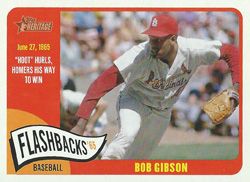
In a display of strength and versatility, Bob Gibson in 1965 pitched 13 innings in a start vs. the Giants on July 7, pitched four innings of relief against the Cubs on July 11 and earned a save with two innings of relief in the July 13 All-Star Game.

bob_gibson15Well aware of Gibson’s workload, the Phillies’ Gene Mauch, National League manager, left it up to the Cardinals’ ace to choose whether to pitch in the All-Star Game at Minnesota.

“He told me before the game that his arm didn’t feel good,” Mauch told the Minneapolis Star-Tribune. “I made it clear that it was his decision whether to pitch or not. During the game, Gibson sent word that he was OK.”

Mauch called on Gibson to protect a 6-5 lead over the final two innings.

“Gibson thinks he can get anybody in the world _ and I do, too,” Mauch told the Associated Press.

Grateful for Gibson’s save, the Dodgers’ Sandy Koufax, who got the All-Star Game win, good-naturedly said to Gibson, “Why don’t you quit starting? There’s a heck of a future in relieving for you.”

NL fireballers

The National League unleashed an array of hard throwers on the American League. Juan Marichal of the Giants started and was followed by the Reds’ Jim Maloney, Dodgers teammates Don Drysdale and Koufax and the Astros’ Turk Farrell before Gibson entered in the eighth. The American League scored all of its runs off Maloney.

Gibson, the Cardinals’ lone all-star representative, retired the first two batters he faced, striking out the Tigers’ Willie Horton and getting the Yankees’ Bobby Richardson on a groundout. After he walked the Twins’ Zoilo Versalles, Bill Freehan of the Tigers followed with a single to center. When the throw from Willie Mays went to third, Freehan took second, putting two runners in scoring position for the next batter, the Twins’ Jimmie Hall.

A left-handed batter, Hall hit a shot to center. Mays started for the ball, slipped and barely recovered in time to make a leaping, backhanded catch, ending the inning.

In the bottom of the ninth, the Twins’ Tony Oliva led off with a double. Attempting a bunt, the Indians’ Max Alvis offered at Gibson’s first pitch and popped out for the first out.

Gibby vs. Killer

Twins slugger Harmon Killebrew was up next. The crowd at Metropolitan Stadium was abuzz at the prospect of their prodigious home run hitter driving in his Twins teammate Oliva from second with the tying run.

Instead, Killebrew struck out.

“He threw me sliders until the last pitch,” Killebrew told the Star-Tribune. “That was a good, hard fastball.”

To the St. Louis Post-Dispatch, Killebrew said, “For a guy who was supposed to be tired, Gibson threw pretty darn good. The ball just seemed to drop under my bat.”

American League manager Al Lopez sent a left-handed pinch-hitter, the Yankees’ Joe Pepitone, to bat next.

Gibson struck him out, sealing the win. Boxscore and video of Gibson at 13:40 mark

Throwing heat

In describing how he pitched Pepitone, Gibson said, “The first two sliders were up and in. They aren’t going to do a darn thing with it if it goes in there. If it doesn’t get in there, that’s a different story. The last pitch was a fastball. That was in there.”

Asked to describe the strikeout pitch, Pepitone said, “Whoosh. I saw it good, too. He was just a little too quick.”

Nine months earlier, Pepitone went 0-for-4 versus Gibson in Game 7 of the 1964 World Series. After fanning Pepitone in the All-Star Game, Gibson said to the Star-Tribune, “The World Series is a lot more thrilling to pitch in than the All-Star Game because there’s money involved.”

In the clubhouse, National League catcher Joe Torre of the Braves soaked his left hand in warm water to ease the soreness from having so many fastballs slam into his mitt.

“I had some real hummers coming out of the bullpen,” Torre told The Sporting News. “The hand really hurts.”

Said Gibson: “I got to admit he was catching some sizzlers.”

Previously: As all-stars, only two hit Bob Gibson more than once


Read Full Post »

In an exhibition established to assist the United States’ war effort and help compensate for the cancelation of the All-Star Game, the Cardinals were part of a baseball experiment.

luke_sewellOn July 10, 1945, Browns manager Luke Sewell used nine pitchers in an exhibition against the Cardinals at Sportsman’s Park. Sewell wanted to see what would happen if he utilized a different pitcher in each of nine innings.

He increased the intrigue factor by alternating a right-hander and a left-hander each inning.

The result: The Browns shut out the Cardinals on two hits and won, 3-0.

Asked whether he’d consider using a different pitcher an inning in a regular-season game, Sewell told the Associated Press, “I wouldn’t think of it … I don’t think this will ever be more than just a novelty.”

Non-essential game

The All-Star Game was canceled in 1945 under orders from Col. J. Monroe Johnson, chief of the Office of Defense Transportation. With the nation needing resources in World War II, the Office of Defense Transportation had the authority to enforce travel restrictions. It viewed the All-Star Game scheduled for July 10, 1945, at Boston’s Fenway Park to be an unnecessary luxury that would sap travel resources needed for the war effort.

To replace the All-Star Game, Major League Baseball proposed eight interleague exhibition games _ four on July 9 and four on July 10. Proceeds from the exhibitions would be donated to the War Service Relief Fund.

The Office of Defense Transportation approved seven of the exhibitions and rejected a proposed game between the Tigers and Pirates at Pittsburgh because of the distance the Tigers would need to travel from Detroit.

The approved games:

_ New York Yankees vs. New York Giants at the Polo Grounds in New York.

_ Chicago Cubs vs. Chicago White Sox at Comiskey Park in Chicago.

_ Cincinnati Reds vs. Cleveland Indians at Municipal Stadium in Cleveland.

_ Brooklyn Dodgers vs. Washington Senators at Griffith Stadium in Washington.

_ Philadelphia Phillies vs. Philadelphia Athletics at Shibe Park in Philadelphia.

_ Boston Braves vs. Boston Red Sox at Fenway Park in Boston.

_ St. Louis Cardinals vs. St. Louis Browns at Sportsman’s Park in St. Louis.

World Series rematch

The Cardinals-Browns game matched the defending league champions. The Cardinals had defeated the Browns in six games in the 1944 World Series.

A crowd of 24,113 turned out at Sportsman’s Park for the exhibition, producing $36,000 for the War Service Relief Fund.

In order, the nine pitchers who appeared for the Browns:

_ First inning, right-hander Tex Shirley.

_ Second inning, left-hander Sam Zoldak.

_ Third inning, right-hander Pete Appleton.

_ Fourth inning, left-hander Earl Jones.

_ Fifth inning, right-hander George Caster.

_ Sixth inning, left-hander Lefty West.

_ Seventh inning, right-hander Sig Jakucki.

_ Eighth inning, left-hander Al Hollingsworth.

_ Ninth inning, right-hander Bob Muncrief.

The Cardinals’ hits were a double Red Schoendienst against Shirley in the first inning and a single by Ray Sanders versus Zoldak in the second.

Browns outfielder Milt Byrnes hit a solo home run against Cardinals starter Red Barrett in the first.

In the fourth, a triple by Pete Gray, a one-armed outfielder, sparked a two-run inning for the Browns against Al Jurisich.

The seven interleague exhibitions attracted a total attendance of 169,880 and raised $244,778 for the War Service Relief Fund.

Read Full Post »

(Updated July 5, 2019)

During a game at Cincinnati, the managers of the Cardinals and Reds threw punches at one another and wrestled on the ground near home plate. One of them may have taken a bite out of the other.

harry_walkerOn July 5, 1955, a fight between managers Harry Walker of the Cardinals and Birdie Tebbetts of the Reds prompted players to rush onto the field and join in the fisticuffs.

Watching from his seat in the Crosley Field stands was National League president Warren Giles. “I never before heard of two major-league managers starting a fight between their teams by being the first to exchange blows,” Giles said to The Sporting News. “To the best of my knowledge, their fight was unprecedented.”

Action inning

The drama began in the ninth.

With the Reds ahead 3-2, Bill Virdon led off the ninth for the Cardinals and hit a home run against former St. Louis pitcher Gerry Staley, tying the score. After a single and a walk, Bob Stephenson gave the Cardinals a 4-3 lead with a one-out RBI-single off Joe Black.

In the Reds’ half of the inning, another former Cardinals player, Ray Jablonski, delivered a RBI-single against reliever Paul La Palme, tying the score at 4-4.

After Walker made a pair of defensive changes, sending Ken Boyer to replace Solly Hemus at third base and Pete Whisenant to replace Joe Frazier in right field, Cardinals catcher Bill Sarni went to the mound to visit with La Palme. Tebbetts suspected Sarni was trying to buy time for Boyer and Whisenant to loosen their arms.

Tebbetts protested to plate umpire Jocko Conlan, claiming the rules called for the game to resume as soon as the new fielders took their positions.

The argument ended without a resolution.

Sam Mele, batting with one out and runners on first and second, flied out to Whisenant.

Johnny Temple was the next batter, but before he could take a stance, Sarni again visited the mound. As he did, Whisenant threw more practice tosses.

Temper tantrums

Tebbetts came out to the plate to complain to Conlan. Walker rushed over to defend his team. The managers began yelling at one another, with Conlan between them.

“We called each other names,” Tebbetts said. “We both seemed to get the idea at once that the only way to settle our argument was with our fists. So we started swinging.”

In The Sporting News, Bob Broeg wrote, “Tebbetts suddenly swung _ and missed _ prompting a return blow that landed.”

Tebbetts, 42, and Walker, 38, grabbed one another, wrestled to the ground and rolled around in the dirt.

Players from both benches emptied onto the field, with several piling onto Walker and Tebbetts. Some squared off in individual battles. Pitchers Art Fowler of the Reds and Larry Jackson of the Cardinals tangled. So did Frazier and Reds outfielder Wally Post.

“Fights were going on all over an area of 50 feet to the right of the plate,” according to the Cincinnati Enquirer, which called it “one of the wildest rhubarbs witnessed at Crosley Field in years.”

Others, such as Stan Musial and Red Schoendienst of the Cardinals and Ted Kluszewski of the Reds, played peacemakers.

Bruised and battered

Walker suffered a bruised forehead and said Tebbetts bit him on the left ear.

“A lot of players must have hit me or kicked me,” said Walker. “At one time, while we were down, I yelled at Birdie, ‘You’re trying to bite me.’ ”

Said Tebbetts: “Someone stomped on my back and someone else kicked me in an ear. I saw another foot coming at me and ducked my head against Harry’s face so close he thought I was trying to bite him. I was just trying to protect my own head.”

Tebbetts suffered a nosebleed and cuts on his lip and neck. “I feel like I have been run over by a steam roller,” Tebbetts said.

Reds rally

Conlan ejected Tebbetts, Walker and Sarni.

As the managers left the field, Walker picked up Tebbetts’ cap from the ground and wore it into the Cardinals’ clubhouse, the St. Louis Post-Dispatch reported.

When played resumed, Temple singled, scoring Chuck Harmon with the run that gave the Reds a 5-4 victory. Boxscore

Giles fined Tebbetts and Walker $100 each.

“Managers have an obligation to preserve or restore order and not, by their actions, to incite disorder,” Giles said.

Said Tebbetts: “I’ve got nothing against Walker. He was just doing his job even if I didn’t agree as to the manner in which he was trying to do it.”

Previously: The story of why Cardinals fired manager Eddie Stanky

Previously: No backing down: Tony La Russa vs. Lloyd McClendon

Previously: Wrangle at Wrigley: Tony La Russa vs. Dusty Baker

Previously: 1980s macho match: Whitey Herzog vs. Roger Craig

Read Full Post »

« Newer Posts - Older Posts »