Feeds:
Posts
Comments

Archive for the ‘Opponents’ Category

(Updated April 22, 2020)

With water filling the dugouts and lapping at the feet of spectators in the box seats, the Cardinals and Reds raced to complete a game at Cincinnati before flooding made conditions unplayable.

crosley_fieldCompleting nine innings in 1:56, the Reds beat the Cardinals, 6-1, on April 22, 1940, at Crosley Field.

The night before, the Ohio River reached the 55-foot stage. Reds officials knew Crosley Field, located near Mill Creek, started flooding when the river got to 57 feet, or five feet above normal flood stage, International News Service reported.

It was expected the river stage would reach 57 feet in late afternoon or early evening on April 22. The Reds moved up the starting time of their game with the Cardinals that afternoon by an hour, from 3 p.m. to 2 p.m.

At game time, however, water stood a foot deep in both dugouts _ even deeper in nearby parking lots _ and a crowd of 5,197 “had to puddle-jump their way into the park,” the Associated Press reported.

Patrons seated in field-level box seats behind third base “pulled their feet higher and higher” as the game progressed and water continued to rise.

“Shortly before game time, there was no water in the front row of the lower tier boxes,” the Cincinnati Enquirer reported, “but before the game was half over the fans in those seats were straddling quite a little pond. Most of them refused to move, although there were plenty of seats right in back of them.”

The players sat on benches in foul territory because the water in the dugouts eventually reached three feet deep, according to the book “Cardinals Journal.”

The game matched starting pitchers Bucky Walters, a 27-game winner in 1939 when he earned the National League Most Valuable Player Award, for the Reds against Bill McGee.

According to the St. Louis Globe-Democrat, “the Cardinals were at low tide” in their performance on the field.

Cincinnati, the defending National League champion, broke a scoreless tie with three runs in the fifth against McGee. The Reds added three more in the seventh off Clyde Shoun.

Walters drove in three runs and pitched eight scoreless innings before the Cardinals struck for a run in the ninth. By then, water was seeping onto the field. Boxscore

“Water backing up from sewers was ready to flow over the wall or the dugouts as the game ended,” the St. Louis Post-Dispatch reported.

The Cardinals were supposed to play the Reds again on April 23 and April 24, but both games were postponed. By then, the Ohio River had reached 58 feet and water covered the Crosley Field outfield. Another foot would put home plate under water.


Read Full Post »

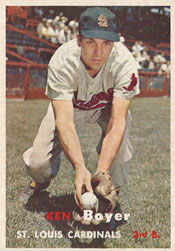
Before he played a game for the Cardinals, Ken Boyer was hyped as their best third baseman all-time. In his debut, he heightened expectations, hitting a home run against a Cardinals nemesis.

ken_boyer9On April 12, 1955, Boyer appeared in his first game in the majors, playing third and batting sixth in the Cardinals’ season opener against the Cubs at Chicago’s Wrigley Field.

In the eighth inning, with two outs, Red Schoendienst on first and the Cubs ahead, 14-2, Boyer slugged a home run off starter Paul Minner. The longball ignited a productive rookie season and a standout Cardinals career.

The Natural

After hitting .319 with 42 doubles, 21 home runs, 116 RBI and 29 stolen bases for the Cardinals’ minor-league Houston affiliate in 1954, Boyer was assured a spot with the 1955 Cardinals. In December 1954, the Cardinals traded their starting third baseman, Ray Jablonski, to the Reds, making Boyer the heir apparent at that position entering spring training.

In an interview with The Sporting News, Art Routzong, Houston’s general manager, said of Boyer, “He is the best prospect I’ve seen in 17 years in baseball.”

In a preview to spring training, St. Louis writer Bob Broeg opined, “If looks didn’t deceive, the Cardinals would have their greatest third baseman ever in Kenton Lloyd Boyer. It does seem possible _ it would be daring to say ‘probable’ _ that the rookie will become the Redbirds’ best at their most vexing position.”

Broeg’s colleague, J. Roy Stockton, added that Boyer “would be the Cardinals’ first complete infielder since Red Schoendienst.”

Solid spring

In spring training, Boyer played well at both third base and shortstop. In a poll of baseball correspondents for The Sporting News, Boyer and Indians pitcher Herb Score were selected the best rookies entering the 1955 season.

Scout Tony Kaufmann compared Boyer with a Hall of Famer, saying the rookie could become “another Pie Traynor.”

“He’s deadly efficient and with no apparent weakness,” Cardinals manager Eddie Stanky said of Boyer.

Wrote Broeg: “He can run fast, throw hard, field well and hit with power.”

Quick adjustment

Boyer’s performance in his debut game affirmed his skills and his ability to adapt.

Minner, a left-hander, often baffled the Cardinals. In a 10-year career with the Dodgers and Cubs, Minner was 21-8 versus St. Louis. He was 48-76 against the rest of the National League. In 1955, when he finished 9-9, Minner was 5-0 against the Cardinals.

In his first big-league at-bat in the season opener, Boyer flied out to right. In his next two at-bats, Boyer struck out against Minner, both times with a pair of runners on base.

In the eighth, Schoendienst singled with two outs. Boyer followed with his home run. Boxscore

(A month later, May 30, 1955, Boyer hit two home runs in a game against Minner, including a two-run, two-out shot in the bottom of the ninth that tied the score.)

Strong season

Boyer had a successful rookie year. He hit .264 with 27 doubles, 18 home runs and 22 stolen bases. Boyer was one of four National League players to achieve double figures in home runs and steals in 1955. The others: Willie Mays of the Giants (51 homers, 24 steals), Sandy Amoros of the Dodgers (10 homers, 10 steals) and Boyer’s teammate, Wally Moon (19 homers, 11 steals).

Among NL third basemen in 1955, Boyer ranked second in double plays turned (24), third in assists (253) and third in fielding percentage (.952).

Yet, Boyer’s teammate, outfielder Bill Virdon, won the 1955 NL Rookie of the Year Award. Virdon hit .281 with 18 doubles and 17 home runs.

As predicted, Boyer developed into the all-time best Cardinals third baseman. In 11 years with St. Louis, he hit .293 with 255 home runs and 1,001 RBI. Boyer also won five Gold Glove awards and the 1964 NL Most Valuable Player Award with the Cardinals.

Previously: 1964 effort supports Ken Boyer Hall of Fame case

Previously: With Ron Santo in Hall, Ken Boyer should be there, too

Previously: Ken Boyer converted from infield to center

Read Full Post »

On a gray, chilly Tuesday afternoon at Chicago’s Wrigley Field, the Cardinals opened their 1991 season with a textbook example of how playing fundamental baseball _ the George Kissell way _ can bring a positive result.

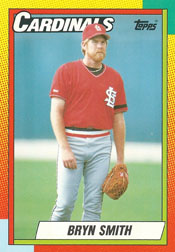
bryn_smithRelying on effective pitching, good base running, plate discipline and timely contact, the Cardinals beat the Cubs, 4-1, on April 9, 1991. Cardinals manager Joe Torre sent the game ball and lineup card to Kissell, the club’s long-time instructor. “Kissell gets this for teaching the Cardinals organization how to play baseball,” Torre told the St. Louis Post-Dispatch.

Smith vs. Jackson

Bryn Smith, 35, a nine-game winner for the 1990 Cardinals, was the starting pitcher for St. Louis in the 1991 opener. Torre selected a batting order of center fielder Rex Hudler, shortstop Ozzie Smith, left fielder Bernard Gilkey, first baseman Pedro Guerrero, right fielder Felix Jose, third baseman Todd Zeile, catcher Tom Pagnozzi, second baseman Jose Oquendo and Bryn Smith.

Cubs manager Don Zimmer chose Danny Jackson as his starting pitcher. Chicago’s lineup featured a pair of future Hall of Famers, second baseman Ryne Sandberg and right fielder Andre Dawson, and standouts such as first baseman Mark Grace, shortstop Shawon Dunston and left fielder George Bell.

Game time temperature was 42 degrees. Rick Hummel of the Post-Dispatch described it as a “numbing, cold, drizzling day.” His colleague, Dan O’Neill, wrote, “The grass was green, but soaking wet and bent by a wintry breeze.”

The Cardinals scored first in the fifth. With the bases loaded and two outs, Gilkey fell behind in the count 0-and-2 before drawing a walk, scoring Pagnozzi from third. The full-count pitch from Jackson to Gilkey “missed inside by a few inches,” according to the Chicago Sun-Times.

Dunston led off the bottom half of the inning with a home run, tying the score at 1-1.

Small ball

In the eighth, the Cardinals struck for three runs, using a walk and three ground balls that never left the infield as their weapons.

Here’s how it happened:

With the bases loaded and one out, Paul Assenmacher relieved Jackson. Oquendo hit a dribbler toward the left side of the infield. “I broke my bat in three pieces,” Oquendo said.

The ball eluded Assenmacher. Dunston raced in from his shortstop position, grabbed the ball and flipped it to second. Pagnozzi beat the toss. Jose streaked home from third on the fielder’s choice play, putting the Cardinals ahead, 2-1, and the bases remained loaded.

“I was panicking,” the slow-footed Pagnozzi said of his sprint from first to second. “I didn’t think I was going to get there.”

Said Oquendo: “He surprised me.”

Bunch of runts

Torre sent Craig Wilson to hit for Bryn Smith. Wilson slapped a grounder toward the mound. Assenmacher reached for it and the ball deflected off his glove toward Dunston, who had no play. Zeile scored from third, putting the Cardinals ahead, 3-1. Wilson was credited with a RBI-single. The bases still were loaded.

“We’ve got the guy (Zeile) at home if I don’t touch it, but the reflex is to go for it,” Assenmacher said.

Said Wilson: “I think he thought it was hit harder than it was.”

Zimmer yanked Assenmacher and replaced him with Les Lancaster. Hudler grounded to Dunston, whose spikes “stuck in the moist dirt,” the Sun-Times reported.

Instead of an inning-ending double play, Dunston settled for a force of Wilson at second, with Pagnozzi scoring from third.

The Cardinals’ bullpen protected the 4-1 lead. Mike Perez pitched a scoreless eighth and Lee Smith earned the save with a scoreless ninth. “I’m glad I’m playing with this bunch of runts,” Lee Smith said of the Cardinals.

Said Bryn Smith: “This was our type of baseball. We’re a patient club and we have to play our game … We feel if we play our caliber of ball you’re going to have to beat us because we won’t beat ourselves.” Boxscore

Previously: Ernie Banks and his greatest hits against Cardinals

Previously: Bob Gibson vs. Billy Williams: a classic duel

Previously: Reds-Cardinals: Easter night to remember

Read Full Post »

Bob Gibson and Steve Carlton appeared together in a regular-season game as Cardinals three times. Two of those games represented milestones for Carlton: his big-league debut and his first major-league save. In all three, Gibson started and Carlton relieved.

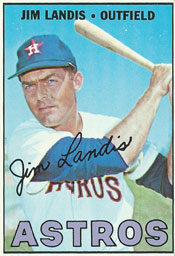
jim_landisThe first time Gibson and Carlton appeared together in a Cardinals regular-season game was April 12, 1965, the season opener for the defending World Series champions against the Cubs at Chicago.

Gibson left after yielding five runs in 3.1 innings.

In the 11th, with the score tied at 10-10, the Cubs had Ron Santo on second with one out and George Altman at the plate. Red Schoendienst, in his regular-season debut as Cardinals manager, lifted Barney Schultz and brought in Carlton to face Altman.

Carlton, 20, making his big-league debut, walked Altman. Schoendienst then brought in Bob Purkey, who got out of the jam without allowing a run.

At that point, the game was called because of darkness, ending in a tie. All the statistics counted. Boxscore

Mopping up

Four months later, on Aug. 25, 1965, Gibson faced the Cubs at St. Louis and gave up six runs in seven innings.

With the Cubs ahead, 6-1, Carlton relieved and pitched two scoreless innings. The Cubs won, 6-3.

Joey Amalfitano, a career .244 hitter, had a single off Gibson and a single off Carlton, becoming the first batter to get hits off both Cardinals in the same regular-season game. Boxscore

Carlton a closer

Entering the 1967 season, Schoendienst told The Sporting News, “We now have men like Dick Hughes, Steve Carlton and Nelson Briles, who can start or relieve. In fact, I’d say only Bob Gibson and Ray Washburn would have to be regarded strictly as starters.”

On April 16, 1967, Gibson faced the Astros at St. Louis. Lou Brock hit a pair of solo home runs off former teammate Mike Cuellar and the Cardinals built leads of 5-0 and 7-3. Gibson, though, wasn’t sharp.

“Gibson admitted he did not have anything today and that he was struggling throughout,” wrote Tom McNamara of the Edwardsville (Ill.) Intelligencer.

The Astros, paced by John Bateman’s two-run home run, scored four in the sixth off Gibson, tying the score at 7-7. The Cardinals regained the lead, 8-7, in the bottom half of the inning on an Orlando Cepeda home run off Carroll Sembera.

After Jim Landis led off the seventh with a double against Gibson, Carlton, making his first appearance of the season, relieved him.

Carlton retired Joe Morgan on a fly out and struck out Jim Wynn and Eddie Mathews, stranding Landis. Like Carlton, Morgan and Mathews were destined for election to the National Baseball Hall of Fame.

The Cardinals scored three off Turk Farrell in the bottom of the seventh, extending their lead to 11-7.

In the eighth, Carlton struck out the first two batters, Bob Aspromonte and Aaron Pointer, giving him four consecutive strikeouts, before Bateman grounded out.

The Astros scored a run in the ninth off Carlton. The key hit in the inning was a Landis double.

Landis, a career .247 hitter, joined Amalfitano as the only batters to get hits off Gibson and Carlton in the same regular-season game.

Carlton earned the save for Gibson in an 11-8 Cardinals victory. Carlton’s line: 3 innings, 1 run, 1 hit, 1 walk, 4 strikeouts. Boxscore

Carlton would earn 329 big-league wins but only two saves. His second came 20 years after his first.

On April 9, 1987, in his first regular-season appearance for the Indians, Carlton, 42, got the save with four shutout innings in relief of Phil Niekro, 48, in a 14-3 Cleveland victory at Toronto. Boxscore


Read Full Post »

(Updated Feb. 8, 2016)

As a rookie, Carlos Villanueva almost kept the 2006 Cardinals from qualifying for the postseason and winning their first World Series title in 24 years.

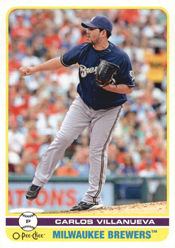
carlos_villanuevaNine years later, Villanueva was competing for the 2015 Cardinals as an effective member of their relief staff.

On Oct. 1, 2006, the Cardinals entered the final day of the regular season needing a win over the Brewers at St. Louis or an Astros loss to the Braves in Atlanta to clinch outright the National League Central Division title. If the Cardinals lost and the Astros won, the Cardinals would need to win a regular-season makeup game against the Giants to clinch the division title and avoid a one-game playoff with the Astros to advance to the National League Division Series against the Padres.

Rookie starters

Cardinals manager Tony La Russa gambled and started rookie Anthony Reyes against the Brewers on three days of rest, choosing to hold back Chris Carpenter in the hope St. Louis would clinch the division crown versus Milwaukee and have their ace available for Game 1 of the NL Division Series.

Brewers manager Ned Yost chose Villanueva as his starter. Villanueva had faced the Cardinals for the first time on Sept. 20 at Milwaukee and pitched seven scoreless innings in a 1-0 Brewers victory. Boxscore

Reyes flopped.

The Brewers scored four in the first on a two-run home run by Prince Fielder, a solo home run by Geoff Jenkins and a RBI-single by David Bell. Reyes was lifted before he could complete the opening inning.

Keep me in, coach

Given a 4-0 lead, Villanueva faced Cardinals leadoff batter Aaron Miles. who “smacked a sharp one-hopper off Villanueva’s pitching hand,” the Milwaukee Journal Sentinel reported.

“It felt bad,” Villanueva said.

Yost went to the mound and asked his right-hander, “How are you doing?”

“Of course, I said, ‘I’m doing great,’ ” Villanueva said.

In truth, the hand throbbed.

Said Yost: “I came close to taking him out. He couldn’t even swing a bat. I kept an eye on him and if I noticed a drop-off in effectiveness I would have taken him out. But I didn’t see it.”

Villanueva baffled the Cardinals. With each inning, their hopes of beating the Brewers dimmed.

Bailout by Braves

Then, in the fifth, a roar erupted from the Busch Stadium crowd as the final from Atlanta was posted: Braves 3, Astros 1. The Braves had prevailed behind six shutout innings from starter John Smoltz and a home run by Jeff Francoeur. Boxscore

The loss by the Astros meant the Cardinals had clinched the division title, regardless of the outcome of their game with the Brewers.

As fans cheered in appreciation, Villanueva stepped off the mound. Derryl Cousins, the home plate umpire, motioned for the game to resume, but Villanueva lingered, letting “the celebration last a few more seconds,” the St. Louis Post-Dispatch reported.

“I wanted to give them their moment,” Villanueva said. “I knew what was going on.”

Drama in ninth

Villanueva shut out the Cardinals through eight innings, extending his scoreless streak against them to 15 innings over two starts.

In the bottom of the ninth, with the Brewers ahead, 5-0, Villanueva got Miles to fly out to right. Then, the Cardinals thundered to life. Chris Duncan launched a 414-foot home run. Albert Pujols followed with a 424-foot shot.

Francisco Cordero relieved and struck out Preston Wilson, but Scott Spiezio followed with a home run, cutting the deficit to two. Cordero then ended the drama _ and the regular season _ by striking out Juan Encarnacion, preserving a 5-3 victory for Villanueva and the Brewers. Boxscore

Unfazed, the Cardinals regrouped and beat the Padres in the NL Division Series, the Mets in the NL Championship Series and the Tigers in the World Series.

Previously: 2006 was critical to Tony La Russa earning Hall of Fame status

Read Full Post »

(Updated Dec. 14, 2015)

Imagine Pete Rose in a Cardinals lineup with Ted Simmons, Keith Hernandez, George Hendrick and Garry Templeton. The Cardinals tried to make it happen.

brock_roseThe catch: Rose likely would have been brought in to replace Lou Brock, relegating the popular Cardinals standout to a reserve role.

In November 1978, Rose left the Reds, his hometown team and the only one for whom he had played since entering the majors in 1963, and became a free agent. Five clubs _ Cardinals, Phillies, Braves, Pirates and Royals _ were finalists in bidding to sign him.

The Cardinals, determined to become contenders after finishing 24 games under .500 in 1978, wanted Rose, 37, to bring his hitting, hustle and hubris to St. Louis.

Rose chose the Phillies, even though the Cardinals and the others made more lucrative offers.

Sorely needed

Before the December 1978 baseball winter meetings began in Orlando, Rose met with Cardinals owner Gussie Busch, general manager John Claiborne and manager Ken Boyer in St. Louis “with the hope the Cardinals might be able to land a man who certainly would fit the type of offensive player so sorely needed by the Redbirds,” The Sporting News reported.

Rose, who started at third base for the 1978 Reds, likely would have played left field for the 1979 Cardinals, joining an outfield of Hendrick in right and Tony Scott in center. Simmons was the St. Louis catcher. The infield for the 1979 Cardinals was Hernandez at first, Ken Oberkfell at second, Templeton at shortstop and Ken Reitz at third.

Brock, the stolen base champion and future Hall of Famer who had sparked the Cardinals to three National League pennants and two World Series titles, had experienced a miserable 1978 season, batting .221 with no home runs and 12 RBI. He would turn 40 in 1979 and there were doubts whether he could be an effective everyday player.

In a 2014 interview with the Web site of Boston radio station WEEI, Rose recalled, “I went to St. Louis to talk with Gussie Busch, who offered me a Budweiser distributorship. I liked that, but he wanted me to replace Lou Brock and I didn’t want to get in that situation.”

(Brock remained the Cardinals’ regular left fielder in 1979 and rebounded strongly, hitting .304 in his final big-league season.)

In the book “The Lords of the Realm,” author John Helyar wrote that Busch talked with Rose about being a Budweiser spokesman and also discussed a distributorship. The meeting occurred at a St. Louis hospital, where Busch was preparing for hernia surgery.

“I probably would have had a hernia, too, if I had to carry all the money he was offering me,” Rose said.

In the Jan. 13, 1979, edition of The Sporting News, Claiborne denied Rose was offered a distributorship from Anheuser-Busch, though he confirmed the Cardinals “had made a very strong pitch for Rose.”

Treated like son

Indeed, Rose said the Phillies’ offer was lower than the bids of the Cardinals, Braves, Pirates and Royals.

“There were five bids and I took the lowest one,” Rose said. “Being conservative, I could have gotten at least another million and a half.

“I wish I could have played a year for each of the other four owners. They treated me like a son. But I had to analyze where I’d be the happiest. And the Phillies’ revised offer was enough that I didn’t have to worry about the money.”

The Phillies initially offered Rose a three-year, $2.1 million contract _ an average of $700,000 per year. When they sweetened the deal to $3.2 million for four years _ an average of $800,000 per year _ Rose accepted. He said his friendship with Phillies players Larry Bowa, Greg Luzinski and Mike Schmidt also persuaded him.

(The book “Pete Rose: A Biography” reports the breakdown of the Phillies deal as $905,000 the first year, $805,000 the second, $705,000 the third and $565,000 the fourth, with a $245,000 bonus if Rose played in 125 games.)

Chasing The Man

Royals owner Ewing Kauffman had made an aggressive bid, “but Rose has insisted all along he is a National Leaguer and what he lusts after most is Stan Musial’s record for hits in that league,” The Sporting News reported.

(Rose would surpass Musial’s NL record of 3,630 hits and then move ahead of Ty Cobb for the all-time mark. Cobb had 4,189 hits. Rose finished with 4,256.)

If Rose had selected the 1979 Royals, he would have played that season for manager Whitey Herzog.

The Braves thought Rose would pick them. Team owner Ted Turner offered Rose $1 million per year for “three years, four years, five years, whatever you want,” Sports Illustrated reported.

“A major network and a wire service columnist reported Rose was headed for the Braves,” wrote The Sporting News. “Team officials in Orlando for the winter meetings had Rose’s statistics printed upon the club’s letterhead and another member of the front office staff flew from Atlanta to Orlando with a Braves jersey and cap for Rose to wear at the signing.”

The contract Rose got from the Phillies made him baseball’s highest-paid player. “$3.2 million for a leadoff man, ye gods!” wrote Atlanta columnist Furman Bisher.

Phillies vs. Cardinals

Rose made his Phillies debut on Opening Day, April 6, 1979, against the Cardinals at St. Louis. Playing first base and batting leadoff a week before his 38th birthday, Rose was 1-for-3 with a walk against John Denny, who pitched a five-hitter in an 8-1 Cardinals triumph. Boxscore

The Cardinals would finish ahead of the Phillies in the NL East in 1979. The Cardinals were third at 86-76 and the Phillies were fourth at 84-78.

Rose had a spectacular 1979 season, collecting 208 hits and batting .331. He finished second to Hernandez (.344) for the NL batting title. Rose led the league in on-base percentage (.418), edging Hernandez (.417).

On Dec. 14, 2015, baseball commissioner Rob Manfred denied a request to reinstate Rose, who was banned from baseball in 1989 for misconduct related to gambling. In 2004, Rose admitted to betting on games during his tenure as Reds manager.


Read Full Post »

« Newer Posts - Older Posts »