Feeds:
Posts
Comments

Archive for the ‘Opponents’ Category

(Updated Jan. 6, 2015)

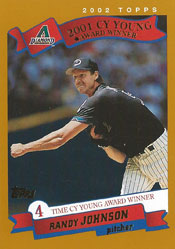
The Cardinals were a tough opponent for Randy Johnson.

randy_johnsonThe 6-foot-10 left-hander had a 7-7 record and 4.17 ERA versus the Cardinals in 16 regular-season career starts. He also was 0-2 against them in two postseason starts.

Johnson, who has 303 wins, five Cy Young awards and ranks second all-time in strikeouts (4,875), was elected to the National Baseball Hall of Fame on Jan. 6, 2015.

Cardinals slugger Albert Pujols was a Johnson nemesis, batting .458 (11-for-24) against him in the regular season, with five home runs and 13 RBI. He also hit a home run versus Johnson in the postseason.

Here is a look at some memorable matchups between Johnson and the Cardinals:

Roughed up by Redbirds

Mike Matheny and Eli Marrero hit solo home runs on consecutive pitches off Johnson in the third inning and Edgar Renteria knocked him from the game with a three-run homer in the sixth, powering the Cardinals to a 9-4 victory over the Diamondbacks on April 8, 2001, at Phoenix.

Johnson yielded 11 hits and nine runs in 5.2 innings. He also walked two and hit two with pitches. Pujols, batting fourth for the first time in the big leagues, had a two-run double off Johnson and Fernando Vina contributed a two-run single. Rick Ankiel got the win, his last as a big-league starter. Boxscore

The nine earned runs were the most Johnson had yielded in a game since April 10, 1994, when the Blue Jays scored 10 in 2.1 innings against him.

“A game like this will stick with you a little while … I pitched real bad,” Johnson said to the Arizona Daily Star after the loss to the Cardinals.

Johnson, 38, recovered from the pounding and posted one of his best seasons. He was 21-6 with a National League-leading 2.49 ERA for the 2001 Diamondbacks. He struck out a career-best 372 and earned his third consecutive NL Cy Young Award.

Pujols delivers

In Game 2 of the NL Division Series at Phoenix on Oct. 10, 2001, Pujols hit his first postseason home run, a two-run shot off a high fastball from Johnson in the first inning, and sparked the Cardinals to a 4-1 victory over the Diamondbacks.

“I wish I could have that pitch back,” Johnson said to the St. Louis Post-Dispatch.

Said Pujols: “That was my pitch.”

Johnson also yielded a run in the third. Pitcher Woody Williams doubled, advanced to third on a bunt by Vina and scored on a sacrifice fly by Placido Polanco.

Johnson went eight innings, surrendering three runs on six hits and two walks. He struck out nine. Boxscore

“He made two mistakes the whole game, to Pujols and Woody Williams,” said Diamondbacks catcher Damian Miller. “The only two bad pitches.”

Good game plan

Jim Edmonds and Scott Rolen each hit a two-run home run off Johnson, leading the Cardinals to a 12-2 triumph against the Diamondbacks in Game 1 of the 2002 NL Division Series on Oct. 1 at Phoenix. Matheny contributed a RBI-single and a double against Johnson.

In six innings, Johnson allowed 10 hits, six runs and two walks. Boxscore

The Cardinals benefitted from a disciplined approach, laying off sliders and waiting for fastballs, according to Joe Strauss of the Post-Dispatch.

“We did a great job of sticking to our game plan,” said Edmonds. “We made him pitch and tried to hit strikes instead of being overaggressive and trying to match his power.”

Said Diamondbacks manager Bob Brenly: “It appeared to me that he was rushing a little bit. When he does that, his velocity drops (and) his slider is not quite as sharp as it usually is. They were a very unforgiving team to him.”

Escape act

The Cardinals hit four home runs off Johnson, but he escaped with a no-decision in an 8-6 Diamondbacks victory on Sept. 1, 2008, at Phoenix.

Pujols hit a two-run home run and Yadier Molina, Joe Mather and Felipe Lopez each hit solo shots against Johnson. He gave up six hits and five runs in 3.2 innings. Eight of the 11 outs Johnson recorded were on strikeouts. Boxscore

Last win

In his last career appearance against the Cardinals, Johnson gave up two home runs to Pujols but earned the win _ the last of his big-league career _ in a 6-3 Giants victory on June 30, 2009, at St. Louis.

Johnson gave up four hits, four walks and three runs in 5.1 innings. Pujols hit a solo home run in the fourth and a two-run shot in the sixth. Ryan Ludwick accounted for the other two hits off Johnson: a double and a triple. Boxscore

The first home run by Pujols carried an estimated 445 feet. “I didn’t make the pitch I wanted to make,” Johnson said to the San Jose Mercury News. “I think it will probably be landing sometime shortly.”

Johnson has the most career strikeouts of any left-hander. Only right-hander Nolan Ryan (5,714) has more. Johnson and Steve Carlton (4,136) are the only left-handers with more than 3,000 strikeouts.

Johnson ranks fifth all-time among left-handers in wins, trailing Warren Spahn (363), Carlton (329), Eddie Plank (326) and Tom Glavine (305).

Previously: Rick Ankiel and his last hurrah as a pitcher

Read Full Post »

david_ecksteinIn December 2004, the Angels did the Cardinals a favor, opting not to re-sign their shortstop, David Eckstein, making him a free agent.

The Cardinals, needing to replace shortstop Edgar Renteria, a free agent who signed with the Red Sox, hardly could believe their good fortune.

Eckstein filled two needs. He replaced Renteria at shortstop and he also batted leadoff. Like Renteria, Tony Womack, who batted leadoff for the 2004 Cardinals, became a free agent. Womack signed with the Yankees.

Pouncing on the opportunity to acquire a player described by general manager Walt Jocketty as “a perfect fit,” the Cardinals signed Eckstein on Dec. 23, 2004, two days after he became available.

It was a move that felt right from the moment it occurred.

Eckstein ignited the Cardinals with his hustle, heart and smarts, leading them to two postseason appearances and a 2006 World Series championship.

Shortstop roulette

Though Eckstein had sparked the Angels to their only World Series title in 2002 and had led American League shortstops in fielding percentage in 2004, the Angels sought an upgrade, citing Eckstein’s lack of arm strength as a liability.

Meanwhile, Renteria, a three-time all-star with the Cardinals, had bolted to the Red Sox, who gave him a four-year, $40 million contract.

With Renteria joining Boston, Orlando Cabrera, the shortstop who helped the Red Sox sweep the Cardinals in the 2004 World Series, declared for free agency. The Angels pursued him, offering a four-year, $32 million deal. When Cabrera accepted, Eckstein became expendable.

According to the Associated Press, the Cardinals, unable to find a suitable replacement for Renteria, were considering signing shortstop Barry Larkin, 40, who had become a free agent after 19 seasons with the Reds. When Eckstein became available, the Cardinals called with a three-year, $10.2 million offer.

Eckstein, 29, accepted and it was a bargain for the Cardinals.

“They were very aggressive,” Eckstein said to the St. Louis Post-Dispatch. “They were pretty much the first team to call … It was clear that this was a good fit. The best fit.”

John Mozeliak, the Cardinals’ assistant general manager, said, “David was the player we focused on right away after Cabrera signed.”

Said Jocketty: “We felt this was the guy, the perfect fit for our club for a lot of reasons. For his personality, for the way he goes about playing the game. He’s a gamer through and through. He’s the kind of player St. Louis will embrace. I think he will become a cult hero with our fans. He’s a hustler.”

Disappointed with the decision to discard a player popular with the team based near Disneyland, San Bernardino Sun columnist Paul Oberjuerge wrote, “The Angels just shot Bambi.”

Size doesn’t matter

Eckstein, 5 feet 6, 170 pounds, had 156 hits in 142 games for the 2004 Angels. He seldom struck out (49 times in 637 plate appearances) and fielded effectively (six errors).

In the 2002 World Series against the Giants, Eckstein batted .310 with nine hits, three walks and six runs scored for the Angels.

Post-Dispatch columnist Bernie Miklasz wrote, “Eckstein is the kind of old-school player who commands such great respect and appreciation in St. Louis, a traditional baseball town.”

Rex Hudler, an Angels broadcaster who had been a hustling utilityman for the Cardinals from 1990-92, told Miklasz he’d named his son, David, in honor of Eckstein.

“He’s going to be revered as the new Huckleberry Finn of St. Louis and Missouri,” Hudler said of Eckstein.

Hudler said his 8-year-old daughter cried when she learned Eckstein was leaving the Angels. “Kids are his biggest fans,” Hudler said. “The children look up to him and relate to him because he’s so small … He inspires all of those kids who have been told they aren’t good enough.”

Asked about Eckstein’s subpar arm, Hudler replied, “He’s so smart. Extremely intelligent. He studies the hitters. He positions himself perfectly. He’s always in the right place. The ball comes right to him. I’ve never seen him make a mental mistake.”

Said Eckstein: “I don’t really look like your typical pro athlete. It means I always have to prove myself … I don’t want to lose that edge.”

St. Louis sparkplug

Cardinals manager Tony La Russa was delighted by the acquisition, calling Eckstein “a winning player.”

After speaking with La Russa, Eckstein told the Associated Press, “Mr. La Russa just said to play my game, be a pest at the plate and play solid defense.”

That’s exactly what Eckstein did for the Cardinals.

In three seasons (2005-07) as the St. Louis shortstop, Eckstein twice was named an all-star. He batted .297 with 465 hits in 398 career games for the Cardinals. He had a .357 on-base percentage with them. In 2005, Eckstein ranked second among National League shortstops in both assists (517) and double plays turned (123).

His crowning achievement came in 2006 when he was named winner of the World Series Most Valuable Player Award. Eckstein hit .364 in the five-game series versus the Tigers, with four RBI and three runs scored.

“He’s the heart and soul of this ball club,” Cardinals second baseman Aaron Miles said to Sports Illustrated.


Read Full Post »

Before Johnny Mize played a game for the Cardinals, they gave up on him and gave him away to the Reds.

Fortunately for the Cardinals, the Reds gave him back.

johnny_mize5During six seasons as the Cardinals’ first baseman, Mize won a National League batting title (.349 in 1939), a RBI crown (137 in 1940) and twice led the league in home runs (28 in 1939 and 43 in 1940).

In three consecutive years (1938-40) with the Cardinals, Mize led the NL in slugging percentage and total bases. Nicknamed “The Big Cat,” Mize was a four-time all-star with St. Louis. He was elected to the National Baseball Hall of Fame.

The story of how Mize transformed into one of the Cardinals’ all-time sluggers is filled with a dizzying array of twists and turns.

Rich Reds

In 1934, Mize, 21, was with the Cardinals’ minor-league Rochester (N.Y.) affiliate. His season was cut short because of a groin injury. In 90 games, Mize hit .339 with 17 home runs.

Larry MacPhail, the Reds’ brash general manager, needed sluggers for a team that ranked last in the major leagues in runs scored (590) in 1934. MacPhail saw Mize as a cornerstone for that rebuilding project.

Jim Bottomley was the Reds’ first baseman. Bottomley, who would be elected to the Hall of Fame, had been a standout for the Cardinals, helping them win two World Series titles (1926 and 1931) and four pennants. The Cardinals traded him to the Reds in December 1932.

Though he hit .284 with 31 doubles for the 1934 Reds, Bottomley, 34, had peaked as a run producer.

Powel Crosley, the Cincinnati radio manufacturer and broadcasting titan, had purchased the Reds in 1934 and was willing to spend money to revive a franchise that had finished in last place in the NL that year. In December 1934, MacPhail approached the Cardinals and offered $55,000 for Mize.

It was an astonishing sum at a time when the nation still was staggered by the economic hardships of the Great Depression. MacPhail’s offer topped the $50,000 the Yankees had paid the San Francisco Seals a month earlier for their highly touted prospect, outfielder Joe DiMaggio.

The Cardinals, who had won the 1934 World Series championship, were quite willing to accept such a large sum for a hobbled player who never had appeared in the big leagues.

On Dec. 13, 1934, the Cardinals sent Mize to the Reds.

String attached

“Whatever happens to the Reds (in 1935), it cannot be said (they) have not put plenty of cash and industry into their efforts,” The Sporting News reported. “The substantial sum of $55,000 was turned over to the Cards for (Mize) … There is ample reason for believing that Mize will prove well worth the expenditure. He is a strapping youngster … who puts a great deal of power into his swing.”

The deal came with one important condition. Wrote The Sporting News: “As for the injury, so confident are the Cardinals that it will not prove a hardship that they have guaranteed the first sacker will be sound for 1935, which means that if the injury still handicaps the player, the Reds need not keep him but instead may return him and get back the money paid for his services.”

As spring training started in February 1935, Mize told reporters he was “entirely recovered” from the groin injury. The Sporting News speculated Bottomley would be traded to the Cubs or Giants.

After watching Mize perform, though, it became evident something was wrong with him. It later was determined spurs had developed on his pelvic bone, restricting his movement and causing pain.

Return to sender

On April 15, 1935, the Reds voided the deal, returning Mize to the Cardinals the day before the start of the season.

Assigned to Rochester, Mize played in 65 games and hit .317 with 12 home runs until the pain became too intense to continue. With his career in jeopardy, Mize agreed to surgery after the season.

In December 1935, The Sporting News reported, “Mize recently underwent an operation to correct a condition that interfered with the free action of his legs … The surgery (Mize) submitted to was for the removal of a growth on the pelvic arch and it has been pronounced a success.”

The report was accurate. Mize opened the 1936 season with the Cardinals and soon after took over from Rip Collins as the first baseman. The rookie hit .329 with a team-leading 19 home runs and 93 RBI for the 1936 Cardinals.

In six seasons with St. Louis (1936-41), Mize batted .336 with 1,048 hits in 854 games. His .600 slugging percentage with the Cardinals ranks third all-time in franchise history and first among left-handed batters. The only players with higher career slugging percentages as Cardinals are Mark McGwire (.683) and Albert Pujols (.617).

On Dec. 11, 1941, seven years after they sent him to the Reds, the Cardinals traded Mize to the Giants for catcher Ken O’Dea, first baseman Johnny McCarthy, pitcher Bill Lohrman and $50,000.


Read Full Post »

(Updated Nov. 16, 2024)

Tracy Stallard had a reputation for being a victim. The Cardinals gave him a chance to be a victor. The right-handed pitcher took advantage of the opportunity.

tracy_stallardOn Dec. 8, 1964, in one of Bob Howsam’s first deals as Cardinals general manager, St. Louis traded outfielder Johnny Lewis and pitcher Gordon Richardson to the Mets for Stallard and shortstop Elio Chacon.

The trade energized Stallard, who went from the last-place club in the National League to the newly crowned World Series champions. Stallard rewarded the Cardinals by producing the best season of his big-league career in 1965.

Until then, Stallard largely had been associated with setbacks. Most notable:

_ Roger Maris broke Babe Ruth’s single-season record when he hit his 61st home run in the 1961 season finale against Stallard at Yankee Stadium. It accounted for the lone run in a 1-0 Yankees triumph over the Red Sox. Maris accomplished one of the most memorable baseball feats. Stallard became the answer to a trivia question. Boxscore

“The pitch was a fastball and over the plate,” Maris said to the New York Times. “I appreciate the fact that he was man enough to pitch to me to try and get me out.”

Stallard told the newspaper, “I’d rather he hit the homer off me than I walk him.”

Years later, asked whether he grooved the 2-and-0 pitch to Maris to give him a shot at the record, Stallard replied to Dan Shaughnessy of the Boston Globe, “God, no … I don’t know how anybody could help anybody hit a home run … The fastball was probably all I had.”

_ Stallard had a 6-17 record for the 1963 Mets. He followed that with a 10-20 mark for the 1964 Mets and led the major leagues in losses that season. He was the starting and losing pitcher when the Phillies’ Jim Bunning achieved a perfect game against the Mets in 1964. Boxscore

“Tracy Stallard is a good pitcher,” New York Daily News columnist Dick Young wrote. “You have to be good to lose 20 games for the Mets. (Manager) Casey Stengel wouldn’t tolerate you that long if you aren’t good.”

Change of scenery

Stallard was born and raised in Coeburn, Va., a coal-mining town in the southwestern corner of the state. His father was a coal miner. “I hate the mines,” Stallard said to George Vecsey of Newsday. “Never wanted to go down there.”

Baseball gave Stallard a career path. He grew to 6-foot-5, became a standout high school pitcher and was signed at 18 by the Red Sox in 1956.

Stallard was 2-7 as a rookie for the Red Sox in 1961. On the day he gave up the home run to Maris, the Boston Patriots were playing the New York Titans in a pro football game at the Polo Grounds. According to Jerry Nason of the Globe, in the club car on the train back to Boston, a young man announced to his fellow passengers that drinks were on him. One of the Patriots players asked, “What’s this all about?” Stallard replied, “Today I became famous. Roger Maris hit his 61st homer off me.”

According to the Globe, Stallard enjoyed the good life and was known as a “real swingin’ kid” and a “member of the Red Sox jet set.” That “zest for living,” as the Globe described it, apparently hampered his pitching and he was sent back to the minors in 1962. After the season, Stallard was traded to the Mets.

According to Newsday’s Joe Donnelly, at spring training in 1964, Casey Stengel chose Stallard to manage one of the teams in an intrasquad game “because Tracy has the largest hat size (7 5/8) of any Met. Casey thinks a large head houses a large brain.”

Stallard was intelligent enough to change his pitching style in 1964, working smarter and harder to make better pitches.

“This year, he’s always thinking,” Mets catcher Jesse Gonder told Newsday in 1964. “He knows what he wants to do. He’d pitch to spots on every hitter. He wouldn’t throw the ball over the middle. He’d work on the corners. He’d always have an idea. Last year (in 1963), he was a thrower. This year, he’s a pitcher.”

Seeking a starter

Though Stallard was 1-3 against the 1964 Cardinals, he yielded just 20 hits (and no home runs) to them in 22 innings and had a 3.27 ERA.

Uncertain whether Ray Washburn would recover from a shoulder injury, Howsam sought a starter to join a rotation of Bob Gibson, Ray Sadecki and Curt Simmons.

The Mets were seeking an outfielder. Lewis, a rookie, began the 1964 season as one of the Cardinals’ regulars. He started 28 games in right field, but batted .234 with two home runs and seven RBI. In June, slowed by an ankle injury, the Cardinals sent Lewis to Class AAA Jacksonville.

Mike Shannon became the Cardinals’ right fielder and Lou Brock, acquired by the Cardinals in June 1964 from the Cubs, became the left fielder.

Bing Devine, the Cardinals general manager who engineered the deal for Brock before being fired in August 1964, had joined the Mets as an assistant to team president George Weiss. Devine recommended Lewis, 25, to the Mets. Weiss and his vice president, Johnny Murphy, negotiated with Howsam on the trade. “Devine stayed out of the picture,” The Sporting News reported.

Devine told the New York Daily News, “I’d say the only difference between Lewis and Shannon is confidence. Lewis has all the assets of Shannon, but Shannon was always confident beyond his record. Lewis never had the confidence that others felt in him.”

Stallard, who shared a midtown Manhattan apartment with Yankees infielder Phil Linz, had become “quite the young man about (town),” according to the Daily News. “He could run a charm school,” Casey Stengel told Bob Broeg of the St. Louis Post-Dispatch.

Yet, when asked his reaction to joining the Cardinals, Stallard told the newspaper, “It’s wonderful. Imagine going from a 10th-place club to a World Series winner.”

Stallard said to Newsday, “This is like going into daylight from darkness.”

Cardinals contributor

In a story headlined “Tracy Ticketed For Starter Job On Cards Staff,” St. Louis manager Red Schoendienst told The Sporting News, “Stallard is a tough competitor and he ought to do a lot better for us because our club can score some runs for him. His best pitches are a slider and a fastball.”

Said Howsam: “We wanted a fourth starter and we think we’ve got him.”

A week later, though, Howsam acquired another starting pitcher, Bob Purkey, from the Reds for outfielder Charlie James and pitcher Roger Craig.

Stallard, 27, began the 1965 season in the Cardinals’ bullpen. He lost his first start April 24 to the Reds, then won his next three decisions as a starter, beating the Pirates twice and the Dodgers. After a win over the Phillies July 18, Stallard was 7-3 with a 2.80 ERA.

His best game for the 1965 Cardinals came on Sept. 1, a day after his 28th birthday, when Stallard pitched a three-hit shutout in a 9-0 victory over the Cubs at Chicago. Stallard struck out eight and yielded only a double by Don Kessinger and singles by Joe Amalfitano and Ernie Banks. Boxscore

Stallard finished second on the 1965 Cardinals in wins (11) and third in innings pitched (194.1). His 3.38 ERA was better than the team average of 3.77. His 11-8 record represented his lone winning season in the majors.

In 1966, Stallard was 1-5 for the Cardinals, who demoted him to the minor leagues. He never returned to the majors, and thus missed a chance to be a teammate of Maris, who was acquired by the Cardinals in December 1966.

Asked about Maris, Stallard told Pat Calabria of Newsday in 1986, “I talked to him a few times after the home run. I’d see him at spring training, or someplace, and we’d talk, but we never talked about the home run … He didn’t bring it up, not once, and neither did I.”

Stallard’s big-league career totals: 30-57 record, 3.91 ERA.


Read Full Post »

(Updated Nov. 13, 2025)

Jim Kaat was 41 when he stole a base and hit a home run in separate games for the 1980 Cardinals.

jim_kaat4At an age when most players are retired, Kaat remained a complete ballplayer.

Speed demon

On June 23, 1980, two months after he was acquired from the Yankees, Kaat earned the win and pitched a complete game for the Cardinals in their 6-1 victory over the Pirates at St. Louis. Kaat didn’t allow a walk or an extra-base hit. He held the Pirates scoreless over the last seven innings and earned his 266th career win, tying Hall of Famer Bob Feller.

In the seventh, he stole a base.

Bobby Bonds was at the plate when Kaat, noticing first baseman Bill Robinson wasn’t holding him on, dashed for second. Bonds took a pitch from Enrique Romo. Catcher Steve Nicosia gunned a throw to Phil Garner, covering second, and Kaat beat the peg.

“Kitty figured as long as somebody wants to give you something, you might as well take it,” Cardinals manager Whitey Herzog said to the St. Louis Post-Dispatch.

Fans at Busch Stadium rewarded Kaat with a standing ovation. “I guess they thought Lou Brock was back,” Kaat said.

In its account of the game, the Associated Press wrote, “It was the aging hurler’s speed that brought the customers to their feet … The accomplishment nearly overshadowed his hurling.”

Said Kaat: “It was the element of surprise. I had a good lead. It was worth it.” Boxscore

The steal was Kaat’s first in nine years. He was 32 when he swiped a base for the Twins against Yankees pitcher Stan Bahnsen and catcher Thurman Munson on July 30, 1971.

His stolen base for the Cardinals was Kaat’s fifth and last in a 25-year career (1959-83) in the majors.

Described by the Post-Dispatch as a “left-handed Methuselah,” Kaat needed only 82 pitches to complete the game. He threw a strike on the first pitch to 25 of 32 Pirates batters.

“He may be 41, but he has the body of a 28-year-old,” said Pirates manager Chuck Tanner.

Sultan of swat

Two months after his steal for the Cardinals, Kaat hit a home run for them.

On Aug. 26, 1980, Kaat homered off the Astros’ Joe Niekro at St. Louis.

“He hit a knuckleball up,” Niekro said to the Associated Press. “He’s a pretty good hitter. I’ve got a brother (Phil) who is 41 and he hits home runs. It’s not the first time I gave up one to a pitcher and it probably won’t be the last.” Boxscore

The home run was the last of 16 hit by Kaat. He slugged his first 18 years earlier on June 19, 1962, off Dom Zanni of the White Sox.

(The oldest player to hit a big-league home run was Mets first baseman Julio Franco, 48, against Randy Johnson of the Diamondbacks on May 4, 2007. Franco was three months shy of his 49th birthday.)

Going strong

Exactly one year after his home run, Kaat, 42, got his last big-league hit, a single for the Cardinals against 25-year-old Giants rookie Bob Tufts on Aug. 26, 1981. Boxscore

The next year, Kaat, 43, appeared in 62 regular-season games for the Cardinals (earning five wins and two saves) and pitched in four games of the 1982 World Series against the Brewers.

He pitched his last game at 44, tossing 1.1 scoreless innings in relief of Joaquin Andujar for the Cardinals against the Pirates on July 1, 1983, at Pittsburgh. Boxscore

Kaat was 19-16 with 10 saves in four seasons (1980-83) with the Cardinals.

Elected to the Baseball Hall of Fame, Kaat totaled 283 career wins and received 16 Gold Glove awards for fielding.


Read Full Post »

As an 11-year-old Cardinals fan, Bill Mueller attended Game 7 of the 1982 World Series at Busch Stadium in St. Louis and witnessed his hometown team clinch the championship against the Brewers.

bill_muellerTwenty-two years later, Mueller returned to a World Series for the first time.

As a 33-year-old big-league veteran, Mueller was the third baseman for the Red Sox in Game 4 of the 2004 World Series at Busch Stadium in St. Louis and witnessed Boston break the hearts of his hometown team by clinching the championship against the Cardinals.

Ten years after that, Mueller has come full circle.

On Nov. 17, 2014, Mueller was named assistant hitting coach of the Cardinals, replacing David Bell, who was promoted to bench coach after Mike Aldrete departed for a coaching job with the Athletics. Mueller had been hitting coach of the Cubs during the 2014 season. He will serve under Cardinals hitting coach John Mabry in 2015.

McGee a favorite

A native of the St. Louis suburb of Maryland Heights, Mo., Mueller grew up a Cardinals fan. Center fielder Willie McGee was his favorite player, Mueller told Jeff Horrigan of the Boston Herald in October 2004.

As a rookie in 1982, McGee sparked the Cardinals to their first National League pennant in 14 years. After splitting the first six games of the 1982 World Series with the Brewers, the Cardinals faced a Game 7 showdown at Busch Stadium.

Mueller attended the game with his father. Their seats were in the upper deck of the outfield. “The nosebleed section,” Mueller told The Patriot Ledger of Quincy, Mass., in 2004.

The Brewers’ Ben Oglive smacked a home run off Joaquin Andujar near the section where the Muellers sat. That’s one of Bill Mueller’s enduring memories of the game. What’s most memorable, of course, is that the Cardinals won, 6-3, earning their first World Series title since 1967. “Pretty cool,” Mueller said of the experience. Boxscore

Turning pro

Mueller became a baseball standout at De Smet Jesuit High School in Creve Coeur, Mo., and at Missouri State University in Springfield. He was drafted by the Giants and made his big-league debut with them in 1996.

In his first appearance at Busch Stadium with the Giants in August 1996, Mueller got five hits in 10 at-bats during a four-game series. Three years later, on May 25, 1999, Mueller hit a grand slam off Kent Mercker at Busch Stadium before more than 30 family and friends in a 17-1 Giants victory over the Cardinals. Boxscore

After the 2000 season, the Giants traded Mueller to the Cubs. He spent two years in Chicago, became a free agent and signed with the Red Sox. In his first season with Boston, Mueller was the 2003 American League batting champion, hitting .326 in 146 games.

Mueller vs. Rolen

The next season, Mueller helped Boston win the American League pennant, their first since 1986. He would be going to the World Series for the first time as a player and for the only time since he attended as a fan in 1982.

“That (1982) was my last experience with a World Series and now I’m going back for a World Series in St. Louis and I’m part of it,” Mueller said to Dan O’Neill of the St. Louis Post-Dispatch on the eve of the 2004 World Series. “It’s really a pretty amazing thing when you think about it.”

In most media previews of the 2004 World Series, the Cardinals, with Scott Rolen, were rated as having the advantage at third base over Mueller and the Red Sox. Rolen had hit 34 home runs with 124 RBI during the regular season and would win his fifth consecutive Gold Glove Award in 2004.

Mueller, though, proved the experts wrong.

The Red Sox swept the Cardinals, winning the first two games at Boston and the next two at Busch Stadium, and earned their first World Series championship since 1918, ending what some considered to be a curse placed on the franchise after it had traded Babe Ruth to the Yankees.

Mueller played an integral role in Boston’s dominance of the Cardinals. He batted .429 (6-for-14) with four walks in the World Series. His on-base percentage was .556. He scored three runs and drove in two.

His counterpart, Rolen, was hitless in 15 at-bats.

Previously: Paul Molitor vs. Cardinals: Sensational, strange 1982 World Series

Read Full Post »

« Newer Posts - Older Posts »