Feeds:
Posts
Comments

Archive for the ‘Opponents’ Category

(Updated Dec. 24, 2018)

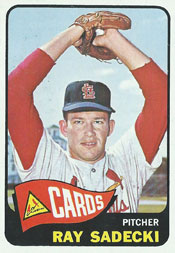
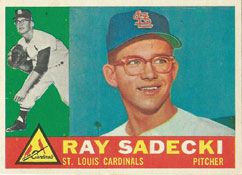
Five months after it appeared he might pitch his way out of the starting rotation, Ray Sadecki earned his 20th win and propelled the 1964 Cardinals into first place in the National League.

ray_sadecki4On Sept 29, 1964, Sadecki got the win, his career-best 20th of the season, in the Cardinals’ 4-2 triumph over the Phillies at St. Louis. The victory was the seventh in a row for the Cardinals and moved them into a tie for first place with the Phillies, who lost their ninth in a row after building a 6.5-game lead with 12 to play.

The Cardinals moved into sole possession of first place on Sept. 30 and went on to win the pennant five days later by a game over the Phillies and Reds.

Early troubles

Based on his subpar beginning, few could have predicted Sadecki would be such a stellar pitcher for the 1964 Cardinals.

Sadecki was 0-1 with a 9.00 ERA in three April appearances for St. Louis.

“Sadecki looked terrible in spring training, was beaten his first three times out during the season and was booed consistently by the normally restrained Cardinals fans,” The Sporting News reported.

Sadecki recovered, earning four wins in each of the next five months, with the last being the 20th on Sept. 29.

In a matchup of left-handers, the Phillies started Dennis Bennett against Sadecki. Bennett had a sore arm because of left shoulder tendinitis and pitchers such as Jim Bunning of the Phillies and Curt Simmons of the Cardinals told author David Halberstam in the book “October 1964” the Phillies should have started someone else.

Before the game, Sadecki looked into the Phillies’ dugout and thought the players, reeling from their losing streak, “resembled a bunch of ghosts” Halberstam wrote.

The Cardinals led, 3-0, after two innings and knocked out Bennett, who was lifted after recording four outs. Sadecki gave up a two-run single to pinch-hitter Gus Triandos in the fourth, but Bill White hit a home run in the sixth off John Boozer, extending the St. Louis lead to 4-2.

In the seventh, the Phillies had the tying runs on first and second, with two outs, when Cardinals manager Johnny Keane replaced Sadecki with Barney Schultz, who got Richie Allen to pop out to first. Schultz pitched 2.1 hitless innings in relief of Sadecki and earned his 13th save. Boxscore

World Series winner

Sadecki became the first Cardinals left-hander since Harvey Haddix in 1953 to win 20 in a season. Sadecki was the only National League left-hander to win 20 in 1964. Sandy Koufax of the Dodgers won 19; Bob Veale of the Pirates and Sadecki’s teammate, Curt Simmons, each won 18. The 1964 season was the only time Sadecki won more than 14 during an 18-year major-league career.

A week after winning his 20th, Sadecki started Game 1 of the World Series on Oct. 7 against Whitey Ford and the Yankees. He earned the win in a 9-5 Cardinals victory at St. Louis. The highlight of Sadecki’s performance was when he struck out Roger Maris to end the second and struck out Mickey Mantle to open the third.

“I had a good curve and was putting it where I wanted, but I had all kinds of trouble with my fastball,” Sadecki said. Boxscore

In “October 1964,” Halberstam explained Sadecki “liked to come in with a high fastball, and the Yankees murdered high fastballs.”


Read Full Post »

At 19, Ray Sadecki replaced Bob Gibson on the 1960 Cardinals staff. As if that wasn’t enough pressure, Sadecki also was given a spot in the starting rotation.

ray_sadecki3Initially, it appeared the Cardinals misjudged. Sadecki was 0-2 with a 7.50 ERA after his first five starts for the Cardinals.

However, in his sixth start, on June 15, 1960, at Cincinnati, Sadecki pitched a three-hit shutout for his first big-league win. It was the first shutout by a Cardinals pitcher in 1960.

All three Reds hits _ by Billy Martin, Gus Bell and Frank Robinson _ were doubles.

Sadecki walked eight and struck out nine. The Reds stranded 11 base runners. The eight walks were one shy of Vinegar Bend Mizell’s National League record for a nine-inning shutout win.

“I don’t know whether the pitching is that good, or our batters are that bad,” Reds general manager Gabe Paul said to The Sporting News.

Sadecki had a 68-64 record in eight seasons (1960-66 and 1975) with the Cardinals. He was 20-11 for the 1964 Cardinals and won Game 1 of the World Series versus Whitey Ford and the Yankees.

Bonus baby

Signed by Cardinals scout Runt Marr after graduating from high school in Kansas City, Kan., at age 17 in 1958, Sadecki opened the 1960 season at Class AAA Rochester. He was 2-1 with a 1.76 ERA in six games for Rochester when the Cardinals promoted him in May. Sadecki replaced Gibson, who was sent to Rochester after posting a 9.72 ERA in five appearances for the Cardinals.

Sadecki failed to go beyond six innings in any of his first five starts for St. Louis, but manager Solly Hemus stuck with the teenager as part of a rebuilt rotation that also included Larry Jackson, Ernie Broglio and Curt Simmons.

Change and speed

Against the Reds on June 15 at Crosley Field, Sadecki displayed “a brilliant changeup to go with a hopping fastball,” The Sporting News reported.

The Reds had a runner on base in every inning except the seventh and ninth, but Sadecki consistently worked out of trouble. In the fourth, the Reds had the bases loaded and two outs when Sadecki got Martin on a fly out to left, ending Cincinnati’s biggest threat.

Sadecki got support from Curt Flood, who hit a pair of home runs off starter Joe Nuxhall. Flood hit a three-run home run in the second and a solo shot in the fourth. It was the first time he hit two homers in a big-league game. Boxscore

Sadecki stayed in the Cardinals’ rotation for the remainder of the 1960 season, finishing 9-9 with a 3.78 ERA in 26 starts.

Read Full Post »

Jerry Reuss Banner

On Nov. 11, 2014, I visited the Dodgers Adult Baseball Camp at Historic Dodgertown in Vero Beach, Fla., to seek out Jerry Reuss for an interview about his time as a pitcher with the Cardinals.

Dressed in a home white Dodgers uniform, Reuss, 65, was patient, thoughtful, articulate and polite.

He debuted with the Cardinals in September 1969 and pitched for them in 1970 and 1971, posting an overall 22-22 record before he was traded to the Astros in April 1972.

In a 22-year major-league career, primarily with the Dodgers (nine years) and Pirates (six years), Reuss was 220-191 with a 3.64 ERA. In 2014, he published a book “Bring in the Right-hander,” a delightful retrospective on his career. You can order an autographed copy at his Web site www.jerryreuss.com.

jerry_reuss2Q.: Two months after the Cardinals traded Steve Carlton, they traded you. It was first reported you were traded because you were in a contract dispute with owner Gussie Busch. Later it comes out it was about your moustache. True?

Reuss: “It was about growing a moustache. Bob Broeg (a writer) had said something to that effect and I thought, ‘No, they wouldn’t be that concerned about that.’ I lived with that for 20 or 25 years.

“It wasn’t until the mid-90s when I was in St. Louis and I went to a ballgame and I saw Bing Devine, who was working as a scout. He had been the general manager of the Cardinals when I was traded. I said, ‘Bing, you got a minute?’ He said, ‘Yeah. Why don’t you sit down and we’ll talk.’ So I asked him about the deal. I figured enough time had passed that I could do that.

“He was more than happy to tell me. He said Mr. Busch at times would act on an impulse. This was one of those times. He insisted on me being traded because I had the moustache. Bing thought if given a little time he (Busch) would come to his senses and make a wise baseball decision rather than a personal decision.

“But he kept hammering about the moustache and would say, ‘Did you get rid of him yet? Why not?’ And the ultimatum was put like this: ‘If you don’t get rid of him, I’ll get rid of you and get somebody who will get rid of him.’ So when you’re faced with a situation like that, you do what has to be done.”

Q.: You still have a moustache and it has become something of a signature look for you…

Reuss: “Yeah. But when you look back about how that was the thinking in baseball in the early 70s and then just two or three years later baseball began to change with the times. Guys were coming in with long hair and beards. And you just wonder: What was the stink all about?

“So on the matter of just a little bit of facial hair _ you could barely see it _ people would ask, “Why didn’t you shave it?’ And I’d say, ‘There wasn’t a rule that the Cardinals had to be clean-shaven and be like a military situation. If it doesn’t bother anybody, if it’s not a rule, then what are we talking about here?’ ”

Q.: Your last year with the Cardinals, 1971, was the year your teammate, Joe Torre, led the National League in hitting and RBI and won the MVP Award. Could you see then the leadership qualities that later would make him a Hall of Fame manager with the Yankees?

Reuss: “Oh, sure. Lights out. At that early age, I just wondered whether there were guys like that on every team.

“He was managing the club on the field. Red (manager Schoendienst) just stepped back and said, ‘Joe, you have a grasp of it. You take care of it. When you’re on the field, you see things that I don’t.’ And Joe, being wise enough and knowing his boundaries, would go to Red and say, ‘Would you consider this or would you consider that?’

“Sometimes there was a lineup that was put out and Joe would go to Red and say, ‘This player won’t say it to you but he’ll say it to me. You might want to give him a day off.’ And Red would say, ‘All right. Let’s do that.’ He’d make the lineup change. Joe was able to get those things from players and he did it only because it helped the club. It wasn’t anything personal with the player.

“You could see the leadership. I’ve never come across another player who was like him. There were a couple that had some of those qualities _ I understand Cincinnati had a few. (Johnny) Bench was one of those guys _ that when he spoke, everybody just said, ‘Let’s reconsider this.’ Joe was that way all the time. Joe was more far-reaching. You knew he would be a manager.”

Q,: After leaving the Cardinals, you played for seven big-league teams. As a St. Louis native who began his career with the hometown team, did you ever hope to return to the Cardinals?

Reuss: “I never gave it a whole lot of thought. Once I got to Los Angeles (in 1979), I said, ‘This is home. This is where I want to be.’ It’s where I always wanted to play.

“Back in those days, it was one of the few grass fields. Lots of artificial turf then. My knees were feeling it. And then I became a ground ball pitcher and the infield I had behind me was particularly adept at playing at Dodger Stadium on the lawn.

“As a result, I had a good defensive ball club become a great defensive ball club. They got a lot of ground balls. That’s where my success was and that’s where I wanted to stay. When I was ready to change teams, I was past my prime. Rather than a lot of teams coming to me, I was going to them and just hoping for a chance.”

Q.: The player who had the most at-bats against you was

Reuss: “Pete Rose. Did you see what he hit against me?”

Q.: .244 in the regular season. (29-for-119).

Reuss: “I couldn’t believe that.”

Q.: What was your secret?

Reuss: “There was no secret. Pete hit me the same way he hit everybody else. It’s just that, when he hit the ball against me, more often it was right at somebody. Did you see the number of times he struck out against me? (9) He was making contact. He came up there swinging.”

Part 1: Jerry Reuss on Bob Gibson as a teammate: He was tough

Read Full Post »

(Updated Dec. 8, 2024)

Paul Molitor is linked with Willie McGee and Darrell Porter as central figures in two prominent plays in the 1982 World Series between the Brewers and Cardinals.

paul_molitorMolitor was the third baseman and leadoff batter for the American League champion Brewers in 1982. He was selected by the Cardinals in the 28th round of the 1974 amateur draft, but chose to attend the University of Minnesota instead. Three years later, the Brewers drafted him in the first round, launching him onto a 21-year career in the majors. Molitor produced 3,319 hits and was elected to the National Baseball Hall of Fame.

In 1982, Molitor, along with Robin Yount, Cecil Cooper and Ted Simmons, played a prominent role in the Brewers winning their lone pennant. He followed that with a World Series versus the 1982 Cardinals that was both sensational and strange.

Here’s a look:

Hits record

Molitor became the first player to get five hits in a World Series game. After grounding out in the first inning, Molitor had five singles in his next five at-bats in Game 1 at St. Louis.

No one else produced five hits in a World Series game until the Cardinals’ Albert Pujols did it in Game 3 of the 2011 World Series. Boxscore

Molitor got his five hits in Game 1 off three pitchers: Bob Forsch (in the second, fourth and sixth), Dave LaPoint (in the eighth) and Jeff Lahti (in the ninth). Boxscore

“He’s a heck of a ballplayer,” Cardinals manager Whitey Herzog said to The Sporting News, “but he had only one line drive. He had three infield singles and a broken-bat bloop. Nothing you can do to stop things like that.”

In the book “Where Have You Gone ’82 Brewers?,” Molitor said, “Five singles. Ozzie (Smith) dove and knocked down three of them at short and almost threw me out on two of them. It was a heck of a way to have your first World Series game unfold.”

Molitor and Yount (four hits in Game 1) were the first teammates to get four hits apiece in a World Series game since the Cardinals’ Joe Garagiola, Whitey Kurowski and Enos Slaughter each had four hits against the Red Sox in Game 4 of the 1946 World Series. Boxscore

Bashing at Busch

Molitor batted .355 (11-for-31) in the seven-game World Series in 1982. He hit .526 (10-for-19) in the four games at St. Louis and .083 (1-for-12) in the three games at Milwaukee.

After his 5-for-6 performance in Game 1, Molitor hit .240 (6-for-25) for the remainder of the World Series. When he grounded out to lead off Game 2, he missed a chance to tie Goose Goslin (1924 Senators) and Thurman Munson (1976) for the World Series record of hits in six consecutive at-bats.

Molitor was devastating when batting with runners in scoring position, hitting .714 (5-for-7) against the Cardinals.

Porter power

After the Brewers won Game 1, 10-0, at St. Louis, the Cardinals felt pressure to win Game 2 before heading to Milwaukee. In the eighth, the Cardinals scored a run, breaking a 4-4 tie.

Molitor led off the ninth against closer Bruce Sutter. In a matchup of future Hall of Famers, Molitor bunted for a single, increasing the pressure on Sutter and his catcher, Darrell Porter.

The next batter was another future Hall of Famer, Robin Yount.

“I told Bruce to be sure to hold him (Molitor) close to the base because I figured they might either try a bunt or a steal,” Porter said to The Sporting News.

Brewers manager Harvey Kuenn called for a hit-and-run.

Said Porter: “I never thought they would try to hit and run.”

Sutter threw his signature pitch, the split-finger fastball. When thrown effectively, the ball dipped sharply into the dirt.

This time, Sutter made a mistake. The pitch stayed up, at shoulder level.

Yount, trying to hit the ball the opposite way to right field, swung and missed. Porter fired a strike to second base and nailed Molitor.

Sutter retired the next two batters and the Cardinals had their first World Series win since Game 4 of 1968. Boxscore

Robbed by McGee

In Game 3 at Milwaukee, Molitor led off the bottom of the first by smashing a Joaquin Andujar fastball into the teeth of a 16 mph wind in center field. Willie McGee, the rookie center fielder, raced to the wall, 402 feet from home plate, climbed the canvas and made the catch.

Inspired, McGee went on to have one of the all-time best games in World Series lore, hitting two home runs, driving in four runs and making another leaping grab in the ninth to deprive Gorman Thomas of a two-run home run. Boxscore

Recalling the catch of Thomas’ drive, McGee said to Cardinals Yearbook in 2016, “The key to making that catch is timing … You condition yourself during batting practice to chase fly balls like that one, and to working on timing your jump.”

Read Full Post »

(Updated Jan. 20, 2019)

Performing an escape act on the sport’s grandest stage, the Cardinals were the first team to emerge victorious in a World Series that ended with the tying run on third base.

red_schoendienst9It happened in Game 7 of the 1946 World Series between the Red Sox and Cardinals.

Nervous ninth

Game 7 of the 1946 World Series is best remembered for the daring dash by Enos Slaughter from first to home on a hit by Harry Walker that scored the decisive run in the eighth inning, earning the Cardinals their third championship in five years. What often is overlooked is the Red Sox nearly tied the score in the ninth.

Cardinals left-hander Harry Brecheen was pitching in relief in Game 7 in 1946 after having achieved wins in two starts in the World Series.

Rudy York led off the Red Sox ninth with a single and Bobby Doerr followed with another single, advancing York to second. Red Sox manager Joe Cronin replaced York with pinch-runner Paul Campbell.

That brought to the plate Pinky Higgins, 37, a 14-year big-league veteran. In what would be his last major-league at-bat, Higgins grounded to third baseman Whitey Kurowski, who threw to shortstop Marty Marion to get the force on Doerr at second base. Campbell advanced to third on the play.

With one out, Roy Partee batted next and popped out to first baseman Stan Musial for the second out.

Brecheen vs. McBride

Cronin sent Tom McBride, a right-handed batter, to bat for pitcher Earl Johnson. McBride hit .301 in 1946, including .333 against left-handers.

In the press box, some expected Cronin to use Don Gutteridge as a pinch-runner for Higgins at first base, but Cronin didn’t make the move.

Brecheen threw “a good screwball” and McBride rapped it on the ground. Second baseman Red Schoendienst got to the ball and gloved it, but the ball rolled up his arm.

In his book “Red: A Baseball Life,” Schoendienst said, “Just as I went to field the ball, it took a crazy hop and I blocked the ball with my left shoulder. Luckily, I was able to trap it.”

Schoendienst kept his cool and flipped a low, underhand toss to Marion, who caught it in time to nip Higgins at second base for the final out.

In his book “Stan Musial: The Man’s Own Story,” Musial told writer Bob Broeg, “Our hearts stood still” as the ball rolled up Schoendienst’s arm. “Red looked like a magician pulling a rabbit out of his sleeve when he finally flipped the ball to Marion,” said Musial.

$40,000 assist

In the St. Louis Star-Times, Sid Keener reported Schoendienst’s toss beat Higgins to the bag “by no more than a step.”

“Cronin’s critics insist Gutteridge would have beaten the play at second,” enabling Campbell to score from third with the tying run, Keener concluded.

McBride told the Society for American Baseball Research, “The ball I hit was a low liner right by Brecheen’s left knee, and when it went by Harry, I thought I had a hit … But the second baseman, Schoendienst, made a good play on the ball. He didn’t catch it clean. The ball bounced up and looked as if it balanced on the web of his glove. He picked it off and threw to second base for a force out.”

Said Schoendienst: “People began to refer to that play as the $40,000 assist because the $40,000 was the approximate difference between the total shares for the winning team and the losing side.”  Boxscore

The play had another benefit for Schoendienst. He wanted to marry his girlfriend, Mary, but her grandfather, Patrick O’Reilly, said he wasn’t keen about a “German” joining the family.

Said Mary: “He was still not sure about Red until he made that play. After the ball hit him in the chest, then rolled up his arm, and he still made the play and we won the game, then my grandfather said, ‘You can marry him now.’ “

Read Full Post »

(Updated Dec. 8, 2024)

Teetering on the brink of another letdown in their bid to end a pennant drought, the Cardinals got the matchup they sought against the Astros in Game 6 of the 2004 National League Championship Series.

Jim Edmonds provided the desired result.

jim_edmonds4On Oct. 20, 2004, Edmonds launched a two-run, walkoff home run in the 12th inning, carrying the Cardinals to a 6-4 victory at St. Louis.

Kept alive by Edmonds’ home run, the Cardinals won Game 7 _ helped, in part, by a diving catch by Edmonds that prevented two runs from scoring in the second inning _  and earned their first National League pennant in 17 years.

Under manager Tony La Russa, the Cardinals had gotten to the National League Championship Series three previous times (1996, 2000 and 2002) but couldn’t clinch a pennant.

It appeared during Game 6 in 2004 that the Cardinals would fall short again.

Sense of dread

After scoring four runs in the first 2.1 innings off starter Peter Munro, the Cardinals were held scoreless by four Astros relievers _ Chad Harville, Chad Qualls, Dan Wheeler and Brad Lidge _ over the next 8.2 innings.

Lidge, the Astros’ closer, had been especially dominating. St. Louis Post-Dispatch columnist Bernie Miklasz described him as “bulletproof.”

Lidge, who entered in the ninth, retired all nine batters he faced. He struck out five, including Edmonds. Only one batter, pinch-hitter Marlon Anderson, who flied to left in the 11th, hit a ball out of the infield against Lidge.

Miklasz wrote that “a growing sense of dread spread through Busch Stadium” as Lidge mowed down the Cardinals.

Lidge, though, had been stretched to the limit with his three innings of relief. He had appeared in 80 games during the regular season and never had worked more than a two-inning stint.

In the 12th, manager Phil Garner lifted Lidge _ along with the Cardinals’ hopes.

High pitch, high drive

Dan Miceli, a right-hander pitching for his 10th big-league team, replaced Lidge.

After Miceli walked leadoff batter Albert Pujols, Scott Rolen popped out.

Edmonds batted next, giving La Russa the matchup he wanted. In the 2004 regular season, left-handed batters hit .307 versus Miceli, with seven home runs. Edmonds hit 37 of his 42 home runs against right-handers in 2004. More than half of Edmonds’ hits (83 of 150) that season were for extra bases.

“I was yelling at him, ‘Hit a line drive. Let’s get first and third.’ That’s all I wanted,” La Russa said to the Associated Press.

On an 0-and-1 pitch, Edmonds got a high, tight fastball, and sent it on a majestic arch over the right-field fence. Check out the You Tube video.

“I got the pitch up again and they hit it out again,” said Miceli, who yielded home runs to Pujols and Rolen in the eighth inning of Game 2.

Said Edmonds: “I wasn’t trying to go deep. I was just trying to hit the ball hard.”

La Russa, delighted Edmonds hadn’t settled for the single he’d been urging him to hit, said, “I didn’t feel too smart. Just happy. Happy and stupid.” Boxscore

Ten years later, in 2014, La Russa told Cardinals Magazine, “He was such a terrific big-game player I wasn’t surprised that he delivered. You’re talking about an individual who is very strong mentally. He was going to keep grinding.”

Big catch

Ahead 1-0 in the second inning of Game 7, the Astros had two on when Brad Ausmus drilled a Jeff Suppan pitch to left-center. An extra-base hit would give the Astros and their ace, Roger Clemens, a 3-0 lead, but Edmonds, with his back to the infield, dived, stretched and snared the ball for the out. The Cardinals went on to win, 5-2. Boxscore

Recalling the catch in an interview for the 2016 Cardinals Yearbook, Edmonds said when he saw where Suppan’s pitch was headed, he adjusted his fielding position, taking a step back.

“Ausmus hit it right where I thought he was going to hit it,” Edmonds said. “I got a really good jump, and when I get a jump like that, I expect to make the catch.” Video

Read Full Post »

« Newer Posts - Older Posts »