Feeds:
Posts
Comments

Archive for the ‘Opponents’ Category

For George Hendrick, the combination of a nervous pitcher and a hanging changeup was a recipe for hitting heroics.

george_hendrickOn May 12, 1984, Hendrick, the Cardinals’ cleanup hitter, ruined a no-hit bid by the Reds’ Mario Soto, slugging a home run with two outs in the ninth inning.

Though the Reds recovered to win, 2-1, against closer Bruce Sutter, Hendrick’s home run after Soto got within a strike of a no-hitter got the headlines.

Soto, 27, a right-hander, was in his eighth season with the Reds when he faced the Cardinals on a Saturday afternoon at Cincinnati’s Riverfront Stadium. Primarily relying on a fastball, Soto struck out 10 Cardinals in the first six innings and 12 overall.

Backed by sparkling defensive plays from second baseman Ron Oester, who stopped an Ozzie Smith grounder in the seventh and swatted the ball to first baseman Dan Driessen, and from right fielder Dave Parker, who made a diving catch of Tommy Herr’s liner to the gap in right-center in the eighth, Soto held the Cardinals hitless.

Nervous ninth

With a 1-0 lead, Soto faced Ozzie Smith leading off the ninth. Most of the 24,355 in attendance rose and cheered wildly. Instead of inspiration, Soto felt fear.

“I was too nervous,” Soto told the Associated Press. “I just couldn’t stand it out there. I was nervous after I made the last out in the eighth. I’ve never felt that way before.”

Still, Soto had a promising start to the ninth. Ozzie Smith grounded out and Lonnie Smith popped out to second. That brought up Hendrick, who had entered the game with one home run and a .224 batting average.

Soto got two strikes on the right-handed batter. Hendrick then fouled off a couple of pitches, building the drama. Hoping to induce Hendrick to swing and miss, Soto threw his next two pitches high. Hendrick wasn’t tempted, though, and the pitches were called balls, evening the count at 2-and-2.

Looking to catch Hendrick off-guard, Soto delivered a changeup.

“As soon as I threw the pitch, I said, ‘That’s trouble.’ I hung the pitch,” Soto said.

Hendrick swung at the high, inside offering and walloped it over the left-field wall, tying the score at 1-1.

Nowhere to hide

Soto appeared stricken as Hendrick circled the bases.

“I almost died right there,” Soto said. “I don’t think anybody felt worse than I did. I wanted to leave. I almost walked out.”

Instead, he walked the next batter, Andy Van Slyke, before getting Ken Oberkfell on a fly out to center, ending the inning.

Cardinals manager Whitey Herzog sent in Sutter to pitch the bottom half of the ninth, even though it wasn’t a save situation. With one out, Dave Concepcion singled and swiped second. Brad Gulden, the Reds catcher who began the day with a .103 batting average, singled, scoring Concepcion, lifting the Reds to a 2-1 victory and salvaging the win for Soto. Boxscore

In his next start, Soto pitched a three-hitter and got the win against the Cubs, even though he yielded a two-run home run on a changeup to Jody Davis. “I’d say that three or four of the seven homers I’ve given up this season have come on the changeup, but that’s not going to stop me from throwing it,” Soto said to The Sporting News.

Soto, who three times led National League pitchers in most home runs given up in a season, finished 1984 with an 18-7 record while yielding 26 home runs, second-most in the league and one behind Bill Gullickson of the Expos.

In his last of seven seasons with the Cardinals. Hendrick finished 1984 with nine home runs and a .277 batting mark.

Previously: George Hendrick influenced hitting style of John Mabry

Read Full Post »

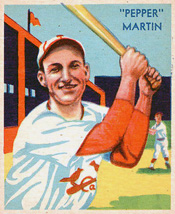
Given a chance at age 35 to return to the starting lineup, Pepper Martin played with a boldness that electrified the Cardinals and startled opponents.

pepper_martinOn May 8, 1939, Martin revived memories of his daring Gashouse Gang days by executing one of the most exciting plays in baseball. Martin made a straight steal of home for the run in the Cardinals’ 1-0 victory over the Dodgers at Brooklyn.

In sparking the Cardinals to World Series championships in 1931 and 1934 with fearless base running and relentless hitting, Martin symbolized the spirit of St. Louis’ Gashouse Gang.

As a center fielder, he hit .500 (12-for-24) and swiped five bases against the Athletics in the 1931 World Series. As a third baseman, he batted .355 (11-for-31) with two steals versus the Tigers in the 1934 World Series. Martin led the National League in stolen bases three times: 1933, 1934 and 1936.

Cardinals captain

By 1939, though relegated to being a role player under first-year manager Ray Blades, Martin also was paid an extra $500 to serve as Cardinals team captain. It was an honor he took seriously. Or, as The Sporting News reported, “it put a bee with a buzzer on Pepper.”

The 1939 Cardinals opened the season with an outfield of Enos Slaughter in right, Terry Moore in center and Joe Medwick in left. Slaughter, in his second big-league season in a career that would earn election to the National Baseball Hall of Fame, was batting .213 when, on May 5, Blades replaced him with Martin.

Wrote The Sporting News, “Pepper Martin was dusted off and installed in the outfield in place of Enos Slaughter.”

On May 8, the Cardinals matched Bob Weiland, 33, a left-hander, against the Dodgers’ Red Evans, 32, a right-hander who was back in the big leagues for the first time in three years.

Dust and glory

Scoreless in the sixth, Martin singled and advanced to second, then third, on a pair of infield outs.

Red Evans went into a long windup against the next batter, Terry Moore.

Martin, seeing his opportunity, broke for the plate.

Associated Press: “Evans stood open-mouthed, too surprised to make the throw to the plate until it was too late.”

New York Journal American: “Evans’ startled and belated throw was wide and Martin was over the plate in a cloud of dust and glory.”

The Sporting News: “Martin is the dynamic force that is … carrying the banner for the Cards as they fan the dying embers of what was the Gashouse Gang into a red glow.”

The steal was Martin’s first of the season. Boxscore

He played 88 games for the 1939 Cardinals, batting .306 with six stolen bases and instilling an aggressive attitude throughout the club.

Slaughter regained his starting job and hit .320, with a league-leading 52 doubles.

First baseman Johnny Mize led the league in batting average (.349) and home runs (28) and had 197 hits, with 44 doubles and 14 triples.

Joe Medwick produced 201 hits and 117 RBI.

The 1939 Cardinals led the league in hits (1,601), doubles (332), runs (779) and RBI (732). They were successful on 44 of 52 stolen base attempts. They finished with a 92-61 record and placed second, 4.5 games behind the Reds.

“Better ballplayers have come and gone in the big leagues than Pepper Martin,” wrote Bill Corum of the Journal American, “but never one who tried more desperately on every play.”


Read Full Post »

Ever since Stan Musial became the first big-league player to hit five home runs in a doubleheader, only one other has matched the feat and no one has surpassed it.

musial_marisOn May 2, 1954, Musial hit three home runs in the Cardinals’ 10-6 victory in Game 1 and clubbed two more in Game 2, a 9-7 victory for the Giants at Busch Stadium in St. Louis.

Eighteen years later, on Aug. 1, 1972, Padres first baseman Nate Colbert, a St. Louis native who began his pro career in the Cardinals’ farm system, hit five home runs off five different pitchers in a doubleheader against the Braves at Atlanta.

Musial is the only left-handed batter to achieve the feat in the majors. Colbert is the only right-handed batter to do the same.

Although sluggers such as Roger Maris, Hank Aaron, Mark McGwire and Barry Bonds have broken single-season and career home run records in the years since Musial hit five home runs in a doubleheader, the record likely will continue to endure because of the degree of difficulty and because the number of doubleheaders played each season has decreased significantly.

For instance, in 2001, when he hit a single-season record 73 home runs for the Giants, Bonds didn’t play in both games of any doubleheader.

Move over, Babe

Maris came close to matching Musial’s feat.

In 1961, when he surpassed Babe Ruth by hitting 61 home runs for the Yankees, Maris played in both games of 23 doubleheaders. On July 25 that season, he hit four home runs in a doubleheader against the White Sox at Yankee Stadium. Maris hit two homers in Game 1 and two in Game 2. In his last at-bat of Game 2, with a chance to match Musial’s record, Maris grounded out to second base.

When Ruth hit 60 home runs for the 1927 Yankees, the most he had in a doubleheader were three against the Red Sox at Boston on Sept. 6. Ruth played in both games of a doubleheader 18 times that season. He also hit three home runs in a doubleheader, all in Game 1, on May 21, 1930, versus the Athletics at Philadelphia.

Jolting the Giants

In 1954, Musial hit more home runs (12) and had more RBI (27) versus the Giants than he did against any other team. He batted .338 against them that year.

Musial’s five home runs in the May 2, 1954, doubleheader came off three pitchers: left-hander Johnny Antonelli and right-handers Jim Hearn and Hoyt Wilhelm (who, like Musial, would be elected to the National Baseball Hall of Fame).

Musial hit well against all three throughout his career. Here’s a look:

_ vs. Antonelli, 11 home runs, .302 batting average.

_ vs. Hearn, 4 home runs, .326 batting average.

_ vs. Wilhelm, 4 home runs, .333 batting average.

5 for No. 6

In Game 1, Musial hit two home runs off Antonelli, with the bases empty in the third and one on in the fifth, and a three-run shot off Hearn in the eighth, breaking a 6-6 tie. Here is how The Sporting News described each:

_ Home run #1: “Swinging like a golfer with arms close to his body, Stan lifted a low pitch inside the strike zone onto the right field roof at Busch Stadium.”

_ Home run #2: Musial “socked a slow curve to the top of the 40-foot pavilion.”

_ Home run #3: Musial hit “a slider and the ball … reached the roof.”

It was the first time Musial hit three home runs in a big-league game. Boxscore

In Game 2, Musial hit both home runs off Wilhelm, with one on in the fifth and none on in the seventh. The Sporting News report:

_ Home run #4: Musial “hammered a slow curve clear out of the park onto Grand Boulevard.”

_ Home run #5: Musial “whacked a knuckler out on the streetcar tracks, this one farther toward right-center.”

In his book “Stan Musial: The Man’s Own Story,” Musial said of that fifth home run, “I’m especially proud that it was hit off a knuckleball. Not just any old knuckleball _ and they’re all pretty tough _ but a great knuckler’s, Wilhelm’s.”

Musial almost had a sixth home run that Sunday afternoon. In the third inning of Game 2, he “sent a tremendous drive to dead center, where it was caught by Willie Mays some 410 feet away and just 15 feet from the bleacher wall,” The Sporting News wrote.

In his book, Musial wrote of that long fly out, “The wind that day blew toward left field. If it had blown toward right, I believe I would have had two three-homer games the same afternoon.”

In his last at-bat of Game 2, facing right-hander Larry Jansen, a pitcher he hit .289 against in his career with four home runs, Musial admitted he was swinging for a home run. Instead, he popped out to first base. “It was high, inside _ a bad pitch,” Musial said to The Sporting News. Boxscore

Musial, batting third and playing right field in both games, was 4-for-4 with six RBI, three runs scored and a walk in the opener. He was 2-for-4 with three RBI, three runs scored and a walk in the second game.

Musial’s totals for the doubleheader: 6-for-8, five home runs, nine RBI, six runs scored, two walks.

“In the clubhouse afterward,” Musial said, “manager Eddie Stanky, who had been coaching third base, told reporters I not only had smiled, but actually had laughed as I trotted around the bases after that fifth homer. You know, I just couldn’t believe I’d hit five homers in one day _ and that no one else had.”

Previously: How Stan Musial got his fourth 5-hit game in one season

Read Full Post »

(Updated April 28, 2025)

In a 1954 series against the Cardinals, Hank Aaron hit his first and second home runs in the big leagues, solidifying his status with the Braves and launching him on a path toward breaking Babe Ruth’s most storied record.

musial_aaron

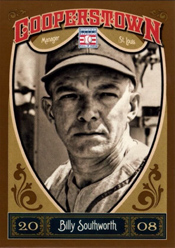
Aaron was 18 when he played his first season in the Braves’ system as a shortstop for Eau Claire (Wis.) in 1952. Braves scout Billy Southworth, the former Cardinals and Braves manager, filed a glowing account on the prospect. According to the book “Baseball’s Greatest Players,” Southworth wrote in his report, “For a baby-faced kid of 18, his playing ability is outstanding.”

Two years later, Aaron, 20, was on the Opening Day roster of the 1954 Braves. Six games into the season, the rookie outfielder was struggling, batting .217 with no home runs and no RBI.

As the Braves entered a three-game series against the Cardinals at St. Louis, speculation was Aaron might be benched whenever outfielder Bill Bruton recovered from a viral infection and returned to the lineup.

Aaron ended that talk with a strong series at St. Louis, hitting .500 (8-for-16) with a pair of home runs and three RBI. He went on to have a solid rookie season (.280 batting average, 27 doubles, 13 home runs and 69 RBI.).

Victim No. 1

In the opener of the Braves-Cardinals series on April 23, 1954, Aaron, batting sixth and playing right field, was 3-for-7 with two runs scored and two RBI in Milwaukee’s 7-5 victory in 14 innings.

In the sixth, with the Cardinals ahead, 4-2, Aaron hit the first of his 755 career home runs, a solo shot off starter Vic Raschi. A week earlier, Aaron got his first hit, a double, also against Raschi. In his autobiography, “I Had a Hammer,” Aaron said, “I was fortunate to be facing him near the end of his career.”

The Braves tied the score in the ninth and each team scored in the 13th.

In the 14th, with Cot Deal pitching for St. Louis, Andy Pafko singled with one out and Aaron also singled, moving Pafko to second. Joe Presko relieved and the first batter he faced, Johnny Logan, reached on an error by shortstop Solly Hemus, loading the bases. Jim Pendleton, batting for pitcher Dave Jolly, singled, scoring Pafko and Aaron. Boxscore

Two days later, on April 25, 1954, in the fifth inning against starter Stu Miller, Aaron hit his second career home run, tying the score at 1-1. Aaron was 5-for-6 in a game won by the Cardinals, 7-6, in 12 innings. Cardinals right fielder Stan Musial was 4-for-6 with a home run. Boxscore

Powerful wrists

Aaron and Musial eventually developed a mutual admiration.

In his book “Stan Musial: The Man’s Own Story,” Musial said Aaron was “one of the best hitters I ever saw … He has tremendous wrist action.”

In choosing his all-time National League outfield, Musial put Aaron in right, Willie Mays in center and Duke Snider in left. The one weakness Musial noticed in Aaron was “the slider bothered him enough to cause him to lose patience and often swing more wildly than he probably intended.”

Aaron said in his autobiography, “Stan Musial was one of my favorite ballplayers because he treated everybody the same _ black or white, superstar or scrub _ and he genuinely loved the game … When he and I were part of a group of players who toured Vietnam, Musial became the first white man I ever roomed with.

“We had been good friends for quite a while,” Aaron said. “Whenever the Braves played the Cardinals, he and I would always manage to meet up at the batting cage and talk about hitting … Basically, his method was to study the pitchers and swing the bat, and that was the way I felt about it … I concentrated on the pitcher. I didn’t stay up nights worrying about my weight distribution, or the location of my hands, or the turn of my hips.”

Big hits

On Sept. 23, 1957, at Milwaukee, Aaron hit a walkoff home run against the Cardinals’ Billy Muffett in the 11th inning, clinching the National League pennant for the Braves.

“I came up with Johnny Logan on first, looking for a pitch I could drive hard enough to bring Logan around,” Aaron said in his autobiography. “I got the breaking ball I was waiting for.” Boxscore

Aaron hit 91 career home runs against the Cardinals. Only the Reds (97) and Dodgers (95) yielded more home runs to him.

The Cardinals pitcher who gave up the most home runs to Aaron was a fellow Hall of Famer, Bob Gibson. Aaron hit eight home runs against Gibson, but batted .215 (35-for-163) versus the Cardinals ace. Aaron had more strikeouts (32) than RBI (26) versus Gibson.

In an interview with Joe Schuster for the 2018 Cardinals Yearbook, Aaron said, “Facing Bob Gibson was kind of like going to the dentist to get a tooth pulled. You know the doctor will give you a shot of Novocaine _ but it ain’t going to be enough. So you just hope it doesn’t hurt too much.”

Aaron’s first home run off Gibson on July 3, 1962, was No. 272 of his career Boxscore and his last home run off Gibson on June 14, 1974, was No. 724. Boxscore

In the book “Sixty Feet, Six Inches,” Gibson said of Aaron, “The man did not miss a fastball … The worst pitch in baseball is the changeup slider, but I’d throw Aaron that changeup slider and he’d be out on that front foot and hit rockets, two hops to the shortstop. All of our shortstops took balls in the chest off the bat of Aaron. They’d go, ‘Damn, Gibby.’ I’d say, ‘Hey, this is the way I get him out. He’s going to knock you over, so be ready for it.’ “

Read Full Post »

(Updated Sept. 20, 2022)

Embarrassed by their inability to stop the Dodgers from stealing bases and convinced they needed to find a solution in order to win a pennant, the 1964 Cardinals turned to an unlikely source for help: Bob Uecker.

bob_uecker2The second-string catcher couldn’t slow Dodgers speedsters, but he did provide a defensive upgrade to a 1964 Cardinals club that won its first pennant and World Series title in 18 years.

On April 9, 1964, St. Louis sent Gary Kolb and Jim Coker to the Braves for Uecker.

Even then, at age 29, well before he became known as a broadcaster and for his comedy roles on television and in the movies, Uecker had a reputation throughout baseball as a funnyman.

Wrote The Sporting News: “Those who know him regard new Cardinals catcher Bob Uecker as a good-humor man.”

“Yes, I guess you can call me a stand-up type of comic,” Uecker said to St. Louis reporter Jack Herman.

The Cardinals, though, were serious about finding a way to overtake the Dodgers.

Armed for defense

In 1963, the Cardinals finished in second place at 93-69, six games behind the National League champion Dodgers. The Cardinals were 6-12 against the Dodgers and stolen bases were a significant reason for that. The Dodgers were successful on 27 of 33 stolen base attempts (82 percent) against the 1963 Cardinals. For the second season in a row, Dodgers speedster Maury Wills had 11 steals in 12 attempts versus the Cardinals.

“If we have a catcher who can throw well, they might think twice about running,” Cardinals manager Johnny Keane said.

Tim McCarver became the starting catcher for the Cardinals after Gene Oliver was traded to the Braves in June 1963 and his primary backup was Carl Sawatski.

McCarver nailed 38 percent of runners (28 of 73) attempting to steal in 1963 and Sawatski nabbed 30 percent (7 of 23). When Sawatski retired after the 1963 season, the Cardinals went looking for a backup for McCarver.

Uecker spent seven seasons in the Braves’ minor-league system. The Braves had groomed Joe Torre to replace veteran Del Crandall as their starting catcher.

In stints with the 1962 and 1963 Braves, Uecker impressed with his arm. He caught 5 of 7 runners attempting to steal in 1962 and 1 of 2 in 1963.

Office politics

Cardinals general manager Bing Devine was ready to make the trade for Uecker, but club consultant Branch Rickey opposed it, in part, because he didn’t want Gary Kolb to be dealt. Rickey had the support of Cardinals owner Gussie Busch and that gave him a voice in any proposed trade.

In his book “October 1964,” author David Halberstam wrote, “As both Keane and Devine pushed hard for the trade, Rickey resisted with a vehemence out of all proportion to the importance of the players at stake.”

As spring training neared its end, Keane asked Devine to make another attempt for Uecker.

“I’m sorry, Johnny, but I can’t go back there anymore,” Devine replied. “I’ve gone as far as i can go on that one.”

According to Halberstam, Devine suggested that Keane could approach Busch and appeal to him to approve the deal. Keane did and Busch granted his permission.

“We got Uecker to help Timmy and make our catching solid,” Keane said. “We’re certainly not vulnerable behind the plate anymore.”

In Uecker’s 1982 book “Catcher in the Wry,” McCarver said, “Uke really did have some talent. The first thing you looked at was his defensive ability _ his throwing arm and glove. I envied his arm (and) his relaxed, quick hands.”

On his first day with the Cardinals, Uecker was introduced to Rickey. According to Halberstam, Uecker extended his hand and said, “Mr. Rickey, I’m Bob Uecker, and I’ve just joined your club.”

“Yes, I know,” Rickey replied, “and I didn’t want you. I wouldn’t trade 100 Bob Ueckers for one Gary Kolb.”

Then Rickey turned and walked away.

Tough test

The 1964 Cardinals opened the season against the Dodgers at Los Angeles. With left-hander Sandy Koufax starting, Keane put Uecker, a right-handed batter, in the Opening Day lineup. (Uecker, the prankster, posed in a left-handed batting stance for his 1965 Topps baseball card.)

Uecker went 0-for-2 at the plate and 0-for-3 in attempting to prevent stolen bases that night. Willie Davis, Maury Wills and Jim Gilliam swiped bases against Uecker and starting pitcher Ernie Broglio.

“Uecker’s arm was not at fault,” The Sporting News reported. “The Dodgers speedsters just got too much of a jump on Ernie Broglio and the catcher’s strong throws were a little too late.” Boxscore

For the season, the 1964 Dodgers had 11 steals in 14 attempts (78 percent) against the Cardinals, but on July 16, 1964, Wills twice was caught attempting to steal against the Cardinals at St. Louis. McCarver was the catcher. Ray Sadecki was pitching the first time Wills was caught; Mike Cuellar was on the mound the second time. Boxscore

Overall, Uecker threw out 38 percent (8 of 21) of all attempted base stealers in 1964. He was 0-for-5 against the Dodgers; 8-for-16 against the rest of the National League. He hit .198, but his defense and his clubhouse popularity enabled him to stick with the Cardinals throughout the season.

The Phillies and Reds turned out to be the Cardinals’ main competition for the crown. Each finished a game behind St. Louis. The Dodgers were 80-82, in sixth place, 13 games behind the Cardinals.

Read Full Post »

(Updated Jan. 19, 2026)

Facing the defending World Series champion Pirates, Cardinals starter Pete Vuckovich performed a high-wire act in the 1980 season opener.

pete_vukovichVuckovich pitched a three-hit shutout in the Cardinals’ 1-0 victory on April 10, 1980, at St. Louis. It was the first of only two times the Cardinals won a season opener by a score of 1-0. The second occurred March 31, 2014, against the Reds at Cincinnati.

In the 2014 game, the Cardinals escaped an eighth-inning jam in which the Reds had runners on first and third with none out. Boxscore

In the 1980 game, Vuckovich performed a Houdini act by striking out the side with two runners on base in the ninth.

Strikeout pitch

Using a variety of off-speed pitches called by catcher Ted Simmons, Vuckovich retired 14 Pirates in a row between the first and sixth innings.

The Cardinals got a run against Bert Blyleven in the second when Bobby Bonds, in his Cardinals debut after being acquired from the Indians, walked and scored on a George Hendrick double.

Vuckovich held the Pirates to two hits through eight innings, but in the ninth it began to unravel.

Pinch-hitter Lee Lacy led off with a single and Omar Moreno followed with a walk, putting runners on second and first with none out.

“We couldn’t ask to be in a better situation,” Pirates manager Chuck Tanner told United Press International.

Tim Foli, who the year before was the toughest National League batter to strike out, stepped to the plate.

Vuckovich struck him out swinging.

Next up, Dave Parker, who was nicknamed “The Cobra” for his ability to uncoil quickly and lash line drives.

Vuckovich struck him out swinging.

“The pitches were looking good and then the ball would break away,” Parker told the St. Louis Post-Dispatch.

Willie Stargell, destined for the Hall of Fame, followed. With the count 0-and-1, Stargell swung and missed at a low pitch that glanced off the wrist of Simmons and rolled into the Pirates’ dugout, enabling Lacy to advance to third and Moreno to second.

Simmons told the Post-Dispatch, “I went to sleep … The ball hit the dirt, but I could have blocked it.”

Stargell watched the next three pitches sail outside the strike zone, making the count 3-and-2.

“You can’t do anything but respect these guys,” Vuckovich said. “There’s no room for getting scared or nervous because they can sense that, too. If they get that feeling, they can get you.”

The payoff pitch from Vuckovich was a wicked breaking ball. “The ball dropped eight inches,” Vuckovich told the Pittsburgh Post-Gazette. Stargell swung and missed with such intensity his bat flew out of his hands and into the stands. The strikeout of Stargell set off a celebration among the 42,867 spectators at Busch Stadium. Boxscore

Praise from Stan

“I was lucky,” Vuckovich said. “It could just as easily have gone the other way.”

Vuckovich delivered 111 pitches, striking out nine and walking two.

“Today was an emotional drain,” Vuckovich said to the Associated Press.

The performance earned Vuckovich the admiration of everyone who witnessed it.

“Amazing,” Stan Musial, the Cardinals’ all-time greatest player, said to The Sporting News. “He throws the best right-handed breaking pitches I ever saw.”

Cardinals pitching coach Claude Osteen said to Bob Fallstrom of the Decatur (Ill.) Herald and Review, “He has total command. Nobody in our league has as many kinds of pitches and such command. There are guys who throw harder. Vuckovich has so many speeds. He has a changeup, an off-speed slider, an off-speed curve. He has great motion on the off-speed pitches. He knows how to pitch.”

Pirates second baseman Phil Garner said, “Vuckovich gets my vote for Cy Young Award already.”

Vuckovich finished 12-9 with three shutouts and a 3.40 ERA for the 1980 Cardinals. After the season, Vuckovich, Simmons and reliever Rollie Fingers were traded to the Brewers. Vuckovich led the American League in winning percentage in each of his first two years with the Brewers and won the 1982 Cy Young Award.


Read Full Post »

« Newer Posts - Older Posts »