Feeds:
Posts
Comments

Archive for the ‘Opponents’ Category

In 1993, when the Cardinals made their first regular-season visit to Miami, several fans of the expansion Marlins switched their allegiance to St. Louis for one game.

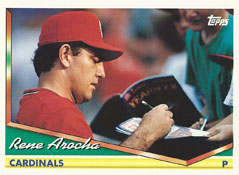
rene_arocha2Cardinals pitcher Rene Arocha, a Cuban defector who settled in Miami, had the support of the South Florida Cuban community when he started against the Marlins on June 23, 1993.

Arocha was a Cardinals rookie in 1993. Two years earlier, on July 10, 1991, while with the Cuban national baseball team, Arocha defected to the United States. He walked out of Miami International Airport and into a waiting car, becoming the first member of Cuban president Fidel Castro’s baseball team to defect, the Sun-Sentinel of Fort Lauderdale reported.

Miami became Arocha’s adopted hometown. The Cardinals won a lottery among major-league teams for the right to sign the Havana native.

A right-hander, Arocha was 5-2 with a 3.05 ERA as he prepared to face the Marlins. He had been on the 15-day disabled list in April after breaking a finger on his glove hand. “If he doesn’t get hurt (again), he’ll win 15,” Cardinals broadcaster Mike Shannon told the Sun-Sentinel. “If he’s lucky, he’ll win 20.”

Rick Hummel of the St. Louis Post-Dispatch wrote that Arocha’s start at Miami was “one of the major happenings of the expansion Florida Marlins’ first season.”

Said Cardinals infielder Jose Oquendo: “The Cubans think that Miami is Cuba.”

Arocha partnered with a Miami radio station and Nike to buy 500 general admission tickets, the New York Times reported. “The Cubans here want to see me pitch,” Arocha told Hummel. “They would be disappointed if I didn’t … The fans, and probably myself, want to win here more than someplace else.”

As anticipation built toward game time at Joe Robbie Stadium, so did Arocha’s anxiety and adrenalin. Cardinals manager Joe Torre and pitching coach Joe Coleman tried to calm him.

“They just told me to concentrate on the job I had to do in the game,” Arocha said. “When I got to the mound, I felt very emotional. I was trying to throw the ball harder than normal.”

Arocha yielded singles to three of the first four batters he faced. “He was pumped up,” Torre said. “He did get a little out of whack trying to throw the ball too hard a few times.”

The Marlins led, 1-0, after an inning. Arocha changed the momentum in the second in a most unexpected way. After the Cardinals scored a run to tie, they had the bases loaded with one out and Arocha at the plate. Arocha, hitless in his first 19 major-league at-bats, drilled a two-run single to center off starter Ryan Bowen, giving St. Louis a 3-1 lead.

“I couldn’t believe it when the ball went into the outfield,” Arocha said of his first big-league hit. “This means more than my first major-league win. I knew what it felt like to win, but I didn’t know what it would feel like to have a base hit.”

Arocha pitched 5.1 innings, yielding six hits and three runs, walking two and striking out two. As he departed, he received a standing ovation from the crowd of 37,936.

“That was a very warm feeling,” Arocha said. “I got a great response from the people that I know were behind me.”

Said Cardinals catcher Erik Pappas: “I was surprised how loud the crowd was. It sounded like they were more for him than they were for the Marlins.”

The Cardinals received 3.2 innings of scoreless relief from Paul Kilgus, Rob Murphy, Mike Perez and Lee Smith, winning, 4-3, and boosting Arocha’s record to 6-2. Boxscore He would finish the season 11-8.

Marlins first baseman and Cuba native Orestes Destrade said of Arocha: “He’s surprised a few of his critics who said he couldn’t pitch at the major-league level.”

Previously: First Rockies lineup had prominent Cardinals connection

Read Full Post »

(Updated June 9, 2020)

Tim McCarver and Terry Pendleton each hit an inside-the-park grand slam for the Cardinals against the Mets on the same date, 22 years apart.

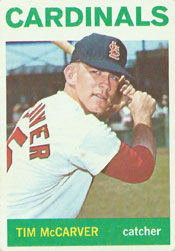
tim_mccarver3Each occurred on June 9 in New York in the second game of a Sunday doubleheader.

McCarver hit an inside-the-park grand slam June 9, 1963, in the Cardinals’ 10-4 win over the Mets in Game 2 of a doubleheader at the Polo Grounds.

Pendleton hit an inside-the-park grand slam June 9, 1985, in the Cardinals’ 8-2 win over the Mets in Game 2 of a doubleheader at Shea Stadium.

Both occurred because of outfield misplays.

Slipping and sliding

The Cardinals led, 6-1, in the eighth inning when McCarver batted with the bases loaded, one out, against Mets rookie reliever Larry Bearnarth and laced a line drive to center.

“I was just figuring on a sacrifice fly,” McCarver told The Sporting News.

Center fielder Rod Kanehl got to the ball and, just as he appeared ready to make the catch, slipped and fell. The ball darted past him and rolled to the wall, 475 feet from home plate. McCarver raced home with his second big-league home run. It was the first grand slam he’d hit at any level of competition.

Cardinals center fielder Curt Flood empathized with Kanehl, informing the St. Louis Post-Dispatch, “The turf is loose and the grass is slippery out there. I slipped three or four times running when the ball wasn’t even hit to me.” Boxscore

Communication breakdown

Like McCarver, Pendleton was looking to extend a Cardinals lead when he came up against Mets reliever Joe Sambito with the bases loaded and one out in the fifth inning. St. Louis led, 4-0.

Pendleton hit Sambito’s first pitch to right-center. Right fielder Danny Heep and center fielder Terry Blocker gave chase.

“At first I thought, ‘Good, we’ll get a run on a sacrifice fly,’ ” Pendleton told the New York Times. “Then I looked in the outfield and saw them flying at each other, not slowing down.”

As Blocker was reaching for the ball, he and Heep collided, and the ball caromed off Blocker’s glove. “We both called for it, but I didn’t hear him until the last second,” Heep said to the New York Daily News.

“I could see it coming,” Cardinals manager Whitey Herzog said to the Associated Press. “Neither one of them knew if they could catch the ball.”

Blocker lay motionless. Heep recovered, retrieved the ball and got it to first baseman Keith Hernandez, whose relay throw was too late to nab Pendleton. Boxscore

“I thought one of them would be able to get up in time,” said Pendleton. “I thought I had a shot at a triple.”

Becker injured both knees and was carried from the field on a stretcher.

“It’s a hell of a way to get a grand slam, isn’t it?” Herzog asked.


Read Full Post »

In 1968, the Cardinals, and all major league teams, were faced with a decision of whether to play games on the day of slain Sen. Robert F. Kennedy’s burial and on the national day of mourning declared in his honor.

stan_rfkCardinals players said publicly they didn’t want to play on either day, but, facing the prospect of forfeiting if the Reds didn’t join them in sitting out, the Cardinals played three games in less than 24 hours over both days.

Other teams and players acted more defiantly, displaying the leadership and clarity baseball commissioner William Eckert lacked.

Kennedy, the New York senator and candidate for the 1968 Democratic presidential nomination, was shot in the predawn morning of June 5, hours after he won the California primary. He died on June 6 at age 42.

The funeral for Kennedy was scheduled for Saturday, June 8, at St. Patrick’s Cathedral in New York. Burial was planned for about 5 p.m. at Arlington National Cemetery near Washington. A train would transport Kennedy’s body from New York to Washington.

President Lyndon Johnson declared Sunday, June 9, a national day of mourning in tribute to Kennedy.

Eckert ordered no big-league game on June 8 would start until after the burial.

The Yankees, Senators and Cubs called off their afternoon home games scheduled for June 8. The Astros called off one of their doubleheader games against the Pirates and said the other game would be held after the burial.

At San Francisco, Mets players refused to play the Giants that Saturday. Mets management supported the players’ decision. The Giants front office, expecting a large crowd at Candlestick Park, was miffed, but agreed to call off the game when Mets officials refused to change their stance.

Other afternoon games, including Cardinals at Reds, were moved to night starts. The Cardinals-Reds game was rescheduled for 7 p.m.

However, when the train carrying Kennedy’s body was delayed by large crowds along the route from New York to Washington, the burial was pushed back several hours.

Cardinals and Reds players held separate pre-game meetings, took the field for warmups, and returned to the clubhouses again when they learned the burial wouldn’t be held before the 7 p.m. game time, the Associated Press reported.

Cardinals players wanted to call off the game, The Sporting News reported, but because they were the visitors they left the decision to the Reds.

Reds manager Dave Bristol urged his team to play. Pitcher Milt Pappas, the Reds’ player representative, disagreed. Pappas told Bristol most Reds players preferred not to play the game, the Associated Press reported. Bristol responded that if he could find nine players to take the field the Reds would play.

“If we go out (on the field to play), we all go out,” Pappas replied. “If we do go out, find yourself a new player representative.”

Pappas took a vote of Reds players on whether to play. The outcome was 12-12, with one abstaining, The Sporting News reported. A second vote was held and the result was 13-12 in favor of playing.

“Pappas lost a power struggle within the club when several players heeded the urgings of manager Dave Bristol to play the game,” The Sporting News reported.

Pappas, telling the Associated Press his “days with the club are numbered,” resigned as player representative.

The June 8 game began at 7:45 p.m. and the Cardinals won, 7-2, before 13,368. Boxscore

“Our position was that we had scheduled this game in good faith at a time about an hour and a half after the burial was scheduled,” Reds general manager Bob Howsam said. “We would have waited if the delay had been a short one.”

Pappas and catcher Tim McCarver, the Cardinals’ player representative, said both clubs voted not to play the doubleheader scheduled for Sunday, June 9, the national day of mourning for Kennedy.

Eckert declared that management of each home club would decide whether to play games that Sunday.

(Two months earlier, Eckert had called off all big-league spring training exhibition games on April 7, the national day of mourning for slain civil rights leader Dr. Martin Luther King Jr. Also, in respect for King’s funeral on April 9, all of the major-league regular-season openers scheduled for April 8 and April 9 were moved to April 10.)

The Orioles called off their June 9 doubleheader with the Athletics and the Red Sox called off their game with the White Sox. All other home teams, including the Reds, decided to play that Sunday.

The Reds scheduled a memorial service for Kennedy before the first game of the doubleheader. The Cardinals won the opener, 10-8, on Lou Brock’s three-run home run. Boxscore The Reds won the second game, 7-6, on shortstop Leo Cardenas’ RBI-double in the 12th off reliever Steve Carlton, the Game 1 starter. Boxscore Attendance was 28,141.

Pappas pitched in relief in both games, yielding a run in eight total innings, and was booed by fans. (Two days later, Pappas was traded to the Braves.)

At Houston that Sunday, Astros third baseman Bob Aspromonte and first baseman Rusty Staub, and Pirates third baseman Maury Wills, refused to play, protesting the decision to hold the game on the national day of mourning. All were fined by their teams.

Pirates outfielder Roberto Clemente decided to join Wills in sitting out the game, but changed his mind after a meeting with manager Larry Shepard, The Sporting News reported. “I preferred not to play,” Clemente said. “The disturbing thing to me was the indifferent attitudes of some of our players.”

Frank Mankiewicz, press secretary for Robert Kennedy, sent telegrams to Pappas, Aspromonte, Staub, Wills and Mets manager Gil Hodges (on behalf of the entire team), thanking them for the stances they took. “Please accept my personal admiration for your actions,” Mankiewicz wrote in the telegrams.

He said Kennedy’s widow, Ethel, would write personal letters to those who received telegrams, the Associated Press reported.

Wrote Bob August of the Cleveland Press, “Baseball’s observance of Senator Kennedy’s death was disorganized, illogical and thoroughly shabby.”

Under the headline, “The Aftermath _ Baseball Takes A Beating,” The Sporting News reported, “Baseball wallowed in a morass of confusion and acrimony in trying to decide what to do about paying respect to Sen. Robert F. Kennedy … For the most part, there was no concrete plan on how mourning for (Kennedy) would be handled.”

Previously: Bob Gibson put aside grief to pitch while mourning MLK

Read Full Post »

On their way to a World Series championship, the 1980 Phillies got sidetracked by a Cardinals rookie pitcher whom Dallas Green, Philadelphia’s tough, savvy manager, called “the mystery man.”

al_olmsteadAl Olmsted, a left-hander and St. Louis native, baffled the Phillies with his screwball during a pair of September starts.

Another rookie left-hander, John Martin, who pitched for three minor league teams in 1980, joined Olmsted in the Cardinals’ starting rotation in September and impressed general manager Whitey Herzog as a pitcher “just wild enough to be good.”

With John Gast and Tyler Lyons, the 2013 Cardinals became the first St. Louis team to use two rookie left-handed starting pitchers in the same season since Olmsted and Martin in 1980.

Olmsted was chosen by the Cardinals in the 13th round of the 1975 amateur draft out of Hazelwood East High School in suburban St. Louis.

After a muscle tear in his left arm decreased his velocity, Olmsted developed a screwball. In 1980, he was 13-9 with a 2.93 ERA in 25 regular-season games combined for Class AA Arkansas and Class AAA Springfield (Ill.). Olmsted also earned two wins in Springfield’s four-game sweep of Denver in the American Association championship series.

The Cardinals rewarded him with a promotion to the big leagues that September.

On Sept. 12, 1980, Olmsted, 23, made his major-league debut, starting against the Phillies in the second game of a doubleheader at Philadelphia. Facing a lineup that included Pete Rose, Mike Schmidt, Greg Luzinski and Lonnie Smith, Olmsted held the Phillies scoreless for 9.1 innings before he was relieved by Jim Kaat.

The Cardinals scored five runs in the 11th and won, 5-0. Boxscore Olmsted didn’t get the decision but proved he belonged in the majors.

“I wasn’t as nervous as I thought I’d be,” Olmsted said to United Press International. “I just wanted to go out there and throw strikes and not embarrass myself. I wasn’t really awed by anybody. My job was to make good pitches and have them hit the ball at somebody.”

Eleven days later, Sept. 23, Olmsted started against the Phillies again, this time at St. Louis. He was pitching on two days’ rest as a substitute for Bob Forsch, who left the team to attend the funeral of his mother.

Olmsted shut out the Phillies for the first six innings, extending his scoreless streak against them to 15.1 innings. He went 8.1 innings, yielding three runs and earning the win in the Cardinals’ 6-3 victory. Boxscore

The loss was a crusher for the Phillies, who fell a half-game behind the Expos in the National League East. The Phillies were 82-68 with 12 to play. Two of their last four losses in a 10-game stretch were in games started by Olmsted.

“(Olmsted) doesn’t throw that many strikes, but he gets us out,” Green said. “He’s a mystery man. But you’ve got to give him credit. He’s figured out how to do it and 82 other pitchers haven’t.”

Said Pete Rose: “(Olmsted) knows what he’s doing. He knows he’s not going to blow a fastball by anybody. Pitchers with slow stuff like that usually give us a lot of trouble.”

Red Schoendienst, the Cardinals’ interim manager, compared Olmsted with Fred Norman, the former Cardinal who went on to become a fixture in the Reds’ rotation, and said Olmsted “gets the ball where he wants it.”

Said Olmsted: “I hope I’m not a mystery man forever.”

Olmsted made five starts for the 1980 Cardinals and posted a record of 1-1 with a 2.86 ERA.

Like Olmsted, Martin spent most of the 1980 season in the minor leagues. A 27th-round choice of the Tigers out of Eastern Michigan in the 1978 draft, Martin was pitching for Class AAA Evansville when Detroit traded him and outfielder Al Greene to the Cardinals for outfielder Jim Lentine on June 2, 1980.

The Cardinals assigned Martin to Springfield and he broke his foot. After he healed, he was sent to Arkansas. He had a 3-3 record and 4.15 ERA in 25 games combined for Evansville, Springfield and Arkansas when he received a surprise promotion to the Cardinals.

Martin’s big-league debut with St. Louis was as unexpected as his call-up. On Aug. 27, in a game against the Astros at St. Louis, Cardinals starter John Fulgham was lifted after one inning when his shoulder stiffened. Martin relieved, limited the Astros to a run in seven innings and earned the win in a 10-2 Cardinals victory.

Martin made 109 pitches and retired 13 in a row during one stretch. Boxscore

“It caught me off guard,” Martin said to the Associated Press of being called into the game in the second inning. “It didn’t give me time to think about it.”

Said Cardinals catcher Terry Kennedy: “He never really gave them anything good to hit. I think he can compete here. I liked his aggressiveness.”

Martin, 24, made his first start on Sept. 6, in the second game of a doubleheader at Houston, yielded a grand slam to former Cardinals outfielder Jose Cruz and took the loss in the Astros’ 6-4 victory. Boxscore

In the season finale, Oct. 5 at St. Louis, Martin pitched his first complete game and got the win in the Cardinals’ 3-2 triumph over the Mets. Martin pitched a seven-hitter and retired the last 10 batters in a row. Boxscore

Herzog said of Martin, “He’s got a good arm. He’s just wild enough to be good.”

In nine games, including five starts, for the 1980 Cardinals, Martin was 2-3 with a 4.29 ERA.

After the 1980 season, the Cardinals traded Olmsted to the Padres in a package for pitchers Rollie Fingers and Bob Shirley and catcher Gene Tenace. After spending the 1981 season at Class AAA Hawaii, Olmsted came back to the Cardinals in the Ozzie Smith trade. He pitched his final season (1982) in the Cardinals’ farm system.

Martin was 17-14 in four seasons with the Cardinals before he was sent back to the Tigers in August 1983.

Read Full Post »

(Updated May 26, 2019)

In the time it takes to circle the bases, Ted Simmons experienced the high of hitting an improbable home run and the low of being ejected.

The incident symbolized the frustrations of the 1978 Cardinals.

ted_simmons16On May 27, 1978, the Cardinals, who’d lost 13 of their last 14 games, faced the first-place Cubs in St. Louis. Frustrated by the strike zone of Paul Runge, Simmons jawed with the plate umpire.

“(Simmons) seemed to be uptight through most of the game,” Runge said to the Associated Press. “Before the seventh inning, I was joking with him and telling him to relax. There was something working on him.”

In the ninth, the Cubs called in closer Bruce Sutter to protect a 2-1 lead. Simmons, who doubled and tripled in the game, was first to bat.

Sutter got ahead on the count 0-and-2. On his next pitch, “I tried to bounce it up there,” Sutter said to the Chicago Tribune, but the pitch was up in the strike zone. Batting left-handed, Simmons crushed it for a 400-foot home run, tying the score.

As he stepped on the plate after rounding the bases, Simmons tipped his batting helmet in Runge’s direction and, according to the ump, said, “Take that.”

Runge ejected Simmons.

“He definitely showed me up, but he didn’t cuss me,” Runge said. “It was a perfect opportunity for him and he took the opportunity.”

Simmons told the Tribune, “I didn’t say a word.”

Cubs manager Herman Franks said he was surprised Simmons got tossed. “I always thought as long as you didn’t swear you couldn’t get thrown out of a ballgame,” Franks said. “It ain’t so anymore.”

The Cubs scored in the 11th and won, 3-2, sending the Cardinals to their 14th loss in 15 games. The Cardinals filed a protest with the National League, arguing Simmons shouldn’t have been ejected.

“I think this has been happening, or brewing, over a long period of time, but unless you call an umpire a name, he (Simmons) shouldn’t be kicked out,” Cardinals manager Ken Boyer said. “We think very strongly that umpires ought to be fined, suspended or reprimanded, just like players.

“The only job (Runge) had was to see if (Simmons) touched the plate. I don’t think that the average fan knew they were having words before. Teddy never once turned around.” Boxscore

Three decades later, in an interview with the San Diego Union-Tribune, Rick Hummel of the St. Louis Post-Dispatch said the ejection of Simmons remained memorable.

“Teddy was not in agreement with Paul Runge’s strike zone,” Hummel recalled. “They had a little debate about balls and strikes. Then Teddy hits a home run to tie the game and as Teddy steps on home plate he is ejected. That’s one of my favorites. Home run and gone.”


Read Full Post »

(Updated June 16, 2023)

As a Cardinals rookie, Dick Hughes delivered a dominant strikeout performance against the Reds that stands out for its artistry and drama.

dick_hughesOn May 30, 1967, Hughes was perfect for seven innings against the Reds at Cincinnati. Then a string of bad breaks and bizarre plays occurred. Hughes struck out 13 in eight innings but took the loss in the Reds’ 2-1 victory.

A right-hander, Hughes spent nine years in the minors. His vision was 20-75 in one eye; 20-300 in the other, according to The Sporting News.

In 1966, Hughes turned around his career by developing a slider and a no-windup delivery. He got his first call to the big leagues with the Cardinals in September 1966.

Hughes, 29, began the 1967 season in the Cardinals bullpen. He became a starter in May, swapping roles with Al Jackson.

Five days after pitching a two-hit shutout in the Cardinals’ 5-0 victory over the Braves in Atlanta Boxscore, Hughes was paired against Reds ace Jim Maloney at Cincinnati’s Crosley Field.

The start of the game was delayed 1 hour, 35 minutes by rain. Unfazed, Hughes retired the first 18 batters. Then play was halted another 55 minutes by rain.

Hughes retired the Reds in order in the seventh, keeping his bid for a perfect game intact, but the second delay had been damaging.

“My slider was not going where I wanted it to and, after the rain stopped the game (a second time), I began relying on my fastball.” Hughes said to the Associated Press.

Cardinals manager Red Schoendienst confirmed, “The delay in the game by rain took a little of the edge off Hughes.”

With the Cardinals ahead 1-0, Tony Perez, leading off the eighth for Cincinnati, swung at a 3-and-2 fastball and lofted a high fly to center. The ball hit off the wall at cozy Crosley for a 380-foot triple “that would have been an easy out in any other park,” The Sporting News reported.

With the perfect game bid ended, Hughes focused on trying to preserve the lead. After he fanned Deron Johnson for the first out, Vada Pinson batted. “Pinson tried to duck from a high pitch, which he later confessed he never saw and, presto, he had a bloop, score-tying double to short left,” The Sporting News reported.

Pinson’s fluke double plated Chico Ruiz, who ran for Perez, tying the score at 1-1.

Trying to set up a double play, Hughes issued an intentional walk to Johnny Edwards, but Leo Cardenas followed with a single, scoring Pinson and giving the Reds a 2-1 lead. Edwards advanced to third on the play, but Cardenas was thrown out at second, trying to stretch the single into a double.

Jim Maloney was due up next. Rather than lift him for a pinch-hitter and turn to a closer in the ninth, manager Dave Bristol opted to let Maloney bat and he ended the inning with a fly out.

Maloney was tiring. Orlando Cepeda opened the ninth with a single. Tim McCarver followed with another single, sending Cepeda to third.

Bristol lifted Maloney and brought in Don Nottebart to face Phil Gagliano, subbing for third baseman Mike Shannon, who had a viral infection.

Gagliano swung at Nottebart’s first pitch and grounded sharply to Cardenas at shortstop. Cepeda should have raced for home. Instead, he hesitated. Cardenas fielded the grounder and flipped to second baseman Tommy Helms, forcing McCarver. Though McCarver slid hard into him, Helms relayed a throw to first baseman Deron Johnson, completing the double play.

(In his book, “Baseball for Brain Surgeons and Other Fans,” McCarver recalled, “I hit Helms so hard on that play that I was concerned enough to call him after the game. In my entire career, that was the only time I called an opposing player to find out if he was OK.”)

On Helms’ throw, Cepeda broke for home. Deron Johnson spotted him and fired the ball to catcher Johnny Edwards, who tagged out Cepeda.

Triple play. Game over.

“Something, eh?” an astonished Dave Bristol said to the Associated Press. “First time I ever threw my cap into the stands.

“I sent Nottebart in to pitch, hoping he would throw a low ball for a grounder. He sure did.” Boxscore

Hughes finished with a pitching line of eight innings, three hits, two runs, one walk and 13 strikeouts. He held Pete Rose hitless, stopping a 25-game hit streak.

“If it hadn’t rained, we never would have got a hit off Hughes,” Chico Ruiz said. “Hughes was just great.”

Read Full Post »

« Newer Posts - Older Posts »