Feeds:
Posts
Comments

Archive for the ‘Opponents’ Category

The Cardinals-Rockies rivalry, known for its high-scoring games, began, improbably, with a shutout.

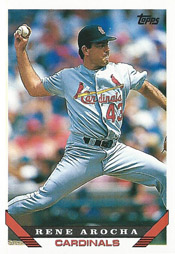
rene_arochaThe Rockies, a National League expansion team, faced the Cardinals for the first time on April 20, 1993, at St. Louis. The Cardinals won, 5-0, on a combined shutout by Rene Arocha and Omar Olivares.

There was a strong Cardinals connection to the first Rockies team that faced St. Louis. Don Baylor, the Rockies’ manager, had been the hitting coach on manager Joe Torre’s staff with the 1992 Cardinals. Rockies first baseman Andres Galarraga and starting pitcher Bryn Smith had played for the 1992 Cardinals. Center fielder Alex Cole had been in the Cardinals’ minor-league system.

Galarraga, who broke his wrist in the Cardinals’ second game in 1992 and finished with a .243 batting average and 39 RBI, signed with the Rockies as a free agent. He entered the Rockies’ first game against the Cardinals with a .422 batting mark and 14 RBI after 11 games.

Before facing the Cardinals, Galarraga told the St. Louis Post-Dispatch, “I’ve always been able to hit, even since I was a little boy in Venezuela. After the injury, I tried too hard when I came back. It got worse. I was swinging at bad pitches.”

Said Baylor: “He’s hitting the ball to right field more. That’s what he has to do to be successful.”

The starting lineups in the first Rockies-Cardinals game:

ROCKIES

1. Eric Young, second base

2. Alex Cole, center field

3. Dante Bichette, right field

4. Andres Galarraga, first base

5. Charlie Hayes, third base

6. Jerald Clark, left field

7. Joe Girardi, catcher

8. Freddie Benavides, shortstop

9. Bryn Smith, pitcher

CARDINALS

1. Geronimo Pena, second base

2. Ozzie Smith, shortstop

3. Gregg Jefferies, first base

4. Ray Lankford, center field

5. Mark Whiten, right field

6. Todd Zeile, third base

7. Brian Jordan, right field

8. Hector Villanueva, catcher

9. Rene Arocha, pitcher

On a chilly Tuesday night before 30,516 at Busch Stadium, the Cardinals scored three in the first and two in the fourth against Smith.

Arocha, a rookie, was cruising through 5.2 innings until a line drive by Bichette struck the pitcher’s gloved hand, fracturing a finger. Olivares relieved and retired the 10 batters he faced. So dominant were Arocha and Olivares that Cardinals outfielders handled just one fly out. Boxscore

The win was the only one Arocha earned against the Rockies in four big-league seasons. The Cardinals won seven of 12 games against the expansion Rockies.

Previously: Revisiting the Gregg Jefferies deal: Cardinals’ good gamble

Read Full Post »

(Updated Nov. 23, 2024)

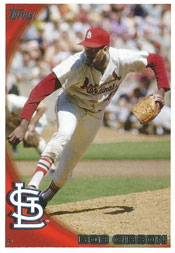
Like the rest of the Cardinals’ rotation in May 1968, Bob Gibson nearly was untouchable. Unfortunately for Gibson and the Cardinals, he wasn’t unbeatable.

bob_gibson13Led by Gibson, Cardinals starters had an ERA of 2.03 in May 1968.

In six starts, Gibson’s ERA in May 1968 was 1.27, but his record that month was 2-4. Both wins required him to pitch extra innings.

Gibson yielded only 10 runs (eight earned) in 56.2 innings in May 1968, but the Cardinals never scored more than three runs in any of his six starts that month. In Gibson’s four May losses, the Cardinals scored three runs total.

Asked about that lack of run support in a 2018 interview with Stan McNeal of Cardinals Yearbook, Gibson said, “I was frustrated. Whenever I pitched, I would be pissed off even before I started because I knew we weren’t going to score.”

May was the only month Gibson had a losing record in 1968. He was a combined 12-0 in June and July.

Gibson finished the 1968 regular season with a 22-9 record, 1.12 ERA, 268 strikeouts, 28 complete games and 13 shutouts. He earned both the National League Most Valuable Player Award and Cy Young Award.

With better run support, he could have been a 25-game winner that season.

Here’s a game-by-game look at Gibson’s six May starts in 1968:

_ Cardinals 3, Astros 1, 12 innings, at Houston, May 1, 1968: Gibson limited the Astros to an unearned run in 12 innings. After the Cardinals scored twice in the 12th, Julio Gotay, a former Cardinal, led off the Astros’ half of the inning with a double. Gibson retired the next three batters on a pair of infield pop-ups and a fly out. Boxscore

_ Cardinals 2, Mets 1, 11 innings, at St. Louis, May 6, 1968: Gibson improved his career record against the Mets to 18-3 in winning a duel with Tom Seaver. Both aces went the distance. They worked so efficiently that the 11-inning game was completed in 2 hours, 10 minutes. In the 11th, Lou Brock tripled and scored on Orlando Cepeda’s single. Boxscore

_ Astros 3, Cardinals 2, at St. Louis, May 12, 1968: Gibson struck out 10 in eight innings, but Denis Menke lifted the Astros with a two-run single in the seventh. Boxscore

_ Phillies 1, Cardinals 0, 10 innings, at Philadelphia, May 17, 1968: In the 10th, Phillies pitcher Woodie Fryman singled. Two outs later, he scored on a single by Bill White, the former Cardinal and Gibson’s friend. Boxscore

_ Dodgers 2, Cardinals 0, at St. Louis, May 22, 1968: Gibson yielded one hit in eight innings. It was a RBI-double by Wes Parker in the third. The Dodgers added a run off reliever Joe Hoerner in the ninth. Boxscore

Frustrated that the Cardinals had failed to score in his last two starts, Gibson was in a foul mood when approached by his catcher after the loss to the Dodgers. In his book “Stranger to the Game,” Gibson said, “(Tim) McCarver followed me into the trainer’s room and said, ‘Hoot, I’m really sorry. I know our crappy hitting has gone on for too long.’ I stopped him in the middle of the apology and snapped, ‘I’m tired of listening to these … excuses.’ Then I turned and disappeared into the shower. I don’t why I took out my frustrations on McCarver _ I guess he was good for that _ but I wouldn’t talk to him for hours afterwards.”

_ Giants 3, Cardinals 1, at St. Louis, May 28, 1968: Gibson yielded a solo home run to Dick Dietz in the sixth and a two-run home run to Willie Mays in the seventh. The homer by Mays, 37, was the last of three in his career against Gibson. Boxscore


Read Full Post »

(Updated April 3, 2018)

Curt Flood slugged two home runs against Dodgers ace Sandy Koufax. The first was part of a rare feat. The second was the last home run hit against Koufax.

sandy_koufaxOn Aug. 17, 1958, Flood and Gene Freese led off a game for the Cardinals against the Dodgers at the Los Angeles Coliseum with back-to-back home runs against Koufax.

Cardinals manager Fred Hutchinson stacked five right-handed batters among the top six in his order against the left-hander. The Coliseum, the Dodgers’ home in their first season after moving from Brooklyn, enticed right-handed batters to pull pitches to a left field fence 251 feet from home plate. A 42-foot screen was erected atop the fence, but batters weren’t deterred.

Flood, in his first season with St. Louis, opened the game by hitting a home run over the left-field screen. Freese, an infielder acquired by the Cardinals from the Pirates in a June trade, followed with a home run to the same spot.

The Cardinals scored four in the first against Koufax and he was lifted with one out in the second. Koufax faced 10 batters, yielded four hits and two walks and took the loss in a game won by the Cardinals, 12-7. Boxscore

“After going five straight games without coming close to a homer, Curt Flood and Gene Freese helped the Cards find the combination again at Los Angeles’ chummy left field fence in the Coliseum,” The Sporting News reported.

Eight years later, on Sept. 29, 1966, at St. Louis, in what would be his last appearance against the Cardinals, Koufax and Flood faced one another for the final time.

Koufax entered the game with 294 strikeouts, needing six more to become the first big-league pitcher to achieve 300 in a season three times. In the fourth inning, Koufax fanned Flood for strikeout No. 300 and got a standing ovation from the St. Louis crowd.

Seeking his 26th win of the season, Koufax and the Dodgers were ahead, 2-0, before Flood led off the seventh with a home run.

It would be the last home run hit against Koufax, who would retire after the season. (Koufax yielded 204 home runs in 12 big-league seasons, plus two in the 1963 World Series.)

In the ninth, Koufax struck out the first two batters, Lou Brock and Jerry Buchek, before Flood doubled to center.

“I got a little tired near the end and made a mistake with Flood,” Koufax said to United Press International. “Imagine, after eight or nine years in the league, I still don’t know how to pitch to Flood.”

Flood hit .296 [32-for-108] in his career against Koufax.

What happened next sparked much debate. Dodgers manager Walter Alston went to the mound and, according to United Press International and the Los Angeles Times, ordered Koufax to intentionally walk Orlando Cepeda, putting the potential go-ahead run on base.

“I didn’t argue,” Koufax said, “but I doubt that we would have done it if we were playing at home.”

Said Alston to the St. Louis Post-Dispatch: “I kind of stuck my neck out a little.”

Cepeda had five career home runs against Koufax. Alston preferred to take his chances with Mike Shannon, one of the top home run and RBI producers on the 1966 Cardinals.

Said Alston: “I went to the mound to Koufax after Curt Flood doubled and said, ‘Sandy, I think I’d rather have you pitch to the other guy (Shannon).’ Sandy agreed.”

Shannon flied out to center fielder Willie Davis, ending the game, a 2-1 Dodgers victory. Boxscore

“How about Alston putting that winning run on base?” said Cardinals manager Red Schoendienst. “I guess you can get away with it when you have Sandy Koufax on the mound.”

Morris McLemore, sports editor of the Miami News, wrote, “In a situation like that, baseball is the most exciting game ever devised, for the final decision was made of drama, great skill and chance-taking in almost equal proportion.”

Koufax finished with a four-hitter and 13 strikeouts.

“I thought I had a better curve ball than I have had at any other time this season,” Koufax said.

Read Full Post »

Not even a word from Bob Gibson could prevent Rick Camp from surrendering the hit that propelled the Cardinals to their first National League pennant in 14 years.

rick_campThe Cardinals completed a three-game sweep of the best-of-five 1982 National League Championship Series, beating Camp and the Braves, 6-2, in Game 3 at Atlanta. The victory vaulted them into the World Series for the first time since 1968, when Gibson was their ace.

Camp is remembered most for the home run he hit with two outs in the bottom of the 18th inning of a July 4, 1985, game against the Mets, tying the score 11-11. The Mets won, 16-13, in 19 innings and Camp was the losing pitcher. Boxscore

In Cardinals history, Camp is better recalled for his second-inning woes in the deciding game of the playoff series.

After Camp retired the Cardinals in order in the first, Keith Hernandez led off the second with a single and Darrell Porter walked. Camp thought he struck out Porter on a pitch instead ruled a checked swing.

George Hendrick singled, scoring Hernandez and advancing Porter to third, and St. Louis led, 1-0.

As Willie McGee approached the plate, Gibson, a Braves pitching coach for manager Joe Torre, went to the mound to talk with Camp. Torre split the pitching coach duties between Gibson and former catcher Rube Walker. “Rube teaches them how to pitch,” Torre told The Sporting News. “Gibby teaches them how to win.”

On Camp’s first pitch after Gibson’s visit, McGee tripled to right-center, scoring Porter and Hendrick.

“I made a bad pitch,” Camp told the Rome (Ga.) News-Tribune. “It was a fastball belt high, a fastball that was up, and that’s what broke it open.”

After the next batter, Ozzie Smith, singled to center, scoring McGee and giving the Cardinals a 4-0 lead, Torre lifted Camp for Pascual Perez. Boxscore

“From the beginning, in the bullpen, I didn’t have anything,” Camp said. “I thought maybe I would work it out in the first two or three innings.”

Instead, Camp faced eight batters, yielding four runs, four hits and a walk. Video

In a nine-year career with the Braves (1976-85), Camp made 28 appearances against the Cardinals, posting a 4-4 record and 4.25 ERA.

Read Full Post »

Cardinals players Tino Martinez and Mike Matheny were involved in an Easter Sunday brawl on April 20, 2003, at Busch Stadium. Martinez and Diamondbacks pitcher Miguel Batista sparked the fight.

tino_martinezBruised egos were the only serious damage either team experienced in the Holy Day melee.

Leading off the bottom of the fifth inning, Martinez was struck on the shoulder by a Batista pitch. It was the fourth time Martinez had been hit by a pitch in the young season.

Wrote Dan O’Neill of the St. Louis Post-Dispatch, “Martinez glared at Batista as he haltingly made his way toward first base. Instead of resuming his place on the mound, Batista stared back at Martinez, watching him all the way to the bag. Cardinals manager Tony La Russa then came out to first base to check on Martinez, and he exchanged stares and unpleasantries with Batista.”

The next batter, J.D. Drew, grounded to second baseman Junior Spivey, who tossed to shortstop Tony Womack, forcing Martinez at second base.

As Martinez headed toward the dugout, he and Batista exchanged looks, then Martinez charged the mound, the Associated Press reported. Martinez threw a punch; Batista fired the ball at him. Both missed.

Players from both sides poured onto the field and a brawl ensued. Wrote O’Neill, “One of the first Cardinals to join the fray was Matheny, who got in a few licks before he and Martinez were pulled down into the pile. Batista continued to throw punches as umpire Ed Montague and Arizona manager Bob Brenly backed him into left field. Martinez and Batista were ejected.”

Regarding Batista, Cardinals pitcher Brett Tomko said, “What makes it worse is he threw the ball at him. That’s just bush. You don’t do that stuff. I understand the guy is coming at you, but there are more things involved in a brawl. You don’t want to seriously injure somebody chucking a ball five feet away from him.”

Said La Russa: “The only thing I’m going to say is when you drill somebody and you stare at him like he stared, that is so unprofessional and so intentional-looking. I mean, he just stared at him like, ‘Hey, I meant to do it’ the whole time.

“Then he runs. That’s ridiculous. I don’t know what history is there, but that’s the kind of stuff that hitters take offense to when they take a plunking. That was brutal.”

The Diamondbacks accused La Russa of inflaming the situation by glaring at Batista. “Definitely,” said catcher Chad Moeller. “There’s no question about that.”

Said Diamondbacks outfielder Luis Gonzalez: “When that first situation happened, he (La Russa) goes up the line and he’s yelling at our pitcher. He’s trying to rattle our guys. That’s how he does it and that’s how he gets his team fired up.”

Brenly said, “I really don’t know what Batista is supposed to do to protect himself against a 240-pound charging bull who is supposed to leave the field immediately after he’s retired (on the forceout).”

Tempers flared again in the ninth. With two outs, reliever Jeff Fassero plunked Gonzalez with a pitch. Fassero and La Russa were ejected.

“That’s old baseball,” Fassero said. “I play old baseball … I still believe in the old ways, settling scores for teams and stuff like that, protect your guys.”

In the bottom half of the inning, with the Diamondbacks ahead, 1-0, Edgar Renteria led off with a double and Jim Edmonds walked against closer Matt Mantei. After Scott Rolen and Miguel Cairo struck out, Drew was hit by a pitch, loading the bases and bringing Matheny to the plate.

Throwing heat, Mantei struck out Matheny, ending the game. Mantei’s final pitch reached 100 mph.  Boxscore

Summing up the day, Arizona first baseman Mark Grace said, “It was one of those situations where boys will be boys … Guys get hit, guys get (mad), guys fight.”

Eight years later, Batista pitched for the Cardinals and La Russa.


Read Full Post »

(Updated April 16, 2020)

Dizzy Dean was a weakened pitcher who was feuding with his manager, but when the Cardinals traded him to the Cubs on the eve of a season opener it was a surprise to nearly everyone.

dizzy_dean4On April 16, 1938, Dean was dealt to the Cubs for $185,000 and three players, pitchers Curt Davis and Clyde Shoun and outfielder Tuck Stainback.

“The deal hit like a lightning bolt from the blue, for there had not been even the slightest indication the famous and eccentric pitcher had been on the block,” the St. Louis Globe-Democrat reported.

Dean, 28, had a 134-75 record in seven Cardinals seasons, including 30-7 in 1934 when he carried them to a World Series title. Dean won twice in the 1934 World Series against the Tigers, including a six-hit shutout in the decisive Game 7.

Reasons to deal

From 1935-37, the Cardinals finished second, second and fourth. When the Cubs approached Cardinals owner Sam Breadon and executive Branch Rickey about a deal for Dean during spring training in 1938, there was interest because:

_ Damaged arm. During the 1937 All-Star Game, a ball hit by Earl Averill of the Indians struck Dean on the left foot and broke his toe. Dean pitched again too soon after the injury. Compensating for the damaged toe, he altered his pitching motion and weakened his right arm, essentially losing his devastating fastball.

In the book “Ol’ Diz: A biography of Dizzy Dean,” author Vince Staten wrote, “Rickey was convinced Diz’s career was over and he was upfront with the Cubs about Diz … The Cubs knew they were getting damaged goods.”

When informed of the trade, Giants manager Bill Terry told the Chicago Tribune, “I do not believe Branch Rickey would get rid of the pitcher Dean was two years ago. If he were still a man who could win 20 to 30 games, I think he would have stayed with the Cardinals. Rickey must know he is through as a great pitcher and has got what he can for him.”

_ Feuds with Frisch. Dean and Cardinals manager Frankie Frisch feuded often. After they had a couple of run-ins during spring training in 1938, the Cardinals decided to act.

“The pitcher and his manager … were embroiled in more than the usual amount of bickering during the training season, with the result that the Cardinals believed that Dizzy’s value to them was dubious, at best,” International News Service reported. “The situation finally reached a point where either Dean or Frisch had to go.”

Wrote The Sporting News: “Renewed trouble with manager Frankie Frisch … finally moved Sam Breadon and Branch Rickey to sell their star of stars.”

On the day of the trade, the Associated Press reported Dean saying to Frisch, “Frankie, I want you to know I’ve enjoyed playing for you.”

Replied Frisch, “Diz, I’m sorry to see you go.”

A Cardinals player, witnessing the exchange, said loud enough for others to hear, “Bunk.”

_ Bigger than team. Rickey and Breadon decided Dean was taking too much credit for team successes and focusing too much attention on self.

“Even when he’s good, one pitcher doesn’t make a club,” Rickey said.

Said Breadon: “I think the team will be a 23-player club now and not a Dizzy Dean club.”

Cubs come calling

When the Cubs first approached the Cardinals about Dean, they offered two players and $150,000, The Sporting News reported. The Cardinals countered with a demand of two players and $200,000. A compromise was reached when the Cubs added Stainback to the deal, giving the Cardinals three players, plus $185,000.

The deal was completed in a phone call between Rickey and Cubs owner P.K. Wrigley while the Cardinals were defeating the Browns, 10-7, in an exhibition game at St. Louis on April 16. The trade was announced immediately after the game, stunning Cardinals players.

“There goes our pennant and World Series money,” Pepper Martin said.

Said fellow outfielder Terry Moore: “Yeah, we’d have been a cinch with Diz.”

Dean told his teammates, “I hate to leave you guys, but I bet that fellow Wrigley will give me more money than I was getting here.”

Replied Martin: “Yeah, maybe Wrigley will buy you a yacht, too, so you can float around on Lake Michigan.”

Informed the Cardinals got a lot of money from the Cubs in the deal, Martin told the St. Louis Globe-Democrat, “You can’t play cash on the baseball field.”

Cubs manager Charlie Grimm told the Chicago Tribune the trade was “a dandy” and said, “We now have a stop pitcher and that’s something we lacked.”

Dean told the Associated Press, “The deal came as a surprise and I haven’t quite got over it yet, but I’m tickled to be playing under Grimm.”

Money ball

In his book, Staten wrote, “The trade would help both clubs in other ways. The $185,000 covered the Cards’ entire season payroll. And Diz helped the Cubs fill the seats at Wrigley Field.”

Also, Rickey had a personal incentive to trade top players for cash because his contract called for him to get a percentage of the sale as remuneration in addition to his salary.

According to the St. Louis Star-Times and St. Louis Globe-Democrat, Rickey tried to acquire fireball pitcher Van Lingle Mungo from the Dodgers after dealing Dean, but it didn’t work out. Rickey also contacted the Phillies about pitchers Claude Passeau and Bucky Walters, but came up empty there, too, the Star-Times reported.

Though sidelined for most of May, June and July, Dean was effective when he pitched in 1938. He was 7-1 with a 1.81 ERA in 13 games for the 1938 Cubs, who won the National League pennant.

The Cardinals stumbled to a sixth-place finish and Frisch was fired in September before the season ended.

Dean, however, never regained the form that made him a sensation with St. Louis. He was 9-7 over the next three seasons with Chicago.

Read Full Post »

« Newer Posts - Older Posts »