Feeds:
Posts
Comments

Archive for the ‘Pitchers’ Category

(Updated Oct. 7, 2020)

Bob Gibson and Sandy Koufax were scheduled to start against one another in a September 1962 showdown of two of the premier pitchers of the era.

The matchup never materialized.

Gibson broke his leg before the game and Koufax was knocked out without completing an inning.

The unlikely standout that night: Cardinals right fielder Charlie James.

On Sept. 21, 1962, at St. Louis, Koufax was making his first start in more than two months. The Dodgers left-hander had been sidelined because of an injured pitching hand. News reports called it a circulatory problem in the index finger of his left hand. The injury was much more serious _ a crushed artery in the palm of his hand, according to Jane Leavy in her book “Sandy Koufax: A Lefty’s Legacy.”

Though, Leavy reported, the hand injury had bothered Koufax since April (by July, the tissue was close to gangrene, she wrote), he entered the September start against St. Louis with a 14-5 record and 2.15 ERA.

Gibson was 15-13 with a 2.85 ERA. The Cardinals right-hander had lost his last four consecutive decisions and was looking to finish on a high note in his final three starts of the 1962 season, beginning with the Friday night game against the Dodgers.

Trouble occurred before the game started.

Wearing new spikes, Gibson participated in batting practice. Turning away sharply from a pitch, his spikes caught in the ground and he toppled over in pain, The Sporting News reported. Gibson fractured a bone above his right ankle and his leg was placed in a cast.

“It sounded just like a twig snapping,” Gibson told The Sporting News. “I could hear it and feel it tear.”

Gibson was replaced by Curt Simmons, a left-hander who had made one start since late August.

Koufax, meanwhile, was making his first appearance since a one-inning start July 17 at Cincinnati.

Relying mostly on fastballs against the Cardinals, Koufax walked the first two batters, Julian Javier and Curt Flood.

When Stan Musial struck out looking and Ken Boyer flied out to left, it appeared Koufax had found his groove, but he walked Bill White, loading the bases.

That brought to the plate James, a right-handed batter with a .277 average. James hadn’t hit a home run or driven in a run all month.

With the count 2-and-2, Koufax was a strike away from getting out of the jam. The next delivery was high and away. James swung and launched a shot onto the pavilion roof in right for a grand slam.

In a six-year big-league career, James hit 29 home runs. His only grand slam was the one off Koufax. James told New York Times columnist Arthur Daley the grand slam “gave me the most personal satisfaction and the most surprise” of any home run he hit.

“I was merely trying to meet the ball and was astonished to see it land on the roof in right field,” James said.

Years later, James told the St. Louis Post-Dispatch, “You couldn’t hit Koufax’s 100 mph fastball, but if the ball started at the knees, it would rise to belt high by the time it got to the plate. That was the only way you could hit it.”

Koufax walked the next batter, Gene Oliver, and was relieved by Ed Roebuck.

“If he had got out of that first inning,” Dodgers manager Walter Alston said about Koufax, “no telling how long he might have gone.”

Asked whether the left index finger still bothered him, Koufax replied, “My finger doesn’t feel 100 percent … but it does feel as good as it did the two or three games before I went under the doctor’s care.”

The Cardinals won, 11-2. Boxscore

Two years later, April 22, 1964, James hit another first-inning home run off Koufax, a three-run shot in a 7-6 Cardinals victory. Boxscore

In a 12-year big-league career, Koufax yielded 204 home runs, including six grand slams.
Read Full Post »

In 2012, the Cardinals shut out the Cubs in consecutive games at St. Louis.

Those were the Cardinals’ first back-to-back shutouts of the Cubs in 23 years.
Spurred by an explosion of power hitting, the 2012 Cardinals beat the Cubs, 12-0, on July 21 and won again, 7-0, on July 22.

Jake Westbrook pitched seven scoreless innings July 21 and relievers Barret Browning, Victor Marte and Trevor Rosenthal completed the shutout. Lance Lynn pitched six scoreless innings July 22 and combined with relievers Fernando Salas and Marc Rzepczynski for the second consecutive shutout.

In 1989, the Cardinals’ back-to-back shutouts of the Cubs occurred in Chicago.

On June 9, 1989, a 15-mph wind came out of the northwest at Wrigley Field, meaning it was blowing toward the batters. Facing Scott Sanderson, the Cardinals scored in the first inning on back-to-back two-out doubles by Ozzie Smith and Pedro Guerrero.

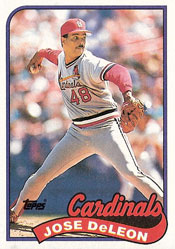
Cardinals starter Jose DeLeon made the run hold up. He limited the Cubs to three hits and struck out 10 in eight innings. In the ninth, Ken Dayley relieved, recorded an out and yielded a single to Damon Berryhill. Todd Worrell came in and retired the next two batters for the save in the Cardinals’ 1-0 victory. Boxscore

“It makes a big difference when the wind is blowing in,” DeLeon said to the Associated Press. “My breaking ball is a lot better when the wind is blowing in.”

Cubs manager Don Zimmer said DeLeon “was outstanding. Over the last two years, he’s the most improved pitcher I’ve seen in the big leagues.”

The next day, June 10, Joe Magrane pitched a complete-game shutout, Tony Pena drove in three runs and St. Louis won, 6-0. Magrane struck out nine, including Ryne Sandberg twice. Boxscore

“I wouldn’t trade (Magrane) for any pitcher in the league, except maybe (Doc) Gooden,” Cardinals manager Whitey Herzog told The Sporting News.

DeLeon (16-12, 3.05 ERA, three shutouts) and Magrane (18-9, 2.91 ERA, three shutouts) had successful seasons for the 1989 Cardinals, but the Cubs won the division title, finishing seven games ahead of St. Louis.

Previously: Cardinals have strong link to Mets’ 50-year anniversary

Read Full Post »

Be careful not to tip your pitches and don’t let a blowout loss keep you down.

Those were among the lessons learned by the 1961 Cardinals after a humiliating loss to the Pirates.

The Pirates beat the Cardinals, 19-0, on Aug. 3, 1961, at St. Louis. It’s the most lopsided shutout loss in Cardinals history. Until then, the only other National League game decided by a 19-0 score was the Cubs’ victory over the Giants on June 7, 1906, according to The Sporting News.
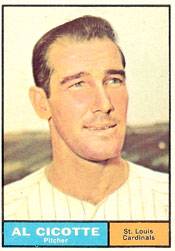
Pittsburgh had 24 hits against three Cardinals right-handers: Al Cicotte, Bob Miller and Lindy McDaniel. Each of the nine Pirates in the starting lineup, including pitcher Harvey Haddix, had at least one hit.

“Some of our pitchers were tipping their pitches,” Cardinals manager Johnny Keane said to the Associated Press. “We were watching them closely after (the Pirates) got a big lead and we could call almost every pitch. Maybe the Pirates could, too.”

Cicotte, making the last start of a five-year big-league career, yielded eight runs in two innings. Miller gave up nine runs in three innings. McDaniel surrendered two runs, but shut out the Pirates over the last three innings.

Among the most notable Pittsburgh hitting achievements that Thursday night at Busch Stadium:

_ Roberto Clemente had hits in each of his first five at-bats. He finished 5-for-6, improving his league-leading batting average to .366, 24 points higher than the next-best hitter, Frank Robinson of the Reds.

“This is just one of those years when the balls are falling in for hits,” Clemente said. “I’m less tense this season than ever before. I can relax better at the plate.”

_ Smoky Burgess had two home runs (both off Cicotte) and six RBI. The homers were the first by Burgess since June 22.

“This is the first time in almost six weeks I’ve been able to pull the ball,” Burgess said. “I know now I tried to play too soon after I hurt my finger late in June. Everything is fine now.”

_ Dick Stuart hit a grand slam off Miller and finished with five RBI.

_ Bill Mazeroski, the eighth-place batter, had four hits.

_ Three Pirates, Don Hoak, Bill Virdon and Bob Skinner, each had three hits. All of Skinner’s hits were doubles.

Pittsburgh, the defending World Series champion, broke a five-game losing streak with the victory. Boxscore

“I can’t help thinking we’d be in the first division if you could spread those runs around a little,” Pirates manager Danny Murtaugh said.

The loss dropped the Cardinals to 48-53.

In a classic example of the power of perserverance, the Cardinals followed the blowout loss with an eight-game winning streak, turning around their season. The Cardinals were 20-9 in August and finished the season at 80-74.

Among the wins in that streak: a shutout of Pittsburgh. On Aug. 9, six days after the Pirates scored 19, Curt Simmons and Ed Bauta combined for a seven-hitter in St. Louis’ 4-0 victory.

Read Full Post »

(Updated Aug. 7, 2018)

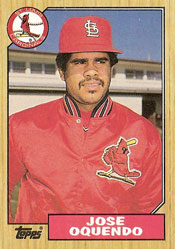
Imagine a Cardinals lineup of Willie McGee at shortstop, Ricky Horton in right field and Jose Oquendo on the mound.

Manager Whitey Herzog could.

In 1987, during a blowout loss to the Phillies, Herzog made all of those unusual moves. He also batted Oquendo for Jack Clark and used John Tudor as a pinch-hitter with two runners on base.
On Aug. 7, 1987, the Cardinals were in first place in the National League East Division, but on that Friday night at Philadelphia’s Veterans Stadium the Phillies grabbed control early, scoring seven runs in the first two innings off Joe Magrane.

In the fifth inning, with the Phillies ahead 12-1, St. Louis had runners on first and second, two outs, when Herzog lifted Clark, the Cardinals’ slugging first baseman, for Oquendo.

Oquendo struck out against Phillies starter Shane Rawley and stayed in the game, replacing Ozzie Smith at shortstop.

In the eighth, Philadelphia led 12-4 and St. Louis had runners on first and third with one out. Reliever Bill Dawley was due to bat against Kent Tekulve, the Phillies’ sidearm-throwing right-hander. Herzog instead sent another pitcher, Tudor, a left-handed batter, to face Tekulve.

Tudor, a career .154 hitter, grounded into an inning-ending 4-6-3 double play, lost his balance as he tried to beat the relay throw and fell. “He runs down the line like a damn nut,” Herzog said to the St. Louis Post-Dispatch.

Things got even more strange.

Needing a pitcher to replace Dawley for the bottom of the eighth, Herzog turned to his shortstop. Oquendo already had played every position except pitcher and catcher in 1987.

To replace Oquendo in the infield, Herzog moved his center fielder, Willie McGee, to shortstop. The right fielder, John Morris, moved to center. That left the Cardinals without a right fielder. So Herzog put pitcher Ricky Horton in that spot.

It would be the only times in their big-league careers McGee would play shortstop and Horton would appear in the outfield.

Two balls were hit to right field. Both carried over the head of the harried Horton. The first, by Glenn Wilson, was ruled a double and drove in a run. The second was a single by Lance Parrish that scored Wilson.

“Horton played what must be described as periscope outfield,” the Post-Dispatch reported. “He would take two steps and watch from afar as the ball sailed over his head.”

“Some outfielders shy away from the walls,” Horton said to The Sporting News. “I just happened to shy away 30 yards from it.”

After watching the spectacle from the mound, Oquendo said, “I could have got out of the inning. We need better outfielders.”

Said Horton: “I apologized to Jose, but the good thing is I didn’t get anybody hurt, including myself.”

McGee handled his defensive chores at shortstop skillfully. With a runner on first, Milt Thompson grounded to McGee, who fielded the ball and threw to second for the forceout. Later in the inning, with Parrish at first, Steve Jeltz grounded to first baseman Jim Lindeman, who threw to McGee covering second for the forceout.

Oquendo surrendered three runs on four hits and a walk in his inning of relief work. He also hit a batter, his friend and fellow Puerto Rican Luis Aguayo.

“The best pitch he threw was when he hit the guy,” umpire Joe West said to the Post-Dispatch.

Before facing his first batter, Oquendo told catcher Steve Lake he could throw six different types of pitches. After his outing, Oquendo quipped, “He called the wrong pitches.”

Lake good-naturedly replied, “He says he’s got six pitches. I call fastball and he says, ‘Yeah.’ I call another fastball. ‘Yeah.’ Then I call something else. He says, ‘No.’ ”

(Oquendo would pitch for the Cardinals in two more games, one in 1988 and the other in 1991. He went four innings in 1988 against the Braves and took the loss in a 19-inning game won by Atlanta, 7-5.)

After the debacle in Philadelphia, a 15-5 Phillies win that broke a six-game losing streak, Herzog told the Associated Press, “In 162 games, you’ll have one like this.” Boxscore

Previously: How Andy Van Slyke amazed Jose Oquendo

Read Full Post »

An eight-game winning streak over seven days in mid-September broke open a tight division race and propelled the Cardinals to their first National League East title in 1982. From there, St. Louis swept the Braves in the league championship series and defeated the Brewers in a seven-game World Series.

On Sept. 14, the 1982 Cardinals were at a critical point in their season. In losing 2-0 the night before to Philadelphia and ex-Cardinal Steve Carlton, St. Louis had slipped out of first place, a half-game behind the Phillies. Boxscore
With two more to play at Philadelphia before heading to New York for a five-game series, including back-to-back twi-night doubleheaders, against the Mets, the Cardinals appeared to be in jeopardy of falling farther behind.

Instead, buoyed by spectacular pitching (including starts from a Mexican League retread and a 43-year-old left-hander), the Cardinals regrouped and won the next eight in a row from Sept. 14 through Sept. 20. The streak placed the Cardinals comfortably into first place, 5.5 games ahead of Philadelphia.

During the streak against the Phillies and the Mets, the Cardinals held their opponents to seven total runs in winning eight, seven on the road.

Here is how it happened:

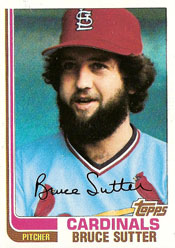
_ Sept. 14 at Philadelphia, Cardinals 2, Phillies 0: Backed by catcher Darrell Porter’s two-run home run, John Stuper (7.1 innings) and Bruce Sutter combined on the shutout. In the eighth inning, with the bases loaded, Sutter got third baseman Mike Schmidt to bounce into an inning-ending double play.

“The eighth and ninth innings belonged to me,” Sutter said to the Associated Press. Boxscore

_ Sept. 15 at Philadelphia, Cardinals 8, Phillies 0: Joaquin Andujar, overcoming a bruised right knee, retired the first 12 batters and finished with a three-hit shutout, his fifth of the season. Right fielder George Hendrick drove in four runs, two with sacrifice flies.

“We still have a long way to go … We have to beat everybody, not just Philadelphia,” Andujar said to United Press International. Boxscore

_ Sept. 17 at New York, Game 1, Cardinals 3, Mets 2: Eric Rasmussen, who spent most of the season with Yucatan in the Mexican League, joined the Cardinals in September. Making his first big-league start since 1980, Rasmussen held the Mets to four hits and two runs in seven innings. Sutter relieved and pitched three scoreless innings for the win.

In the 10th, rookie center fielder Willie McGee doubled, driving in first baseman Keith Hernandez from second with the winning run. Boxscore

_ Sept. 17 at New York, Game 2, Cardinals 7, Mets 1: Steve Mura (5.2 innings) started and earned the win, his last as a Cardinal and his first in more than a month. Doug Bair pitched 3.1 innings of scoreless relief.

After sweeping a doubleheader started by the unlikely duo of Rasmussen and Mura, manager Whitey Herzog told the Associated Press, “My pitching has been good this year. I have no complaints.” Boxscore

_ Sept. 18 at New York, Game 1, Cardinals 2, Mets 0: Bob Forsch (7.1 innings) and Bruce Sutter combined on the shutout. David Green, getting the start in center field, hit a fourth-inning home run off ex-Cardinal Pete Falcone. Boxscore

_ Sept. 18 at New York, Game 2, Cardinals 6, Mets 2: Jim Kaat, 43, got the start, his first since June and the 625th and last of his major-league career. Kaat went three innings and limited the Mets to a run, a solo homer by catcher Bruce Bochy. Jeff Lahti pitched the last six innings for the win. Boxscore

_ Sept. 19 at New York, Cardinals 3, Mets 1: Stuper (6.1) innings and Bair combined on another gem, completing the five-game sweep.

“I never figured on taking all five,” Herzog said to the Associated Press. “Maybe three, possibly four, but never five.” Boxscore

_ Sept. 20 at St. Louis, Cardinals 4, Phillies 1: Hendrick’s two-run double during a three-run fifth knocked out ex-Cardinal John Denny. Boxscore

Seven days later, the Cardinals clinched the division championship with a 4-2 victory over the Expos at Montreal. Boxscore

The 1982 Cardinals received several outstanding individual performances in September. Among the best:

_ Andujar, 5-0 record, 0.81 ERA.

_ Bair, 2 saves, 1.65 ERA.

_ Hendrick, .341 batting average, .383 on-base percentage, 17 RBI.

_ Hernandez, .333 batting average, .438 on-base percentage, 13 RBI.

_ Sutter, 6 saves, 2.04 ERA.

Previously: Jim Kaat interview: 1982 Cardinals were most close-knit club

Read Full Post »

A record-setting hitting performance by the Braves knocked the 1936 Cardinals out of first place. Seventy-six years later, the 2012 Cardinals matched the Braves’ feat of hitting seven doubles in an inning.

On July 21, 2012, six Cardinals collected seven doubles in a 12-run seventh inning of a 12-0 victory over the Cubs at St. Louis. Allen Craig, who appeared as a pinch-hitter in the inning, hit a pair of doubles. Carlos Beltran, Jon Jay, David Freese, Skip Schumaker and Matt Holliday hit one double apiece. The seven doubles were hit against three Cubs relievers, James Russell, Manny Corpas and Rafael Dolis. Boxscore

The 1936 Braves were unlikely candidates to establish the standard of seven doubles in an inning. They would finish the season with the lowest batting average in the National League and would rank last among the eight teams in doubles.

On the morning of Aug. 25, 1936, the Cardinals and Giants were tied for first place in the NL, each with a 72-46 record. The Cardinals had a doubleheader against the Braves that Tuesday afternoon at St. Louis. The Giants were facing the Reds.

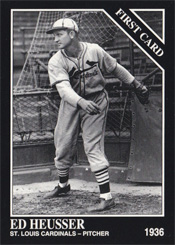
In the opener, the Cardinals started Si Johnson, who had been acquired from the Reds on Aug. 6. The Braves pounded Johnson for eight runs, seven hits and a walk in the first inning. He recorded only two outs before being lifted for Ed Heusser, the Cardinals’ top reliever in 1936.

Three Braves _ Gene Moore, Buck Jordan and Tony Cuccinello _ hit two doubles apiece in the first inning. Shortstop Rabbit Warstler accounted for the other.

With Boston ahead 11-0 after a half inning, Cardinals manager Frankie Frisch decided to stay with Heusser. Nicknamed “The Wild Elk of the Wasatch” for the mountain range in his native Utah, Heusser gave up 12 runs on 18 hits and four walks in 8.1 innings. Moore and Jordan each had five hits and five RBI in the Braves’ 20-3 victory. Boxscore

In the second game, St. Louis, behind ace Dizzy Dean, led 4-1 through five innings, but the Braves rallied and tied the score. In the ninth, Si Johnson, the Game 1 starter, relieved Dean. He yielded a RBI-single to Jordan and the Braves won, 5-4. Johnson was the losing pitcher in both games.

Coupled with the Giants’ 13th win in a row, a 6-5 victory over the Reds, St. Louis fell 1.5 games behind New York. The Giants went on to win the pennant, finishing five games ahead of the Cardinals and Cubs, who tied for second place.

Johnson and Heusser both recovered from their thumpings by the Braves.

Four days after losing both games of the doubleheader, Johnson pitched a complete-game shutout against the Phillies. Boxscore He finished 5-3 with a 4.38 ERA for the 1936 Cardinals.

Heusser was 7-3 with a 5.43 ERA in 42 appearances for the 1936 Cardinals. Eight years later, as a starter for the Reds, his 2.38 ERA led the NL.

Previously: Baseball and romance: Cardinals’ Cuban adventures

Read Full Post »

« Newer Posts - Older Posts »