Feeds:
Posts
Comments

Archive for the ‘Pitchers’ Category

Early in the 1943 season, a report circulated that Mort Cooper, ace of the Cardinals’ rotation, had a sore arm. A few weeks later, The Sporting News claimed “warm weather brought the (arm) around.”
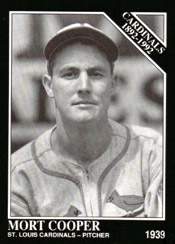
Whatever the explanation, Cooper recovered and became the only Cardinal to pitch one-hitters in consecutive complete-game starts.

Cooper’s back-to-back one-hitters occurred five years after the Reds’ Johnny Vander Meer became the only big-league pitcher to toss consecutive no-hitters.

On Memorial Day, May 31, 1943, Cooper held the Dodgers to one hit in the Cardinals’ 7-0 victory in the opener of a doubleheader at St. Louis.

Billy Herman got the lone Dodgers hit. Herman’s double to start the fifth inning was “a high, twisting two-bagger just inside the foul line,” United Press reported, and it fell beyond the reach of right fielder Stan Musial.

Herman, who also walked, and Augie Galan, who walked twice, were the only Dodgers baserunners. Cooper struck out two and improved his record to 5-3. His brother, catcher Walker Cooper, and Musial drove in two runs apiece. Boxscore

“If Cooper still has a sore arm,” wrote Hugh Fullerton Jr. of the Associated Press, “manager Billy Southworth probably wishes that all his other pitchers would go out and get one just like it.”

Four nights later, June 4, 1943, at St. Louis, Cooper held the Phillies hitless for seven innings and settled for a one-hitter in the Cardinals’ 5-0 victory.

Jimmy Wasdell of the Phillies opened the eighth by lining a single to left. Pinky May, who reached on an error by Cooper and was erased on a double play, was the only other Phillies baserunner. Cooper struck out five in a game that took 1:42 to complete. Boxscore

Jack Cuddy of United Press described why Cooper was so effective:

“Mort can provide the pitch that’s needed at a proper time _ fastball, screwball, forkball or curve. His fastball is the most effective pitch. This is blurred lightning, with a hop at the end. But to southpaw batsmen, he feeds screwballs, keeping them on the outside so that they can’t be pulled to right field.

“Right-handed hitters get the fastball and the forkball. The latter approaches the plate in drunken fashion, like a knuckler’s butterfly pitch. It’s almost impossible to smack the ‘fork’ solidly. In addition, Mort has unusual control. With a 3-and-2 count on the batsman, he can produce a feint or an actual in the strike zone that forces (1) a waiting called strike or (2) a whiff.”

In his start after the second one-hitter, Cooper pitched another complete game and earned the win in the Cardinals’ 4-3 victory over the Pirates on June 9, 1943, at St. Louis. The Pirates got seven hits, two apiece by Vince DiMaggio and pitcher Rip Sewell. Boxscore

Helping the Cardinals win their second consecutive pennant, Cooper, 30, finished 1943 with a 21-8 record and 2.30 ERA. He had six shutouts and 24 complete games among his 32 starts.

His back-to-back gems in 1943 were the only one-hitters of his major-league career.


Read Full Post »

In February 1954, Jack Buck was hired to join Harry Caray on the Cardinals broadcast team.

Caray was entering his 10th season as play-by-play voice of the Cardinals when Buck was chosen to join him after calling minor-league games for Rochester in 1953. Buck replaced former catcher Gus Mancuso as Caray’s broadcast partner.
Buck had been given a tryout in 1953, broadcasting a Cardinals-Giants regular-season game from New York. In his book, “That’s a Winner,” Buck said, “What stood out to me that day was how helpful some people were, like the Giants’ announcer, Russ Hodges. He gave me all the information I needed and offered a lot of encouragement.”

In April 1954, two months after Buck got the offer to join Caray on the broadcast team, Milo Hamilton, who had done television work in the St. Louis area for WTVI of Belleville, Ill., was hired “to handle commercials and color on road broadcasts,” meaning Buck’s work in the booth initially was limited to home games.

“(Hamilton) and I split time on the air,” Buck said. “Milo went on the road with Caray for the first half of the season. I did the scoring updates and commercials from the studio. We switched at the all-star break, and I went on the road, but didn’t have a lot to do because the broadcasts definitely were Harry’s. I did a couple of innings a game, and that was it.”

Caray didn’t get along with Buck and Hamilton. “It didn’t take me long to realize that Harry and I not only had different styles of announcing, we had different personalities and lifestyles,” Buck said. “Our relationship got off badly because he didn’t want me to get the job in the first place. He wanted the Cardinals to hire Chick Hearn, who at the time was a broadcaster in Peoria, Illinois (and eventually would become the voice of the NBA Lakers.)

“Harry didn’t get along with Milo any better than he got along with me at the time,” Buck said, “and we knew he wanted to get somebody else on the broadcast with whom he was more friendly. The man he wanted _ and got _ was Joe Garagiola.” (Hamilton was fired after the 1954 season and replaced by Garagiola.)

All three members of the Cardinals’ 1954 broadcast team would receive the Ford C. Frick Award from the National Baseball Hall of Fame for their career achievements. (Buck won the award in 1987; Caray in 1989; and Hamilton, 1992.)

Buck’s first regular-season Cardinals broadcast as an official member of the team was the 1954 season opener on April 13 at St. Louis. The Cubs beat the Cardinals, 13-4, behind the hitting of Clyde McCullough (4-for-5, two RBI) and Randy Jackson (three RBI). Paul Minner earned a complete-game win for Chicago. Among the Cardinals’ few highlights were solo home runs by Wally Moon and Stan Musial. Boxscore

“The most memorable event of my first season in St. Louis came on a Sunday afternoon, May 2, 1954, in a rain-delayed doubleheader against the Giants,” said Buck. “Stan Musial hit five home runs, three in the first game, two in the second, and might have had another with the longest ball he hit all day, but it was to straightaway center and was caught by Willie Mays. Caray was on the air for all five homers, and it was just as well. It used to bother him when he wasn’t on the air when something really big happened.” Game 1 and Game 2

Read Full Post »

(Updated May 26, 2020)

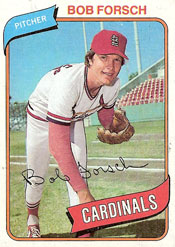
An official scorer’s ruling created a controversy when Bob Forsch pitched his first big-league no-hitter for the Cardinals.

Forsch’s gem in the Cardinals’ 5-0 victory over the Phillies on April 16, 1978, at St. Louis stirred an array of emotions. Boxscore
Garry Maddox opened the eighth against Forsch with a grounder to the left of third baseman Ken Reitz, who was playing in front of the bag. “I thought he might bunt,” Reitz told the Philadelphia Inquirer. The ball bounced into the outfield after Reitz appeared to tip it with his glove. Video at 8:36 mark

Official scorer Neal Russo, a reporter for the St. Louis Post-Dispatch, ruled it an error. The next batter, Bob Boone, grounded into a double play and Forsch retired the final four batters without incident for the first of his two big-league no-hitters. Video

It was the first Cardinals no-hitter in St. Louis since Jesse Haines achieved the feat against the Braves, also by a 5-0 score, on July 17, 1924. Boxscore

Varying opinions

The Phillies were unsparing in their criticism of Russo’s call.

“Base hit all the way,” Phillies manager Danny Ozark told Russo. “Reitz didn’t even touch the ball.”

Said Phillies third baseman Mike Schmidt: “Forsch pitched a dazzling one-hitter.”

Bake McBride, the Phillies’ right fielder and a former Cardinal, said, “We almost all fell off the bench when the call was made.”

Russo, who had 15 years of experience scoring National League games, never wavered. “I thought Reitz should have had it,” Russo told the Associated Press. “I called it immediately. It was an ordinary play, maybe a step to Reitz’s left. The ball wasn’t hit that hard. There was no doubt in my mind.”

Responding to the criticism, Russo said, “Of course, the Phillies, to a man, argued. That’s human nature.”

The Cardinals were just as adamant in their support of the call. Broadcaster Mike Shannon, the former Cardinals third baseman, told Russo, “It was an error, but it’s going to be controversial. Reitz had a chance to make the play and he didn’t.”

Catcher Ted Simmons told the Post-Dispatch, “It hit off his glove. If it wasn’t an error, I’d say so.”

Explained Reitz: “I thought the ball was hit a lot harder than it was. When I went for the ball, I double-pumped and when I came up with the glove the second time, the ball hit the webbing and went by me. I make that play 99 out of 100 times. This was the 100th time. It was an error all the way.”

Good luck

Somewhat lost amid the hubbub was the pitching of Forsch, who used mostly fastballs, curves and changeups to stop the Phillies. “He had full command of everything he threw,” Simmons said.

In a 2020 interview with Stan McNeal of Cardinals Gameday Magazine, Simmons recalled, “Forsch threw a profound power sinker,” and he used it to try to get the Phillies to hit grounders.

Said Forsch: “When I was warming up, I didn’t think I had real good stuff. So I just tried to keep the ball down in the first three innings and mixed up my pitches.”

Forsch’s biggest threat to the no-hitter was Schmidt, who hit three drives to the warning track. All were caught by center fielder Tony Scott. “1,200 feet of outs,” the Philadelphia Inquirer declared.

On a day when the temperature was 41 degrees, the wind was blowing in “and the ball carried like a shotput through the heavy river air,” wrote Bill Conlin of the Philadelphia Daily News.

“The ball Schmidt hit in the first inning I thought was going to hit the Stadium Club,” Forsch said candidly to the Philadelphia Daily News. “I think that’s a home run easy on a normal day here.”

Forsch concluded, “You’ve got to be lucky to pitch a no-hitter, and I was lucky, but I made some good pitches and any time I got into trouble I got right out of it.”

It was the first Cardinals no-hitter since Bob Gibson’s masterpiece against the Pirates in an 11-0 victory at Pittsburgh on Aug. 14, 1971. Simmons also was the catcher in that game. Boxscore

An appreciative Cardinals manager Vern Rapp said of Forsch, “He’s a complete pitcher now. He was a master out there this time. An artist.”

It would be the last win of Rapp’s tenure as St. Louis manager. After the Cardinals lost their next five in a row, Rapp was fired.

Previously: The story of how Bob Forsch converted to pitching

Read Full Post »

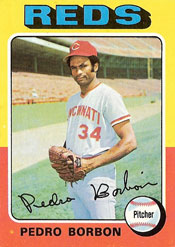
Pedro Borbon was best-known as a Reds pitcher, but he began and ended his professional playing career with the Cardinals.

Borbon was a reliable reliever for the Big Red Machine teams of the 1970s. In 12 big-league seasons (1969-80), Borbon was 69-39 with 80 saves. He pitched in the World Series for the Reds in 1972, 1975 and 1976. He won 11 and saved 14 for Cincinnati in 1973 and was 10-5 with 18 saves for the 1977 Reds.
What’s not as well-known is Borbon became a professional baseball player on one of the most magical days in Cardinals history. He was signed as a non-drafted free agent by St. Louis on Oct. 15, 1964, the day the Cardinals won Game 7 of the World Series against the Yankees.

Borbon was a success in his three seasons in the St. Louis system. He was 6-1 with a 1.96 ERA in 38 games for Class A Cedar Rapids in 1966 and 5-4 with a 2.29 ERA in 36 games for Class A St. Petersburg in 1967. Both clubs were managed by Ron Plaza.

In 1968, Borbon, 21, caught the attention of several big-league organizations with his performance for the Cardinals’ Class A Modesto club of the California League.

He established a league record by appearing in 18 consecutive games without allowing an earned run. In a May 15 game against Fresno, with the score 4-4, Modesto manager Joe Cunningham brought  in Borbon in the ninth inning with a runner on first, one out and a 3-and-0 count on batter Chris Arnold. Borbon struck out Arnold on three pitches and catcher Ted Simmons, 18, threw out the runner attempting to steal second. Modesto scored in the bottom of the ninth, giving Borbon the win.

Borbon finished 8-5 with a 2.34 ERA and 96 strikeouts in 100 innings for Modesto in 1968. In December, the two-time defending National League champion Cardinals failed to protect Borbon on their major-league roster and he was chosen by the Angels as the fourth pick in the first round of the Rule 5 draft.

The Angels were one of at least five big-league clubs that rated Borbon as the best available player in the draft, according to The Sporting News.

“He might be a real catch,” Angels manager Bill Rigney said. “Everyone was high on him.”

Borbon made the Angels’ roster in 1969. He got the win in his major-league debut on April 9 against the Seattle Pilots. Boxscore He finished 2-3 with a 6.15 ERA in 22 games for the 1969 Angels. In November, the Angels dealt Borbon and pitchers Jim McGlothlin and Vern Geishert to the Reds for outfielder Alex Johnson and infielder Chico Ruiz. Bob Howsam, the Reds’ general manager, had been the Cardinals’ general manager when Borbon signed with St. Louis.

Eleven years later, Borbon, 33, was looking for work after being released by the Giants in April 1980. The Cardinals gave him a job as their batting practice pitcher. After two weeks, they determined Borbon was better than some of the pitchers in their bullpen. St. Louis relievers had a collective 7.46 ERA. Desperate for help, general manager John Claiborne acquired Jim Kaat, 41, from the Yankees and signed Borbon. A headline in The Sporting News blared, “Redbirds Turn to Greybeards to Liven Up Their Bullpen.”

Borbon provided immediate results. He pitched three scoreless relief innings against the Astros in his Cardinals debut on May 3, 1980. Boxscore

In his second Cardinals appearance, Borbon earned a save _ and got revenge against the team that released him _ with 2.2 scoreless relief innings against the Giants. Boxscore

Borbon’s third appearance resulted in his first Cardinals win _ and last of his career in the majors _ in a 15-7 St. Louis victory over the Dodgers. Boxscore

But Borbon’s effectiveness soon waned. He yielded a home run in each of his final three appearances. The last two came in consecutive games _ a three-run homer by Padres catcher Gene Tenace on May 24 Boxscore and a grand slam by Padres third baseman Barry Evans (his second and last home run of a five-year big-league career) on May 25. Boxscore

Four weeks after they had added him to the roster, the Cardinals released Borbon. His St. Louis record: 1-0 with one save and a 3.79 ERA in 10 games. With that, Borbon’s big-league career was finished.

His son, a left-handed pitcher also named Pedro Borbon, had a nine-year career in the majors with the Braves, Dodgers, Blue Jays, Astros and Cardinals. Like his father, he finished as a Cardinal, pitching seven games for St. Louis in 2003 and posting an 0-1 record and 20.25 ERA.

Read Full Post »

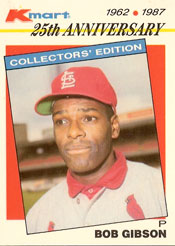
In the mid-1950s, two world-class athletes were produced from the same neighborhood in Omaha, Neb.

Bob Gibson, who would become the greatest pitcher in St. Louis Cardinals history, and Bob Boozer, a standout basketball forward who would become a NCAA all-American, an Olympian and a NBA champion, were friends and teammates.
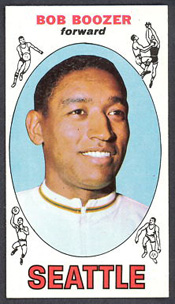
Both were coached by Bob Gibson’s older brother, Josh, on a YMCA-sponsored baseball team, the Monarchs. Both were teammates on a YMCA-sponsored basketball team, the Travelers. Both were teammates for a year on the Omaha Tech High School varsity basketball team. Both became business partners as radio station owners.

“He and Bob Gibson showed people that minority players could come out of Omaha and play professional football or baseball or whatever it may be,” Gale Sayers, running back for the Chicago Bears, told the Omaha World-Herald.

Sayers and two other football standouts, Marlin Briscoe (first black quarterback in the American Football League and later a wide receiver for the undefeated 1972 Dolphins) and Heisman Trophy winner Johnny Rodgers, were raised in the same Omaha neighborhood as Gibson and Boozer, following in their paths.

“I used to sit in the stands at Burdette Field (in Omaha) and watch Gibby pitch,” Boozer said to Leo Adam Biga, who wrote a series on standout black athletes from Omaha. “As good a baseball player as he was, he was a finer basketball player. He could play. He could get up and hang.”

A positive influence on both was Josh Gibson. “He was my mentor,” Bob Gibson said in a 2009 interview with Matt Crossman of The Sporting News. “Not just mine, but he coached guys like Bob Boozer, the basketball player, and Gale Sayers. He was really influential on the kids in Omaha at the time.”

In his book, “From Ghetto to Glory,” Bob Gibson said, “At a dinner in Omaha, Bob Boozer made a speech and said he probably would not be where he is now if it had not been for Josh. Another athlete who came under Josh’s influence is Gale Sayers.”

Bob Gibson, 17 months older than Boozer, went to Creighton, played for the Harlem Globetrotters and eventually gave up basketball to pursue a Hall of Fame career with the Cardinals.

Boozer, 6 feet 8 and 215 pounds, went to Kansas State and averaged 21.9 points per game in three varsity seasons and twice was named all-American. As a junior, he led Kansas State to the NCAA Tournament Final Four.

In 1959, Gibson’s rookie season with the Cardinals, Boozer was chosen as the No. 1 overall pick in the NBA draft by the Cincinnati Royals, but Boozer declined to join the NBA that year, preferring to keep his amateur status so he could play for the United States in the 1960 Summer Olympics in Rome. Boozer helped the U.S. win the gold medal, then embarked on a NBA career.

Boozer played in the NBA for 11 seasons (1960-71) and averaged 14.8 points and 8.1 rebounds per game for his career. He played for the Royals (1960-63), Knicks (1963-65), Lakers (1965-66), Bulls (1966-69), SuperSonics (1969-70) and Bucks (1970-71). With teammates Kareem Abdul-Jabbar and Oscar Robertson, he helped the Bucks win the 1971 NBA championship.

That same year, Starr Broadcasting sold Nebraska radio stations KOWH and KOZN to an ownership group led by Gibson and including Boozer.

“I don’t think I understood the full meaning of the word bigotry until I tried to sell advertising time for KOWH,” Gibson said in the book “Stranger to the Game.” “Almost none of the established businesses would buy from us and they searched hard for reasons not to.”

Gibson and his partners sold the stations to RadiOmaha in 1978.

“As the principal investor in KOWH, I had been operating at a personal liability that was eventually too much to handle,” Gibson said.

Boozer worked 27 years as a community affairs executive and federal lobbyist for a communications company, Northwestern Bell-US West.

In 2005, the Omaha World-Herald ranked the top 100 Nebraska athletes of all-time. The top five, in order: Gibson, Sayers, pitcher Grover Cleveland Alexander, Boozer and Rodgers.

“There are other neighborhoods in America that have produced impressive lists of athletes and maybe some have been more prolific than the north side of Omaha,” Gibson said in “Stranger to the Game.” “… But I have a hard time believing that any community as small and isolated as the Logan Fontenelle housing projects can match us for quantity and quality and diversity of athletes.”

Previously: How Bill Bergesch got Bob Gibson to the Cardinals

Read Full Post »

When the Cardinals played in Dodger Stadium for the first time the weekend of May 18-20, 1962, they felt right at home. The Cardinals swept the three-game series, receiving complete-game wins from each of their starting pitchers, and Stan Musial stroked a single, surpassing Honus Wagner to become the National League all-time hits leader.

Moved from Brooklyn to Los Angeles after the 1957 season, the Dodgers played four years at the Coliseum while Dodger Stadium was being built. On April 10, 1962, in the first regular-season game at Dodger Stadium, the Reds defeated the Dodgers, 6-3. Boxscore

As the Cardinals-Dodgers series opened May 18, the Dodgers were in second place, three games behind the Giants, at 23-12. The Dodgers had won four in a row and eight of their last nine. The Cardinals were in third place at 18-13 and had lost five of their last seven.

The Cardinals’ arrival brought out the entertainment crowd. While the Cardinals were warming up before the first game, comedian Milton Berle, seated near the dugout, performed card tricks for Musial, Red Schoendienst and Ernie Broglio, the Los Angeles Times reported.

The opener matched Johnny Podres against Larry Jackson. In the first inning, Ken Boyer smashed a drive that struck Podres in the left forearm. Podres threw three pitches out of the strike zone to the next batter, Gene Oliver, and walked off the field, unable to pitch. X-rays revealed a severe bruise, no fracture.

Bill White drove in three runs, Charlie James scored three runs and knocked in two, and Jackson went the distance as the Cardinals won, 8-3, before 38,951. Boxscore

“I had a pretty good curve and fastball,” Jackson told the St. Louis Post-Dispatch.

The story the next night, May 19, normally would have been the pitching of Cardinals left-hander Ray Sadecki. The Dodgers had defeated six consecutive left-handers and Sadecki was 0-3 in his career against them, but Sadecki changed the script, pitching his first complete game of the season and got the win in the Cardinals’ 8-1 triumph before 44,559. Boxscore

The headlines, however, went to Musial, the 41-year-old left fielder. His single to right field in the ninth inning off a curve from Ron Perranoski gave Musial his 3,431st hit and moved him ahead of Wagner for No. 1 on the NL career list, breaking a mark that had been held for 45 years. Dodgers first baseman Wally Moon, a former Cardinals teammate, fielded the throw from right fielder Frank Howard and handed the ball to Musial, who received a standing ovation.

“Stan hit a good curveball,” Perranoski told The Sporting News.

Said Musial: “I never worked so hard for two hits.”

(Musial had hit the record-tying single off Juan Marichal in San Francisco on May 16, ending a string of 15 hitless at-bats. He went hitless in nine more after that until he connected on the 0-and-1 pitch from Perranoski.)

“At least I got it in a beautiful new park and against the Dodgers, who have been good to me over the years,” Musial said.

Only Ty Cobb (4,191) and Tris Speaker (3,515) had more career hits than Musial at that time.

After the game, Musial and teammates Boyer and Schoendienst went to the Stadium Club at the ballpark. Musial enjoyed a steak sandwich and French fries. As Neal Russo reported in The Sporting News, few tables had a trio with more hits _ a total surpassing 7,000.

Exhausted by the strain to break the record, “I just about wilted when I got to first base with the record hit,” Musial said.

While Musial sat out the series finale on Sunday afternoon, May 20, Schoendienst, 39, started at second base for the fifth consecutive game. He was filling in for Julian Javier, who was sidelined because of a torn fingernail on his right index finger.

Curt Simmons yielded three runs, none earned, and got the complete-game win in the Cardinals’ 4-3 victory before 38,474. Boxscore

The Cardinals had swept a series in Los Angeles for the first time since the Dodgers left Brooklyn. They moved into a second-place tie with the Dodgers and got within 4.5 games of the Giants.

Previously: How Stan Musial turned in a great comeback year at 41

Read Full Post »

« Newer Posts - Older Posts »