Feeds:
Posts
Comments

Archive for the ‘Pitchers’ Category

(Updated Feb. 19, 2023)

In a classic example of the adage “if you can’t beat ’em, join ’em,” the pitcher who posted the worst career record against the Cardinals got traded to them and enjoyed the best stretch of his big-league tenure.
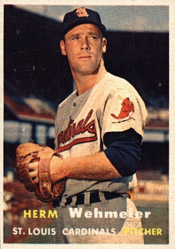
In 31 appearances against the Cardinals for the Reds and Phillies from 1949-1956, Herm Wehmeier was 0-14 with a 4.89 ERA.

(Yovani Gallardo has the second-worst career mark versus the Cardinals. In 19 starts against the Cardinals, Gallardo was 1-11 with a 6.45 ERA.)

Wehmeier’s 14th loss to St. Louis occurred May 9, 1956, in the Cardinals’ 3-0 victory over the Phillies. Boxscore

Two days later, on May 11, 1956, the Cardinals traded pitchers Harvey Haddix, Stu Miller and Ben Flowers to Philadelphia for Wehmeier and pitcher Murry Dickson. The deal was unpopular with many Cardinals fans. Haddix won 20 in 1953 and 18 in 1954. Though his record in 1955 fell to 12-16, many saw him as a pillar of St. Louis’ rotation.

Cardinals coach Terry Moore, who was the Phillies’ manager when Philadelphia acquired Wehmeier from the Reds in 1954, recommended Wehmeier to St. Louis general manager Frank Lane. According to The Sporting News, Lane said he sought Wehmeier “because he can be depended upon to trouble Brooklyn and Milwaukee, teams the Cards must stop to win.”

Cardinals pitching coach Bill Posedel was successful in working with Wehmeier. Reporting for The Sporting News, Bob Broeg wrote, “Wehmeier began to work with a high leg kick, similar to Paul Derringer’s, and … he concentrated on letting up on his fastball and curve when the opposition would expect the Wehmeier of old to try to bust his fastball by ’em.”

The results were impressive. Wehmeier won eight of nine decisions for the 1956 Cardinals from July 21 to Sept. 11. He saved his best for his last start of the year.

On the morning of Saturday, Sept. 29, the next-to-last day of the 1956 season, the Braves held first place in the National League, a half-game ahead of the Dodgers.

That day, the Dodgers swept a doubleheader against the Pirates. The Braves entered their night game at St. Louis knowing they needed to win to keep a share of first place. Milwaukee started its ace, Warren Spahn, against Wehmeier.

(In his autobiography, “I Had a Hammer,” Hank Aaron called Wehmeier “my worst nightmare,” because in 1955 he batted .105 against him, with two singles in 19 at-bats.)

Spahn and Wehmeier dueled into the 12th inning with the score tied 1-1. In the bottom of the 12th, Rip Repulski lashed a double against Spahn, scoring Stan Musial from second and giving the Cardinals a 2-1 victory. Boxscore

In Aaron’s book, Spahn said, “Beyond a doubt, that Saturday game in St. Louis was the most heartbreaking moment I had in 21 years of baseball.”

The loss dropped the Braves a game behind the Dodgers, who clinched the pennant the next day. The win capped a successful season for Wehmeier. The right-hander finished 12-9 with a 3.69 ERA for St. Louis. It would be the most single-season wins he’d post in his big-league career.

Wehmeier was named the Cardinals’ 1957 Opening Day pitcher by manager Fred Hutchinson. The assignment was especially important for Wehmeier because he would be facing the Reds in Cincinnati.

A Cincinnati native, Wehmeier had been an outstanding athlete at Western Hills High School. When he signed with the Reds at age 18, he was billed as a hometown hero. Instead, plagued by wildness and high expectations, Wehmeier was a bust. In nine seasons with the Reds, Wehmeier was 49-69. He issued more walks (591) than strikeouts (478) and became a target of fan hostility.

“He was one of the greatest natural athletes we ever had in Cincinnati,” Reds general manager Gabe Paul said. “But never in my long baseball experience have I heard a man booed as bitterly as was Wehmeier. Nothing he could do was right. Even when he won, they booed him.”

Wrote Broeg: “One of Wehmeier’s troubles as a Red was that the former Cincinnati high school hero tried too hard. The more red-necked he became and the harder he tried to throw, the wilder he became, either walking himself into trouble or getting the ball up where power hitters and others could swing for the fences.”

When Wehmeier took the mound in the Cardinals’ 1957 opener, his mother, father, sister and brother were in the stands. What they witnessed must have stunned many Reds fans. Wehmeier pitched a complete game and got the win in the Cardinals’ 13-4 victory. Boxscore

Wehmeier was winless in May and June, but recovered to win five consecutive decisions from Aug. 24 to Sept. 15. He finished the 1957 season at 10-7 with a 4.31 ERA.

In May 1958, Wehmeier was sent to the Tigers in a waiver deal. He suffered an elbow injury soon after and, at 31, his playing career was done. His big-league record: 92-108. For St. Louis, Wehmeier was 22-17.

Wehmeier scouted for the Reds for three years (he recommended they sign another phenom from Western Hills High School, Pete Rose) and then left baseball. He worked for a trucking company in Texas.

In May 1973, Wehmeier, 46, was testifying during a theft trial in federal court in Dallas when he suffered a fatal heart attack. In an obituary, The Sporting News reported, “Wehmeier was on the witness stand testifying for the government when he collapsed. The case involved theft of merchandise from a shipping company of which Wehmeier was an official.”

Previously: An interview with former Cardinals pitcher Al Jackson

Read Full Post »

In 1968, Larry Jaster made a conversion from reliever to starter for the Cardinals.

Jaster began the 1968 season in the bullpen. A 24-year-old left-hander, Jaster was 1-1 with a 2.13 ERA in seven relief appearances until he moved into the rotation in late May.
Here is how he did in his first four starts that season:

_ Cardinals 2, Dodgers 1, May 20, 1968, at St. Louis: Jaster pitched a two-hitter, yielding singles to Wes Parker and Paul Popovich, and stopped the Cardinals’ four-game losing streak.

The Dodgers scored an unearned run in the first. Willie Davis walked, took second on a passed ball by Tim McCarver, was bunted to third and scored on a groundout by ex-Cardinal Ken Boyer.

Jaster had pitched five consecutive shutouts against the Dodgers in 1966. After he baffled the Dodgers again with his first start of 1968, frustrated Los Angeles manager Walter Alston stormed into the clubhouse, grabbed a box of bubble gum and threw it across the room “as players and the chewy pellets scattered,” The Sporting News reported. Boxscore

_ Phillies 1, Cardinals 0, May 25, 1968, at St. Louis: Lack of run support led to Jaster taking a loss, even though he held Philadelphia to one earned run in 7.1 innings.

The Phillies scored in the sixth when a sacrifice fly by Don Lock drove in Johnny Callison from third.

St. Louis was held to five singles by ex-Cardinal Larry Jackson and reliever Turk Farrell. The Cardinals had two on with one out in the ninth when Farrell relieved and got Phil Gagliano to pop out and Dave Ricketts to line out. Boxscore

_ Cardinals 2, Mets 0, May 31, 1968, at New York: Outdueling Tom Seaver with a dazzling curve to complement his fastball and changeup, Jaster pitched a two-hitter, walking none.

The Mets were hitless until Greg Goossen singled between short and third with two outs in the eighth.

“It wasn’t a bad pitch. The pitch (a curve) was lower than waist high,” Jaster said to The Sporting News.

A ninth-inning single by Don Bosch accounted for New York’s other hit.

“I think I would have got the perfect game if I had got past Goossen,” Jaster said. Boxscore

_ Cardinals 3, Astros 1, June 5, 1968, at Houston: Jaster allowed one earned run in eight innings. Wayne Granger pitched the ninth for the save. Bob Aspromonte drove in Jim Wynn from third with a single for Houston’s run. Boxscore

Jaster was 4-2 with a 0.98 ERA after the win over Houston. He won just once after July 23, losing eight of his last nine decisions and finishing 9-13 with a 3.51 ERA.

Read Full Post »

(Updated Nov. 21, 2024)

Long before Fidel Castro began his dictatorial reign in Cuba, the Cardinals visited that country to play spring training exhibition games.

The Cardinals’ Cuba trips were noted for baseball _ even a bit of romance _ and not controversy.
The Cardinals visited Cuba in 1936, 1937 and 1940, playing exhibition games in Havana.

Mike Gonzalez, a Cuban native born in Havana in 1890, was a coach with the 1936 Cardinals and resided in Havana. He was instrumental in helping arrange the Cardinals’ four-game exhibition series in March 1936 against two longtime Cuban League clubs, Habana and Almendares.

(Gonzalez had a 17-year career as a big-league catcher, including three stints with the Cardinals. He played winter ball in the Cuban League from 1910-1936. Gonzalez was a Cardinals coach from 1934-46. He twice served as the Cardinals’ interim manager, replacing Frankie Frisch in 1938 and Ray Blades in 1940, and compiled a 9-13 record overall in that role.)

Under the headline, “Cards’ Spanish Bad, So Is Their Playing,” The Sporting News reported on the arrival of the 1936 Cardinals in Havana:

“A big crowd was at the dock when the S.S. Florida nosed into Havana Bay and, what is more important, there was a tremendous crowd at the beautiful Tropical Park, a sunken garden baseball field, when the Cardinals put on their uniforms to play the Habana team of the Cuban winter league.”

Habana won the first and third games against the Cardinals by scores of 13-8 and 2-1 in 11 innings. In the first game, The Sporting News reported:

“An aviator flew so low over the field that the bleacherites pulled in their necks. He was dropping handbills and it was reported the next day that he drew a $1,000 fine for endangering the crowd, besides scaring hell out of the Cards.”

The Cardinals won the second and fourth games, against Almendares, by scores of 5-4 and 6-1. (In Game 2, outfielder Pepper Martin had a ninth-inning RBI to tie the score and then scored the winning run for St. Louis.)

More than 30,000 attended the four games, with near-sellout crowds for the final two at Tropical Park, a setting so spectacular The Sporting News described it as “playing a ballgame in the orchard room of a big greenhouse.”

A year later, March 1937, the Cardinals returned to Cuba for a two-game exhibition set against the New York Giants, who were using Havana as a spring training base. The Cardinals and Giants split the two games, with the Cardinals winning 4-3 in the opener and the Giants winning 5-4 in 10 innings in the second game. (Cardinals manager Frankie Frisch stroked a two-run pinch-hit single in the seventh inning of the first game.)

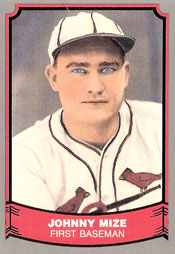
The trip became more noteworthy for what happened off the field for 24-year-old first baseman Johnny Mize.

Jene Adams, a 19-year-old aspiring concert contralto singer from St. Louis, and her mother had been spending the late winter of 1937 in Daytona Beach, Fla., the Cardinals’ spring training base. They became acquainted with Mrs. Sam Breadon, wife of the Cardinals’ owner, and Mrs. Robert Hyland, wife of the Cardinals’ physician. Mrs. Breadon and Mrs. Hyland invited Jene Adams and her mother to accompany them to Havana for the Cardinals’ games with the Giants.

The Sporting News, in a 1940 feature, described what happened next:

“At the Plaza Hotel in Havana one morning, Jene was talking to Mrs. Hyland in the lobby when Mize strolled by. Mrs. Hyland introduced him to Miss Adams.

“We could hang out a tropical moon here for trimmings, but nothing happened in the way of romance until the team returned to Daytona Beach. There the young pair became better acquainted. Dan Cupid gradually worked into the picture. The engagement of the National League’s No. 1 slugger and Miss Adams came early in the summer of the same year, 1937. On Aug. 8, they were married.”

In March 1940, the Cardinals returned to Havana for a four-game exhibition series against a Cuban all-star team. The all-stars were managed by Havana native Dolf Luque, who pitched in the big leagues for 20 years (primarily with the Reds and Giants) and earned 194 wins, and featured left-handed pitcher Luis Tiant Sr., father of the future major-league pitcher of the same name.

(In the book “Voices from Cooperstown,” Hall of Fame catcher Al Lopez told author Anthony J. Connor, “I caught Dolf Luque at the end of his career and that was an education. He was the smartest pitcher I ever caught. He could spot the ball wherever he wanted, any kind of pitch.”)

The Cardinals’ batting order for the opening game was third baseman Don Gutteridge, second baseman Stu Martin, right fielder Enos Slaughter, first baseman Johnny Mize, catcher Don Padgett, center fielder Terry Moore, left fielder Pepper Martin, shortstop Marty Marion and pitcher Mort Cooper.

St. Louis won the first three games by scores of 5-4, 6-0 and 5-3. Left fielder Joe Medwick, who had been a holdout from spring training because of a contract dispute, made his first official appearance of the spring as a pinch-hitter in the third game. The Cuban all-stars won the finale, 4-2, behind the four-hit pitching of Agapito Mayor.

Read Full Post »

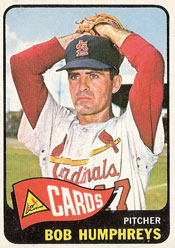
Bob Humphreys, a reliever for the 1964 World Series championship Cardinals, played a significant role in the professional baseball development of catcher Mike Matheny.

Matheny was drafted by the Brewers in 1991, played in their minor-league system and made his big-league debut with Milwaukee in 1994. He played for the Cardinals from 2000-2004 and was their manager from 2012-2018.

Humphreys was among his most influential Brewers instructors, Matheny told MLB.com. Humphreys was the Brewers’ coordinator of player development from 1984-94 and their coordinator of pitching and field development from 1994-95.

In 1964, Humphreys played a role in helping the Cardinals win the National League pennant and World Series title. Called up to St. Louis from Class AAA Jacksonville in July, the right-handed reliever went 2-0 with two saves and a 2.53 ERA in 28 appearances for the 1964 Cardinals.

Both of Humphreys’ wins occurred in September, when the Cardinals compiled a 21-8 record and overcame the first-place Phillies.

Humphreys was acquired by the Cardinals from the Tigers in a cash transaction in March 1963. He had the inscription “You can’t make it” on his glove as a motivational reminder of what the Tigers told him when he left their organization.

Humphreys started the 1963 season with Class AAA Atlanta and was 5-1 with a 1.13 ERA as a reliever before getting promoted to the Cardinals in late May.

He featured an unusual side-saddle windup, pumping two or three times with both hands to one side of his body.

In Humphrey’s second appearance for the Cardinals, on June 2, 1963, at St. Louis, he gave up home runs to Willie Mays and Orlando Cepeda. The home run by Mays hit the scoreboard in left field and traveled about 480 feet, according to The Sporting News. Boxscore

Humphreys spent most of the rest of the 1963 season on the Cardinals’ disabled list. In nine games for the 1963 Cardinals, Humphreys was 0-1 with a 5.06 ERA.

When the Cardinals sent Humphreys to Jacksonville at the end of spring training in 1964, he said he was tempted to quit baseball. Instead, he posted a 6-2 record and 3.07 ERA in 26 games for Jacksonville.

Along with Barney Schultz and Gordon Richardson, Humphreys helped revamp the Cardinals’ bullpen in the second half of the 1964 season.

“I didn’t think I’d get another chance up here after spring training,” Humphreys said in an August 1964 interview distributed by the Associated Press. “I allowed only one run in 9.1 innings and still didn’t make the team. I was going to quit if I didn’t get a chance to pitch more at Jacksonville.”

On Sept. 6, 1964, Humphreys, 29, earned his first big-league win. Facing the Cubs in St. Louis, the Cardinals scored twice in the ninth, tying the score at 4-4. In the 10th, Cardinals reliever Mike Cuellar yielded a walk and a double to the first two batters and was lifted for Humphreys.

After issuing an intentional walk to Ron Santo, loading the bases with none out, Humphreys retired Ernie Banks and Jimmy Stewart on forceouts and struck out Len Gabrielson without allowing a run.

In the 11th, Humphreys executed a successful sacrifice bunt, moving Tim McCarver to second and setting up Lou Brock for a game-winning single. Boxscore

“If I have to wait as long for my second big-league win as I did for my first, I’ll be an old man,” Humphreys said.

Three days later, Sept. 9, 1964, against the first-place Phillies at Philadelphia, Humphreys recorded his second win, along with his first major-league hit and first major-league RBI. The Cardinals scored twice in the ninth, tying the score at 5-5. Humphreys relieved and pitched two scoreless innings. In the 11th, the Cardinals scored five times for a 10-5 victory. Humphreys’ single scored Julian Javier from second with the final run. Boxscore

Humphreys appeared once for the Cardinals in the 1964 World Series against the Yankees and pitched a scoreless inning in Game 6. Boxscore

In April 1965, the Cardinals traded Humphreys to the Cubs for infielder Bobby Pfeil and pitcher Hal Gilson.

Humphreys pitched nine years in the big leagues for the Tigers, Cardinals, Cubs, Senators and Brewers, posting a 27-21 record, with 20 saves and a 3.36 ERA. From 1974-78, he was head baseball coach at Virginia Tech.

Humphreys returned to professional baseball as minor-league pitching coordinator for the Blue Jays. After five seasons with Toronto, he began his long run in player development with the Brewers.

In 2002, after a stint coaching his alma mater (Hampden-Sydney College), Humphreys returned to the Cardinals’ organization. He was the Cardinals’ minor-league field coordinator from 2002-2004 when Matheny was the Cardinals’ catcher.

Previously: Cardinals can thank Pat Hentgen for Mike Matheny

Read Full Post »

(Updated Nov. 22, 2024)

On April 11, 1967, Bob Gibson pitched nine innings, walked none and struck out 13 in the Cardinals’ season-opening 6-0 victory over the Giants at St. Louis.

Gibson struck out the first five batters _ Ken Henderson, Jesus Alou, Willie Mays, Willie McCovey and Jim Ray Hart _ before retiring Tom Haller on a pop-up to catcher Tim McCarver. All five went down swinging. Gibson became the third National League pitcher to strike out the first five batters of a game, joining the Dodgers’ Dazzy Vance (1926) and the Giants’ Bob Bolin (1966).

Mays and McCovey each went 0-for-4. McCovey struck out three times; Mays, once. “My slider was my best pitch, but I had a good fastball, too,” Gibson told the St. Louis Post-Dispatch.

Cardinals shortstop Dal Maxvill said to the newspaper, “Gibby was really blowing the ball by them in the first two innings. He’d nip the corners with his great slider and then, when they’d be looking for the slider, he’d run the fastball in on their hands. He was busting the bats right out of their hands.”

Gibson yielded five hits, all singles. The Giants got three in succession in the third inning but failed to score. With one out, Hal Lanier singled to left and Juan Marichal singled to center, advancing Lanier to second. Henderson followed with a single to short right, loading the bases. Gibson got out of the jam by inducing Alou to ground into a double play. Alou hit the ball to Orlando Cepeda, who stepped on first and threw to McCarver, who tagged out Lanier at the plate.

The win was Gibson’s first against the Giants since 1965. He was 0-3 against them in 1966. “I always pitch good against them and get beat,” Gibson said to the Associated Press. “It’s refreshing to beat them.”

St. Louis scored all of its runs against Marichal, who yielded 14 hits. Lou Brock’s three-run home run in the second was the big blow.

“I felt good,” Marichal said. “They were hitting my good stuff.” Boxscore

Though the Cardinals were the only National League club to have more wins (21) than losses (18) versus Marichal in his career, he had their respect.

In 2018, Tim McCarver recalled to Cardinals Yearbook, “I remember Marichal used to run out to the mound, like he couldn’t wait to face the hitters. If you see that when you’re in the on-deck circle, it doesn’t do much for your confidence. Then you go to bat and watch him throw any pitch in any count _ and he had a bunch of pitches _ and you understand why he was so eager to get out there.”

Read Full Post »

Ernie Broglio was in midseason form on Opening Day for the 1963 Cardinals.

Broglio pitched a two-hit shutout in the Cardinals’ season-opening 7-0 victory over the Mets at the Polo Grounds on April 9, 1963. The right-hander retired 20 consecutive batters between the second and ninth innings.

“Harsh reality, wearing the uniform of the St. Louis Cardinals, smothered the New York Mets like a huge wet blanket,” Leonard Koppett wrote in the New York Times.

Second baseman Larry Burright, batting leadoff, got both Mets hits. Burright led off the first with a single to center and started the ninth with a double to left.

“Unless Ernie gets hurt, he should win 20,” Mets center fielder Duke Snider said to The Sporting News. “He has so many good pitches and can get them over the plate, so a batter can’t wait for a certain pitch.”

Broglio’s gem was one of several notable performances by the Cardinals:

_ First baseman Bill White and third baseman Ken Boyer each drove in two runs.

_ Left fielder Stan Musial, making the final Opening Day appearance of his Hall of Fame career, went 1-for-3 with a walk and a RBI.

_ Shortstop Dick Groat, making his regular-season Cardinals debut after being acquired from the Pirates, had three hits, scored twice and fielded flawlessly.

“It will be a sad day for me when they tear down the Polo Grounds,” Groat said to the Associated Press. “This park is just too much. Everything good has happened to me here. I played my first professional game here back in 1952. I got my first big-league hit and my first home run here. I also played in the last game here before the Giants moved to San Francisco.

“Most important, I met my wife right in this park (in May 1955). I was immediately attracted to Barbara (after being introduced by her father), but for the life of me I couldn’t remember her name. I remembered, though, where they were sitting, and I got Bob Prince, who broadcasts the Pirates’ games, to go to their box and get their telephone number.”

Said Cardinals manager Johnny Keane: “Groat is more valuable to us than any statistics can ever show. He helped us even before we played our first game. He’s taken Julian Javier in hand and made a better second baseman out of him. The Cardinals haven’t had a good double-play combination in years. Now we’ve got just about the best in the league.”

As good as the Cardinals looked in the opener, the Mets looked just the opposite.

“When the game got under way, Curt Flood, the first batter, chopped a little squibbler down the third-base line on the second pitch,” the Associated Press reported. “Charlie Neal charged it and threw it about 10 yards wide of first base. Flood wound up on second, eventually scored and the Cards led 2-0 before the Mets could swing a bat.”

Mets pitchers were called for three balks and their fielders made two errors. They probably committed more miscues than that. On one such play, “A hard smash bounced off the shins of new first baseman Tim Harkness into the hands of new second baseman Larry Burright, who threw the ball over old pitcher Roger Craig’s head. It was scored a hit,” the Associated Press reported.

“Now you may not believe this,” said Mets manager Casey Stengel, “but my club is better than it looked today. It’s tremendously improved over the shellshocked bunch I had last year, when I couldn’t give ’em away. Now, we can sell at least six of them right now.”

The Mets who drew praise from Stengel were Ed Kranepool, the 18-year-old right fielder, and Snider, the 36-year-old center fielder. “The only two who did well was an old man and a young feller,” Stengel said. “And, would you believe it, they were the only two I was worried about.” Boxscore

Previously: Ernie Broglio built great home record the hard way

Read Full Post »

« Newer Posts - Older Posts »