Feeds:
Posts
Comments

Archive for the ‘Pitchers’ Category

(Updated Dec. 24, 2018)

Dennis Bennett played a role in the drama that enabled the Cardinals to overcome the Phillies in the final two weeks of the regular season and win the 1964 National League pennant.
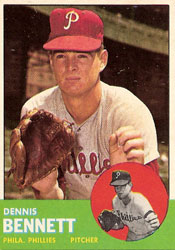
Bennett was a member of the Phillies’ starting rotation in 1964. Before the season, he predicted he’d win 20. His record through July 5 was 9-5, but he lost his next seven decisions.

In early September, Bennett began to regain his winning form, giving Phillies manager Gene Mauch hope for a reliable starter to join stalwarts Jim Bunning and Chris Short. Crediting a sidearm delivery with giving him better control and enabling him to keep his pitches low in the strike zone, Bennett told The Sporting News, “My ball is moving much more. The curve is really breaking off now.”

A left shoulder ailment knocked Bennett off track again.

Bennett, who lost to the Cardinals on May 4 Boxscore and again on July 25 Boxscore, made his last start of the 1964 season on Sept. 29 at St. Louis.

The Cardinals and Phillies were headed in opposite directions. St. Louis had won six in a row and Philadelphia had lost eight in a row. The Cardinals began the day a game behind the first-place Reds and a half-game ahead of the Phillies.

According to the David Halberstam book “October 1964,” Bennett had tendinitis in his left shoulder, resulting in “a dead arm.” Pitching in pain, Bennett was no match for the red-hot Cardinals. They scored a run in the first on a Dick Groat RBI-double and scored twice in the second on a Tim McCarver RBI-single and a Curt Flood RBI-groundout. Bennett was lifted after giving up three runs, five hits and a walk in 1.1 innings.

The Cardinals won, 4-2, and, paired with the Pirates’ 2-0 victory over the Reds, moved into a tie with Cincinnati for first place. The Associated Press reported the defeat was “a near-fatal blow to the Phillies’ slim pennant hopes.” Boxscore

St. Louis went on to win the pennant and the World Series title. Bennett, who finished 12-14 in 1964, was 0-3 with a 15.83 ERA in four games against the Cardinals that season. On Nov. 29, 1964, Bennett was traded to the Red Sox for first baseman Dick Stuart.

Boston, which had a 4.50 team ERA in 1964, was desperate for pitching and was hopng Bennett would become their best left-handed starter since Mel Parnell, who retired after the 1956 season.

Bennett never developed into a big winner. He pitched for the Red Sox, Mets and Angels, appearing in his final big-league game in 1968. He was 43-47 with a 3.69 ERA in seven major-league seasons.

Bennett did get a measure of revenge against the Cardinals. His final big-league win came against them at St. Louis in the first game of a doubleheader on July 16, 1967. Starting for the Mets, Bennett held the Cardinals to one run in seven innings and New York won, 2-1, on Ed Kranepool’s two-run home run against Ray Washburn in the seventh. Boxscore

In 14 career appearances against the Cardinals, Bennett was 2-7 with a 5.95 ERA.

Previously: Ryne Duren threw roadblock at 1964 Cardinals
Read Full Post »

(Updated Sept. 28, 2019)

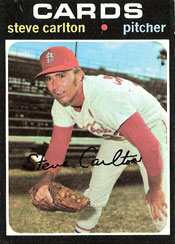
At the time, the Cardinals’ game against the Mets on Sept. 28, 1971, seemed of little importance. In retrospect, it was a significantly historic matchup because of the starting pitchers involved and what happened to them after the season.

In the next-to-last game of the 1971 season for both teams, attendance that Tuesday afternoon at Shea Stadium was 3,338. The Cardinals were assured of finishing in second place in the National League East Division; the Mets were battling the Cubs for third.
The starting pitchers were Steve Carlton for the Cardinals and Nolan Ryan for the Mets. What no one knew was this would be the last game each would play for his team.

In trades each team long would regret, the Mets sent Ryan to the Angels in December 1971 and the Cardinals dealt Carlton to the Phillies in February 1972.

Each pitcher would go on to enjoy a spectacular career that earned enshrinement into the National Baseball Hall of Fame. Carlton finished with 329 wins, 4,136 strikeouts and four Cy Young awards. Ryan finished with 324 wins, 5,714 strikeouts and seven no-hitters.

Their pairing on Sept. 28, 1971, hardly was viewed as a matchup of baseball giants who should have been the cornerstones of their franchises for the next decade or more.

Instead, Carlton, 27, was seen by some as an underachiever. He had 19 losses the season before. Although he had experienced a turnaround in 1971, with 19 wins heading into the game against Ryan and the Mets, he’d lost two of his previous three decisions.

Like Carlton, Ryan, 24, clearly had talent but too often disappointed. He began the 1971 season with a big-league career record of 19-24. Entering the game against Carlton and the Cardinals, Ryan had won two of his last 13 starts and had a season record of 10-13.

Ryan’s lack of command hurt him immediately against the Cardinals. He walked the first four batters _ Lou Brock, Ted Sizemore, Matty Alou and Joe Torre, forcing in a run. When Ted Simmons followed with a single to right, scoring Sizemore and Alou, manager Gil Hodges lifted Ryan.

Ryan’s final appearance as a Met resulted in five batters faced, four walks and a hit without recording an out.

“It was the most distressing day of my life,” Ryan told the St. Louis Post-Dispatch. “I never was so embarrassed.”

Said Hodges: “It seemed he was just throwing the ball because it had to be thrown.”

The Cardinals scored twice in the second inning. Carlton ignited the offense with a leadoff single. Handed a 5-0 lead, Carlton clamped down on the Mets. He pitched a seven-hitter, striking out eight, as St. Louis won, 5-2, for its 90th victory of the season. Boxscore

Carlton (20-9) became a 20-game winner for the first time in the big leagues and the first Cardinals left-hander to achieve the feat since Ray Sadecki in 1964. The complete game was Carlton’s 18th in 36 starts that season.

“There was a lot of skepticism about me before the season,” Carlton said to The Sporting News. “A lot of people didn’t think I could bounce back after last year (and the 19 losses).”

Carlton credited an effective slider with enabling him to beat the Mets.

“The Mets are like the Giants and the Reds for me _ they all wait for my fastball,” said Carlton. “My slider was good when I was warming up, so I decided to go with it.”

Ryan (10-14) was the subject of trade speculation soon after the season ended, but in an Oct. 9, 1971, story in The Sporting News headlined, “Mets Swap Ryan? ‘No Way,’ Says Gil,” Hodges denied the Mets wanted to deal the pitcher.

“We never have given any consideration to trade Nolan Ryan,” Hodges said. “You cannot give up this easily on a guy who has as much talent as he has. You would hate to give up on him and then see him develop into what he can be with some other club.”

On Dec. 10, 1971, Mets general manager Bob Scheffing traded Ryan, outfielder Leroy Stanton, pitcher Don Rose and catcher Frank Estrada to the Angels for Jim Fregosi, a shortstop whom the Mets planned to move to third base.

After the deal was made, Hodges reiterated to The Sporting News his belief Ryan had all-star potential. “When or if or how he’s going to do it, I don’t know. But he’s got ability,” Hodges said.

Fregosi hit .232 for the Mets in 1972 and was dealt to the Rangers a year later. Ryan earned 19 wins with nine shutouts, 329 strikeouts and a 2.28 ERA for the 1972 Angels.

Two months after the Mets traded Ryan, Carlton made contract demands, angering Cardinals owner Gussie Busch, who ordered general manager Bing Devine to trade Carlton.

In his book, “The Memoirs of Bing Devine,” Devine said, “Mr. Busch had a meeting with me and Dick Meyer, his right-hand man at Anheuser-Busch. And the team brain trust, if that’s what you want to call it, decided we ought to trade Carlton because we didn’t have him signed and he wanted too much money. Basically, Mr. Busch wanted him gone. I don’t want to cop a plea here, but getting rid of Carlton was not a deal that I initiated or tried to talk anybody into. It was just the relationship between Carlton and Mr. Busch.”

The Cardinals sent Carlton to the Phillies for pitcher Rick Wise on Feb. 25, 1972. Wise was 16-16 for the 1972 Cardinals. Carlton, pitching for a last-place Phillies team, was 27-10 with a 1.97 ERA, 329 strikeouts, nine shutouts and 30 complete games.

Previously: Mets messed with Steve Carlton’s sub-2.00 ERA

Read Full Post »

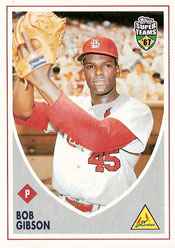
Two players who battled Bob Gibson in World Series competition had the most success against him in All-Star Game showdowns.

Red Sox outfielder Carl Yastrzemski and Tigers catcher Bill Freehan are the only players to get more than one hit against Gibson in the six all-star appearances made by the Cardinals pitcher.
In 11 All-Star Game innings, Gibson gave up 11 hits to nine players.

Yastrzemski was 2-for-3 against Gibson in all-star competition. He had singles in the 1967 and 1970 games, and grounded out in the 1972 game.

In the 1967 World Series, Yastrzemski hit .273 (3-for-11) against Gibson, with two singles and a double.

Like Yastrzemski, Freehan also was 2-for-3 against Gibson as an all-star. He had a single in 1965, struck out in 1967 and delivered a RBI-single in 1969.

In the 1968 World Series, Freehan hit .111 (1-for-9) and struck out five times against Gibson, but the hit (a Game 7 double) drove in a run.

Here are the players who got hits against Gibson in all-star play:

_ Tom Tresh, Yankees (double, 1962)

_ Bill Freehan, Tigers (single, 1965; single, 1969)

_ Tony Oliva, Twins (double, 1965)

_ Carl Yastrzemski, Red Sox (single, 1967; single, 1970)

_ Don Mincher, Angels (single, 1967)

_ Sal Bando, Athletics (single, 1969)

_ Willie Horton, Tigers (single, 1970)

_ Brooks Robinson, Orioles (triple, 1970)

_ Reggie Jackson, Athletics (double, 1972)

Of the nine, Yastrzemski, Robinson and Jackson, like Gibson, are enshrined in the National Baseball Hall of Fame.

Gibson earned his first all-star selection in 1962. In his book “Stranger to the Game,” Gibson expressed how important that selection was to his career: “To the surprise of many, including myself, I was named to my first National League all-star team. With that, the rehabilitation of my confidence was nearly complete … I loved the recognition _ it was bound to help me as a pitcher, I figured, by establishing my credentials in the eyes of the batters _ and soaked up the hoopla.”

In the 1965 All-Star Game, Gibson earned the save, holding the American League scoreless in the eighth and ninth innings of a 6-5 National League victory. Boxscore

The National League catcher was the Braves’ Joe Torre, who later became a teammate and friend of Gibson, but, at that time, Torre, like all opponents, was viewed as the enemy by Gibson, who never fraternized. Torre said Gibson wouldn’t speak to him during the All-Star Game.

In the clubhouse after the game, Torre offered his congratulations to Gibson, but “he didn’t acknowledge I was even in the neighborhood. … Baseball was war for him,” Torre told the St. Louis Post-Dispatch.

Gibson was 0-0 with a 3.27 ERA and 10 strikeouts as an all-star. Among his strikeout victims were Hall of Famers Harmon Killebrew of the Twins and Luis Aparicio of the White Sox, and sluggers such as Rocky Colavito of the Tigers and Tony Conigliaro of the Red Sox.


Read Full Post »

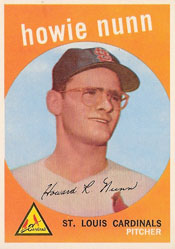
In a short stint as a Cardinals pitcher, Howie Nunn benefitted from a couple of timely slugging performances by Stan Musial.

Nunn spent five seasons (1954-58) as a successful pitcher in the Cardinals’ minor-league system, posting a 79-33 record (including 23-7 for Class C Fresno in 1956).
At 23, he earned a spot with the Cardinals, opening the 1959 season in the bullpen and joining a staff with fellow rookies Bob Gibson and Ernie Broglio.

A right-hander, Nunn initially struggled with the Cardinals. After eight appearances, he was 0-1 with a 6.94 ERA.

On May 6, 1959, at Philadelphia, Nunn was brought in to face the Phillies, who led, 6-4, and pitched a scoreless seventh. In the eighth, Musial led off with a home run against Ray Semproch, sparking a four-run rally. The Cardinals held on for an 8-7 victory, earning Nunn his first big-league win. Boxscore

The Cardinals were home the next night to play the Cubs. Nunn relieved in the seventh with the score tied 3-3 and shut out Chicago over three innings. In the bottom of the ninth, Musial led off with a homer, the 400th of his career, against Don Elston, giving St. Louis a 4-3 victory and delivering to Nunn his second win in two nights. Boxscore

Musial became the sixth big-league player to achieve 400 homers, joining Babe Ruth, Jimmie Foxx, Mel Ott, Lou Gehrig and Ted Williams.

“That’s a lot of home runs for a singles hitter,” Musial said to the Associated Press. “I don’t pretend to be a home run hitter.”

On May 8, 1959, Cardinals manager Solly Hemus, indicating Nunn would replace Jim Brosnan as closer, utilized the rookie for the third night in a row. With one out and the bases loaded, Nunn entered in the eighth, looking to protect a 2-1 lead for starter Gary Blaylock. Nunn walked the first batter he faced, Randy Jackson, forcing in the tying run. The Cubs won, 3-2, scoring a run off Brosnan in the 10th. Boxscore

The blown save seemed to set back Nunn. In his last five appearances for the Cardinals, Nunn yielded nine earned runs over four innings. In June, the Cardinals dealt Brosnan to the Reds and demoted Nunn to Class AAA Rochester. Nunn was 2-2 with a 7.59 ERA in 16 games for St. Louis.

At Rochester, Nunn went 8-9 with a 4.03 ERA and made unwanted headlines in September when he and outfielder Gene Green were suspended by manager Clyde King for “their condition and conduct” on a late-night team flight to Montreal. Nunn and Green apologized and were reinstated the next day.

In April 1960, the Cardinals sold Nunn’s contract to the Reds, where he was reunited with Brosnan. In 1961, Nunn was 2-1 in 24 games for a Reds team that won the National League title.

In his book about that championship season, “Pennant Race,” Brosnan wrote about his colleague and road roommate. An excerpt:

Nunn is a small, slight-built right-hander who wears glasses and has a prominent, bobbing Adam’s apple. To keep his glasses free from sweat, Nunn wears a thick white band on his forehead. He’s called “The Apache.”

Nunn, as if to compensate for his slight stature, is particularly intense in his pitching delivery. Disregarding classic, or Spalding Guide, form, Nunn throws all of himself into his pitches. His neck wobbles, his hips jerk, his elbows fly about, his front foot stomps the mound, and he stares, mouth agape, toward the plate after each pitch. Fortunately, he gets pretty good stuff on his pitches, the sight of which is not so funny to the batter…

After six appearances for the 1962 Reds, Nunn’s big-league career was finished. His career totals: 4-3 with a 5.11 ERA in 46 games.

Previously: Stan Musial’s 400th homer showed flair for dramatic

Read Full Post »

The Cardinals career of Steve Mura was as unusual as it was short.

Unusual because Mura was successful (12 wins in 1982) yet he didn’t appear in the National League Championship Series or World Series for the Cardinals that year.

Unusual because Mura arrived in a trade that took two months to complete and he departed because of a free-agent signing that didn’t involve him or the Cardinals.
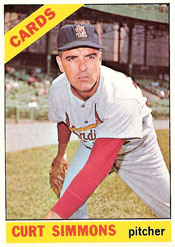
Unusual because Mura at times pitched terribly for St. Louis and other times nearly was unhittable, sometimes experiencing both extremes in consecutive starts.

Mura, a right-hander, was 12-11 with a 4.05 ERA for the ’82 Cardinals. He ranked second among Cardinals pitchers that season in complete games (7) and strikeouts (84), and third in wins (12), starts (30) and innings pitched (184.1). He also was first in walks (80).

Despite that steady use, manager Whitey Herzog preferred to start Dave LaPoint and John Stuper (along with aces Joaquin Andujar and Bob Forsch) ahead of Mura in the postseason.

Mura, a right-hander, was acquired by the Cardinals from the Padres in December 1981 in a trade for outfielder Sixto Lezcano. The deal also was supposed to include Cardinals shortstop Garry Templeton for Padres shortstop Ozzie Smith, but that part wasn’t completed until February 1982.

Though he had a 5-14 record for the 1981 Padres, Mura earned a spot in a Cardinals rotation that included Forsch, Andujar, John Martin and Andy Rincon to open the season.

Mura started the Cardinals’ 1982 home opener, but lasted just 1.1 innings, allowing 3 runs, 3 hits and 3 walks in the Pirates’ 11-7 victory. Boxscore

Five days later, April 15, Mura pitched a four-hitter against the Cubs in the Cardinals’ 6-1 victory at Wrigley Field. Chicago’s only run came on a Keith Moreland home run with two out in the ninth. Boxscore

Those kinds of up-and-down performances continued for Mura and, along with his high walk totals, contributed to Herzog’s decision not to use him in the postseason.

Mura was 0-4 with a 5.59 ERA in June and 3-0 with a 1.77 ERA in July.

He told The Sporting News a rediscovered curveball, a new cut fastball and the ditching of an ineffective slider led to his turnaround in July.

“I can’t throw the ball straight anymore,” Mura said. “The ball is taking off all over. It’s moving more than usual and I’m not used to it. But it helps me more than it hurts me. I’m getting so many more pop-ups now.”

After pitching a complete game in the Cardinals’ 12-5 victory over the Pirates at Pittsburgh on Aug. 15, Mura was 11-7 with a 3.62 ERA. Boxscore

Then he lost four of his last five decisions.

After the Cardinals won the World Series title, Mura filed for salary arbitration.

At the time, big-league baseball rules stated if a team lost a top free agent (deemed Type A) to another team, it could replace the departed player with a major-league caliber player from a compensation pool. Any big-leaguer left off a 26-player protected list by his team was eligible to be chosen from the compensation pool. (This rule was instituted after the 1981 season and lasted four years before it was erased).

The White Sox had lost free-agent outfielder Steve Kemp to the Yankees after the 1982 season. The White Sox chose Yankees pitcher Rudy May from the compensation pool. But May had a no-trade clause, voiding the deal.

Instructed to make another choice, the White Sox selected Mura, who had been left unprotected by the Cardinals.

Mura reported to spring training in 1983, expecting manager Tony La Russa and pitching coach Dave Duncan to have him in Chicago’s starting rotation. But Mura opened the season in the bullpen and his career headed into a downward spiral.

He made just six relief appearances for the 1983 White Sox and was critical of La Russa and Duncan. “I’m not doing any good throwing 5 minutes of batting practice,” Mura said to The Sporting News. “… I wish they would make up their mind and trade me or something instead of letting me rot.”

In May, the White Sox demoted Mura to Class AAA Denver. He was 3-11 with a 4.82 ERA in 19 starts for Denver. Meanwhile, La Russa and Duncan were leading the White Sox to their first American League West Division championship.

At spring training in 1984, Mura competed for the No. 5 starter spot in the White Sox rotation. La Russa told The Sporting News Mura “was much improved from last year. He showed he can pitch in the majors.” But the White Sox released him before the season began.

Mura pitched for the Phillies’ Class AAA team in Portland (Ore.) in 1984, posting a 9-4 record and 5.00 ERA. Released by the Phillies, he signed for 1985 with the Athletics. After opening the season at Class AAA Tacoma and posting a 7-5 record, Mura was called up to Oakland on July 1. In 23 games for the Athletics, including one start, Mura was 1-1 with a 4.13 ERA.

In December 1985, two months shy of his 31st birthday, Mura was released by the Athletics. His professional baseball career was finished.

Previously: Jim Kaat interview: 1982 Cardinals were most close-knit club

Read Full Post »

(Updated Feb. 20, 2023)

Hank Aaron could have added to his home run total if not for an unusual call in a game against the Cardinals.

Aaron, who would break Babe Ruth’s career home run record of 714 in 1974 and finish with 755, hit a home run against the Cardinals in 1965 that didn’t count toward his total.

On Aug. 18, 1965, at St. Louis, Aaron came to bat for the Braves against Cardinals starter Curt Simmons with the score tied 3-3 in the eighth.

In his autobiography, “I Had a Hammer,” Aaron said, “I always had difficulty with Curt Simmons because he would put the ball behind his back and then pound his leg with his glove. You never knew where the ball was coming from. Simmons used to drive me crazy with his herky-jerky delivery and his floating change of pace.”

In the 1965 game, Simmons teased Aaron with a changeup so high and so slow it seemed much like a blooper pitch. “I double-hitched my swing,” Aaron said in his book, “and took a big step up to meet the ball.”

Aaron lifted a high fly ball onto the pavilion roof in right for an apparent go-ahead home run.

Instead, Aaron was called out by plate umpire Chris Pelekoudas for being out of the batter’s box when he connected with the ball, nullifying the home run. Pelekoudas, in his sixth season as a National League umpire, ruled Aaron’s left foot was in front of the batter’s box.

“It’s the worst call I’ve ever seen,” Aaron said to the Associated Press. “I did the same thing the time before and popped up, and he (Pelekoudas) didn’t say a word. I always hit Simmons that way.”

Braves manager Bobby Bragan argued with the umpire and was ejected.

“It was either a grudge call, or he wanted to get his name in the paper,” Bragan said. “I’ve never seen such a call.”

Said Pelekoudas: “Bragan’s protest was strictly on judgment. His only argument was about a grudge _ and that is stupid. I didn’t hesitate in making the call.”

Cardinals catcher Tim McCarver said Aaron stepped out of the box and, “I expected (Pelekoudas) to call it.”

Cardinals coach Joe Schultz told the St. Louis Post-Dispatch, “You’ve got to give the umpire credit for having the nerve to call it.”

Aaron said in his book, ‘I won’t swear to you that I didn’t step over the line of the batter’s box, but it was nothing that I or other hitters hadn’t done before.”

Cardinals backup catcher Bob Uecker wasn’t in the game, but years later, in July 1973, he claimed to the Boston Globe and the Associated Press that he “pointed out Aaron’s cleat marks” to Pelekoudas. “It was one of the few occasions I’ve seen Aaron blow his stack,” Uecker said to the Associated Press.

In his 1982 book “Catcher in the Wry,” Uecker told another version. “I had to tell Henry the truth. It wasn’t me,” Uecker said. “Tim McCarver was the catcher who took the homer away from him, but it was the sort of thing I would have been proud to do.”

In the ninth, with Ray Washburn pitching in relief of Simmons, the Braves sent Don Dillard to pinch-hit with a runner on base and two outs. Dillard delivered a home run _ the last of his big-league career.

In a fitting twist, the Cardinals argued the ball hit by Dillard didn’t clear the wall and shouldn’t have been ruled a home run, but the Cardinals lost that argument and the game, 5-3. Boxscore

Umpire Bill Jackowski said the ball hit the top of the wall, caromed off a fan in the stands and bounced back onto the field.

The Post-Dispatch reported the ball Dillard hit “came straight down and hit the outfield wall padding before bouncing onto the field.”

“I came very close to catching the ball,” Cardinals center fielder Curt Flood said to the Post-Dispatch. “I thought it was a big can of corn. There was no way for the ball to come down the way it did if a fan had touched the ball.”

Read Full Post »

« Newer Posts - Older Posts »