Feeds:
Posts
Comments

Archive for the ‘Pitchers’ Category

(Updated Feb. 20, 2023)

Hank Aaron could have added to his home run total if not for an unusual call in a game against the Cardinals.

Aaron, who would break Babe Ruth’s career home run record of 714 in 1974 and finish with 755, hit a home run against the Cardinals in 1965 that didn’t count toward his total.

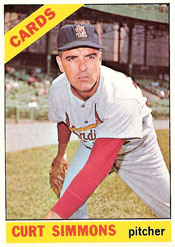
On Aug. 18, 1965, at St. Louis, Aaron came to bat for the Braves against Cardinals starter Curt Simmons with the score tied 3-3 in the eighth.

In his autobiography, “I Had a Hammer,” Aaron said, “I always had difficulty with Curt Simmons because he would put the ball behind his back and then pound his leg with his glove. You never knew where the ball was coming from. Simmons used to drive me crazy with his herky-jerky delivery and his floating change of pace.”

In the 1965 game, Simmons teased Aaron with a changeup so high and so slow it seemed much like a blooper pitch. “I double-hitched my swing,” Aaron said in his book, “and took a big step up to meet the ball.”

Aaron lifted a high fly ball onto the pavilion roof in right for an apparent go-ahead home run.

Instead, Aaron was called out by plate umpire Chris Pelekoudas for being out of the batter’s box when he connected with the ball, nullifying the home run. Pelekoudas, in his sixth season as a National League umpire, ruled Aaron’s left foot was in front of the batter’s box.

“It’s the worst call I’ve ever seen,” Aaron said to the Associated Press. “I did the same thing the time before and popped up, and he (Pelekoudas) didn’t say a word. I always hit Simmons that way.”

Braves manager Bobby Bragan argued with the umpire and was ejected.

“It was either a grudge call, or he wanted to get his name in the paper,” Bragan said. “I’ve never seen such a call.”

Said Pelekoudas: “Bragan’s protest was strictly on judgment. His only argument was about a grudge _ and that is stupid. I didn’t hesitate in making the call.”

Cardinals catcher Tim McCarver said Aaron stepped out of the box and, “I expected (Pelekoudas) to call it.”

Cardinals coach Joe Schultz told the St. Louis Post-Dispatch, “You’ve got to give the umpire credit for having the nerve to call it.”

Aaron said in his book, ‘I won’t swear to you that I didn’t step over the line of the batter’s box, but it was nothing that I or other hitters hadn’t done before.”

Cardinals backup catcher Bob Uecker wasn’t in the game, but years later, in July 1973, he claimed to the Boston Globe and the Associated Press that he “pointed out Aaron’s cleat marks” to Pelekoudas. “It was one of the few occasions I’ve seen Aaron blow his stack,” Uecker said to the Associated Press.

In his 1982 book “Catcher in the Wry,” Uecker told another version. “I had to tell Henry the truth. It wasn’t me,” Uecker said. “Tim McCarver was the catcher who took the homer away from him, but it was the sort of thing I would have been proud to do.”

In the ninth, with Ray Washburn pitching in relief of Simmons, the Braves sent Don Dillard to pinch-hit with a runner on base and two outs. Dillard delivered a home run _ the last of his big-league career.

In a fitting twist, the Cardinals argued the ball hit by Dillard didn’t clear the wall and shouldn’t have been ruled a home run, but the Cardinals lost that argument and the game, 5-3. Boxscore

Umpire Bill Jackowski said the ball hit the top of the wall, caromed off a fan in the stands and bounced back onto the field.

The Post-Dispatch reported the ball Dillard hit “came straight down and hit the outfield wall padding before bouncing onto the field.”

“I came very close to catching the ball,” Cardinals center fielder Curt Flood said to the Post-Dispatch. “I thought it was a big can of corn. There was no way for the ball to come down the way it did if a fan had touched the ball.”

Read Full Post »

A bonus to being able to interview Cardinals broadcaster and ex-pitcher Rick Horton at Cardinals Legends Camp Jan. 27 was the chance to watch a few innings of a game between former players and the campers at Roger Dean Stadium in Jupiter, Fla.

Because the public isn’t allowed to attend the games, there were only about five people in the stands — likely friends or relatives of the players. So the event took on a “Field of Dreams” aura as Hall of Fame players such as Lou Brock, Ozzie Smith and Bruce Sutter stepped onto the field in crisp, white Cardinals uniforms to play inside a ballpark so empty it might as well have been an Iowa cornfield.

Sitting along the right-field line in the warm sunshine, I regrettably had only about 20 minutes to watch the action before having to return to my day job.

Pitching for the Cardinals was Dave LaPoint, the left-hander nicknamed “Snacks” who was a member of the 1982 World Series champions’ starting rotation.

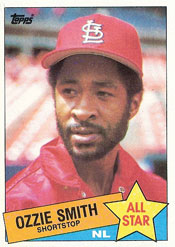
Brian Jordan and Tom Lawless and Tom Pagnozzi were among those in the field. Sutter coached first base. And playing shortstop, wearing the familiar No. 1 and still looking to be in big-league shape, was The Wizard, Ozzie Smith.

In the home half of the first inning, Smith, batting second, stepped into the left side of the batter’s box against a right-handed camper. The first couple of pitches missed the strike zone. Smith, giving the camper his money’s worth, swung at several subsequent pitches out of the strike zone, fouling off one offering after another until he got one to his liking.

When the right pitch came, Smith uncoiled and launched a high fly ball into medium right field, near where I was sitting. The camper stationed in right looked into the sun and staggered, trying to follow the ball’s flight and gauge where it might land.

He extended both arms, the glove on his left hand turned up, and prepared for the ball to fall. It landed halfway up one arm, near the edge of his shirtsleeve. With arms still stretched outward, he brought them together as the ball rolled toward his hands as if on a conveyor belt.

For a moment, it appeared the ball might travel down his arms and into the glove. But then it slipped off his wrist and off his glove and toward the outfield grass. The fielder lurched forward, reached out with his bare right hand and snagged the ball, just as it was about to hit the ground.

“Out!” was the umpire’s correct call.

Ozzie Smith, who had circled first base and was headed to second, flashed a smile and headed back to the Cardinals’ third-base dugout, taking a good-natured razzing along the way from campers and Cardinals teammates.

Witnessing that gave me a sense for the special vibes that come from Cardinals Legend Camp. The retired players clearly enjoy being together again and being on the ballfield.

“That’s the neat thing about this camp _ the access to the players,” said camper Joe Pfeiffer, a Cardinals account executive. “These players want to be here. It’s genuine _ which makes it better for the campers.”

The camp, which was launched with significant help from broadcaster and former pitcher Al Hrabosky, is in its 12th year. Rick Horton has participated in 10 of the camps.

“It’s just been a blast every time I come down here,” Horton told me. “The fun we have here is unprecedented. Anything else I do the entire year _ nothing is as fun as this camp.”

Proceeds from the weeklong camp benefit Hire Heroes USA, a non-profit group that helps military veterans and their spouses find jobs after the completion of their service time.

“They do phenomenal work with job placement and counseling for people who are trying to get back into the workplace after their military service,” Horton said. “They really try to encourage businesses to hire heroes, people who have given an awful lot to our country, and kind of give them a head start into assimilating into a nice job opportunity.”

Asked about pitching in a camp game the day before, Horton described the feeling of being reconnected with former Cardinals teammates and the special bond they maintain.

“Sometimes we wonder, ‘Whose fantasy is this, really?’ ” said Horton. “I fielded a ground ball back to me yesterday. I turn around and throw the ball to Ozzie Smith. He jumps straight up in the air, avoids the slide and throws on to first base for a double play. I got to tell you, it was a rush for me. 

“I know I’m getting out a dentist or a doctor or a lawyer, but just to be on the field with Ozzie again _ I really want to be a part of that. Playing is what gets us back to the relationships we were in 25 years ago. So that’s part of the magic of this.

“The campers see us transform into players again. They see us get into that persona again. It’s a thing that’s very special, very meaningful. It’s a part of our lives that will never really go away and this gives us a chance to celebrate it.”

Previously: Rick Horton discusses the 2012 Cardinals

Previously: Rick Horton pays tribute to Bob Forsch

Read Full Post »

(Updated Nov. 3, 2019)

Pitchers Bob Forsch and Ricky Horton were Cardinals teammates for four seasons (1984-87). During that time, the Cardinals won two National League pennants.

Horton turned 25 in 1984, the year he made his major-league debut with the Cardinals. Forsch was 34 that season.

In 15 years with the Cardinals, 1974-88, Forsch pitched two no-hitters and helped St. Louis win the 1982 World Series title.

Forsch died Nov. 3, 2011, at age 61. In retirement, he had been a fixture at the yearly Cardinals Legend Camp at Jupiter, Fla. When I interviewed Horton, now a Cardinals broadcaster, at that camp Jan. 27, 2012, it was evident Forsch’s presence was missed. In honor of his teammate, I asked Horton to share his favorite Bob Forsch story.

Here is how Rick Horton responded:

After a game in Chicago, he and I got on the L train to get back to our hotel after a Cardinal win. We had a bunch of Cardinals fans, who had had a few too many Budweiser products, on the train with us and they were loving Bob, saying, “Bob you’re my favorite player” and they were just going bananas over the fact that they were on the L train with Bob Forsch.

At one point, a guy says to Bob, “We always wondered if your son played baseball.” And Bob said, “I have two daughters. I don’t have a son.” And the guy pointed at me and said, “Isn’t he your son?”

I’ll never forget that. I laughed so hard. Bob laughed so hard.

You couldn’t write a better script, because the next day, honest, was Father’s Day. So I went to the hotel gift shop and bought him a Father’s Day card and had it up in his locker the next day. And I did that for a number of years to follow, treating Bob as my Dad.

In some ways, more aptly, Bob was like an older brother for me, in terms of showing me the way, showing me the right things, keeping me away from the wrong things, encouraging what professionalism is all about. Anybody who played with him knew Bob as a professional.

As well-known as he is, I’d still say he’s the most underrated Cardinals pitcher in the last 75 years. When you look at the Cardinals record books, his name is all over that. He spanned two decades.

The two no-hitters almost condenses him too much, almost makes him to be that guy instead of a guy who was so much more than that. He won a World Series game, pitched in three World Series for the Cardinals and really was the heart and soul of the pitching staff, at least when I was there.

When we lost Bob as a teammate, we lost an awful lot of leadership. And when we lost him this past year, we lost a lot more than that.


Read Full Post »

Rick Horton, Cardinals broadcaster and former pitcher, says manager Mike Matheny is an outstanding leader and Adam Wainwright could win 20 for St. Louis this year.

Horton, entering his ninth season as a Cardinals broadcaster after pitching for St. Louis from 1984-87 and 1989-90, granted me an interview while taking a break from participating in the Cardinals Legends Camp at Jupiter, Fla. The tape-recorded interview was conducted Friday, Jan. 27, 2012, at Roger Dean Stadium. Horton, smart and personable, was generous with his time and thoughtful with his answers.

Q: Let’s go back to August of last season. Things looked bleak for the Cardinals. What do you think turned it around for them?

Rick Horton: A couple of things happened. One thing you can’t overlook is the trade of Colby Rasmus and getting the bullpen shored up by getting Marc Rzepczynski. Around the same time, the Cardinals got Rafael Furcal to play shortstop. So the defense for the Cardinals improved tremendously.

Defense matters. It’s an absolute fact that if you can’t catch the ball better than the rest, you’re going to lose games you shouldn’t lose. I don’t care how well you hit and how well you pitch. If you can’t catch the ball consistently and make some plays better than the other guy, especially up the middle, it’s really tough to win, and that’s been true in baseball forever.

The Cardinals became better up the middle when they had Furcal at shortstop and Jon Jay in center field, so I think that’s a big piece. And I think the bullpen all came together at the same time. They all kind of got into a flow and got onto a roll.

So the makeup of the team changed. That team always knew they were better than they were showing. When they started to show it, it just raised the bar for them in terms of their own expectations of how they could play.

Q: From a pitcher’s perspective, Game 5 of the Division Series, Chris Carpenter vs. Roy Halladay, a 1-0 victory for the Cardinals over the Phillies. How good was that?

Rick Horton: That’s the game I want to watch. People like offense. I like offense. But the game is more fun to me _ it’s more pure _ when it’s a 2-1 game or a 3-2 game, when every run matters and every decision that a manager makes is critical and every executed little thing matters more.

You get the bunt down in a 17-2 game in the third inning and nobody remembers and nobody cares. So the beauty of the bunt, the beauty of the hit-and-run or the stolen base or taking the extra base or hitting the cutoff man, all those little things about baseball become infinitely more important in a game when you have Carpenter and Halladay pitching.

Q: Game 6 turned out to be the greatest Cardinals comeback in a World Series, culminating with the walkoff home run by David Freese. Where were you for that game?

Rick Horton: For most of the game I was in the ballpark, going from place to place and preparing for the postgame show, which I was doing.

So about the seventh inning, I went to the outside part of the ballpark on the north side where they had set up where we were going to do our postgame set, right next to the ESPN set. I went to the set with Al Hrabosky and was prepared to do the postgame analysis of the Cardinals losing Game 6 of the World Series. We had monitors out there and were watching the last couple of innings. We were writing scripts and preparing conversation about how it was a good season but just didn’t finish well.

A minute before we’re about to go on and do the postgame wrapup of the Cardinals season, things got changed, our scripts got rewritten and baseball changed in a heartbeat for a lot of players, and lives changed in a heartbeat, including David Freese’s. The number of moments that happened from that seventh inning on, so many things critical to the Cardinals winning that game. Phenomenal.

I remember when it was over and we were trying to ad-lib new scripts now that the Cardinals had won it. The thing we kept talking about was you can’t condense Game 6 into a soundbite. I think our postgame show went about two hours and we probably had about two more hours we could have talked about.

Q:  Were you surprised by manager Tony La Russa’s decision to retire or did you have an inkling?

Rick Horton: I did not have an inkling. At the time, it was a shock. But in retrospect I looked back at some things he’d said and some things I’d seen in him and I was less surprised. It seemed like he was a little more relaxed in the second half of the season. Of course, winning had something to do with that. But, even beyond that, I think there was a resignation to stop and smell the roses more. I could see evidence of that in the rearview mirror.

Q: Did Albert Pujols’ decision to leave the Cardinals surprise you?

Rick Horton: Yes, it did. But by a hair. I kind of had it 50-50 the whole time and I was going back and forth 60-40 both ways when I was asked about it all year long. When Tony decided to leave, that started swaying me 60-40 that Albert would go. But as the negotiations were going on I wasn’t sure another team was going to jump up and go to the level that would convince him to go elsewhere. I think had it (the money) been close he would have stayed in St. Louis. He loves St. Louis and St. Louis loves Albert.

If I’m in his shoes and somebody offers me a quarter of a billion dollars, we could all say, ‘I wouldn’t have taken it, I’d stay.’ Well, wait until that happens before you’re sure that you would say no. I hope history sees it as a guy who did what’s best for his career because five years from now he may be a DH anyway, so his value is much higher as an American League commodity than as a National League commodity.

And the way contracts work I think it was just the best business deal for him. It would not have been a good business deal for the Cardinals to pay him a quarter of a billion dollars for 10 years. Nothing against him, it just wouldn’t. Some would say it isn’t a good business deal for the Angels. Time will tell.

Q: Realistically, what can be expected this year from Adam Wainwright on his comeback from Tommy John surgery?

Rick Horton: He’s already throwing. He’s down here working out. He’s thrown some bullpens already. The doctors have said his elbow is more sound than it would be normally. So I don’t think there’s a real concern about reoccurrence.

Adam knows his mechanics well enough and he knows who he is as a pitcher well enough that I think he’s going to get back up on the bicycle and ride it. Some pitchers get hurt and they’re always feeling for their mechanics. He’s so consistent that I don’t think he’ll have any problem getting back to where he was.

I wouldn’t be surprised if he wins 20 games. I just wouldn’t.

Q: Jaime Garcia this year could become just the fourth Cardinals left-hander in the last 50 years to have three consecutive double-digit win seasons. As someone who has the perspective of a left-handed pitcher, where do you see Garcia’s career going?

Rick Horton: I see Garcia at a fork in the road. I don’t mean to imply that I think he’s got anything wrong with him. But I could see him going in two different directions.

I could see him escalating, because he’s got really good stuff. And I could see him getting something that clicks in that makes him go from good to great.

I could see him in that other part of that fork, becoming just an average-to-good left-hander who is productive. I don’t see him going south. But he could stay the same or he could go much better.

Inconsistencies in his pitching mechanics make him feel for the game a little bit, and there are times when it’s really easy for him and times when it’s hard. And there are times when he loses it, he loses it quickly and he doesn’t know how to get it back. So the negative things about him are things that he could fix and figure out and he may never go back there again. That’s possible and that’s what you hope for.

So I would say he has potential to be three notches higher than he is as a pitcher _ and he’s already good _ or he has the potential to be just a good big-league pitcher the rest of his career, which isn’t so bad.

Q: What is your take on Mike Matheny as Cardinals manager?

Rick Horton: Mike Matheny is an outstanding leader of men. I know him very well. He knows baseball. The style he is going to have as a manager and how he handles the things he’s going to have to handle is an unknown to everybody, including him. Because you don’t know until you’re in those shoes.

Every indication would be that he has the intellect, the baseball feel, the leadership ability to be able to handle the position and be good at what he does. I have a lot of confidence in him because I know him as a man. People like him, people will follow him.

Last year in spring training, Tony La Russa brought him in to this clubhouse and Mike Matheny gave a talk to the entire Cardinals team that Tony asked him to give and it was a 20-minute talk about what it means to be a professional player.

As people left that clubhouse _ media was not allowed in there _ one guy after another were coming up and going, “Holy cow. You would not believe how awesome that was.”

These are guys who have heard from five-star generals. They’ve heard from people before. They’re not naive about that. The coaches were saying the same thing. I remember Joe Pettini coming out and saying, “I’ve never heard anything like that.”

For people at spring training to be wowed at 9 o’clock in the morning is pretty impressive. But that’s the kind of guy Mike is. I wouldn’t call him overly dynamic, but he’s a man’s man, a leader and people respond to him.

Q: The Cardinals have a great tradition of ballplayers turning into top-notch broadcasters. Joe Garagiola. Bill White. Bob Uecker. Tim McCarver. Mike Shannon. I see you as the next in carrying on that legacy. Where do you see your career going?

Rick Horton: I appreciate you seeing me in that list of people. I don’t see myself that way. I see myself as a guy who gets the opportunity to talk about the team. I see myself as being more of a conduit to Cardinals fans. That’s where my equity is. That’s where my connection is.

I don’t really think bigger than that. I don’t really have a vision beyond that. I want to be good at what I’m doing. I want to keep getting better at what I’m doing.

The reason I’m doing it in the first place is the right people told me I should try it. And the right person was Jack Buck. He said, “You might want to get into this business.” When Jack Buck says it, you’ve got to try it.

I take it seriously but I don’t try to be serious in the way I do it. It’s a viewership responsibility for me to be a voice for the fans. It’s a pleasure to do it. Every day I get a chance to be a Cardinals broadcaster, it’s an honor.

Read Full Post »
(Updated Sept. 10, 2022)

My choices for the top 5 iconic moments in Cardinals history:

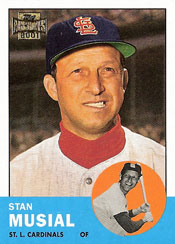
1: STAN MUSIAL’S FINAL AT-BAT

What happened: In a fitting ending to an illustrious career, Stan Musial went out like he came in. Playing in his final big-league game on Sept. 29, 1963, against the Reds at St. Louis, Musial broke a scoreless tie in the sixth by smacking a single past second baseman Pete Rose, scoring Curt Flood. Lifted for a pinch-runner, Musial left to a thunderous ovation. He finished his final game with two hits and a RBI. Boxscore Ever consistent, Musial began his career in similar fashion, getting two hits and two RBI in his big-league debut on Sept. 17, 1941, against the Braves at St. Louis. Boxscore The Cardinals won both games by the same score: 3-2. Musial had 3,630 career hits (1,815 at home and 1,815 on the road).

Why it qualifies: The final at-bat brought to a close the career of the greatest Cardinal. No Cardinal has been more outstanding.

Fun fact: After being lifted from the game, Jim Maloney, the Reds pitcher who gave up the two hits to Musial, went to the St. Louis clubhouse to seek out the retiring Cardinal and tell him, “It was a pleasure watching you play ball.”

Top quote: “It was a great day and I’m grateful that I was able to do something well in my last game.” _ Stan Musial to the Associated Press.

2: THE STRIKEOUT OF TONY LAZZERI

What happened: On Oct. 10, in Game 7 of the 1926 World Series at New York, the Cardinals led 3-2. In the seventh, the Yankees loaded the bases with two outs against starter Jesse Haines, who split a finger on his pitching hand. Cardinals manager Rogers Hornsby called on Grover Cleveland Alexander to relieve. Alexander had pitched a complete game the day before in the Cardinals’ Game 6 victory. Boxscore In the book “The Glory of Their Times,” Cardinals catcher Bob O’Farrell said Alexander was “tight asleep in the bullpen, sleeping off the night before,” when Hornsby called him into Game 7.

Facing rookie Tony Lazzeri, who had 18 home runs and 114 RBI that season, Alexander struck him out. Alexander shut down the Yankees with 2.1 hitless innings, earning a save to go with two World Series wins and preserving the 3-2 St. Louis victory. Boxscore

Why it qualifies: By defeating the Yankees and winning their first World Series championship, the Cardinals transformed from a perennial also-ran into an elite franchise in the National League.

Fun fact: Alexander retired the first six batters he faced in Game 7. None of them hit a fair ball out of the infield. The seventh, Babe Ruth, walked with two outs in the ninth and was thrown out attempting to steal.

Catcher Bob O’Farrell, who fired the ball to Hornsby at second to nab Ruth, told author Lawrence Ritter, “I wondered why Ruth tried to steal second there. A year or two later, I went on a barnstorming trip with the Babe and I asked him. Ruth said he thought Alexander had forgotten he was there. Also, that the way Alexander was pitching they’d never get two hits in a row off him, so he better get in position to score if they got one. Maybe that was good thinking and maybe not. In any case, I had him out a mile at second.”

Top quote: “I knew he was all rattled and nervous and would go after anything, so I gave him a low curve a foot and a half from the plate and he swung and missed.” _ Grover Cleveland Alexander to The Sporting News, describing the pitch on which he struck out Tony Lazzeri.

3: DAVID FREESE’S HOME RUN

What happened: On Oct. 27, in Game 6 of the 2011 World Series at St. Louis, third baseman David Freese, whose two-out, two-run triple in the ninth tied the score, delivered a game-winning home run to lead off the 11th. The Cardinals rallied from deficits of 1-0, 3-2, 4-3, 7-4 and 9-7 against the Rangers to win 10-9 in 11 innings. St. Louis became the first team to score in the eighth, ninth, 10th and 11th innings of a World Series game. The Cardinals were within one strike of elimination in the ninth and 10th innings, and survived. Boxscore

Why it qualifies: The home run capped the most dramatic World Series comeback victory in Cardinals history. It advanced the Cardinals to Game 7 and they clinched their 11th World Series title.

Fun fact: Freese became the fourth Cardinal to receive the World Series Most Valuable Player Award, joining pitcher Bob Gibson (1964 and 1967), catcher Darrell Porter (1982) and shortstop David Eckstein (2006).

Top quote: “Your Game 6 performance, David, will turn out to be one for the ages.” _ Baseball commissioner Bud Selig, in presenting the World Series MVP Award to David Freese.

4: ENOS SLAUGHTER’S DASH TO HOME PLATE

What happened: On Oct. 15, in the eighth inning of Game 7 of the 1946 World Series at St. Louis, the Cardinals’ Enos Slaughter was on first base with two outs and the score tied, 3-3. Harry Walker hit a line drive that fell into left-center, where Leon Culberson (who had replaced an injured Dom DiMaggio) retrieved the ball and threw to the cutoff man, shortstop Johnny Pesky. Slaughter rounded third and slid home safely, beating Pesky’s throw. The daring baserunning gave the Cardinals a 4-3 victory and the championship. Boxscore

Why it qualifies: Slaughter’s hustle symbolized the smart and sound Cardinals teams that dominated the National League in the 1940s. The Cardinals won four pennants and three World Series championships in the decade and finished second five times.

Fun fact: Slaughter credited third-base coach Mike Gonzalez for waving him to home plate as soon as he reached third. It was redemption for Gonzalez, who was criticized after Game 4 when two Cardinals baserunners he waved home were thrown out at the plate.

Top quote: “They say if Pesky hadn’t held the throw I would have been out by a country mile. I don’t know about that. I know the throw to the plate was a little wide, up the third-base line. I also know I had to score.” _ Enos Slaughter to International News Service.

5: OZZIE SMITH’S HOME RUN

What happened: In Game 5 of the best-of-seven National League Championship Series on Oct. 14, 1985, at St. Louis, Ozzie Smith snapped a 2-2 tie with a home run in the ninth against Dodgers reliever Tom Niedenfuer, giving St. Louis a 3-2 victory. Boxscore It was the first home run Smith hit left-handed in eight years as a big-leaguer.

Why it qualifies: The blast (along with broadcaster Jack Buck’s memorable call of “Go crazy, folks! Go crazy!”) symbolized the spirit of manager Whitey Herzog’s 1980s Cardinals clubs and helped clinch Smith’s reputation as a Hall of Famer.

Fun fact: Niedenfuer said the pitch was supposed to be up and in to Smith, but instead was down and in. That mistake enabled Smith to drop the head of the bat on the ball and golf it over the right-field wall.

Top quote: “All I was trying to do was get the ball down the line, into the corner. Fortunately, I got enough to put it out. It was exciting.” _ Ozzie Smith to the Associated Press.

Read Full Post »

(Updated June 9, 2024)

One of the most remarkable teams in St. Louis history was the 1987 Cardinals.

Managed by Whitey Herzog, the 1987 Cardinals overcame adversity and several back-to-the-wall predicaments to finish 95-67 (three games ahead of the favored Mets in the National League East). The Cardinals then won the pennant by beating the Giants in the League Championship Series and got to Game 7 of the World Series before losing to the champion Twins.

In his book “Mookie,” Mets center fielder Mookie Wilson said, “I loved the Cardinals’ style of play. They were so aggressive, always running on the bases until there was no place else to go … It was an exciting brand of baseball. I always believed that I could have fit in well with that club because I liked running when there were no rules or boundaries.”

The Cardinals started the season with an injury to their top starting pitcher, John Tudor, who suffered a broken kneecap in the dugout when Mets catcher Barry Lyons crashed into him while chasing a pop fly Boxscore, and ended the season without their top slugger, first baseman Jack Clark, who was limited to one postseason at-bat after tearing a tendon in his ankle in a game at Montreal Sept. 9. Boxscore

Two nights after the injury to Clark, the Cardinals were at Shea Stadium to open a three-game series against the second-place Mets, who had moved to within 1.5 games of St. Louis in the NL East standings.

In the ninth, the Mets led 4-1 and were within a strike of getting within a half-game of St. Louis, but Willie McGee delivered a two-out, two-strike RBI-single and Terry Pendleton followed with a two-run home run off Roger McDowell, tying the score. The Cardinals scored twice in the 10th to win, 6-4, stunning the Mets and building their lead to 2.5 games. Boxscore

After clinching the division title Oct. 1 with an 8-2 victory over the Expos at St. Louis, Herzog told the Associated Press, “We could’ve folded when we lost Jack, but we didn’t. The Mets talk about adversity, but we really had it.” Boxscore

In the best-of-seven NL Championship Series, the Giants won three of the first five (on the strength of four Jeffrey Leonard home runs) before the Cardinals won Game 6, 1-0, behind Tudor and two relievers Boxscore and Game 7, 6-0, on a Danny Cox masterpiece. Boxscore

The Cardinals won three of the first five in the World Series against the Twins and held leads in Game 6 (5-2 in the fifth inning) and in Game 7 (2-1 after four) before losing both at Minnesota.

“I look back on that as the biggest miracle year _ the 1987 team,” Herzog said to Cardinals Magazine. “No one even gave us a chance … That was the first year of the juiced-up baseball _ and I didn’t have much juice on that team.”

In honor of this resilient team, here are 10 top facts about the 1987 Cardinals:

1. Shortstop Ozzie Smith led the team in hitting, with a .303 batting average _ the only time he hit .300 or better in a season during his 19-year major-league career.

2. Clark had 57 fewer hits than McGee (120 to 177), but finished with one more RBI (106 to 105).

3. Clark drew 136 walks in 131 games. Mark McGwire (with 162 in 155 games in 1998) is the only Cardinal with more walks in a season.

4. Left fielder Vince Coleman was first in the NL in steals (109), second in runs (121) and second in singles (153).

5. With 35, Clark was the only Cardinal to hit more than 12 home runs.

6. Cardinals hitters were remarkably consistent. They batted .264 at home and .263 on the road.

7. Four Cardinals pitchers posted double-digit win totals, but none won more than 11: Cox (11-9), Greg Mathews (11-11), Bob Forsch (11-7) and Tudor (10-2).

8. Pendleton produced 96 RBI, the most in his seven years with the Cardinals and 22 more than his next-best total for St. Louis.

9. McGee had 37 doubles, 11 triples, 11 home runs and 105 RBI, but also grounded into a league-leading 24 double plays.

10. Catcher Tony Pena, who hit .214 in the regular season, hit .381 (8-for-21) in the NL Championship Series and .409 (9-for-22) in the World Series.

Previously: Sweep of Dodgers gives Cardinals a link to 1987

Read Full Post »

« Newer Posts - Older Posts »