Feeds:
Posts
Comments

Archive for the ‘Pitchers’ Category

(Updated Feb. 4, 2023)

When Arthur Rhodes pitched for St. Louis in Game 1 of the 2011 World Series, he became the fifth Cardinals player _ and the first in 29 years _ to appear in a Fall Classic at age 40 or older.
All five Cardinals age 40 or older to play in a World Series were pitchers:

_ Grover Cleveland Alexander, 41, in the 1928 World Series.

_ Jesse Haines, 41, in the 1934 World Series.

_ Dazzy Vance, 43, in the 1934 World Series.

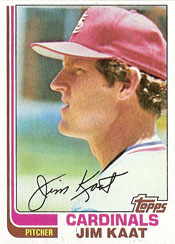
_ Jim Kaat, 43, in the 1982 World Series.

_ Arthur Rhodes, 41, in the 2011 World Series.

Haines and Vance pitched in the same game.

Alexander, Haines, Kaat and Vance were inducted into the National Baseball Hall of Fame.

Here is a look at their World Series performances for the Cardinals after they turned 40:

GROVER CLEVELAND ALEXANDER

The right-hander was a hero of the 1926 World Series, winning two starts and sealing the Cardinals’ Game 7 victory against the Yankees with an iconic save. It was a different story for Alexander and the Cardinals in the 1928 World Series.

At 41, Alexander still was effective. He made 31 starts, completing 18, for the 1928 Cardinals and was 16-9 with a 3.36 ERA for the National League champions.

So it was somewhat surprising when the Yankees pummeled him in the World Series. Alexander started Game 2 and lasted 2.1 innings, allowing six hits, four walks and eight runs, including a three-run, first-inning home run to Lou Gehrig. The Yankees won, 9-3. Boxscore

In Game 4, the Yankees led 4-1 with one out in the seventh when Alexander relieved starter Bill Sherdel. Alexander yielded three runs, including solo homers to Babe Ruth and Cedric Durst, and the Yankees went on to a 7-3 victory, sweeping the Series. Boxscore

Alexander ended the 1928 World Series with a record of 0-1 and a 19.80 ERA, allowing 11 runs in five innings.

JESSE HAINES

The right-hander started games for the Cardinals in the 1926, 1928 and 1930 World Series. At 41 in 1934, he primarily was a reliever. He appeared in 37 games, 31 in relief, during the regular season, posting a 4-4 record and 3.50 ERA.

In his lone appearance in the 1934 World Series, Haines entered Game 4 against the Tigers with one out in the eighth. He yielded a RBI-single to third baseman Marv Owens, and then struck out outfielder Pete Fox and pitcher Elden Auker. Boxscore

DAZZY VANCE

When the Reds placed Vance on waivers after the right-hander went 0-2 with a 7.50 ERA for them in 1934, it appeared his career was done at 43. The Cardinals, however, claimed him on June 25, bringing him back for a second stint with the club, and he was a productive member of the staff. Vance was 1-1 with a 3.66 ERA in 19 games, 15 in relief, for St. Louis.

A 16-year big-league veteran, primarily with the Dodgers when he led the National League in strikeouts seven seasons in a row, Vance made his only World Series appearance in Game 4 of the 1934 Series. He relieved starter Tex Carleton with two outs in the third. Though he yielded a RBI-single to Hank Greenberg, he pitched 1.1 innings, striking out three, including Tigers player-manager Mickey Cochrane. Boxscore

JIM KAAT

In the 1965 World Series, Kaat made three starts for the Twins and was matched each time against the Dodgers’ Sandy Koufax. Kaat won one of those three.

Seventeen years later, at 43, Kaat was an effective situational left-handed reliever for the Cardinals. During the 1982 regular season, Kaat appeared in 62 games and was 5-3 with a 4.08 ERA.

In the 1982 World Series, Kaat pitched in four of the seven games and had a 3.86 ERA, helping St. Louis to its first Fall Classic championship in 15 years.

In his book “Still Pitching,” Kaat wrote of Cardinals manager Whitey Herzog:

“Herzog was the most brilliant and the brightest manager I ever played for. The way he used me, and the way he ran a game, he was the best.”

ARTHUR RHODES

In his 20th big-league season, Rhodes, 41, made his first World Series appearance in Game 1 in 2011.

Entering with two outs in the eighth, Rhodes retired Josh Hamilton on a flyout to center and held the lead for closer Jason Motte, who sealed the Cardinals’ 3-2 victory over Texas. Boxscore

Rhodes turned 42 during the World Series _ on Oct. 24, 2011 _ and pitched in Game 7 on Oct. 28. Overall, Rhodes made three appearances in the 2011 World Series and didn’t allow a base runner in a total of one inning.

Rhodes had been released by the Rangers Aug. 8 and was signed by the Cardinals three days later.
Read Full Post »

(Updated Dec. 15, 2016)

A dominant bullpen contributed to the success of the Cardinals’ 2011 postseason, resulting in a World Series championship. To fully appreciate how far the Cardinals’ bullpen progressed, it’s important to look back to where it was on Opening Day in 2011.

Consider:

_ Of the seven relievers on the Cardinals’ 2011 Opening Day roster, only two, Mitchell Boggs and Jason Motte, remained with the team in the postseason.

_ Five of the Cardinals’ relievers on Opening Day were Bryan Augenstein, Miguel Batista, Ryan Franklin, Trever Miller and Brian Tallet. None remained with the team in the postseason.

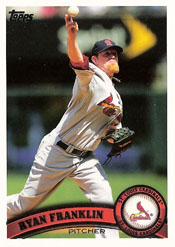
_ Opponents batted .367 in 27.2 innings against Franklin, who opened the season as St. Louis’ closer. Since 1996, the Cardinals’ first season with manager Tony La Russa and pitching coach Dave Duncan, only one St. Louis pitcher had a higher batting average against in 27 or more innings: Mike Maroth, whom opponents batted .394 against in 38 innings in 2007.

_ The quartet of Augenstein (.407 batting average against in 5.2 innings), Franklin (.367 in 27.2 innings), Miller (.306 in 15.2 innings) and Tallet (.339 in 13 innings) all allowed opponents to bat better than .300 against them in 2011.

_ The 26 blown saves by the 2011 Cardinals during the regular season were the most by any of the nine St. Louis teams to make the postseason since the arrival of La Russa and Duncan.

_ Only three Cardinals teams under La Russa and Duncan qualified for the postseason while failing to successfully convert at least 65 percent of their save opportunities. Those teams: 1996 Cardinals (64 percent, with 43 saves in 67 chances), 2000 Cardinals (63 percent, with 37 saves in 59 chances) and 2011 Cardinals (64 percent, with 47 saves in 73 chances).

_ The trio of Batista, Franklin and Miller had seven blown saves in nine opportunities in 2011, setting a terrible early-season pattern for the Cardinals.

_ Once help arrived for the bullpen, the Cardinals found an effective mix. Six Cardinals relievers held opponents to batting averages of .207 or less during the 2011 regular season: right-handers Eduardo Sanchez (.144 batting average against), Octavio Dotel (.182), Fernando Salas (.186), Motte (.202), Lance Lynn (.203) and left-hander Arthur Rhodes (.207).

_ The trio of Dotel, Salas and Sanchez in 2011 were the first Cardinals to each pitch at least 24 innings and hold opponents to a regular-season batting average of less than .200 since Troy Percival (.171), Jason Isringhausen (.179) and Russ Springer (.181) in 2007.

_ Three Cardinals relievers each pitched at least 22 innings and held opponents to one home run apiece during the regular season: Dotel, left-hander Marc Rzepczynski and Sanchez. To put into perspective how important that was to the bullpen’s turnaround, consider that Franklin yielded nine homers in 27.2 innings and Tallet gave up four homers in 13 innings.

Read Full Post »

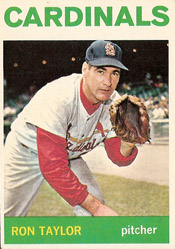
One of the Cardinals’ best single-game postseason relief efforts was performed by Roger Craig and Ron Taylor in the crucial Game 4 of the 1964 World Series at Yankee Stadium.

Craig and Taylor pitched 8.2 innings of scoreless relief, limiting the Yankees to two hits, in the Cardinals’ 4-3 victory on Oct. 11, 1964. Boxscore The win evened the series at 2-2 and repositioned the Cardinals to clinch the championship in seven games.
Few could have predicted Craig and Taylor would shut down the Yankees. Though the Cardinals sizzled in September to overtake the Phillies and win the pennant on the final day of the regular season, Craig and Taylor stumbled to the finish.

Craig started in eight of his last nine regular-season appearances and was 1-4 in his last six starts. Taylor surrendered eight runs over 7.1 innings in his last five regular-season relief appearances.

Until Game 4, Craig and Taylor made their marks in the World Series off the field.

Before Game 2 at St. Louis, Craig and his road roommate, catcher Bob Uecker, walked out to left field, where a band was entertaining the crowd. “Uecker borrowed a tuba and blew vigorously without too much success as Craig popped baseballs into the tuba Uecker was blowing,” The Sporting News reported.

Meanwhile, Taylor was collaborating with journalist Neil MacCarl on World Series articles for his hometown Toronto Star.

Ray Sadecki, a 20-game winner in 1964, started Game 4 for St. Louis but was ineffective. The Yankees scored twice against the left-hander in the first inning and had Roger Maris at third base with one out when Cardinals manager Johnny Keane lifted Sadecki for Craig.

The first batter Craig faced was Elston Howard. The catcher singled, scoring Maris from third and giving New York a 3-0 lead. Craig then struck out Tom Tresh and retired Joe Pepitone on a flyout to right.

From then on, Craig was in control. He struck out the side in the second and in the fourth. He picked off Mickey Mantle at second base. In 4.2 innings, Craig struck out eight and yielded two hits.

“I was throwing mostly breaking stuff, ” Craig said. “My curve was breaking so big it had the batters ducking away.”

When Craig was lifted after the fifth inning, the Yankees maintained their 3-0 lead, but in the sixth Cardinals third baseman Ken Boyer hit one of the biggest home runs in franchise history _ a grand slam against Al Downing. Video

Taylor entered to pitch the bottom of the sixth with a 4-3 lead.

“After I got that homer off a high changeup, I told Taylor to keep ’em fast and low. He did,” Boyer told the Associated Press.

Relying mostly on fastballs, Taylor pitched four scoreless, hitless innings to earn the save for Craig.

Said Taylor: “Kenny told me as I came out that I ought to keep the ball low and fast. I did, and I threw a few curves and sliders. But I kept it low and no changeups. It was the biggest thrill of my life to help win the game.”

Only one batter, Johnny Blanchard, who flew out to center, hit a ball out of the infield against Taylor. Eight of the 12 outs he recorded were groundouts, including all three in the ninth inning.

“We didn’t do much toward the end of the season,” Craig said, referring to he and Taylor. “We wondered if we’d get a chance in the Series. Our pride was hurt. And we talked about it in the bullpen.”

Said Keane: “I’ve never seen them better. They were absolutely great.”

Read Full Post »

(Updated Jan. 22, 2019)

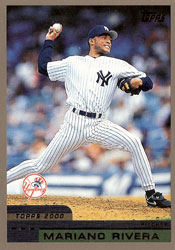
Three saves against the Cardinals are among the career total for the Yankees’ Mariano Rivera, major league baseball’s all-time leader at 652. On Jan. 22, 2019, Rivera became the first player unanimously elected to the National Baseball Hall of Fame by the Baseball Writers Association of America.

In his only three regular-season appearances against the Cardinals, Rivera was at the height of his dominance. He faced 10 batters over 3.1 total innings and only one reached base. Rivera earned saves in all three appearances.

_ Yankees 5, Cardinals 2, June 13, 2003, at New York: It was a postseason-like atmosphere before a Friday night crowd of 55,214 at Yankee Stadium as Rivera entered in the ninth, looking to save the 300th career win for Roger Clemens.

Rivera struck out Orlando Palmeiro and retired Kerry Robinson and Miguel Cairo on groundouts. Boxscore

“I was really happy to go out there and save that game for Clemens,” Rivera told MLB.com. “I wanted to be a part of that … It was a huge game for Roger and for us.”

_ Yankees 5, Cardinals 2, June 15, 2003, at New York: Rivera threw three pitches in the ninth inning to earn the save and give the Yankees a three-game sweep on a Sunday afternoon before 54,797 at Yankee Stadium.

Rivera hit Albert Pujols with a pitch to open the ninth. Ex-Yankee Tino Martinez grounded into a double play and Jim Edmonds, batting for Wilson Delgado, grounded out to second. Boxscore

_ Yankees 5, Cardinals 0, June 11, 2005, at St. Louis: With New York leading 4-0 in the eighth, St. Louis had runners on second and third with two outs when Rivera relieved Tom Gordon. After Larry Walker worked the count to 3-and-2, Rivera delivered a 94 mph fastball on the outside corner. Walker took the called third strike, ending the Cardinals’ threat.

In the ninth, Pujols popped out to first, and Rivera struck out Reggie Sanders and Mark Grudzielanek, preserving the win for Randy Johnson before 50,177 on a Saturday afternoon at Busch Stadium. Boxscore

Read Full Post »

From Curt Davis in 1938 to Jake Westbrook in 2011, 10 Cardinals pitchers have hit grand slam home runs.

Bob Gibson is the only one to do it twice. Gibson and Rick Wise are the only Cardinals pitchers to hit grand slams in the same season.
With grand slams from Chris Carpenter in 2009, Brad Penny in 2010 and Westbrook in 2011, the Cardinals are the only team in major-league history to have a pitcher slug a four-run homer in three consecutive seasons, according to the Elias Sports Bureau.

Here are the Cardinals pitchers who hit grand slams:

_ Curt Davis: A right-hander who earned 158 wins and hit 11 home runs in a 13-year big-league career, Davis slugged a fourth-inning grand slam off Al Hollingsworth, helping St. Louis to a 5-0 lead on April 26, 1938, at Cincinnati. Playing before a Tuesday afternoon gathering of 2,386, the Reds rallied for an 8-7 victory. Boxscore

_ Bob Gibson: Twenty-seven years after Davis’ blast, Gibson connected for a grand slam off Gaylord Perry on Sept. 29, 1965, at San Francisco. With Cardinals runners on second and third, one out, in the eighth, Perry relieved Bob Shaw. Perry issued an intentional walk to Bob Skinner, loading the bases for Gibson, who gave St. Louis an 8-0 lead with his fifth homer of the season. The Cardinals held on for an 8-6 victory. Boxscore

“I knew it was going to the fence,” Gibson told the Associated Press, “but I didn’t think it was going over.”

_ Bob Gibson: In the first game of a doubleheader on July 26, 1973, at St. Louis, Gibson earned a complete-game win and smashed a fifth-inning grand slam off Mets reliever John Strohmayer in the Cardinals’ 13-1 victory. It was the 24th and last home run of Gibson’s 17-year big-league career. Boxscore

_ Rick Wise: Capping a seven-run third inning, Wise powered a grand slam off Roric Harrison on Aug. 21, 1973, at Atlanta. It was the second grand slam of Wise’s career (he hit one for the Phillies in 1971) and the 15th and final homer of his 18-year big-league career. The Braves held St. Louis scoreless the rest of the game and Atlanta won, 11-7. Boxscore

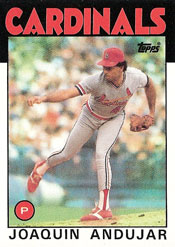
_ Joaquin Andujar: In the eighth inning on May 15, 1984, at St. Louis, Braves reliever Jeff Dedmon gave an intentional walk to Tom Nieto, loading the bases with two out. Andujar, a career .127 hitter in 13 big-league seasons, belted a grand slam, helping the Cardinals to a 9-1 victory. Boxscore

“I usually hit five or six home runs in batting practice every day,” Andujar told United Press International.

_ Bob Forsch: With a fifth-inning grand slam off a hanging curve by Mike Bielecki, Forsch earned his 12th win of the year in the Cardinals’ 5-4 victory over the Pirates on Aug. 10, 1986, at St. Louis. Forsch hit 12 homers in a 16-year major-league career. Boxscore

“I looked terrible on the breaking ball when he struck me out (in the third),” Forsch told the Associated Press, “so I figured he’d throw it again.”

Said Pirates manager Jim Leyland: “He (Bielecki) can’t hang a pitch like that; anybody could hit it out.”

_ Donovan Osborne: A switch-hitter batting left, Osborne slugged a fifth-inning grand slam off Andy Ashby in the Cardinals’ 8-3 victory over the Padres on Sept. 7, 1996, at St. Louis. It was the only homer hit by Osborne in nine big-league seasons. Boxscore

_ Kent Mercker: On the same night Mark McGwire hit two home runs, Mercker had the big blast, a fourth-inning grand slam off Jesus Sanchez, helping St. Louis to a 14-4 victory over the Marlins on Sept. 2, 1998, at Florida. For Mercker, a .113 career hitter, it was his lone homer in 18 major-league seasons and his first since high school. Boxscore

“Mark gave me some batting tips,” Mercker told the Palm Beach Post.

Said McGwire to the St. Louis Post-Dispatch: “I loved his trot.”

_ Chris Carpenter: The first big-league homer of Carpenter’s career was a second-inning grand slam off former St. Louis teammate Kip Wells in the Cardinals’ 13-0 victory on Oct. 1, 2009, at Cincinnati. Boxscore

_ Brad Penny: A third-inning grand slam by Penny off former St. Louis pitcher Joel Pineiro helped the Cardinals beat the Angels, 9-5, on May 21, 2010, at St. Louis, but Penny turned out to have an injury near his right shoulder, was unable to continue pitching and never played another game for the Cardinals. Boxscore

“I left a hanging slider to Penny,” Pineiro told the Associated Press. “I knew he was coming out swinging.”

_ Jake Westbrook: An 11-year big-league veteran, Westbrook’s first homer was a grand slam off Randy Wolf in the Cardinals’ 8-3 victory on Aug. 31, 2011, at Milwaukee. Boxscore

“It’s pretty special,” Westbrook told the St. Louis Post-Dispatch. “Just to go back and say you hit a grand slam in the big leagues is a lot of fun.”

Read Full Post »

In 1985, the Cardinals led the National League in runs scored, with 747, an average of 4.6 per game. When Joaquin Andujar pitched, the run production usually was higher _ and the right-hander knew what to do when given that kind of support.

Andujar won 18 starts in a row in which the Cardinals scored three or more runs in 1985, according to the Elias Sports Bureau.

The Cardinals scored at least five runs in Andujar’s first 13 wins in 1985 and in 16 of his first 19. Of Andujar’s six losses in that stretch, the Cardinals never scored more than two runs and were outscored overall, 22-3.

Of Andujar’s 19 wins from April 14 through Aug. 13, the Cardinals only once failed to score three runs _ a 2-1 St. Louis victory against the Padres on July 26 at San Diego. Andujar held the Padres to a run in 11 innings. He got the win when Ozzie Smith drove in Jack Clark from third with a single in the 12th. Ken Dayley shut down the Padres in the bottom half of the inning for the save. Boxscore

During his streak, Andujar won six times by a margin of one run. His most fortunate break came June 14 in a game against the Cubs at Chicago. Andujar allowed four runs and seven hits, walked four and threw two wild pitches before being lifted when his shoulder tightened with one in the sixth and St. Louis leading, 6-4.

Relievers Bill Campbell and Jeff Lahti combined to give up six runs, but the Cardinals held on for an 11-10 victory. Bob Forsch, who entered with two out in the ninth and a runner on second, got Keith Moreland to fly out to right fielder Andy Van Slyke, who made a sliding catch near the bullpen area in foul territory. That earned Forsch the second save of his career and got Andujar his 12th win of the year. Boxscore

“I had to slide between two relief pitchers to get it,” Van Slyke told United Press International of his game-ending catch.

“I was so close to the wall,” Van Slyke told the Chicago Tribune, “that I could have written graffiti on it.”

On Aug. 18, facing the Expos at St. Louis, Andujar lost for the first time that season when the Cardinals scored at least three runs. With the score 4-4, Andujar was lifted in the 10th with one out and runners on second and third. Ken Dayley relieved and Terry Francona greeted him with a two-run single off the glove of third baseman Terry Pendleton. The runs were charged to Andujar. St. Louis scored in the bottom half of the inning and had the bases loaded with two out before Jeff Reardon struck out Van Slyke. Boxscore

Andujar finished the regular season with a 21-12 record, 3.40 ERA and 10 complete games in 38 starts. He was the first Cardinals pitcher since Bob Gibson in 1969-70 to win 20 in consecutive seasons.

After his implosion in the 1985 World Series (0-1, 9.00 ERA, Game 7 ejection), Andujar was traded to the Athletics, pitched three more big-league seasons and went a combined 17-17 for Oakland and Houston.

Read Full Post »

« Newer Posts - Older Posts »