Feeds:
Posts
Comments

Archive for the ‘Pitchers’ Category

When the Houston Colt .45s began play in the National League in 1962, one of the most anticipated homestands was the one with the Cardinals.

Houston had been a Cardinals minor-league affiliate from 1921-35 and from 1946-58. Many in the region were Cardinals fans.

The 1962 Cardinals had several close connections to Houston. Cardinals manager Johnny Keane and pitching coach Howie Pollet were Houston residents. Keane had played for Houston (1934-37) and also had managed the club (1946-48). Pollet had pitched for Houston (1939-41).

Also, Cardinals coach Harry Walker had been the last Houston manager (1956-58) while it was a Cardinals affiliate. Top 1962 Cardinals players, such as third baseman Ken Boyer and pitcher Larry Jackson, had played for the Houston farm club.

St. Louis made its first visit to Houston for the second homestand in Colt .45s history (the franchise changed its name to Astros in 1965). The Cardinals and Colt .45s were scheduled for three midweek night games April 24-26.

The Cardinals won one, lost one and tied another. Two games each were decided by a run and the other ended in a tie after 17 innings.

According to Clark Nealon of the Houston Post in a story for The Sporting News, Houston “waited years for the first National League series with the St. Louis Cardinals and when it came it was tremendous.”

Houston 4, Cardinals 3, April 24, 1962

In pre-game ceremonies, The Sporting News reported, each member of the Cardinals was “introduced individually to ringing applause.”

At the end, the cheers were for Houston starter Hal Woodeshick, who pitched a six-hitter.

Houston left fielder Don Taussig, who had played for the Cardinals in 1961, hit a solo home run off Jackson in the sixth.

With one on and two outs in the ninth, Bill White ripped a sinking liner that Houston right fielder Johnny Weekly snared at his shoetops.

Attendance was 19,335 _ impressive for a weeknight at a ballpark that seated about 25,000. Boxscore

Cardinals 5, Houston 5, 17 innings, April 25, 1962

In the afternoon, Keane was honored at a Chamber of Commerce luncheon and presented with a replica of a Colt .45 gun. He told the audience, “We’re a lot better club than we showed you on April 24.”

The Cardinals’ manager again was honored in ceremonies before the game. Among his gifts was a king-sized pass to “the first World Series game in Houston.” (It would be 2005 before Houston made its first World Series appearance.)

The game began at 8:02 p.m. It was halted at 1:15 a.m. because of a local curfew in Houston that forbid starting an inning after 12:50 a.m. The game was replayed on another date but all the statistics counted.

Boyer’s RBI-single to left in the ninth off Turk Farrell scored Julian Javier from second, tying the score 5-5.

Ed Bauta pitched eight scoreless innings for the Cardinals after entering in the 10th.

The Cardinals had runners on first and second with no outs in the top of the 17th, but Doug Clemens struck out and Red Schoendienst hit into a double play.

Six Houston pitchers struck out 18 Cardinals, including Boyer three times. Houston left 16 runners on base and the Cardinals stranded 15. Boxscore

Cardinals 3, Houston 2, April 26, 1962

The Cardinals were spared embarrassment by salvaging a victory in the series. Bob Gibson pitched a two-hitter for his first win of the season and Stan Musial drove in the deciding run with a two-out single in the eighth, scoring Curt Flood from third base. Boxscore

Part Two: Cardinals broke Astrodome hex with 19 RBI in one game

Part Three: Forsch vs. Forsch: Bob had edge in brotherly matchup
Read Full Post »

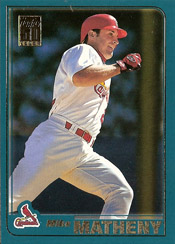
Pat Hentgen played one season for the Cardinals, but his impact on the franchise was significant.

It was Hentgen who recommended the Cardinals sign Mike Matheny, a free agent, to a contract in December 1999. The Cardinals were looking for a backup to catcher Eli Marrero.
Matheny signed a one-year deal for $750,000, leapfrogged Marrero to become the starting catcher in 2000 and remained the Cardinals’  catcher for five seasons, helping them to four postseason appearances and their first National League pennant in 17 years.

After the 2011 season, Matheny became the Cardinals’ manager, replacing Tony La Russa, and led them to a National League pennant in 2013.

Hentgen, a right-handed starting pitcher who won the American League Cy Young Award in 1996, was acquired by the Cardinals from Toronto in November 1999 along with pitcher Paul Spoljaric in a trade for catcher Alberto Castillo and pitchers Lance Painter and Matt DeWitt.

Matheny had been Hentgen’s teammate with Toronto in 1999. Though Matheny was the backup to Blue Jays catcher Darrin Fletcher, he made a lasting impression on Hentgen because of his arm, defense, leadership and management of a pitching staff.

In an article in May 2000, the Associated Press reported the Cardinals signed Matheny “largely at the urging of Hentgen.”

“He was pretty vocal about it. He was on my side,” Matheny said. “That’s just the ultimate compliment _ when a pitcher with as much experience and success as Pat has had thinks that highly of me to put his name on the line.”

Matheny had a stellar start for St. Louis in 2000. He batted .313 in April and threw out 15 of the first 22 baserunners who attempted to steal.

When Marrero tore a ligament in his left thumb on July 1, the Cardinals had little help behind Matheny. A couple of weeks later, Matheny cracked a rib but continued to play. He wore a flak jacket and had his chest taped before every game.

Gritty determination was one element of Matheny’s leadership style. He also displayed respect and selflessness when the Cardinals acquired first baseman Will Clark from the Orioles on July 31, 2000.

For most of his 15-year big-league career, Clark had worn uniform No. 22 _ the same number worn by Matheny in his seven seasons in the major leagues. Matheny offered the number to Clark as a welcome to the Cardinals, asking for nothing in return. Clark was touched by the gesture. Matheny switched to uniform No. 44.

“It’s just a number,” Matheny told The Sporting News in September 2000. “I don’t see the big deal.”

Matheny hit .261 with 47 RBI in 128 games for the 2000 Cardinals. He sat out the postseason after he accidently severed two tendons and a nerve in his right ring finger while using a hunting knife he received as a 30th birthday gift. Matheny threw out 49 of 93 baserunners attempting to steal in 2000 and received the NL Gold Glove Award.

Hentgen had a 15-12 record and 4.72 ERA in 33 starts for the Cardinals. He became a free agent after the 2000 season and signed with the Orioles.

Read Full Post »

(Updated Nov. 2, 2019)

The Cardinals planned for Bob Forsch to be a third baseman, not a pitcher.

Forsch was chosen by the Cardinals in the 26th round of the 1968 amateur draft and sent to their Gulf Coast League team in Sarasota. Forsch, 18, played third base and some outfield. His instructors included George Kissell and Joe Medwick. Forsch displayed a strong arm but batted .224 in 44 games.

In the book “Tales From The Cardinals Dugout,” Forsch described his first day as a professional ballplayer:

I had sort of thought I was going to Florida on a vacation to play baseball. And so I went to the minor-league complex and they gave me a uniform. It was wool. And it had patches in the seat from where other guys had ripped it up while they were sliding. They didn’t have enough caps, because there were too many players. So I got a batting helmet and put that on.

In 1969, Forsch continued to play third base but hit .203 in 26 games for Lewiston of the Northwest League and .235 in 33 games for Modesto of the California League.

At age 20, his playing career was in jeopardy after he opened the 1970 season by hitting .149 in 20 games for Modesto, striking out 21 times in 47 at-bats. Forsch was moved to Cedar Rapids of the Midwest League and did even worse, hitting .088 through 19 games.

Short of pitchers, manager Roy Majtyka put Forsch into a game as a reliever against Clinton. Forsch had pitched in batting practice for Cedar Rapids and had posted a 9-1 record as a pitcher during his senior year in high school at Sacramento, Calif.

The first Clinton batter Forsch faced was Bob Hansen, who would become a first baseman with the Brewers. Forsch’s first pitch sailed over Hansen’s head.

“Mick Kelleher, our shortstop, came over to me and said, ‘Come on, Bob, you can throw it by him,’ ” Forsch told The Sporting News in 1974. “Hansen hit the next pitch for the longest home run I’ve ever seen, even though I threw the ball as hard as I could.”

Forsch worked three innings and gave up six hits and four runs, but his career as a pitcher had begun. The Cardinals sent him to Lewiston and instructed manager Fred Hatfield to use Forsch as a pitcher. In seven games, five as a starter, Forsch was 2-3 with a 4.94 ERA.

When Forsch reported to spring training in 1971, he didn’t know whether the Cardinals planned to employ him as a pitcher or as a third baseman because the Cardinals had a shortage of third basemen in their farm system.

Bob Kennedy, a former big-league player and manager, was the Cardinals’ director of player development and he made the decision Forsch would be converted exclusively to pitching.

Forsch was 11-7 with a 3.13 ERA for Cedar Rapids in 1971 and 8-10, including a no-hitter, for Arkansas in 1972. After the 1972 season, he went to the Florida Instructional League and posted a 7-1 record while working with instructor Bob Milliken.

Forsch was 12-12, including another no-hitter, for Tulsa in 1973.

Playing for manager Ken Boyer at Tulsa in 1974, Forsch was 8-5 with a 3.67 ERA in 15 games when the Cardinals, on the recommendation of Kennedy, called him to the major leagues in July. “He threw hardest and had an excellent curve,” Kennedy explained.

Said Forsch: “I didn’t even know how to throw a curve until Bob Milliken showed me how at the Florida Instructional League.”

Read Full Post »

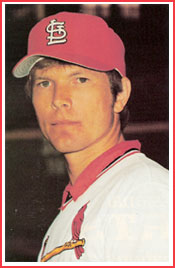
On July 7, 1974, I went with my parents and younger sister to a Cardinals-Reds doubleheader at Riverfront Stadium in Cincinnati. It was a blistering hot Sunday afternoon along the Ohio River. I was 18 and pumped with a mix of excitement and dread about seeing the team I followed passionately, the Cardinals.

The excitement came from the anticipation of seeing two Cardinals games in one day. The Cardinals were in first place in the National League East, three games ahead of the Expos, and I was getting my first look at them in person that year.
The dread came from knowing the Cardinals would be facing the Big Red Machine. This was the Reds lineup of Pete Rose, Ken Griffey Sr., Joe Morgan, Johnny Bench, Tony Perez and George Foster.

We had missed by one day seeing St. Louis ace Bob Gibson, who had pitched a three-hitter in the Cardinals’ 3-1 victory against the Reds Saturday afternoon. Boxscore

For the doubleheader, the Cardinals’ starters would be a pair of 24-year-old right-handers _ Bob Forsch, making his major-league debut, in Game 1, and Mike Thompson, 0-2 with a 5.06 ERA, in the second game.

Thompson was yanked after allowing three runs on four walks in one inning of Game 2 and never pitched again for St. Louis. (The Reds won, 11-2. Boxscore).

Forsch, though, was splendid in the opener. Paired against Tom Carroll, 21, a right-hander who also was making his major-league debut, Forsch pitched with poise against a potent lineup.

Griffey, Morgan, Perez and Bench each was 0-for-3 against Forsch. Bench struck out twice. Rose managed only an infield single against the rookie.

Center fielder Cesar Geronimo, the seventh-place batter, was Forsch’s nemesis. In the second inning, after a home run by first baseman Ted Simmons gave the Cardinals a 1-0 lead, Geronimo hit a two-out double, scoring Dan Driessen from second base, tying the score.

In the seventh, Geronimo hit a home run against Forsch. It was the deciding run in the Reds’ 2-1 victory. Forsch pitched 6.2 innings, allowing four hits, five walks and striking out two. Boxscore

“When you give up just two runs and four hits, you ought to win,” Tim McCarver, who caught Forsch’s debut game, told the St. Louis Post-Dispatch. “I’m proud of Bobby. He did a good job, an excellent job. You couldn’t ask any more of him.”

I became a big Bob Forsch fan that day and remained so. His sudden death at age 61 on Nov. 3, 2011, stunned and deeply saddened me.

After my wife and I settled in Florida in 2002, we went as spectators to a Cardinals fantasy camp game at Jupiter, Fla., and saw Forsch as he and pitcher Joe Magrane were walking down the right-field line at Roger Dean Stadium. We called to them and they came over and were wonderful to us. I mentioned to Forsch that I had witnessed his debut in the majors. He smiled and said, “In the pregame meeting, they told me, ‘Whatever you do, don’t walk Geronimo.’ Well, I didn’t.”

Forsch wrote a book, “Tales From The Cardinals Dugout,” which I had brought with me and asked him to sign it. In bold, clear handwriting, he wrote, “Diane and Mark: Hope you enjoy! Bob Forsch”

There is a passage in the book where Forsch writes about his big-league debut:

“Tim McCarver caught my first big-league game … Red Schoendienst was the manager then and all Red said before I went to the mound was, ‘Go out and do the best you can. No matter what happens, you’ll get another chance.’ That was good to hear. I didn’t know Red well enough to think he’d lie to me!

“We had gone over the hitters before the game, how to pitch to each one … Geronimo was their center fielder, and he was real fast and a threat to steal. They told me, ‘Just don’t walk him. Make him hit to get on.’ He ended up hitting a double … and a home run. But, hey, I didn’t walk him.”

Read Full Post »

(Updated Oct. 28, 2017)

In a 2011 World Series jammed with dramatic moments, the Cardinals’ championship was defined, in large part, by the home run.

_ Albert Pujols hit three home runs in Game 3.
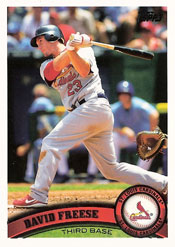
_ David Freese hit a walkoff 11th-inning home run in Game 6.

_ Allen Craig hit three home runs, including a go-ahead shot in Game 7.

_ The eight home runs hit by the 2011 Cardinals established the franchise record for most in a World Series. The previous mark was set in 1968 when the Cardinals hit seven home runs in a World Series against the Tigers.

_ The nine home runs allowed by the 2011 Cardinals are tied for the second-most in the franchise’s World Series history. Only the Yankees, with 10 in 1964, hit more home runs against the Cardinals in a World Series.

_ The 17 total home runs by the Cardinals and Rangers are the most in a World Series involving the Cardinals. The previous high was 15 total home runs _ in the 1964 World Series between the Cardinals and the Yankees and again in the 1968 World Series between the Cardinals and the Tigers.

Here are the home run totals in World Series involving the Cardinals:

YEAR…….CARDINALS HRS…….OPPONENT HRS…….TOTAL HRS

1926………4………………………….4…………………………8

1928………1………………………….9…………………………10

1930……..2………………………….6………………………….8

1931……..2…………………………..3…………………………5

1934……..2………………………….2………………………….4

1942……..2………………………….3………………………….5

1943……..2………………………….2………………………….4

1944……..3………………………….1………………………….4

1946……..1………………………….4………………………….5

1964……..5………………………….10……………………….15

1967……..5…………………………8………………………….13

1968……..7…………………………8………………………….15

1982……..4…………………………5………………………….9

1985……..2…………………………2………………………….4

1987……..2…………………………7………………………….9

2004…….2…………………………4…………………………..6

2006…….2…………………………4…………………………..6

2011……..8…………………………9………………………….17

2013…….2………………………….4………………………….6

Read Full Post »

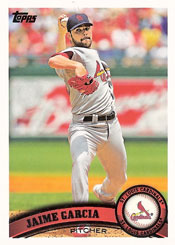
Jaime Garcia is the fifth Cardinals left-hander to pitch seven scoreless innings in a World Series game, but the first not to record a win for doing so.

Garcia held the Rangers without a run for seven innings in Game 2 of the 2011 World Series but got no decision when Texas scored twice against the bullpen in the ninth and won, 2-1.

The other Cardinals left-handers to pitch at least seven scoreless innings in a World Series game _ Bill Hallahan, Ernie White, Harry Breechen and John Tudor _ all earned wins in those starts. Hallahan and Breechen each did it twice.

BILL HALLAHAN

In 1930, Hallahan, 28, led National League pitchers in strikeouts (177) and walks (126) while compiling a 15-9 record and 4.66 ERA.

After the Athletics won the first two games of the 1930 World Series, Hallahan started Game 3. In the first inning, the Athletics loaded the bases with two outs before Hallahan struck out Bing Miller.

The Athletics reached base in seven of nine innings, but Hallahan kept them from scoring. In the ninth, the Athletics put two on with two outs. Hallahan struck out Jimmy Dykes to end the game and preserve the Cardinals’ 5-0 victory. Boxscore

Hallahan gave up seven hits, walked five and struck out six. In the first inning, Hallahan yielded two singles and a walk, but struck out the side.

“We had plenty of chances to score in the opening inning while Hallahan was wild,” Athletics manager Connie Mack told the Associated Press. “Unfortunately, however, when he did get it over he was unhittable.”

In 1931, Hallahan again led NL pitchers in strikeouts (159) and walks (112) while posting a 19-9 record and 3.29 ERA.

And, again, Hallahan shut out the Athletics in the World Series.

In Game 2 of the 1931 Series, Hallahan pitched a three-hitter in the Cardinals’ 2-0 victory. Boxscore

Hallahan retired the first 11 batters before issuing a walk to Mickey Cochrane with two outs in the fourth.

The Athletics got their first hit in the fifth, a Bing Miller single. Philadelphia loaded the bases with one out before Hallahan induced pitcher George Earnshaw to ground into a double play.

The Cardinals almost blew the game in the ninth. The Athletics had two on with two outs when Hallahan struck out Jimmy Moore, who swung at a pitch in the dirt that catcher Jimmie Wilson mishandled.

Moore, thinking the game over, started toward the dugout as fans poured onto the field. Athletics coach Eddie Collins shouted at Moore to head to first base. As he did, Wilson grabbed the ball and inexplicably fired it to third base. All hands were safe. The bases were loaded.

The next batter, Max Bishop, uncorked a twisting fly ball into foul territory down the right field line. First baseman Jim Bottomley gave chase, stumbled into the Athletics bullpen, caught the ball and fell into the stands, completing a dramatic ending.

Hallahan walked seven and struck out eight.

In his syndicated column, Cardinals second baseman Frankie Frisch said of Hallahan, “He was effective because he had great speed, a fine breaking fast curve and good control of his change of pace slow curve.”

ERNIE WHITE

White, 26, rode a hot streak into the 1942 World Series, winning his last three regular-season starts and finishing 7-5 with a 2.52 ERA.

In Game 3 of the Series, White limited the Yankees to six hits, walked no one and struck out six in the Cardinals’ 2-0 victory. Boxscore

White set the tone in the first inning when, with Phil Rizzuto on second and two outs, he struck out Joe DiMaggio. White also benefitted from a spectacular catch by each outfielder: Stan Musial, Terry Moore and Enos Slaughter.

It was, White told the St. Louis Globe-Democrat, “the greatest game I ever hope to pitch.”

HARRY BREECHEN

After posting a 16-5 record in 1944, Breechen, 29, started Game 4 of the World Series against the Browns. Breechen held the Browns scoreless for the first seven innings as the Cardinals built a 5-0 lead. In the eighth, the Browns scored on a double-play grounder.

Though the Browns reached Breechen for nine hits and four walks, they were limited to that lone run as the Cardinals evened the Series with a 5-1 victory. Boxscore

In 1946, Breechen lost four of his first five decisions. He won his last two regular-season starts to finish 15-15 with a 2.49 ERA.

In Game 2 of the World Series against the Red Sox, Breechen pitched a four-hit shutout in the Cardinals’ 3-0 victory. Boxscore

Ted Williams was 0-for-4 with a strikeout versus Brecheen. In the ninth, Dom DiMaggio led off with a single, but Breechen retired Williams on a pop-up and got Rudy York and Bobby Doerr each to fly out.

“He (Breechen) certainly fooled me,” Williams said. “Somebody had told me he never threw a screwball. All of a sudden, Breechen would rear back and toss one of them at me.”

JOHN TUDOR

After limiting the Royals to a run and beating them in Game 1 of the 1985 World Series, Tudor, 31, did even better in Game 4, shutting out Kansas City on five hits in a 3-0 Cardinals victory. Boxscore

Tudor, who was 21-8 with a 1.93 ERA during the regular season, walked one and struck out eight, including George Brett twice on breaking pitches. Tudor retired the side in order in five innings, including the ninth. The Royals’ only extra-base hit was an eighth-inning double by Lynn Jones.

“I did just about everything right tonight,” Tudor told The Milwaukee Sentinel. “… I mixed pitches up and got them over the plate. I knew I had good stuff when I was warming up.”

JAIME GARCIA

Garcia, 25, held the Rangers to three singles and a walk in Game 2 of the 2011 Series. Texas was hitless until Michael Young singled with two outs in the fourth.

Garcia, a 13-game winner in 2011, stood to get the win when Allen Craig, batting for Garcia in the seventh, slashed a RBI-single to give the Cardinals a 1-0 lead, but Texas scored twice in the ninth, winning 2-1. Boxscore

“I’ve been working a lot to keep the ball down, get ahead early in the count,” Garcia told MLB.com.

Read Full Post »

« Newer Posts - Older Posts »