Feeds:
Posts
Comments

Archive for the ‘Pitchers’ Category

Gaylord Perry had a career record of 14-14 versus the Cardinals, but there was nothing mundane about the night-and-day seasons he experienced against them in consecutive years during the 1960s.

In four starts against the Cardinals in 1966, Perry was 4-0 and didn’t walk a batter.

The next year, Perry was 0-5 in five starts versus the Cardinals.

Perry pitched well against the Cardinals in both seasons (1.06 ERA in 1966) and (2.23 ERA in 1967), but one of the big differences between the two years was the blistering bat wielded by his ex-teammate, St. Louis slugger Orlando Cepeda.

On-the-job training

Relying on a fastball and curve, Perry reached the majors with the Giants in 1962. After four seasons with them his record was 24-30. His breakthrough came in 1966 when he mastered the spitball taught two years earlier by Bob Shaw.

Acquired by the Giants from the Braves in January 1964, Shaw was throwing at spring training when Perry observed how his pitches dipped sharply. Asked how he did it, Shaw showed Perry how to throw a spitball, a pitch banned in the majors.

In his book “Me and the Spitter,” Perry said Shaw told him, “It takes a lot of work. You got to know how much to apply, where, how to hold the ball and control it, and, most important, how to load it up without anybody seeing you.”

From then on, “Shaw and I were inseparable, spitball buddies, so to speak,” Perry said in his book.

According to Perry, “Most pitchers experiment with a spitter but soon give it up. If you don’t throw it correctly, it is just a hanging curveball, a gopher pitch. It took me the rest of that (1964) season and the next (1965) to master it in every way.”

At the same time, Perry also worked on developing a slider, and on learning to control his emotions on the mound.

Big winner

“By Opening Day, 1966, I had my spitter, my slider and my temper in good shape,” Perry said in his book.

The results were spectacular: Perry won 20 of his first 22 decisions and finished with 21 wins for the 1966 Giants.

His four wins against the Cardinals were by scores of 2-0, 4-2, 3-2 and 3-1.

Perry was 2-0 for the season when he entered a May 1, 1966, start against Bob Gibson and the Cardinals at Candlestick Park in San Francisco.

Limiting the Cardinals to four singles, including two infield hits, in the 2-0 shutout, Perry credited the slider. Cardinals manager Red Schoendienst said to the San Francisco Examiner, “Slider? I didn’t see anything but fastballs.” Boxscore

Five days later, at St. Louis, Perry again beat Gibson and the Cardinals. Gibson pitched a three-hitter, struck out 14 but lost, 4-2. Boxscore

On July 4 at San Francisco, Perry got the game-winning hit, a single versus Nelson Briles, in a 3-2 victory over the Cardinals. Boxscore

A week later, in the All-Star Game at steamy St. Louis, Perry was the winning pitcher for the National League with two scoreless innings of relief. Boxscore

Facing the Cardinals for the final time in 1966, Perry ran his season record to 19-2 with a 3-1 win at San Francisco on Aug. 16. A key moment came in the sixth inning when, with one out and the Giants ahead, 2-1, the Cardinals put runners on first and third. Perry struck out Orlando Cepeda and got Mike Shannon to end the inning with a grounder. Boxscore

The four wins over the Cardinals in 1966 gave Perry a career record of 6-0 against them.

Give and take

Cepeda was the Giants first baseman the first time Perry threw a spitter in a game, May 31, 1964, in an epic 23-inning marathon with the Mets at Shea Stadium in New York. Perry pitched 10 scoreless innings of relief.

One of the first batters he threw the spitter to was Mets pitcher Galen Cisco, who, with two on and one out in the 15th, grounded into a double play. After snaring the relay throw, Cepeda “rolled the ball along the grass, tumble-drying it by the time it reached the mound,” Perry recalled in his book. “Everybody protects a spitball pitcher.” Boxscore

Two years later, in May 1966, Cepeda was traded to the Cardinals. In his first full season with them, he won the 1967 National League Most Valuable Player Award and the Cardinals won a World Series title. He also beat up on Perry and the Giants that year.

Perry’s five losses to the 1967 Cardinals were by scores of 2-1, 4-1, 3-1, 2-1 and 2-0. Cepeda had the game-winning hit in three of those.

The first came on April 18 at San Francisco. After Roger Maris reached second on an error with two outs in the 11th, Cepeda got jammed by a Perry pitch but muscled it into right-center for a RBI-single, breaking a 1-1 tie. Boxscore

Two months later, on June 18 at San Francisco, Cepeda’s two-run home run against Perry snapped a 1-1 tie in the eighth and carried the Cardinals to victory. Boxscore

“Cepeda especially enjoyed beating Perry because Gaylord and Orlando weren’t always the best of friends when they were Giants teammates,” The Sporting News reported.

According to the St. Louis Post-Dispatch, Cepeda said Perry charged him with not putting out 100 percent when they were teammates.

On June 26, 1967, the Cardinals beat Perry and the Giants at St. Louis. Boxscore When the Giants returned two months later, Cepeda slammed another two-run home versus Perry in a 2-1 Cardinals triumph. Boxscore

For the 1967 season, Cepeda hit .471 versus Perry and .419 with 11 RBI versus the Giants.

In his book “Baby Bull,” Cepeda said of the 1967 season, “I saved some of my best hitting exploits for the Giants … Roger Maris said he had never seen any one player so single-handedly beat another team like I beat the Giants that year.”

Spit and polish

In Perry’s fifth loss to the 1967 Cardinals, on Aug. 24 at San Francisco, Dick Hughes pitched a four-hit shutout and delivered a run-scoring single in the 2-0 triumph. (“Hughes, by the way, threw a pretty good spitter,” Perry said in his book.) Cepeda had a single and two walks, and was almost flattened by a Perry pitch, The Sporting News reported.

After the game, Cepeda said in mocking fashion to the Post-Dispatch, “Poor Gaylord Perry. He pitched a good game again.” Boxscore

Cepeda’s success against Perry in 1967 didn’t last. He hit .217 against him for his career.

Other career batting marks versus Perry among 1967 Cardinals regulars: Lou Brock (.212), Curt Flood (.171), Julian Javier (.169), Roger Maris (.273), Dal Maxvill (.111), Tim McCarver (.186) and Mike Shannon (.190).

Perry was tough on the Cardinals when they repeated as National League champions in 1968. He pitched a no-hitter against them and was 3-1 with an 0.82 ERA.

In Perry’s last career appearance against the Cardinals, at Atlanta in 1981, he faced the likes of Keith Hernandez, Tommy Herr and Garry Templeton. Perry, 42, started for the Braves and Jim Kaat, 42, relieved for the Cardinals. Boxscore

Read Full Post »

Rescued from the Reds farm system, where he languished as a reliever, Kurt Kepshire developed into a starter for a Cardinals contender.

On Dec. 6, 1982, Kepshire was chosen by the Cardinals in the Rule 5 draft after being left off the Reds’ big-league winter roster.

The Cardinals might have kept Kepshire in a relief role as well if not for a fluke incident involving an Army tank.

Smashing success

A right-hander, Kepshire was a standout pitcher his senior season at Bridgeport Central Catholic High School in Connecticut. Five days before he was to start in a state quarterfinal playoff game, a careless classmate accidently pounded Kepshire’s pitching hand with a sledgehammer, breaking his index and middle fingers, the St. Louis Post-Dispatch reported.

“My coach said, ‘You can’t pitch,’ ” Kepshire recalled to The Sporting News. “I said, ‘Watch me warm up.’ “

Given the start, Kepshire struck out 17 and got the win. A few days later, he started and won the state championship game. “I pitched in pain, I’ll tell you that,” Kepshire said to The Sporting News. “It was pride. I love to pitch and I love a challenge.”

Kepshire enrolled at the University of New Haven and signed with the Reds after being selected in the 25th round of the 1979 amateur draft.

Used primarily as a reliever, Kepshire pitched four seasons in the Reds organization before he was drafted by the Cardinals on the recommendation of their Louisville farm club manager, Joe Frazier, according to the Post-Dispatch.

Ready, aim, fire

Assigned to the Cardinals’ Class AA Arkansas team in 1983, Kepshire made 19 relief appearances before being promoted to Class AAA Louisville.

Soon after Kepshire arrived in Louisville, Jim Fregosi, who had replaced Frazier as manager, approached him an hour before a game versus Omaha and asked if he could start. “I was shocked,” Kepshire told the Louisville Courier-Journal.

Fregosi made the request because Louisville’s scheduled starting pitcher, Todd Worrell, sprained his back “when he slipped off a tank that he was inspecting” while visiting a military museum at Fort Knox earlier that day, the Louisville newspaper reported.

Under the headline “Tanks A Lot,” the Courier-Journal reported that Kepshire pitched six scoreless innings in his surprise start and got the win in Louisville’s 2-0 triumph over Omaha.

“He threw great,” catcher Tom Nieto told the Louisville newspaper. “His fastball was just taking off and he was spotting pitches and keeping the ball down, going right at them.”

In 21 appearances, including 10 starts, for Louisville in 1983, Kepshire was 6-2.

Big-league stuff

Sent back to Louisville to begin the 1984 season, Kepshire was in the starting rotation from the first day. Relying on a fastball and slider, he was 7-5 in 16 starts when the Cardinals called him to the big leagues in July to replace John Stuper in the starting rotation.

“Kepshire wasn’t ready (for the majors) at the beginning of the season, but he’s come into his own,” Fregosi told the Post-Dispatch. “He has a better idea of how to pitch.”

Making his debut in a start against the Giants the day after his 25th birthday, Kepshire allowed one run in 8.1 innings and got the win. “He challenges those guys,” Herzog told The Sporting News. “He’s got guts. I love it.” Boxscore

A month later, Kepshire prevailed in a start against Nolan Ryan and the Astros. Boxscore

Praising Kepshire for his willingness to pitch inside to batters, Herzog told The Sporting News, “He’s got nerve. Of all the kid pitchers, he’s going to be the best.”

The rookie capped his season with shutouts of the Cubs and Expos, finishing 6-5 with a 3.30 ERA. Boxscore and Boxscore

Cardinals pitching coach Mike Roarke said Kepshire “made tremendous progress” since spring training and adjusted to a change in his delivery that enabled him “to throw downhill,” the Post-Dispatch reported.

Falling out

Kepshire went to spring training in 1985 assured of a spot in a Cardinals starting rotation with Joaquin Andujar, John Tudor and Danny Cox. “He goes after hitters and he doesn’t rattle easily,” Herzog told the Post-Dispatch in March 1985. “Right now, I’m looking at him as a good No. 3 starter.”

After beating the Pirates on Aug. 15, Kepshire had a season record of 9-6, but then staggered down the stretch, winning one of his next six starts.

In his last start, Sept. 14 versus the Cubs, Kepshire threw 14 pitches and 13 were out of the strike zone. After walking the bases loaded, he was lifted with the count 1-and-0 count on the next batter. Boxscore

Kepshire finished the season 10-9. His wins were important for a division champion that finished just three games ahead of the Mets, but he walked more (71) than he struck out (67) and gave up more hits (155) than innings pitched (153.1). The Cardinals left him off their playoff roster.

“I still think he can be a hell of a pitcher,” Herzog told the Post-Dispatch. “He needs an off-speed pitch, and he’s got a good one in the bullpen, but he can’t get it over in a game.”

Kepshire said to the newspaper, “I stunk it up the second half of (the) season. That’s my fault. It was a mental thing. I was in a rut.”

Different direction

The Cardinals tried to trade Kepshire after the season but didn’t get any takers, the Post-Dispatch reported.

“The Cardinals are dead wrong on me,” Kepshire said to the Springfield (Ill.) State Journal-Register. “I can throw strikes.”

He opened the 1986 season with them, made two appearances, including a start, and was demoted to Louisville.

“I don’t ever see myself coming back here,” Kepshire said to the Post-Dispatch as he left St. Louis.

Herzog responded, “If he has that attitude, he’ll never come back.”

Kepshire spent what he described to United Press International as “a miserable year” in the Cardinals farm system in 1986, signed with the Cleveland Indians after the season, got released in spring training, pitched in Mexico and in the minors for Expos and Twins affiliates, but never got back to the majors.

His career record with the Cardinals was 16-15, including marks of 4-1 against the Cubs and 3-0 versus the Giants.

Read Full Post »

The first home run hit by Leon Durham for the Cubs came against the relief ace the Cardinals acquired for him.

On April 29, 1981, Durham slugged a two-run home run versus Bruce Sutter to tie the score at Wrigley Field in Chicago.

Four months earlier, the Cardinals had traded Durham, Ken Reitz and Ty Waller to the Cubs to get Sutter as their closer. He did the job, leading the National League in saves in three of his four seasons with the Cardinals and helping them win a World Series championship in 1982.

Nonetheless, it was a peculiar quirk of fate that when Sutter did have his first setback with the Cardinals, it was Durham who was responsible.

Still pals

Sutter was successful in his first four save opportunities for the Cardinals, including his first appearance against the Cubs.

In St. Louis on April 20, 1981, the Cubs played the Cardinals for the first time since the Sutter trade. Sutter, who played five seasons for the Cubs and won the 1979 National League Cy Young Award while with them, visited his former team’s clubhouse before the game “to renew old acquaintances,” the Chicago Tribune reported.

Later, from the Cardinals’ dugout, “It was really strange before the game, looking over there at the Cubs across the field and realizing I wasn’t one of them,” Sutter told the Tribune, “but once the game started, all of the feelings were gone. When I had to pitch against them, it was just a job. That’s what they pay me to do.”

Entering in the eighth to protect a 2-1 lead, Sutter retired all six batters he faced. He struck out two (Ivan DeJesus and Steve Henderson) and got Durham on a pop fly to left for the final out. Boxscore

“Bruce is the best at what he does,” Cubs manager Joey Amalfitano told the Tribune. “It looked like somebody pulled the pins out the way his ball was dropping when he struck out DeJesus.”

Showing there were no hard feelings, Sutter said to the St. Louis Post-Dispatch, “I’ll probably go out later and have a few beers with some of the guys I played with.”

Durham delivers

Nine days later, the Cardinals made their first visit of the season to Chicago for a doubleheader with the Cubs at Wrigley Field.

The Cubs won the opener, snapping a 12-game losing streak to put their season record at 2-13. Sutter relieved in the seventh inning of the second game with the Cardinals ahead, 2-0. He hadn’t allowed a run in five appearances totaling 10.2 innings for the Cardinals.

Sutter retired the first Cubs batter, then gave up a single. Durham was up next. As a Cardinals rookie in 1980, Durham had a single and a walk in two plate appearances versus Sutter, then a Cub.

Like many of the Cubs, Durham got off to a poor start in 1981. The triple he hit against the Cardinals’ Jim Kaat in the first game of the doubleheader raised his batting average to .209 and produced just his second RBI of the season. He still was seeking his first home run as a Cub.

Digging in against Sutter in Game 2, Durham later told the Tribune, “I was really keyed up to face him. Any time you face a guy you’ve been traded for, you really want to get a piece of him.”
A left-handed batter, Durham sliced a Sutter pitch into a strong wind. “The ball barely reached the basket in front of the left field stands,” the Tribune noted, but was good enough for a two-run home run, tying the score at 2-2. 

“I just wanted a hit off him,” Durham said to the Post-Dispatch. “He got me in St. Louis, and I got him today.”

Sutter told the newspaper, “I threw my best pitch. He hit it out. That’s the way it goes when you’re a relief pitcher.”

Sutter held the Cubs scoreless in the eighth and ninth before being lifted for a pinch-hitter.

With the score still tied after 11 innings, the game was suspended because of darkness. It was scheduled to be resumed July 3, but the players’ strike kept that from happening. The suspended game never was resumed and was declared a tie, with all statistics counting in the record books. Boxscore

Durham hit two more home runs against Sutter. Both came for the Cubs in 1985 when Sutter was with the Braves. For his career, Durham had a .412 batting average and .444 on-base percentage (seven hits and a walk in 18 plate appearances) versus Sutter.

In 1982, when the Cardinals were World Series champions, Sutter had six saves in seven appearances versus the Cubs, but his career ERA against them was 5.36, by far his highest versus any foe.

Against the Cardinals, Sutter had 25 career saves and a 3.21 ERA.

Read Full Post »

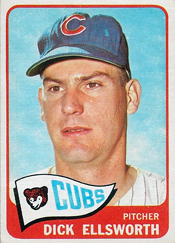
Stan Musial played in 3,026 regular-season games for the Cardinals. Only once did he strike out three times in a game. The pitcher who did it: Dick Ellsworth.

A left-hander who pitched in 13 seasons with the Cubs, Phillies, Red Sox, Indians and Brewers, Ellsworth had a career record of 115-137. He twice lost 20 in a season with the Cubs (9-20 in 1962 and 8-22 in 1966).

Ellsworth’s most noteworthy season was 1963. He was 22-10 for the Cubs and his 2.11 ERA ranked second in the National League to the Dodgers’ Sandy Koufax (1.88).

That also was the year Ellsworth did to Musial what no other pitcher had been able to do.

Top talent

As a youth in Fresno, Calif., Ellsworth followed the local minor-league team, an affiliate of the Cardinals. One of the players who made a strong impression on him was Larry Jackson, who had a 28-4 record for the 1952 Fresno Cardinals.

Ellsworth developed into an outstanding pitcher with Fresno High School. He had a 15-0 record his senior season and struck out 195 in 100 innings, according to the Fresno Bee. He was one of three future big-league players on the 1958 Fresno High School team. The others: Jim Maloney and Pat Corrales. Later, Tom Seaver attended the school.

The day after he graduated in June 1958, Ellsworth, 18, signed with the Cubs. Brought to Chicago, he started in a charity exhibition game against the White Sox at Comiskey Park and pitched a four-hit shutout.

A week later, Ellsworth made his official big-league debut in a start against the Reds at Cincinnati. With the bases loaded and the score tied at 1-1, Ellsworth was lifted for Glen Hobbie, whose belt-high fastball was slugged for a grand slam by Gus Bell. Boxscore

Sent to the minors, Ellsworth came back to stay with the Cubs in 1960. In his first appearance against the Cardinals, on May 14, 1960, at Chicago, he pitched seven scoreless innings and got the win. Boxscore

A year later, on May 20, 1961, Ellsworth earned his first big-league shutout, a 1-0 win against the Cardinals at Chicago. Matched against the pitcher he used to watch at Fresno, Larry Jackson, Ellsworth won the duel, tossing a three-hitter. After Ellsworth got Musial to tap to the mound with a runner at second for the final out in the top of the ninth, Ed Bouchee led off the bottom of the inning and walloped Jackson’s first pitch for a walkoff home run. Boxscore

Words of wisdom

After Ellsworth’s 20-loss season in 1962, two former Cardinals _ Cubs pitching coach Fred Martin and (there’s that name again) Larry Jackson _ helped convert him into a 22-game winner in 1963.

Ellsworth had stopped using a slider because the pitch caused him elbow pain, but at spring training in 1963 Martin showed him a better way to throw it, the St. Louis Post-Dispatch reported.

(Martin later taught Bruce Sutter to throw the split-fingered pitch that put him on the path to the Hall of Fame.)

Larry Jackson, acquired by the Cubs from the Cardinals after the 1962 season, helped Ellsworth develop the slider taught by Martin. “When Jackson joined our club, I asked him how he threw his slider because he has one of the best in the business,” Ellsworth told The Sporting News. “He showed me how to grip the ball and release it without jerking my arm. Now I can throw it without the slightest twinge in my arm.”

Jackson and another veteran Cubs pitcher, Bob Buhl, mentored Ellsworth on his approach to pitching. “I’d sit and talk to them after a game and they’d ask, ‘Why did you throw this pitch to that hitter in that spot?’ or ‘Why didn’t you curve with a 3-and-2 count?’ They helped teach me to think.”

Ellsworth, 23, learned his lessons well. He won eight of his first 11 decisions in 1963. One of the losses was to Ernie Broglio and the Cardinals by a 1-0 score. Boxscore

The next time Ellsworth faced the Cardinals, on July 15, 1963, at St. Louis, he used his bat, as well as his arm, to beat them. Ellsworth pitched 6.2 scoreless innings, exiting after a strikeout of Musial, and drilled a two-run single to center versus Broglio in the 2-0 victory. Boxscore 

Though his sinking fastball remained his best weapon, “the slider gave me a pitch that kept them honest,” Ellsworth explained to The Sporting News. “I’d push the right-handers back by jamming them on the wrists with the slider.”

Special stuff

Two weeks later, on July 28, 1963, Ellsworth started against the Cardinals at Chicago and beat them for his 15th win of the season. Ellsworth pitched a complete game, drove in a run, and struck out 10. Most remarkable, though, were his three strikeouts of Musial. No one had done that to The Man. Boxscore

With his whiff on July 15, followed by the three on July 28, Musial struck out in four consecutive plate appearances versus Ellsworth.

“It surely marked the lowest point of his 1963 season,” author James N. Giglio wrote in his book “Musial: From Stash to Stan the Man.”

Though 42 and in his final season as a player, Musial remained a tough out. That month, for instance, he belted a home run against Juan Marichal and produced two hits in a game versus Warren Spahn. He still made consistently hard contact and would finish his 22-year career never having struck out as many as 50 times in a season.

Against Ellsworth, it was different. Musial hit .219 with 10 strikeouts versus Ellsworth for his career. All seven of his hits against him were singles.

“I just can’t seem to pick up his ball,” Musial told the Post-Dispatch. “My timing hasn’t been right against him.”

Ellsworth said to the Fresno Bee, “I never think about strikeouts. I try to make them hit my pitch. I get more satisfaction in using my head than my arm. I don’t think I’m doing a real good job when I strike out a batter.”

On Sept. 2, 1963, Ellsworth beat the Giants for his 20th win of the season. That same day, his former high school teammate, Jim Maloney of the Reds, beat the Mets for his 20th win of the season.

Ellsworth was the first Cubs left-hander to achieve 20 wins in a season since Hippo Vaughn did it in 1919. 

“I wouldn’t trade him for Sandy Koufax,” pitching coach Fred Martin told The Sporting News. “Dick has more pitches than Koufax and he gets them over.”

Moving on

Ellsworth had losing records in each of the next four seasons. On July 18, 1966, at St. Louis, he gave up a pair of three-run home runs. Tim McCarver hit one and Mike Shannon belted the other 450 feet to left. Boxscore

In 1968, Ellsworth had a resurgence with the Red Sox, posting a 16-7 record for the defending American League champions.

Ellsworth finished with a career record of 15-14 versus the Cardinals. He had more wins against the Cardinals than he did versus any other club.

A son, Steve Ellsworth, pitched for the Red Sox in 1988.


Read Full Post »

Looking to cap a comeback from an injury that nearly shattered his season, pitcher Tommy Boggs was expecting to start Game 2 of the National League Championship Series for the Braves against the Cardinals.

Instead, his hopes for a storybook ending got washed away on a stormy St. Louis night.

After suffering a partial tear of the rotator cuff in his right shoulder early in the season, Boggs wasn’t expected to pitch again in 1982, but he defied the odds and returned to the starting rotation on the last day of August, helping the Braves over the final month in their bid for a National League West Division title. The Braves felt so confident about Boggs’ recovery that they planned to give him a start in the playoff series versus the East Division champion Cardinals.

A right-hander, Boggs pitched nine seasons in the majors for the Rangers and Braves.

Top talent

Born in Poughkeepsie, N.Y., Boggs was a year old when his family moved to Lexington, Ky. Boggs later played youth baseball there and rooted for the Reds, according to the Lexington Herald and the Austin American-Statesman.

After the family relocated to Austin, Texas, Boggs became a standout pitcher at Lanier High School. The Rangers took him with the second overall pick in the first round of the 1974 amateur baseball draft. Boggs was selected ahead of other first-rounders such as Lonnie Smith (Philies), Dale Murphy (Braves), Garry Templeton (Cardinals), Willie Wilson (Royals) and Rick Sutcliffe (Dodgers).

The Rangers called up Boggs, 20, from their Sacramento farm club in July 1976 and he joined a starting rotation with the likes of Gaylord Perry, Bert Blyleven and former Cardinal Nelson Briles. Boggs made his major-league debut in a start against the Red Sox, The first batter he struck out was Fred Lynn. The first hit he gave up was to Carl Yastrzemski. Boxscore

Relying on his fastball, Boggs impressed many, including Cleveland Indians manager Frank Robinson, who told The Sporting News, “He’s good now and he can be a great one. He has poise. He gives the impression he’s in total command, and that’s rare for one his age.”

After Boggs got his first big-league win against Whitey Herzog’s Royals, Rangers manager Frank Lucchesi told the Kansas City Times, “The kid is something special. He reminds me of a young Tom Seaver.” Boxscore

Trials and tribulations

The high expectations created a strain not even an exceptional fastball could overcome. Boggs’ record in two seasons with the Rangers was 1-10. In December 1977, they traded him to the Braves.

“Everything was always, potential, potential,” Boggs told the Austin newspaper. “You really get sick of hearing about it. One time, in triple-A, I saw this sign, one of those Charlie Brown things, that said, ‘The greatest burden in life is potential.’ For about three years, I really believed that.”

Boggs lost 21 of his first 24 decisions in the majors.

It wasn’t until 1979, when he was with the Braves’ farm club in Richmond, Va., that Boggs, 23, began fulfilling his potential. He credited Richmond pitching coach Johnny Sain, who taught him to throw a slider. “Before that, I was a two-pitch pitcher, fastball and curve,” Boggs told the St. Louis Post-Dispatch. “When my curve was off, the batters would just sit on my fastball.”

Boggs had his best season as a pro with Richmond, posting a 15-10 record with 16 complete games.

“I finally got the confidence that I could win again, and the slider was a big part of it,” Boggs said to the Austin American-Statesman. “The pitch, and the confidence, were the two big differences.”

In 1980, Braves manager Bobby Cox and pitching coach Cloyd Boyer, the former Cardinal, gave Boggs a spot in the starting rotation. Mixing his pitches effectively, he finished 12-9, including 3-0 versus the Cardinals.

“The key to pitching against the Cardinals is to keep Garry Templeton off base in front of the big guys,” Boggs told the Atlanta Constitution.

Boggs regressed in 1981 (3-13 record), but showed enough at spring training in 1982 to be a starter for manager Joe Torre and pitching coach Bob Gibson. In the Braves’ home opener, Boggs and Al Hrabosky combined to beat Don Sutton and the Astros. Boxscore

After two more starts in April 1982, Boggs felt pain in his right shoulder.

Down, not out

“When they told me it was a rotator cuff, it really scared me,” Boggs said to the Atlanta Constitution. “There goes your livelihood.”

Torre said, “If he helps us before the end of the season, I’d consider it a plus. I’m not thinking of him coming back before the end of the year.”

Specialists advised Boggs that rest, rather than surgery, was best. Two months later, Dr. Frank Jobe informed Boggs the tear in the rotator cuff had healed and cleared him to begin workouts.

When the Braves played the Cardinals that season, Boggs sought the advice of catcher Darrell Porter, who had experienced a similar injury in 1981. “It’s healed as much as it can, but I still have pain,” Porter told the Atlanta Constitution. “I can’t throw over the top like I used to. I can’t extend my arm. Boggs is facing something difficult.”

After working to strengthen the shoulder, Boggs made three starts for Richmond and was called up to the Braves.

On Aug. 31, 1982, in a start against the Phillies, Boggs made his first big-league appearance since the injury. He pitched six shutout innings and got the win. The two batters he struck out were Pete Rose and Mike Schmidt. Boxscore

“His control was phenomenal,” pitching coach Bob Gibson told the Atlanta Constitution. “I didn’t expect him to have control. He could be a big lift for us.”

Boggs said, “There were times in the last four months when I didn’t know if I could pitch again. Just to go out there was more gratifying than I can explain.”

Boggs made six starts in September for the Braves, showing he could contribute in the playoff series against the Cardinals.

Tough break

Torre chose Phil Niekro, Pascual Perez and Rick Camp as the starting pitchers for the first three games of the best-of-five National League Championship Series. Boggs was picked to start if a Game 4 was necessary.

Wet weather in St. Louis altered those plans. In Game 1 on Wednesday Oct. 6, Niekro pitched 4.1 scoreless innings and had a 1-0 lead when the game was called off because of rain. In the rescheduled Game 1 on Thursday Oct. 7, the Cardinals routed Perez and won, 7-0, on Bob Forsch’s three-hitter.

After the loss, Torre said he would start Niekro in Game 2 on Friday night Oct. 8, but on the morning of the game he changed his mind and said Boggs would start that night against the Cardinals. Torre told the Atlanta Constitution he based his decision on two factors: (1) Whether it’d be fair to pitch Niekro on one day’s rest, and (2) the possibility of having another Niekro start rained out that night.

Gibson called Boggs in his hotel room and informed him of Torre’s decision. Pitching in the playoffs is “something you prepare yourself for all your life,” Boggs told the Post-Dispatch.

Unfortunately for Boggs, it rained relentlessly and the game was called off before a pitch was thrown.

Afterward, Torre changed his mind again, saying Niekro, not Boggs, would start the rescheduled Game 2 on Saturday Oct. 9.

“Someone once told me that changing your mind is a sign of intelligence,” Torre said to the Atlanta Constitution. “After all the times I’ve changed my mind about pitching this year, I must be the most intelligent guy in the world.”

Though Torre said Boggs would start Game 4, if one was necessary, it didn’t soothe the sting Boggs felt about having his Game 2 assignment rained out and being bypassed for Niekro in the rescheduled game. “I’m disappointed,” Boggs told the Post-Dispatch. “I thought I had earned a right to pitch.”

The Cardinals won Game 2, rallying against reliever Gene Garber after Niekro went six innings, and clinched the pennant by beating Rick Camp in Game 3.

Boggs never got to pitch in a playoff game. His last season in the majors was 1985. He ended with a career record of 20-44.

Read Full Post »

On the day he secured his sixth National League batting title, Stan Musial learned he should stick to hitting instead of pitching.

Musial pitched for the only time in a big-league game on Sept. 28, 1952, in the Cardinals’ season finale against the Cubs at St. Louis.

He threw one pitch to one batter, his closest pursuer for the batting title, Cubs outfielder Frankie Baumholtz, then returned to the outfield.

Musial’s pitching appearance was prearranged by the Cardinals, who hoped it would generate interest in a game with nothing at stake in the standings.

Instead, the stunt was an embarrassment to Musial.

Show time

The Cardinals (88-65) entered the final day of the 1952 season in third place in the National League and the Cubs (76-77) were in fifth. Regardless of the outcome in the season finale, both teams were assured of finishing in those spots in the standings.

On the morning of the final game, the St. Louis Post-Dispatch reported Musial would pitch that Sunday afternoon, but only to Baumholtz. Cardinals manager Eddie Stanky told the newspaper Musial would pitch at least once to Baumholtz.

According to The Sporting News, the Cardinals received permission from National League president Warren Giles for Musial to pitch against Baumholtz.

In his book, “Stan Musial: The Man’s Own Story,” Musial said he “was persuaded” to pitch to Baumholtz “as a box office promotion.”

Musial entered the game with a league-leading .336 batting average. Baumholtz was second at .326. According to the Post-Dispatch, it remained mathematically possible for Baumholtz to surpass Musial for the batting title. For that to happen, Baumholtz would have to go 5-for-5 in the finale and Musial would need to go hitless in at least four at-bats.

If Baumholtz went 5-for-5, he’d finish with a batting average of .334. If Musial went 0-for-4 or 0-for-5, he’d finish at .333.

Though the odds were stacked against Baumholtz overtaking Musial, the Cardinals thought having Musial pitch to him would make it more intriguing.

On the mound

Musial began his professional career as a left-handed pitcher in the Cardinals’ system. After pitching two seasons (1938-39) for Williamson (W.Va.), Musial pitched for another Class D farm, the Daytona Beach (Fla.) Islanders, in 1940.

Musial was 18-5 with a 2.62 ERA for Daytona Beach. On days he didn’t pitch, he often played the outfield. In August 1940, he was playing center field against Orlando when he damaged his left shoulder trying to catch a sinking line drive.

The injury ended Musial’s pitching career. Moved fulltime to the outfield in 1941, Musial, 20, rose through the farm system, impressing with his hitting, and reached the majors with the Cardinals in September that year.

Eleven years later, he was asked to give pitching another try in order to end Frankie Baumholtz’s last-gasp bid to snatch the batting crown from him.

Having regrets

A crowd of 17,422 gathered at Sportsman’s Park for the 1952 season finale. Rookie left-hander Harvey Haddix was the Cardinals’ starting pitcher. Musial began the game in center field.

Haddix walked the Cubs’ leadoff batter, Tommy Brown. Then, with Baumholtz coming up, Musial went to pitch, Haddix moved to right field, and Hal Rice shifted from right to center.

“Musial took only a couple of pitches for warmup,” the Post-Dispatch reported.

In his autobiography, Musial said, “I didn’t relish the contrived show. I didn’t like it particularly because the one batter I’d face would be Baumholtz. I didn’t want to give any impression I might be trying to show him up.”

As Musial warmed up, Cubs manager Phil Cavarretta said to Baumholtz, “They’re trying to make a fool of you, Frank,” Baumholtz told author Danny Peary for the book “We Played the Game.”

Baumholtz said he replied, “I don’t think so. I think it’s just a gimmick to get a lot of people in the stands to watch two also-rans on the last day of the season.”

Send in the clowns

Baumholtz was strictly a left-handed batter, but he stood in from the right side to face Musial. Baumholtz never had batted right-handed. According to The Sporting News, Baumholtz made the switch as a gesture of sportsmanship because he “refused to try for a cheap hit” against the National League batting leader posing as a pitcher.

Or, as the St. Louis Globe-Democrat put it, “Baumholtz didn’t want to get something for nothing.”

Musial threw Baumholtz a fastball, the Post-Dispatch reported. In describing the pitch in his book, Musial said, “I flipped the ball.”

Baumholtz “met the ball squarely and it bounced on a big hop” to third baseman Solly Hemus, the Post-Dispatch reported. “Figuring on a double play, Hemus fumbled the ball. He then threw late and wide to first, and Brown took third.”

As United Press noted, “Baumholtz was safe on an error on what should have been a double play ball.”

Reaching on an error made Baumholtz 0-for-1 for the game and virtually eliminated his chance of overtaking Musial for the batting crown.

“I’m not proud of that circus,” Musial said in his autobiography.

After the Baumholtz at-bat, Musial, Haddix and Rice returned to their original positions. Haddix got the next batter, Bill Serena, to ground into a double play, but Brown scored from third for a 1-0 Cubs lead.

When Musial batted in the third inning, Cubs starter Paul Minner “tried to tease him with a slow underhand toss but it was wide of the plate,” the Globe-Democrat reported. On a curve, Musial fouled out to the catcher.

In the ninth, Musial lined a 3-and-2 pitch from Minner to left for a single. In going 1-for-3 in the game, Musial finished the season with a .336 batting average.

Baumholtz went 1-for-4 _ his hit was a bunt single in the sixth _ and placed second in the batting race at .325.

Haddix pitched eight innings and allowed three runs. Minner pitched a shutout in a 3-0 Cubs victory. Boxscore

Higher standards

In the seven seasons in which he won batting titles, Musial’s .336 mark in 1952 was his lowest. It also was the lowest figure by a NL batting leader since Ernie Lombardi of the Reds hit .330 in 1942.

“I had a bad year,” Musial said to the Globe-Democrat. “I wish I could have done better. My timing was off during the season.”

Yep, it was terrible. In addition to winning the batting crown, Musial, 31, led the National League in slugging percentage (.538), hits (194), total bases (311) and doubles (42) in 1952.

In his autobiography, Musial said he was “most disappointed” in his RBI total of 91 in 1952. It was the only time in a 10-year stretch from 1948-57 that Musial didn’t drive in 100 runs in a season.


Read Full Post »

« Newer Posts - Older Posts »