Feeds:
Posts
Comments

Archive for the ‘Pitchers’ Category

Dizzy Dean always could talk a good game, so given the choice of being a coach or a broadcaster, the former Cardinals ace grabbed the microphone.

On July 7, 1941, Dean quit as Cubs coach and signed a three-year deal with Falstaff Brewing to call Cardinals and Browns home games on St. Louis radio station KWK.

“I can make enough in radio in three years to put me on easy street,” Dean told The Sporting News. “There is no future coaching in baseball.”

Desperate measures

Dean made a dazzling debut in the majors with the Cardinals in 1930 and went on to become one of the game’s best and most popular players. He led National League pitchers in strikeouts four times and had 30 wins for the 1934 Cardinals, plus two more in the World Series.

A right-hander, he was 27 when he injured his pitching arm in 1937. A year later, in April 1938, the Cubs sent $185,000 and three players to the Cardinals to acquire Dean.

“When the Cubs purchased Dean, they said they made the move with their eyes wide open,” The Sporting News noted. “They knew his arm was bad, but were confident that proper treatment would take care of everything. It didn’t.”

Dean was 7-1 in 1938 for the National League champion Cubs and 6-4 in 1939, but his arm ached and his availability was limited.

In June 1940, with his ERA for the season at 6.18, Dean, 30, accepted a demotion to the Cubs’ Tulsa farm club.

“Diz is supposed to have made the suggestion,” The Sporting News reported. “He told club officials he wanted to develop a new sidearm delivery.”

The Cubs assigned scout Dutch Ruether, a former big-league pitcher, to work with Dean at Tulsa. “It will be Ruether’s job to keep an eye on Dean’s conduct and assist him in his professed aim to master the sidearm delivery,” The Sporting News reported.

Dean returned to the Cubs in September but “still had the nothing ball,” according to the Chicago Tribune. He was 3-3 with a 5.17 ERA for the 1940 Cubs. All three losses were to the Cardinals.

Different role

Dean, whose top salary as a player was $25,000 in 1935 with the Cardinals, signed with the Cubs for $10,000 in 1941, according to The Sporting News.

Cubs manager Jimmie Wilson, a former catcher who was Dean’s teammate with the Cardinals, endorsed the signing, saying Dean provided the club with “color and pep.” Wilson indicated he’d start Dean against second-division opponents. “Whatever he wins is gravy,” Wilson told The Sporting News.

On April 25, 1941, Dean started against the Pirates, pitched an inning and gave up three runs. Boxscore

“The arm simply went dead and the best doctors in the country couldn’t fix me up,” Dean told the St. Louis Star-Times.

Dean, 31, wrote a letter to Cubs general manager Jim Gallagher, asking to be placed on the voluntary retirement list.

“I have tried everything I know about to get my arm in shape, and this is a step I deeply regret having to take,” Dean wrote. “I sincerely and gratefully appreciate the many kindnesses the club have extended me. I only hope some day, some way, I may be able to repay in part, at least, the debt I owe it.”

On May 14, 1941, the Cubs gave Dean his unconditional release and then signed him to be a coach.

“Dean’s wife had urged him to retire for several weeks before he took the step that made him a coach,” the Chicago Tribune reported.

According to The Sporting News, “Arrangements were made for the remainder of his season’s salary to go into an annuity and a new salary was agreed for the coaching job.”

Follow the money

Dean’s coaching role primarily was to “pitch batting practice and lead cheers in the dugout,” the Chicago Tribune noted.

After a couple of weeks, The Sporting News declared, “Dean is taking his new job as coach as seriously as Diz could be expected to take anything.”

On June 6, 1941, Dean was ejected from a game at Brooklyn for arguing that Dodgers batter Billy Herman interfered with a throw from catcher Clyde McCullough. After being tossed, Dean headed for the clubhouse but returned and had to be chased a second time, The Sporting News reported. League president Ford Frick punished Dean with a $50 fine and five-day suspension. Boxscore

Three weeks later, Cubs first-base coach Charlie Grimm resigned to become manager of a farm team in Milwaukee and Dean replaced him.

Dean was the first-base coach for two weeks before he, too, resigned to accept the offer to become a broadcaster in St. Louis.

According to The Sporting News, Dean would be paid $5,000 to broadcast for the remainder of the 1941 season and $10,000 per season for the next two years.

“I only hope I’m as great an announcer as I was a pitcher,” Dean said to national columnist Walter Winchell.

Meet me in St. Louis

After attending the 1941 All-Star Game in Detroit, Dean boarded a train to St. Louis to begin his broadcasting job. When he arrived at Union Station at 8 a.m. on July 9, he was greeted by a band playing and a welcoming committee of about 300 people, the St. Louis Globe-Democrat reported.

Arriving on the train with Dean was Joe DiMaggio, who played in the All-Star Game and was joining the Yankees in St. Louis for a series with the Browns.

According to the St. Louis Star-Times, “A parade was formed and Dizzy was taken to the Park Plaza hotel for a breakfast reception. DiMaggio joined in the festivities.”

Dean’s first broadcast on KWK was the July 10 game between the Yankees and Browns at Sportsman’s Park. He joined sportscasters Johnny O’Hara and Johnny Neblett in describing the 1-0 Yankees victory. The game was called after five innings because of rain, but DiMaggio got a single in the first, extending his record hitting streak to 49 games. Boxscore

Dean was an immediate hit that summer. The Sporting News credited him with attracting “many new listeners because of his conversational style.”

Some examples of Dean’s style:

_ On the inability of Red Sox pitcher Mickey Harris to throw strikes: “A pitcher can’t pitch that way in the majors, or in the minors either, and parade up to the cashiers window every first and fifteenth.”

_ On Red Sox slugger Ted Williams: “I don’t know if Ted’s got a nickname, but I’m going to give him one: Goose. That’s what he looks like to me _ tall, skinny, loose-jointed.”

_ On batters who complain about an umpire’s strike zone: “It just don’t do you any good to think when you’re up there hitting that the ump has given you a bum call. The ump does his thinking first and that settles it all.”

Dean went on to have a long career in broadcasting, including national telecasts for ABC and CBS.

Read Full Post »

The distance from Clinton, Iowa, to St. Louis is 285 miles, but it took Tom Hilgendorf a decade to complete the trek.

A left-handed pitcher who was born and raised in Clinton, Hilgendorf was 18 when he signed with the Cardinals in 1960. He was 27 when he finally got to pitch for them in the big leagues in 1969.

Hilgendorf’s route to the majors was filled with detours, including illness and a career change, but he persevered.

In six big-league seasons with the Cardinals, Indians and Phillies, Hilgendorf was 19-14 with 14 saves. His most important save occurred off the field while on a road trip with the Indians when he rescued a youth from drowning.

Traveling man

Hilgendorf’s baseball talent was evident early. According to The Sporting News, he pitched for the St. Mary’s High School varsity team when he was 13.

After signing with the Cardinals when he graduated from high school, Hilgendorf began an odyssey through their farm system.

While with Winnipeg in 1961, he played outfield on some days he didn’t pitch. Hilgendorf told the Philadelphia Daily News that farm director Walter Shannon and outfielder Stan Musial scouted him on a Cardinals off-day during the season.

“Musial came to Winnipeg to see me hit,” Hilgendorf said. “He had tagged me as just the kind of hitter he was when he quit pitching in the minors. The next week I was back to pitching. They were overloaded with outfielders and short on arms.”

After the 1965 season, Hilgendorf went to Nicarauga to play winter baseball.

“I was sitting in the dugout and (teammate) Mel Queen said, ‘Hey, your eyes are yellow,’ ” Hilgendorf told the St. Louis Post-Dispatch. “I went and looked in a mirror and he was right. Then I noticed my arms were yellow, too.”

Hilgendorf had hepatitis. He returned to Iowa and said he spent a week in a hospital and four months in bed at home.

The Cardinals put Hilgendorf on the restricted list and he sat out the 1966 season. According to the Post-Dispatch, “he lost 45 pounds and started to think about a different future.”

He informed the Cardinals he wouldn’t play in 1967 either. “I went to work for DuPont’s cellophane plant in Clinton,” Hilgendorf told the Wilmington (Del.) News Journal.

“The hours were great and the money good,” said Hilgendorf, who operated a slicer, “but I couldn’t see myself sitting behind a machine all my life, never seeing the sun until I get off work.”

Hilgendorf returned to the Cardinals’ farm system in 1968. He began the season at Arkansas before moving to Class AAA Tulsa, managed by Warren Spahn

Back with Tulsa in 1969, Hilgendorf didn’t appear prominent in the plans of the Cardinals, whose bullpen ace was another left-hander from Iowa, Joe Hoerner.

“My mother and father would ask me why the Cardinals wouldn’t trade me to some team that would use me, or they’d say, ‘Why don’t you find yourself a nice job?,’ ” Hilgendorf said to the Wilmington News Journal.

Major achievement

In August 1969, Hilgendorf finally got the call from the Cardinals.

With prominent sideburns and a beefy physique, Hilgendorf “looks like a guy who just wheeled an 8-axle semi rig up to a truck stop somewhere on Route 66 and said to Marge the Waitress, ‘How’s tricks, Sweetie? Rustle me up a cheeseburger and black coffee,’ ” Bill Conlin wrote in the Philadelphia Daily News.

Hilgendorf made his major-league debut with an inning of scoreless relief against the Braves. Boxscore

The next month, Hilgendorf earned saves in consecutive games versus the Expos. The second one preserved the first win for Jerry Reuss, who was making his major-league debut. Boxscore

In six appearances covering 6.1 innings for the 1969 Cardinals, Hilgendorf had a 1.42 ERA.

After the 1969 season, the Cardinals dealt Joe Hoerner to the Phillies. Hilgendorf became “the prime candidate” to replace Hoerner as the top left-handed reliever, The Sporting News declared.

Hilgendorf opened the 1970 season with the Cardinals, but it didn’t work out. He was 0-4 with three saves for them and spent part of the season back at Tulsa, pitching for Spahn.

On Dec. 2, 1970, the Cardinals traded Hilgendorf to the Royals for pitcher Ike Brookens.

Fork it over

The Royals assigned Hilgendorf to the minors and left him there. In July 1972, they traded him to the Indians. The deal reunited Hilgendorf, 30, with Spahn, the Indians’ pitching coach.

“He’s got a good arm,” Spahn told The Sporting News. “He throws strikes, keeps the ball low.”

Facing a stretch with multiple doubleheaders, the Indians gave Hilgendorf his first start in the big leagues versus the Brewers. He pitched a six-hitter for his his first major-league win. Boxscore

Hilgendorf was 3-1 with a 2.68 ERA in 19 appearances for the 1972 Indians. In five starts for them, he was 2-1 with a 2.72 ERA.

The next year, Hilgendorf was 5-3 and led the Indians in games pitched (48), ERA (3.14) and saves (six). Hilgendorf credited a forkball, a pitch described by The Sporting News as “a no-spin pitch with a sharp drop,” with helping him get established in the majors.

Big save

Hilgendorf was 4-3 with three saves for the 1974 Indians. The highlight came on July 6 when the Indians were in Anaheim to play the Angels.

Hilgendorf was returning from dinner at 11:20 p.m. when he noticed a boy at the bottom of the motel swimming pool, the Long Beach Independent reported.

According to the newspaper, 13-year-old Jerry Zaradte of San Francisco was playing in the pool when he was overcome with cramps and sank to the bottom. Hilgendorf dived fully clothed into the pool to rescue him.

“I got him up once, but he slipped back,” Hilgendorf told the Long Beach Independent. “The second time, I made it. He’s a lucky kid. Normally, I wouldn’t have passed by the pool, but I decided to take a shortcut because it was getting late.”

Hilgendorf “was credited with saving the life” of the youth, The Sporting News reported.

Philadelphia story

In March 1975, the Indians traded Hilgendorf to the Phillies.

“I’ve been after Hilgendorf for two years,” Phillies general manager Paul Owens told The Sporting News. “He can pitch.”

In joining the Phillies, Hilgendorf crossed paths again with former Cardinals teammate Joe Hoerner. With Tug McGraw sidelined because of a back ailment, Hoerner and Hilgendorf were the left-handers in the Phillies’ bullpen.

Hilgendorf was 7-3 with a 2.14 ERA in 53 appearances for the Phillies. In seven games versus the Cardinals, he was 1-1 with a 1.76 ERA.

The Phillies released Hilgendorf, 34, just before the start of the 1976 season. The Pirates signed him, but he never returned to the majors.

After his playing career, Hilgendorf was a self-employed carpenter in Iowa.

Read Full Post »

Pitcher Gary Blaylock hit two home runs for the Cardinals and he did it in consecutive at-bats.

On May 12, 1959, in his final at-bat of the game, Blaylock hit a two-run home run against Reds reliever Jim O’Toole.
Four days later, on May 16, Blaylock took his next at-bat, against Phillies starter Jim Owens, and hit another two-run home run.

The homes in consecutive at-bats were the only ones Blaylock hit in the majors. The 1959 season, Blaylock’s lone year as a big-league player, was split between the Cardinals and Yankees.

Long wait

Blaylock was born in the Missouri Bootheel, the southeasternmost part of the state, in the town of Clarkton, and grew up on a farm in nearby Malden.

A right-hander, he developed his arm strength milking cows, according to the St. Louis Post-Dispatch. Blaylock was 18 when he signed with the Cardinals in 1950.

Blaylock spent nine seasons in the Cardinals’ farm system. He had success, winning 23 for Johnson City in 1951 and 14 for Rochester in 1958, for instance. The Sporting News noted he “has appeared close to stardom at times,” but Blaylock repeatedly was passed over for a spot in the big leagues.

“We always have considered him a fine prospect,” Cardinals general manager Bing Devine told The Sporting News, “but he was young and found it difficult to control his temper. He fought himself and was … a thrower instead of a pitcher.”

The Cardinals liked what they saw of Blaylock, 27, at spring training in 1959.

“He has matured,” Devine said. “He’s a pitcher now.”

Cardinals manager Solly Hemus told The Sporting News, “I’ll bet that if the state of the ballclub permits the use of Gary every fourth day, he’ll win 12 games. If he is used only in spots and not as a regular starter, he’ll win at least seven.”

On the run

The Cardinals opened the 1959 season with a starting rotation of Larry Jackson, Ernie Broglio, Vinegar Bend Mizell and Lindy McDaniel. Hemus said rookies Blaylock and Bob Gibson would be relievers and spot starters.

After waiting since 1950 to reach the big leagues, Blaylock made his debut on Opening Day at St. Louis, but not as a pitcher. He entered the game in the eighth inning as a pinch-runner for Stan Musial, and it was quite an adventure.

Taking a big lead in anticipation of a hit-and-run play, Blaylock became trapped when Giants pitcher Johnny Antonelli made a pickoff throw to first.

“All I could think of _ and I thought of a lot in a split second _ was, ‘My gosh, I’ve been in baseball 10 years, waiting to get into a big-league game, and now look what I’ve done,’ ” Blaylock told the Post-Dispatch.

Blaylock made a desperate dash toward second. A throw to shortstop Andre Rodgers, covering second, arrived ahead of the runner, but Blaylock made a belated slide, eluded “a slow, careless tag” by Rodgers, and was called safe, The Sporting News reported.

Blaylock advanced to third on a groundout and scored on an Alex Grammas single. Boxscore

Hot and cold

Six days later, on April 16, Blaylock pitched in a big-league game for the first time. Appearing in relief against the Dodgers at Los Angeles, Blaylock tossed two scoreless innings, retiring all six batters he faced. Boxscore

Hemus rewarded him with a start against the Cubs at Chicago on April 21. Blaylock pitched a complete game, but the Cubs won, 1-0, behind Glen Hobbie’s one-hitter. Musial got the Cardinals’ lone hit, a double with two outs in the seventh. Sammy Taylor drove in the Cubs’ run in the second. Boxscore

In May, Hemus put Blaylock in the starting rotation. On May 12 at St. Louis, he held the Reds scoreless for five innings. With the Cardinals ahead 5-0, Blaylock hit a two-run home run deep into the seats in left-center in the bottom of the fifth.

“I’ve always been a fair hitter,” Blaylock told the Post-Dispatch.

He pitched 6.2 innings for the win, but was lifted before he had another at-bat. Boxscore

In his next appearance, a start versus the Phillies at St. Louis, Blaylock broke a scoreless tie with a two-run home run in his first at-bat of the game in the third. Blaylock went the distance and got the win, boosting his record to 3-1. Boxscore

After that, Blaylock’s season unraveled. He never won another start and was sent to the bullpen in the middle of June. In July, the Cardinals put him on waivers and the Yankees claimed him.

In 26 appearances for the 1959 Cardinals, Blaylock was 4-5 with a 5.13 ERA. He was 3-4 as a starter and 1-1 in relief. As a batter, Blaylock was 4-for-34 with 17 strikeouts.

Blaylock was an effective reliever for the 1959 Yankees. He had a 2.59 ERA in 14 relief appearances for them. A highlight came on Aug. 15 at Yankee Stadium when he pitched five scoreless innings and drove in Norm Siebern with a double. Boxscore

Shelled in his one start, against the Tigers, Blaylock finished the season 0-1 with a 3.50 ERA for the Yankees.

Nurturing talent

Blaylock pitched in the Yankees’ farm system from 1960-63, then moved into managing. He was a minor-league manager for the Yankees and Royals.

In 1971, when Blaylock managed the Royals’ farm team in Billings, Mont., his shortstop was George Brett, 18, who was in his first season as a professional. According to the Kansas City Star, Blaylock said he wasn’t convinced Brett “had enough arm to be a top-flight shortstop” and moved him to third.

“I was thoroughly impressed with him as a kid and as a guy that liked to play,” Blaylock said, “but I wasn’t impressed to the point that I thought he’d be a star.”

Blaylock also served as a scout and minor-league pitching instructor for the Royals. He mentored pitching prospects Bret Saberhagen, Danny Jackson and Mark Gubicza.

“He understands me more than anybody except my family,” Gubicza told the Kansas City Star.

The Royals named Blaylock pitching coach on the staff of manager Dick Howser in 1984. Blaylock succeeded another former Cardinal, Cloyd Boyer.

Blaylock was Royals pitching coach from 1984-87.

His coaching highlight came in 1985 when the Royals became World Series champions, defeating the Cardinals.

Royals pitchers limited the Cardinals to 13 runs in seven games. Saberhagen was 2-0 with an 0.50 ERA and won the World Series Most Valuable Player Award. He also was the recipient of the 1985 American League Cy Young Award.

Note: Special thanks to Cardinals researcher Tom Orf for providing the inspiration to research and write this post.

Read Full Post »

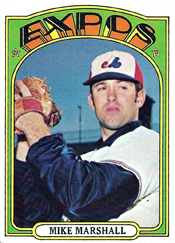
Dubbed by Sports Illustrated as the “busiest and brainiest relief pitcher in baseball,” Mike Marshall usually was effective against the Cardinals, but they also had some spectacular successes, twice beating him with walkoff home runs.

A right-hander with remarkable stamina, Marshall was the first relief pitcher to win a Cy Young Award. It happened in 1974, when he pitched for the Dodgers in 106 games, a major-league record for most appearances in a season by a pitcher.

A student of body movement who earned a doctorate in exercise physiology, Marshall developed an approach that enabled him to pitch often and well throughout most of the 1970s. He was an innovator, educator and baseball rebel.

Changing course

At age 11, Marshall was a passenger in a car that was struck by a train near his home in Adrian, Mich. Marshall’s uncle was killed in the accident and Marshall suffered a back injury, according to Sports Illustrated.

Despite an aching back, Marshall became a standout high school athlete in multiple sports, including as a baseball shortstop. He was 17 when he signed with the Phillies in September 1960.

While playing shortstop in the Phillies’ farm system, Marshall enrolled at Michigan State and attended classes during the baseball off-seasons.

Marshall hit for average in the minors, but his back bothered him, making it difficult for him to field grounders, and he told the Phillies he wanted to pitch, the Detroit News reported.

Marshall had a 3.39 ERA in 44 games for Phillies farm clubs in 1965. The Tigers purchased his contract in April 1966 and brought him to the big leagues in 1967. He pitched for the Seattle Pilots, an American League expansion team, in 1969 and the Astros in 1970. 

At Michigan State, Marshall earned a bachelor’s degree in physical education in 1965 and a master’s degree in 1967. His mentor was William Heusner, a professor in kinesiology, the study of body movement. Heusner made Marshall an assistant, giving him a chance to teach.

Describing himself as an educator first and ballplayer second, Marshall told The Sporting News that as a teacher, “I feel I am performing a function that makes me feel vital as a human being.”

Marshall’s academic work helped him develop an approach to pitching. He taught himself to throw a screwball without straining his arm, but the Tigers, Pilots and Astros prohibited him from throwing the pitch.

“Those three were linked by a common denominator of insecurity,” Marshall told The Sporting News. “They couldn’t accept someone trying anything different, or admit that another man’s way might be right.”

Good match

Marshall’s baseball career took an upturn in June 1970 when the Astros traded him to the Expos. Gene Mauch was Expos manager and he encouraged Marshall to throw the screwball.

“It was Mauch who allowed Marshall to develop the concepts, the artistry, the free expression Marshall exhibits on the mound,” The Sporting News noted.

Marshall said, “Our relationship was poetry. I felt we talked as peers.”

Mauch showed faith and patience. Marshall was 3-7 with the 1970 Expos. The first time he faced the Cardinals was as a starter on Aug. 8 and he gave up five runs in 2.1 innings. Boxscore

The turning point came the next year when Marshall focused on relieving and earned 23 saves for the 1971 Expos.

“I’d say 1971 was my most satisfying season,” Marshall told The Sporting News. “That was the year I realized I was a major-league player.”

Marshall had a spectacular August for the 1971 Expos, with five saves and an 0.83 ERA, but suffered a setback against the Cardinals in September.

On Sept. 24, 1971, Joe Hague hit a walkoff grand slam against Marshall in the 10th inning, giving the Cardinals a 10-6 victory. It was the first walkoff home run allowed by Marshall in the majors. Boxscore

Head of the class

In the next two seasons with the Expos, Marshall had 14 wins, 18 saves and a 1.78 ERA in 1972, and 14 wins, a league-leading 31 saves and a 2.66 ERA in 1973. He led the league in games pitched _ 65 in 1972 and 92 in 1973.

During those two seasons, Marshall either won or saved 77 of the Expos’ 149 victories.

The Sporting News noted, “Marshall has revolutionized the thinking about relief pitchers, about their conditioning, about their concepts while on the mound.

“He has applied his understanding of kinesiology to the screwball, which he can make move in more than one direction, and to a conditioning program that makes it possible for him to pitch with a frequency and consistency that is beyond the capabilities of all other pitchers.”

Speaking out

After the 1973 season, Marshall was named Expos player of the year by the Montreal chapter of the Baseball Writers Association of America. The honor came with a $5,000 check from O’Keefe Brewery, a sponsor of Expos games, but Marshall refused to accept the money.

“I don’t feel I should compete against my own teammates for money like this,” Marshall said to The Sporting News.

Marshall requested in writing that the brewery donate the money to sickle cell anemia research. When he learned the brewery instead gave the $5,000 to an amateur baseball program, Marshall objected and pressured the brewery to honor his request, The Sporting News reported.

Marshall created another controversy when, in an interview with a Michigan reporter, he criticized the Expos’ defensive play.

“Who the hell wants to go back and pitch for that defense any more?” Marshall said. “Second base was terrible. There’s no way we can play another year with Ron Hunt … Third base was terrible. We have absolutely no defense with Bob Bailey. Zero. You can put a high school kid out there and get the same production out of our defense.”

Marshall apologized, but the controversies lingered. Described by Sports Illustrated as a “brooding intellectual of the bullpen” with a “mantle of Kierkegaardian gloom,” Marshall was traded by the Expos to the Dodgers for outfielder Willie Davis in December 1973.

Special season

Dodgers manager Walter Alston let Marshall pitch as much as he wanted. Marshall pitched in 13 consecutive Dodgers games and was 6-0 with two saves and 1.67 ERA in that stretch.

“What he has done is against everything that I ever felt was physically possible,” Dodgers pitcher Jim Brewer told The Sporting News.

Another Dodgers pitcher, Andy Messersmith, said to Sports Illustrated, “He’s a unique and complex individual. There is no one like him in this game. He’s small and rotund, but I haven’t seen anything athletic he can’t do if he puts his mind to it. I’ve never known Mike to go into anything, even Frisbee throwing, without some thought about the muscles involved.”

Marshall was 15-12 with a 2.42 ERA for the 1974 Dodgers and led the league in games pitched (106) and saves (21). He pitched 208.1 innings in relief. The Dodgers won the pennant, and in the World Series against the Athletics, Marshall pitched in all five games, allowing one run in nine innings. Video

Sports Illustrated said of the 1974 National League Cy Young Award winner: “It is his knowledge of his own body, its strengths and limitations, that allows him to pitch in as many as 100 games a season.”

Magic numbers

At his peak, Marshall was dominant against the Cardinals, with ERAs of 1.10 in 1972, 1.69 in 1973 and 1.06 in 1974. In 1976, Marshall made three appearances versus the Cardinals and got wins in all three, posting a 1.08 ERA.

After being traded by the Dodgers in June 1976, Marshall pitched for the Braves, Rangers, Twins and Mets. With the Twins, he was reunited with Mauch and was the American League leader in saves (32) and games pitched (90) in 1979.

In 96 career innings versus the Cardinals, Marshall gave up only two home runs to them. The first was the walkoff grand slam by Joe Hague in 1971. The other came in Marshall’s final season, 1981, with the Mets.

On Sept. 12, 1981, Julio Gonzalez hit a two-run walkoff homer run versus Marshall in the 13th inning, giving the Cardinals a 4-2 triumph. It was Gonzalez’s first homer in the big leagues in three years. Boxscore

Marshall finished with a career record of 97-112 and 188 saves. Against the Cardinals, he was 6-7 with 33 saves.

Marshall is one of five pitchers to pitch in 90 or more games in a big-league season. The list:

_ Mike Marshall: 106 (1974 Dodgers), 92 (1973 Expos) and 90 (1979 Twins).

_ Kent Tekulve: 94 (1979 Pirates), 91 (1978 Pirates), 90 (1987 Phillies).

_ Salomon Torres: 94 (2006 Pirates).

_ Pedro Feliciano: 92 (2010 Mets).

_ Wayne Granger: 90 (1969 Reds).

Read Full Post »

When his arm was sound, Ernie White had the talent to be an ace on the Cardinals’ pitching staff.

In June 1941, White pitched consecutive two-hit shutouts for the Cardinals against the Dodgers and Giants.
The back-to-back gems were the centerpieces in a stretch of 27.2 scoreless innings pitched by White, a left-hander who threw hard with an easy motion.

White earned 17 wins for the 1941 Cardinals, but arm ailments kept him from ever having another double-digit win season.

Turning pro

In 1937, White, 20, was pitching for a textile mill team in his native South Carolina when he was discovered and signed by Cardinals scout Frank Rickey, brother of club executive Branch Rickey, according to the Society for American Baseball Research.

White made his Cardinals debut in 1940 and was a prominent part of the pitching staff in 1941.

Besides White, the 1941 Cardinals pitching staff for manager Billy Southworth included Lon Warneke, Mort Cooper, Max Lanier, Harry Gumbert and Howie Krist. All posted double-digit win totals for the 1941 Cardinals.

On June 7, 1941, the Cardinals started Sam Nahem against the Giants at the Polo Grounds. A New York native, Nahem had a law degree from St. John’s University and enjoyed classical music and literature.

A right-hander, Nahem gave up three runs and was relieved by White with none out in the second. Referring to Nahem as the “boy lawyer,” J. Roy Stockton of the St. Louis Post-Dispatch wrote dismissively, “The Brooklyn barrister didn’t have his usual stuff. Southworth told Sam to spend the rest of the afternoon reading, or something.”

White pitched eight scoreless innings of relief and got the win as the Cardinals prevailed, 11-3. Boxscore

Right stuff

White’s next appearance came on June 15 in a start versus the Dodgers in the second game of a doubleheader at St. Louis.

With two outs and none on in the third inning, pitcher Hugh Casey doubled for the Dodgers’ first hit of the game. White hit Pee Wee Reese with a pitch and walked Billy Herman, loading the bases.

“Ernie was plainly rattled,” W. Vernon Tietjen of the St. Louis Star-Times observed.

Up next was Pete Reiser, who hit a hard grounder to the right side toward Don Padgett, a hulking catcher and outfielder who was making a rare start at first base.

“Padgett threw his 215 pounds at the ball, stuck out his glove and, sure enough, when he picked himself up the ball was stuck in it,” Tietjen wrote in the Star-Times.

Padgett tossed to White, covering first, for “a sensational putout.”

In the bottom half of the third, White doubled, sparking a three-run Cardinals uprising.

White allowed one other hit, a double by Reese in the sixth, and finished with a two-hit shutout in the Cardinals’ 3-0 victory. Boxscore

Special talent

The shutout of the Dodgers ran White’s scoreless innings streak to 17.

His next appearance came June 21 in a start versus the Giants at St. Louis. White pitched another two-hit shutout. The Giants’ hits were singles by Billy Jurges in the second and Mel Ott in the fourth.

In the sixth, White stroked a RBI-single against Bill Lohrman, “a drive that took Lohrman’s cap right off his head and made him wonder, no doubt, if perhaps he wasn’t wearing his protective helmet during the wrong part of the game,” the Post-Dispatch noted. Boxscore

Four days later, on June 25, White started against manager Casey Stengel’s Braves at St. Louis.

In the second, with two outs and Braves runners on second and third, Sibby Sisti grounded a ball just out of the reach of second baseman Creepy Crespi. The hit scored both runners, ending White’s scoreless streak at 27.2 innings.

White held the Braves scoreless in the last seven innings and got the win as the Cardinals triumphed, 6-2. White also drove in one of the Cardinals’ runs with a sacrifice fly.

The win boosted White’s record for the season to 5-1 and kept the Cardinals in first place, a half-game ahead of the Dodgers. Boxscore

In the Star-Times, W. Vernon Tietjen wrote, “Everybody knows baseball pennants are rarely, if ever, won without a Paul Derringer or Bucky Walters, a Dizzy Dean, a Carl Hubbell or a Red Ruffing. Everybody knows, too, that the Cardinals are still leading this race without a substantial facsimile thereof. A good many persons strongly suspect, however, that the Cardinals have one in the making in Ernest Daniel White.”

White “has all the attributes of pitching greatness,” Tietjen declared. “His fastball, delivered with no more apparent effort than a warmup pitch, leaves batters wondering where it went.”

Career curtailed

The Cardinals (97-56) finished in second place, 2.5 games behind the champion Dodgers (100-54). White was 17-7 and was third in the National League in ERA at 2.40. He had 12 complete games and three shutouts.

An arm ailment sidelined White for part of the 1942 season, but he pitched a shutout in Game 3 of the World Series, leading the Cardinals to a 2-0 victory over the Yankees at New York. The Yankees’ lineup featured four future Hall of Famers: Bill Dickey, Joe DiMaggio, Joe Gordon and Phil Rizzuto. Boxscore

According to the Society for American Baseball Research, White was the first pitcher to shut out the Yankees in a World Series game since the Cardinals’ Jesse Haines did it in 1926.

White had a shoulder injury in 1943. He entered the Army in January 1944, fought in the Battle of the Bulge in World War II and was discharged in January 1946.

He returned to baseball, but his arm wasn’t right. The Cardinals released White in May 1946 and he signed with the Braves, rejoining his former Cardinals manager, Billy Southworth. His final season in the majors was 1948 and he departed with a career mark of 30-21 with a 2.78 ERA.

White went on to manage teams in the farm systems of the Braves, Reds, Athletics, Yankees and Mets for 15 seasons.

In 1963, 22 years after his scoreless innings streak ended against Casey Stengel’s Braves, White became a coach on the staff of Stengel’s Mets. 

Read Full Post »

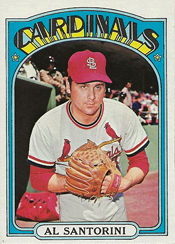
Al Santorini pitched for a while with Bob Gibson and Steve Carlton in the starting rotation of the Cardinals.

On June 11, 1971, the Cardinals acquired Santorini from the Padres for outfielder Leron Lee and pitcher Fred Norman.

A right-hander, Santorini’s three seasons with the Cardinals were highlighted by the three shutouts he pitched in 1972. Overall with the Cardinals, Santorini was 8-13.

Prized prospect

A son of a truck driver for Ballantine beer, Santorini was born in Irvington, N.J., and excelled at high school athletics in Union Township, N.J.

Santorini was a standout prep quarterback and bowler, but his best sport was baseball. As a pitcher, his high school record was 35-1. A high school teammate, Elliott Maddox, also went on to play in the majors.

Santorini, 18, was considered a prime prospect entering the June 1966 amateur baseball draft. The Cardinals, with the seventh selection in the first round, drafted Leron Lee. The Phillies had the ninth pick in the first round and their scout, Paul Owens, hoped they’d take Santorini.

“I scouted Santorini quite a bit,” Owens told the St. Louis Post-Dispatch. “He had a great fastball and looked so good that I recommended we select him as No. 1.”

Instead, the Phillies used their first-round pick to draft Mike Biko, a pitcher who never reached the majors.

With the 11th pick in the first round, the Braves chose Santorini and assigned him to the minors. The next year, he underwent an operation on his right elbow.

After posting a 2.68 ERA for Class AA Shreveport in 1968, Santorini was called up by the Braves and made his major-league debut in a start against the Giants on Sept. 10 at Atlanta. The Braves’ starting catcher, Walt Hriniak, also was playing his first game in the majors. The regular catcher, Joe Torre, shifted to first base.

Santorini held the Braves scoreless for two innings, but gave up four runs in the third. The big blow was Willie McCovey’s decisive three-run home run. McCovey never got another hit versus Santorini, finishing 1-for-17 against him in his career. Boxscore

A month later, the Braves failed to protect Santorini in the National League expansion draft and he was picked by the Padres.

Fun and games

In three seasons with the Padres, Santorini was 9-24. He was 0-1 against the Cardinals but with a 2.86 ERA in 28.1 innings.

On May 26, 1971, Santorini started both games of a doubleheader for the Padres against the Astros at San Diego.

In Game 1, Padres manager Preston Gomez thought he would outmaneuver the Astros, who started a lineup of mostly left-handed batters. As Santorini warmed up in the Padres’ bullpen before the game, left-hander Dave Roberts secretly got loose in the San Diego Chargers’ football clubhouse.

“When they saw Santorini warming up, they had all those left-hand hitters ready to hit against him,” Gomez said to the Associated Press.

After Santorini retired leadoff batter Roger Metzger, Roberts relieved. He pitched the remainder of the game, but the Astros won, 2-1. Boxscore

In Game 2, Santorini started, went six innings and gave up four runs. His counterpart, Larry Dierker, pitched a one-hitter and the Astros prevailed, 8-0. Boxscore

Two weeks later, Santorini was dealt to the Cardinals.

Hard to win

Used as both starter and reliever, Santorini was 0-2 with two saves and a 3.81 ERA for the 1971 Cardinals. He had a 2.10 ERA in 14 relief appearances and a 5.62 ERA in five starts. In his first start for the Cardinals, Santorini lost, 1-0, to Don Gullett and the Reds. Boxscore

With the Cardinals, Santorini was reunited with Joe Torre, his former Braves teammate. Helped by weight loss, Torre won the National League Most Valuable Player Award with the Cardinals in 1971. He urged Santorini to lose weight, too.

Santorini went from 202 pounds to 190 after the 1971 season. He and Torre shared an apartment in north St. Louis County at the start of the 1972 season.

“Every time Joe caught me having a high-calorie soft drink or eating anything, he’d call me things like fatso or slob,” Santorini told the Post-Dispatch. “Joe is like a guy who gave up smoking finally and then can’t stand to see anyone else smoking.”

Santorini began the 1972 season as a reliever and spot starter. On April 17, 1972, with his parents in attendance at Philadelphia, Santorini got his first Cardinals win in a relief stint versus the Phillies. Boxscore

The win snapped a streak of 12 consecutive losses for Santorini, dating back to April 1970. “It was beginning to get to me,” Santorini told The Sporting News. “It has to make you wonder some.”

Throwing zeroes

On July 4, 1972, Cardinals starting pitcher Scipio Spinks injured a knee in a plate collision with Reds catcher Johnny Bench and was sidelined for the rest of the season. Santorini (4-6) replaced Spinks in the rotation.

Santorini pitched the first of his three Cardinals shutouts on Aug. 6, 1972, in a 6-0 victory against the Phillies. He told the Philadelphia Daily News his arm stiffened in the sixth inning, “but you don’t want to come out when you’re pitching a shutout.” Boxscore

On Sept. 16, Santorini shut out the Pirates in a 4-0 win. A key moment occurred in the seventh when, with two outs and runners on second and third, Santorini struck out Richie Zisk, a former New Jersey prep rival, on three pitches. “Those were the three hardest pitches I threw all day,” Santorini told the Post-Dispatch. Boxscore

Two weeks later, on Wednesday afternoon Sept. 27 in the Cardinals’ final home game of the season, 3,380 spectators, the smallest crowd to attend a Cardinals game since Busch Memorial Stadium opened in May 1966, watched Santorini spin a shutout in a 4-0 triumph over the Mets.

Santorini threw 149 pitches and struck out a career-high 12 batters, extending his scoreless innings streak to 20.

“My buddies back in New Jersey were probably watching the game on TV, just off the golf course and drunk,” Santorini said to the Post-Dispatch. “They don’t work.” Boxscore

Santorini finished 8-11 with a 4.11 ERA for the 1972 Cardinals.

The next year, he had a 5.50 ERA in six relief appearances when the Cardinals traded him to the Royals for pitcher Tom Murphy on May 8, 1973.

Santorini spent the rest of the 1973 season in the minors. In 1974, he was in the Phillies’ system, but was released in July.

Santorini called the Cardinals and they signed him to pitch for their Tulsa affiliate. “I was lucky to latch onto a club for the remainder of the season,” Santorini told The Sporting News. “I feel I still can do the job in the major leagues as a reliever.”

After posting a 5.57 ERA for manager Ken Boyer’s Tulsa team, Santorini was bypassed when the Cardinals called up players in September. At 26, his pitching career was finished.

Read Full Post »

« Newer Posts - Older Posts »