Feeds:
Posts
Comments

Archive for the ‘Pitchers’ Category

(Updated April 11, 2026)

After saying adios to the Cardinals, pitchers Max Lanier and Fred Martin and infielder Lou Klein returned from exile three years later and helped the club challenge the Dodgers in a down-to-the-wire National League pennant race.

On June 5, 1949, baseball commissioner Happy Chandler granted amnesty to 18 major-league players and six minor-leaguers who defected to the Mexican League, lifting their five-year bans and allowing them to apply for reinstatement to professional baseball in the United States.

The trio of Cardinals who defected _ Lanier, Martin and Klein _ all asked to come back and the Cardinals agreed.

“They’ve been punished enough and we’ll be glad to give them a chance to prove they’re still major leaguers,” Cardinals manager Eddie Dyer said to the St. Louis Post-Dispatch.

Crossing the border

In 1946, Lanier, Martin and Klein broke their contracts with the Cardinals and jumped to the rival Mexican League in pursuit of more lucrative salaries. Chandler banned them all from returning to professional baseball in the U.S. for five years.

In addition to the three Cardinals, the most prominent defectors were Giants pitcher Sal Maglie and Dodgers catcher and former Cardinal Mickey Owen.

Lanier, Martin and another defector, Giants outfielder Danny Gardella, filed lawsuits against Major League Baseball, challenging the legality of the reserve clause that bound a player to the team holding his contract.

In explaining why he lifted the bans on the defectors, Chandler said he decided “to temper justice with mercy,” United Press reported.

Roster revamp

On the day Chandler granted amnesty, the Cardinals beat the Braves, improving their record to 23-19 and putting them 1.5 games behind the first-place Giants. The Cardinals figured to get a boost from the three Mexican League refugees.

Lanier, 33, was a left-handed pitcher who debuted with the Cardinals in 1938 and developed into a consistent winner. He posted records of 15-7 in 1943 and 17-12 in 1944 for pennant-winning Cardinals clubs. His ERA of 1.90 in 1943 was best in the National League. Lanier also was the winning pitcher for the Cardinals against the Browns in the Game 6 championship clincher of the 1944 World Series.

In 1946, Lanier was 6-0 with a 1.93 ERA for the Cardinals when he joined Martin and Klein in bolting to the Mexican League in May. In the book “Redbirds Revisited,” Lanier said his Cardinals salary was for $10,500. The Mexican League offered him a $25,000 signing bonus, plus a five-year contract for $20,000 per year. “You didn’t need to be a brain to see how much more that was than what the Cardinals were paying me,” Lanier said.

Martin, 33, was a right-handed pitcher who was 2-1 with a 4.08 ERA as a Cardinals rookie in 1946. ‘He knew how to pitch,” Cardinals outfielder Stan Musial told writer Roger Kahn. “Not the greatest fastball, but he was smart.”

Klein, 30, was a second baseman who debuted with the Cardinals in 1943 and had a big rookie season (.287 with 180 hits). In 1946, he was the Cardinals’ Opening Day second baseman before he slumped and was replaced by Red Schoendienst.

Dyer envisioned Lanier as a starter for the 1949 Cardinals, with Martin in the bullpen and Klein backing up Schoendienst and shortstop Marty Marion.

“I don’t know of any player on the club who holds anything against them and won’t be happy to see them come back,” Musial said to the St. Louis Star-Times.

Helping hands

All three prodigal Cardinals helped the club in 1949. Lanier won five consecutive decisions between Aug. 28 and Sept. 21. Martin, who moved into the starting rotation, was 3-0 in August and 2-0 in September. Klein batted .323 with runners in scoring position.

In August 1949, Lanier and Martin dropped their antitrust suit against Organized Baseball. Two months later, Gardella also discontinued his lawsuit and signed with the Cardinals as a free agent.

On Sept. 20, 1949, after Martin improved his record to 6-0 with a win against the Phillies, the Cardinals were in first place, 1.5 games ahead of the Dodgers. Boxscore

The next day, Sept. 21, 1949, the Dodgers and Cardinals played a doubleheader at St. Louis. Lanier pitched a five-hit shutout in the opener and the Cardinals won, 1-0. Boxscore

The Dodgers won the second game, 5-0, behind the pitching of Preacher Roe, a former Cardinal, and a two-run triple by Luis Olmo, one of the defectors to the Mexican League who was allowed back. Boxscore.

After losing five of their next seven, the Cardinals went into the last day of the regular season a game behind the first-place Dodgers.

The Cardinals won their finale, 13-5 versus the Cubs at Chicago, but the Dodgers also won, beating the Phillies, 9-7, at Philadelphia on 10th-inning RBI-singles by Olmo and Duke Snider, and clinched the pennant. Boxscore

As for the trio who came back to the Cardinals from Mexico:

_ Lanier had a son, Hal Lanier, who became a major-league infielder for the Giants and Yankees, a coach with the Cardinals from 1981-85 and manager of the Astros from 1986-88.

_ Martin became a Cubs pitching instructor and taught the split-fingered pitch to prospect Bruce Sutter, who went on to a Hall of Fame career highlighted by his stint with the 1982 World Series champion Cardinals. In an interview for the 2006 Hall of Fame yearbook, Sutter said, “It was just a stroke of luck that I ran into Fred Martin. He just said, ‘Try this pitch. It’s a pitch you don’t have to rotate your wrist or twist your elbow.’ It came to me right away.”

_ Klein managed the Cubs for parts of 1961-62 and 1965.

Read Full Post »

Mudcat Grant began the 1969 season as the top starting pitcher for the Expos and ended it as the top right-handed relief pitcher for the Cardinals.

On June 3, 1969, the Expos traded Grant to the Cardinals for pitcher Gary Waslewski.

Grant, 33, preferred to start but the Cardinals needed bullpen help.

As a reliever, Grant appeared in 27 games for the 1969 Cardinals and was 6-3 with seven saves and a 3.22 ERA. In three starts, he was 1-2 with a 7.62 ERA. Overall, in 30 appearances for the 1969 Cardinals, Grant was 7-5 with a 4.12 ERA.

“Our bullpen did OK once we got Mudcat Grant,” Cardinals pitching coach Billy Muffett said to The Sporting News.

Pointing to his forehead, Muffett added, “He has it up here.”

Name game

James Timothy Grant was at a Cleveland Indians minor-league camp in Daytona Beach when a colleague, mistakenly assuming the Florida native was from Mississippi, began calling him Mudcat, according to the Society for American Baseball Research.

The nickname stuck like Mississippi mud on a catfish’s whiskers.

Grant made his major-league debut with the Indians in 1958 and got traded to the Twins in 1964. He had his best season in 1965, posting a 21-7 record, and made three starts in the World Series against the Dodgers. Grant won Game 1 and Game 6 and lost Game 4.

In November 1967, the Twins traded Grant to the Dodgers and they converted him from a starter to a reliever. Grant did well in the role. As a reliever, Grant appeared in 33 games for the 1968 Dodgers and was 5-2 with three saves and a 1.80 ERA. He also made four starts. Overall, in 37 appearances for the 1968 Dodgers, Grant was 6-4 with a 2.08 ERA.

Playing our song

The Expos selected Grant in the National League expansion draft and wanted him to be a starter. “Mudcat will win more games than any pitcher ever on a first-year expansion team,” Expos manager Gene Mauch predicted to the Montreal Gazette.

Grant impressed by yielding one earned run in spring training and was chosen to start the Expos’ first regular-season game on April 8, 1969, against the Mets at New York. Matched against Tom Seaver, Grant lasted 1.1 innings, surrendering three runs, but the Expos won, 11-10. Boxscore

Grant, a professional singer who toured with the group, “Mudcat and the Kittens,” said he planned to open a discotheque in downtown Montreal. “I’ve been in a lot of countries and a lot of states, but I’ve never felt as free as I feel right here in Montreal,” he said.

Though his record for the Expos was 1-6 with a 4.80 ERA, Grant “made a big impression” with Cardinals scout Bob Kennedy, who recommended the club acquire him to bolster the bullpen, The Sporting News reported.

Initially, Grant was displeased with the trade. “I’ll have to go back to the bullpen and I don’t dig that,” he said to the Montreal Gazette.

Grant told the St. Louis Post-Dispatch, “All pitchers prefer to start. Man, that’s where the action is.”

Action man

Grant got decisions in his first three relief appearances for the Cardinals.

In his Cardinals debut, on June 7, 1969, at Houston, Grant relieved Ray Washburn in the seventh inning with the score tied at 2-2, yielded a two-run single to former Cardinal Johnny Edwards and was the losing pitcher in a 4-2 Astros victory. Boxscore

On June 11, 1969, Grant pitched seven innings in relief of starter Mike Torrez and was the winning pitcher in the Cardinals’ 10-5 triumph over the Reds at Cincinnati. Boxscore

Grant’s third Cardinals appearance was June 19, 1969, versus the Expos at St. Louis and he got the win with 5.1 scoreless innings in relief of Washburn in a 5-3 Cardinals victory. Boxscore

Six days later, Grant started the second game of a doubleheader against the Expos at Montreal, pitched a complete game and got the win in an 8-3 Cardinals triumph.

Grant was “loudly booed” by the crowd of 28,819 at Jarry Park, the Post-Dispatch reported. After the game, as Grant walked near the stands, a spectator threw a cup of beer in his face and Grant retaliated

“I let him have a Joe Frazier right-cross right on the back of the ear,” Grant said. “I buckled him.” Boxscore

After losing each of his next two starts, to the Cubs and Mets, Grant returned to a relief role.

That’s entertainment

Grant made as big a splash in St. Louis with his singing as he did his pitching. On July 12, 1969, Grant performed at an event sponsored by the St. Louis Pinch-Hitters, wives and friends of Cardinals players, before more than 1,200 people at the Stouffer’s Riverfront Inn.

Under the headline, “Mudcat Grant Steals Show At Ball-B-Que,” the Post-Dispatch reported Grant performed solo and did numbers such as “I’m Going To Sit Right Down and Write Myself A Letter,” and “If I Had A Hammer.”

Four nights later, on Teen Night at Busch Stadium, Grant sang with the Bob Kuban band before a July 16 game. Video of Mudcat Grant singing “Wonderful World” at 2011 memorial for Harmon Killebrew

Grant’s best month with the 1969 Cardinals was August when he was 2-1 with a save and a 2.19 ERA. In September, he had five saves.

“Mudcat is sneaky out there,” said Cardinals catcher Tim McCarver. “He showed me he knows the hitters and he showed me he likes to pitch.”

On Dec. 5, 1969, the Cardinals sold Grant’s contract to the Athletics for what The Sporting News described as “considerably in excess of” the $25,000 waiver price. The move backfired on the Cardinals. In 1970, pitching for the Athletics and Pirates, Grant made 80 appearances and was 8-3 with 24 saves and a 1.86 ERA.

Grant played 14 seasons in the big leagues for the Indians, Twins, Dodgers, Expos, Cardinals, Athletics and Pirates, producing a 145-119 record and 3.63 ERA.

Read Full Post »

Tom Underwood began his big-league career with Philadelphia, City of Brotherly Love, but nothing prepared him for the challenge he and his sibling faced.

On May 31, 1979, Tom and his younger brother, Pat Underwood, opposed one another as starting pitchers in Pat’s major-league debut.

Brothers have faced one another as starting pitchers in big-league games before and since, but the matchup of the Underwoods was the only time a pitcher made his major-league debut against his brother.

The family affair occurred at Exhibition Stadium in Toronto, with Tom, 25, starting for the Blue Jays against Pat, 22, starting for the Tigers.

Both left-handers rose to the challenge and pitched superbly. Pat prevailed, getting the win in a 1-0 Tigers victory.

Major talents

Tom and Pat were born and raised in Kokomo, Ind.

Tom debuted in the majors with the 1974 Phillies and made his first big-league start on April 13, 1975, with a shutout against the Cardinals at Philadelphia. Boxscore

On June 15, 1977, the Phillies traded Tom and outfielders Dane Iorg and Rick Bosetti to the Cardinals for outfielder Bake McBride and pitcher Steve Waterbury.

Tom was 6-9 with a 4.95 ERA for the 1977 Cardinals. After the season, on Dec. 6, 1977, the Cardinals dealt Tom and pitcher Victor Cruz to the Blue Jays for pitcher Pete Vuckovich and a player to be named, outfielder John Scott.

Pat was selected by the Tigers in the first round of the 1976 June amateur draft. He was the second overall choice after the Astros took pitcher Floyd Bannister with the top pick.

The Tigers promoted Pat to the big leagues in May 1979 after he pitched for manager Jim Leyland at their Evansville farm club.

All in the family

When Tigers manager Les Moss chose to have Pat start against his brother, Tom was not pleased.

“I think it’s stupid,” Tom said to the Detroit Free Press. “It will be the first game of his major-league career and they’re making him start against his brother.

“I’m not sure it’s really fair to Pat. There’s enough pressure on you when you’re pitching your first game in the big leagues without worrying about your brother.”

Helen Marie Underwood, the mother of Tom and Pat, said, “I prayed for rain.”

The skies were all clear, though, in Toronto for the Thursday night game. Helen Marie told the Free Press, “Now I’m just hoping for a shutout _ on both sides.”

Tom and Pat got together the day of the game and Tom said to his brother, “Pat, let’s put on a show. We’ve got center stage tonight and we may never have it again. Let’s make the most of it.”

Mirror image

Pat retired the first 12 Blue Jays batters in a row before yielding a leadoff double to 39-year-old Rico Carty in the fifth inning.

Tom was equally effective and the game was scoreless until the eighth when Jerry Morales, a former Cardinal, led off with a home run for the Tigers.

In the bottom of the ninth, after Alfredo Griffin doubled with one out, Moss went to the mound and Pat said, “I told him I was feeling really good even before he had a chance to say anything.”

Moss had two relievers ready and opted to replace Pat with Dave Tobik. After Tobik retired Bob Bailor on a fly out, John Hiller relieved and struck out Roy Howell, preserving the win for Pat.

After Pat congratulated Hiller with a handshake, he went across the field, put his arm around Tom and together they walked over to where their family was seated.

“I feel awfully happy for Pat,” Tom told the Free Press. “I’m just sorry it was at my expense.”

In remarks to the Associated Press, Tom said, “I taught him how to throw a slider and changeup while he was in high school. When I looked out, I felt like I was watching myself.”

Pat’s line: 8.1 innings, three hits, no runs, one walk and four strikeouts.

Tom’s line: nine innings, six hits, one run, two walks, six strikeouts. The loss dropped Tom’s record for the season to 0-7. Boxscore

Sibling rivalries

According to Baseball Almanac, other brothers who started a game against one another in the big leagues were Virgil and Jesse Barnes, Phil and Joe Niekro, Gaylord and Jim Perry, Greg and Mike Maddux, Pedro and Ramon Martinez, Andy and Alan Benes, and Jered and Jeff Weaver.

The Benes brothers, Andy for the Cardinals and Alan for the Cubs, started against one another on Sept. 6, 2002. Andy got a complete-game win in the Cardinals’ 11-2 victory. Boxscore

Bob Forsch of the Cardinals and his brother, Ken Forsch of the Astros, pitched against one another but didn’t start against one another.

Tom Underwood pitched in the major leagues for 11 seasons with six teams, Phillies, Cardinals, Blue Jays, Yankees, Athletics and Orioles, and had a career record of 86-87 with 18 saves and a 3.89 ERA.

Pat Underwood pitched in the major leagues for four seasons, all with the Tigers, and had a career record of 13-18 with eight saves and a 4.43 ERA.

Read Full Post »

Allen Watson, a Cardinals pitcher struggling to get outs, and Orestes Destrade, a Marlins batter struggling to get hits, took out their frustrations on each other.

On May 22, 1994, Watson hit Destrade with a pitch, triggering a fight on the field at Joe Robbie Stadium in Miami.

Watson and Destrade were ejected and each received a suspension _ Watson for eight games and Destrade for four. Cardinals outfielder Bernard Gilkey and Marlins pitcher Luis Aquino also got ejected for instigating another fight and Gilkey got a four-game suspension for inadvertently making contact with umpire Charlie Reliford.

Bruised feelings

Watson entered the Sunday afternoon start with a 6.70 ERA for the season and Destrade came in batting .210.

In the first inning, Destrade hit a two-run double against Watson. In the second, Watson yielded a solo home run to Rich Renteria and two-run home runs to Carl Everett and Jeff Conine, giving the Marlins a 7-2 lead. Everett’s home run was his first in the major leagues.

After Conine delivered the Marlins’ third home run of the inning, Destrade stepped to the plate and Watson’s first pitch hit him in the back.

“Obviously, it was intentional,” Destrade said to the St. Louis Post-Dispatch.

Said Watson: “I was trying to throw inside and it ran too much and hit him.”

Sticks and stones

Destrade charged toward Watson, who removed his glove and flung it hard in self-defense. The mitt struck Destrade, knocking the eyeglasses off his face. Columnist Bernie Miklasz of the Post-Dispatch said Watson displayed “his best location of the day” with his glove toss.

“I knew he was going to charge, so I wasn’t going to stand there and get my head kicked in,” Watson said.

Destrade grabbed Watson in a headlock and landed a punch to the face.

“I fight with my fists,” Destrade said to the Palm Beach Post. “I didn’t throw my helmet at him. He has to take his medicine.”

As both benches emptied, Watson and Destrade grappled until separated by teammates.

“Basically, he’s a wimpy, little gutless college boy,” Destrade said. “He was trying to make up for stinking. What he did isn’t being an athlete. It’s being a wimp.”

Replied Watson, “A wimp? I was calling for him to come out. I charged at him, too. I didn’t back down. That’s not being a wimp.”

Redbirds rally

Rich Rodriguez relieved Watson and pitched 3.2 scoreless innings. As Rodriguez was returning to the dugout after an inning, a fan threw a cup of beer at him and Rodriguez hurled his glove at the guy.

“It wasn’t an Anheuser-Busch product,” Rodriguez said. “That’s what got me upset.”

The Cardinals scored four in the sixth to get within a run at 7-6. The Marlins responded with two runs in the bottom half of the inning against John Habyan to go up 9-6.

Rob Murphy held the Marlins scoreless in the seventh and eighth, keeping the Cardinals in the game.

In the ninth, the Cardinals had two outs and none on against Marlins closer Jeremy Hernandez, who had nine saves and a 1.42 ERA on the season.

After Jose Oquendo walked and advanced to second on a wild pitch, Mark Whiten drove him in with a double, making the score 9-7. Ray Lankford’s single scored Whiten and got the Cardinals within one at 9-8. After Luis Alicea singled for his fifth hit of the game, Gregg Jefferies doubled down the right-field line, plating Lankford and Alicea for a 10-9 Cardinals lead.

“I had nothing on any of my pitches,” Hernandez said. “I probably should have told the coaches I felt terrible.”

In the bottom of the ninth, Mike Perez struck out Kurt Abbott, hit Bret Barberie with a pitch and got Dave Magadan to ground into a game-ending double play. Boxscore

Destrade played two more games for the Marlins, got released and never played in the big leagues again.

Read Full Post »

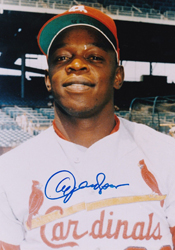
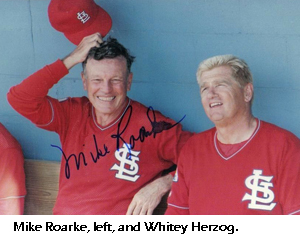
Four years after pitcher Joaquin Andujar was sent away by the Cardinals, manager Whitey Herzog wanted to bring him back and give him a chance to earn a spot in the starting rotation.

In May 1989, Andujar wrote to the Cardinals, apologized for his behavior and asked to come back.

Herzog advocated for Andjuar’s return, but the front office wasn’t interested.

Spurned by the Cardinals, Andujar pitched successfully in a senior professional league, earned a tryout with the Expos but failed in his attempt to get back to the major leagues.

Good, bad, ugly

Andujar was a stalwart of the Cardinals’ staff from 1981-85. posting a 68-53 record. In 1982, he earned 15 wins in the regular season and three wins in the postseason, including the clinchers in the National League Championship Series against the Braves and the World Series versus the Brewers. Andujar had 20 wins in 1984 and 21 wins in 1985.

In his last year with the Cardinals, Andujar fell out of favor with management because of drug use and an on-field temper tantrum in Game 7 of the World Series against the Royals.

At a September 1985 federal trial of an accused drug dealer in Pittsburgh, Andujar and former Cardinals Bernie Carbo, Keith Hernandez, Lonnie Smith and Lary Sorensen were among major-league players identified as cocaine users. A month later, Andujar was ejected from the decisive game of the World Series for his tirade directed at umpire Don Denkinger.

Embarrassed by Andujar’s behavior and concerned he had become a divisive clubhouse presence, the Cardinals traded him to the Athletics on Dec. 10, 1985, for catcher Mike Heath and pitcher Tim Conroy.

After posting records of 12-7 in 1986 and 3-5 in 1987 with the Athletics, Andujar pitched for the Astros in 1988. He was 2-5 for Houston, became a free agent after the season and remained at home in the Dominican Republic when he received no major-league offer.

No, thanks

In April 1989, as the Cardinals neared Opening Day, Herzog sized up his starting pitching and openly lobbied for the club to sign Andujar. “I wish we had him now,” Herzog said to the St. Louis Post-Dispatch.

A month later, with the Cardinals in need of a No. 5 starter, Herzog pressed again for the team to sign Andujar.

“Herzog has hoped the Cardinals and Anheuser-Busch would reconsider their stance on not having Andujar around anymore,” the Post-Dispatch reported on May 20, 1989.

Knowing he needed to repair relations with upper management, Andujar, with the help of agents Alan Hendricks and David Hendricks, wrote a letter to Cardinals chief operating officer Fred Kuhlmann, “apologizing for his actions and hoping for a job,” according to the Post-Dispatch.

Herzog said Kuhlmann wrote Andujar “a polite reply,” but made it clear the club was uninterested, a stance supported by general manager Dal Maxvill.

“He can’t pitch,” said Maxvill. “He hasn’t pitched well since we sent him” to the Athletics.

Herzog wanted to place Andujar, 36, with the Cardinals’ top farm club at Louisville, give him a chance to work into shape and bring him to St. Louis in the summer.

“There’s nothing to lose,” Herzog said. “There are a lot of veteran pitchers who haven’t had as much success as he has.”

Super senior

In July 1989, the Post-Dispatch published a story from Cox News Service, which sent a reporter to visit Andujar in his hometown of San Pedro de Macoris in the Dominican Republic. Andjuar said he was supplying food and water to the poor as well as donating baseball equipment to youth players.

“It’s time the people know the good sides to Joaquin Andujar, not only the bad side,” Andujar said.

Asked whether he’d play again in the big leagues, Andujar replied, “I can still throw 90-something miles per hour, but I said last year somebody wanted Joaquin Andujar out of baseball and you see that’s true. If they don’t want me, I don’t want to play.”

A few months later, after the 1989 major-league season ended, Andujar joined the fledgling Senior Professional Baseball Association for players older than 35. Playing for manager Earl Weaver’s Gold Coast Suns in Pompano Beach, Fla., Andujar was 5-0 with a 1.31 ERA. Impressed, the Expos signed him to a minor-league contract in December 1989 and invited him to their big-league spring training camp in 1990.

“If they give me the ball and leave me alone, I can win 20 games,” Andujar said to the Associated Press. “I’m not going to play in the minor leagues. I’m not a minor-league pitcher.”

Au revoir

After reporting five days late to Expos spring training camp, Andujar, 37, had root canal surgery. He pitched in two exhibition games, yielding two earned runs in five innings, and was released on April 3, 1989, before the season began.

In an interview with the Toronto Globe and Mail, Andujar said, “I’m being blackballed” and mocked the Expos for releasing him.

“I’ve never seen a crazy ballclub like Montreal, believe me,” Andujar said. “They’re out of their minds. They’re all miserable _ from the manager to the bat boy.

“That club doesn’t know what they’re doing. Everybody in the world knows I can help a club like that one.”

Read Full Post »

Like a couple of grand chess masters, managers Joe Torre of the Cardinals and Jim Leyland of the Pirates engaged in a series of maneuvers designed to outwit the other. Torre won, and the result was as unusual as it was satisfying.

On May 17, 1994, Torre utilized six pitchers to achieve a shutout against the Pirates at Pittsburgh.

At the time, the Cardinals tied a National League record. Since then, several teams have used more than six pitchers to record a shutout. The Indians established a major-league record by using nine pitchers in a shutout against the Tigers on Sept. 17, 2016, according to the Elias Sports Bureau. Boxscore

Tom terrific

The Cardinals-Pirates game was played on a 40-degree Tuesday night at Three Rivers Stadium. The starting pitchers were left-handers Tom Urbani for the Cardinals and Zane Smith for the Pirates.

Urbani entered the start with a season record of 0-3 and a 5.04 ERA. The Cardinals wanted to send him to the minor leagues, but balked when left-hander Rheal Cormier injured his shoulder.

Both starters worked fast and the first seven innings were played in less than 90 minutes. The Cardinals scored a run in the sixth and another in the seventh and led 2-0.

The Pirates’ lone hit against Urbani was a single by Carlos Garcia leading off the fourth.

“I set up hitters and I got them out the way I wanted to get them out,” Urbani said to the St. Louis Post-Dispatch.

Torre observed, “Even when he didn’t hit his spots, he had enough on the ball where they didn’t get good wood on it.”

Mix and match

In the eighth, the Pirates had two on via walks with two outs when Torre lifted Urbani and brought in right-hander John Habyan to face Lance Parrish. Leyland countered by using Dave Clark, a left-handed hitter, to bat for Parrish and Habyan walked him, loading the bases.

Torre called for left-hander Rob Murphy to pitch to Orlando Merced, a switch-hitter, but again Leyland countered and switched to right-handed batter Don Slaught. Murphy got Slaught to hit a grounder to shortstop Ozzie Smith, who threw to second baseman Jose Oquendo for the inning-ending force on Clark.

In the ninth, Torre used three pitchers to get three outs.

Garcia led off with a single against Mike Perez. After Jay Bell popped out to second, left-hander Rich Rodriguez came in to face the former Cardinal, Andy Van Slyke.

A left-handed batter, Van Slyke turned on a Rodriguez fastball and hit it high and far. Van Slyke’s drive had home run distance but landed a few feet foul down the right-field line.

“I was able to get away with a pitch,” Rodriguez said. “I had new life and once I did I figured I’d better make something happen.”

Rodriguez switched to sliders and struck out Van Slyke.

Playing the percentages, Torre brought in right-hander Rene Arocha to face right-handed Brian Hunter and got him to fly out to shallow left, ending the game.

Urbani pitched 7.2 innings, limiting the Pirates to one hit and four walks, and earned his second career win in the big leagues. Boxscore

In using Habyan, Murphy, Perez, Rodriguez and Arocha to complete the shutout, Torre emptied his bullpen.

“I didn’t have any left,” Torre said to the Associated Press. “(Arocha) was the last I had.”

Read Full Post »

« Newer Posts - Older Posts »