Before Al Hrabosky became prominent, another pitcher with a double-consonant start to his name, Joe Grzenda, was the Cardinals’ top left-handed reliever.
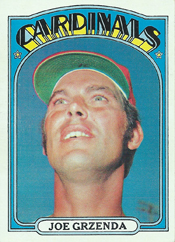 Grzenda pitched eight seasons in the major leagues for the Tigers (1961), Athletics (1964 and 1966), Mets (1967), Twins (1969), Senators (1970-71) and Cardinals (1972).
The Cardinals, seeking a reliever who could get out left-handed batters, acquired Grzenda from the Senators for infielder Ted Kubiak on Nov. 3, 1971, but it didn’t work out the way they’d hoped.
Nervous energy
Grzenda was born in Scranton, Pa. His father was a coal miner. Grzenda signed with the Tigers when he was 18 in 1955. He injured his arm in the minor leagues and developed a sidearm delivery, relying on a sinker.
After making his major-league debut with the Tigers in 1961, Grzenda was released in 1963 and joined the Athletics. According to Hardball Times, when Grzenda was in the Athletics’ farm system in 1964, his teammates “quickly took note of his habit of drinking two pots of coffee each day. They also noticed his chain-smoking, as he plowed through three packs of Lucky Strikes in a typical day. Sometimes Grzenda would light a cigarette and start smoking, leave it on the bench, and then work so quickly on the mound that he could return to the dugout and finish off the cigarette. A bundle of nervous energy fueled by cigarettes and coffee, he was in constant motion.”
In 1967, with Dave Duncan as his primary catcher, Grzenda was 6-0 with a 1.20 ERA in 52 appearances for the Birmingham club in the Athletics’ farm system. Mets president Bing Devine was impressed and purchased Grzenda’s contract on Aug. 14, 1967. Grzenda made 11 appearances with the 1967 Mets and had a 2.16 ERA.
Grzenda had his biggest successes in the major leagues with the 1969 Twins and 1971 Senators.
Playing for manager Billy Martin, Grzenda was 4-1 with three saves for the Twins, who won the 1969 American League West title.
In March 1970, the Twins traded Grzenda to the Senators, who were managed by Ted Williams.
In the book “Kiss It Goodbye,” Senators radio voice and author Shelby Whitfield noted, “Williams was the only one who saw potential in Grzenda.”
Getting a grip
During the 1970 season, Senators catchers told Grzenda “he was throwing the slider with more velocity than his fastball,” The Sporting News reported.
Seeking a remedy, Grzenda went to Senators pitching coach Sid Hudson, who suggested a grip change. Grzenda tried it and his fastball developed the action of a slip pitch. Bob Broeg of the St. Louis Post-Dispatch described the slip pitch as “a delivery that fades and falls like a screwball.”
“It serves not only as a changeup,” Broeg wrote, “but also as a good double-play pitch for right-handed hitters who try to pull it.”
Many pitchers can’t control a slip pitch, but for Grzenda it “was love at first sight,” according to Broeg.
Hudson said, “Now he has more confidence in what he is doing because he has more velocity and is throwing pitches with different speeds.”
Grzenda was 5-2 with five saves and a 1.92 ERA in 46 relief appearances for the 1971 Senators. He limited batters to 17 walks in 70.1 innings. Left-handed batters hit .226 against him.
Filling a need
Cardinals scout Joe Monahan was impressed and said Grzenda has “a good curve, his fastball is alive and he has excellent control. His fastball sinks and has the effect of a screwball against right-handed batters.”
After the 1971 season, the Senators moved from Washington, D.C., to Texas and were renamed the Rangers. The club was seeking a second baseman and Williams viewed Kubiak, a Cardinals utility infielder, as an ideal candidate.
“Ted Williams has been interested in Kubiak for a couple of years,” Rangers owner Bob Short told The Sporting News.
Williams contacted the Cardinals to inquire about Kubiak’s availability. Monahan “highly recommended” the Cardinals ask for Grzenda in exchange. Devine, who had left the Mets and was in his second stint as Cardinals general manager, was willing to acquire Grzenda a second time.
“We needed an experienced left-handed reliever so badly,” Devine said.
Devine figured Grzenda and Don Shaw would give the 1972 Cardinals a pair of quality left-handers in the bullpen. Shaw was 7-2 with a 2.65 ERA for the Cardinals in 1971 and left-handed batters hit .171 against him.
Slippery slope
The plan unraveled early in the 1972 season.
Shaw developed a shoulder ailment, made eight appearances for the Cardinals and was traded to the Athletics in May.
Grzenda’s slip pitch no longer was effective. He had a 6.75 ERA in April and an 8.59 ERA in May.
Grzenda and his road roommate, Moe Drabowsky, made unwanted headlines during a series in Houston in May when it was discovered their hotel room was extensively damaged. Devine described the damage as “pretty bad.” According to the Post-Dispatch, light bulbs and drinking glasses were smashed and a bed headboard was “sighted sailing down a corridor” of the hotel.
In June, when he turned 35, Grzenda had a turnaround. He didn’t allow an earned run in 6.1 innings over five appearances for the month. He also got a win with 1.1 innings of scoreless relief against the Giants on June 17. Boxscore
After that, the highlights were few. Grzenda had a 6.75 ERA in August and a 12.46 ERA in September.
The Cardinals, out of contention and headed for a 75-81 finish, used the last few weeks of the season to look at some prospects, including Hrabosky.
Grzenda made the most appearances (30) of any left-hander on the 1972 Cardinals and was 1-0 with a 5.66 ERA. He gave up 46 hits in 35 innings and walked more batters (17) than he struck out (15). Left-handed batters hit .436 against him.
The 1972 season was Grzenda’s last in the big leagues. His career mark in the majors: 14-13 with 14 saves and a 4.00 ERA.
Hrabosky, who had brief stints with the Cardinals from 1970-72, pitched in 44 games for them in 1973 and went on to become their top left-handed reliever from 1974-77 while developing a persona as the self-psyching “Mad Hungarian.”
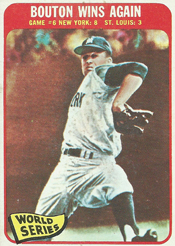 In 1964, Bouton made two starts for the Yankees against the Cardinals in the World Series and won both.
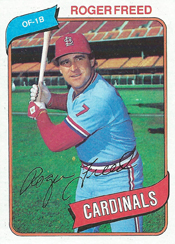 On July 1, 1979, Denny got into an animated argument with teammate Roger Freed, whose rah-rah spirit annoyed the Cardinals’ pitcher.
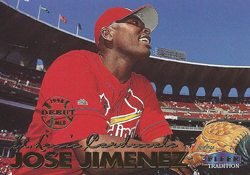 On June 25, 1999, Jimenez pitched a no-hitter for the Cardinals, beating Johnson and the Diamondbacks, 1-0, at Phoenix.
 Buckner played 22 seasons in the major leagues, primarily as a first baseman, and was a premier hitter, winning a National League batting title in 1980 and generating a career total of 2,715 hits. A left-handed batter with a .289 career average, Buckner never struck out more than 39 times in a season.
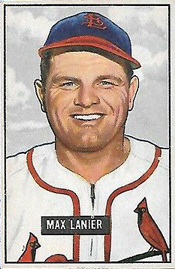 On June 5, 1949, baseball commissioner Happy Chandler granted amnesty to 18 major-league players and six minor-leaguers who defected to the Mexican League, lifting their five-year bans and allowing them to apply for reinstatement to professional baseball in the United States.

