Feeds:
Posts
Comments

Archive for the ‘Pitchers’ Category

Much like being forced to ride in the back of a bus, African-American customers attending a National League Cardinals game or an American League Browns game at Sportsman’s Park in St. Louis were restricted to seats behind the outfield walls.
On May 4, 1944, the Cardinals and Browns became the last big-league teams to end segregated seating.

Until then, African-Americans, or anyone defined as Negroes, could purchase tickets only in the outfield bleachers or in the outfield pavilion at Sportsman’s Park. The pavilion was a roofed section behind the right-field wall. A 25-foot screen, extending from right to right-center, was built atop the wall.

Blacks weren’t allowed to sit in Sportsman’s Park’s double-decked grandstand, meaning any seats behind home plate and along the lines, or, in other words, the seats with the best views.

African-American baseball fans in St. Louis were unable to buy tickets to seats of their choice to watch Cardinals clubs featuring Rogers Hornsby in the late 1920s, or the Gashouse Gang of the 1930s, or the Stan Musial teams of the early 1940s.

Three years after the racist restriction was lifted, Jackie Robinson of the Dodgers integrated the big leagues in 1947. Dodgers executive Branch Rickey, credited with bringing Robinson to the majors, was head of Cardinals baseball operations during the time Sportsman’s Park had segregated seating.

Bowing to racism

Located at the corner of North Grand and Dodier, Sportsman’s Park was home to both St. Louis teams from 1920-53. The Browns moved to Baltimore after the 1953 season and Sportsman’s Park was renamed Busch Stadium. The Cardinals played there until they moved into a downtown stadium in 1966.

Sportsman’s Park was owned by the Browns, but both they and the Cardinals agreed to segregated seating.

In his book, “Branch Rickey: A Biography,” author Murray Polner said Rickey approached Cardinals owner Sam Breadon in the 1930s about the possibility of ending the discriminatory seating policy.

Rickey said his proposal received “effective opposition on the part of ownership and on the part of the public, press, everybody.”

According to the book, Breadon told Rickey he personally didn’t care about segregated seating but believed removing the restrictions would be bad for business.

Rickey said the city of St. Louis had no ordinance segregating blacks from whites at Sportsman’s Park and the decision was made by the clubs. Rickey suggested Breadon end the Cardinals’ policy without making a formal announcement, but there was no interest.

Unable to generate support, Rickey “backed away, unwilling to offend Breadon or white customers.”

Right stuff

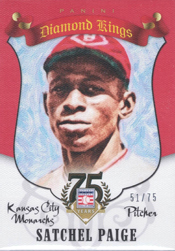
Satchel Paige had the courage to do what the Cardinals and Browns would not.

On July 4, 1941, the Kansas City Monarchs and Chicago American Giants were scheduled to play a special holiday Negro League game at Sportsman’s Park. The St. Louis Stars, a Negro National League team, had played their home games at Stars Park at the corner of Laclede and Compton before disbanding after the 1931 season.

Paige, the ace pitcher and showman, was the gate attraction for the game at Sportsman’s Park and he refused to play unless seating that day was unrestricted for all customers, according to Timothy M. Gay, author of the book “Satch, Dizzy & Rapid Robert: The Wild Saga of Interracial Baseball Before Jackie Robinson.”

Unwilling to risk playing without Paige, officials gave in to his demand.

In a March 2010 guest column for the St. Louis Post-Dispatch, Gay wrote, “Thanks to Satchel Paige’s gutsy stand, blacks could sit wherever their pocketbooks would allow.”

An interracial crowd of 19,178 came to see Paige and the Monarchs win, 11-2. “It was almost unheard of in the St. Louis of that era for the races to commingle at a public venue,” Gay wrote, “but they did that day.”

In its game report, the Post-Dispatch declared the crowd was “the largest ever to witness a Negro baseball game in St. Louis.”

Paige pitched four entertaining innings. In the third, he “waved in his outfielders and gave the next batter his old trouble ball,” the Post-Dispatch reported. “His trouble ball is a hard fast one, usually thrown at the handle of the bat, because Satchel says no living human can hit such a ball with the handle.”

Paige struck out the batter.

“The record crowd enjoyed every minute that the master showman worked,” the St. Louis Star-Times reported.

Keep it quiet

Following Rickey’s advice from years earlier, the 1944 decision to end the segregated seating practice of the Cardinals and Browns was done without fanfare and received brief mention in publications. There were no press conferences nor any statements made to media.

“Restrictions confining Negroes to the right field pavilion have been lifted by both the Cardinals and the Browns, with the colored fans now being allowed to purchase grandstand seats,” The Sporting News reported. “St. Louis had been the only major-league city with this discriminatory rule.”

The Associated Press reported the St. Louis teams “have discontinued their old policy of restricting Negroes to the bleachers and pavilion at Sportsman’s Park.”

Breadon couldn’t be reached for comment, the Star-Times noted, and Browns general manager Bill DeWitt Sr. declined to comment.

Pioneer players

On May 21, 1947, Robinson became the first African-American to play at Sportsman’s Park in a big-league game. The largest weekday crowd of the season, 16,249, came to see Robinson and the Dodgers play the Cardinals. “About 6,000 were Negroes,” according to the Post-Dispatch.

“Robinson was cheered each time he went to bat and the Dodgers as a team received more vocal encouragement than they usually get at Sportsman’s Park,” the Post-Dispatch reported. Boxscore

Two months later, the Browns followed the Dodgers and Indians, becoming the third big-league club with African-American players.

On July 17, 1947, second baseman Hank Thompson made his major-league debut for the Browns versus the Athletics before 3,648 at Sportsman’s Park. Boxscore Another black player, outfielder Willard Brown, debuted with the Browns two days later against the Red Sox before 2,434 at Sportsman’s Park.

Paige would play three seasons (1951-53) for the Browns.

The Cardinals waited until 1954 before first baseman Tom Alston integrated the team.

As late as 1961, the Cardinals had segregated housing for their players at spring training in Florida until first baseman Bill White, with the help of civil rights activist Dr. Ralph Wimbish, led an effort to have integrated accommodations.
Read Full Post »

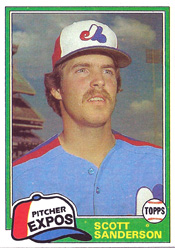
Scott Sanderson enhanced his status as a starter by pitching a 10-inning gem against the Cardinals before the largest crowd to attend a baseball game in Montreal.

Sanderson was 23 and in his second major-league season with the Expos when he earned the complete-game win versus the Cardinals in the second game of a doubleheader on Sept. 16, 1979, before 59,282 spectators at Olympic Stadium.
After yielding seven hits in 4.1 innings, Sanderson retired the next 17 Cardinals batters in a row. Sanderson earned the win, but his effort was overshadowed by second baseman Dave Cash, whose improbable grand slam with two outs in the bottom of the 10th lifted the Expos to a 5-1 victory.

Big chance

Banished to the bullpen in late July by Expos manager Dick Williams after a stretch of ineffective starts, Sanderson’s stint against the Cardinals was a turning point in his big-league career.

The Cardinals and Expos played consecutive doubleheaders Sept 15-16. In the opener of the Sept. 16 doubleheader, Expos starter Ross Grimsley was lifted after two innings and the club used three relievers in a 4-3 loss to the Cardinals.

Looking to salvage a split of the doubleheader before the big crowd, the Expos needed a strong performance from Sanderson, who was making his second start since July 27 and seeking his first win since Aug. 1.

“I was hoping somewhere along the way I could be used as a starter and help this team out when it needed it,” Sanderson said to the Montreal Gazette.

The Expos scored a run in the first against Cardinals starter John Denny on Cash’s RBI-double and the Cardinals tied the score in the second on Ken Oberkfell’s sacrifice fly, scoring Jerry Mumphrey from third.

Denny went seven innings, but Sanderson kept going. “I wanted to go as long as I could,” Sanderson said.

Unbelievable error

After the first two Expos batters made outs in the bottom of the 10th, “the game looked as though it would go on forever,” the Gazette reported.

Gary Carter sparked the rally when he looped a liner to left and hustled to second for a double, beating the throw from Lou Brock. Jerry White was walked intentionally, bringing left-handed batter Warren Cromartie to the plate to face left-hander Darold Knowles.

Cromartie hit a routine grounder “ever so softly” to Oberkfell at second base, the Gazette reported, for what appeared to be an inning-ending out.

According to the St. Louis Post-Dispatch, “Oberkfell fielded the ball cleanly enough, then inexplicably, as he prepared to throw to first, dropped it. Desperately, he reached for the ball on the ground but fumbled it again.”

Cromartie was safe at first and the bases were loaded.

“Obie wouldn’t boot that play away again if he tried for 100 years,” said Cardinals manager Ken Boyer.

Cromartie theorized Oberkfell made the error “because he was watching me bust my ass down to first.”

Said Oberkfell: “It was the easiest ball hit to me all day. I don’t know how I did it.”

Cashing in

Boyer brought in right-hander George Frazier to face Cash, who’d spent most of the season as a utility player before replacing Rodney Scott at second base in late August.

Cash hit Frazier’s third pitch over the left-field wall for his first home run of the season and the only grand slam of his 12-year career in the major leagues.

“I knew if I could hang in there long enough I’d get a chance,” Cash said to the Post-Dispatch.

In a baseball version of the red carpet treatment, Williams and Expos outfielder Ellis Valentine stretched out towels from the entrance of the clubhouse to Cash’s locker cubicle as the hitting hero arrived from the field.

“Almost overlooked in the euphoria,” the Gazette reported, was the effort of Sanderson, who showed the Expos he had the right stuff to stay a starter. Boxscore

Consistent winner

Sanderson finished the 1979 season with a 9-8 record and 3.43 ERA for the second-place Expos.

In 19 seasons (1978-96) in the major leagues, Sanderson, a right-hander, was 163-143 with a 3.84 ERA. His career record versus the Cardinals was 10-11 with a 3.63 ERA.

Sanderson pitched for the Expos (1978-83), Cubs (1984-89), Athletics (1990), Yankees (1991-92), Angels (1993), Giants (1993, White Sox (1994) and Angels again (1995-96).

Playing for manager Tony La Russa and pitching coach Dave Duncan, Sanderson was 17-11 with a 3.88 ERA in 34 starts for the 1990 Athletics, who won the American League pennant. The 17 wins were his single-season career high.

In six seasons with the Expos, Sanderson was 56-47 with a 3.33 ERA. In six seasons with the Cubs, he was 42-42 with a 3.81 ERA.

Read Full Post »

Though the Cardinals were two-time defending National League champions, the American League Browns became the darlings of the St. Louis sports scene early in the 1944 season.

In April 1944, the Browns set an American League record by winning their first nine games.

Picked by national baseball scribes to finish fifth in the eight-team league, the Browns’ season-opening hot streak caught most people by surprise. The year before, the 1943 Browns finished 72-80 and 25 games out of first place.

On the eve of the 1944 season opener, Browns manager Luke Sewell told the Associated Press, “I can’t tell you what the Browns will do this year, but I know darned well we won’t be last. A lot depends on our pitching.”

The Browns held foes to two runs or less in six of the nine wins in the streak.

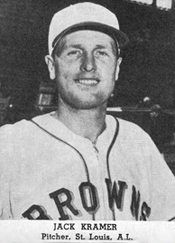
Jack Kramer, a Navy veteran who spent most of the 1943 season with the minor-league Toledo Mud Hens, was 3-0 with an 0.68 ERA during the streak. Nelson Potter and Steve Sundra each got two wins. George Caster and Sig Jakucki got one win apiece.

Vern Stephens, the Browns’ 23-year-old shortstop and cleanup hitter, batted .344 during the streak and first baseman George McQuinn hit .333.

The Browns’ stock price rose from $2.25 a share on Opening Day to $3.75 a share at the height of the streak.

The nine consecutive wins by the Browns shattered the American League record of seven consecutive wins to start a season set by the 1933 Yankees. The Browns tied the major-league mark held by two National League clubs, the 1918 Giants and 1940 Dodgers. Since then, the 1982 Braves and the 1987 Brewers each achieved the major-league record of 13 consecutive wins to start a season.

Here is a look at each of the Browns’ nine wins in the streak:

Win No. 1

The Browns opened the season on April 18 with a 2-1 victory at Detroit against the Tigers. The Browns scored in the first inning against Dizzy Trout and added another in the ninth on a home run by Stephens.

In the bottom of the ninth, Kramer struck out the first two batters before yielding a home run to Pinky Higgins. After Jimmy Outlaw singled, Caster, the Browns’ bullpen ace, relieved. Caster walked Don Ross before getting Bob Swift to ground out, ending the game. Boxscore

Win No. 2

Sundra, who five years earlier posted an 11-1 record for the 1939 Yankees, pitched a three-hitter for the Browns in their 3-1 triumph against the Tigers. Boxscore

Win No. 3

The Browns completed a three-game sweep of the Tigers with an 8-5 victory. Stephens had a RBI-single and a two-run double against Tigers ace Hal Newhouser. Boxscore

Win No. 4

The Browns beat the White Sox, 5-3, in the April 21 home opener before 2,021 at Sportsman’s Park in St. Louis. Mike Kreevich, a 5-foot-7 right fielder who had no home runs in 60 games for the 1943 Browns, hit a two-run home run in the first inning against Thornton Lee and a solo homer off Lee in the sixth. Boxscore

Win No. 5

In the first game of a Sunday doubleheader against the White Sox before 7,709 at St. Louis, the Browns won, 5-2. Kramer pitched a complete game and hit a two-run home run off Bill Dietrich in the second inning. Boxscore

Win No. 6

The Browns completed the doubleheader sweep with a 4-3 win. With the White Sox ahead, 3-1, the Browns rallied for a run in the seventh and two in the eighth. Al Zarilla drove in the winning run with a single. Boxscore

The Post-Dispatch reported, “Those are strange expressions you see on the faces of followers of the Browns today as they stagger around in a daze thinking of the club’s six-game winning streak.”

In The Sporting News, Frederick G. Lieb wrote, “St. Louis is holding its breath to see how long it lasts.”

Win No. 7

In the first of a two-game series versus the Indians, the Browns won, 5-2, before 960 spectators at St. Louis. “Leaden skies and weather too chilly for grandstand comfort held down the attendance,” according to the Post-Dispatch.

The Browns broke a scoreless tie with four runs in the sixth against Allie Reynolds. The big hit was a two-run double by Stephens. Boxscore

Win No. 8

The Browns established an American League record for most wins to start a season with a 5-1 triumph over the Indians before 1,106 witnesses at St. Louis. Stephens had a two-run single in the first and Hal Epps, a light-hitting outfielder, had his first RBI of the season with a two-run single in the second. Boxscore

Asked about setting the record, Sewell replied to The Sporting News, “I still get hungry at meal time and still get sleepy at bed time. Maybe I’m pleased, but otherwise I don’t feel any different from the days before the season started.”

Win No. 9

In the opener of a series against the White Sox at Chicago, Kramer pitched a four-hitter and the Browns won, 3-1. Boxscore

The rest of the story

The streak ended on April 29 with a 4-3 loss to the White Sox at Chicago. The Browns had a 3-0 lead, but the White Sox scored two in the seventh, one in the eighth and the winning run in the ninth. Boxscore

The Browns and Tigers went into the last game of the regular season tied atop the American League standings. When the Browns beat the Yankees, 5-2, at St. Louis and the Tigers were defeated, 4-1, by the Senators at Detroit, the Browns finished 89-65, one win better than the Tigers at 88-66. The Browns were 13-9 versus the Tigers in 1944.

In the World Series, the Cardinals, National League pennant winners for the third consecutive year, won four of six against the Browns for the championship.

Read Full Post »

Bob Gibson and Jim Baxes, two rookies whose careers went in opposite directions, are connected by one swing of the bat.

On April 15, 1959, Gibson made his major-league debut for the Cardinals against the Dodgers at Los Angeles and the first batter he faced, Baxes, hit a home run.
Gibson went on to have a Hall of Fame career. Baxes played one year in the major leagues.

Who are you?

After posting a 2.84 ERA in 190 innings pitched for Cardinals farm teams in 1958, Gibson was a candidate to earn a spot on the big-league club’s 1959 Opening Day roster.

Early in spring training at the Cardinals’ camp in St. Petersburg, Fla., first-year manager Solly Hemus approached a player and asked, “Are you Olivares?”

The player replied, “No, I’m Bob Gibson.”

According to The Sporting News, Gibson turned to a teammate and said, “I must have made a hell of an impression on the manager. After a week, he doesn’t even know who I am.”

Gibson’s fastball got him the attention he desired and the 23-year-old rookie won a spot on the 1959 Cardinals’ pitching staff as a reliever.

Though the St. Louis Post-Dispatch expressed concern Gibson “needs either a better curve or a changeup to go with his blazer and his slider,” Cardinals pitching coach Howie Pollet said, “He’s fast enough to throw one quick one by them a lot of times, even when they’re looking for it. Within a few weeks, we might have him getting his breaking ball over better.”

In a column for the Post-Dispatch on the eve of the 1959 season opener, Bob Broeg, rating the Cardinals’ pitchers, said, “If there’s one who does stir the imagination a bit, though he’s green, it’s Bob Gibson.”

Waiting his turn

Meanwhile, at Dodgers spring training camp in Vero Beach, Fla., Baxes, a 30-year-old rookie, was manager Walter Alston’s surprise choice to open the regular season as the third baseman.

Baxes’ father immigrated to the United States from Greece in 1900, went to work in a San Francisco rope factory, married and started a family. His son, Dimitrios Speros Baxes, became known in the Russian Hill neighborhood of San Francisco as Jim.

Jim Baxes and his younger brother, Mike, developed into professional ballplayers. Mike made it to the majors with the Athletics in 1956, but Jim, who started his career in the Dodgers’ farm system in 1947, waited 12 years until getting his shot in the big leagues in 1959.

Baxes was a right-handed power hitter who slugged 30 home runs for Fort Worth in 1953 and 28 home runs for Spokane in 1958, but, according to the Los Angeles Times, he was a “ferocious flailer” who swung and missed too often.

“I’m confident I can cut it,” Baxes said to The Sporting News. “I’ve improved the last couple of seasons and I don’t think my age will prove any handicap.”

Temper tantrum

After losing three of their first four games of the 1959 season, the Cardinals faced Dodgers right-hander Don Drysdale at the Los Angeles Memorial Coliseum.

In the sixth inning, Stan Musial of the Cardinals tried to score from second on Joe Cunningham’s line single to center, but was called out by umpire Dusty Boggess.

“I almost fell off the bench when Musial was called out,” Hemus told the Post-Dispatch.

Convinced he slid into the plate before catcher John Roseboro applied a high tag after fielding a throw from Don Demeter, Musial argued with Boggess, “but he was Casper Milquetoast compared to his boss,” the Los Angeles Times reported.

Hemus ran onto the field, charged at Boggess, “threw his cap to the ground and repeatedly kicked the dirt” before he was ejected, according to the Post-Dispatch.

“He took the ballgame away from us,” Hemus said. “That was the worst so-called exhibition of baseball umpiring I ever saw.”

Rude greeting

In the seventh inning, with the Dodgers ahead, 3-0, Gibson, wearing uniform No. 58, relieved starter Larry Jackson. Baxes led off and hit Gibson’s third big-league pitch into the seats in left-center for his first big-league home run.

Gibson “received a rough welcome into major-league warfare,” the Post-Dispatch reported.

Baxes gave Gibson “quite an initiation,” the Los Angeles Times wrote.

Gibson retired the next three batters in order, getting Drysdale to line out to second, Ron Fairly to fly out and Wally Moon to ground out.

In the eighth, Roseboro singled, moved to second on Demeter’s sacrifice bunt, stole third and scored on Charlie Neal’s sacrifice bunt. Gil Hodges, the last batter Gibson faced in the game, popped out to the catcher. Boxscore

Gibson made two more relief appearances for the Cardinals before he was sent back to the minor leagues on April 28, 1959.

In his book, “Stranger to the Game,” Gibson said, “Hemus had me convinced that I wasn’t any damn good and consequently I wasn’t.”

Different paths

On May 9, three weeks after his home run against Gibson, Baxes was assigned to the minors because the Dodgers wanted Jim Gilliam at third base. The demotion was devastating to Baxes, who batted .303 for the Dodgers. “I think that entitled me to a better chance than I received,” Baxes said to the Associated Press.

Baxes refused to report to the minors, went home to Long Beach, Calif., and got a job at a sheet metal company. The Indians, seeking a backup infielder, contacted the Dodgers and on May 22, 1959, Baxes was dealt to Cleveland.

In his first at-bat for the Indians, on May 23, 1959, Baxes slugged a pinch-hit home run against Jim Bunning of the Tigers. Boxscore

Baxes played in 77 games for the 1959 Indians and hit 15 home runs, but he wasn’t brought back. He played two more seasons in the minors, finishing in 1961 with a Cardinals farm club, the Portland Beavers.

Gibson, meanwhile, was called up to the Cardinals on July 29, 1959, and put in the starting rotation.

Read Full Post »

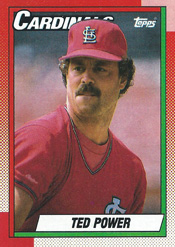
After a rough beginning to his season with the Cardinals, Ted Power recovered and developed into a reliable starting pitcher for them.

On March 28, 1989, the Cardinals signed Power, 34, to a minor-league contract following his release by the Tigers.
Five months later, Cardinals manager Whitey Herzog was referring to Power as the “savior” of the pitching staff.

Versatile pitcher

In 1981, Power debuted in the major leagues with the Dodgers, spent parts of two seasons with them and was traded to the Reds. A right-handed reliever, his breakout season came in 1985 when he produced eight wins, 27 saves and a 2.70 ERA for Cincinnati.

Reds manager Pete Rose put Power into the rotation in August 1986 and he was 6-1 with a 2.59 ERA in 10 starts. The next year, Power led the 1987 Reds in starts (34), innings pitched (204) and strikeouts (133).

The Reds traded Power to the Royals for pitcher Danny Jackson after the 1987 season. According to the St. Louis Post-Dispatch, Royals reliever Steve Farr displayed two baseball cards _ one of Dan Quisenberry and the other of Power _ atop his locker. “One of them is my idol on the field (Quisenberry) and the other my idol off the field,” Farr said.

The Royals sent Power to the Tigers in August 1988 and after the season he had surgery to remove calcium deposits near his right elbow. When spring training began in 1989, Power was ready to pitch for the Tigers.

Comeback bid

In March 1989, the Cardinals were in the market for pitching depth after starters Danny Cox and Greg Mathews went on the disabled list because of elbow ailments. General manager Dal Maxvill sent scout Rube Walker to Tigers camp to assess Power, and Herzog spoke with Detroit manager Sparky Anderson about the pitcher.

On March 25, 1989, the Tigers released Power and three days later he signed with the Cardinals, who assigned him to their Louisville farm club. Under terms of the contract, if Power received an offer from another big-league team while with Louisville, the Cardinals would have 48 hours to decide whether to promote him to St. Louis or let him depart.

“I look at those major-league box scores every day and see middle relievers and starters who aren’t doing the job,” Power said to the Louisville Courier-Journal. “I have all the confidence in the world that I’m going to get back. When I do, I won’t take anything for granted. You can get too comfortable up there. I won’t ever do that again.”

Louisville manager Mike Jorgensen placed Power in the rotation and he produced a 3-1 record and 2.73 ERA in five starts, prompting the Phillies to make him an offer. Unwilling to let Power go, the Cardinals promoted him to St. Louis on May 4, 1989.

“We were kind of forced to bring him up,” Herzog said to The Sporting News. “We didn’t want to bring him up that early.”

On the brink

After appearing in two games for the Cardinals, Power pulled a ribcage muscle while taking batting practice on May 17 and didn’t pitch again for them until June 20.

Herzog put Power in a rotation with Jose DeLeon, Joe Magrane, Ken Hill and Scott Terry, but he wasn’t effective. He reached a nadir on July 17, 1989, when he gave up seven runs to the Giants before being lifted with one out in the second inning. Boxscore

Power said he was overthrowing, causing his breaking pitches to “flatten out.” Said Herzog: “A lot of high sliders.”

Though he was 1-4 with a 7.43 ERA, Power made his next scheduled start against the Padres on July 22, 1989, held them to a run in 6.2 innings and got the win. Boxscore

“I feel like I belong in the big leagues, but this makes me feel like I belong on this team,” Power said.

Over his next three starts, Power shut out the Expos for seven innings, limited the Mets to a run in 6.2 innings and held the Pirates scoreless for eight innings.

“He’s kind of been a savior to us,” Herzog said.

Said Cardinals shortstop Ozzie Smith: “He’s throwing the ball as well as I’ve ever seen him throw it. It’s nice to see a guy like that come back. He was really on his way out.”

Getting it done

On Aug. 22, 1989, Power, matched against Derek Lilliquist, took a no-hitter and a 10-0 lead into the eighth against the Braves before he tired and gave up home runs to Tommy Gregg and Dale Murphy. Boxscore

In six August starts, Power produced a 2.61 ERA.

“He has more idea of what he wants to do,” said Cardinals catcher Tony Pena. “Before, he had no idea where he was throwing the fastball.”

Said Maxvill: “I look at 25 other clubs and how many have better fifth starters than Ted Power?”

On Sept, 2, 1989, Power beat the Astros in Bob Forsch’s last big-league start and last appearance against his former Cardinals teammates. Boxscore

Five days later, in a start against the Mets, Power suffered a hamstring injury. He was sidelined for two weeks and when he returned he made six appearances in relief.

Power finished with a 7-7 record and 3.71 ERA for the Cardinals in 1989. He became a free agent after the season and got a one-year offer from the Cardinals, but signed with the Pirates, who gave him a contract for 1990 with an option for 1991.

“I would really love to go back to St. Louis … but I’ve got to think of myself and my family,” Power said to the Post-Dispatch. “It looks like a deal that could be solid for a couple of years.”

Power went on to pitch the next four seasons for the Pirates (1990), Reds (1991), Indians (1992-93) and Mariners (1993). He completed 13 seasons in the big leagues with a 68-69 record, 70 saves and a 4.00 ERA.

Read Full Post »

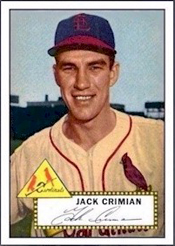
Surviving a scare from the last batter he faced in the game, Jack Crimian earned his first major-league win for the Cardinals in his hometown of Philadelphia.

Crimian reached the big leagues with the Cardinals in 1951, pitched in two seasons for them and also played for the Athletics and Tigers.

A right-hander, Crimian was a relief specialist with the Cardinals, but had his most successful season as a starter in the minor leagues.

Willing to work

After graduating high school in Philadelphia, Crimian was signed by the hometown Phillies. In 1944, his first season in the Phillies’ minor-league organization, Crimian earned 18 wins. He joined the Army in 1945 and served as a paratrooper. A year later, he returned to the Phillies’ farm system and was chosen by the Cardinals in the November 1946 minor-league draft.

In 1951, Crimian’s fifth season as a Cardinals minor leaguer, he thrived as a reliever for Columbus manager Harry Walker.

Crimian worked in 30 of Columbus’ first 50 games, developing a reputation as a “rubber-armed pitcher,” according to The Sporting News.

“Crimian is a big-league relief pitcher,” said Charlie Grimm, manager of the Braves’ Milwaukee farm team. “I’ll not miss him when the St. Louis Cardinals call him up.”

On Walker’s recommendation, the Cardinals promoted Crimian on July 1, 1951, as they were about to embark on a three-week road trip. “Harry told me Jack was one of those guys you can use every day for a couple of innings and have him go at top speed,” said Cardinals manager Marty Marion. “That’s what we need.”

Frustrating the Phillies

Crimian, 25, made his major-league debut for the Cardinals on July 3, 1951, against the Reds at Cincinnati. Relieving Harry Brecheen in the sixth inning, Crimian faced two batters, yielding a walk to Dixie Howell and a three-run double to Barney McCosky. Boxscore

The highlight of Crimian’s stint with the Cardinals came two weeks later, on July 15, 1951, in the first game of a doubleheader against the Phillies at Shibe Park in Philadelphia.

With the score tied at 3-3, Crimian relieved Brecheen and held the Phillies scoreless in the sixth, seventh and eighth innings, working around a leadoff triple by Granny Hamner in the seventh. The Cardinals scored twice in the seventh and twice in the eighth, taking a 7-3 lead into the bottom of the ninth.

With one out, Del Ennis hit a home run against Crimian, cutting the Cardinals’ lead to 7-4. After Hamner grounded out, Jimmy Bloodworth walked and Del Wilber doubled, putting runners on second and third and bringing the potential tying run to the plate.

Dick Sisler, a former Cardinal, was the batter. After working the count to 2-and-1, he hit a pitch from Crimian over the right-field wall. If the ball landed fair, it would have been a three-run home run, tying the score, but it curved into foul territory.

Unwilling to let Crimian throw another pitch to Sisler, Marion brought in Al Brazle to finish the job. Brazle’s first pitch was a curveball and Sisler watched it bend across the plate for strike three, preserving the win for Crimian. Boxscore

A week later, on July 24, 1951, Crimian made his first appearance at Sportsman’s Park in St. Louis and Sisler again played a central role. With the Cardinals leading the Phillies, 8-5, Crimian relieved Brecheen with two on and two outs in the eighth and struck out Sisler. The Cardinals scored a run in the bottom of the eighth and Crimian retired the Phillies in order in the ninth, earning a save. Boxscore

On the move

Crimian made 11 appearances, all in July, for the 1951 Cardinals and was 1-0 with a 9.00 ERA before he was returned to the minors.

In 1952, Crimian was called up to the Cardinals in June, pitched in five games, posted a 9.72 ERA and was demoted.

Playing for Walker at Rochester in 1953, Crimian was 13-5 with a 2.86 ERA, but the Cardinals didn’t call. On Dec. 2, 1953, the Cardinals sent Crimian and $100,000 to the Reds for shortstop Alex Grammas.

According to the Dayton Daily News, Walker spoke to Reds manager Birdie Tebbetts about Crimian and said there’s “no reason why he can’t relieve successfully in the majors.”

The Reds, though, never gave Crimian a chance. On April 8, 1954, the Reds sold Crimian’s contract to the Toronto Maple Leafs, an unaffiliated minor-league club owned by Jack Kent Cooke. The Maple Leafs manager was Luke Sewell, who managed the St. Louis Browns to the 1944 American League pennant and a berth in the World Series against the Cardinals.

Back in the bigs

Crimian earned 30 saves for the Maple Leafs in 1954. During the summer, the Yankees expressed interest in acquiring him, “but Cooke wouldn’t part with Crimian in midseason,” The Sporting News reported.

In 1955, Sewell put Crimian in the starting rotation because he “wasn’t getting enough work to stay sharp” as a reliever.

“I have trouble keeping a fine touch if I don’t get enough work,” Crimian said.

Crimian posted a 19-6 record and 2.10 ERA, earning International League pitcher of the year honors.

The pitching-poor Athletics of the American League took notice. On Oct. 12, 1955, the Athletics acquired Crimian from the Maple Leafs for pitcher Marion Fricano and $60,000.

“If they give this fellow a chance to learn the hitters, he can’t miss,” Sewell said. “He’s got the best control I’ve seen in any pitcher.”

Crimian spent the 1956 season with the Athletics and was 4-8 with a 5.51 ERA in 54 appearances. His highlight came on Sept. 4, 1956, when he won a start against the Indians and outdueled Herb Score, a 20-game winner. Boxscore

In December 1956, the Athletics traded Crimian to the Tigers. He pitched in four games for them in 1957, including on April 18 when Indians rookie Roger Maris hit his first major-league home run, a grand slam, against Crimian in the 11th inning at Detroit. Boxscore

Read Full Post »

« Newer Posts - Older Posts »