Feeds:
Posts
Comments

Archive for the ‘Pitchers’ Category

(Updated Oct. 18, 2022)

Born and raised near Pittsburgh, John Stuper wanted to pitch for the Pirates, went to the Cardinals instead and became a World Series winner as a rookie.

On Jan. 25, 1979, the Pirates traded Stuper to the Cardinals for infielder Tommy Sandt.

The minor-league move turned into a big deal for the Cardinals, but not before Stuper had to revive a career headed in reverse.

Hometown hopeful

A native of Butler, Pa., near Pittsburgh, Stuper had a 34-3 record in three seasons as a college pitcher. He was 25-3 in two years at Butler County Community College and 9-0 for Point Park College in downtown Pittsburgh.

The Pirates chose Stuper in the 18th round of the June 1978 amateur draft, offered a $2,500 bonus and signed him that night.

“It’s been my lifelong dream to be a professional baseball player,” Stuper said to the Pittsburgh Post-Gazette. “I know the odds are against making it to the majors, but I’m not thinking about that now.”

Years later, asked by the St. Louis Post-Dispatch why he wasn’t drafted in a higher round, Stuper replied, “The rap on me in high school and later in college was I labored too much and didn’t have a smooth enough delivery.”

A right-hander, Stuper was assigned to the Pirates’ Class A club at Charleston, S.C., and posted a 4-8 record and 5.33 ERA.

“He still has a few mechanical problems he has to correct,” said Pirates farm director Murray Cook.

Said Stuper: “I learned a lot. It was an adjustment getting used to being away from home and playing against better talent.”

Climbing the ladder

Four months after his first professional season ended, Stuper was called at home by Cook, who told him of the trade to the Cardinals.

“I was a little disappointed when I was traded, but my friends encouraged me to think positively that the Cardinals wanted me, not that the Pirates didn’t,” Stuper said to The Pittsburgh Press.

In the Cardinals’ minor-league system, Stuper had ERAs of 2.71 in 1979 and 2.41 in 1980. He credited Cardinals pitching instructor Hub Kittle for the turnaround.

“I don’t make it to the big leagues without Mr. Hub Kittle,” Stuper told Cardinals Magazine. “I loved the man. He believed in me. He was probably the best pitching coach for mechanics I’ve ever encountered.”

Kittle told The Southern Illinoisan, “When we got him, he was a strong and well-conditioned kid, but he was throwing down from the side. Gradually we changed his mechanics, and when he came over the top, the ball began to jump.”

After the 1979 season, Stuper earned a degree in English at LaRoche College in McCandless, Pa. He pitched winter ball in Mexico after the 1980 season.

When Stuper got to Cardinals spring training camp in 1981, he was “in midseason form,” he later told the Post-Dispatch, because of his work in Mexico.

Stuper impressed the Cardinals, who conceded he pitched well enough to deserve a role on the Opening Day roster, but they sent him to Class AAA Springfield, Ill., so he could pitch regularly as a starter.

“He’s going to be a good pitcher,” said Cardinals manager Whitey Herzog. “He’s been awfully impressive.”

A step back

Stuper struggled at Springfield and couldn’t get untracked. When major leaguers went on strike in June 1981, Herzog said he intended to go to Springfield “to see what’s wrong with Stuper,” who had lost seven of nine decisions.

Turns out the toll of pitching in Mexico, followed by a spring training workload, left Stuper out of sorts. He finished the 1981 season with a 6-14 record and 4.92 ERA.

“In the long run, pitching in the winter hurt me,” Stuper said. “My arm was very fatigued all season.”

Stuper went home and worked to get his arm in shape, but he had a poor spring training in 1982 and the Cardinals sent him to Class AAA Louisville in mid-March.

A year after being the surprise of spring training camp, Stuper went to Louisville knowing he needed a good showing to get back in the Cardinals’ plans.

Mission accomplished

“One of my goals this year is to show that last season was a fluke,” Stuper said to the Associated Press.

After taking the loss on Opening Night, Stuper won seven consecutive decisions for Louisville and was 7-1 with a 1.46 ERA when he was called up to the Cardinals on May 28, 1982.

“I was shooting for September,” Stuper said to the Louisville Courier-Journal. “I would have been happy with that, so obviously I’m elated with this.”

Stuper made his major-league debut on June 1, 1982, in a start against the Giants at St. Louis. He pitched eight innings, allowing three runs, tripled against Atlee Hammaker and scored the tying run, but the Giants prevailed, 4-3, in 11. Boxscore

Giants first baseman Reggie Smith, a former Cardinal, said, “I liked the young guy’s guts. He challenges you.”

Said Stuper: “I thought my stuff was OK, but I wasn’t real sharp. I was getting behind on too many hitters. My location wasn’t as good as I like it to be.”

Homeward bound

Stuper won four of his first five decisions with the Cardinals.

On Aug. 14, 1982, Stuper pitched in Pittsburgh for the first time as a big-leaguer, getting the start against the Pirates. He yielded one run in 7.1 innings, earning the win in a 4-1 Cardinals triumph. Boxscore

“I’d be lying if I said it wasn’t kind of special. Very special,” Stuper said. “I always dreamed about coming here to pitch for the Pirates. The day I got traded, I started dreaming about coming here to pitch against them.”

Stuper finished his rookie season with a 9-7 record and 3.36 ERA, helping the Cardinals win the National League East Division title.

In the postseason, he made three starts and the Cardinals won all three, though he didn’t get a decision in Game 2 of the National League Championship Series against the Braves or in Game 2 of the World Series versus the Brewers.

Stuper did win Game 6 of the 1982 World Series, pitching a four-hitter in a 13-1 Cardinals victory and setting up a decisive Game 7 won by St. Louis.

Stuper was 12-11 for the Cardinals in 1983 and 3-5 in 1984 before he was traded to the Reds for outfielder Paul Householder.

In 1989, Stuper earned a master’s degree in English from Slippery Rock University. He was a Cardinals minor-league pitching instructor in 1991 and 1992 before becoming head baseball coach at Yale in 1993.
Read Full Post »

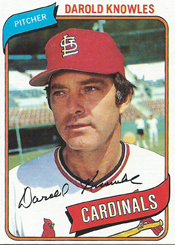
Darold Knowles was the first free-agent player signed by the Cardinals, the club he dreamed of playing for as a youth in Missouri.

On Jan. 16, 1979, the Cardinals signed Knowles to a two-year contract for $100,000 per season.

Three years after baseball put in a system enabling players to become free agents, the Cardinals finally acquired one.

Free agency for players occurred in 1976 after Cardinals outfielder Curt Flood challenged baseball’s reserve clause in court and arbitrator Peter Seitz ruled pitchers Andy Messersmith and Dave McNally should be free to sign with any teams they wanted after playing a season without contracts.

On July 12, 1976, a new collective bargaining agreement between players and owners created the framework for determining who could become free agents.

Though the Cardinals did pursue Pete Rose and other free agents, they consistently were outbid.

The signing of Knowles, a left-handed reliever, wasn’t a blockbuster, but he was respected, experienced and wanted to play for the Cardinals.

Redbirds rooter

Knowles was born in Brunswick, Mo., a rural community known for producing pecans, and he became a standout amateur player.

The first major-league game he saw as a youth was at St. Louis in the 1950s. “I’ve been a Cardinals fan for as long as I can remember,” Knowles said to the St. Louis Post-Dispatch.

The Cardinals, though, weren’t too interested in Knowles and he signed with the Orioles in February 1961.

Knowles, 23, made his major-league debut for the Orioles in 1965, pitched in five games for them and was traded after the season to the Phillies.

Storybook success

With his mother and father in attendance, Knowles got his first major-league win in his first appearance for the Phillies on April 14, 1966, at St. Louis against the Cardinals.

“I can pitch up here,” Knowles said to the Philadelphia Inquirer. “I’ve got to throw strikes. I don’t consider myself a strikeout pitcher. If I can throw 27 ground balls, I’m happy.”

The Phillies led, 5-3, when Knowles relieved starter Ray Herbert with a runner on first and none out in the fourth. Knowles pitched “six pressure-packed innings” and “constantly worked his way out of trouble,” the Inquirer reported.

After the Cardinals scored in the fifth, pulling within a run at 5-4, Lou Brock led off the seventh with a walk, but was picked off by Knowles.

“We were going to bunt Lou over,” Cardinals manager Red Schoendienst said. “I don’t know what he was doing trying to steal.”

Said Knowles: “I figured that with them one run down, Brock would try to steal sometime. So I decided to throw to first right away. We got Brock and that was the ballgame. It was a big lift for me.” Boxscore

Championship caliber

In addition to the Orioles and Phillies, Knowles pitched for the Senators (1967-71), Athletics (1971-74), Cubs (1975-76), Rangers (1977) and Expos (1978) before joining the Cardinals.

With the 1970 Senators, Knowles was 2-14 with 27 saves and a 2.04 ERA.

Knowles was with the Athletics when they won three consecutive World Series championships (1972-74). He pitched in all seven games of the 1973 World Series versus the Mets, earning saves in Game 1 and Game 7, and totaled 6.1 scoreless innings.

In 1978, when he joined the Expos, Knowles was reunited with manager Dick Williams, who managed the championship Athletics clubs in 1972 and 1973. Knowles was 3-3 with six saves and a 2.38 ERA for the Expos and they wanted to re-sign him in 1979, “but my family and I didn’t like Montreal,” Knowles said.

Knowles, 37, became a free agent and interested the Cardinals, who were seeking a left-hander to join Mark Littell as short-inning relievers.

Old pro

“I feel good and I think I can have four or five more good years,” Knowles said when he signed with the Cardinals. “I’ve never been overpowering, but I’ve been blessed with good control and the ability to keep my pitches low.”

Said Cardinals catcher Ted Simmons: “Knowles knows what he’s doing. He’s been through every kind of situation. Whatever he’s lost with his arm, he can compensate for with his head. He knows how to approach his job, and the approach is 70 percent of the game.”

At first, Knowles did well for the Cardinals, posting a 2-1 record with four saves and a 2.00 ERA in May, but he finished the 1979 season at 2-5 with six saves and a 4.07 ERA.

Knowles, 38, returned to the Cardinals in 1980 for the second year of his contract.

In his second appearance, on April 18, 1980, Knowles was brought in to protect an 8-7 lead against the Pirates with one on and one out in the sixth. He threw a “scroogie changeup” to the first batter he faced, Dave Parker, who hit a home run and put the Pirates ahead, 9-8.

“The ball was low enough, but I didn’t want it over the plate,” Knowles said.

Knowles allowed another run before completing the inning and was the losing pitcher in a 12-10 Pirates triumph. Boxscore

“We were in a position to win this game and I screwed it up,” Knowles said.

Coaching career

On May 9, 1980, Knowles was released soon after the Cardinals acquired left-hander Jim Kaat from the Yankees.

“I didn’t have that much left,” Knowles said to the Society for American Baseball Research. “I didn’t have the good stuff that I had earlier, but it was OK. I wound up playing for my boyhood dream team and loved every minute in St. Louis.”

Knowles finished with a career record of 66-74, 143 saves and a 3.12 ERA.

The next year, the Cardinals hired Knowles as minor-league pitching coach and he served in the role from 1981-88. In 1983, when Cardinals pitching coach Hub Kittle left the club in June to be with his ailing wife, Knowles filled in for him the remainder of the season.

In 1989, Phillies general manager Lee Thomas, the former Cardinals director of player development, hired Knowles to be pitching coach. Serving on the staff of manager Nick Leyva, a former Cardinals coach, Knowles was Phillies pitching coach in 1989 and 1990.

Read Full Post »

(Updated Nov. 27, 2021)

Before he gained fame with the Pirates for pitching 12 perfect innings against the Braves and earning two World Series wins versus the Yankees, Harvey Haddix began his career with the Cardinals and was their ace.

A left-hander at 5 feet 9, 160 pounds, Haddix “relied on technique instead of strength,” the Pittsburgh Post-Gazette reported.
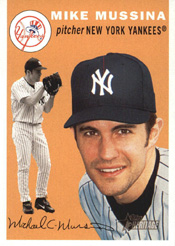
On May 26, 1959, at Milwaukee, Haddix pitched 12 perfect innings, retiring the first 36 batters he faced, but lost when the Braves scored an unearned run in the 13th. Boxscore

The Pittsburgh Press called it “the greatest of all baseball tragedies” and, years later, Marino Parascenzo of the Post-Gazette hailed Haddix as “a little guy with a big heart, big enough to pitch baseball’s greatest game and absorb one of baseball’s greatest disappointments, both in the same day _ and come up smiling.”

A year after his Milwaukee masterpiece, Haddix started and won Game 5 of the 1960 World Series at Yankee Stadium, and he pitched the ninth inning of Game 7 and got the win when Bill Mazeroski hit a walkoff home run for the Pirates. Boxscore

Those feats overshadowed the achievements of his early years with the Cardinals when he had a 20-win season, led the National League in shutouts and was selected to three all-star teams.

Catapult to success

Haddix grew up on an Ohio farm and signed with the Cardinals in 1947 after attending a tryout camp in Columbus. He pitched four seasons in the Cardinals’ system and was 18-6 for Class AAA Columbus in 1950 before serving in the Army.

After military service, the Cardinals brought Haddix to the major leagues. In his debut in a start against the Braves on Aug. 20, 1952, at St. Louis, Haddix got the win, singled, stole a base, drove in a run and scored a run in a 9-2 victory. Boxscore

Haddix was matched in his debut against Braves starter Lew Burdette. Seven years later, Burdette was the opposing pitcher who held the Pirates scoreless for 13 innings while Haddix was perfect for 12.

Haddix “bears a strong resemblance” to teammate Harry Brecheen in “size, pitching technique and ability,” Bob Broeg of the St. Louis Post-Dispatch reported.

Brecheen, nicknamed “The Cat,” earned 128 wins in his Cardinals career and was the 1948 National League ERA leader. Because he appeared to be a younger version of “The Cat,” Haddix got tabbed “The Kitten.”

Years later, according to Broeg, Cardinals outfielder Enos Slaughter said, “You know how much I think about Brecheen. Harvey is even better.”

Big winner

Haddix was 2-2 with a 2.79 ERA in 42 innings for the 1952 Cardinals. He maintained his rookie status in 1953 because he had pitched fewer than 45 innings in the major leagues.

Haddix posted a 20-9 record for the 1953 Cardinals, led the league in shutouts (six) and finished second to Dodgers infielder Jim Gilliam in balloting for the Rookie of the Year Award. Haddix also batted .289 with 11 RBI.

Haddix’s best pitching performance in his 20-win season was a two-hit shutout of the Phillies in a 2-0 Cardinals triumph on Aug. 6, 1953, at St. Louis.

Haddix held the Phillies hitless for eight innings. Richie Ashburn, leading off the ninth, attempted to bunt Haddix’s first pitch, fouled it off and got booed. “That’s what he’s paid to do, try to win,” Haddix said.

With the count 1-and-2 on Ashburn, Cardinals catcher Del Rice called for a slider, but Haddix shook off the sign and threw a curve. Ashburn lined the pitch to right for a single.

“He wouldn’t have hit that curve if I had got it where I wanted it _ down,” Haddix said. “It was high, though, and he should have hit it.”

With one out, Del Ennis bounced a single into left, but Haddix got Granny Hamner to ground into a game-ending double play. Boxscore

Haddix got his 20th win of the season on Sept. 25, 1953, in an 11-2 Cardinals rout of the Cubs at Wrigley Field. Boxscore

He became the first Cardinals pitcher to achieve 20 wins in a season since Howie Pollet was 20-9 in 1949.

Master craftsman

In 1954, Haddix was 18-13 for the Cardinals. From May 8, 1954, to June 23, 1954, Haddix won 10 consecutive decisions and lowered his ERA from 4.17 to 2.85. He allowed one run in the last 36 innings of the streak.

On July 1, 1954, at Milwaukee, Haddix was struck on the left knee by a Joe Adcock liner and was carried off the field on a stretcher. “I never threw the same after that,” he told author Walter Langford.

Haddix was 12-16 for the 1955 Cardinals, but was chosen for the All-Star Game for the third consecutive year. He pitched three innings and retired Ted Williams on a groundout to end the fifth and got Mickey Mantle on a groundout to start the sixth. Boxscore

The next year, Haddix appeared ready to give the Cardinals another good showing. On April 25, 1956, he pitched a two-hit shutout in a 6-0 Cardinals victory against the Cubs at St. Louis. Boxscore

Two weeks later, the Cardinals traded Haddix and pitchers Stu Miller and Ben Flowers to the Phillies for pitchers Murry Dickson and Herm Wehmeier.

In five seasons with St. Louis, Haddix was 53-40 with a 3.65 ERA and 12 shutouts. “He had the misfortune to be the Cardinals’ best pitcher at a time they didn’t have enough,” wrote Broeg.

Haddix went on to pitch for the Phillies (1956-57), Reds (1958), Pirates (1959-63) and Orioles (1964-65). His pitching coach with the Orioles was Brecheen, a reunion of “The Cat” and “The Kitten.”

Haddix was 40 when he pitched his last big-league game and he finished with a career mark of 136-113.

Haddix became a pitching coach for the Mets (1966-67), Reds (1969), Red Sox (1971), Indians (1975-78) and Pirates (1979-84).

With the Mets, Haddix was the first big-league pitching coach for Nolan Ryan and Tom Seaver. When Frank Robinson became the first African-American manager in the big leagues with the 1975 Indians, he chose Haddix to be the pitching coach. In 1979, the Pirates won the World Series championship with Chuck Tanner as manager and Haddix as pitching coach.

In winters, Haddix returned to his Ohio farm near the village of South Vienna. “Haddix was a good rifle shot,” Broeg wrote. “Back home in Ohio, they considered him a hero after a neighbor’s bull went on a rampage and threatened life and property. Haddix delivered a bull’s-eye shot with only a .22-caliber.”

A year before he died at age 68 in January 1994, the Associated Press reported, Haddix, needing an oxygen tank, talked about his smoking habit.

“I was a three-pack-a-day man,” Haddix said. “That was my friend. My wife and kids didn’t travel with me. I could handle the drinking part of it, but not the cigarettes.

“I loved cigarettes, but they finally got to me.”

Read Full Post »

(Updated Jan. 22, 2019)

In his lone career appearance against the Cardinals, Mike Mussina gave them an understanding of why he is a Hall of Famer.

On June 15, 2003, Mussina limited the Cardinals to four hits in eight innings and earned the win in a 5-2 Yankees victory at New York.
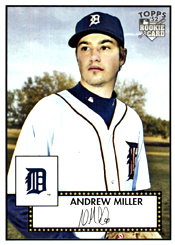
Mussina, a right-hander who achieved a 270-153 record in 18 seasons with the Orioles and Yankees, was elected to the National Baseball Hall of Fame on Jan. 22, 2019.

Center stage

Mussina posted double-digit win totals in 17 consecutive seasons (1992-2008) and pitched in 537 regular-season games, all but one as a starter. He debuted with the Orioles in 1991, pitched 10 seasons for them and spent his last eight years with the Yankees.

In 2003, Mussina was 17-8 and one of his best performances was his start versus the Cardinals before 54,797 on a Sunday afternoon at Yankee Stadium.

The Yankees were going for a sweep of the three-game series and matched Mussina against Woody Williams.

Mussina retired 10 of the first 11 batters and had a 1-0 lead before the Cardinals scored twice in the fourth. With one out, Albert Pujols hit a home run, tying the score, Tino Martinez walked and, after Scott Rolen flied out to right, Mussina uncorked a wild pitch, moving Martinez to second. Edgar Renteria’s infield single advanced Martinez to third and Kerry Robinson’s single drove him in, putting the Cardinals ahead, 2-1.

Under control

The Yankees went up, 5-2, with a four-run sixth. Robin Ventura hit a two-run double and scored on a single by Hideki Matsui. Ruben Sierra’s double drove in Matsui.

The Cardinals didn’t get another base runner against Mussina after the fourth. He retired the last 13 batters in a row before Mariano Rivera relieved and pitched a scoreless ninth. Boxscore

“If you’re a control pitcher, things can come and go on you rather quickly,” Mussina said to the New York Daily News, “so you try to stay on top of it.”

Asked about being lifted for Rivera after eight innings, Mussina replied, “I had no problem with that. It would have had to be a much bigger lead for me to go back out there.”

Rivera, baseball’s all-time saves leader, also was elected to the National Baseball Hall of Fame on Jan. 22, 2019, the same day as Mussina.

Read Full Post »

Andrew Miller made his first major-league start for the Tigers against the Cardinals, impressed Jim Leyland and Tony La Russa and helped his club achieve a measure of redemption against the defending World Series champions.

On May 18, 2007, three days before he turned 22, Miller pitched six scoreless innings and got his first big-league win against the Cardinals at Detroit.
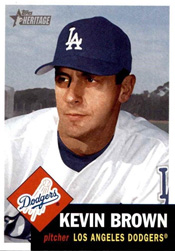
The 6-foot-7 left-hander pitched with poise and skill and appeared to be headed toward a long, distinguished career as a starter.

Eleven years later, Miller, a free agent, joined the Cardinals with the expectation he would be their top left-handed reliever. He hadn’t made a start in seven years.

Escape artist

Miller was a standout pitcher at the University of North Carolina, establishing the school’s career strikeout record, and was selected by the Tigers in the first round of the 2006 amateur draft.

After making his major-league debut with the Tigers in 2006 and appearing in eight games, all in relief, Miller was at Class AA Erie in May 2007 when he got called up to Detroit to fill in for injured starter Jeremy Bonderman.

Miller’s first big-league start was the Tigers’ first game versus the Cardinals since losing four of five against them in the 2006 World Series.

Pitching before a sellout crowd of 40,816 at Comerca Park, Miller worked in and out of trouble in the first three innings.

The Cardinals loaded the bases in the first on singles by Albert Pujols and Juan Encarnacion and a walk to Scott Rolen, but with two outs Ryan Ludwick popped out to second baseman Placido Polanco.

In the second, the Cardinals had Yadier Molina on third with one out, but stranded him when David Eckstein grounded out to short and So Taguchi flied out to right.

The Cardinals put runners on first and second with one out in the third before Miller retired Rolen and Ludwick.

After that, Miller yielded no hits and walked two over his last three innings.

The Tigers scored seven runs against Cardinals starter Braden Looper and another seven against Kelvin Jimenez and won, 14-4. Miller’s line: 6 innings, 4 hits, 0 runs, 3 walks, 2 strikeouts, 1 batter hit by pitch. The Cardinals were 0-for-5 against him with runners in scoring position. Boxscore

Rave reviews

Under the headline, “Dandy, Andy,” the Detroit Free Press declared Miller “arrived amid some fanfare and delivered on cue, showing he might have as much to do with the team’s current fortunes as its future.”

Other comments about Miller after the game:

_ Tigers manager Jim Leyland: “This is real talent. He should have a very, very bright future.”

_ Cardinals manager Tony La Russa: “I was impressed with how often he was around the plate and how when he had the potential to throw a ball through the screen, he stayed within himself and didn’t try to strike out the side. Very impressive.”

_ Tigers pitching coach Chuck Hernandez: “I learned he’s got a little feel for pitching to go along with a good fastball.”

_ Free Press columnist John Lowe: “He confirmed anew that he will one day be a dominant big-league pitcher.”

Said Miller: “I know that I can do this.”

Bullpen specialist

Miller went on to have more bad outings than good ones as a starter in the major leagues. He finished 5-5 with a 5.62 ERA for the 2007 Tigers and was part of a package of prospects traded to the Marlins after the season for slugger Miguel Cabrera and pitcher Dontrelle Willis.

In three seasons with the Marlins, Miller was 10-20 with a 5.89 ERA. They traded him to the Red Sox and he was 6-3 with a 5.54 ERA in 2011 before being converted into a reliever.

Miller was consistently effective in relief roles for the Red Sox (2012-14), Orioles (2014), Yankees (2015-16) and Indians (2016-18). He earned 36 saves for the 2015 Yankees and was 4-0 with a 1.55 ERA for the 2016 pennant-winning Indians.

Miller was an American League all-star with the Indians in 2016 and 2017 and was named most valuable player of the 2016 AL Championship Series when he struck out 14 Blue Jays in 7.2 scoreless innings.

Through 2018, Miller had a 49-48 record, 3.98 ERA and 53 saves in 13 big-league seasons. He was 20-27 with a 5.70 ERA as a starter and 29-21 with a 2.56 ERA as a reliever.

On Dec. 21, 2018, Miller, 33, agreed to terms with the Cardinals on a two-year, $25 million contract with an option for 2021.

“Andrew Miller is one of the premier relievers in the major leagues,” said Cardinals president of baseball operations John Mozeliak.

Read Full Post »

The Cardinals wanted free-agent pitcher Kevin Brown and thought they had a legitimate chance, offering to extend their payroll budget to get him, but the Dodgers took the bidding to unexpected heights.

On Dec. 12, 1998, the Dodgers signed Brown to a seven-year contract, making him the first $100 million player in baseball.

Brown, represented by agent Scott Boras, got a $105 million deal, with an average salary of $15 million a season. The contract also called for the Dodgers to provide a private jet to fly Brown’s family back and forth from Macon, Ga., and Los Angeles 12 times a season.

The Cardinals were willing to give Brown, 33, a six-year offer, general manager Walt Jocketty told the St. Louis Post-Dispatch, and were stunned by what he got from the Dodgers.

“It’s insane,” said Jocketty. “I don’t understand it.”

Baseball mercenary

Kevin Brown majored in chemical engineering at Georgia Tech, pitched for the baseball team and was selected by the Rangers in the first round of the 1986 amateur draft.

A 6-foot-4 right-hander, Brown pitched eight seasons for the Rangers, including 1992 when he was 21-11. He became a free agent, played one season for the Orioles, became a free agent again and went to the Marlins.

In two seasons with the Marlins, Brown was 33-19 and they won a World Series championship in 1997. The Marlins traded him to the Padres and he was 18-7 in 1998, helping them win a National League pennant and a berth in the World Series against the Yankees.

Brown was 0-3 with a 6.04 ERA in four World Series starts for the Marlins and Padres, but those setbacks didn’t damage his value. He became a free agent for a third time after the 1998 World Series and let it be known through Boras he was seeking a six-year contract at $13 million per season.

High stakes

The Cardinals were in dire need of starting pitching. Kent Mercker (11-11, 5.07 ERA) led the Cardinals in wins in 1998 and the club finished out of title contention at 83-79. Jocketty told the Post-Dispatch “we have expressed interest” in Brown.

On Nov. 5, 1998, Post-Dispatch columnist Bernie Miklasz declared “the Cardinals were thought to be favorites” in the bidding for Brown and noted, “Brown looms as an exciting purchase, but how smart is it? For Brown money, Jocketty may be able to get two starting pitchers.”

Jocketty said he thought the length of a contract for Brown “could, and should, go down to five years” rather than the six the pitcher sought.

The Padres, Rockies, Orioles, Angels and Dodgers joined the Cardinals in pursuit of Brown.

On Nov. 25, 1998, Miklasz reported the Cardinals “have quietly remained at the table” as the “expensive and risky poker game” for Brown unfolded.

“I believe we’ll go over budget to get him,” Cardinals manager Tony La Russa said. “Our ownership would get so fired up about him coming to St. Louis, they’d go get him. If he says, ‘I want to come to the Cardinals,’ our owners will find the money.”

La Russa said “several people close to Brown keep telling us that he’ll seriously consider the Cardinals.”

Golden Brown

On Dec. 2, 1998, the Post-Dispatch reported the Cardinals “would balk at six years but would be interested at five” as the length of a contract for Brown.

“They know of our interest and we know he’s interested in here,” Jocketty said.

A week later, on Dec. 11, 1998, as the baseball winter meetings were getting under way, the Post-Dispatch reported Jocketty still was pursuing Brown “as his first pitching choice.”

The next day, Brown and Boras announced the agreement with the Dodgers. Boras said the deal was sealed when the Dodgers agreed to a contract length of seven years.

“I basically knew the Dodgers were his primary choice and I went to the Dodgers and told them they could have exclusive negotiations if they went to a seventh year,” Boras said.

Boras said the Dodgers, owned by Rupert Murdoch and the Fox media empire, were among four teams willing to pay Brown an average of at least $15 million a season.

Jocketty told Rick Hummel of the Post-Dispatch the Cardinals were prepared to give Brown a six-year pact. “I told (Boras) after the fact that if we thought the dollars were right for six years we would have considered doing that,” Jocketty said.

Boras confirmed the Cardinals “were in the running” at six years.

Regarding a seven-year contract at $105 million, Jocketty said, “It’s too much and too long. It just doesn’t make good sense. I don’t think it’s a very good deal for baseball.”

Miklasz, who described Brown as “Kevin Green, the new U.S. mint,” concluded, “It’s a sobering day when the Cardinals, prepared to offer Brown a fortune, think they have a legitimate chance, only to discover that they couldn’t wipe Brown’s cleats with their contract proposal.”

Padres owner John Moores said he offered Brown six years at $60 million and “held my nose and got nauseated.”

Return on investment

Kent Bottenfield was the ace of a weak Cardinals pitching staff in 1999 and the club finished 75-86.

Brown was 18-9 for the 1999 Dodgers, but they finished 77-85. Brown alone couldn’t carry a Dodgers rotation with Darren Dreifort (4.79 ERA), Chan Ho Park (5.23) and Carlos Perez (7.43).

Brown’s records in his other four seasons with the Dodgers: 13-6, 10-4, 3-4 and 14-9. In five seasons with the Dodgers, Brown was 58-32 with a 2.83 ERA, but the club never qualified for the postseason while he was with them.

On Dec. 13, 2003, Brown, with two years left on his contract, was traded by the Dodgers to the Yankees for a package of players, including pitcher Jeff Weaver, and cash.

In two seasons with the Yankees, Brown was 14-13 with a 4.95 ERA. He was 40 years old when he pitched his last game for them.

Brown, who never won a Cy Young Award, finished a 19-year big-league career with a 211-144 record and 3.28 ERA. In 11 career starts against the Cardinals, Brown was 6-2 with a 2.21 ERA.

Read Full Post »

« Newer Posts - Older Posts »