Feeds:
Posts
Comments

Archive for the ‘Pitchers’ Category

(Updated March 5, 2026)

On a night when Juan Marichal was supposed to start for the Giants, Gaylord Perry got the call instead and outdueled the most dominant pitcher in baseball.
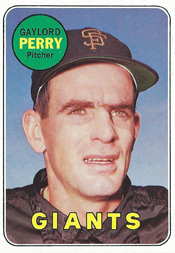
On Sept. 17, 1968, Perry pitched a no-hitter against the Cardinals at Candlestick Park in San Francisco. The Giants won, 1-0, overcoming a typically stellar performance by Bob Gibson.

Perry, pitching on three days’ rest because Marichal was sidelined by a sore right knee, tired in the eighth, prompting Giants pitching coach Larry Jansen to ask manager Herman Franks whether a reliever should get ready. Franks stuck with Perry, who delivered the only no-hitter of his Hall of Fame career.

One and done

The Tuesday night game against the Giants was the Cardinals’ first since they clinched the National League pennant two days earlier on Sept. 15, 1968, at Houston.

Manager Red Schoendienst started most of his regulars against Perry. The exceptions were Bobby Tolan, who substituted for Lou Brock in left field, and Phil Gagliano, who replaced Julian Javier at second base.

Gibson, on his way to securing NL Most Valuable Player and Cy Young awards, entered the game with a 21-7 record and 1.13 ERA. Perry was 14-14 and 2.55.

In the bottom of the first inning, Giants second baseman Ron Hunt, a St. Louis native, hit Gibson’s third pitch of the game over the left-field fence for a home run, his second and last of the season.

Hunt told the San Francisco Examiner the pitch “was about waist high and I think Gibson was just trying to throw me a strike.”

“Hunt hit a fastball that I threw a little inside,” Gibson said to United Press International.

Getting wet

In the second, the Cardinals got their first base runner when Mike Shannon walked with two outs, but Perry retired the next batter, Gagliano.

With two outs in the fourth, Perry made what he described as a “fat pitch,” a high slider, to Orlando Cepeda, but it was popped up to first baseman Willie McCovey, who caught it in foul territory for an out.

“The most important thing was my control,” Perry said to the Associated Press. “I was hitting the spots, keeping the ball low and my slider was really working.

“I knew after the fifth inning that I had a chance for a no-hitter and I tried to hit the corners all the way.”

Perry threw three types of pitches _ “a fastball, a sinking slider and a slider that was breaking real sharp on the outside,” catcher Dick Dietz told the Examiner.

“Most of the Cardinals charged that Perry threw about 75 percent spitballs or Vaseline balls,” the St. Louis Post-Dispatch reported.

“Perry was throwing his same old sinker, but it was wet and it sure dropped,” Schoendienst said.

Wetting the ball with saliva or any substance such as Vaseline was against the rules, and the Cardinals were adamant Perry was in violation. Cepeda told the Post-Dispatch that Perry threw him six spitballs or Vaseline balls in his last at-bat, and pinch-hitter Johnny Edwards said all but one pitch to him were spitters.

Giants reliever Frank Linzy told the Tulsa World, “Gaylord threw about 90 percent spitters that night.” Linzy said Vaseline usually was hidden behind the right ear and underside of the left wrist.

In his 1974 book “Me and the Spitter,” Perry admitted, “I was greasing that night, but only a few times.”

“I had a great slider that day. Honest,” Perry said.

Fine fielding

Cardinals center fielder Curt Flood said, “We were trying to do anything to get a base hit.”

The Cardinals came close to getting a hit in the sixth.

Dal Maxvill led off and smacked a sharp grounder to Perry’s left. A right-hander, Perry wore his glove on his left hand and he was able to field the ball and throw out Maxvill. “The ball just fell right into my glove,” Perry said to the Post-Dispatch. “If the ball had been hit to my right, I couldn’t have got it.”

With two outs, Tolan cracked a hard grounder between first and second, but McCovey snared it and made a perfect toss to Perry, who was covering first. Perry credited McCovey with making a “tremendous play to his right.”

The Cardinals hit two balls to the outfield the entire game and both were caught by Bobby Bonds in center.

Finish the job

In the eighth, Gagliano walked with two outs and Jansen, the pitching coach, didn’t like what he was seeing. “When a pitcher’s ball starts to come up from the (batter’s) knees and gets around the waist or higher, then you have to feel he is beginning to tire,” Jansen said. “That’s the way it looked in the eighth.”

Jansen told Franks, “I think he is beginning to lose his stuff. Do you want to get somebody warm?”

Franks replied, “Not until they get a hit off him.”

After the walk to Gagliano, Perry struck out Edwards, who was batting for Maxvill.

In the ninth, Brock, batting for Gibson, led off and grounded out to short. Tolan followed with a groundout to second and Flood, who led the club in hits, came up next. “I was really worried about Flood,” Perry said. “Flood hits to all fields and I thought he might hit a ball between the infielders.”

Instead, Flood took three called strikes. Boxscore

Good calls

In his book “Stranger to the Game,” Gibson praised home plate umpire Harry Wendelstedt, “who distinguished himself with what I consider to be the best job of calling balls and strikes that I ever witnessed.”

“Harry didn’t miss a pitch all night,” said Gibson, “and I told him so afterwards. That wasn’t an easy thing for me to do, not only because I was reluctant to compliment an umpire, as a rule, but mostly because I was not in a sociable mood when the game ended.”

Gibson’s line: 8 innings, 4 hits, 1 run, 2 walks, 10 strikeouts. “That may have been one of the best games I ever pitched,” Gibson told Stan McNeal of Cardinals Yearbook in 2018.

Perry’s line: 9 innings, 0 hits, 0 runs, 2 walks, 9 strikeouts.

The no-hitter was the first against the Cardinals since Don Cardwell of the Cubs did it on May 15, 1960. Perry also became the first Giant to toss a no-hitter since Marichal achieved one against Houston on June 15, 1963.

Perry’s gem was completed in one hour, 40 minutes and played before 9,546 spectators. He threw 101 pitches.

After celebrating with a dish of ice cream, Perry signed autographs for about 100 fans who were waiting for him outside the clubhouse.

Less than 24 hours later, on Wednesday afternoon, Sept. 18, 1968, Ray Washburn pitched a no-hitter against the Giants in the Cardinals’ 2-0 victory at Candlestick Park. Boxscore

Perry and Washburn became the first big-league pitchers to toss no-hitters in consecutive games.

Read Full Post »

Dean Stone earned a save in his Cardinals debut, flirted with a no-hitter in his lone start for them and was the victim of a rare hitting feat.

A left-hander, Stone pitched in 18 games for the Cardinals in 1959, spent the next two seasons in their minor-league system and did well enough to earn a return to the majors with the Houston Colt .45s when the National League expanded from eight teams to 10 in 1962.

Stone pitched eight seasons in the big leagues with the Senators (1953-57), Red Sox (1957), Cardinals (1959), Colt .45s (1962), White Sox (1962) and Orioles (1963), composing a 29-39 record, 12 saves and a 4.47 ERA.

He was 0-1 with a save and a 4.20 ERA for the 1959 Cardinals.

All-star quality

Stone had his best major-league season in 1954 with the Senators and was named to the American League all-star team.

In the eighth inning of the All-Star Game at Cleveland on July 13, 1954, the National League led 9-8 and had Red Schoendienst on third base and Alvin Dark on first with two outs and Duke Snider at the plate. Stone was brought into the game by manager Casey Stengel to face Snider, a left-handed batter.

As Stone was about to throw his third pitch to Snider, Schoendienst broke from third and attempted a steal of home. Stone made a quick throw to catcher Yogi Berra, who applied the tag on Schoendienst for the third out. National League coaches Leo Durocher and Charlie Grimm claimed Stone committed a balk in his rush to throw home, but umpire Bill Stewart rejected their argument.

In the bottom half of the inning, the American League rallied for three runs and an 11-9 lead. Virgil Trucks pitched a scoreless ninth, earning the save, and Stone was credited with a win, even though he didn’t retire a batter. Boxscore

Stone finished the 1954 season with a 12-10 record, 3.22 ERA and 10 complete games. He slipped to 6-13 in 1955 and 5-7 in 1956 and was dealt by the Senators to the Red Sox on April 29, 1957.

After posting a 1-3 record and 5.27 ERA for the Red Sox in 1957, Stone spent all of 1958 with their farm club at Minneapolis and was 13-10 with a 3.18 ERA and three shutouts.

Meet me in St. Louis

Minneapolis was in the American Association and so was Omaha, the Cardinals’ affiliate managed by Johnny Keane. When Keane became a Cardinals coach on manager Solly Hemus’ staff in 1959, he recommended Stone to general manager Bing Devine.

On March 14, 1959, the Cardinals traded pitcher Nelson Chittum to the Red Sox for Stone.

The Boston Globe described the trade as a “transaction of no great magnitude.” Devine agreed and told the St. Louis Post-Dispatch, “It’s not a sensational move, of course, but any time we get a chance to look at a pitcher who might augment our left-handed staff we’ve got to consider it … Johnny Keane thought he might help us.”

Stone, 28, was assigned to Omaha where he was managed by Joe Schultz. After losing his first three decisions, Stone won nine of his next 12 and had a 9-6 record and 3.87 ERA in 121 innings when he got called up to the Cardinals in July 1959.

Positive impression

Stone made his National League debut on July 11, 1959, pitching 3.2 scoreless innings in relief of starter Marshall Bridges in a 4-3 Cardinals victory over the Phillies at Philadelphia. Stone yielded two hits, walked none, struck out five and got a save in what the Post-Dispatch described as “a brilliant relief job.” Boxscore

Stone used an “overpowering fastball” against the Phillies, the Sporting News reported.

“Funny thing, when we talked about bringing up Dean from Omaha, Joe Schultz said he had the stuff to help, but questioned his ability to relieve because of only one thing _ control,” Cardinals business manager Art Routzong said.

Stone yielded one run over his first 10 innings of relief work for the Cardinals and after five appearances had an ERA of 0.90.

No mercy

When Cardinals starter Vinegar Bend Mizell developed an aching back, Hemus gave Stone a start against the Braves on July 31, 1959, at Milwaukee.

Stone held the Braves hitless for five innings and was locked in a scoreless duel with Braves starter Bob Buhl.

In the sixth, Del Crandall led off with the Braves’ first hit, a double. After Buhl struck out, Bobby Avila walked and Felix Mantilla dribbled a grounder past shortstop Alex Grammas and into left field for a single, scoring Crandall and advancing Avila to third. Grammas told the Post-Dispatch he should have fielded the ball. “I couldn’t make up my mind whether to backhand the ball,” Grammas said. “I don’t know whether I could have thrown him out, but I should have stopped the ball.”

Hank Aaron followed with a weak single to left, scoring Avila with the second run and moving Mantilla to second. “By this time, Stone couldn’t have been expected to keep holding off the mighty Braves any more than Custer was expected to keep cutting down the Indians,” the Post-Dispatch wrote.

Joe Adcock followed with a three-run home run, capping the Braves’ five-run sixth. Stone went seven innings, giving up five runs on five hits and two walks, and Buhl pitched a shutout in a 6-0 Braves triumph. Boxscore

Ups and downs

Two days later, on Aug. 2, 1959, Bill Bruton of the Braves hit a pair of bases-loaded triples, one against Mizell and the other off Stone. Bruton became the second big-league batter since 1900 to hit two three-run triples in a game, according to The Sporting News. Boxscore

After the 1959 season, the Cardinals removed Stone from their roster and assigned him to Rochester. He was 9-7 with a 3.67 ERA in 130 innings for Rochester in 1960 and 12-8 with a 2.73 ERA in 178 innings for the Cardinals’ affiliate in San Juan and Charleston, W.Va., in 1961.

On Nov. 27, 1961, the Colt .45s selected Stone in the Rule 5 minor-league draft. He opened the 1962 season in their starting rotation and pitched 21.1 consecutive scoreless innings, including back-to-back shutouts versus the Cubs, before the Cardinals scored four runs against him in the fourth inning on April 25. Boxscore

Read Full Post »

They came from places one might find in a John Grisham novel, but Wilmer Mizell of Vinegar Bend, Ala., and Ed Bailey of Strawberry Plains, Tenn., were real and they were central characters in an unusual game between the Cardinals and Reds.

On Sept. 1, 1958, in the opening game of a doubleheader at St. Louis, Mizell established a National League record for most walks in a shutout, issuing nine in a 1-0 Cardinals victory.

One reason Mizell was able to thrive despite a lack of command was his ability to retire Bailey in key situations. Three times, Bailey batted with two on and two outs and Mizell got him out each time.

Path to success

Mizell was from Leakesville, Miss., located along the Chickasawhay River in the southeast part of the state near the Alabama border. The nearby town of Vinegar Bend, Ala., became Mizell’s adopted home because Leakesville was on the Vinegar Bend mail route.

At 16, Mizell began playing baseball in Sunday leagues in Vinegar Bend and from then on he became known as Vinegar Bend Mizell.

A left-handed pitcher, Mizell signed with the Cardinals in 1949 when he was 18 and established himself as a top prospect. He was 12-3 with a 1.98 ERA for Albany (Ga.) in 1949 and also had strong seasons for Winston-Salem (17-7, 2.48) in 1950 and Houston (16-14, 1.97) in 1951.

Mizell got to the major leagues with the Cardinals in 1952, posted a 10-8 record and issued the most walks (103) of any National League pitcher. After composing a 13-11 record for the Cardinals in 1953, Mizell spent two years in military service and rejoined the Cardinals in 1956.

Windmill windup

Mizell brought an 8-11 record into his Labor Day start against the Reds in 1958. He faced his first challenge in the first inning when Bailey batted with two outs and runners on first and second.

Bailey, a left-handed batter, was born and raised in Strawberry Plains, about 20 miles from Knoxville, and made his major-league debut with the Reds in 1953. He became their starting catcher in 1956 when he hit 28 home runs.

Mizell got Bailey to fly out to right and escaped the first inning unscathed.

The Cardinals scored the lone run in the second against hard-luck Reds left-hander Joe Nuxhall, whose defense let him down. Ken Boyer led off, grounded to third baseman Alex Grammas and reached safely when Grammas booted the ball. After Joe Cunningham flied out, Gene Green hit a roller to second baseman Johnny Temple, who was thinking he could turn a double play, but when he went to scoop the ball it got past him for an error. Boyer advanced to third and Green was safe at first.

Wally Moon followed with a high chopper to the right of the mound. As Nuxhall reached for the ball, Boyer streaked to the plate and Nuxhall’s only play was to throw to first to retire Moon.

In the third, Bailey came up with two outs and runners on first and third, and again he flied out to right.

Mizell, described by the Cincinnati Enquirer as a “big left-hander with the windmill windup,” walked six in the first four innings, but had a no-hitter entering the fifth.

Escaping trouble

In the fifth, Temple singled for the Reds’ first hit, but was erased on Jerry Lynch’s double-play grounder. Pete Whisenant followed with a single, stole second and also stole third. Frank Robinson walked and stole second, giving the Reds runners on second and third with two outs and Bailey at the plate.

Bailey grounded out to second, ending the Reds’ best threat. He would hit .140 (7-for-50) against Mizell in his big-league career.

The Reds put a runner on base in every inning except the ninth and stranded 11. They had nine walks, five stolen bases and four singles but no runs, snapping a six-game winning streak.

The Post-Dispatch described the game as “an unusual thriller” and The Sporting News reported it as “a weird duel.” Boxscore

Mizell threw 150 pitches.

The major-league record for most walks issued in a shutout is 11 by Lefty Gomez of the American League Yankees on Aug. 1, 1941, in a 9-0 victory over the Browns at New York. Boxscore

Read Full Post »

The career paths of pitcher Curt Davis and outfielder Ernie Koy intersected in two prominent ways for the Cardinals.

The first occurred on Aug. 24, 1938, when Davis pitched a one-hitter for the Cardinals against the Dodgers. Koy produced the only hit, a bunt single.

Two years later, on June 12, 1940, Davis and Koy were part of a blockbuster trade between the Cardinals and Dodgers. The Cardinals sent Davis and slugger Joe Medwick to the Dodgers for Koy, third baseman Bert Haas, pitchers Carl Doyle and Sam Nahem, and $125,000.

It was the second time Davis was part of a major Cardinals trade. On April 16, 1938, the Cardinals dealt pitcher Dizzy Dean to the Cubs for Davis, pitcher Clyde Shoun, outfielder Tuck Stainback and $185,000.

Though Davis wasn’t the caliber of future Hall of Famers Medwick and Dean, he was a successful starting pitcher who achieved 11 double-digit win seasons after getting a late start to his major-league career.

Late bloomer

Davis was born in Greenfield, Mo., and moved with his family to a farm near Salem, Ore., when he was 3. As a young adult, Davis held a variety of jobs, including picking apples, lumberjacking and driving a truck at a logger camp, according to a biography by the Society for American Baseball Research.

A right-handed pitcher, Davis played semipro baseball and signed his first minor-league contract when he was 24. He made his major-league debut with the 1934 Phillies at age 30 and had an impressive rookie season, with 19 wins and a 2.95 ERA for a seventh-place club.

Davis had 16 wins for the 1935 Phillies, was traded to Cubs for slugger Chuck Klein in May 1936, and won 11 for the Cubs in 1936 and 10 in 1937. When the Cubs had a chance to get the sore-armed Dean on the eve of the 1938 season, they jumped at the chance. Cardinals fans were disappointed to see Dean depart and took out their frustrations on Davis, whom they viewed as an inadequate replacement for the colorful ace.

Tough to handle

Davis, 34, took a 9-6 record and 4.48 ERA into his start against the Dodgers at Sportsman’s Park in St. Louis. He’d started two days earlier, Aug. 22, 1938, against the Reds and yielded five runs and eight hits in 3.2 innings.

The Cardinals and Dodgers both had losing records and the Wednesday game on a sweltering afternoon drew a paid crowd of 1,403. Another 1,183 boys and girls were admitted for free, putting the total attendance at 2,586.

With one out in the second inning, Koy, a rookie, pushed a drag bunt between the first-base line and the pitcher’s mound. As Koy, a former running back for the University of Texas football team, barreled toward the bag, first baseman Johnny Mize fielded the slow roller and tossed the ball to Davis, who was covering first.

“I hesitated an instant on my way over to first to let Mize get the ball out of his glove,” Davis said to the St. Louis Star-Times. “For a split second, I was afraid the throw would go behind me.”

The throw was on target, but Davis fumbled the ball as Koy streaked across the base and was called safe by umpire George Magerkurth.

Davis disagreed with the call, telling the Star-Times, “I thought I had Koy beat … Just as I caught the ball, I felt a thud behind me and naturally I thought it was an out.”

According to the Brooklyn Daily Eagle, “Davis never did get his hands on the throw,” and both the New York Daily News and The Sporting News reported Davis mishandled the ball.

Magerkurth said Koy beat Mize’s throw to the bag and would have been safe even if Davis caught the ball cleanly, so the official scorer ruled the play a hit and not an error.

High quality

Medwick led off the bottom half of the second with a home run against Luke Hamlin, giving the Cardinals a 1-0 lead. It was all the support Davis needed.

The Dodgers’ only other baserunner, Cookie Lavagetto, drew a walk with one out in the fifth and was picked off first by Davis.

The Cardinals got a two-run double from Stu Martin in the fifth, a RBI-single by Davis in the seventh and a final run driven in by Lynn Myers in the eighth, winning, 5-0, in a game played in 1:40.

Davis’ line: nine innings, one hit, one walk, four strikeouts and 28 batters faced. Boxscore

Two months earlier, on June 15, 1938, the Reds’ Johnny Vander Meer pitched a no-hitter against the Dodgers and walked eight. Davis’ gem on one day’s rest “was a far better pitching performance than the no-hit game,” the Daily Eagle declared.

That’s a winner

Davis finished with a 12-8 record and 3.63 ERA for the 1938 Cardinals. In 1939, he was 22-16 for the Cardinals.

The Cardinals got off to a dismal start in 1940 and by June the club was looking to deal veteran players for cash. Davis was 0-4 with a 5.17 ERA and Medwick was sulking and losing fan support when the Dodgers offered to take them.

Davis pitched the last seven seasons (1940-46) of his career with the Dodgers and was 66-54 for them. In 1941, when the Dodgers won the National League pennant, Davis was 13-7 with a 2.97 ERA.

In 13 seasons in the major leagues, Davis had a 158-131 record.

Read Full Post »

(Updated Jan. 13, 2025)

Two months after Joe Magrane won five consecutive decisions as a starting pitcher, the Cardinals gave up on him.

Magrane, 29, was released by the Cardinals on Aug. 15, 1993.
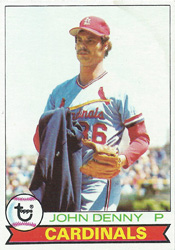
Trying to rebuild his career after being sidelined all of 1991 and most of 1992 because of reconstructive surgery on his left elbow, Magrane returned to the Cardinals’ starting rotation in 1993. He was 1-2 in April and 1-3 in May before posting a 5-1 record and 2.47 ERA in June.

Magrane, however, slumped in July (1-3, 11.50 ERA) and was moved to the bullpen. In two August relief stints, he was 0-1 with a 21.60 ERA.

“Once he went to the bullpen, he didn’t really fit into what we’re doing,” Cardinals manager Joe Torre told the St. Louis Post-Dispatch.

Right stuff

Magrane was a first-round choice of the Cardinals in the 1985 amateur draft. Looking back on how that happened, Cardinals scouting director Fred McAlister told Cardinals Yearbook in 1988, “(Scout) Marty Keough liked him more than I did, and we really were all set to take a catcher named Trey McCall, but the Phillies picked him … The next name on our list was Magrane … If Keough hadn’t sold me on him, I would not have taken him, but I’m glad we’ve got him.”

Magrane made his major-league debut with St. Louis in 1987, earned nine regular-season wins and was the starting pitcher in Game 1 and Game 7 of the World Series against the Twins.

Bright and personable, Magrane, a communications major at University of Arizona, was popular with the media. “Few players combined his love of word play, his wit and his sharp bluntness _ an oxymoron he might appreciate,” Post-Dispatch columnist Tom Wheatley wrote. “His word choice was precise, as was his diction.”

Magrane wasn’t all talk either. He was the National League leader in ERA (2.18) in 1988 and he was 18-9 with a 2.91 ERA in 1989.

A damaged elbow altered his status. After sitting out the 1991 season, Magrane didn’t pitch again for the Cardinals until September 1992 when he was 1-2 with a 4.02 ERA in five starts.

Hot and cold

Magrane opened the 1993 season as part of a Cardinals starting rotation with Bob Tewksbury, Rheal Cormier, Donovan Osborne and Rene Arocha.

In his first start of the season, on April 10, 1993, at St. Louis against the Reds, Magrane pitched eight scoreless innings before he was relieved by Lee Smith in a game won by the Cardinals, 2-1, in 10 innings. Boxscore

“He was sensational,” said Torre. “… You could tell his ball was moving because the opposition was not hitting it on the good part of the bat when he got behind in the count.”

Magrane showed more signs of returning to form when he won five consecutive decisions from June 6 to June 27 in starts against the Reds, Expos, Pirates, Marlins and Mets.

His June 11 performance versus the Expos was the best. Magrane pitched 7.2 scoreless innings, limiting the Expos to two singles, before he was relieved by Paul Kilgus in a game the Cardinals won, 1-0, at St. Louis. Boxscore

The win was Magrane’s first at St. Louis since 1990. “I’m not the same pitcher I was before,” Magrane said. “I know I’m not throwing as hard and my breaking ball isn’t as good, but I have a better changeup and my location is better.”

July was a different story. Magrane pitched well in one start, against the Braves, and was knocked around in the rest. Magrane gave up 22 hits and 17 runs in seven total innings over his last three starts. “He just got into a dead-arm period,” said Cardinals pitching coach Joe Coleman. “There just wasn’t enough in there to get people out.”

Letting go

Taken out of the starting rotation, Magrane mostly sat in the bullpen and pitched poorly the two times he was used. “I don’t think they have any confidence in me to bring me into a close game,” Magrane said.

The Cardinals offered Magrane the option to go on the disabled list “because of an assortment of minor ailments,” the Post-Dispatch reported. Magrane, however, declined and said, “I thought that was a bad idea … I’ve been on the disabled list enough. My arm feels great and my elbow is a non-issue.”

Torre was torn about what to do _ “I’ve been wrestling with this thing for a while,” he said _ but recommended the Cardinals release Magrane.

“No disrespect intended, but I thought (Torre) panicked a bit,” Magrane said.

Magrane was 8-10 with a 4.97 ERA in 22 appearances for the 1993 Cardinals. He had almost as many walks (37) as strikeouts (38) in 116 innings pitched. “Magrane has Bob Tewksbury’s speed and stuff, but not the control,” Wheatley wrote. “Walks killed him. So did slipshod defense. Strapped to get three outs, he could not muster four.”

In six seasons with St. Louis, Magrane was 51-54 with a 3.34 ERA. “It was not the most successful era in Cardinals history, but it was certainly the most erudite,” Wheatley noted.

Said Magrane: “I was proud to be a St. Louis Cardinal and part of a tradition-rich ballclub. The organization has been good as far as treating you like a man and allowing you to get ready, not meddling with your affairs.”

Empty tank

On Aug. 19, 1993, four days after the Cardinals released him, Magrane signed with the Angels. Whitey Herzog, Magrane’s first manager with the Cardinals, was in the Angels’ front office as senior vice president and director of player personnel and he advocated for Magrane.

Magrane made eight starts for the 1993 Angels and was 3-2 with a 3.94 ERA. They brought him back in 1994 and he flopped (2-6, 7.30 ERA).

After spending 1995 in the minor leagues with the Ottawa Lynx, an Expos affiliate, Magrane pitched his final big-league season in 1996 with the White Sox and was 1-5 with a 6.88 ERA.

Read Full Post »

An umpire’s ruling and an official scorer’s decision prevented the Cardinals from achieving a no-hitter against the Mets.

On Aug. 12, 1978, John Denny and Roy Thomas combined to pitch a one-hitter in a 5-1 Cardinals victory over the Mets at New York.

John Stearns had the lone hit, an infield single leading off the seventh inning.

Stearns would have been out on the play, but umpire Paul Pryor said first baseman Roger Freed took his foot off the bag too soon while catching a throw from second baseman Mike Tyson.

Pryor called Stearns safe and official scorer Red Foley of the New York Daily News credited Stearns with a single. If Stearns was safe because of Freed’s misstep, the play should have been scored an error, not a hit, the Cardinals argued.

Pitching and fielding

The game matched starting pitchers John Denny of the Cardinals against Kevin Kobel of the Mets. Denny was making his first appearance in two weeks after recovering from “a bad back, a bad left leg and a bad cold,” the St. Louis Post-Dispatch reported.

Kobel was a left-hander and Cardinals manager Ken Boyer decided to give his first baseman, left-handed batter Keith Hernandez, a break in the Saturday afternoon game. Backup first baseman Roger Freed started in place of Hernandez.

The Cardinals scored a run in the first and three in the second against Kobel. Denny limited the Mets to a walk in the first three innings.

In the bottom of the fourth, with one out, Denny walked Lee Mazzilli, who moved to second on a groundout by Willie Montanez. Stearns followed with a grounder to shortstop Garry Templeton, “who lobbed a throw to first,” according to the Post-Dispatch. The ball eluded Freed, Mazzilli scored from second and Templeton was charged with a two-base error.

Playing footsie

The Mets remained hitless entering the seventh against a tiring Denny. Boyer told the Post-Dispatch he planned to lift Denny after the inning, even if the no-hitter was intact. “After the fifth inning, I was losing it rapidly,” Denny said.

Stearns led off the Mets’ half of the seventh with a slow bouncer toward second. Tyson charged, grabbed the ball barehanded and, though off-balance. fired an accurate throw to Freed at first base.

As Stearns reached first, Pryor pointed toward the bag and the fielder, indicating Freed had pulled away too quickly after snaring Tyson’s toss.

“He pulled his foot off the base,” Pryor said to the Post-Dispatch. “Tyson made a hell of a play and, if he (Freed) had caught the ball with his foot on the bag, Stearns would have been out.”

Freed disagreed with the umpire and said, “He blew the play … We had him by a step and a half.”

Stearns and Mets first-base coach Denny Sommers said Pryor made the correct call.

Judgment call

As soon as Pryor declared Stearns safe, Foley scored the play a single.

Tyson disagreed, saying, “If he’s safe, then it’s got to be an error.”

Home plate umpire Ed Vargo told the Post-Dispatch, “It’s got to be an error.”

In Foley’s judgment, though, no error was made because the play was difficult and the fielders executed as best they could.

“It was a tough play for (Tyson) and he had to make a hell of a play just to make it close,” Foley said to the Post-Dispatch. “I’d like to give this guy a no-hitter, but I can’t.”

Denny got the next batter, Steve Henderson, to hit into a double play and Joel Youngblood grounded out to Templeton, ending the inning. Denny was done after yielding one unearned run, one disputed hit and three walks in seven innings.

The Cardinals scored another run in the eighth and Boyer put in Hernandez, who would win the first of 11 consecutive Gold Glove awards that year, as a defensive replacement for Freed. Thomas relieved Denny, allowed no hits and a walk in two innings, and closed out a 5-1 Cardinals victory.

Denny shrugged off any concern about missing a chance to be part of a no-hitter. “The idea is to win the game,” he said. Boxscore

Read Full Post »

« Newer Posts - Older Posts »