Feeds:
Posts
Comments

Archive for the ‘Pitchers’ Category

With a pitching performance as entertaining as it was admirable, Jose Oquendo impressed teammates, frustrated the Braves and earned a spot in Cardinals lore.
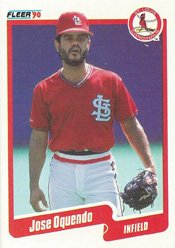
On May 14, 1988, at St. Louis, Oquendo was asked by manager Whitey Herzog to relieve in the 16th inning because no one on the pitching staff was available. Oquendo shifted from first base to the mound and shut out the Braves for three innings before yielding two runs in the 19th. Though he lost, Oquendo surprised most by doing as well as he did for as long as he did.

Another surprise was the performance of Jose DeLeon, a Cardinals pitcher who played the outfield in the final four innings.

Limited options

The Saturday night game matched starting pitchers Cris Carpenter, making his major-league debut for the Cardinals, against Zane Smith. The Cardinals led, 5-4, before the Braves tied the score with a run in the seventh.

Oquendo, a utility player, entered the game in the ninth as a replacement for first baseman and ex-Brave Bob Horner. In the bottom half of the inning, Oquendo and Tony Pena were on base, with one out, when Vince Coleman hit a grounder past pitcher Jose Alvarez. Second baseman Ron Gant dived, stopped the ball and started a double play, sending the game into extra innings.

In the 12th, former Cardinals catcher Ted Simmons led off for the Braves. Facing his friend, Bob Forsch, Simmons pulled a pitch hard on the ground. Oquendo ranged to his right, snagged the ball and threw to Forsch, covering first, in time to nip Simmons.

In the 15th, Herzog brought in his last available pitcher, Randy O’Neal, whom the Cardinals acquired from the Braves the year before. O’Neal had experience as a starter and Herzog figured to let him finish the game, no matter how many innings it took.

However, after retiring the Braves in order in the 15th, O’Neal said his arm hurt. Herzog had used all his pitchers except three: DeLeon, Larry McWilliams and John Tudor. All were deemed unavailable. DeLeon had pitched 8.2 innings the previous night, McWilliams was scheduled to start the next game and had been sent home by Herzog in the 10th inning, and Tudor had a tender shoulder.

Herzog turned to Oquendo, who’d made one big-league pitching appearance, a 1987 mop-up role during a blowout loss to the Phillies.

Serious business

Selecting Oquendo to pitch, Herzog needed someone to play first base. He moved Duane Walker from left field to first and brought in DeLeon to play left.

DeLeon hadn’t played a position other than pitcher since entering the big leagues in 1983. Asked how Herzog broke the news to him, DeLeon told the St. Louis Post-Dispatch, “He said, ‘Can you play outfield?’ I said, ‘Sure.’ I didn’t mind.”

Herzog approached umpire Bob Davidson to inform him of the lineup switches. Recalled Davidson: “Whitey said he was bringing in Oquendo to pitch and he said, ‘Can I forfeit?’ ”

When catcher Steve Lake went to the mound to review the pitch signals, Oquendo told him he had three pitches: fastball, slider and split-finger. “I started chuckling,” Lake said. “Then I see that he’s dead serious.”

Ken Griffey Sr. led off the 16th against Oquendo and doubled. After Gerald Perry was walked intentionally, Ozzie Virgil Jr. hit a single to right. In a decision the Atlanta Constitution described as “a blunder,” third-base coach Willie Stargell sent Griffey to the plate, where Lake awaited with the ball after fielding a strong peg from right fielder Tom Brunansky. Griffey was out by 10 feet.

“I’ve got to thank Stargell because he didn’t hold the guy (at third),” Herzog said. “The game should have been over then.”

Mix and match

As the game moved along through the 17th and 18th, Herzog continually shifted DeLeon and Brunansky in an effort “to put DeLeon where the batter was least likely to hit the pitch,” according to the Constitution. DeLeon and Brunansky switched spots in right field and left field 11 times.

DeLeon had two fly balls hit to him and he caught both. “I was a little nervous,” DeLeon said. “My knees were shaking.”

In the 18th, with Cardinals runners on first and third, none out, Lake grounded out to third. After Luis Alicea walked, loading the bases, Walker hit a broken-bat liner that was caught by shortstop Andres Thomas and resulted in a double play when Brunansky was unable to get back to the bag at third.

“I didn’t get the job done,” said Walker. “All I had to do was hit a fly ball to end the game.”

Said Herzog: “We should have won in the 18th.”

The Cardinals stranded 21 on base in the game.

Staying alive

In the 19th, Griffey hit a two-run double against Oquendo with two outs. Rick Mahler retired the Cardinals in order in the bottom half, completing eight scoreless innings of relief and sealing a 7-5 Braves victory. Mahler “pitched the best he has in three years,” said Braves manager Chuck Tanner.

Oquendo finished with a pitching line of four innings, four hits, two runs, six walks and one strikeout. “He threw a lot of sliders and a lot of split-fingers,” said Lake. “I never knew where his fastball was going. I didn’t know if he was going to drop down (sidearm) or throw overhand.”

Oquendo became the first non-pitcher to receive a decision since outfielder Rocky Colavito won a relief stint for the Yankees against the Tigers in 1968.

“I’m glad I got a chance to pitch and I’m glad nobody got hurt,” Oquendo said.

Said Braves slugger Dale Murphy, who was hitless in seven at-bats: “It wouldn’t have looked very good if we had lost. It didn’t look too good anyway, but we won.” Boxscore

Herzog said utility player Tom Lawless would have relieved Oquendo if the game had gone to a 20th inning. “That would have been brutal,” said Lawless. “I’d already thrown batting practice.”

Read Full Post »

Sons of Polish fathers, Stan Musial and Moe Drabowsky reached the major leagues, played central roles in a baseball milestone and honored their heritages by helping others learn the game they loved.

On May 13, 1958, Musial got his 3,000th career hit, a double against Drabowsky at Wrigley Field in Chicago. The feat forever linked Drabowsky with Musial.
The relationship didn’t end there. In September 1987, Musial and Drabowsky went to Poland together to instruct men and women in their fathers’ homeland how to play baseball.

Land of opportunity

Miroslav Drabowski, later known as Moe Drabowsky, was born on July 21, 1935, in Ozanna, Poland. His father was Polish and his mother was American. In 1938, when Miroslav was 3, the family moved to the United States and settled in Connecticut.

In America, Miroslav took the name of Myron Walter Drabowski, though nearly everyone called him Moe. He was a natural as a baseball player. In school, his name often was misspelled as Drabowsky and he stuck with that, according to a biography by the Society for American Baseball Research.

After earning an economics degree from Trinity College in Connecticut, Drabowsky signed with the Cubs and made his big-league debut with them in 1956.

Musial, whose father immigrated to the United States from Poland in 1910, entered the 1958 season needing 43 hits to become the eighth player to reach 3,000. On May 12, against the Cubs at Wrigley Field, Musial got his 2,999th hit and indicated he’d prefer to achieve No. 3,000 before the fans in St. Louis.

Work day

Cardinals manager Fred Hutchinson told Musial to sit out the May 13 game at Chicago and prepare to return to the lineup May 14 against the Giants at St. Louis. Musial went to the bullpen along the right-field line at Wrigley Field and watched the game.

In the sixth inning, with the Cubs ahead, 3-1, Gene Green led off for the Cardinals and doubled. Hal Smith was up next, with pitcher Sam Jones on deck. As Smith batted, Hutchinson motioned for Musial. After Smith grounded out, Musial walked from the bullpen to the dugout, picked out a bat and went to the plate to hit for Jones. The Tuesday afternoon crowd of 5,692 cheered in approval.

Drabowsky, 22, was glad Cubs manager Bob Scheffing showed confidence in letting him pitch to Musial. Drabowsky won 13 for the Cubs in 1957 and was considered one of their best pitchers in 1958.

“I thought, ‘Here’s a guy who deserves No. 3,000.’ A nice guy,” Drabowsky told David Condon of the Chicago Tribune. “Then I remembered our 3-1 lead and that I was trying to preserve a victory. So I told myself, ‘Sure, he’s a nice guy, but he’ll have to earn No. 3,000.’ So I bore down.”

Hugs and kisses

Working methodically, Drabowsky alternated curves and fastballs. Musial fouled off three pitches to left and watched two others go wide of the strike zone.

With the count at 2-and-2, Drabowsky threw a curve. “Outside corner, higher than intended,” Drabowsky said.

In his book “Stan Musial: The Man’s Own Story,” Musial said, “I picked up the spin of the pitch, strode into the ball and drove it on a deep line into left field. I knew as soon as it left my bat that it would go between the left fielder, Walt Moryn, and the foul line.”

Musial’s No. 3,000 was a run-scoring double. “I don’t mind him getting 3,000 off me,” Drabowsky said, “but when I had two strikes, I thought I had him _ not for a strikeout, but I figured he’d hit it in the ground.” Video

As Hutchinson ran onto the field to congratulate Musial, he was followed by a pack of photographers. Umpire Frank Dascoli retrieved the ball and handed it to Musial, who was lifted for a runner, pitcher Frank Barnes.

Before leaving the field, Musial went to the box seats next to the Cardinals dugout and kissed his wife, Lillian. A photographer asked, “Say, Stan, did you know that blonde?” Musial laughed and replied, “I’d better. That’s my wife.”

Sparked by Musial’s hit, the Cardinals scored three more runs against Drabowsky in the inning and won, 5-3. Boxscore

Polish pride

Musial, who retired after the 1963 season, batted .405 with two home runs, four doubles and six walks against Drabowsky in his career.

Drabowsky pitched 17 seasons in the major leagues with eight teams: Cubs (1956-60), Braves (1961), Reds (1962), Athletics (1962-65), Orioles (1966-68 and 1970), Royals (1969-70), Cardinals (1971-72) and White Sox (1972). His best years were as an Orioles reliever. In Game 1 of the 1966 World Series, Drabowsky struck out 11 Dodgers, including six in a row, and earned the win with 6.2 innings of scoreless relief. Boxscore

In two seasons with the Cardinals, Drabowsky was 7-2 with 10 saves.

In 1987, Musial and Drabowsky reconnected, going to the town of Kutno in Poland to teach baseball to men and women in the Polish Baseball Union. It was Drabowsky’s first visit to Poland since he left when he was 3.

With equipment provided by baseball commissioner Peter Ueberroth, Musial and Drabowsky gave out enough bats, balls, gloves and catchers’ gear to supply 12 men’s teams and six women’s teams, according to the Chicago Tribune.

“We’re here to help get them going and maybe we can invite some of their coaches to the U.S. next year to see how we train so they can come home and teach the kids more,” said Musial.

The effort by Musial and Drabowsky led to Kutno, Poland, becoming home to the Little League Baseball European Leadership Training Center.

Read Full Post »

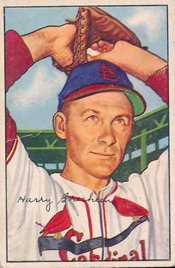
Harry Brecheen came close to being perfect for the Cardinals.

Brecheen began the 1948 season with three consecutive shutouts, including a one-hitter.

A left-hander, Brecheen followed consecutive shutouts versus the Cubs with a nearly perfect game against the Phillies. His scoreless streak reached 32 innings before the Pirates broke through with a run in the sixth inning of Brecheen’s fourth start of the season.

Hot start

Brecheen, 33, made his first start of 1948 on April 23 against the Cubs at Chicago. He yielded nine hits and a walk, but the Cubs stranded nine and the Cardinals won, 1-0. Boxscore

A week later, on May 1, Breechen got his second start, against the Cubs at St. Louis, and again held them scoreless. The Cubs got six hits and a walk, stranded seven and the Cardinals won, 4-0. Boxscore

Facing the Phillies in his third start on May 8 at St. Louis, Brecheen was extra sharp. Using a mix of screwballs, curves and fastballs, he retired the first 20 batters in a row.

With two outs in the seventh, rookie Johnny Blatnik, starting in place of slumping left fielder Harry Walker, was the batter. Brecheen got ahead on the count, 0-and-2, and decided to waste a pitch.

“I threw one in there high, above his head,” Breechen told The Sporting News.

Decisive call

Blatnik, a right-handed batter, swung at the ball and hit “a high, slow bouncer” along the third-base line, the St. Louis Post-Dispatch reported.

Third baseman Whitey Kurowski fielded the ball on the foul line and fired across the diamond to first baseman Nippy Jones. “I thought I made a good throw,” Kurowski said.

First-base umpire Babe Pinelli called Blatnik safe, an infield single that ended Brecheen’s bid to pitch the first perfect game in the big leagues since Charlie Robertson of the White Sox did it against the Tigers in 1922.

“I was aware Brecheen was pitching a perfect, no-hit game when that play came up, but if I had to call it again, it would be the same,” said Pinelli. “Blatnik was safe at first. There was no doubt about that in my mind when I called the play.”

Difference of opinions

Though the Cardinals didn’t challenge the call on the field, they were united in their belief Blatnik was out.

_ Harry Breechen: “I thought Blatnik was out at first, but, of course, I’m prejudiced.”

_ Whitey Kurowski: “From where I was standing, my throw appeared to have beaten Blatnik by a good margin.”

_ Nippy Jones: “I felt the ball hit my mitt while the base runner was still in the air. I was surprised when the umpire called him safe. In fact, I didn’t think the play was even close.”

_ Eddie Dyer, Cardinals manager: Jones “was positive in his statement when he told me Kurowski’s throw had the runner by a good half-step.”

_ Red Schoendienst, Cardinals second baseman: “I was satisfied the base runner was out.”

Throwing strikes

Blatnik was the only Phillies batter to reach base. Breechen retired the last seven in a row and the Cardinals won, 5-0. Boxscore

Brecheen exhibited pinpoint control. Richie Ashburn was the only Phillies batter who worked a count to 3-and-2, and he struck out.

After the game, Pinelli met Brecheen in a runway leading from the Cardinals’ dugout to the locker room and consoled the pitcher on missing out on a perfect performance, according to The Sporting News.

A week later, on May 15 at St. Louis, Brecheen made his fourth start, against the Pirates, and held them scoreless until, with two outs in the sixth, Frankie Gustine singled and scored on Johnny Hopp’s triple. Brecheen pitched a complete game and got the win in an 8-3 Cardinals victory.

Brecheen finished the 1948 season with a 20-7 record and led the National League in ERA (2.24), shutouts (seven) and strikeouts (149).

Read Full Post »

(Updated Nov. 25, 2024)

When the Cardinals saw Dizzy Dean for the first time in the 1938 regular season, he looked a lot different to them. He was wearing the uniform of the Cubs instead of the Cardinals, he was throwing sidearm instead of overhand, and his pitches were slow instead of fast.

What remained familiar, however, was his result.
On April 24, 1938, in his first appearance at Chicago’s Wrigley Field as a member of the Cubs, Dean faced the team that traded him and pitched a shutout against the Cardinals.

Relying exclusively on off-speed pitches, or, “his dipsy-do stuff,” as the Chicago Tribune described it, because of a damaged right arm, Dean limited the Cardinals to four hits and two walks in a 5-0 Cubs victory. Dean also produced a single and scored twice.

Pitching on a Sunday afternoon before 34,520 spectators, including Cardinals owner Sam Breadon, Dean “caused clouds of gloom to gather over the Cardinals” with his performance, the St. Louis Star-Times reported.

Slow and steady

With an intimidating fastball, Dean was the ace of the Cardinals’ Gashouse Gang teams of the 1930s, leading National League pitchers in strikeouts four years in a row (1932-35) and posting win totals of 30 (1934), 28 (1935) and 24 (1936) in his peak seasons.

His career skidded off course in 1937, however, when he suffered a toe injury in the All-Star Game. Rushed back into the Cardinals’ lineup before the injury healed, Dean altered his delivery to compensate for pain in his toe and damaged his arm.

The Cardinals traded him to the Cubs on April 16, 1938, three days before the season opened. On April 20, Dean made his first regular-season appearance for the Cubs, starting against the Reds at Cincinnati, and got the win, yielding two runs over six innings in a 10-4 Chicago victory.

Before his second start, against the Cardinals, Dean and catcher Gabby Hartnett devised a plan for how to pitch to them. “Gabby knows them better than I do,” Dean told United Press. “All I had to do was put the ball where he said.”

Throwing sidearm, Dean “mixed a fast curve with a slow curve and a fadeaway knuckler curve that threw the Cardinals’ batters off stride,” home plate umpire Larry Goetz told the Star-Times.

Dean threw 92 pitches and, because “he didn’t have a fastball,” relied on “changing pace on a half-speed delivery,” The Sporting News reported.

The Cardinals “dug in at the plate and swung from their heels,” according to the St. Louis Post-Dispatch. “In so doing, they helped to beat themselves.”

Said Cardinals manager Frankie Frisch: “We were too eager. We swung too hard.”

Right stuff

The Cardinals’ hits were a pair of doubles by Terry Moore and a single each by Enos Slaughter and pitcher Max Macon.

Twice, the Cardinals had two runners on the bases, but Dean escaped unscathed.

In the second inning, with Johnny Mize on third, Moore on second and two outs, Dean got Mickey Owen to fly out to left on a 3-and-2 pitch.

In the sixth, Dean retired the first two batters before Slaughter singled and Pepper Martin walked. With Mize, a power threat, at the plate, Cubs manager Charlie Grimm had Charlie Root loosen in the bullpen.

Pitching knuckle-curves away from Mize, Dean worked the count to 1-and-2. His next pitch, described by the Post-Dispatch as a “firecracker curve,” was his fastest. Mize swung at it and popped out to third.

After retiring Mize for the last out in the ninth, Dean was swarmed by teammates. “They whacked him on the back, shook his hands and jostled him into a daze,” the Tribune reported. Hartnett and shortstop Tony Lazzeri wanted to lift Dean onto their shoulders and carry him off the field, the Star-Times observed, but Dean shook them off. Boxscore

Smart guy

Dean finished his gem in one hour, 38 minutes.

“One of the smartest pitched games I have ever seen,” said Goetz. “His control was his best asset.”

When the final was posted on the scoreboard at Sportsman’s Park in St. Louis, where 11,041 had gathered to watch the Browns play the White Sox, the crowd roared its approval in support of Dean.

Surrounded by reporters and photographers in the Wrigley Field locker room, Dean said, “I’m sure glad to get over that one. That was the game I was really worried about.”

About 5,000 fans waited in a runway outside the clubhouse to applaud Dean. “Police had to be summoned to make a path for the great man to leave the park,” the Post-Dispatch reported.

Though Dean said his arm was fine, it wasn’t. He didn’t pitch from May 4 through July 16 because of arm soreness. When he did pitch, he was effective. Dean produced a 7-1 record and 1.81 ERA in 13 appearances for the 1938 Cubs, who won the National League pennant. He started Game 2 of the World Series against the Yankees, but was the losing pitcher.

Dean, who pitched for the Cubs from 1938-41, went on to make eight career appearances against the Cardinals, but the shutout he pitched was his only win against them. Dean’s career record versus the Cardinals: 1-4 with a 5.58 ERA.

Though Dean’s pitching skills diminished while with the Cubs, his competitiveness never waned.

In the Book “Voices From Cooperstown,” Cubs second baseman Billy Herman told of the time during spring training with the Cubs when Dean used “sleight of hand” with two coins to win several bottles of rare whiskey in a bar bet.

“He kept one bottle and gave the rest away,” Herman said. “He never even wanted them. He just wanted to win. That was Diz. Cheat you on the golf course, tee them up in the rough, he’d do anything in the world _ just to win. He’d cheat you out of 50 cents in a card game and then take you out and spend $100 on you. Didn’t care about money _ he just wanted to win.”

Read Full Post »

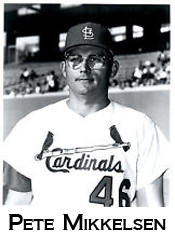
Pete Mikkelsen pitched against the Cardinals in a World Series and, four years later, helped them return to another while revitalizing his career.

On April 22, 1968, in a trade involving four pitchers, the Cubs sent Mikkelsen and Dave Dowling to the Cardinals for Jack Lamabe and Ron Piche.

Mikkelsen, who was a rookie for the Yankees in 1964 when they played the Cardinals in the World Series, appeared in five games for the 1968 Cardinals, who won the National League pennant and advanced to the World Series against the Tigers.

Though Mikkelsen spent most of the 1968 season with the Cardinals’ minor-league Tulsa Oilers affiliate, it turned around his career. Placed in the starting rotation by Tulsa manager Warren Spahn, Mikkelsen developed an effective palmball, a pitch that helped him return to the major leagues in 1969 with the Dodgers and launched him into a successful rebirth as a reliever.

Turnaround in Tulsa

After posting a 7-4 record with 12 saves for the American League champion Yankees in 1964, Mikkelsen appeared in four games for them against the Cardinals in the World Series. He was the losing pitcher in Game 5, yielding a three-run home run to Tim McCarver in the 10th inning. Boxscore

Traded by the Yankees to the Pirates for pitcher Bob Friend in December 1965, Mikkelsen, a right-hander, made 71 appearances for Pittsburgh in 1966 and was 9-8 with 14 saves. In May 1967, Mikkelsen injured his back in a car accident, lost his effectiveness and was claimed on waivers by the Cubs in August.

Mikkelsen opened the 1968 season as a Cubs reliever, but allowed home runs in each of his first three appearances and fell out of favor with manager Leo Durocher.

When the Cardinals acquired him, they assigned Mikkelsen, 28, to Tulsa. On May 5, he made his first start in three years and pitched a five-hit shutout. After posting a 6-2 record and 1.36 ERA for Tulsa, Mikkelsen was promoted to the Cardinals on June 10, 1968.

Short stay

The Cardinals wanted Mikkelsen for their bullpen. He made his Cardinals debut on June 12, 1968, against the Braves in Atlanta and pitched 1.2 scoreless innings in relief of starter Nelson Briles. Boxscore

Mikkelsen’s most impressive outing for the Cardinals came on June 23, 1968, in the first game of a doubleheader against the Braves at St. Louis. Briles started, faced five batters and was lifted without recording an out. Mikkelsen relieved and pitched eight innings, allowing one unearned run and three hits. He also committed two errors. “The fans cheered derisively for Mikkelsen when he fielded a ball cleanly,” the Post-Dispatch reported. Said Mikkelsen: “I never had been cheered by so many people just for making a catch.” Boxscore

When pitcher Dick Hughes came off the disabled list on June 30, the Cardinals returned Mikkelsen to Tulsa, even though he’d yielded only two earned runs in 16 innings (1.12 ERA).

Championship caliber

Back with the Oilers, Mikkelsen was returned to the starting rotation by Spahn. Using the palmball, Mikkelsen pitched like an ace. “I do not have the greatest fastball and I do not have the great curve,” Mikkelsen told the Los Angeles Times. “I have to have something different … My palmball really started doing things.”

Mikkelsen finished with a 16-4 record and 1.91 ERA for Tulsa. He had three shutouts among his 12 complete games. Tulsa won the Pacific Coast League title and Spahn credited Mikkelsen and outfielder Gary Geiger for supplying leadership, The Sporting News reported.

“Mikkelsen has certainly earned another major-league opportunity,” Spahn said.

In October 1968, the Cardinals traded Mikkelsen to the Dodgers for pitcher Jim Ellis. Two Dodgers right-handed relievers, Mudcat Grant and Jack Billingham, were taken by the Expos in the expansion draft and Mikkelsen was acquired to help fill those gaps.

“God didn’t mean for me to be a star,” Mikkelsen said. “I guess He just meant for me to pitch. I am resigned to that fact now. I thought it wasn’t so a few years ago.”

Mikkelsen spent four years (1969-72) with the Dodgers and was 24-17 with 20 saves. In nine big-league seasons, Mikkelsen was 45-40 with 48 saves.

Read Full Post »

Desperate for pitching, the 1943 Athletics turned to Carl Scheib, a 16-year-old with a strong arm. Eleven years later, the 1954 Cardinals, desperate for pitching, took a chance on Scheib, a 27-year-old with a damaged arm.

Scheib finished his major-league career with the Cardinals after a brief, unsuccessful stint with them.

The Cardinals’ pitching in 1954 was so bad they were willing to try just about anything to give the staff a boost. On May 7, 1954, in a creative cash transaction, the Cardinals acquired Scheib from the Athletics on a conditional basis. The Cardinals agreed to give Scheib a look in exchange for a small amount of cash to the Athletics. If the Cardinals kept Scheib for 30 days, they would increase the amount of compensation to the Athletics.

Teen-age wasteland

Scheib, born Jan. 1, 1927, became the youngest player to appear in an American League game when he debuted with the Athletics in the ninth inning of the second game of a doubleheader against the Yankees on Sept. 6, 1943. Boxscore

The 1943 Athletics had the worst pitching staff (4.05 ERA) in the league and the team, managed by Connie Mack, finished in last place at 49-105.

A year later, on June 10, 1944, Joe Nuxhall, 15, became the youngest player to appear in a major-league game when he debuted with the Reds in the ninth inning against the Cardinals.

Scheib pitched for the Athletics from 1943-45 and from 1947-54. His best season was 1948 when he had a 14-8 record and 3.94 ERA with 15 complete games. He also experienced two particularly dreadful seasons in 1950 (3-10 record, 7.22 ERA) and 1951 (1-12, 4.47).

Bargain shopping

When Scheib got to spring training in 1954, it was evident to the Athletics he was experiencing weakness in his right shoulder, according to a biography by the Society for American Baseball Research. After making his final spring training appearance, Scheib didn’t appear in another game for more than a month until given a regular-season start against the White Sox on May 3, 1954. Scheib yielded five runs in two innings and took the loss. Boxscore

Four days later, on May 7, 1954, the Cardinals made the conditional deal to land Scheib.

Cardinals pitchers gave up 34 runs in their last three games prior to acquiring Scheib. The staff would finish the 1954 season with a 4.50 ERA. Their relievers formed the worst bullpen in franchise history.

Cardinals manager Eddie Stanky said Scheib was “the best we could do because we couldn’t get a big-name pitcher without giving up too much playing strength in return.”

Two days after the deal was made, Scheib reported to the Cardinals in Cincinnati and threw pitches to coach Johnny Riddle while Stanky watched. Scheib “showed speed, a sweeping curve and promising knuckler,” the St. Louis Post-Dispatch reported.

Said Reds manager Birdie Tebbetts, a former American League catcher who had faced Scheib often: “Don’t worry about his record. He was with a poor ball club over there. If waivers had been asked on him, I’d have claimed him.”

Short stay

Scheib made his first Cardinals appearance in a start against the Phillies in the second game of a doubleheader on May 16, 1954, at Philadelphia. He struck out the first two batters, but gave up five runs, including back-to-back home runs by Johnny Wyrostek and Del Ennis, in two innings and was the losing pitcher. Boxscore

Cardinals general manager Dick Meyer said catcher Del Rice “didn’t think Scheib was as bad as those five early runs would indicate.”

Scheib was used twice in relief by the Cardinals, pitching two scoreless innings against the Reds on May 22 and yielding a home run to Cubs catcher Joe Garagiola in a stint that lasted two-thirds of an inning on May 24.

By then, the Cardinals decided Scheib wasn’t effective enough to pay additional compensation to the Athletics. On May 27, they returned Scheib to the Athletics. Two days later, the Athletics asked waivers on Scheib for the purpose of giving him an unconditional release.

Unclaimed and free to make his own deal, Scheib signed with the Portland Beavers of the Pacific Coast League. He spent two years (1954-55) with Portland and two more (1956-57) with the San Antonio Missions, managed by future Cardinals coach Joe Schultz, of the Texas League before ending his playing career.

Read Full Post »

« Newer Posts - Older Posts »