Feeds:
Posts
Comments

Archive for the ‘Pitchers’ Category

Andy Benes left the Cardinals and went to the Diamondbacks because he, his agent and general manager Walt Jocketty couldn’t follow baseball rules.
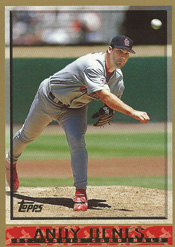
On Feb. 3, 1998, Benes, a starting pitcher, signed a three-year contract worth $18 million to play for the Diamondbacks, who joined the National League as an expansion team that season.

Benes had reached an agreement to stay with the Cardinals, but the deal came together after expiration of a deadline mandated by the baseball owners’ Player Relations Committee.

Instead of getting the Cardinals’ offer of a five-year contract worth $32.5 million, Benes settled for less with the Diamondbacks.

Deadline pressure

Benes joined the Cardinals as a free agent after the 1995 season. He was 18-10 with a 3.83 ERA in 1996 and 10-7 with a 3.10 ERA in 1997 before becoming a free agent.

The Cardinals wanted to re-sign him and Benes indicated he wanted to remain in St. Louis, but negotiations stalled.

Because the Cardinals hadn’t offered Benes salary arbitration, baseball rules established by the Player Relations Committee dictated he and the club had to reach a contract agreement by midnight on Dec. 7, 1997, or else Benes would not be eligible to re-sign with the Cardinals until May 1, 1998.

Benes didn’t want to wait until May to sign a contract, so it became imperative he and the Cardinals reach an agreement by the Dec. 7 deadline if he was to stay in St. Louis.

Breaking the rule

Jocketty and Benes’ agent, Scott Boras, went down to the wire in the negotiations. When it became apparent they needed more time, they asked Major League Baseball officials for an extension and were granted an additional 30 minutes to get a deal done.

The deadline extension passed without an agreement being reached. About two hours later, the sides settled on the five-year, $32.5 million contract.

The Player Relations Committee, however, ruled the agreement invalid because it hadn’t been reached in the allotted time.

Benes and the Cardinals initially appealed the ruling, but dropped the matter when it became clear baseball officials wouldn’t budge.

Bernie Miklasz, columnist for the St. Louis Post-Dispatch, questioned why the agreement wasn’t approved. “The bureaucrats who run baseball are poised to kill the deal and all of this good faith because of some arcane rule? Absurd,” Miklasz wrote.

Go west

With the Cardinals out of the picture, Benes and Boras negotiated with the Cubs, Mets and Indians, but got no offers, in part, because Boras wanted a contract clause that would allow Benes the option to leave his next team after one season.

With little bargaining leverage remaining, Benes agreed to the three-year offer from the Diamondbacks that gave him the option to depart after two seasons.

Though he could have waited until May and signed with the Cardinals, Benes feared he could suffer an injury during the wait and ruin any chance for a contract offer, so he opted to sign the guaranteed contract from the Diamondbacks.

“We made a very substantial offer, which unfortunately wasn’t able to get completed on time,” Jocketty said. “We can’t look back.”

Said Benes: “I was disappointed with the way things didn’t work out in St. Louis, but things sometimes don’t work out for a reason. Maybe (Arizona) is the place I was supposed to be after all.”

Post-Dispatch columnist Dan O’Neill described Benes’ departure as “a messy tale of a ballplayer burned by the system, a victim of bad timing, a casualty of miscommunication and red tape.”

In two seasons with the Diamondbacks, Benes was 14-13 with a 3.97 ERA in 1998 and 13-12 with a 4.81 ERA in 1999. After that, he exercised his option, departed and rejoined the Cardinals, playing his final three big-league seasons (2000-2002) with St. Louis.
Read Full Post »

(Updated Feb. 14, 2019)

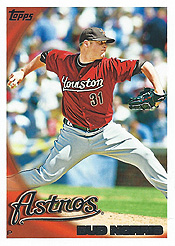
In his first major-league start, Bud Norris pitched against the Cardinals with the poise and skill of an established winner.

On Aug. 2, 2009, Norris, appearing in his second big-league game, started for the Astros at St. Louis, held the Cardinals to two hits in seven innings and earned the win.
Nine years later, on Feb. 14, 2018, Norris, a free agent, joined the Cardinals, signing a one-year contract for a base salary of $3 million after earning 19 saves for the 2017 Angels.

“I’m honored to be here,” Norris said to the St. Louis Post-Dispatch. “This is a world-class organization.”

With Luke Gregerson the projected closer, the Cardinals viewed Norris as a candidate for any number of roles, including starting. Though he succeeded as a reliever with the 2017 Angels, Norris told the Post-Dispatch he was excited about possibly having a chance to start for the Cardinals. “In my heart of hearts, I believe I can do that,” Norris said.

This Bud’s for you

David Norris, nicknamed “Bud” because at age 3 he imitated his father and ordered a beer in a restaurant, was selected by the Astros in the sixth round of the 2006 amateur draft.

After making his major-league debut in relief against the Cubs on July 29, 2009, Norris, 24, got the start four days later at Busch Stadium when Astros ace Roy Oswalt became sidelined with a bad back.

Norris, a right-hander, held the Cardinals hitless the first five innings.

In the sixth, the Cardinals appeared poised to strike when Adam Wainwright led off with a single and, one out later, Colby Rasmus walked. Norris got out of the jam by inducing Albert Pujols to pop out to third and striking out Matt Holliday.

“He kept his composure,” Wainwright said.

In the seventh, the Cardinals threatened again. With one out, Mark DeRosa walked and Yadier Molina singled, but Norris struck out Julio Lugo and Joe Thurston.

The Astros prevailed, 2-0. “I told him he had 299 (wins) more to go and he’d be in the Hall of Fame,” Oswalt said. Boxscore

Purpose pitches

Norris was 7-2 with a 2.17 ERA in his first 11 career appearances versus the Cardinals. Pujols took to calling him “Chuck Norris,” in reference to the tough-guy actor, Rick Hummel of the Post-Dispatch reported.

By the time Norris joined the Cardinals, his career mark against them was 8-7, but he maintained the reputation as a nemesis.

Perhaps Norris’ best outing came on June 8, 2011, when he limited the Cardinals to one hit in eight innings in a 4-1 Astros victory at Houston.

“Every pitch he threw had a purpose,” said Cardinals leadoff batter Ryan Theriot.

Wrote Post-Dispatch columnist Bernie Miklasz: “The Cardinals turn Norris into Bob Gibson, circa 1968.”

The lone hit allowed by Norris was a solo home run to former teammate Lance Berkman with two outs in the seventh. Noting how Norris effectively mixed sliders and changeups with fastballs, Berkman said, “He’s got a better feel for his off-speed stuff.” Boxscore

Norris had his best season as a starter (15-8, 3.65 ERA) with the 2014 Orioles.

In 2018, Gregerson was injured and Norris stepped into the role of closer. Norris led the Cardinals in saves (28) and posted a 3-6 record and 3.59 ERA in 64 relief appearances. In July 2018, a report by The Athletic indicated tensions had developed between Norris and rookie reliever Jordan Hicks, but Hicks told the Post-Dispatch that Norris “has the best intentions for me.”

Read Full Post »

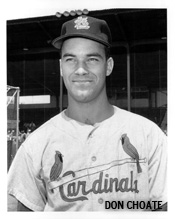
Along with Bob Gibson and Ray Sadecki, Don Choate was a prized pitching prospect who was projected to be in the Cardinals’ plans entering the decade of the 1960s, but he never got the chance to play for them in the regular season.

Instead, Choate went to the Giants in the trade that brought Bill White to the Cardinals.
Choate, a right-hander, reached the major leagues with the Giants in 1960.

A native of Potosi, Mo., Choate grew up in East St. Louis, Ill. He signed with the Cardinals in 1956, the year he turned 18, and made his pro debut that season with their minor-league club in Peoria, Ill. In February 1957, Cardinals general manager Frank Lane cited Choate as one of the “talented kids from the St. Louis area in the Cardinals organization,” The Sporting News reported.

Assigned to the Billings, Mont., team in the Cardinals’ farm system, Choate had a breakout season in 1957, posting a 19-8 record. At 19, he pitched 20 complete games and 240 innings. On successive days, Aug. 30-31, Choate pitched shutouts against Salt Lake City. He pitched a one-hitter in a 5-0 victory cut to five innings because of rain, and came back the next night with a three-hitter in another 5-0 triumph in the seven-inning opener of a doubleheader.

Choate pitched in spring training exhibition games for the Cardinals in 1958 and was touted by The Sporting News as an “impressive” prospect. He split the 1958 season between Cardinals farm clubs in Omaha and Houston. When Choate retired 19 consecutive batters in a game against Denver, The Sporting News reported he “scintillated on the mound.”

After producing a combined record of 12-11 in 34 games for Omaha and Houston in 1958, Choate played winter ball for the Licey team in the Dominican Republic. He won his first six decisions and had a 1.54 ERA. Choate “has developed into the Dominican loop’s leading hurler,” The Sporting News reported. Cardinals assistant farm director George Silvey said Choate “is sneaky fast and his curve has been improving. He’s a pitcher, not a thrower. A definite big-league prospect.”

Cardinals manager Solly Hemus and farm director Walter Shannon went to the Dominican Republic to see the top players. Hemus filed a favorable report on Choate. As the Cardinals prepared for spring training in 1959, Choate seemed a likely candidate to earn a spot on the big-league team.

While in the Dominican Republic, Hemus and Shannon also saw Bill White, who was in the Giants’ organization, and were impressed by his power, run production and versatility at first base and in the outfield. Eddie Stanky, a Cardinals scout who managed White in the minor leagues, also recommended him.

On March 25, 1959, the Cardinals traded Choate and a starting pitcher, Sam Jones, to the Giants for White and utility player Ray Jablonski. Most analysts said the deal favored the Giants. Bob Broeg of the St. Louis Post-Dispatch predicted Choate “eventually might make the grade” as a major-league pitcher.

“There’s no doubt in my mind we’ve improved our pennant chances tremendously with Jones coming to our team,” Giants manager Bill Rigney told United Press International. Rigney added, “It was the most important pitching deal we’ve made since I’ve been manager.”

Said Bing Devine, who replaced Lane as Cardinals general manager, “We believe White will solve our outfield problem and give us the added power at the plate we have been looking for.”

White became one of the Cardinals’ best players and a premier first baseman in the National League.

Choate was assigned to the Giants’ farm club at Phoenix in 1959 and was 4-7 in 22 appearances.

In 1960, after posting a 10-15 record for Tacoma, Choate was called up to the Giants in September. He made four relief appearances, including a one-inning scoreless stint against the Cardinals at St. Louis on Sept. 17, and had a 0-0 record and 2.25 ERA.

Choate pitched one more season, 1961, with Tacoma, hurt his arm and was finished as a pro player at 23. He had a second career as a firefighter.

Read Full Post »

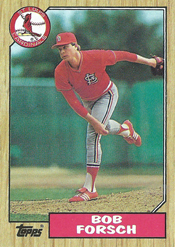
In the first eight months of 1988, Bob Forsch rejoined the Cardinals, turned in one of his best stretches as a starting pitcher and was traded when they determined he no longer fit their plans.

Forsch’s topsy-turvy 1988 was set in motion by the actions of the Cardinals in December 1987. Though Forsch tied for the team lead in wins (11) and also earned a win apiece in the National League Championship Series and World Series in 1987, the Cardinals released him in a cost-cutting move just before Christmas.

Baseball rules said a club could cut the salary of a player on the roster by no more than 20 percent, but the Cardinals wanted to reduce Forsch’s pay by more than that. By releasing him and making him a free agent, the Cardinals could re-sign him without restrictions.

The Cardinals offered Forsch a 1988 salary of $200,000, a reduction of 73 percent from the $750,000 he made in 1987, the St. Louis Post-Dispatch reported.

“I can’t think of too many players who won 11 games and they gave them a 73 percent cut,” Forsch said. “I can’t think of too many players who won 11 games and got released.”

Said Cardinals general manager Dal Maxvill: “I felt his performance last year, even though he tied for the lead in wins, was such that we didn’t feel we should pay him $750,000.”

Preferring to stay in St. Louis, Forsch, 38, negotiated a compromise. He would pitch for the 1988 Cardinals at a base salary that was 47 percent less than what he made in 1987. In January 1988, he signed a $400,000 contract with the Cardinals. The deal also gave Forsch the chance to earn more if certain incentives were met.

“I really want to stay here, but I’m not going to play very many more years and I plan to get as much money as I can before I retire,” Forsch said. “The whole Cardinals organization has been super to me, but you just get to a point where you get tired at the whole process … You get tired of hearing how old you are.”

Good enough to trade

Though he made 30 starts for them in 1987, the Cardinals projected Forsch to be a reliever in 1988. However, because injuries depleted the rotation, Forsch made 12 starts for the 1988 Cardinals, including six in August when he had a 5-1 record and a 2.25 ERA.

“Forsch’s secret has been consistency,” the Post-Dispatch reported. “He’s endured with the strength of a marathon runner, the fortitude of a mountain climber.”

Said Cardinals manager Whitey Herzog: “Just when you count the son of a buck out, he fights back. He’s something.”

By the end of August, Forsch was 9-4 with a 3.73 ERA in 30 appearances for the 1988 Cardinals. As a starter, he was 5-2 with a 2.97 ERA. Nonetheless, the Cardinals told Forsch they couldn’t commit to him being on the team in 1989.

“I know (Forsch) has pitched well, but he’s going to be 39 years old,” Maxvill said.

When Forsch signed in January, he and Maxvill had discussed the possibility of a trade late in the season, the Post-Dispatch reported.

Still wanting to pitch, Forsch said he would agree to a trade to a contender. As a player who spent five years with one team and 10 in the league, Forsch, under baseball rules, needed to approve any proposed deal involving him.

Business deal

The second-place Astros, managed by former Cardinals coach Hal Lanier, showed the most interest in Forsch. They saw him as a starter who could help them in their pursuit of the NL West-leading Dodgers.

Forsch agreed to the trade when the Astros guaranteed him a contract for 1989.

On Aug. 31, 1988, after 15 seasons with the Cardinals, Forsch was traded to the Astros for utility player Denny Walling.

“I hate leaving, but I’m going to someplace where I’m going to enjoy it,” Forsch said.

Said Forsch’s friend, Cardinals trainer Gene Gieselmann: “I was hoping he would always be a Cardinal, but baseball is a business and all of us in baseball have to look at it that way.”

Calling Forsch “a great teacher and a great person,” Maxvill told him the Cardinals would give him a job in the organization in 1989 if he was unable to pitch for the Astros. “I feel good about that,” Forsch responded.

Forsch won his first start for the 1988 Astros, shutting out the Reds for eight innings and contributing a three-run double. Boxscore  However, in six starts for them, Forsch was 1-4 with a 6.51 ERA and the Astros finished in fifth place.

In 1989, his last season in the big leagues, Forsch was 4-5 with a 5.32 ERA for the Astros.

Previously: Why Bob Forsch didn’t end his career as a Cardinal

Read Full Post »

(Updated Oct. 1, 2025)

Bob Bailey had lots of hits against the Cardinals in his career, but it was an out he made that was most memorable.

Bailey, a right-handed hitter with power, played 17 years in the major leagues. Primarily a third baseman and left fielder, Bailey played for the Pirates (1962-1966), Dodgers (1967-1968), Expos (1969-1975), Reds (1976-1977) and Red Sox (1977-1978).
In 199 games versus the Cardinals, Bailey had 176 hits, including 20 home runs, and 82 RBI. He batted .358 (24-for-67) against the Cardinals in 1964 and .339 (20-for-59) in 1974. One of his best games occurred on May 21, 1968, when he produced five RBI for the Dodgers against the Cardinals at St. Louis.

“That Bailey makes his living off high sliders,” Cardinals catcher Ted Simmons told The Sporting News.

By 1977, when Bailey was with the Reds, he primarily was a pinch-hitter. That was the year he had a feature role in a St. Louis drama.

Big Red Machine

On May 9, 1977, a game between the Reds and Cardinals at Busch Stadium was the ABC-TV “Monday Night Baseball” national telecast. The Reds, with their powerful Big Red Machine lineup, were two-time defending World Series champions. The Cardinals, in their first season under manager Vern Rapp, were looking to make a mark after finishing 18 games under .500 in 1976.

In the bottom of the eighth inning, the Cardinals’ Keith Hernandez led off with a home run against Rawly Eastwick, tying the score at 5-5.

Rapp sent Al Hrabosky to pitch the ninth. The left-hander, known as the “Mad Hungarian,” got into immediate trouble. Ken Griffey singled, Joe Morgan walked, Dan Driessen bunted for a single, loading the bases with none out. George Foster was up next and Johnny Bench was on deck _ both right-handed sluggers.

“I thought with Foster and Bench coming up, there was no way,” Hernandez said to Dick Kaegel of the St. Louis Post-Dispatch. “I thought they’d at least get a fly ball and get a run in.”

Mind games

Hrabosky, forced by Rapp to shave his Fu Manchu in compliance with the manager’s policy banning facial hair, decided to challenge the sluggers exclusively with fastballs. “They knew it was coming,” said Simmons.

Foster struck out swinging.

Bench did the same.

With a left-handed batter, Cesar Geronimo, due up next, Reds manager Sparky Anderson sent Bailey to face Hrabosky. Bailey, whose father, Paul, played in the Cardinals’ farm system in 1940, batted .370 as a Reds pinch-hitter in 1976.

When the count got to 1-and-2 on Bailey, Hrabosky walked in a semicircle from the mound almost to second base, turned his back on Bailey, talked aloud to himself, pounded the ball into his mitt and stomped back onto the hill.

“I talk to the gypsy war gods,” Hrabosky said. “I work myself into a controlled rage.”

Bailey fouled off each of Hrabosky’s next three pitches. After each one, Hrabosky went behind the mound and performed his antics, heightening the tension with each delivery. “In a way, I self-hypnotize myself,” he told the Chicago Sun-Times. “I learned how to manipulate my mind between pitches.”

On the seventh pitch of the at-bat, Bailey watched the ball go into Simmons’ glove for a called strike three.

Hrabosky gave a performance worthy of Houdini, striking out three right-handed sluggers and leaving the bases loaded.

“I was completely in awe,” said Hernandez.

Said Simmons: “It was dark and all of a sudden he groped around until he found the light switch and turned it on.”

Hrabosky told Stan McNeal of Cardinals Magazine, “After I struck out Foster … and Bench, I didn’t know if I would get a third strikeout, but I knew there was no way they were going to score.”

Perfect play

After the Cardinals went down in order in their half of the ninth, Hrabosky returned to pitch the 10th. He retired the first two batters before Ray Knight singled. Griffey followed with a double off the wall in right.

As Knight raced around the bases, right fielder Mike Anderson, inserted as a defensive replacement for starter Hector Cruz, fielded a carom off the padding of the wall, turned and fired a throw to the cutoff man, shortstop Don Kessinger.

“He gave me a good, high relay throw where I could handle it,” Kessinger said.

Simmons kneeled in front of home plate, awaiting the peg from Kessinger. “My theory is to block the plate. Don’t let him get there,” Simmons said.

Knight dived head-first and was tagged out by Simmons, ending the Reds’ threat.

“It was a perfect play,” Rapp told United Press International. “Anderson acted real cool and Kessinger did a superb job. Simmons knew he had the guy.”

Simmons connects

The Reds brought in Dale Murray, a right-hander, to pitch the bottom half of the 10th. His best pitch was a sinking fastball, but it had been staying up in the strike zone in recent outings. With switch-hitter Simmons, batting left-handed, leading off, Murray told Bench he would throw knuckleballs.

Hernandez tipped off Simmons that Murray might throw the knuckler. “The thing I try to do with knuckleballs is not swing until I have to,” Simmons told the Associated Press. “All you can hope is that you can gauge the speed of it.”

With the count 2-and-2, Murray delivered a knuckleball that darted toward Simmons’ right knee. He drove it over the wall in right for a walkoff home run, giving the Cardinals a 6-5 triumph. Boxscore

“It was the greatest game I ever played in,” Hernandez said.

Calling it “a game that wobbled the knees and blew the mind,” Kaegel informed Post-Dispatch readers, “It was a classic thriller, baseball at its spine-tingling best.”

Previously: 5 memorable Reds-Cardinals games of 1970s

Read Full Post »

(Updated Aug. 23, 2018)

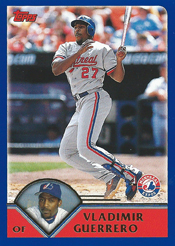
In his major-league debut for the Cardinals, Rick Ankiel gave up a home run to Vladimir Guerrero. Like many pitchers, Ankiel learned fast Guerrero was a dangerous hitter.

Guerrero was elected to the National Baseball Hall of Fame in 2018. In his playing career with the Expos (1996-2003), Angels (2004-2009), Rangers (2010) and Orioles (2011), Guerrero batted .318 with 2,590 hits, 449 home runs and 1,496 RBI.

A right-handed batter and outfielder, Guerrero batted .280 against the Cardinals with 59 hits in 55 games and 43 RBI.

His best seasons versus St. Louis were 1999 (.333 with nine RBI in nine games) and 2002 (.409 with seven RBI in six games).

Guerrero had two hits, both home runs, and three walks in seven career plate appearances against Ankiel.

Rookie mistake

Ankiel, 20, was a highly touted pitching prospect. He heightened expectations by posting a combined 13-3 record and 2.35 ERA with Class AA Arkansas and Class AAA Memphis in 1999. The Cardinals promoted him to the big leagues in late summer and he was given a start in his debut on Aug. 23, 1999, at Montreal.

In his first at-bat against Ankiel, Guerrero grounded out sharply to first baseman Mark McGwire in the second inning. With the Cardinals ahead, 4-1, Guerrero batted again in the fourth. Ankiel, a left-hander, wanted to jam Guerrero with a fastball on the fists, but the pitch stayed over the plate and Guerrero lined it over the right-field wall. The home run was his 30th of the season and extended his hitting streak to 28 games.

“I didn’t get the fastball inside,” Ankiel told columnist Bernie Miklasz of the St. Louis Post-Dispatch. “I left it out there and he capitalized on it.”

Speaking through an interpreter, Guerrero told the Associated Press, “The only thing I do is try to swing. So far, so good. I’m going to keep swinging.”

In the sixth, after Jose Vidro singled, Cardinals manager Tony La Russa lifted Ankiel with Guerrero at the plate and St. Louis ahead, 4-2. “Guerrero already had centered two balls off him, so I thought it was time for the change,” La Russa said.

Heathcliff Slocumb relieved and got Guerrero to pop out to McGwire. After that, the game unraveled for the Cardinals. Vidro eventually scored and Slocumb and Rich Croushore gave up eight runs. The Expos won, 11-7, and Ankiel, who departed with the lead, didn’t get a decision. Boxscore

Hitting a hanger

A year later, on Aug. 1, 2000, at Montreal, Guerrero came to bat against Ankiel with runners on first and second, two outs, in the fifth inning of a scoreless game.

Ankiel’s first pitch to Guerrero was a curve. He “tried to throw the best curveball he ever threw,” La Russa said. “Sometimes you try to do more and you end up doing less.”

The pitch floated over the middle of the plate and Guerrero hit it over the wall in left-center for a three-run home run. The Expos went on to win, 4-0.

Said Ankiel: “I hung it … With him up to bat, you can’t hang that pitch in that situation.” Boxscore

Pals with Pujols

Guerrero, 6 feet 3 and 235 pounds, hit 12 career home runs against the Cardinals. He hit three against Matt Morris, two apiece off Ankiel and Garrett Stephenson and one each against Cliff Politte, Larry Luebbers, Travis Smith, Jason Simontacchi and Woody Williams.

In 2001, when the Expos and Cardinals shared a spring training facility at Jupiter, Fla, Guerrero befriended Cardinals rookie Albert Pujols, who, like Guerrero, is a native of the Dominican Republic. Pujols, in a big-league camp for the first time, was looking to fit in. Guerrero included Pujols in friendly games of dominoes with other Dominican players and treated him to his mother’s home-cooked meals.

“Vladdy was one of the first guys I looked up to,” Pujols said to the Los Angeles Times in a 2016 interview. “People kind of misread Vladdy because he doesn’t like to talk too much, but he’s one of the best guys that I’ve ever been around. The way he treats people is really special. He’s always smiling. He played the game hard and had fun.”

Pujols was playing left field for the Cardinals in a game at Montreal when Guerrero hit a ball so hard it bent the top of the wall and carried over for a home run.

“On a line. He bent the wall,” Pujols said to Yahoo Sports in 2016. “He was unbelievable … He was a fearless hitter … You had to stop and watch him. If they were on TV and you were going out, you had to watch his at-bat first.”

Previously: How Cardinals gambled on Rick Ankiel in 1997 draft

Previously: Revisiting Rick Ankiel’s debut with Cardinals


Read Full Post »

« Newer Posts - Older Posts »