Feeds:
Posts
Comments

Archive for the ‘Pitchers’ Category

To avoid setting a major-league record for futility, Anthony Young needed to beat the Cardinals, but he couldn’t do it.
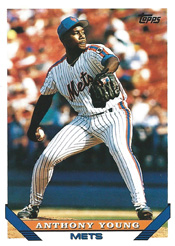
On June 27, 1993, Young was the losing pitcher for the 24th time in a row in a 5-3 Cardinals victory over the Mets at New York.

Young’s 24 consecutive losses over two seasons surpassed the big-league mark of 23 straight defeats by Cliff Curtis of the 1910-11 Braves.

Young would lose 27 decisions in a row before earning a win.

On the skids

Young was a defensive back and University of Houston football teammate of Heisman Trophy winner Andre Ware, but baseball was Young’s preferred sport and he believed it offered him his best chance for a professional career.

A right-hander, Young made his big-league debut with the 1991 Mets and finished the season at 2-5 with a 3.10 ERA.

In 1992, Young won his first two decisions, including an April 9 start against the Cardinals, before losing 14 in a row, including two to the Cardinals, and finishing with a 2-14 record and 4.17 ERA.

Young was 0-9 in 1993 _ giving him a record-tying 23 consecutive losses over two seasons _ when he entered the June 27 game against the Cardinals at Shea Stadium

Playing with fire

The Mets scored twice in the first, but the Cardinals rallied against Young with three runs in the fourth and two in the sixth. Rod Brewer contributed a two-run double for St. Louis and Brian Jordan, Tom Pagnozzi and starting pitcher Joe Magrane each had a RBI-single.

Each starter pitched seven innings: Magrane allowed 10 hits, no walks and three runs. Young yielded eight hits, two walks and five runs.

Magrane, who earned his fifth consecutive win, was relieved Young didn’t break the losing streak against him.

“I would have rather faced Doc Gooden or Bret Saberhagen,” Magrane said to the St. Louis Post-Dispatch. “I certainly didn’t want to be the answer to a trivia question. I was really scared of the game. It was like dancing on the rim of Vesuvius, waiting for it to explode. I was hoping that I wasn’t going to be the one to be torched.” Boxscore

Said Young: “It was the same old thing. I thought I pitched a pretty good game except for a couple of hits.”

Dallas Green, who was evaluating all the Mets after replacing Jeff Torborg as manager a month earlier, said Young “has a great arm … but the important things to scout are the head and the heart.”

Cardinals closer Lee Smith, expressing empathy for Young, said to the Associated Press, “I’d tell him to hang in there. I know what he’s going through. I was with the Cubs.”

Season to forget

After his loss to the Cardinals, Young lost three more in a row, stretching the streak to 27, before he earned a win on July 28 against the Marlins.

Young finished the 1993 season with a 1-16 record and a 3.77 ERA.

He spent the 1994 and 1995 seasons with the Cubs, posting an overall mark of 7-10, before completing his major-league career with a 3-3 record for the 1996 Astros.

His overall record in the majors: 15-48 with a 3.89 ERA.

Young’s career record against the Cardinals is 1-6 with a 2.86 ERA in 16 appearances, including six starts. Three of his losses during his streak of 27 were to the Cardinals.

Previously: Why 22-game loser Roger Craig appealed to Cardinals
Read Full Post »

Taking advantage of a pitching staff with the worst earned run average in the National League, the 1937 Cardinals capped a doubleheader sweep of the Phillies by scoring their most runs in an extra inning.

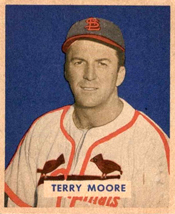
On July 16, 1937, Terry Moore hit a three-run home run to highlight an eight-run 10th inning in an 18-10 Cardinals victory. Boxscore

No Cardinals club has scored more in an extra inning, though the 2017 team came close to matching the feat.

On June 20, 2017, Yadier Molina and Tommy Pham each hit a two-run home run to highlight a seven-run 11th in an 8-1 Cardinals victory over the Phillies. Boxscore

Hitter’s haven

The 1937 Phillies had one of the worst pitching staffs all-time. The Phillies finished the season with a 5.05 team ERA, yielding 868 total runs. Only three of their pitchers posted an ERA better than 5.00: Claude Passeau (4.34), Orville Jorgens (4.41) and Bucky Walters (4.75).

Just before the 1937 Cardinals arrived in Philadelphia, the Phillies blew a 10-4 lead at home, giving up six runs in the ninth, and losing 11-10 to the Giants in 10 innings.

The Friday afternoon doubleheader between the Cardinals and Phillies drew a Ladies Day crowd of about 9,000 in sweltering conditions.

“It was a hot, muggy day,” wrote J. Roy Stockton of the St. Louis Post-Dispatch. “It is funny to hear people in Philadelphia talk about the St. Louis heat. You can breathe in St. Louis. In Philadelphia, when it is hot, the humidity creeps up and stifles you. It was that kind of a day.”

Walters started Game 1 for the Phillies and allowed a solo home run to Moore, a two-run home run to Joe Medwick and a double to Johnny Mize before he was relieved by Jorgens after retiring one batter.

The Cardinals scored five in the first _ four of the runs charged to Walters _ and five in the fifth off Jorgens, cruising to a 10-3 victory. Si Johnson pitched a complete game and earned the win for the Cardinals. Boxscore

It’s raining runs

Moore led off Game 2 by lofting a pop fly to George Scharein, a rookie shortstop. As Scharein made the catch, his cap fell off. When he reached for it, the ball slipped out of his glove. Moore, who hustled into second base, was ruled safe by umpire Bill Stewart.

Phillies fans, who thought Scharein had held onto the ball long enough for the play to be ruled an out, “threw pop bottles from the stands in the direction of Stewart,” the Post-Dispatch reported.

Trailing 6-5, the Cardinals scored five in the eighth _ two off Wayne LaMaster and three against Walters _ for a 10-6 lead, but the Phillies responded with four off Lon Warneke in the bottom half of the inning, tying the score at 10-10.

After Walters held the Cardinals scoreless in the ninth, St. Louis manager Frankie Frisch brought in the Game 1 winner, Si Johnson, to pitch the bottom half of the inning. The Phillies didn’t score and the game went to an extra inning.

In the 10th, the Cardinals scored three off Walters and five against Jorgens for an 18-10 lead.

“Singles, doubles and home runs blossomed quicker than worms on a concrete walk after a rainstorm,” wrote Stan Baumgartner of the Philadelphia Inquirer.

When Johnson sealed the victory with a scoreless 10th, he earned his second win of the day. Walters was the losing pitcher in both games, even though he had “more stuff than he ever showed before,” Stewart, the umpire, told The Sporting News.

Previously: How Cardinals, Reds kept their heads above water

Read Full Post »

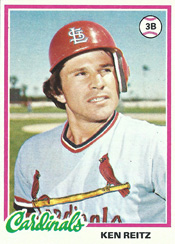
In his most productive game for the Cardinals, Ken Reitz redefined the meaning of the Mendoza Line.

On June 28, 1977, Reitz had a career-high eight RBI against the Pirates in the second game of a Tuesday night doubleheader at St. Louis.

Reitz, the Cardinals’ third baseman, generated those RBI on three hits: a single and two home runs.

The first home run was a grand slam off starter Grant Jackson.

The second was a three-run shot off Mario Mendoza.

Pace setter

An infielder, Mendoza was making his first and only big-league pitching appearance.

As a hitter, Mendoza often had a season batting average of about .200. He eventually became the symbol of the minimum expected of a big-league batter. Today, a .200 batting average commonly is referred to as the Mendoza Line.

As a pitcher, the Mendoza Line is a 13.50 earned run average. That’s what he posted after facing Reitz and the Cardinals.

Let’s play two

In the first game of the June 28 doubleheader, Reitz had a single in four at-bats and the Cardinals won, 6-1.

Cardinals manager Vern Rapp offered to let Reitz sit out the second game _ “He’d been going so hard all season and it was hot,” Rapp explained to the St. Louis Post-Dispatch _ but Reitz wanted to play because the Pirates were starting Jackson, a left-hander. Reitz hit .282 against left-handers in his big-league career and .247 versus right-handers.

Rapp put Reitz in the No. 5 spot in the batting order.

After grounding out in the first inning, Reitz got a RBI-single off Jackson in the third, extending the Cardinals’ lead to 4-2. “The first RBI was the most exciting because it helped us get rolling,” Reitz said.

In the fourth, Reitz, batting with two outs, hit a high, inside pitch off Jackson _ “It was not in the strike zone,” Reitz said _ for the grand slam, putting the Cardinals ahead, 10-2.

“I didn’t even know how many guys were on base when I hit the grand slam because I was concentrating so much at-bat,” Reitz said.

Tough job

With the score 10-3, Pirates manager Chuck Tanner lifted Jackson after six innings. Wanting to rest an overworked bullpen staff, Tanner turned to Mendoza.

“We’ve had him throw batting practice,” Tanner said to United Press International. “We had five games in three days and figured this was a good time to use him.”

Mendoza told the Pittsburgh Press, “My dad used to be a pitcher in the semipros … He said pitching is a tougher life than to be a shortstop.”

Mendoza, a right-hander, pitched a scoreless seventh, getting Keith Hernandez to line out into an inning-ending double play.

In the eighth, Reitz faced Mendoza with runners on first and second, two outs. Mendoza threw a wild pitch, advancing the runners, Roger Freed and Tony Scott, to second and third.

Reitz pulled the next pitch, a breaking ball, down the line. The ball struck the corner of the foul pole for a home run, giving the Cardinals a 13-3 lead. Boxscore

“He’s got a surprisingly good curveball,” Reitz said. “He just threw one too many to me and I happened to hit it down the line. I usually just get doubles off those pitches.”

Reitz was the first Cardinals batter with eight RBI in a game since Augie Bergamo did it in Game 2 of a doubleheader against the Giants on July 4, 1945, at New York.

Reitz would finish the 1977 season with single-season career highs in home runs (17) and RBI (79).


Read Full Post »

For Fernando Valenzuela, a baseball odyssey that began brilliantly with the Dodgers ended sadly in a short, unsatisfying stint with the Cardinals.

Seeking a veteran to temporarily plug an opening in their starting rotation, the Cardinals took a chance on Valenzuela, 36, and acquired him in a six-player trade with the Padres.
The deal, made on June 13, 1997, was a surprise. The Cardinals had approached the Padres about a utility infielder. In talks with his counterpart, Kevin Towers of the Padres, Cardinals general manager Walt Jocketty learned Valenzuela was available.

The trade was Valenzuela, infielder Scott Livingstone and outfielder Phil Plantier to the Cardinals for pitchers Danny Jackson and Rich Batchelor and outfielder Mark Sweeney.

The player the Padres wanted most was pitcher Mark Petkovsek, but when Jocketty insisted on pitcher Tim Worrell in return the Padres backed off, according to the St. Louis Post-Dispatch.

“None of the exchanged players are at the top of their game right now,” columnist Bernie Miklasz wrote.

Valenzuela was the most prominent _ and intriguing _ of the group.

Traveling man

After debuting in the big leagues in 1980 with the Dodgers, Valenzuela made a splash in 1981, winning the National League Cy Young and Rookie of the Year awards and creating energy and interest in a strike-marred season.

In 1990, his final year with the Dodgers, Valenzuela pitched a no-hitter against the Cardinals.

After that, he was more journeyman than ace. From 1991-97, Valenzuela pitched for the Angels, Orioles, Phillies and Padres.

His record for the 1997 Padres was 2-8 with a 4.75 ERA.

When Jocketty and Towers began trade talks, Livingstone and Jackson were the players involved. The Cardinals wanted a backup infielder who batted left-handed. Livingstone, who led the NL in pinch-hits in 1996, fit that need.

The Cardinals needed a starting pitcher to fill in for Donovan Osborne, who was on the disabled list because of a torn groin muscle. When the Padres offered Valenzuela, the Cardinals expanded the deal.

“Fernando was an important part of this,” Jocketty said. “(He) gives us some flexibility. When Donovan gets back, Fernando will go to the bullpen. We feel he’ll be better there than Danny (Jackson) would have been.”

Valenzuela was informed by Padres manager Bruce Bochy of the trade while warming up in the bullpen for a start against the Angels.

“It wasn’t easy to look him in the face,” Bochy said to the Los Angeles Times. “He was shocked.”

Tough stretch

Valenzuela joined the Cardinals in Milwaukee on June 16 and was given a start against the Brewers the next night.

He held the Brewers to two hits _ a Jeff Cirillo single and a Mike Matheny double _ and no runs through five innings.

In the sixth, Valenzuela allowed the first four batters to reach base. All scored. Cirillo led off the inning with a home run. Television replays indicated it was a foul ball. A throwing error by Valenzuela after he fielded a bunt by Jeromy Burnitz aided the Brewers’ comeback. The Brewers won, 4-3, and Valenzuela was the losing pitcher. Boxscore

Valenzuela lost his second Cardinals start _ 3-0 to the Cubs on June 23. Boxscore

In his next start, June 28 versus the Reds, the Cardinals won, 12-6, but Valenzuela didn’t get a decision. He was lifted in the fifth inning with the Cardinals ahead, 10-5. “Sometimes it’s better to give the ball to somebody else who can have better stuff,” Valenzuela said. Boxscore

In his fourth start, July 3 against the Pirates, Valenzuela suffered his third loss with the Cardinals. Boxscore

Manager Tony La Russa decided to give Valenzuela extra rest. Eleven days later, Valenzuela got his fifth Cardinals start. It would be his last.

Time to go

On July 14, against the Reds, Valenzuela yielded three runs, issued six walks and hit a batter before being relieved with two outs in the third. The Reds won, 4-2. Boxscore

“Today was a step backward,” La Russa said.

Said Valenzuela: “It’s hard to pitch when you’re not even close to the plate.”

After five starts for the Cardinals, Valenzuela had an 0-4 record and 5.56 ERA.

Valenzuela was released the next day.

La Russa had asked Valenzuela if he wanted to go on the disabled list, but the pitcher said his arm didn’t hurt.

“He said, ‘I can’t be dishonest,’ ” La Russa told the Post-Dispatch.

Said Jocketty: “Commendable. He’s such a nice man and he’s had such a distinguished career. It’s tough.”

The release brought an end to Valenzuela’s big-league career. In 17 seasons, Valenzuela had a 173-153 record and 3.54 ERA. He pitched more than 200 innings in a season seven times.


Read Full Post »

(Updated Jan. 6, 2019)

Every club in the major leagues knew Rick Ankiel was a pitching prospect worthy of being taken early in the 1997 draft. Many, though, thought it would cost too much to sign him. The Cardinals decided to take a chance.

On June 3, 1997, the Cardinals selected Ankiel in the second round. Ankiel, who had indicated he wanted between $5 million and $10 million, signed two months later with the Cardinals for $2.5 million.
The move sent a clear signal Cardinals ownership, in its second year under a group headed by Bill DeWitt, was committed to investing in talent.

Prep sensation

Ankiel, a left-hander, was a standout pitcher at Port St. Lucie High School on Florida’s Treasure Coast. He had a three-year record of 30-4.

As a senior, Ankiel was 11-1 with an 0.41 ERA. He pitched three no-hitters and four one-hitters and struck out 162 batters in 74 innings.

“He went from being good his sophomore year to great his junior year and this year he became the best,” John Messina, baseball coach at Port St. Lucie High School, told the Palm Beach Post.

Said Marty Maier, Cardinals scouting director: “We think he’s the top left-handed high school pitcher in the draft.”

Ankiel also batted .359 with seven home runs and 27 RBI as a senior.

John DiPuglia, who scouted Ankiel for the Cardinals, told the St. Louis Post-Dispatch, “In Florida, I’ve never seen a left-handed pitcher with his type of composure and stuff on the mound.”

In March 1997, Ankiel signed a letter of intent to attend the University of Miami. Ankiel and his adviser, Scott Boras, told major-league organizations it would take as much as $10 million, and no less than $5 million, to sign him, or else he would play college baseball for the Miami Hurricanes.

“A couple of teams said, ‘Will you take less than ($5 million)?’ and I told them no,” Ankiel said. “I was firm.”

Steal of a deal

No organization wanted to pay the price Ankiel was asking and few were willing to risk using a high draft choice on a player they might not be able to sign.

“He should have been drafted in the top 10,” said Cardinals general manager Walt Jocketty.

Deep into the second round, Ankiel still was undrafted.

When it was the Cardinals’ turn to make their second choice, with the 72nd overall pick, they took Ankiel, not knowing whether they could sign him.

“We thought long and hard about it,” Jocketty said. “We took our time … Bill DeWitt was there with us.”

Wrote the Post-Dispatch: “The Cards might have taken a risk in the second round, but possibly got the steal of the draft.”

Boras, a former Cardinals minor-league player, had warned Ankiel he might slip past the first round because of his financial demands. “It was something we talked about and we kind of knew in a way it was going to happen,” Ankiel said.

Sales pitch

Two weeks after the draft, Jocketty, Maier, vice president of player personnel Jerry Walker and player development director Mike Jorgensen met with Ankiel and his parents at their home in Fort Pierce, Fla.

Jocketty said they talked about how the Cardinals develop pitchers and informed them about the history and philosophy of the organization. He said they didn’t discuss money.

When contract discussions got under way with Boras, both sides played hardball. “At one point,” Jocketty said, “we were prepared to go the other way and he was prepared to go to school. It was a tough negotiation, but not any tougher than most.”

On Aug. 25, a month after his 18th birthday and three days before he was to enroll at Miami, Ankiel agreed to a deal with the Cardinals. He signed the contract on Aug. 28 in St. Louis.

Though the $2.5 million was much less than what he said he wanted, Ankiel received more money than infielder Adam Kennedy, the Cardinals’ first-round pick who signed two months earlier for about $1 million.

“We told (Ankiel) all along we would approach him like a first-round pick,” Jocketty said.

In recalling the signing in his book, “The Phenom,” Ankiel said, “The only job I’d ever had was helping a friend’s father tear up carpet and scrape floors. He’d pay me out of his pocket. I didn’t have a checking account. I didn’t have a savings account. Whatever money I had was in my wallet, maybe $50, but probably not. And then I was rich. I was really rich.”

High hopes

The Cardinals projected Ankiel to develop fast. “If he stays healthy and progresses like he should, he should move quickly through our organization,” Jocketty said to the Associated Press.

Said Ankiel: “I’m thinking I’ll make it to the big leagues in three years. My goal is to be here when I’m 21.”

Ankiel advanced ahead of schedule, making his Cardinals debut at age 20 in August 1999.

After achieving an 11-7 record with a 3.50 ERA and 194 strikeouts in 175 innings during the 2000 regular season, Ankiel had a meltdown in the postseason, losing his ability to throw strikes consistently.

He gave up pitching after the 2004 season, transformed into an outfielder and made his big-league comeback with the 2007 Cardinals.

Ankiel played in the majors for 11 seasons, four as a pitcher and seven as an outfielder. He posted a 13-10 pitching record and a .251 batting average with 49 home runs.

Read Full Post »

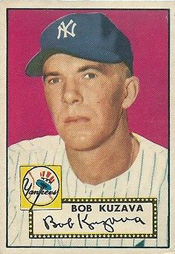
Seeking a left-handed reliever to help their pennant push, the Cardinals got Bob Kuzava, a proven producer under postseason pressure. The price, though, was steep: To open a roster spot for Kuzava, the Cardinals cut loose a future Hall of Fame pitcher.

With nine games left in the 1957 season, the second-place Cardinals, in pursuit of the Braves, were without a left-hander in their bullpen. On Sept. 19, general manager Frank Lane filled the need, acquiring the contract of Kuzava, 34, from the Pirates.

With their roster at the limit, the Cardinals needed to remove a player to create a spot for Kuzava. They opted to send Hoyt Wilhelm to the Indians for the waiver price.

Wilhelm went on to pitch in 1,070 big-league games and became the first reliever to be inducted into the National Baseball Hall of Fame.

Kuzava pitched in three games for the 1957 Cardinals, who lost six of their last nine and finished eight behind the pennant-winning Braves.

A World Series standout with the Yankees, Kuzava never got a chance to pitch in the postseason for the Cardinals.

Series star

Kuzava made his major-league debut with the 1946 Indians and also pitched for the White Sox and Senators before being dealt to the Yankees in June 1951.

In Game 6 of the 1951 World Series, the Yankees led the Giants, 4-1, entering the ninth inning at Yankee Stadium. Johnny Sain, in his second inning in relief of starter Vic Raschi, yielded singles to the first three Giants batters. Yankees manager Casey Stengel called on Kuzava to end the threat.

Kuzava retired all three batters he faced, earning the save in the Yankees’ 4-3 championship clincher. Boxscore

A year later, Kuzava did it again. In Game 7 of the 1952 World Series at Brooklyn, the Yankees led, 4-2, but the Dodgers loaded the bases with one out in the seventh. Stengel brought in Kuzava to relieve Raschi. Kuzava got Duke Snider to pop out to third and Jackie Robinson to pop out to second. Kuzava held the Dodgers scoreless in the eighth and ninth, sealing the championship for the Yankees. Boxscore

Placed on waivers by the Yankees in August 1954, Kuzava went on to pitch for the Orioles and Phillies. He opened the 1957 season with the Pirates, but was sent to their Class AAA farm club, the Columbus (Ohio) Jets, in May.

Comeback in Columbus

Used primarily as a starter, Kuzava won his first six decisions with Columbus. The highlight occurred on July 20 when he pitched a one-hitter against Richmond. Kuzava retired the first 17 batters before yielding a ground single by pitcher Marty Kutyna in the sixth.

In August, Kuzava was sidelined because of elbow trouble. Still, he won two of his last three decisions and finished the minor-league season with an 8-1 record and 3.41 ERA in 20 appearances.

Cardinals manager Fred Hutchinson wanted a left-handed reliever. The staff’s lone left-hander was starter Vinegar Bend Mizell.

“We’ve been unable to jockey against tough left-handed hitters who don’t like southpaws,” Hutchinson said to the St. Louis Post-Dispatch.

Columbus general manager Harold Cooper, who had been trying to interest the Reds in Kuzava, was glad to make a deal with the Cardinals.

(A day after acquiring Kuzava, the Cardinals obtained another left-handed reliever, Morrie Martin, from the Class AAA Vancouver Mounties, an Orioles farm club, for outfielder Eddie Miksis.)

Too little, too late

The Cardinals had three games remaining with each of three foes: Reds, Braves and Cubs. Figuring the Cardinals needed to win nearly all nine to have a chance to overtake the Braves, Hutchinson wanted left-handers to use against sluggers such as Ted Kluszewski of the Reds and Eddie Mathews and Wes Covington of the Braves.

The Cardinals won two of three against the Reds at Cincinnati and went to Milwaukee five games behind the Braves with six to play. The Braves clinched the pennant by beating the Cardinals in the series opener, 4-2, on Hank Aaron’s two-run home run off Billy Muffett in the 11th inning.

Kuzava appeared in three games _ one against the Reds and two versus the Cubs _ for the Cardinals and posted a 3.86 ERA in 2.1 innings pitched. Left-handed batters were 0-for-3 with a walk against him. Right-handed batters were 4-for-8 with a walk.

After the season, the Cardinals assigned Kuzava to the minors, but promised he would be given a chance to make the St. Louis staff in spring training.

Kuzava got his chance, but pitched poorly for the Cardinals in spring training in 1958.

On March 11, he yielded four runs in three innings against the Athletics. On March 25, he gave up six runs to the Dodgers in the ninth inning. “It was dangerous all over the field the way they were bombarding Kuzava,” the Post-Dispatch reported.

Kuzava, 35, spent the 1958 season with the Cardinals’ Class AAA Rochester Red Wings club on a staff that included 22-year-old Bob Gibson. Kuzava was 5-3 with a 3.31 ERA in 25 games.

Kuzava finished his playing career in the White Sox farm system in 1959 and 1960.

Previously: How Hoyt Wilhelm got traded to Cardinals

Read Full Post »

« Newer Posts - Older Posts »