Feeds:
Posts
Comments

Archive for the ‘Pitchers’ Category

In his spring training stint with the Cardinals, Mike Caldwell appeared to be a pitcher whose career was in decline. Shelled early and often, Caldwell showed no signs of developing into what he would become: a 20-game winner who would torment the Cardinals in the World Series.

Caldwell’s five-month stint as a Cardinal is a tale of a late bloomer who was in the wrong organization at the wrong time.

In March 1977, Caldwell, 28, was considered a leading candidate to fill a role in the Cardinals’ bullpen. Instead, he was traded before he got a chance to appear in a regular-season game for St. Louis.

Giant troubles

Caldwell, a left-hander, made his major-league debut with the 1971 Padres. He had a 13-25 record in three seasons with the Padres before he was traded to the Giants for slugger Willie McCovey.

In 1974, his first year with the Giants, Caldwell had a breakout season, posting a 14-5 record and 2.95 ERA.

After the season, Caldwell had surgery to remove bone spurs in his left elbow. When he returned, he struggled. “I lost some movement on my best pitch, the sinker, and I tightened up some and came sidearm at times,” Caldwell told the St. Louis Post-Dispatch.

By 1976, Caldwell was having troubles in the Giants clubhouse as well as on the mound. “I didn’t get along with a couple of the coaches and they took it personally,” Caldwell said.

The Giants’ pitching coach was the former catcher, Buck Rodgers.

Caldwell reached a low point on April 28, 1976, when Doug Clarey hit a home run, the lone hit of his big-league career, against him in the 16th inning, lifting the Cardinals to a 4-2 victory.

Caldwell finished 1-7 with a 4.86 ERA for the 1976 Giants. “I lost my confidence, tried too hard _ overthrew, I guess you’d say _ and I didn’t do very well,” Caldwell said.

Hope rekindled

On Oct. 26, 1976, the Giants traded Caldwell, pitcher John D’Acquisto and catcher Dave Rader to the Cardinals for pitcher John Curtis, outfielder Willie Crawford and utility player Vic Harris.

“I’m just glad to get away from a bad situation,” Caldwell said of leaving the Giants.

The Cardinals slotted Caldwell for the bullpen. “It’s common knowledge that the problem with the Cardinals last year was that middle relief and late relief, except for Al Hrabosky, couldn’t get the other clubs out,” said St. Louis manager Vern Rapp.

Said Caldwell: “I have no illusions. I’ve got to prove I’m good enough to make the staff.”

Bad audition

On March 12, in the Cardinals’ 1977 spring training opener against the Mets, Caldwell pitched two innings and gave up four runs. Three days later, Caldwell pitched an inning against the Dodgers and yielded three runs.

The Cardinals didn’t pitch him much after that.

On March 29, 1977, the Cardinals traded Caldwell to the Reds for pitcher Pat Darcy. In eight spring training innings, Caldwell yielded nine earned runs.

“Rapp called me in and told me, ‘Don’t get mad. You’re going to a contender,’ ” Caldwell said. “I wasn’t mad about that. I just thought he should’ve had some respect for me as a pitcher. That’s all I wanted: Throw me out there to see what I can do.”

Right fit

The Reds weren’t too impressed with Caldwell either. Three months after they acquired him, the Reds dealt Caldwell to the Brewers.

In 1978, Caldwell got a break when the Brewers named George Bamberger their manager. Under Bamberger, who had been a pitching coach for the Orioles, Caldwell fulfilled his potential. He was 22-9 with a 2.36 ERA and 23 complete games for the 1978 Brewers.

“Lots of people had given up on me,” Caldwell said to The Sporting News, noting he was traded by four clubs, including the Cardinals. “Maybe the people who gave up on me were responsible in an indirect way for my coming back. I knew I could pitch and I hope those who gave up on me will say now, ‘Well, he had the guts to battle back and win.’ ”

The third-base coach for Bamberger’s Brewers was Buck Rodgers, with whom Caldwell had feuded in his last season with the Giants. In 1980, Rodgers replaced Bamberger as Brewers manager.

Old wounds

Early in the 1982 season, Caldwell had a run-in with Rodgers aboard a plane, The Sporting News reported. In June 1982, Rodgers was fired and replaced by hitting coach Harvey Kuenn. Rodgers said disgruntled players had “tried to stab me in the back.”

Kuenn led the Brewers to the 1982 American League pennant and a matchup against St. Louis in the World Series.

Five years after he’d been dealt by the Cardinals, Caldwell would be facing them on baseball’s biggest stage.

Series drama

Caldwell, nicknamed “Mr. Warmth” by teammate Gorman Thomas because of his sometimes grumpy nature, was Kuenn’s choice to start Game 1.

Caldwell responded with a three-hit shutout in a 10-0 Brewers victory. Boxscore

Cardinals first baseman Keith Hernandez said he thought Caldwell was throwing a spitter, an illegal pitch. “He might have been throwing me screwballs, but I never saw a screwball drop like that,” Hernandez said.

Caldwell said he threw “natural sinkers.” Regarding the spitball accusation, Caldwell replied, “I look at it as a compliment. If the ball drops so much that they’re accusing me of throwing a spitter, I’ve got pretty good stuff.”

With the Series deadlocked at 2-2, Caldwell started Game 5 and again was the winning pitcher. He yielded 14 hits and two walks in 8.1 innings, but the Cardinals stranded 12 and the Brewers won, 6-4. Boxscore

The Cardinals won Game 6, setting up a deciding Game 7.

Clinging to a 4-3 lead in the eighth, the Cardinals had runners on first and second, two outs, when Kuenn lifted Moose Haas and replaced him with Caldwell. Darrell Porter and Steve Braun responded with RBI-singles, stretching the lead to 6-3, before Caldwell got Willie McGee to ground out.

Bruce Sutter set down the Brewers in order in the ninth, clinching the championship for the Cardinals. Boxscore
 

Read Full Post »

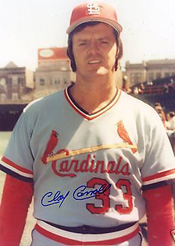
Though relief pitcher Clay Carroll was successful in his lone season with St. Louis, his most significant Cardinals connection came as an opponent.

clay_carrollOn May 30, 1969, in what The Sporting News described as a storybook feat, Carroll hit the only home run of his big-league career. The improbable shot was struck against Bob Gibson in the 10th inning and it carried the Reds to a 4-3 victory over the Cardinals.

Eight years later, Carroll was traded to the Cardinals and excelled for them as a consistently reliable reliever.

Heavy lumber

Carroll’s home run against Gibson occurred in the opener of a series between the Reds and Cardinals at St. Louis. With the Cardinals ahead, 3-0, in the seventh inning, Johnny Bench tied the score with a three-run home run _ his first career hit against Gibson.

Carroll relieved Wayne Granger in the eighth and the game became a duel between Carroll and Gibson.

After Gibson retired the first two batters in the 10th, Carroll stepped to the plate with a bat he borrowed from teammate Alex Johnson, a former Cardinal. Johnson’s bats, Carroll explained to the St. Louis Post-Dispatch, “have a lot more wood in them than the one I had been using.” Johnson’s bats “normally are about as heavy as any in baseball _ some weighing as much as 40 ounces,” the Cincinnati Enquirer reported.

With the count 3-and-2, Carroll swung at a high fastball and lifted a fly ball to left. “I don’t want to brag, but when I hit the ball I knew it was gone,” Carroll said to United Press International. “Did you see it take off?”

The ball hit the top of the fence at Busch Stadium and bounced over the wall, giving the Reds a 4-3 lead.

“I was just swinging, trying to get on,” said Carroll. “Usually when I face Gibson, I just chop at the ball. That’s about all you can do against him.”

Said Reds manager Dave Bristol: “You should have seen the smile on Carroll’s face when he returned to the dugout. It looked like a cut watermelon.”

In the bottom half of the 10th, Carroll got Joe Hague to fly out before walking Lou Brock. Curt Flood grounded out, moving Brock into scoring position at second, before Vada Pinson, Carroll’s former Reds teammate, lined out to shortstop, ending the game.

Carroll pitched three hitless innings to earn the win. Boxscore

Championship caliber

Carroll was an important contributor to Reds teams that won pennants in 1970, 1972 and 1975. In 14 World Series appearances for the Reds, Carroll was 2-1 with a save and a 1.33 ERA over 20.1 innings. He was the winning pitcher in Game 7 of the 1975 World Series, shutting out the Red Sox for two innings.

Dealt by the Reds to the White Sox in December 1975, Carroll produced a 4-4 record, six saves and a 2.56 ERA for Chicago in 1976.

On March 23, 1977, the Cardinals acquired Carroll, 35, from the White Sox for pitcher Lerrin LaGrow. The Cardinals projected Carroll to set up closer Al Hrabosky.

“This is obviously what we’ve been after _ consistency and experience from a right-handed reliever, a guy who’s been under fire in championship play,” said manager Vern Rapp. “We had nobody on our staff who fit those qualifications.”

Said Carroll: “I want to work as often as possible because the more I work the more consistent I am. I like the Cardinals, especially because they’re an aggressive team at bat and on the bases.”

Carroll reported to camp at 215 pounds, according to the Post-Dispatch. Rapp wanted him to be at 200 pounds when the season began. He instructed Carroll to run extra laps each day during spring training.

A master at locating his pitches, Carroll delivered for the 1977 Cardinals. “When Carroll wasn’t saving games, he at least was dousing huge blazes to keep the Cardinals in the games,” The Sporting News reported. “The tighter the situation, the more (Carroll) seemed to enjoy it.”

Noting how Carroll got batters to swing at pitches out of the zone, Bristol said, “Carroll would rather eat a green fly at home plate than throw a strike.”

Carroll was 4-2 with four saves and a 2.50 ERA in 51 appearances for the Cardinals before they traded him back to the White Sox on Aug. 31, 1977.

3-for-1

The trade created “a lot of eyebrow raising” because Carroll had been the Cardinals’ most consistent reliever, The Sporting News reported.

The Cardinals were 10 games out of first place with about a month remaining in the season when the deal was made. The White Sox wanted Carroll because they were in contention for a division title, two games behind the first-place Royals.

St. Louis got three players in the deal: pitchers Silvio Martinez and Dave Hamilton and outfielder Nyls Nyman.

Carroll was disappointed to leave the Cardinals. “I thought I did a good job,” he said. “I guess they’re planning to go with a younger pitching staff next year.”

Read Full Post »

Two years after he made his big-league debut against St. Louis as a winner in a game that ended Bob Gibson’s career, Buddy Schultz surprised the Cardinals by becoming one of their most effective relievers.

buddy_schultzOn Feb. 28, 1977, Schultz was traded by the Cubs to the Cardinals for minor-league pitcher Mark Covert.
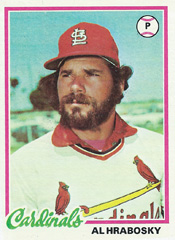
A left-hander, Schultz, 26, was acquired to pitch for the Cardinals’ top farm club.

When given a chance to fill in for an injured pitcher early in the Cardinals’ season, Schultz capitalized on the opportunity and gained the confidence of manager Vern Rapp.

On a staff with established talent such as Bob Forsch, John Denny and Al Hrabosky, it was Schultz who emerged as the Cardinals’ leader in earned run average that season.

Name game

Charles Budd Schultz was born Sept. 19, 1950, in Cleveland. “The middle name was for my Uncle Bud and they fancied it up by adding the extra ‘d,’ ” Schultz told Dick Kaegel of the St. Louis Post-Dispatch.

Schultz received a baseball scholarship from Miami University in Oxford, Ohio, where he earned a bachelor’s degree in industrial arts. In a game for Miami against Wright State, Schultz struck out 26 batters.

The Cubs selected Schultz in the sixth round of the June 1972 amateur free-agent draft.

Win vs. Gibson

Schultz made his big-league debut for Chicago on Sept. 3, 1975, at St. Louis. In the sixth inning, with the score tied at 6-6, Schultz relieved Tom Dettore and got Bake McBride to ground out to second, ending the inning.

In the seventh, the Cubs struck for five runs against Gibson, who had relieved Ron Reed. Pete LaCock, batting for Schultz, hit a grand slam off Gibson, giving the Cubs an 11-6 lead. Paul Reuschel shut out the Cardinals over the last three innings, preserving the win for Schultz. Boxscore

Gibson, 39, never pitched in a big-league game again, ending a career that led to induction into the National Baseball Hall of Fame.

A week later, on Sept. 10, 1975, Schultz pitched 1.1 scoreless innings in relief of Steve Stone and got his second win in the Cubs’ 7-5 triumph over the Cardinals at Chicago. Boxscore

In two seasons (1975-76) with the Cubs, Schultz was 3-1 with a 6.14 ERA in 35 games.

Getting a break

On the eve of spring training in 1977, Schultz got into a contract squabble, prompting the Cubs to make him available. Cardinals general manager Bing Devine took a chance on Schultz, signed him to a minor-league contract and instructed him to report to the Class AAA New Orleans Pelicans.

“Devine asked me what I wanted and I told him and I signed in one minute,” Schultz said. “Maybe I should have asked for more.”

On March 31, 1977, Schultz worked a scoreless eighth inning in a 2-1 Cardinals spring training victory over the Mets. He caught Rapp’s attention by retiring all three batters he faced, striking out two. “You had to like what Schultz did,” said Rapp.

However, when the 1977 big-league season opened, the Cardinals kept rookie relievers John Urrea and Johnny Sutton on the roster. Schultz stayed behind at the minor-league camp in Florida.

On April 9, two days after the Cardinals’ season opener, pitcher John D’Acquisto injured his right calf and was placed on the disabled list. Schultz was called up to replace him.

Good stuff

Mixing a slider with a fastball and palmball, Schultz pitched consistently well in long relief for the Cardinals.

On May 12, 1977, he combined with D’Acquisto and Hrabosky on a one-hitter against the Reds at St. Louis. Relieving D’Acquisto, who started and pitched four hitless innings, Schultz held the Reds hitless until Ken Griffey doubled with two outs in the eighth.

“The fastball Griffey hit was up in his eyes,” Schultz said.

Hrabosky pitched a hitless ninth, preserving the win for Schultz, who was 2-0 with a 1.23 ERA. Boxscore

A month later, the Cardinals made a series of moves that blindsided Schultz.

Strikeout artist

On June 15, 1977, the Cardinals acquired a starter, Tom Underwood, from the Phillies and a reliever, Rawly Eastwick, from the Reds.

Eastwick joined three other high-profile veterans _ Hrabosky, Clay Carroll and Butch Metzger _ in the St. Louis bullpen. Needing to open a roster spot for the newcomers, the Cardinals demoted Schultz (3-1, 1.41 ERA) to New Orleans, with instructions to use him as a starter.

Stunned, Schultz took out his frustration on American Association batters.

In his first start for New Orleans, on June 18, 1977, Schultz struck out 15 in a 9-3 victory over Denver. Schultz also contributed a double, single and RBI. “Maybe they sent me down here to work on my hitting,” he said to The Sporting News.

In his second start, Schultz struck out 10 before a blister developed on a left finger, causing him to depart in the sixth.

Over two starts for New Orleans, Schultz struck out 25 in 14.2 innings.

When John Denny pulled a hamstring and was placed on the disabled list, the Cardinals recalled Schultz to replace him.

Triumphant return

On June 28, 1977, the Cardinals gave Schultz his first big-league start in the opener of a doubleheader against the Pirates at St. Louis. Schultz, who held the Pirates to a run over 7.1 innings in a 6-1 Cardinals victory, departed to a standing ovation.

“With that, he suddenly produced a two-arm victory thrust and yelled, ‘I’m back,’ ” Neal Russo of the Post-Dispatch reported.

Before he could make a second start for St. Louis, Schultz pulled a leg muscle and was placed on the disabled list. When he returned, the Cardinals utilized him primarily as a reliever.

“He’s much too valuable to take out of the bullpen,” said Cardinals pitching coach Claude Osteen.

Schultz finished the 1977 season with a 6-1 record and a team-leading 2.32 ERA.

Previously: Bob Gibson and his final days with Cardinals

Read Full Post »

(Updated Jan. 7, 2026)

In a classic clash of individual free will versus organizational authority, Al Hrabosky challenged the rules of manager Vern Rapp, creating a controversy that threatened to divide the Cardinals during spring training in 1977.

al_hrabosky3Rapp, the Cardinals’ first-year manager, declared no player could have a beard, moustache, long sideburns or long hair. Hrabosky, the Cardinals’ top relief pitcher, earned the nickname “Mad Hungarian,” in part, because of an intimidating look that featured a Fu Manchu moustache.

Bristling at what he considered unnecessarily rigid rules and convinced a clean-shaven look hampered his effectiveness as a pitcher, Hrabosky ripped Rapp in comments to media.

For Rapp, who never had been in the big leagues until replacing the popular Red Schoendienst as manager, Hrabosky’s outburst was a critical test of his ability to command the respect of the team.

Spirit of St. Louis

A St. Louis native, Rapp was a catcher in the Cardinals’ system from 1946-50 and from 1953-54. He was a Cardinals minor-league manager from 1965-68 before moving to the Reds organization.

After the Cardinals fired Schoendienst, they hired Rapp because of a no-nonsense reputation. Before leaving for 1977 spring training, Rapp, 48, revealed his edict on hair. “Rapp’s tonsorial order took priority over a lot more important matters among St. Louis fans,” The Sporting News reported. “The two daily newspapers were swamped with letters, most of them in favor of the manager.”

In explaining why he implemented the ban, Rapp told the St. Louis Post-Dispatch, “I’ve had those codes on teams I’ve managed since 1965. It’s to give the players a feeling of being responsible to the profession they’re in. The dress and hair codes reflect their character and personality to the public. It’s a big way they can start developing pride.”

Rapp’s rules

Most Cardinals players reported to spring training clean-shaven and with haircuts. Third baseman Ken Reitz “was asked by the manager to get his hair trimmed and did, but not enough to suit Rapp,” the Post-Dispatch reported.

“There are a couple of others who still didn’t get their hair trimmed enough at the sides, but they will,” Rapp said.

The first player to challenge the rule was outfielder Bake McBride, who attempted to keep a goatee. When Rapp ordered McBride to shave, McBride responded, “You’re going to make enemies.”

Said Rapp: “I didn’t come down here to win friends.”

Hrabosky, ever the showman, invited the media to film and photograph him as he shaved his Fu Manchu and beard.

The hair code wasn’t the only change introduced by Rapp. He issued daily mimeographed instructions to the players, gave them identical team exercise suits to wear, required them to attend a demonstration by coach Sonny Ruberto on how uniforms should be worn and scheduled workouts before and after lunch.

After the Cardinals lost, 10-0, to the Mets in their spring training opener, “Rapp sent his players on a 15-lap tour from first to home,” the Post-Dispatch reported.

Hate mood

Hrabosky initially tried to use his unhappiness with the hair code as motivation to pitch well. “I want to prove to Rapp that I’m his No. 1 relief pitcher,” Hrabosky said. “I want to be his No. 1 stopper. I wanted to be in a hate mood and Rapp put me there by taking away my beard and moustache. Look, I super-like Vern. I want to help him, help the ballclub and help myself. He has aroused something in me to fight back.”

A few days later, though, Hrabosky directed his frustration at Rapp.

Al apologizes

On March 20, Hrabosky told the Associated Press, “My mental outlook is atrocious. There’s more dissension on this club than I’ve ever seen.”

That same day, Hrabosky told United Press International his teammates were being stifled by Rapp. “The guys are just standing still,” Hrabosky said. “The reason is they’re afraid to move.”

Informed of Hrabosky’s comments, Rapp told the Post-Dispatch, “I just don’t understand it.”

Before the Cardinals left for their March 21 exhibition game against the Red Sox at Winter Haven, Fla., Rapp called a team meeting.

“I wanted to get everything out in the open,” Rapp said. “I wanted the players to know that I am the manager of this team. They fully realize this and they are willing to accept it.”

Hrabosky stood up at the meeting and apologized.

“I’m man enough to admit I was wrong … I’m going to keep my mouth shut and do what I have to do,” Hrabosky told the Post-Dispatch. “I offended Vern. I feel I threatened his helm. As a team member, I felt I had no right to say what I did.”

Catcher Ted Simmons, the only other player to speak at the meeting, urged his teammates to conduct themselves professionally. Said Simmons of Rapp: “He is the manager and that’s that. If he wants you to stand on your head, then you should do it.”

Family feud

The Cardinals opened the 1977 regular season with a victory at Pittsburgh. Hrabosky pitched 2.1 innings and helped protect the win for starter John Denny.

Afterward, a jubilant Hrabosky was asked by The Sporting News to reflect on his spring training criticism of Rapp. “Maybe I was a little selfish and a little childish about the matter,” Hrabosky said. “I accept it now.”

Peace, though, wasn’t long-lasting.

In May, Rapp suspended Hrabosky for insubordination after the pitcher refused the manager’s request to meet.

In June, McBride, who remained unhappy with Rapp, was traded to the Phillies.

In July, with Hrabosky beginning to grow facial hair and threatening to file a grievance with the players’ union, Cardinals owner Gussie Busch ordered Rapp to discontinue the hair code.

Hrabosky led the 1977 Cardinals in saves (10) and games pitched (65) but his ERA was 4.38. After the season, he was traded to the Royals.

Rapp was fired in April 1978 and replaced by Ken Boyer.

In a 1989 interview with Kris Thompson of the Tampa Tribune, Hrabosky said, “Vern was the most insecure person I’ve ever been around. He tried to instill discipline by coming up with these new rules all the time. It was always you got to do this my way or else. Most of what he wanted to do didn’t make any sense … We were grown men and Rapp was treating us like a bunch of babies … I just made a stand against a person that I couldn’t respect.”

Read Full Post »

For reliever Hoyt Wilhelm, a stint with the Cardinals turned out to be a detour on his path to the Hall of Fame.

hoyt_wilhelmOn Feb. 26, 1957, the Cardinals acquired Wilhelm from the Giants for first baseman and outfielder Whitey Lockman.
Wilhelm, 34, had a 42-25 record with 41 saves and a 2.98 ERA in five seasons with the Giants, but his success didn’t carry over to the Cardinals.

Help wanted

Wilhelm, a knuckleball specialist, was a rookie for the Giants in 1952 when he produced a 15-3 record, 11 saves and a 2.43 ERA. For the pennant-winning 1954 Giants, Wilhelm was 12-4 with seven saves and a 2.10 ERA.

He was regarded a big upgrade to a Cardinals bullpen whose best reliever in 1956 was converted starter Larry Jackson.

Wilhelm became available because the Giants needed help at first base and left field after first baseman Bill White and left fielder Jackie Brandt went into military service. Lockman played both positions and the Giants were quite familiar with him because he played for them before going to the Cardinals in June 1956 in a deal involving second baseman Red Schoendienst.

Before approaching the Cardinals about Lockman, the Giants attempted to replace White with Jackie Robinson, who was acquired from the Dodgers in December 1956, but Robinson retired and the deal was voided. Cardinals general manager Frank Lane told The Sporting News he doubted he could have obtained Wilhelm if Robinson had reported to the Giants.

When the trade for Wilhelm was made, the Cardinals were at spring training in St. Petersburg, Fla., and the Giants were at their camp in Phoenix. In the book “The Original San Francisco Giants,” Lockman said, “So I left St. Petersburg, driving to Phoenix, and (Wilhelm) did the same thing, driving from Phoenix to St. Petersburg. We passed each other in Dallas, and saw each other, and stopped and had a little chat and went on our ways. Can you believe that?”

Insider tips

Before making the trade, Lane asked manager Fred Hutchinson whether the Cardinals had a catcher who could handle Wilhelm’s knuckleball. Hutchinson “assured Lane that Hal Smith could master the assignment,” The Sporting News reported.

Smith was the Cardinals’ starting catcher and Hobie Landrith was his backup. Lane and Hutchinson arranged for their catchers to have a dinner meeting with retired catcher Rick Ferrell, who’d caught five knuckleball pitchers while with the Senators, to get insights into how to deal with the elusive pitch.

Asked about the session with Ferrell, Landrith told the St. Louis Post-Dispatch: “He advised us not to crouch or squat as low when catching knuckleball pitchers as we would for others. He told us that from a half standing position … we could move laterally better and also drop on a knuckler falling off the table.”

Wilhelm was one of three pitchers with the 1957 Cardinals who threw a knuckleball. The others were Murry Dickson and Jim Davis.

“The thing about a good knuckler is that it’s tough to hit whether you’re hitting .300 or .200,” said the Cardinals’ best hitter, Stan Musial. “It jumps around like mercury in a bottle.”

Said Wilhelm: “The biggest factor in your knuckler is the wind condition. It’s a non-rotating pitch and therefore does better the more resistance it meets, meaning against the wind. When the wind is blowing in _ from behind the pitcher _ the knuckler seldom will do anything. Then it’s only a mediocre pitch and you’re a batting practice target.”

Disappointing results

After a good spring training, Wilhelm had a poor start to the 1957 season. He didn’t earn his first save until May 24 when he lowered his ERA from 6.11 to 5.89.

Wilhelm had one stellar month _ six saves and a 1.88 ERA in June _ but otherwise was unimpressive.

Though the Cardinals contended with the Braves in pursuit of a 1957 National League title, Hutchinson lost confidence in Wilhelm and seldom used him during the September pennant stretch.

Wilhelm said he needed to pitch regularly in order to regain effectiveness with his knuckleball. When Hutchinson stopped using him, Wilhelm had trouble controlling the pitch.

On Sept. 21, 1957, the Cardinals sent Wilhelm to the Indians for the waiver price. He had a 1-4 record, a team-leading 11 saves and a 4.25 ERA in 40 appearances for the Cardinals.

When Hutchinson informed Wilhelm the Cardinals had dealt him, the pitcher shook hands with the manager and said, “It’s good to have been with you. I’m sorry I couldn’t help you more.”

Wilhelm went on to pitch in 1,070 big-league games. He was inducted into the National Baseball Hall of Fame in 1985 and was the first reliever to earn the honor.

Previously: Enduring record: Stan Musial and his 5 homers in a day

Read Full Post »

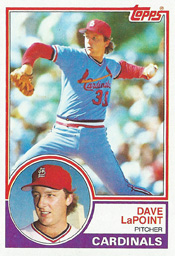
Looking to rebuild his reputation, Dave LaPoint returned to the organization where he felt the most comfortable and had enjoyed his greatest success.

dave_lapointOn Jan. 19, 1987, LaPoint, a free agent, signed with the Cardinals, who expected him to compete for a spot in their starting rotation.

At 27, his career was at a crossroads.

Five years earlier, LaPoint, a left-hander, helped the Cardinals win the 1982 National League pennant and World Series championship.

After the Cardinals traded him in February 1985, LaPoint’s career spiraled. He pitched for three teams in two years, posting losing records at each stop, got traded twice and released once.

Out of shape and labeled a clubhouse jester, LaPoint said he was committed to rededicating himself to becoming a winner and was seeking a nurturing environment in which to attempt that comeback.

The 1987 Cardinals and manager Whitey Herzog provided the setting LaPoint sought.

Cards contributor

LaPoint’s tenure with the Cardinals began in December 1980 when he was acquired from the Brewers in a deal engineered by Herzog. The Cardinals traded Rollie Fingers, Ted Simmons and Pete Vuckovich for Sixto Lezcano, David Green, Lary Sorensen and LaPoint.

LaPoint’s breakthrough year was 1982. He began the season as a reliever and joined the starting rotation in May. LaPoint appeared in 42 games, including 21 as a starter, for the 1982 Cardinals and had a 9-3 record and 3.42 ERA. He started Game 4 of the 1982 World Series against the Brewers, yielded one earned run in 6.1 innings and got no decision in a 7-5 Milwaukee victory.

LaPoint earned 12 wins for the Cardinals in both 1983 and 1984.

When the Cardinals, seeking a run producer to replace George Hendrick, had a chance to get Jack Clark before the start of the 1985 season, they sent LaPoint, Green, Jose Uribe and Gary Rajsich to the Giants.

Rick Hummel of the St. Louis Post-Dispatch later reported the Cardinals parted with LaPoint because they “thought he might be influencing young players unduly.”

Hummel described LaPoint as a “leader in clubhouse revelry” and “a top consumer of the owner’s (Anheuser-Busch’s) product.”

Prodigal son

LaPoint had a 7-17 record for the 1985 Giants, who traded him to the Tigers after the season.

LaPoint and Tigers manager Sparky Anderson were a bad match. “I couldn’t get along with Sparky,” LaPoint said. After posting a 3-6 record and 5.72 ERA for the Tigers, LaPoint was traded to the Padres in July 1986. He was 1-4 for the Padres, who released him after the season.

LaPoint decided to make changes. Weighing between 230 and 240 pounds, he dropped to 220.

The Expos and Giants wanted to sign LaPoint, but he chose the Cardinals, whose offer of a base salary of $125,000 was a cut from his $550,000 contract in 1986.

“It feels finally that I’m back where I belong,” LaPoint said. “… In talking to Whitey, he said he would use me like he did in ’82. That’s fine with me. It got me a World Series ring.”

Asked his reaction to LaPoint rejoining the Cardinals, center fielder Willie McGee said, “I like him … He’s kind of a clown, but that’s Dave LaPoint.”

It’s a reputation LaPoint said he was determined to change.

“I used to mess around during drills and I don’t do that anymore,” LaPoint said after reporting to Cardinals camp. “… It was time to put a stop to it.”

Redbird reliever

LaPoint had a successful spring training. He was 2-0 with a 2.34 ERA in 15.1 innings pitched in Grapefruit League exhibition games.

The Cardinals opened the 1987 regular season with five left-handers: starters John Tudor and Greg Mathews and relievers Ricky Horton, Pat Perry and LaPoint. (Ken Dayley, another left-handed reliever, was on the disabled list.)

In his first appearance for the 1987 Cardinals, on April 10 against the Pirates at Pittsburgh, LaPoint took the loss when he yielded a RBI-double to Sid Bream in the bottom of the ninth. Boxscore

LaPoint was scheduled to make a start April 25, 1987, versus the Mets at New York, but that plan was scratched when the Cardinals called up Joe Magrane from the minors and put the rookie left-hander into the rotation.

LaPoint remained in the bullpen and largely was ineffective.

He got a win on April 18, 1987, against the Mets at St. Louis, but didn’t perform well. In the 10th, LaPoint threw a wild pitch, enabling Al Pedrique to score from third with the go-ahead run. LaPoint was rescued when the Cardinals scored five times off Jesse Orosco in the bottom half of the inning. Tom Pagnozzi’s RBI-single tied the score at 8-8 and Tommy Herr’s grand slam made LaPoint the winner. Boxscore

On the road again

With his ERA at 6.75 after four relief appearances, LaPoint was demoted to Louisville on April 27, 1987. LaPoint had the option of declaring himself a free agent, but agreed to return to the minor leagues for the first time since 1981.

Placed in the starting rotation by Louisville manager Dave Bialas, LaPoint lost his first three decisions, but found his groove. He completed four of his last five starts for Louisville and had a 5-5 record when he was recalled by the Cardinals on July 8, 1987.

“It was the best thing in the world for me,” LaPoint said of his stint in the minors. “… I’ve learned to pitch a little different style.”

LaPoint made two July starts for the Cardinals and got no decision in either.

On July 30, 1987, the Cardinals traded LaPoint to the White Sox for minor-league pitcher Bryce Hulstrom.

“LaPoint’s main problem has been control,” the Post-Dispatch reported. “If he gets the ball up, he gets hammered. It usually takes him a couple of innings to find the strike zone and by then the game usually is out of control.”

After posting a 1-1 record and 6.75 ERA for the 1987 Cardinals, LaPoint was 6-3 with a 2.94 ERA for the 1987 White Sox.

The Cardinals, helped by a combined 30 wins from left-handed starters Mathews, Tudor and Magrane, finished 95-67 and won the pennant.

Previously: Trade for Jack Clark shook Cards from their slumber

Read Full Post »

« Newer Posts - Older Posts »