Feeds:
Posts
Comments

Archive for the ‘Pitchers’ Category

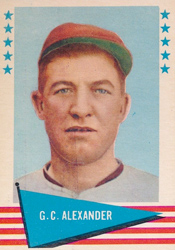
In a span of about 24 hours, Grover Cleveland Alexander twice held the fate of the 1926 Cardinals in his right hand. With a loss meaning elimination of the Cardinals from the World Series, Alexander delivered a win and a save against the Yankees of Babe Ruth and Lou Gehrig at New York.

grover_alexander2Alexander’s save, one of the top five iconic moments in Cardinals lore, was accomplished on Sunday afternoon, Oct. 10, in Game 7 with 2.1 innings of hitless relief, including the storied strikeout of Tony Lazzeri with two outs and the bases loaded in the seventh inning, in a 3-2 Cardinals victory.

Alexander’s win, accomplished a day earlier on Saturday afternoon, Oct. 9, in Game 6, was just as impressive, but often overshadowed by the Game 7 drama.

With the Yankees in position to clinch the championship with a victory, Alexander, 39, got a complete-game win for the Cardinals in Game 6.

Displaying remarkable command of his pitches, Alexander kept Ruth from hitting a ball out of the infield and limited Gehrig to a single in the 10-2 Cardinals victory.

In an Associated Press report, Cardinals player-manager Rogers Hornsby said of Alexander, “(He) has left a mark for the next generation to aim at.”

Wrote The Sporting News: “(Alexander) has been pitching a long, long time, but it is doubtful if he ever rose to the heights he ascended in this Series.”

Duel of veterans

On Oct. 3 at Yankee Stadium, Alexander started and won Game 2 of the 1926 World Series, pitching a complete-game four-hitter and striking out 10 in the Cardinals’ 6-2 triumph. That win evened the best-of-seven Series at 1-1.

The Yankees won two of the next three at St. Louis.

With Game 6 at Yankee Stadium, Alexander was matched against Bob Shawkey, 35, who had pitched primarily in relief during the regular season.

Yankees manager Miller Huggins was confident Shawkey could deliver a strong start. Shawkey had pitched in relief in Game 2 and Game 3 and hadn’t allowed the Cardinals a baserunner over 3.2 total innings. Huggins also was confident Alexander wouldn’t be as sharp in Game 6 as he had been in Game 2.

Under control

As Shawkey took the mound for the start of Game 6, “the sun was shining but there was an October chill in the air,” according to the St. Louis Post-Dispatch.

The Cardinals scored three in the first, led 4-1 through six and secured their grip with a five-run seventh.

Alexander never gave the Yankees a chance to rally. He threw 104 pitches, including 75 for strikes. “It was remarkable to watch the old master put the ball almost where he wanted to,” the Post-Dispatch reported. “It was the finest exhibition of control seen in many a day.”

Said Alexander: “The day was cold and at times I had trouble in cutting loose with my fastball, but my control was exceptionally good with men on the bases and that was what helped me.”

Besting The Babe

Alexander especially was effective against Ruth, who’d hit 47 home runs during the season and three against the Cardinals in Game 4 of the World Series at St. Louis. Ruth was 0-for-3 with a walk against Alexander in Game 6. In the third inning, Ruth batted with runners on first and second, two outs, and grounded out to first. In the seventh, with runners on second and third, two outs, Alexander induced Ruth to ground out to shortstop.

“It was my control that kept Ruth from hitting,” Alexander said. “Every ball that Babe hit broke on the inside of the plate, close enough so that the big fellow could do no damage.”

Said Huggins: “Alexander had a better game left in his system than we thought.”

Alexander was supported by the hitting of Les Bell (four RBI, three hits, including a two-run home run), Hornsby (three RBI) and Billy Southworth (double, triple, three runs). Boxscore

“I want to thank the fans of New York for the way they have treated the Cardinals at the Stadium,” Alexander said. “They have been fair and square, ever ready to applaud when a good play was made.”


Read Full Post »

(Updated Nov. 22, 2024)

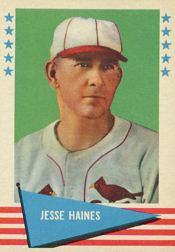
In the first World Series game played in St. Louis, nine future inductees into the National Baseball Hall of Fame, including Babe Ruth, Lou Gehrig and Rogers Hornsby, appeared in the starting lineups. The player who delivered the masterpiece performance was the pitcher among that stellar cast, Jesse Haines of the Cardinals.

jesse_hainesOn Oct. 5, 1926, in Game 3 of the World Series at Sportman’s Park, Haines pitched a complete-game shutout and hit a two-run home run, carrying the Cardinals to a 4-0 victory.
Haines and Bucky Walters of the 1940 Reds are the only pitchers with a shutout and a home run in a World Series game. Walters achieved his feat in Game 6 against the Tigers.

Impossible dream

With his performance, Haines defied the odds. Consider:

_ The 1926 Yankees featured the famed “Murderer’s Row” lineup of Ruth, Gehrig, two other future Hall of Famers, Tony Lazzeri and Earle Combs, and standouts Bob Meusel and Joe Dugan.

(In “Babe Ruth’s Own Book of Baseball,” Ruth said, “Lou Gehrig would rather fish than eat. Most any day in winter you’ll find him out on the banks after cod … Lou is a great eel fisherman, too, and in the summer after the ballgame he’ll take his mother in his car and go shooting down to Long Island to spear eels. His mother pickles them, and now and then she’ll send a big jar of pickled eels around to the clubhouse. When the boys struck a big hitting stride, they got the idea that the pickled eels were responsible for their hitting, and for weeks they wouldn’t go into a ballgame until they all had taken a couple of bites of pickled eel.”)

_ The Yankees, who led the major leagues in runs scored (847) in 1926, had been shut out just three times during the regular season.

_ Haines, in his eighth big-league season, had hit one career home run. It occurred six years earlier on Aug. 11, 1920, at Philadelphia against former Cardinals pitcher Lee Meadows of the Phillies.

Seeing red

Haines also had to deal with the heightened expectations of a city stirred into a frenzy by the thrill of hosting its first World Series game.

“Classes in public schools were dismissed at 1:30 and the pupils assembled in the auditoriums to hear the Cardinals-Yankees scores by radio,” the St. Louis Post-Dispatch reported.

“Buildings in the neighborhood of the (ballpark) held many long-distance fans, who cocked ears and craned necks, some leaning out windows, others standing on roofs,” the newspaper reported. “Many a chimney top was dusted off to make a seat for a fan.”

In the New York American, Damon Runyon observed, “The city is jammed with wide-hatted Missourians and fat-waisted Ohioans and thin-flanked Illinoisans and other of the citizenry of the Mississippi Valley.”

A crowd of 37,708 _ the largest to attend a baseball game in St. Louis at that time _ stuffed into Sportsman’s Park.

“When the teams took the field, there was not a vacant seat in lower stand, upper stand, pavilion or bleachers _ row upon row of humanity splashed with red,” the Post-Dispatch wrote. “It was the only color visible. Women wore it in their hats. Men in their neckties. Red scarfs, red shirts, red dresses, red flowers _ Cardinal red.”

Go crazy, folks

The Cardinals and Yankees had split the first two games of the World Series in New York. Haines had appeared in Game 1 on Oct. 2, pitching a scoreless eighth inning in relief of starter Bill Sherdel.

Three days later, he was starting Game 3 behind a Cardinals lineup that included fellow future Hall of Famers Jim Bottomley, Chick Hafey, Billy Southworth and Hornsby. (Unlike the others, Southworth, though an outfielder with pop, would be elected to the Hall of Fame as a manager, not a player.)

In the top of fourth, the game was delayed for a half-hour by a downpour that left the infield a mess.

In the bottom half of the inning, the Cardinals ahead, 1-0, Haines batted from the right side against starter Dutch Ruether with a runner on first and two outs.

Ruether, a left-hander, threw a pitch high and outside. Haines swung at the curveball and connected with what Runyon described as “a line wallop over Bob Meusel’s head into the laps of the fans in the long, low green pavilion in right field.”

Wrote the Associated Press: “It was a towering blow, worthy of a Ruth or a Southworth.”

Haines’ home run gave the Cardinals a 3-0 lead and created bedlam.

“Screams, shrieks, whoops, bawls, howls, hollers, roars swept the muddy ballyard with the weird noises raised by cow bells, auto horns, whistles, rattles and musical instruments mixed with the medley,” wrote Runyon.

Battling The Babe

In the fifth, the Cardinals added a run on a RBI-groundout by Bottomley, making the score 4-0.

Three innings later, Haines walked pinch-hitter Ben Paschal to open the eighth. With the top of their batting order coming up next, the Yankees sensed this was their chance to get back into the game.

“Even the Cardinals betrayed a little concern,” wrote the Post-Dispatch. “They gathered about Haines to steady him.”

Haines struck out Combs. The next batter, Mark Koening, grounded out to first, moving Paschal to second.

That brought to the plate Ruth.

“Ruth was an enemy and they didn’t like him and nobody made any attempt to conceal the fact,” James R. Harrison of the New York Times reported. “… Ruth was met in St. Louis with a frank chorus of boos, groans and hisses.”

With first base open, some expected Hornsby, the player-manager of the Cardinals, to order an intentional walk.

The first two pitches from Haines to Ruth were outside the strike zone. “It was evident that Jess was trying only to keep the ball out of the home run circle,” wrote the Post-Dispatch.

On the third pitch, Ruth looked at a called strike.

The Bambino swung at the next delivery and pulled a grounder to Hornsby at second for the third out of the inning.

The threat was over and the Cardinals prevailed. The final line for Haines: 9 innings, 5 hits, 0 runs, 3 walks, 3 strikeouts. All of the Yankees’ hits were singles: two by Gehrig and one each by Ruth, Combs and Dugan. Boxscore

Haines got his next start in Game 7. He pitched 6.2 innings and earned the win in a game best remembered for Grover Cleveland Alexander striking out Lazzeri with the bases loaded and getting the save.

Previously: How Cardinals got Grover Cleveland Alexander

Read Full Post »

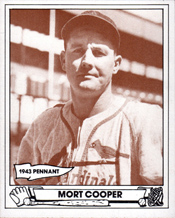
After a season in which he ranked among the National League leaders, no one would have figured Cardinals ace Mort Cooper would do better as a hitter than as a pitcher in the 1942 World Series.

mort_cooper5Cooper, who led the NL in wins (22), shutouts (10) and ERA (1.78) and placed among the top two in strikeouts (152), starts (35) and innings pitched (278.2), started Games 1 and 4 of the 1942 World Series against the Yankees.

To the surprise of most, the right-hander posted an 0-1 record and 5.54 ERA in those two games.

However, in Game 4, Cooper delivered a two-run single off starter Hank Borowy and scored a run, contributing to a 9-6 Cardinals triumph and putting the Yankees on the brink of elimination.

In the ninth inning, Cardinals reliever Max Lanier, who got the win, produced a RBI-single off Tiny Bonham, the Yankees’ 6-foot-2, 215-pound pitcher.

Pitchers with pop

With the run-scoring hits from Cooper and Lanier, the 1942 Cardinals are one of five teams that have had two pitchers produce RBI in a postseason game, according to the Elias Sports Bureau.

The others:

_ Jack Bentley and Hugh McQuillan for the Giants versus the Senators in Game 5 of the 1924 World Series.

_ Lefty Gomez and Johnny Murphy for the Yankees versus the Giants in Game 6 of the 1936 World Series.

_ Steve Avery and Mike Stanton for the Braves versus the Pirates in Game 2 of the 1992 NL Championship Series.

_ Kyle Hendricks and Travis Wood for the Cubs versus the Giants in Game 2 of the 2016 NL Division Series.

Cooper contributes

Cooper was the losing pitcher in the 1942 World Series opener on Sept. 30. He yielded 10 hits, three walks and five runs in 7.2 innings.

After the Cardinals won Games 2 and 3, manager Billy Southworth opted to start Cooper in Game 4 at Yankee Stadium on three days’ rest on Oct. 4 rather than Lanier, a 13-game winner who hadn’t yet appeared in the 1942 World Series.

Lanier, a left-hander, had made 20 starts for the 1942 Cardinals, but he was 5-0 with a 1.25 ERA in 14 relief appearances that season.

The Yankees led, 1-0, in Game 4 before the Cardinals scored six runs in the fourth. Stan Musial opened the inning with a bunt single. The Cardinals took the lead on Whitey Kurowski’s two-run single and Cooper, who batted .184 with seven RBI during the regular season, increased the advantage to 4-1 with his two-run hit.

“Cooper found an outside pitch to his liking and blooped a single to right that sent (Johnny) Hopp and Kurowski home and moved (Marty) Marion to third,” the St. Louis Post-Dispatch reported.

Run-scoring hits by Terry Moore and Musial capped the inning and gave the Cardinals a 6-1 advantage.

Manager misjudgment

Cooper, though, couldn’t shut down the Yankees. He surrendered five runs in 5.1 innings.

Cooper “went into the classic too tired to show at his best,” wrote columnist Dan Daniel in The Sporting News. “After he had been batted out of the first game, he decided that his troubles traced to his fastball. When again he encountered the Bombers (in Game 4), he tried to get by on his curve and it was nothing much. He just didn’t have it.”

Fortunately for the Cardinals, Lanier, who followed Cooper and relievers Harry Gumbert and Howie Pollet, pitched three scoreless innings for the win.

The Cardinals clinched the title with their fourth consecutive victory in Game 5.

“About my only regret was that the Yankees did not see the real Mort Cooper,” Southworth said. “In Mort’s first game, he just wasn’t sharp. He was too careful. In his second start, he should have had another day’s rest. I was to blame. But Mort wanted to go and I admit I wanted him to. I should have waited another day.” Boxscore

Previously: Big-game losses haunt Mort Cooper, Justin Verlander

Read Full Post »

Less than two weeks after they finished the 1936 season tied for second place in the National League, the Cardinals and Cubs determined each had what the other needed in order to win a pennant.

lou_warnekeThe Cardinals, whose team ERA of 4.47 ranked seventh in the eight-team league in 1936, needed a reliable starting pitcher to pair with their ace, Dizzy Dean.

The Cubs, whose 76 home runs ranked fifth in the league, wanted a slugger.

On Oct. 8, 1936, the Cubs traded a premier pitcher, Lon Warneke, to the Cardinals for power-hitting first baseman Rip Collins and pitcher Roy Parmelee.

The blockbuster deal between the rivals rocked the baseball world.

Cubs clout

The Cardinals and Cubs each finished the 1936 season at 87-67, five games behind the champion Giants.

Cubs owner Phil Wrigley directed manager Charlie Grimm to make any trade necessary to improve the club’s chances of winning the 1937 pennant.

Grimm wanted more production from his first baseman. Phil Cavarretta hit nine home runs as the first baseman for the 1936 Cubs. Grimm wanted to move Cavarretta to center field in 1937.

Collins, the Cardinals’ first baseman from 1932-35, hit 35 home runs _ a franchise record for a switch hitter _ in 1934. He became expendable when Johnny Mize took over the position for St. Louis in 1936.

Collins, 32, batted .307 for the Cardinals from 1931-36. His best season was 1934 when he led the league in slugging percentage (.615), extra-base hits (87) and total bases (369). He batted .333 with 200 hits for the National League champions that season. In the 1934 World Series versus the Tigers, Collins batted .367 (11-for-30) with four runs scored.

According to the Associated Press, Grimm told Wrigley “he offered the Cardinals … every other hurler on the staff. The Cardinals, however, insisted on Warneke. Grimm, determined to get Collins, yielded.”

Said Collins to the St. Louis Post-Dispatch: “It’s a great break for me … The front office at St. Louis might have traded me to a second-division club, but they didn’t.”

Great addition

Warneke, 27, a right-hander, earned 100 wins for the Cubs from 1931-36. At the time of the trade, The Sporting News described him as “one of the few great pitchers in the league.”

Warneke compiled 20 wins or more for the Cubs three times between 1932-35. He was 16-13 with a 3.45 ERA in 1936.

“With Dizzy Dean and Warneke, the Cardinals assured themselves of a nucleus for what may be the best pitching staff in the major leagues,” the Associated Press reported.

Grimm said he “hated like hell to part with Warneke” and praised him as a “great pitcher and a loyal, faithful player.”

The Sporting News concluded the Cubs had “given up a lot in Warneke,” adding that “with the Cardinals, he should be even better. He’ll be pitching for a team able to give him some runs, a pleasure he seldom experienced as a Cub.”

The third player in the deal, Parmelee, 29, posted an 11-11 record and 4.56 ERA in his lone season with the Cardinals after being acquired the year before from the Giants.

Coming up short

Even though Warneke and Collins delivered, the trade didn’t bring the results in the standings either team wanted.

The 1937 Giants repeated as National League champions at 95-57. The Cubs placed second at 93-61 and the Cardinals were fourth at 81-73.

Warneke had a stellar season, leading the 1937 Cardinals in wins with an 18-11 record. He would play six seasons (1937-42) with the Cardinals, posting an 83-49 record.

Collins batted .274 with 16 home runs and 71 RBI for the 1937 Cubs. In two seasons with Chicago, Collins totaled 29 home runs and 132 RBI.

Parmelee was 7-8 with a 5.13 ERA in 1937, his lone season with the Cubs.

Previously: Rip Collins was one-of-a-kind hitter for Cardinals

Read Full Post »

Harry Brecheen prevented the Cardinals from experiencing an epic collapse, saving the victory that carried them into the 1946 World Series.

harry_brecheen2On Oct. 3, 1946, the Cardinals beat the Dodgers, 8-4, at Ebbets Field in Brooklyn in Game 2 of a best-of-three playoff series to determine the National League champion. The Dodgers trailed by seven runs before mounting a ninth-inning rally that threatened to steamroll the Cardinals until Brecheen relieved and put a stop to it.

In the ensuing World Series against the American League champion Red Sox, Brecheen, a left-hander nicknamed “The Cat,” continued his poised mastery, earning three of the Cardinals’ four wins.

Dickson delivers

The Cardinals and Dodgers completed the 1946 regular season tied for first place in the NL with records of 96-58.

In Game 1 of the playoff series on Oct. 1, 1946, the Cardinals won, 4-2, at St. Louis. The starting pitchers for Game 2 were Murry Dickson for the Cardinals and Joe Hatten for the Dodgers. Each entered the game with 14 wins that season.

After yielding a run and two hits in the first inning, Dickson held the Dodgers hitless over the next seven innings. The Cardinals scored five runs in five innings against Hatten and added three more off Dodgers relievers. Whitey Kurowski, Enos Slaughter and Marty Marion contributed two RBI apiece. After eight innings, St. Louis led, 8-1.

Dickson “turned in a magnificent pitching job as the Redbirds put the squelch on the loud-mouthed Dodgers of Brooklyn,” the St. Louis Post-Dispatch opined.

Brooklyn frenzy

Dickson, though, as he later admitted to The Sporting News, was tired. The Dodgers scored twice against him in the ninth, cutting the St. Louis lead to 8-3, and had runners on first and second, one out, when manager Eddie Dyer went to the mound to replace Dickson with Brecheen.

Brecheen primarily was a starting pitcher, though he earned two saves in five relief appearances that season.

The first batter he faced, Bruce Edwards, hit a curve for a single, scoring Carl Furillo from second and getting the Dodgers within four at 8-4.

When Brecheen issued a walk to Cookie Lavagetto, loading the bases and bringing the potential tying run to the plate, the crowd of 31,437 “almost went into convulsions,” The Sporting News reported. According to the United Press, the crowd “was roaring with all the bloodthirsty ferocity of ancient Romans watching the kill.”

Though he later told The Sporting News he never was worried, Brecheen said to Oscar Fraley of United Press, “It felt like being under a microscope with a million horns blowing in your ears.”

Under pressure

Eddie Stanky, who led the NL in on-base percentage (.436) and walks (137) in 1946, stepped to the plate.

Brecheen struck out Stanky looking at a fastball.

Up next was Howie Schultz, a 6-foot-6 slugger. Working the count to 3-and-2, the tension increasing with each pitch, Brecheen struck out Schultz swinging at a screwball, ending the game. Boxscore

(In the book “Redbirds Revisited,” Brecheen told authors David Craft and Tom Owens that Pirates pitcher Cy Blanton taught him the screwball when Brecheen was playing American Legion baseball at home in Oklahoma. Blanton also was from Oklahoma and would return there in the baseball off-seasons. “Blanton showed me how to put the reverse spin on the pitch,” Brecheen said.)

Brecheen’s effectiveness carried over into the World Series. He started and won Games 2 and 6, holding the Red Sox to a run in 18 innings.

Dickson got the start in Game 7, yielding three runs in seven innings before being relieved by Brecheen. The Cardinals snapped a 3-3 tie in the eighth when Slaughter made a daring dash from first to home on a hit to center by Harry Walker. Brecheen pitched two shutout innings and got the win, giving the Cardinals their third World Series title in five years.

Read Full Post »

Relying primarily on high fastballs, Larry Jaster got inside the heads of Dodgers batters and kept them from scoring a run against him.

larry_jaster3Jaster, 22, a Cardinals left-hander, made five starts against the 1966 Dodgers and tossed shutouts against them each time.

On Sept. 28, 1966, Jaster pitched the last of those five shutouts _ a 2-0 Cardinals victory at St. Louis _ and tied a major-league record.

Jaster became the third and last pitcher to shut out the same club five times in a season. He joined Senators pitcher Tom Hughes, who shut out the Indians five times in 1905, and Phillies pitcher Grover Cleveland Alexander, who shut out the Reds five times in 1916. Alexander was 8-0 with an 0.50 ERA in eight starts against the 1916 Reds.

Jaster is the only pitcher to achieve five consecutive shutouts against the same club in a season. Before Jaster, the record was held by Giants pitcher Freddie Fitzsimmons, who had four shutouts in a row versus the Reds in 1929.

In his five starts against the 1966 Dodgers, Jaster pitched 45 shutout innings and held them to 24 hits, all singles. He struck out 31, walked eight and hit a batter.

Cardinals vice president Stan Musial had the best explanation. In an interview with the Los Angeles Times after Jaster shut out the Dodgers for the fifth time, Musial, the Cardinals’ all-time best hitter, said, “It gets to be a psychological thing with the hitters when a guy beats them one time after another.”

Beating the best

Jaster held the Dodgers to five hits or less in four of his five shutouts. He beat Don Drysdale and Claude Osteen twice each and Don Sutton once. Drysdale and Sutton would be elected to the National Baseball Hall of Fame.

The 1966 Dodgers were an elite opponent. They were the defending World Series champions and they would repeat as National League pennant winners in 1966.

The first four shutouts by Jaster versus the 1966 Dodgers were:

_ April 25 at Los Angeles. Jaster pitched a seven-hitter and the Cardinals won, 2-0, versus Osteen. Boxscore

_ July 3 at Los Angeles. Jaster had a three-hitter and the Cardinals won, 2-0, versus Drysdale. Boxscore

_ July 29 at St. Louis. Jaster pitched a five-hitter and the Cardinals won, 4-0, versus Drysdale. Boxscore

_ Aug. 19 at Los Angeles. Jaster had a five-hitter and the Cardinals won, 4-0, versus Osteen. Boxscore

Baseball mystery

The Sept. 28 start for Jaster against the Dodgers at St. Louis would be his last of the season. He was matched against Sutton.

The Cardinals were looking to end an eight-game losing streak. The Dodgers, who had a three-game lead over the second-place Pirates with five remaining, were looking to secure the pennant.

In the fourth inning, with two outs and the bases empty, Jaster yielded singles to Lou Johnson and Tommy Davis. Dick Stuart walked, loading the bases. The next batter, Jim Lefebvre, flied out to right fielder Mike Shannon, ending the threat.

“This is a mystery,” Lefebvre said. “That ball Jaster throws looks good (to hit). It rises a little and it has a spin on it, but it still looks good. I could see the ball very well every time. I just can’t believe what happened. It’s beyond me.”

In the bottom half of the inning, Ed Spiezio hit a two-out, two-run double into the left-field corner off Sutton, giving the Cardinals a 2-0 lead.

The Dodgers threatened once more in the seventh. Tommy Davis singled and so did Dick Schofield, but, with two outs, Al Ferrara struck out. The Dodgers were hitless in the eighth and ninth. Jaster finished with a four-hit shutout.

“You’ve got to be kind of lucky to do this,” Jaster told the St. Louis Post-Dispatch. “I don’t feel I throw any differently against the Dodgers _ just up and down, in and out, 90 percent fastballs. I just try not to walk anybody and keep the leadoff man off base.”

Said Cardinals pitching coach Joe Becker: “Jaster just goes around the clock _ high inside, high outside, low inside, low outside. The same thing as (Sandy) Koufax, but, of course, he doesn’t have Sandy’s velocity.”

Said Koufax, the Dodgers’ ace: “Jaster makes it look easy.” Boxscore

Simply incredible

Jaster finished the 1966 season with an 11-5 record and 3.26 ERA. He was 5-0 with an 0.00 ERA versus the Dodgers; 6-5 with a 4.63 ERA against the rest of the National League.

“The kid has the same kind of motion and delivery that (Cardinals left-hander) Howie Pollet used to have,” Musial said. “The ball used to jump out of Pollet’s hand. Jaster throws a lot of balls high, but he keeps them outside.”

Said Dodgers outfielder Willie Davis: “He’s been throwing just one pitch, a fastball, but most guys try to keep the ball low and he’s keeping the ball up.”

Jaster was a .500 pitcher against the Dodgers the rest of his career. He was 9-5 with a 2.81 ERA in 25 career appearances versus the Dodgers.

In 1991, on the 25th anniversary of his five-shutout performance, Jaster told John Sonderegger of the Post-Dispatch: “As time goes on, you think about it and you realize it was kind of an incredible thing.”

In 2011, 45 years after Jaster’s feat, Tim McCarver, the catcher in each of the five shutouts against the Dodgers, told Dan O’Neill of the Post-Dispatch: “It was just one of those wonderful things to be a part of that you really can’t explain.”

Previously: Larry Jaster and his sparkling September with Cards

Read Full Post »

« Newer Posts - Older Posts »