Feeds:
Posts
Comments

Archive for the ‘Pitchers’ Category

Three months after he was traded by the Giants to the Cardinals, Billy Southworth hit a home run against his former team, providing the winning run in the victory that clinched the first National League pennant for St. Louis.
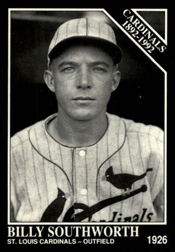
billy_southworth4It was sweet revenge for Southworth, whose deteriorating relationship with Giants manager John McGraw led to the trade.

On Sept. 24, 1926, Southworth broke a 3-3 tie with a two-run home run in the second inning, carrying the Cardinals to a 6-4 victory over the Giants at the Polo Grounds in New York. The victory gave the Cardinals a three-game lead over the second-place Reds with two remaining.

In a biography of Southworth by author John C. Skipper, Southworth said, “I couldn’t have asked for a better setting, in the Polo Grounds against the Giants who had traded me. That was the timeliest home run I ever hit and to have hit it against the Giants, with McGraw snarling his defiance from the bench, made it doubly thrilling and satisfying.”

Quite a comeback

Southworth, a right fielder, was traded by the Giants to the Cardinals on June 14, 1926. “I was unable to subordinate myself to McGraw’s rigid system,” Southworth explained. “So when he decided, in 1926, that I was, from his viewpoint, hopeless, he traded me with no personal feeling one way or the other.”

Contributing to their pennant push, Southworth hit .317 in 99 games for the 1926 Cardinals.

To pitch the potential pennant clincher against the Giants, Cardinals manager Rogers Hornsby chose 20-game winner Flint Rhem as his starter.

After the Cardinals failed to score in the top of the first against Hugh McQuillan, Bill Terry slugged a three-run home run off Rhem in the bottom half of the inning.

Said Southworth: “Hornsby poured acid on us when we came back to the bench. He told us we hadn’t been taking our full cuts at the ball for several games and to get out there and swing.”

Hornsby’s words woke up the Cardinals.

In the second, Les Bell doubled and, with one out, advanced to third on a wild pitch. Bell scored on Bob O’Farrell’s infield single. The No. 8 batter in the order, Tommy Thevenow, doubled, moving O’Farrell to third.

Rhem was due up next, but Hornsby lifted him for a pinch-hitter, Specs Toporcer.

Toporcer, who hit .391 as a pinch-hitter for the 1926 Cardinals, drilled a two-run double, tying the score at 3-3.

After Taylor Douthit flied out, Southworth batted and hit his home run into the upper deck in right field, giving the Cardinals a 5-3 lead.

Bill Sherdel, who relieved Rhem, held the Giants to one run in eight innings and got the win. Boxscore

Dancing downtown

In downtown St. Louis that Friday afternoon, the game was broadcast over loudspeakers set up for the public.

When Sherdel nailed down the final out, sealing the Cardinals’ victory, it “loosed bedlam in the downtown district,” according to the St. Louis Post-Dispatch.

“Scenes comparable only with the ending of the Great War were enacted in the business section and repeated upon a smaller scale in other centers of the city’s life,” the newspaper reported. “Blizzards of paper enveloped every office building in the downtown area between Twelfth Boulevard and Fourth.”

Wrote the Associated Press: “Traffic at the principal corners was in a hopeless jam. Policemen, trying vainly to keep some semblance of order, were unable to keep the automobiles and street cars moving. Parades formed on Olive Street, Washington Avenue and other principal thoroughfares.”

At the Polo Grounds, the victorious Cardinals “merely smiled as they hurried to the clubhouse, shaking hands and slapping one another on the back” wrote the Associated Press.

That night, reported J. Roy Stockton in the Post-Dispatch, “as the young men sat around the lobby of the Alamac Hotel, accepting congratulations and reading telegrams from friends back home, they appeared suddenly to have knocked 10 years off their age.”

Confident Cards

Contacted by the Associated Press, Cardinals owner Sam Breadon said, “Nothing could possibly have made me happier than the winning of the pennant. When I took charge of the club seven years ago, I did it with the sole hope of winning a championship for St. Louis.”

Asked about the Cardinals being matched against the American League champion Yankees in the 1926 World Series, Hornsby boasted to The Sporting News, “Of course we are going to win the world’s championship. We have the punch and that means we do not fear the Yankees’ pitchers. We have better pitchers of our own, for that matter. Also, a faster fielding team.”

The Cardinals went on to win four of seven games against the Yankees, earning the World Series title.

Previously: How Cardinals got Grover Cleveland Alexander
Read Full Post »

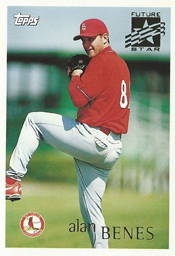
Working with Cardinals coaches Mark Riggins and Bob Gibson after his promotion from the minor leagues to St. Louis in September 1995, Alan Benes adjusted his approach, mixing off-speed pitches with his fastball, and delivered a double-digit strikeout performance in earning his first win.

alan_benes3On Sept. 30, 1995, Benes, in his third big-league appearance, struck out 10 Pirates in the Cardinals’ 5-1 victory at St. Louis.
Twenty-one years later, Luke Weaver joined Benes and Stu Miller as the only Cardinals pitchers to achieve double-digit strikeouts in one of their first four appearances for St. Louis, according to researcher Tom Orf.

Miller struck out 10 Dodgers in his fourth Cardinals appearance on Aug. 26, 1952. Boxscore Weaver struck out 10 Brewers in his fourth Cardinals appearance on Aug. 31, 2016. Boxscore

Valued prize

Like Weaver in 2014, Benes was a first-round draft choice of the Cardinals. Benes was selected in the 1993 June amateur draft with the 16th overall pick just after the Blue Jays took pitcher Chris Carpenter with the 15th pick.

Benes produced a 17-3 record and 2.28 ERA in 30 starts in the Cardinals’ minor-league system in 1994. Limited by an injury, he was 4-2 with a 2.41 ERA in 11 starts for Class AAA Louisville in 1995 before his call-up to the Cardinals.

In September 1995, the St. Louis Post-Dispatch described Benes as “the most valued prize in the Cardinals’ farm system.”

Learning curve

Benes, 23, made his Cardinals debut on Sept. 19, 1995, in a start against the Pirates at Pittsburgh. He displayed an impressive fastball, but wasn’t effective. His line: 4 innings, 8 hits, 7 runs, 1 walk and 5 strikeouts. The Pirates won, 12-1, and Benes was the losing pitcher.

“He threw a few too many strikes,” Riggins told writer Rick Hummel. “He didn’t make the hitters chase some pitches and he can. That comes with experience.”

Said Benes: “I didn’t really move the ball around as much as I could have. I didn’t throw inside enough. I basically had one pitch.”

Six days later, on Sept. 25, Benes made his second appearance, starting against the Cubs at Chicago, and the results were similar to his first. Benes’ line: 3.1 innings, 9 hits, 7 runs, 1 walk, 5 strikeouts. The Cubs won, 7-0, dropping Benes’ record to 0-2.

“He didn’t get his breaking ball over,” said Cardinals manager Mike Jorgensen. “… He’s throwing hard. It’s a matter of pitching rather than throwing.”

Said Benes: “I’m not happy, but I’m not going to put a lot of stock in it. The first three or four games you’ve got to learn.”

That’s a winner

Benes was a quick study. Riggins, the pitching coach, and Gibson, the bullpen coach and former ace, worked with Benes on pitch selection and command.

In his third Cardinals appearance, on Sept. 30 against the Pirates at St. Louis in the next-to-last game of the season, Benes was dominant.

The 6-foot-5 right-hander shut out the Pirates through eight innings. He entered the ninth with a 5-0 lead.

With two outs and runners on first and third, Midre Cummings hit a double to center off Benes, driving in a run.

Jorgensen was booed when he went to the mound and called for closer Tom Henke to replace Benes. Henke struck out Kevin Young, saving Benes’ first win. Benes’ line: 8.2 innings, 7 hits, 1 run, 2 walks and 10 strikeouts. Boxscore

In his analysis of Benes’ performance, Cardinals catcher Danny Sheaffer said, “He got ahead in the count. No doubt that made a big difference. That and he pitched a little different with the early lead.”

Entering the off-season on a positive, Benes admitted, “This was a real important game for me to win.”

Three months later, the Cardinals signed his older brother, starting pitcher Andy Benes, who had become a free agent after pitching for the Padres and Mariners. In 1996, Andy and Alan Benes combined for 31 regular-season wins, helping the Cardinals to a division championship.

Previously: The story of Stu Miller and his stellar start with Cards

Previously: Unlike Lance Lynn, Alan Benes unlucky in big K effort

Read Full Post »

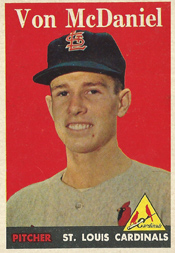
When Von McDaniel joined his brother, Lindy, on the 1957 Cardinals staff and began shutting down opponents, comparisons were made to another sibling pitching duo in St. Louis lore, Dizzy and Paul Dean.

von_mcdanielFor a while during that summer of 1957, Von McDaniel, 18, created as much excitement among Cardinals fans as the Dean brothers did in 1934 when they combined for 49 regular-season wins in pitching St. Louis to a National League pennant.
Von McDaniel opened his Cardinals career by pitching 19.2 consecutive scoreless innings over four appearances. He pitched eight scoreless innings over two relief appearances, then 11.2 scoreless innings over two starts.

Little brother

Von McDaniel received a $50,000 bonus when he signed with the Cardinals on May 27, 1957, after graduating from high school in Hollis, Okla. He was placed on the Cardinals’ active roster, joining Lindy, who had received the same bonus amount when he signed with the Cardinals in August 1955 at age 19.

Lindy McDaniel made his Cardinals debut on Sept. 2, 1955. He was used primarily in relief by them in 1956 and joined their starting rotation in 1957.

When Von McDaniel joined the Cardinals in May 1957, scout Fred Hawn, who had signed both McDaniel brothers, told The Sporting News, “Von throws harder than Lindy.”

Fred Hutchinson, the Cardinals manager, was in no hurry to use Von. “I’ll let him get acquainted, get the feel of things and then let him mop up (in a game),” Hutchinson said.

Von was the definition of a greenhorn. Four days after he signed with the Cardinals, Von took his first train ride when the club traveled from St. Louis to Milwaukee.

Dominant debut

Von was inactive during his first two weeks with the Cardinals.

On June 13, at Philadelphia, the Phillies led, 8-1, through four innings when Hutchinson decided the time was right for Von to make his debut.

Hal Smith, the Cardinals’ catcher, met Von at the mound and, attempting to keep things simple, told the rookie he would signal 1 for a fastball, 2 for a curve and 3 for a changeup. As Smith turned to go back behind the plate, Von said, “And No. 4 for my slider.”

Von pitched four scoreless innings, yielding only a single to Granny Hamner and striking out four. He retired the last 10 consecutive batters. Boxscore

Dodgers dazzled

Three days later, on June 16, the Cardinals were in Brooklyn to face the defending NL champion Dodgers in a doubleheader. In Game 1, the Dodgers led, 6-2, through five when Hutchinson put in Von.

Again, the rookie pitched four scoreless innings, allowing two baserunners _ Elmer Valo doubled and Charlie Neal was hit by a pitch _ and striking out five. When the Cardinals rallied for a 7-6 victory, McDaniel had his first big-league win. Boxscore

Said Dodgers slugger Duke Snider, who struck out and grounded out versus Von: “He’s real good. Got a fine curveball and exceptional control.”

Sensational start

Five days later, on June 21, Hutchinson pulled a surprise, announcing Von would start that night in St. Louis against the Dodgers. Earlier, Hutchinson had said Willard Schmidt would get the start. The manager later admitted he used Schmidt as a decoy so Von wouldn’t lose sleep in anticipation of his first start.

Pitching before a Friday night crowd of 27,972, Von held the Dodgers hitless through the first five innings.

In the sixth, with the score at 0-0, the Dodgers loaded the bases with none out on two singles and an error. The catcher, Smith, went to the mound and told Von, “If the ball is hit to you, don’t forget to throw it to me.”

Nonplussed, Von patted the veteran on the shoulder and said, “OK, Smitty, and don’t worry.”

The batter, Valo, hit a comebacker to Von. He threw to Smith, whose relay to first baseman Stan Musial completed the double play. When Gino Cimoli followed by grounding out to Von, the rookie left the mound to a standing ovation from the energized crowd.

The Cardinals triumphed, 2-0, and Von got a complete-game shutout. He limited the Dodgers to two hits and three walks, striking out four. Boxscore

“He’s either the greatest in the league, or we’re the worst hitters,” Dodgers manager Walter Alston said to the St. Louis Post-Dispatch.

In The Sporting News, Bob Broeg wrote, “The sensational arrival of Von McDaniel to give the Cardinals a red-hot brother pitching act has created the most excitement in St. Louis since Paul Dean joined brother Dizzy to help pitch the Gashouse Gang to the 1934 pennant.”

Fast fade

The next day, June 22, Dizzy Dean met the McDaniel brothers at the Cardinals’ ballpark. “You fellows are going to go a long way,” Dean told them. “Some day you’ll win 49 games (in a season) like me and Paul.”

Von got his second start on June 27 against the Phillies at St. Louis. He didn’t allow a run in the first two innings, extending his scoreless streak to 19.

In the third, after retiring the first two batters, Von gave up a single to Hamner and a run-scoring double to Ed Bouchee.

Though Von gave up four runs in 7.1 innings, he got the win as the Cardinals prevailed, 6-4. Hoyt Wilhelm, the future Hall of Famer, earned the save with 1.2 innings of scoreless relief. Boxscore

Through his first five appearances for the Cardinals, Von posted a 4-0 record and 1.71 ERA. He finished the 1957 season at 7-5 with a 3.22 ERA in 17 games, including 13 starts.

“What he had was phenomenal control,” Al Hollingsworth, pitching coach for the 1957 Cardinals, told Larry Harnly of The State Journal-Register of Springfield, Ill. “He had the facility to keep the ball knee-high _ not an inch higher or lower.”

After the season, Von got out of shape. When he reported to spring training in 1958, he had lost command of his pitches. “He changed his style and tried to throw harder,” Hollingsworth said. “He couldn’t. All he had was control.”

Von appeared in two games for the 1958 Cardinals and was sent back to the minor leagues. He soon gave up on pitching and became a third baseman, playing in the minors until 1966 but never returning to the major leagues.

Read Full Post »

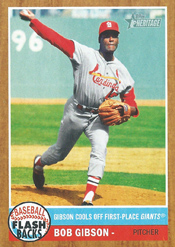
In a matchup against the Giants, Cardinals ace Bob Gibson pitched a complete game, struck out 14 batters and slugged a home run, but it wasn’t enough to win.

bob_gibson22On Aug. 30, 1972, the Giants beat the Cardinals, 3-2, at St. Louis despite Gibson’s dominance.

Giant killer

Gibson, 36, carried a 10-game, three-year winning streak against the Giants into his 1972 start versus them. He hadn’t lost to the Giants since Sept. 17, 1968, when Gaylord Perry pitched a no-hitter against the Cardinals at San Francisco. Since then, Gibson had posted records versus the Giants of 3-0 in 1969, 3-0 in 1970 and 4-0 in 1971.

In his only 1972 start against the Giants, Gibson held them hitless in the first inning, but yielded three singles, resulting in a run, in the second.

In the sixth, Gibson struck out the side, Bobby Bonds, Jim Howarth, Chris Speier, and led off the bottom half of the inning with a home run into the left-field seats against starter Jim Willoughby, tying the score at 1-1. It was Gibson’s fifth home run of the season and matched the career high he first achieved in 1965.

Price is right

Each of the Giants in the starting lineup struck out at least once against Gibson and he held the Giants hitless from the third inning through the eighth. “Gibson may be close to 37, but he still amazes me every time he gets out there,” Giants coach Joey Amalfitano told the Associated Press. “He’s one guy I’d pay to watch.”

The Cardinals were unable to break though against Willoughby, a rookie, and the score remained tied at 1-1 through eight.

In the ninth, a tiring Gibson yielded a walk and three singles, including RBI-hits by Dave Rader and Tito Fuentes, giving the Giants a 3-1 lead.

Bernie Carbo hit a solo home run off Willoughby in the bottom of the ninth, but it wasn’t enough for the Cardinals. Boxscore

“I’d trade those 14 strikeouts for a win anytime,” Gibson said.


Read Full Post »

Ken Burkhart was the first Cardinals pitcher to earn a save and a win in relief in his first three major-league games, according to researcher Tom Orf.

ken_burkhartBurkhart, who pitched with an unusual delivery, like someone heaving a shot put, was 28 when he achieved his feat in April 1945.
Working the farm

Burkhart (the original spelling of the name was Burkhardt) was working as a machinist in Cleveland in the summer of 1937 when he attended a Cardinals tryout camp at Columbus, Ohio. The Cardinals invited him to their baseball school at Winter Haven, Fla., the following spring.

The Cardinals signed Burkhart, 21, at the 1938 Winter Haven camp and he began an odyssey through the St. Louis farm system.

Burkhart earned 20 wins for Class B Asheville (N.C.) in 1940. A broken left leg in 1942 set him back.

After posting a 15-9 record for Class AA Columbus (Ohio) in 1944, Burkhart was invited to the Cardinals’ spring training camp in 1945. With several pitchers in military service, Burkhart was given a long look by the Cardinals and the rookie won a spot on their Opening Day roster.

“It seemed a long time coming up, but I kept aiming for the top,” Burkhart told The Sporting News.

Fast start

On April 21, 1945, Burkhart made his major-league debut in the Cardinals’ home opener, pitching two scoreless innings and getting the win in a 3-2 St. Louis victory over the Reds at Sportsman’s Park.

Following starter Blix Donnelly and Bud Byerly, Burkhart entered in the eighth with the score tied at 2-2 and retired six of the seven batters he faced in his two innings of work. In the bottom of the ninth, Johnny Hopp delivered a RBI-single against starter Arnold Carter, lifting the Cardinals to victory. Boxscore

The next day, April 22, Burkhart pitched 1.1 innings of scoreless relief in Game 2 of a doubleheader versus the Reds.

In his third appearance, April 29, Burkhart got his save.

With the Cardinals ahead, 4-3, in Game 2 of a Sunday doubleheader at Crosley Field in Cincinnati, Burkhart relieved starter Mort Cooper with two outs in the seventh. He shut down the Reds, yielding no runs in 2.1 innings. The Cardinals won, 8-3. Boxscore

Relentless grinder

Burkhart completed the 1945 season with an 18-8 record and 2.90 ERA in 42 appearances for the Cardinals. He made 22 starts and 20 relief appearances, totaling 217.1 innings. The right-hander was 12-7 with a 2.75 ERA as a starter and 6-1 with three saves and a 3.40 ERA as a reliever.

Burkhart was a combined 6-0 that season against the Cubs and Dodgers.

“He’s one of the gamest pitchers I’ve ever had work for me,” Cardinals manager Billy Southworth said. “I’ve had men with more stuff, but none who ever bore down harder all the way.”

Calling strikes

His rookie season was Burkhart’s best as a big-league pitcher.

In four seasons with the Cardinals, Burkhart was 27-17 with seven saves and a 3.60 ERA. In July 1948, the Cardinals dealt Burkhart to the Reds for first baseman Babe Young. Burkhart was 0-3 with one save and a 5.40 ERA in two seasons with Cincinnati.

With his pitching career at an end, Burkhart returned to the minors and began a second career as an umpire.

Burkhart was a National League umpire from 1957-73. He worked the 1964 World Series between the Yankees and Cardinals. It was the Cardinals’ first World Series appearance since Burkhart pitched for them in 1946.

Burkhart was the home plate umpire when the Yankees won, 2-1, in Game 3 of the 1964 World Series.

In his 1964 book “Stan Musial: The Man’s Own Story,” Musial, commenting on Burkhart as a pitcher, said, “Ken had an idea the plate was wider and the strike zone bigger than he sees them now as an umpire. He had a frozen shoulder, a strange shot-put delivery, and only limited skill, but he had a good competitive heart.”

Previously: The day Ralph Kiner hit 3 home runs vs. Cardinals

Read Full Post »

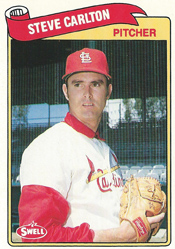
At 21, Steve Carlton was a quick study in learning the art of pitching. Combining skill with knowledge, Carlton earned his first big-league win with the Cardinals on Aug. 5, 1966.

steve_carlton6Mixing a changeup with a fastball and curve, Carlton pitched a complete game in the Cardinals’ 7-1 victory over the Mets at Shea Stadium in New York.

“Up here you need that third pitch, especially when you’re having trouble with either your fastball or your curve,” Carlton said to the St. Louis Post-Dispatch. “I wasn’t getting my curve over this time.”

It was the first of 329 regular-season wins for Carlton in his 24 years in the big leagues. He ranks second all-time in wins among left-handers. Only Warren Spahn (363) has more.

Carlton earned 77 wins in seven years (1965-71) with the Cardinals before he was traded to the Phillies.

Hall of Fame game

In 1965, Carlton’s first big-league season, he pitched in 15 games, including two starts, for the Cardinals and had an 0-0 record.

Carlton opened the 1966 season with Tulsa and was 9-5 with a 3.59 ERA in 19 starts for the Class AAA club.

On July 25, 1966, the Cardinals and Twins played an exhibition game as part of the National Baseball Hall of Fame induction festivities at Cooperstown, N.Y. Not wanting to use one of their starters, the Cardinals gave the assignment to Carlton, who still was on the Tulsa roster. Taking advantage of the opportunity, Carlton pitched a complete game and struck out 10 in a 7-5 Cardinals victory. Four of the runs scored by the Twins were unearned.

Liking what they saw, the Cardinals put Carlton on their active roster and gave him a start against the Dodgers on July 31, 1966. Carlton pitched four innings, yielded two runs and didn’t get a decision.

Pitch like a pro

Five days later, with the Cardinals looking to shake a five-game losing streak, Carlton got the start against the Mets.

The leadoff batter reached base in four of the first five innings against Carlton, but the Mets scored just once. Carlton held the Mets hitless over the last four innings.

The Mets totaled six hits: five singles and a Ken Boyer double.

“The kid has a nice, easy motion and pitches as if he’s been around for 10 years,” said Mets manager Wes Westrum. “His ball is really live.”

Said Carlton: “I was getting the ball in good spots this time, but I still was putting too many men on base. Red Schoendienst (Cardinals manager) was nice going with me as long as he did.”

Carlton was supported by three Cardinals home runs, including a three-run shot from his catcher, Tim McCarver. Julian Javier contributed a two-run home run and Tito Francona had a solo shot. Boxscore

Carlton made nine starts for the 1966 Cardinals, posting a 3-3 record and 3.12 ERA.

Previously: How Chase Riddle got Steve Carlton for Cardinals


Read Full Post »

« Newer Posts - Older Posts »