Feeds:
Posts
Comments

Archive for the ‘Pitchers’ Category

In the first week of his first season as Cardinals manager, Tony La Russa had a problem. After five games, his bullpen was overworked. Entering the finale of a six-game road trip, La Russa needed his No. 5 starter, rookie Mike Busby, to pitch as long as possible in his big-league debut against the Braves in Atlanta.

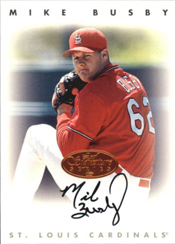
mike_busbyOn April 7, 1996, Busby absorbed a beating by the Braves, who scored 13 runs in four innings before Busby was relieved. The Braves scored twice in the first inning, five times in the second, four times in the third and twice in the fourth.

La Russa and pitching coach Dave Duncan had hoped Busby could pitch at least five innings.

Climbing the ladder

Busby was selected by the Cardinals in the 14th round of the 1991 draft. His best performance in their minor-league system was in 1993 when he was 12-2 with a 2.44 ERA for Class A Savannah.

In 1996, Busby opened the season in the big leagues for the first time as the No. 5 starter for the Cardinals behind Andy Benes, Todd Stottlemyre, Alan Benes and Tom Urbani.

After splitting the first two games of the season with the Mets, the Cardinals gave up 10 runs in a Game 3 loss to New York and won a pair against the Braves in 12 innings and in 10 innings.

Long balls

La Russa and Duncan hoped to avoid using the bullpen much in the finale of the series in Atlanta.

The Braves hammered Busby for nine hits, including seven for extra bases. Busby yielded four home runs, including a Marquis Grissom grand slam. Busby also issued four walks and hit a batter.

Duncan said Busby likely was tipping his pitches because of how he held his glove.

“The way they were swinging the bats, nothing was surprising them,” Duncan told the St. Louis Post-Dispatch.

Said Busby: “You can’t make mistakes to those big hitters. Down in the minor leagues, you can get away with those mistakes. Here, they jump all over them.”

Guts, no glory

The Braves won, 13-3. Tony Fossas and Cory Bailey each pitched two innings of scoreless relief for St. Louis.

La Russa held a closed-door clubhouse meeting after the game.

“I made it a point to commend Mike in front of everybody,” La Russa said. “He was in a tough situation, but he never once embarrassed himself or embarrassed the team. He’s got special insides. He’ll be fine.”

Said Busby: “I don’t want any sympathy.” Boxscore

Mixed results

The next day, the Cardinals sent Busby to Class AAA Louisville and called up pitcher Brian Barber. Busby spent the remainder of the season in the minors. He was 2-5 with a 6.38 ERA for Louisville.

Busby appeared again with the Cardinals in each of the next three seasons. He was 0-2 in 1997, 5-2 in 1998 and 0-1 in 1999.

Granted free agency after the 1999 season, Busby signed with the Brewers but never pitched in the big leagues again. His career totals with the Cardinals: 5-6, 6.48 ERA in 45 games.


Read Full Post »

(Updated April 17, 2022)

Three years after the Blue Jays removed Chris Carpenter from their big-league roster and told him he’d have to go to the minors if he wanted to remain with the organization, the pitcher returned to Toronto as a member of the Cardinals and showed why giving up on him was a mistake.

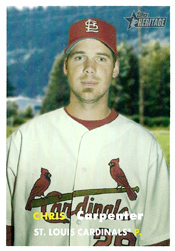
chris_carpenter11On June 14, 2005, Carpenter faced the Blue Jays for the first time since leaving them and pitched a one-hit shutout for a 7-0 Cardinals victory that was as much personal as it was professional.

The masterpiece at Toronto helped establish Carpenter as a pitcher who got big wins in the big games for St. Louis. Carpenter posted a 95-44 regular-season record and 10-4 postseason mark (including 3-0 in the World Series) as a Cardinals starter from 2004-2012.

Oh, Canada

Carpenter began his professional career with the Blue Jays. He was selected by them with the 15th pick in the first round of the 1993 amateur draft, just ahead of pitcher Alan Benes, who was chosen by the Cardinals with the 16th selection.

Four years later, Carpenter made his big-league debut. One of the teammates who influenced him was pitcher Pat Hentgen, who, like Carpenter, would pitch for the Cardinals after leaving the Blue Jays.

“He taught me the importance of what every fifth day was,” Carpenter told Cardinals Magazine. “You get one time every five days to go and make an impact, and you need to make that important. I learned from him that you have to find a way to grind through it, no matter if you feel good or not.”

Carpenter had a 49-50 record for Toronto from 1997-2002.

In October 2002, the Blue Jays removed Carpenter, who had undergone shoulder surgery, from their big-league roster and offered him a spot at Class AAA Syracuse. Instead, Carpenter chose to become a free agent and signed with the Cardinals.

He spent 2003 working his shoulder into shape and didn’t pitch in the major leagues that season. He returned to the big leagues with the Cardinals in 2004.

Good stuff

After posting a 15-5 record in 28 starts for the 2004 Cardinals, Carpenter established himself as the staff ace in 2005. He took an 8-4 record into the start at Toronto.

Carpenter’s return to Toronto drew a Tuesday night crowd of 37,536, including actor Bruce Willis. One fan held up a sign that read: “Thanks for four years of frustrating mediocrity, Carpenter.”

Carpenter responded to the wise guy with a tip of his cap.

Mostly, he let his pitching do the talking.

Effectively mixing a four-seam fastball, curve and changeup, Carpenter baffled the Blue Jays. “My stuff was good and I thought I kept them off balance pretty good,” Carpenter said to the St. Louis Post-Dispatch.

Said Cardinals manager Tony La Russa: “He had movement all over, mostly down.”

Gregg Zaun, drawing a leadoff walk in the third, was the first Blue Jays batter to reach base. The next batter, Orlando Hudson, grounded into a double play.

The Blue Jays were hitless until, with two outs in the sixth, rookie Russ Adams pulled a ball that landed barely inside the right-field foul line for a double.

Carpenter retired the last 10 batters in a row. Video

“In a game of inches, he came within a couple of inches of throwing a no-hitter,” Cardinals designated hitter Larry Walker said.

Toronto tormentor

The one-hitter was the first of Carpenter’s big-league career. It also was the 19th one-hitter by a Cardinals pitcher and the first since Vicente Palacios achieved the feat for St. Louis against the Astros in 1994.

“He wanted to come back (to Toronto) and make an impression,” La Russa said of Carpenter. “He did.”

Blue Jays manager John Gibbons told the Associated Press, “He throws downhill at you. He throws 94 mph with that big old hook that he can control. It’s tough to hit that.”

Carpenter was supported by four home runs: Walker hit a pair of two-run home runs, Reggie Sanders hit a solo shot and Albert Pujols also had a two-run home run. Boxscore

Carpenter pitched one more one-hitter. It occurred on Sept. 7, 2009, in a 3-0 Cardinals victory over the Brewers at Milwaukee. The lone hit off Carpenter was a fifth-inning double by Jody Gerut.

On June 23, 2010, at Toronto, Carpenter faced the Blue Jays for the second and last time in his career. He pitched eight scoreless innings and got the win in a 1-0 Cardinals victory.

Matt Holliday broke a scoreless tie with a two-out, RBI-single in the top of the ninth off Kevin Gregg, who had relieved starter Ricky Romero.

Ryan Franklin earned the save, yielding a single and a walk _ but no run _ in the bottom of the ninth.

Previously: Mike Matheny helped Chris Carpenter join Cards

Read Full Post »

(Updated July 5, 2020)

To many, Jeff Weaver looked like a washed-up pitcher when he was with the 2006 Angels. To the Cardinals, Weaver looked like the answer to a need.

weaver_brothersOn July 5, 2006, the Cardinals got Weaver from the Angels for minor-league outfielder Terry Evans. The Angels also paid $2.5 million of the remaining $4 million owed Weaver on his 2006 contract, the Los Angeles Times reported.

After a shaky start to his Cardinals career, Weaver became an effective starter in the 2006 postseason and was integral to St. Louis winning a World Series championship.

“Without him, we don’t win,” Cardinals center fielder Jim Edmonds told Fox Sports Midwest.

Available assets

Entering the majors in 1999, Weaver pitched for the Tigers, Yankees and Dodgers before becoming a free agent and joining the 2006 Angels. He had 13 wins with the 2004 Dodgers and 14 wins with the 2005 Dodgers.

With the 2006 Angels, Weaver was 3-10 with a 6.29 ERA in 16 starts. Opponents hit .309 against him. His younger brother, rookie Jered Weaver, replaced him in the Angels’ rotation.

The Cardinals, looking to replace Sidney Ponson in their rotation, had dispatched two scouts to evaluate Jeff Weaver. Dave Duncan, the Cardinals’ pitching coach, watched video of the Angels’ right-hander and determined he could help the club.

On June 30, 2006, Weaver, 29, was designated for assignment by the Angels, meaning he needed to be traded or released. The Cardinals were one of eight teams to make the Angels an offer for him.

“We’ve seen the guy pitch a few times … and still feel he has the assets he’s had in the past,” Cardinals general manager Walt Jocketty told Rick Hummel of the St. Louis Post-Dispatch. “Maybe he hasn’t been using them as best he could be.

“One of the scouts who saw him thought he was using his breaking ball too much and wasn’t using his fastball. He’s got a pretty good fastball and there might be a chance we can make a change that makes him better.”

In an interview with Joe Strauss of the Post-Dispatch, Weaver said, “Maybe I was throwing too many strikes. I was getting hurt quite a bit on 0-and-2 pitches. I could probably do a better job of expanding the strike zone.”

Championship caliber

Post-Dispatch columnist Bernie Miklasz liked the acquisition. “Dave Duncan’s overall success rate with fading veterans is superb,” Miklasz wrote. “That’s why we expect to see Jeff Weaver improve in St. Louis.”

In a 2016 interview with Dan McLaughlin of Fox Sports Midwest, Weaver recalled when he arrived in St. Louis he met with Cardinals manager Tony La Russa, who told him, “We just want you to go out there and compete.”

Said Weaver: “I knew how to do that.”

Weaver’s first Cardinals appearance was a start against the Braves at St. Louis on July 17, 2006. He didn’t impress. In four innings, Weaver yielded six runs, including a Brian McCann grand slam, and took the loss. Boxscore

“It took a little while to get in a groove,” Weaver said.

Weaver made 15 regular-season starts for the 2006 Cardinals and was 5-4 with a 5.18 ERA. However, he won his last three decisions, including a Sept. 29 triumph against the Brewers that extended the Cardinals’ lead over the second-place Astros from a half-game to 1.5 games with two to play. Boxscore

Noting that Weaver had been “all but left on the shoulder of a Southern California freeway by the Angels,” Miklasz wrote of the gritty win over the Brewers, “The quality of Weaver’s determination was superior to the numbers on his final pitching line. He deserved the standing ovation that came his way as he departed the mound. In this critical final month, Weaver is 3-1 with a 4.15 ERA. He’s no longer a junker.”

Said La Russa after that game: “Weaver was outstanding. The way he competed, you could see him working hard to get the outs. That’s one of the reasons why we like him. He’s a terrific competitor. He really did a good job for us. He did exactly what we needed.”

Weaver carried that effort into the 2006 postseason. He was 1-0 vs. the Padres in the National League Division Series and 1-1 against the Mets in the NL Championship Series.

In the World Series, Weaver got the clinching win in Game 5, holding the Tigers to two runs in eight innings and striking out nine.

After that, Weaver became a free agent and signed with the Mariners.

Read Full Post »

An effective combination of quality and depth in the starting rotation enabled the 1941 Cardinals to win their first 12 road games. That streak remains the franchise record for most road wins in a row.

howie_kristEight different Cardinals pitchers accounted for those 12 consecutive road wins. Ten of those wins were achieved by starters, including eight complete-game efforts.

Mort Cooper earned three of the dozen road wins. Lon Warneke and Max Lanier had two apiece. Five Cardinals pitchers each got a win during the road streak: Johnny Grodzicki, Sam Nahem, Howie Krist, Hank Gornicki and Ernie White.

The streak was achieved in two parts _ from April 15-17 and from April 26-May 5 _ in five cities. Of the dozen road wins, three were accomplished at Cincinnati against the Reds, two at Chicago against the Cubs, three at New York against the Giants, two at Philadelphia against the Phillies and two at Boston against the Braves.

Sweeping the champs

The 1941 Cardinals opened the season on April 15 at Cincinnati against the defending World Series champion Reds. Ernie Koy, Enos Slaughter and Johnny Mize each hit a home run and the Cardinals won, 7-3. Warneke, who pitched a complete game, yielded 10 hits, but walked none and was helped by a defense that turned three double plays. Boxscore

In the second game of the series on April 16, Cooper pitched a five-hitter and the Cardinals won, 4-2. With the score tied at 2-2 in the ninth, Jimmy Brown hit a two-run, two-out double off Johnny Vander Meer. Boxscore

Another ninth-inning rally enabled the Cardinals to complete the series sweep on April 17. With the Reds ahead 6-5, Slaughter scored from third base with the tying run on a Bob Logan wild pitch. Marty Marion walked and scored the go-ahead run on a triple by Frank “Creepy” Crespi.

In the bottom of the ninth, reliever Hersh Lyons, making his debut in what would be his only big-league appearance, loaded the bases with one out. Lanier replaced him, induced two groundouts without allowing a run to score and was credited with the win in a 7-6 Cardinals triumph. Boxscore

The Sporting News hailed the Cardinals for a “sensational three-in-a-row start in Cincinnati.”

From there, the Cardinals went to St. Louis for a six-game homestand with the Cubs, Pirates and Reds. The Cardinals won three of those games, giving them a 6-3 record as they embarked on a 14-game road trip to six cities.

Rolling along

The journey began on April 26 at Chicago with a 6-2 Cardinals victory over the Cubs. Lanier started and pitched a two-hitter for the win. Mize and Marion each drove in two runs for the Cardinals. Boxscore

The Cardinals completed the two-game series and earned their fifth consecutive road win with an 8-5 victory over the Cubs on April 27. Cooper got the win, even though he yielded four walks and eight hits, including a three-run home run by Bill “Swish” Nicholson. Slaughter had three RBI and the Cardinals compiled 13 hits. Boxscore

After a day off, the Cardinals began a three-game series at the Polo Grounds in New York.

In the opener on April 29, the Giants scored three runs in the first two innings off Bill McGee. Johnny Grodzicki, making his fourth big-league appearance, relieved, pitched six innings and limited the Giants to a run on three hits. He got the win when the Cardinals rallied and prevailed, 5-4. Boxscore

On April 30, Sam Nahem, acquired a year earlier in the trade that sent slugger Joe Medwick to the Dodgers, made his second Cardinals start, pitched eight innings and got the win in a 6-4 Cardinals triumph over the Giants. Slaughter and Mize each hit a home run. Boxscore

The Cardinals extended their road win streak to eight with a 5-0 victory over the Giants on May 1. Warneke pitched the shutout, even though he surrendered nine hits and a walk. The Giants stranded nine. Brown and Marion each hit a two-run home run for the Cardinals. Boxscore

Fine fiber

Warneke’s gem was the start of a dominant stretch for Cardinals pitchers. In the last five road wins of the streak, the Cardinals yielded a total of four runs.

On May 2 at Philadelphia, the Cardinals beat the Phillies, 4-2. Howie Krist, in his first start of the season, pitched a five-hitter for the win. He held the Phillies scoreless for the first eight innings. Boxscore

The Cardinals got their 10th consecutive road win in a most unexpected manner. Hank Gornicki, 30, made his first big-league start and pitched a one-hitter in a 6-0 Cardinals triumph over the Phillies on May 3. Stan Benjamin broke up the no-hit bid with a single in the sixth. Boxscore

Boston was the next stop for the Cardinals.

On May 4,  the Cardinals beat the Braves, 3-1. Cooper got the win, shutting out the Braves over the last six innings. The Cardinals scored all of their runs in the eighth, with Cooper’s brother and batterymate, Walker, contributing one of the RBI. Boxscore

The 12th consecutive road win for the Cardinals was a 5-1 victory over the Braves on May 5. Ernie White, making his first start of the season, pitched a five-hitter. Slaughter hit a two-run home run for St. Louis. Boxscore

In The Sporting News, Dick Farrington wrote, “When a team can win away from the friendly surroundings of its home playgrounds, it is always considered a rather definite sign of class and fiber.”

Second best

On May 6, the road win streak ended at Boston. The Braves scored all of their runs in the fifth off Grodzicki, making his final appearance of the season for St. Louis, and won, 5-4. The Cardinals had 11 hits and received seven walks, but stranded 13. Boxscore

The 1941 Cardinals finished in second place in the National League at 97-56, 2.5 games behind the Dodgers. The Cardinals were 44-32 on the road and 53-24 at home.


Read Full Post »
Two years after they joined Bob Gibson in forming the foundation of the World Series champion Cardinals’ starting rotation, left-handers Curt Simmons and Ray Sadecki were St. Louis outcasts.

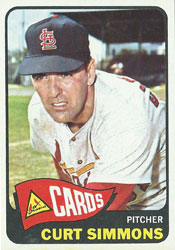
curt_simmons3At least the Cardinals got a significant return, first baseman Orlando Cepeda, for Sadecki, 25, when they traded him to the Giants on May 8, 1966. All the Cardinals got for Simmons was cash.
On June 22, 1966, Simmons, 37, was purchased by the Cubs from the Cardinals for $20,000.

Simmons, unhappy with the way he was being utilized by the Cardinals, looked forward to joining the Cubs’ starting rotation.

The Cardinals, who had tried to get a player in return for Simmons, were willing to move him to open room in their rotation for a pair of promising left-handers, Larry Jaster, 22, and Steve Carlton, 21.

Arm for hire

In 1964, when they won their first World Series title in 18 years, the Cardinals’ top three starters were Gibson (19 wins), Sadecki (20 wins) and Simmons (18 wins). The next year, Gibson won 20, but the win totals of Sadecki (6) and Simmons (9) declined significantly.

During 1966 spring training, the Cardinals tried to trade Simmons.

Initially, Simmons “was available at a modest price in players or cash,” The Sporting News reported.

When Simmons sparkled in spring training, yielding no walks in 25 innings, the Cardinals increased the price for him.

The Orioles showed interest, but “the Cardinals want a promising, young player in return and the Orioles are reluctant to give up anything more precious than cash,” The Sporting News reported.

Seeking starts

The 1966 Cardinals entered the season with more starters than spots in the rotation. Joining Gibson, Sadecki and Simmons were left-handers Jaster and Al Jackson and right-handers Ray Washburn, Tracy Stallard, Art Mahaffey and Nelson Briles.

Sadecki got three starts before he was traded. Simmons also was used sparingly.

Simmons got his first 1966 start on April 13 against the Phillies at St. Louis.

He didn’t get another start until more than a month later, May 17, at Philadelphia. In that game, Simmons yielded three runs and was lifted after three innings. “I had nothing out there,” Simmons said. “You’ve got to pitch guys in rotation. You can’t play checkers with pitchers.”

Simmons waited nearly three more weeks before getting his third start of the season on June 4 versus the Braves.

“It’s frustrating,” Simmons said of the limited number of starts he and other veterans were getting with the Cardinals. “We’re rusting and our market value is going down. If they’re going with the young guys, they ought to hurry up and make up their minds and let us go.”

Referring to Cardinals general manager Bob Howsam, Simmons said, “He’s burying too many good pitchers.”

Few suitors

A St. Louis newspaper reported the Braves were discussing the possibility of trading outfielder Rico Carty to the Cardinals for Simmons. Braves manager Bobby Bragan nixed the deal, telling The Sporting News he was concerned about Simmons’ long-term effectiveness.

In 10 appearances, including five starts, for the 1966 Cardinals, Simmons was 1-1 with a 4.59 ERA. As Simmons had predicted, his market value was diminishing.

With their options dwindling, the Cardinals sent Simmons to the last-place Cubs, who put him in a rotation with Dick Ellsworth, Ken Holtzman and Bill Hands.

In seven years (1960-66) with the Cardinals, Simmons posted a 69-58 record, 3.25 ERA and 16 shutouts.

On June 26, four days after he was acquired, Simmons made his Cubs debut and pitched a five-hit shutout against the Mets at Chicago. Boxscore

Two weeks later, still desperate for pitching, the Cubs signed Robin Roberts, 39, who first had become a teammate of Simmons with the 1948 Phillies, and put him in the starting rotation as well.

Simmons was 4-7 with a 4.07 ERA for the 1966 Cubs. He spent the next season with the Cubs and Angels before retiring as a player.

Previously: Cardinals rolled out welcome mat for Orlando Cepeda

Previously: Art Mahaffey and his short, shaky stint with Cardinals

Previously: Final home opener at Busch I was bust for Cardinals

Read Full Post »

(Updated June 22, 2020)

In his fourth major-league start for the Cardinals, Anthony Reyes delivered a brilliant and frustrating performance.

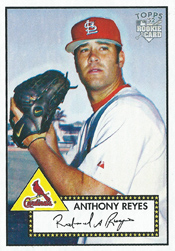
anthony_reyes2On June 22, 2006, Reyes pitched a one-hitter for the Cardinals against the White Sox in Chicago, but lost. The hit he surrendered, a home run by Jim Thome in the seventh inning, carried the White Sox to a 1-0 victory.

“There is no justice that he is the losing pitcher,” Cardinals manager Tony La Russa said to the St. Louis Post-Dispatch.

White Sox coach Joey Cora, who was filling in for suspended manager Ozzie Guillen, said of Reyes’ pitching: “Hall of Fame stuff.”

Changing speeds

Reyes, 24, was called up to the Cardinals from Class AAA Memphis before the game to replace injured Mark Mulder in the rotation. Reyes debuted with the Cardinals in August 2005 and also made two starts for them in May 2006 before being sent to Memphis.

A right-hander, Reyes was facing a White Sox lineup that pummeled Cardinals pitching in the first two games of the series. The White Sox won those games by scores of 20-6 and 13-5.

Using fastballs, changeups and curves, Reyes kept the batters off balance. “He changed speeds, moved the ball in and out,” Cora said to the Chicago Sun-Times. “He was outstanding.”

Good wood

With one out in the seventh and the score at 0-0, Reyes hadn’t yielded a hit. Asked whether he was aware he had a chance for a no-hitter, Reyes told the Associated Press, “I never thought about it.”

Thome, the designated hitter for the White Sox, came to the plate.

“You’re not thinking home run when a guy is pitching like that,” Thome said to the Chicago Tribune. “You’re thinking about a certain pitch and putting good wood on it and getting something started.”

Reyes’ first pitch to Thome was a fastball. The slugger swung and launched a shot into the bleachers.

“The ball was in the middle and I was fortunate to hit it,” Thome said.

Said Reyes: ‘I just missed a little bit over the plate and you can’t really do that up in this league.”

Series star

Reyes pitched the 23rd one-hitter in Cardinals franchise history.

His line for the game: 8 innings, 1 hit, 1 run, 0 walks, 6 strikeouts.

It was the first time the White Sox won with one hit since May 21, 2000, a 2-1 victory versus Toronto.

The Cardinals were kept in check by starter Freddy Garcia. He limited them to four hits _ a David Eckstein double and singles by Scott Rolen, Juan Encarnacion and Aaron Miles _ in eight innings. Bobby Jenks pitched a hitless ninth.

“This was a very tough game to lose,” La Russa said. “We had a chance to win and we didn’t win it.” Boxscore

Reyes made 17 starts for the 2006 Cardinals and was 5-8 with a 5.06 ERA. His gem against the White Sox was his only complete game that season.

In the 2006 World Series, Reyes delivered another surprise. He started and won Game 1 for the Cardinals, holding the Tigers to four hits and two runs in eight innings in a 7-2 St. Louis triumph at Detroit.


Read Full Post »

« Newer Posts - Older Posts »