Feeds:
Posts
Comments

Archive for the ‘Pitchers’ Category

Phil Regan was the premier relief pitcher in the National League with the Dodgers and Cubs in the late 1960s. He twice led the league in saves, with 21 in 1966 and 25 in 1968.
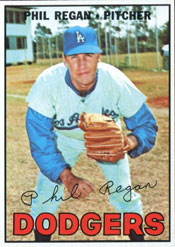
phil_reganRegan’s best season was 1966, his first in the NL after the Dodgers acquired him from the Tigers. Closing games in support of a starting rotation that featured Sandy Koufax, Don Drysdale, Don Sutton and Claude Osteen, Regan posted a 14-1 record and 1.62 ERA, helping the Dodgers win the pennant.

After his 13-year career as a big-league pitcher ended in 1972 with the White Sox, Regan built a commendable reputation as an instructor. He has been a pitching coach with the Mariners, Indians and Cubs. In 1995, he managed the Orioles.

In 2015, Regan, 78, was pitching coach of the Class A minor-league St. Lucie Mets. He mentored most of the pitchers on the staff of the 2015 NL champion New York Mets.

On Oct. 28, 2015, I interviewed Regan near the Mets’ training complex in Port St. Lucie, Fla. Richard Stone, who organizes a sports card show in Sebastian, Fla., helped arrange the interview.

After Regan shared details about his career and his role instructing Mets pitchers, I asked him if he’d answer questions about his recollections of Cardinals. Regan generously agreed and thoughtfully provided his insights.

Here is a segment of that interview:

Q.: From 1963 through 1968, the Dodgers and Cardinals were the only clubs to win NL pennants. The Dodgers won in 1963, 1965 and 1966. The Cardinals won in 1964, 1967 and 1968. What was that rivalry like from your perspective with the Dodgers?

Regan: “It was like two organizations that were almost the same. Both of them were speed, pitching, good defense and playing the fundamentals very well.”

Q.: How did the Dodgers try to beat the Cardinals?

Regan: “We always felt that if we could get to Bob Gibson early _ get him in the first inning, because we didn’t get any runs off him after that _ we could hold on and win with our pitching.”

Q.: The 1967 and ’68 champion Cardinals had Lou Brock. Was he the batter in that lineup that pitchers needed to focus on?

Regan: “He was one of them … When I was with the Cubs, he would bunt on (first baseman) Ernie Banks. Ernie wasn’t very fast. Ernie couldn’t field the bunts. Brock would beat it out every time.”

Q.: Who else in that Cardinals lineup?

Regan: “Another guy who helped them was Roger Maris.”

Q.: Maris batted .077 (2-for-26) with no home runs against you in his career. How did you do it?

Regan: “I’ll tell you why. When I was with Detroit, I roomed with (pitcher) Frank Lary. And Lary would tell me, ‘Maris has his swing grooved. Anything inside, he’ll hit.’

“So, I threw him nothing but sinkers down and away and let him try to pull the ball. And I got him out.

“I threw him one slider inside in Detroit and he hit it foul, a bullet, and I said I’m going to stay with sinkers away. He was geared to pull everything. He geared his swing to hit home runs, but it took away the outer part of the plate, which is where I pitched him.”

Q.: What else do you recall about those 1967 and ’68 Cardinals?

Regan: “I came in to pitch at St. Louis (on Aug. 9, 1967) and loaded the bases with no outs. Wes Parker was playing first base and Jimmy Campanis was catching.

“I’m thinking, ‘How can I get out of this situation?’ The next hitter (Eddie Bressoud) pops up to first base, to Wes Parker, a great fielder, near the bag.

“(Mike Shannon) is on third base and he fakes like he’s going home after the catch. Wes Parker takes the ball and lobs it toward home plate. I’m backing up the play, near the fence.

“The ball hits in front of Campanis and scoots under his leg and goes halfway between the catcher and me _ and (Shannon) scores the winning run.”

(Here is the boxscore from that game. Shannon told the Associated Press, “I hesitated when I saw the ball roll away. I couldn’t tell how far it was going … but it just kept rolling, so I went.”)

Q.: As a successful instructor, you’re like the Mets’ version of the Cardinals’ George Kissell. Did you have any interaction with Kissell?

Regan: “I got a lot of his notes. He’s got a little book out, a handbook for managers on all phases of the game. Throughout it are his sayings.

“He told pitchers they should try to strike out 13 hitters a game. Now, that’s a lot. He’d say, ‘You strike out the first hitter of every inning _ that’s nine times _ and the pitcher four times.’

“Really, what he was saying was that the most important man in the inning to get out is that first hitter. Be ready to pitch to him. If you get him out, it stops everything.

“I use it all the time. If you get the first hitter out, you can load the bases and get out of the inning with one pitch. If you don’t get the first hitter out, he’ll score 80 percent of the time. I follow a lot of his stuff.”

Q.: A George Kissell disciple who came up through the Cardinals system was Jim Riggleman. In 1997 and ’98, Riggleman managed the Cubs and you were their pitching coach. How was that?

Regan: “I love Jim Riggleman. He was one of the best young managers. In 1997, we weren’t a very good club (68-94 and last place in the NL Central). In 1998, the general manager called us in and said, ‘I’m going to have to hold you guys responsible if you don’t turn it around.’ We went on to win a one-game playoff with the Giants and got into the postseason (with a 90-73 record).”

Q.: In 1994, when you were pitching coach for the Indians, one of the pitchers on your staff was Derek Lilliquist. Today, he’s the Cardinals’ pitching coach. Did you see then his potential to become an instructor?

Regan: “I didn’t know he would become the pitching coach that he is today. He loved the game. He was quite a jokester. A lot of times, I’d back up the pitcher when we were taking batting practice. One day, in Toronto, we noticed none of the balls were coming in from the outfield. He was the ringleader of this. I said, ‘Where are the balls?’ All of a sudden, they threw about 100 balls at me at the same time.

“He had fun playing the game. That’s one of the things that makes you a good coach. You can laugh and have a good time and yet they know when you’re serious, too.”

Q.: Any other Cardinals recollection to share?

Regan: “(In 1982), I got a call from an agent (Jack Childers) in Chicago, who said, ‘Phil, I remember when you played here with the Cubs. You had a good sinker. I have a player who has lost his fastball. I represent him. I need him to learn a sinker. Would you be willing to work with him?’ I said, ‘Yeah, I will. Who is it?’ He said, ‘Al Hrabosky, the Mad Hungarian.’ (Hrabosky had been released by the Braves.)

“I said, ‘We’re in our fall program at Grand Valley State (where Regan was head baseball coach). If he wants to come up here, I’ll work with him.’ So he came up and spent four days with us and worked on a sinker. He had lost his fastball. When he left, he said, ‘I’m going to Venezuela (winter league) to work on this sinker. Would you mind calling some people (in the big leagues) and telling them where I am and what I’m working on?’

“I called Jim Campbell with the Tigers and Roland Hemond with the White Sox. Then I read an article that said Seattle was looking for a left-handed reliever. I didn’t know anybody there. So, I called and got hold of the general manager, Dan O’Brien.”

O’Brien gave Regan a job as Mariners advance scout, returning him to the big leagues for the first time since his pitching career ended. Hemond invited Hrabosky to spring training for a tryout with White Sox manager Tony La Russa and pitching coach Dave Duncan.

Previously: Denny McLain on Dizzy Dean, Bob Gibson, ’68 Cards

Previously: Al Hrabosky’s last stand tested Dave Duncan, Tony La Russa

Read Full Post »

When the Cardinals traded half of their all-star infield to the Phillies, the all-star they got in return no longer had the skills to be a consistent starter.

art_mahaffeyOn Oct. 27, 1965, the Cardinals traded first baseman Bill White, shortstop Dick Groat and catcher Bob Uecker to the Phillies for pitcher Art Mahaffey, outfielder Alex Johnson and catcher Pat Corrales.

Two years earlier, four Cardinals _ White, Groat, second baseman Julian Javier and third baseman Ken Boyer _ formed the starting infield for the 1963 National League all-star team.

After White and Groat were traded, only Javier remained with the Cardinals from that infield. Boyer had been traded by the Cardinals to the Mets a week before White and Groat were sent to the Phillies.

Mahaffey, a hard-throwing right-hander, had been an all-star with the 1961 and 1962 Phillies. He earned 19 wins in 1962 and was second in the league that season in complete games (20) and fourth in innings pitched (274).

Though limited by an arm ailment to 71 innings pitched while posting a 2-5 record for the 1965 Phillies, the Cardinals saw Mahaffey, 27, as a candidate to bolster their rotation.

In addition to a starting pitcher, Cardinals general manager Bob Howsam also believed he had acquired a starting left fielder (Johnson) and an upgrade at backup catcher (Corrales).

Feuding Phillies

In 1965, Mahaffey fell into disfavor with Phillies manager Gene Mauch. Mahaffey didn’t make a start after July 5 and appeared twice in relief after Sept. 1.

Mahaffey and Mauch “have not seen eye to eye for quite a while,” The Sporting News reported.

Published reports speculated the Phillies would trade Mahaffey to an American League club. The Senators expressed keen interest.

“I was waiting to get traded, but I had no idea I would go to the Cardinals,” Mahaffey said.

“All I need to do is start. I’m a starting pitcher, not a reliever. I can’t pitch in relief … because I have to warm up longer since I had the arm trouble a couple of years ago. My arm is all right now, however.”

Rotation depth

Agreeing to a request from Howsam, Mahaffey went to the Cardinals’ Florida Instructional League club at St. Petersburg in November 1965 with the goal of developing a slider.

“The slider should make a big difference for me,” Mahaffey said. “On days when my fastball isn’t as good as it should be, I could use my slider on left-handed hitters.”

Entering spring training in February 1966, the Cardinals had nine prime candidates for the five starting rotation spots. Joining Mahaffey among the right-handers were Bob Gibson, Ray Washburn, Tracy Stallard and Nelson Briles. The left-handers were Ray Sadecki, Curt Simmons, Al Jackson and Larry Jaster.

“Our pitching depth is much, much better than it was at this time last year,” Howsam said.

In a sign of the confidence they had in Mahaffey, the Cardinals issued him the uniform No. 14 Boyer wore.

Mahaffey “is one of the hardest workers in the Cardinals camp. He has a mission,” The Sporting News reported.

Said Mahaffey: ” I want to make a good impression. I think I can win and win big. I’m healthy, my arm is sound.”

Mahaffey sealed a spot on the Opening Day roster by pitching four scoreless innings in an exhibition start against the Reds on March 22, 1966, at St. Petersburg.

Unhappy beginning

The Cardinals opened the 1966 season with 13 pitchers. Needing only four starters early in the season, Cardinals manager Red Schoendienst and pitching coach Joe Becker chose Gibson, Washburn, Jaster and Briles.

Simmons, Stallard, Sadecki and Mahaffey complained about lack of work.

“We’re rusting and our market value is going down,” Simmons said.

Mahaffey, who switched to uniform No. 30, was the last of the 13 pitchers to appear in a game, making his Cardinals debut with four innings of shutout relief against the Astros on April 28. Boxscore

“I can’t understand it,” Mahaffey said. “I was assured when I was traded that I would be a starting pitcher.

“Bob Howsam wanted me to get off to a quick start this season, so I agreed to go to the winter league for a month. I had to drop my winter jobs and that cost me a couple of thousand dollars. So this is how I get repaid.”

Shaky starts

On May 7, 1966, Mahaffey got his first Cardinals start _ and it was a dud. Facing the Giants, Mahaffey pitched two scoreless innings before yielding seven runs in the third. Four were scored on a grand slam by Orlando Cepeda. Boxscore

(The next day, Cepeda was traded for Sadecki.)

Mahaffey made five starts for the Cardinals and won one _ against the Braves Boxscore _ and was returned to the bullpen. He earned a save _ the only one of his big-league career _ against the Mets. Boxscore

Overall, Mahaffey was 1-4 with a 6.43 ERA in 12 appearances for the Cardinals before he was demoted to Tulsa in mid-July. Mahaffey was 4-4 with a 5.05 ERA in 11 starts for the Class AAA club.

After the 1966 season, the Cardinals retained the rights to Mahaffey but gave him permission to make a deal with another club. The Giants invited him to spring training at Arizona in 1967.

Mahaffey pitched for the Giants in spring training, but they were unimpressed and returned him to the Cardinals. On April 1, 1967, Stan Musial, who had replaced Howsam, traded Mahaffey and infielders Jerry Buchek and Tony Martinez to the Mets for infielder Eddie Bressoud, outfielder Danny Napoleon and cash.

The Mets assigned Mahaffey to their Class AAA Jacksonville club and he was 1-1 with a 5.50 ERA before being released.

Mahaffey signed with Dallas-Fort Worth, an affiliate of the Cubs, and joined a staff that included his former Cardinals teammate, Stallard, and Don Larsen, 38, who’d pitched a perfect game in the World Series for the Yankees 11 years earlier.

After posting a 2-7 record and 6.00 ERA in 16 games for the Class AA club, Mahaffey, 29, was finished as a professional pitcher.

Read Full Post »

(Updated April 30, 2023)

From a public relations perspective, the trade of Ken Boyer from the Cardinals to the Mets was a disaster. From a baseball perspective, it was a marquee deal that produced mixed results.

ken_boyer11On Oct. 20, 1965, the Cardinals traded Boyer, their third baseman and cleanup batter, to the Mets for pitcher Al Jackson and third baseman Charlie Smith.

Cardinals general manager Bob Howsam made the trade because he indicated he believed Boyer, 34, was in decline and the club needed pitching and speed to adapt to their spacious new downtown stadium in 1966.

Howsam said Jackson, 29, bolstered the rotation, and he saw Smith, 28, as a more agile third baseman than Boyer with more power potential.

Bing Devine, former Cardinals general manager who was special assistant to Mets president George Weiss, advocated for New York to acquire Boyer as much for his leadership and professionalism as for his ability to produce runs and stabilize the third base position.

In their first four seasons after entering the National League as an expansion team in 1962, the Mets developed a reputation as a clownish club. Devine envisioned Boyer as a player who could help change that perception.

Ham-handed Howsam

The trade was unpopular with many Cardinals fans. Boyer was Cardinals royalty. In handling the trade callously, Howsam appeared to treat Boyer disrespectfully.

Boyer, who signed with the Cardinals as an amateur free agent in 1949, played 11 seasons for St. Louis (1955-65) and was named an all-star seven times.

He also won the Gold Glove Award five times and earned the NL Most Valuable Player Award in 1964, when he produced 24 home runs, 119 RBI and 100 runs in leading the Cardinals to a pennant and World Series title. Overall, Boyer had 1,855 hits in 1,667 career games with the Cardinals, including 255 home runs and 1,001 RBI.

Boyer learned of the deal in a phone call with reporter Jack Herman of the St. Louis Globe-Democrat.

“You’re kidding,” Boyer said when told of the trade. “That’s really something.

“Seventeen years is a long time (with one organization). I don’t know what to think right now. I wouldn’t be truthful if I didn’t say I was sorry to be leaving.”

The Sporting News reported “various Cardinals officials tried to contact” Boyer to tell him about the trade, but Cardinals fans concluded management, especially Howsam, didn’t try hard enough.

“As soon as the Boyer deal became public property, Cardinals fans touched off a storm,” The Sporting News reported. “They swamped all the news media and even tried to get through to Cardinals general manager Bob Howsam to register protests and threats to cancel tickets.”

The furor was comparable to the uproar that ensued when the Cardinals traded popular standouts such as Rogers Hornsby, Enos Slaughter and Red Schoendienst.

Support from Stan

Schoendienst, who completed his first season as Cardinals manager in 1965, endorsed the trade of Boyer. “We’re sorry to see Kenny go, but good left-handed pitchers are few and far between,” Schoendienst told the Associated Press. “Smith can drive in the runs and is an improved fielder.”

Stan Musial, a Cardinals vice president in 1965, told United Press International the trade was a “good deal” for St. Louis. Musial was impressed by Jackson. “Al is a good competitor,” Musial said. “That guy can beat the tough clubs.”

Said Howsam: “We hate to see a player of Ken’s caliber go, but we had a chance to get a man in Smith who is a power hitter and good fielder, and a fine starting pitcher in Jackson. We felt we couldn’t pass it up.”

Developing a deal

Initially, the Cardinals talked with the Astros about a deal that would have featured Boyer for third baseman Bob Aspromonte. The Mets had been discussing with the Angels a trade of Jackson and Smith for outfielder Jose Cardenal.

When those talks stalled, The Sporting News reported, the Cardinals and Mets struck their deal.

Jackson earned a franchise-leading 40 wins in his four seasons with the Mets. In 1965, Jackson was 8-20 with a 4.34 ERA.

Smith, who played for the Dodgers, Phillies and White Sox before joining the Mets, hit .244 in 1965. His power numbers that season (20 doubles, 16 home runs, .393 slugging percentage) were better than those produced in 1965 by Boyer (18 doubles, 13 home runs, .374 slugging percentage).

“I think I’ll be able to help the Mets,” Boyer said. “The sentiment is gone for the Cardinals … It will strictly be on a business basis now.”

Boyer led the 1966 Mets in RBI (61) and doubles (28) and was second on the club in home runs (14).

In his autobiography, “Cleon Jones: Coming Home,” Mets outfielder Cleon Jones said, “Ken Boyer was an icon, the very best at what he did at his position. Ken Boyer was one of the greatest third basemen to play the game. He was a great defensive player, an offensive force and became a great teammate.

“He was the kind of guy who would always reach out to his teammates. He could talk about the game in a way that made you feel like you belonged in the league, that you could do it because he wasn’t talking to you about what you did wrong but about how you have to be prepared to be successful. That was one of the bright spots in my early career. to have Ken Boyer as a teammate and to watch him go out on the field and perform like he did.”

Al Jackson was second to Bob Gibson in wins (13), complete games (11) and innings pitched (232.2) for the 1966 Cardinals. He had nine wins for the 1967 World Series champion Cardinals, then was dealt back to the Mets.

Charlie Smith had 104 hits and struck out 81 times in 116 games for the 1966 Cardinals. He produced 10 home runs and 43 RBI. After the season, Smith was traded to the Yankees for Roger Maris and was replaced at third by Mike Shannon.


Read Full Post »

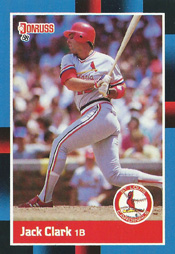
If Tommy Lasorda had ordered Tom Niedenfuer to intentionally walk Jack Clark in the ninth inning of Game 6 in the National League Championship Series, Brian Harper likely would have been facing Jerry Reuss with the outcome on the line.

jack_clark5Instead, Lasorda, the Dodgers’ manager, made the fateful decision to allow Niedenfuer to pitch to Clark with Willie McGee on third, Ozzie Smith on second, first base open and two out.

On Oct. 16, 1985, Clark cracked a first-pitch fastball from Niedenfuer for a three-run home run, erasing a 5-4 Dodgers lead and carrying the Cardinals into the World Series with a 7-5 pennant-clinching victory at Los Angeles.

“After he hits the home run, even my wife knows I should have walked him,” Lasorda told the Daily Breeze of Torrance, Calif.

Match game

Jay Johnstone, a Dodgers reserve outfielder, wrote in his postseason column for the Daily News of Los Angeles that “Tommy, in fact, was going to walk him. Then he changed his mind.”

Andy Van Slyke, a left-handed batter, was on deck when Clark stepped to the plate against Niedenfuer.

“I was looking into the Dodgers dugout, waiting for Tommy to put up four fingers,” Van Slyke told reporters.

“If you were Tommy Lasorda, wouldn’t you rather pitch to me than to Jack Clark?”

Not, it turns out, if the pitcher is a right-hander, such as Niedenfuer.

If Clark had been walked intentionally, Lasorda intended to have a left-hander face Van Slyke. The left-hander the Dodgers had warming in the bullpen was Reuss, a former Cardinal.

In his book “White Rat: A Life in Baseball,” Cardinals manager Whitey Herzog said, “If Tommy walks Clark and brings in a lefty to pitch to Andy, I would have countered with Brian Harper, the only right-handed pinch-hitter I had left.”

Harper, a utility player, had batted .250 with no home runs in 43 games for the 1985 Cardinals.

In a rebuke of Lasorda, Herzog said, “I would rather let Brian Harper try to beat me than Jack Clark.”

Watching from the dugout, Harper was preparing for the chance to bat with the bases loaded. “Even when they pitched to Jack, I figured they would pitch around him,” Harper told the Daily Breeze.

Clark agreed, saying, “When they decided to pitch to me … I didn’t expect to get a pitch to hit.”

Cat and mouse

Niedenfuer was thinking the same. In the seventh inning, with the score tied 4-4 and Cardinals runners on first and third, Niedenfuer struck out Clark on sliders.

So, when Clark came to bat in the ninth, “I figured he wouldn’t be looking for a fastball,” Niedenfuer said.

Niedenfuer’s assumption had merit. In his book “You’re Missin’ a Great Game,” Herzog called Clark “the greatest fastball hitter of his era,” but said the slugger “took more heaters for strikes than any player I’ve ever seen.”

Said Herzog: “Jack Clark might have been the worst guesser I ever saw. He terrified people as a fastball hitter, but he took the wrong message from that. He believed nobody _ nobody _ would ever throw him a fastball. So he never sat on his best pitch. Jack would stand there waiting for the curve and … those pitchers would sneak heaters right by him.”

Knowing this, Niedenfuer said he intended to start Clark with a fastball on the outside part of the strike zone and try to get Clark to chase subsequent pitches outside the zone.

There were, however, two problems with this approach:

_ “I was looking for a fastball,” Clark said to the Daily News.

_ The fastball Niedenfuer delivered wasn’t on the outside corner. Instead, it was in the middle of the plate, about belt high.

Clark swung at the pitch and lifted a drive deep into the left-field bleachers.

“The only hope was that it would hit the Goodyear blimp and fall straight down,” Niedenfuer told Knight-Ridder Newspapers.

Said Clark: “It was the biggest, furthest, most important hit of my career.” Video

It also was the only home run Clark would hit in 47 career postseason at-bats. Boxscore

Previously: Trade for Jack Clark shook Cardinals from slumber

Read Full Post »

Ozzie Smith and Tom Niedenfuer, forever linked by a home run, were involved in a couple of other notable encounters before their infamous 1985 postseason showdown.

tom_niedenfuerOn Oct. 14, 1985, Smith sealed his spot in Cardinals lore by hitting a walkoff home run against Niedenfuer in the pivotal Game 5 of the National League Championship Series against the Dodgers at St. Louis. Boxscore

Though the home run was the most important swing of Smith’s Hall of Fame career, it wasn’t the first time he delivered a key hit against Niedenfuer.

One of those hits produced an unusual double play. Another helped cause a meltdown by the Dodgers bullpen, foreshadowing the drama that would unfold in the 1985 postseason.

Strange play

On Sept. 1, 1982, the Cardinals and Dodgers were in the 11th inning of a game at Los Angeles, with the score tied at 5-5. The Cardinals had Tommy Herr on second base and George Hendrick on first with one out when Smith stepped to the plate, facing Niedenfuer.

Smith looped a single to right field.

As Herr and Hendrick advanced, right fielder Pedro Guerrero made a strong throw to the plate. Herr, uncertain he could score, held at third. Hendrick, expecting Herr to head home, rounded second. When he saw Herr on third, Hendrick applied the brakes.

Guerrero’s throw to catcher Mike Scioscia was on target. Scioscia caught the ball and, seeing Hendrick take the wide turn around second, fired a throw to second baseman Steve Sax, who tagged out Hendrick as he tried getting back to the base.

When Herr saw Scioscia throw to second, he took off from third. Sax threw back to the catcher, who blocked the plate as Herr went into his slide. Scioscia caught the ball and tagged out Herr, ending the inning.

Instead of resulting in the go-ahead run, or at least loading the bases, Smith’s single off Niedenfuer resulted in a double play.

“Strange double play, all right,” Cardinals manager Whitey Herzog said to the Associated Press, shaking his head.

In the 13th, Smith delivered another single, against Ricky Wright, and it produced a run, scoring Kelly Paris from second and giving the Cardinals a 6-5 lead. Jim Kaat, 43, got the last two outs in the bottom half of the inning, stranding Steve Garvey at third and earning the last save of his career. Boxscore

“I’ve managed about 2,000 of these games and I have never seen one like this,” Herzog said to the Daily Breeze of Torrance, Calif.

Discouraged Dodgers

Two years later, on July 8, 1984, Smith contributed to a Cardinals rally against Niedenfuer at Los Angeles.

The Dodgers entered the ninth inning with a 6-2 lead. With one out, Willie McGee and Darrell Porter both singled against Dodgers reliever Ken Howell.

Niedenfuer relieved and the first batter he faced, Andy Van Slyke, hit a three-run home run, cutting the Dodgers lead to 6-5.

“Even after he hit it out, I still thought Tom would shut them down,” said Dodgers pitcher Orel Hershiser.

Instead, Smith followed with a single, knocking Niedenfuer from the game and keeping alive the Cardinals’ comeback hopes.

Hershiser relieved and struck out Mike Jorgensen for the second out of the inning, but Lonnie Smith singled, advancing Ozzie Smith to second, and Herr also singled, driving in the tying run.

In the 12th, the Cardinals scored twice off Pat Zachry and won, 8-6.

“We blew it and I’m very discouraged,” Dodgers manager Tommy Lasorda said to the Orange County Register. Boxscore

Wizardry from Oz

In 1985, Ozzie Smith was 0-for-4 for the year versus Niedenfuer before corking his Game 5-winning NL Championship Series home run _ his first batting from the left side. Video

In the decisive Game 6 of that series, Smith produced a RBI-triple and a walk versus Niedenfuer in two plate appearances. Boxscore

For his career, including regular season and postseason, Smith batted .353 (6-for-17) against Niedenfuer, with four singles, a triple, a home run, three walks, two RBI and no strikeouts.

In April 1990, Niedenfuer was released by the Mariners and signed with the Cardinals, becoming a teammate of Smith. “We’ve got to give him a job after all he’s done for us,” Herzog told the St. Louis Post-Dispatch.

When Niedenfuer entered the Cardinals’ clubhouse for the first time, first baseman Pedro Guerrero, his former Dodgers teammate, introduced him to Smith.

“I’d never really met him,” Ozzie said to columnist Bernie Miklasz. “I mean, what do you say _ thanks for that home run? But Niedenfuer took it well. I’m glad he’s here.”

In 52 games with the 1990 Cardinals, Niedenfuer was 0-6 with a 3.46 ERA.

Previously: Tom Niedenfuer revisits Cardinals’ historic home runs

Read Full Post »

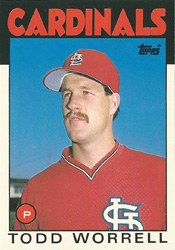
In the game that produced one of the most important Cardinals home runs, an exchange between Todd Worrell and his coach, Mike Roarke, played a critical role in setting the stage for the dramatic finish.

todd_worrell2On Oct. 14, 1985, Ozzie Smith hit a walkoff home run in the ninth inning against the Dodgers’ Tom Niedenfuer, lifting the Cardinals to a 3-2 victory in Game 5 of the National League Championship Series at St. Louis.

Smith’s blast became a beloved part of Cardinals lore, in part, because of broadcaster Jack Buck’s joyous, pitch-perfect call _ “Go crazy, folks! Go crazy!” _ and because of the shock value. Video

Smith, a switch hitter known more for his fielding than his hitting, had played eight seasons in the big leagues and hadn’t slugged a home run left-handed until doing so in the critical Game 5. The victorious shot gave the Cardinals their third win in a row after losing the first two games of the series and put them in position to clinch the pennant and a World Series berth in Game 6 at Los Angeles.

Circumstances might have been much different, though, if Roarke hadn’t connected with Worrell two innings earlier.

Rookie feels heat

In the seventh, with the score tied at 2-2, Ken Dayley was preparing to pitch his fourth inning in relief of Cardinals starter Bob Forsch. The first batter of the inning, Mike Scioscia, walked on four pitches. The next batter, Enos Cabell, hit the first pitch for a single, putting runners on second and first with none out.

Manager Whitey Herzog replaced Dayley with Worrell.

The hard-throwing rookie faced Steve Sax, who was instructed to bunt.

Worrell’s first two pitches were out of the strike zone and Sax took both for balls.

“The adrenaline was pumping and I was excited,” Worrell told Larry Harnly of The State Journal-Register of Springfield, Ill.

With the count 2-and-0, Sax got the take sign from third-base coach Joe Amalfitano.

Worrell threw another out of the strike zone, making the count 3-and-0.

Roarke to the rescue

From the top step of the dugout, Roarke, in his second season as pitching coach, shouted at Worrell and got his attention. Roarke had noticed Worrell’s pitches were being thrown from an angle that brought his arm up and over the top.

Roarke knew “Worrell’s accuracy improves when his delivery is from three-quarters rather than directly overhead,” the Daily News of Los Angeles reported.

Said Worrell: “Sometimes I try too hard and get myself mechanically screwed up.”

When Worrell threw from what appeared to the batter as an angle at 10 o’clock, he was effective. He lost command when his pitches were delivered from a 12 o’clock direction.

As Worrell peered into the dugout at his coach, Roarke held his arm at a 10 o’clock angle and moved it toward 12.

Worrell got the message.

Quick fix

Awaiting the 3-and-0 offering, Sax got another take sign. The pitch was a strike.

“After I got the first strike in there to Sax, I knew I would be all right,” Worrell said.

With the count 3-and-1, Sax got a third straight take sign. The pitch, another fastball, was a strike, making the count 3-and-2.

Said Worrell of Sax: “He’s aggressive _ he had doubled off me in another game _ so I knew if I got a fastball close, he would be hacking.”

Worrell threw a pitch that tailed away from the batter. Sax swung and missed, striking out.

Asked about being given three take signs, Sax told the Daily Breeze of Torrance, Calif., “I just have to do what I’m told.”

Said Dodgers manager Tommy Lasorda: “We were looking for a walk to Sax to load the bases.”

Out of danger

The next batter, pitcher Fernando Valenzuela, hit a groundball up the middle. Worrell knocked down the ball, recovered it behind the mound and made an accurate toss to first, retiring Valenzuela as the runners advanced to second and third.

“I let Fernando hit because I was happy with the way he was throwing the ball,” Lasorda said when asked why he didn’t use a pinch-hitter.

Mariano Duncan, the Dodgers’ slumping leadoff batter, followed by swinging at the first pitch and popping out to catcher Darrell Porter, ending the threat.

“First and second, nobody out and a 3-and-0 count,” said Dodgers outfielder Mike Marshall, lamenting the lost scoring opportunity. “You either have to say we blew it, or give them credit.”

The score remained tied until, with one out in the ninth, Smith worked his magic. Boxscore

Previously: How speedsters rattled Bob Welch in 1985 NLCS

Read Full Post »

« Newer Posts - Older Posts »