Feeds:
Posts
Comments

Archive for the ‘Pitchers’ Category

In a span of three days, Bob Gibson experienced the emotional swing of being honored for his Cardinals achievements before ending his career on a downturn. bob_gibson20
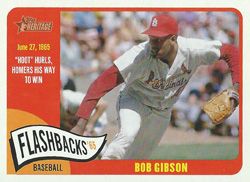
The Cardinals designated Sept. 1, 1975, as Bob Gibson Day. Gibson, 39, was feted in an hour-long ceremony before the Cubs played the Cardinals in front of 48,435 spectators on a Labor Day afternoon at St. Louis.

Two days later, Sept. 3, Gibson yielded a grand slam and took the loss in his final Cardinals appearance.

Nervous ace

Before reporting to spring training, Gibson had said 1975 would be his last year as a player. He began the season in the starting rotation but was shifted to the bullpen during the summer.

The Gibson Day event was an opportunity to salute the Cardinals’ all-time best pitcher. Gibson was the ace on 1960s Cardinals clubs that won three National League pennants and two World Series titles. He is the franchise’s career leader in wins (251), shutouts (56), strikeouts (3,117), complete games (255), innings pitched (3,884.1) and games started (482).

In a ceremony at home plate, the Cardinals declared Gibson’s uniform No. 45 would join the No. 6 of Stan Musial and the No. 17 of Dizzy Dean as the only numbers retired by the franchise. Club owner Gussie Busch presented Gibson with a $32,250 luxury motor home.

Gibson told onlookers, including former teammates Musial and Bill White, “I’m more nervous than I was before a World Series game.”

Then it was Gibson’s turn to address the crowd.

In the book “Gibson’s Last Stand,” author Doug Feldmann wrote, “At first, Gibson was too moved to speak when he approached the microphone down on the field. Several times he stepped toward it again, but had to pause with every attempt, as each standing ovation was louder than the one a moment earlier.”

When he was ready, Gibson told the crowd, “One thing that I’ve always been proud of is the fact that I’ve never intentionally cheated anyone out of what they paid their money to come and see. Most of all, I’m proud of the fact that whatever I did, I did it my way.”

Reflecting on his future as a retired player, Gibson said, “It’s going to be a new life, a strange life for me. I just hope I can be half as successful as I have been in baseball.”

To cap the festivities, Busch got behind the wheel of the motor home and drove Gibson, his mother and his two daughters around the perimeter of the field as the stadium organist played “Auld Lang Syne.” Said Busch to Gibson: “I bet you never had a chauffeur like this before.”

Inspired, the Cardinals went out and beat the Cubs, 6-3, behind Lou Brock (three hits, three steals, two runs) and the pitching of Bob Forsch and Al Hrabosky. The victory moved the second-place Cardinals to within three games of the Pirates in the NL East Division. Boxscore

Tough to take

On Sept. 3, in the finale of the series, the Cubs led, 6-1, before the Cardinals rallied for five runs in the sixth, tying the score at 6-6.

Sensing an opportunity to give his fading star another shot at glory, Cardinals manager Red Schoendienst called on Gibson to relieve starter Ron Reed and hold the Cubs in the seventh.

The move backfired.

The Cubs loaded the bases on a Champ Summers infield single and walks to Jose Cardenal and Andre Thornton. With two outs, Gibson uncorked a wild pitch and Gene Hiser, running for Summers, raced home from third, giving the Cubs a 7-6 lead. Gibson issued an intentional walk to Jerry Morales, reloading the bases.

Pete LaCock, a pinch-hitter, batted next. LaCock, who had lost the starting first base job to Thornton, was best-known as the son of game-show host Peter Marshall of “Hollywood Squares.”

With the count 3-and-2, LaCock stunned Gibson by drilling a fastball over the right-field wall for a home run _ the lone grand slam of his big-league career.

Dejected, Gibson retired the next batter, Don Kessinger, on a groundout and walked off the mound for the final time. Boxscore

“I had reached my absolute limit in humiliation,” Gibson said in his book “Stranger to the Game.” “I said to myself, ‘That’s it. I’m out of here.’ ”

Gibson remained idle while the Cardinals fell out of contention.

On Sept. 15, two weeks after his special day, Gibson said goodbye to his teammates and headed home with 10 games remaining in the season, knowing he’d never pitch again.

Previously: Bob Gibson and his final Opening Day with Cardinals

Previously: How Ron Reed replaced Bob Gibson in Cards rotation

Previously: How Bob Gibson achieved career win No. 250
Read Full Post »

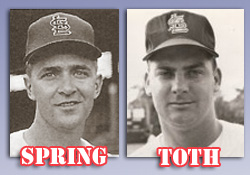
For pitchers Jack Spring and Paul Toth, being part of one of the Cardinals’ best trades did little for their careers other than making them answers to a trivia question.

spring_tothWho were the players the Cardinals acquired with outfielder Lou Brock from the Cubs on June 15, 1964, for pitchers Ernie Broglio and Bobby Shantz and outfielder Doug Clemens?

Spring and Toth.

Because of the impact of the deal on Brock and the Cardinals, few recall St. Louis got anyone else in the trade.

Brock sparked the Cardinals to the 1964 National League pennant and World Series championship and built a Hall of Fame career in St. Louis.

For Spring, the Cardinals became a brief stop during a year in which he played for three big-league teams before finishing the season in the minors.

For Toth, the trade was a reunion, returning him to the organization he started with but doing nothing to get him back to the major leagues.

Aloha, Jack

Spring, a left-hander, debuted in the major leagues with the 1955 Phillies. He also pitched for the 1957 Red Sox and 1958 Senators before joining the expansion Angels in 1961. In four years with the Angels, Spring was 11-2 with eight saves.

In 1964, Spring began the season with the Angels before being sent to the Cubs on May 15 in a cash transaction.

He made his Cardinals debut on the same day he was traded from the Cubs. In an inning of relief against the Colt .45s at Houston, Spring yielded four runs, one earned, on three hits and walk. In the eighth, Brock made his Cardinals debut, pinch-hitting for Spring. Boxscore

“When the trade was made, I was home in Chicago,” Spring told the Society for American Baseball Research. “My wife called out to me that they’re talking about it on the TV. Brock and I flew to Houston, where the game had already started. I went to the bullpen. They told me to warm up and go into the game. The catcher was Tim McCarver. I got to the mound, and he said, ‘Hi, Jack. I’m Tim. What do you throw?’ ”

Five days later, on June 20, Spring made his second and last Cardinals appearance. In two innings of relief against the Giants at St. Louis, Spring gave up five runs on five hits, including a three-run double by Hal Lanier and a two-run home run by Orlando Cepeda. All the runs were unearned. Boxscore.

Spring had yielded nine runs in three innings for St. Louis but had an ERA of 3.00 because only one of those runs was earned.

The Cardinals assigned Spring, 31, to their Class AAA club at Jacksonville, but he refused to report. If he was going to accept a demotion to the minors, Spring, a resident of Spokane, Wash., preferred to play in the Pacific Coast League.

On July 9, the Cardinals accommodated Spring, sending him to the Angels in a cash transaction. The Angels assigned him to their Pacific Coast League team in Hawaii. Bob Lemon, the Hall of Fame pitcher, was Hawaii’s manager. Spring thrived there, posting a 3-3 record and 2.11 ERA in 30 games.

Spring got his final big-league chance with the 1965 Indians, pitching in 14 games. He spent the remainder of his playing career in the Pacific Coast League, finishing with his hometown club, Spokane, in 1969.

Cardinals prospect

Unlike Spring, Toth was sent directly to the minor leagues after his trade to the Cardinals and never returned to the big leagues.

Toth, a right-hander, was signed by the Cardinals in 1955. He pitched in their system until 1958 before spending two years in military service.

When he resumed his playing career in 1961, the Cardinals sent Toth to Class AA Tulsa. He had his best season, posting an 18-7 record and 2.37 ERA.

That performance caught the attention of Cardinals manager Johnny Keane. At the 1962 spring training camp, Toth got to pitch in Cardinals exhibition games and did well. He held the Mets to a hit in three innings in the second spring exhibition and was cited by The Sporting News as the camp’s “sleeper” prospect.

Toth was one of 10 pitchers on the Cardinals’ 1962 Opening Day roster. He appeared in six games and was 1-0 with a 5.40 ERA. His highlight was a complete-game win in a start against the Colt .45s on Aug. 5 at St. Louis. Boxscore

“Paul showed a good assortment and plenty of poise,” said Cardinals pitching coach Howie Pollet.

Wrote The Sporting News: “Toth’s chief assets are a good slider and a reputation as a tough battler.”

Less than a month later, though, on Sept. 1, the Cardinals traded Toth to the Cubs for pitcher Harvey Branch.

Toth was 3-1 with a 4.24 ERA for the 1962 Cubs. He earned his first win for them on Sept. 18 against the Cardinals in a 4-3 victory at Wrigley Field. Toth pitched 8.2 innings, yielding a solo home run in the second to his former road roommate, catcher Carl Sawatski, and a two-run homer in the ninth to Stan Musial. Boxscore

“He figures in my plans for next year,” Cubs manager Charlie Metro said. “He’s the kind of guy you like to have on your club. A real bear-down guy. He knows how to pitch. He moves all of his pitches around and showed a real good change-up.”

Toth was 8-12 in three seasons with the Cubs. He was with their Salt Lake City farm club when he was traded back to the Cardinals in the Brock deal.

The Cardinals assigned Toth, 29, to Jacksonville. He was 4-6 with a 3.25 ERA. After the 1964 season, Toth was sent to the Yankees, managed by Keane, in a cash transaction.

Toth never pitched for the Yankees, finishing his playing career in the minor leagues in 1967.

Previously: Lou Brock hit the ground running in 1st start with Cardinals

Read Full Post »

(Updated April 6, 2026)

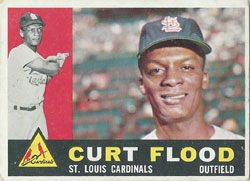
Five facts that may surprise you about Cardinals center fielder Curt Flood:

curt_flood7No. 1: Cardinals foe

Flood made his major-league debut against the Cardinals.

On Sept. 9, 1956, at St. Louis, Flood, 18, was a pinch-runner for Smoky Burgess, the stocky Reds catcher who hit a double in the eighth inning off Cardinals starter Murry Dickson.

Flood was stranded when Bob Thurman popped out to third, ending the inning. Boxscore

As a September call-up, Flood played in five games for the 1956 Reds and three for the 1957 Reds. The Cardinals were the foe in three of those eight games.

Flood and outfielder Joe Taylor were traded by the Reds to the Cardinals for pitchers Willard Schmidt, Ted Wieand and Marty Kutyna on Dec. 5, 1957.

It was the first trade made by Cardinals general manager Bing Devine and it was one of his best. Devine credited Cardinals manager Fred Hutchinson with encouraging him to make the deal.

In his book “October 1964,” author David Halberstam wrote, “Devine was uneasy because it was his first deal and because he had not only never seen (Flood) but he had no sense of him either. But (Hutchinson) seemed confident of Flood’s ability and Devine had a good deal of faith in Hutchinson’s ability to judge talent.”

No. 2: Cardinals infielder

Flood, who won seven consecutive Gold Glove awards as a Cardinals center fielder from 1963-69, played two games at third base and one at second for St. Louis.

In all three instances, Flood shifted from the outfield to the infield late in games. The breakdown:

_ On July 6, 1958, Flood started in center field against the Giants at San Francisco. In the ninth, Ken Boyer moved from third base to shortstop and Flood replaced Boyer at third. Flood didn’t field any chances in the inning. Boxscore

_ On May 10, 1959, at St. Louis against the Cubs, Flood moved from center field to second base in the 10th, replacing Don Blasingame, who had been lifted for a pinch-runner the previous inning. Flood played two innings at second base and didn’t field any chances. Boxscore

_ On June 21, 1960, Flood started in center field versus the Pirates at Pittsburgh. In the eighth, Boyer was ejected and Flood replaced him at third base. Flood had one ball hit to him at third _ by Burgess, then with the Pirates _ and fielded it cleanly. Boxscore

In the book “Redbirds Revisited,” Flood said to authors David Craft and Tom Owens, “There was a time when I was with Cincinnati … when they were hoping to teach me to play the infield (but) I had trouble making the double play, trouble throwing toward shortstop.”

No. 3: Tough and durable

At 5 feet 9 and 165 pounds, Flood was an iron man. He played in 150 or more games in a season seven times.

Flood ranks eighth all-time in games played (1,738) as a Cardinal. Just ahead of him is Red Schoendienst (1,795).

No. 4: Hit man

Flood ranks 10th all-time in most hits (1,853) by a Cardinal, just two behind Ken Boyer (1,855).

No. 5: Hitting the best

Flood often was at his best when facing the best.

Here are his career batting marks against some Hall of Fame pitchers:

_ .394 (13-for-33) vs. Don Sutton.

_ .326 (29-for-89) with a home run vs. Warren Spahn.

_ .319 (44-for-138) with two home runs vs. Don Drysdale.

_ .296 (32-for-108) with two home runs vs. Sandy Koufax.

_ .286 (34-for-119) with four home runs vs. Juan Marichal.

_ .286 (14-for-49) with two home runs vs. Ferguson Jenkins.

On May 3, 1968, at San Francisco, before a crowd that included his mother and other relatives, Flood hit two home runs in a game against Marichal. Flood hit a solo home run in the first and a two-run shot in the fifth “Curt hit a good pitch (fastball) the first time, but I hung a slider on the second home run,” Marichal told the St. Louis Post-Dispatch. Boxscore

Postscript

Flood was an integral member of a Cardinals franchise that won two World Series championships and three National League pennants in the 1960s.

In 12 seasons with the Cardinals, Flood was a three-time all-star who hit .293 with 1,853 hits in 1,738 games, including two consecutive seasons (1963-64) with 200 or more hits. When the Cardinals traded him to the Phillies after the 1969 season, Flood refused to report and challenged baseball’s reserve clause, paving the way for free agency.


Read Full Post »

(Updated Sept. 20, 2023)

In the seven seasons they played together for the Cardinals, Bob Forsch and Ted Simmons formed a special bond. Forsch pitched 12 shutouts during that time, including his first big-league win and a no-hitter, and Simmons was the catcher for each of those dozen gems.

simmons_forsch2When Forsch debuted with the Cardinals on July 7, 1974, in the first game of a doubleheader against the Reds at Cincinnati, Tim McCarver was the catcher and Simmons played first base. After that, Simmons caught the majority of Forsch’s games while they were Cardinals teammates from 1974-80.

Simmons caught more of Forsch’s games than any other catcher during the pitcher’s 16 seasons in the majors.

Forsch pitched in 498 regular-season games. Simmons was his catcher in 181 of those (or 36 percent), according to baseball-reference.com.

(The catchers who caught Forsch the next-most were Darrell Porter at 85 and Tony Pena at 40. Craig Biggio, inducted into the National Baseball Hall of Fame as a second baseman, broke into the major leagues as a catcher and was Forsch’s batterymate in 25 games for the Astros in 1988 and 1989.)

Simmons, who led the Cardinals in RBI for seven consecutive seasons (1972-78), helped Forsch develop into a Cardinals ace. Forsch had a career ERA of 3.76. In games caught by Simmons, Forsch’s ERA was 3.43.

Opponents had a career batting average against Forsch of .261. In games caught by Simmons, foes hit .254 versus Forsch.

“Bob had a work ethic that was unsurpassed, but mainly he had a sinkerball that hitters just couldn’t lift,” Simmons told Cardinals Magazine. “It was such an effective pitch that it wasn’t unusual for him to throw six consecutive sinkers and sometimes as many as 10 in a row.

“Did you ever try to get a bowling ball in the air? A lot of nights, that’s what his sinker was like. The sinker came to him naturally. There is something about the combination of a pitcher’s release and his arm slot that enables him to turn the reverse-side spin of a sinker into a funky pitch. Bob had the gift. The only other pitcher I caught who had a comparable sinker was Mike Caldwell in Milwaukee.”

Here is a breakdown of the shutouts Forsch pitched with Simmons as his catcher:

First win

In his second appearance with the Cardinals _ and his first with Simmons as his catcher _ Forsch pitched a four-hit shutout against the Braves for his first win in the major leagues.

Forsch held the Braves to four singles at St. Louis on July 12, 1974. He also singled off Lew Krausse for his first big-league hit.

Simmons was 1-for-3 with a run scored. He also walked and was hit by a pitch.

The Cardinals supported Forsch with a nine-run first inning and won, 10-0.

“With a lead like that, I just wanted to make sure I didn’t walk anybody,” Forsch said to the Associated Press. Boxscore

Beat the Mets

Forsch yielded a leadoff single to Bud Harrelson, then didn’t give up another hit until the fifth. He pitched a four-hitter in a 3-0 Cardinals victory against the Mets on Sept. 6, 1974, at St. Louis.

Simmons contributed two singles against Jerry Koosman and a double off a former teammate, Harry Parker. Boxscore

Fast start

In the Cardinals’ second game of the season, Forsch pitched a two-hitter in a 4-0 victory over the Expos at St. Louis on April 9, 1975. The Expos were limited to singles by Tony Scott and Barry Foote.

Simmons had a sacrifice fly, a single and a RBI-double off Steve Rogers. Boxscore

Astros grounded

Cesar Cedeno singled in the first, Larry Dierker singled in the third and the Astros were held hitless by Forsch for the rest of the game. Forsch pitched a two-hitter in a 6-0 Cardinals victory at Houston on June 6, 1975.

Simmons had a single, a walk and scored a run. Boxscore

Cubs all wet

In a game delayed by rain for more than two hours at the start, Forsch retired the first 10 Cubs batters in a row before Rick Monday doubled with one out in the fourth. Forsch pitched a four-hitter in a 4-0 triumph on Aug. 2, 1975, at Chicago.

Simmons and Forsch each had a RBI. Boxscore

Big finale

In his last start of the season, Forsch pitched a three-hitter in a 1-0 victory over the Pirates on Sept. 26, 1975, at St. Louis. Simmons drove in the run with a single off Jim Rooker in the first, scoring Lou Brock.

Forsch limited the Pirates to singles by Rennie Stennett, Willie Stargell and Manny Sanguillen. Boxscore

Cruise control

Forsch pitched a three-hitter in a 4-0 Cardinals victory over the Astros at St. Louis on July 21, 1977. Jose Cruz, Forsch’s former teammate, had two of the hits. Enos Cabell had the other. Simmons twice drove in Garry Templeton from third with RBI-groundouts off J.R. Richard. Boxscore

Mets muzzled

After yielding a single to Bruce Boisclair in the first inning, Forsch gave up one other hit _ a Lenny Randle single in the sixth _ in pitching a two-hitter against the Mets on Aug. 17, 1977, at St. Louis.

Simmons had a single and a walk and scored a run in the Cardinals’ 2-0 triumph. Boxscore

Unhittable

Forsch pitched the first of his two no-hitters, beating the Phillies, 5-0, on April 16, 1978, at St. Louis.

“Forsch threw a profound power sinker, and that day it was so powerful that we all knew he was going to throw it, but that wasn’t going to make a bit of difference,” Simmons recalled to Cardinals Magazine.

“By the fifth inning, they realized he was going with his sinker 98 percent of the time and they weren’t going to be able to lift it. If they made contact, it was going to be a groundball and they were going to be out.”

In the ninth, Forsch got Jay Johnstone, Bake McBride, Larry Bowa on groundouts.

Simmons was 2-for-4 with a run scored. Boxscore

On a roll

In his third start after the no-hitter, Forsch pitched a five-hitter in a 9-0 Cardinals victory over the Giants on May 2, 1978, at St. Louis. Simmons and Forsch each had a RBI.

The Giants had three doubles, including one by Jack Clark, and stranded seven. Boxscore

Ted goes deep

Simmons broke a scoreless tie in the seventh with a home run off Burt Hooton and Forsch pitched a three-hitter in a 2-0 Cardinals victory over the Dodgers on May 11, 1978, at Los Angeles.

In the bottom of the ninth, Vic Davalillo, the former Cardinal, led off with a single. Forsch then got Ron Cey to hit into a double play and followed that with a strikeout of Steve Garvey. Boxscore

Phillies baffled

Forsch held the Phillies to three singles _ including one by their 37-year-old catcher, McCarver _ in a 5-0 Cardinals victory on July 27, 1979, at Philadelphia.

Pete Rose and Mike Schmidt were a combined 0-for-6 with a walk against Forsch.

Simmons and Forsch each contributed a RBI. Boxscore


Read Full Post »

(Updated Nov. 28, 2024)

A playful blonde in a flaming red dress gave an unexpected mix of sex appeal and comedy to the first regular-season night game played by the Cardinals.

kitty_burkeOn a sultry evening in Cincinnati, July 31, 1935, Kitty Burke, 25, a nightclub entertainer, emerged from an overflow crowd at Crosley Field during a game between the Cardinals and Reds, grabbed a bat and stood at the plate, expecting a delivery from St. Louis pitcher Paul Dean.

Amazingly, with the approval of the plate umpire and with the commissioner of baseball watching from the stands, Dean tossed a soft pitch, Burke swung at it and connected with a groundball to the pitcher.

Satisfied, she departed back into the crowd and the game resumed.

Night baseball

Two months earlier, regular-season night baseball had debuted in the major leagues with a game between the Phillies and Reds at Crosley Field.

The Cardinals, who wouldn’t have lights at their home field, Sportsman’s Park, until 1940, were the defending World Series champions in 1935 with a lineup of colorful Gashouse Gang characters such as Dizzy Dean, Pepper Martin, Joe Medwick, Frankie Frisch and Leo Durocher. That made the Cardinals-Reds night game at Cincinnati a big draw, even on a Wednesday.

(In the book “Voices From Cooperstown,” Stan Musial told author Anthony J. Connor, “I always thought I would’ve enjoyed playing in that Gashouse era, although I didn’t have the same color as a guy like Pepper Martin.”)

Crosley Field in 1935 seated 26,060. Thousands more than that turned out for the Cardinals-Reds game and were admitted. Many were in a partying mood.

Out of control

“A big part of the overflow came into the park shortly before game time on special trains from Dayton, Ohio _ and to say that a good many of these excursionists were feeling their oats is putting it mildly,” The Sporting News reported. “They had been hitting it up on the train and were out for a high time. When they found no seats for themselves at the park, they just leaped the field-box fences and made for the foul lines.”

Fans initially stood along both foul lines and in territory behind the plate. When some fans who were seated in box seats had their view of the playing field obstructed by those standing in foul territory, they left their seats and joined those on the grass. Eventually, the crowd swelled so much that spectators “completely encircled Crosley Field,” the Associated Press reported.

Wrote The Sporting News: “Fans were standing right against the base lines and so close behind the catcher that it was impossible for any player to catch a foul ball.”

Official attendance was listed as 30,000. The Sporting News estimated the crowd at 30,450. Among those in attendance were baseball commissioner Kenesaw Mountain Landis and Reds president Powel Crosley, who stood together for most of the game “because they couldn’t see the field while seated in box seats,” The Sporting News reported.

In the fourth inning, “irate fans stormed the field, holding up the game for 10 minutes” because of mixups in the seating arrangements, according to International News Service.

The Associated Press reported, “Players were forced to shoulder their way through to the plate. The heat _ on Cincinnati’s hottest day of the year _ added to police troubles, a number of fans being ejected from the park for disorderly conduct.”

Sizing up the boozy crowd, third-base umpire Cy Rigler ordered beer sales stopped in the fourth inning.

Kitty takes the stage

From her perch in a field-level seat, Kitty Burke was one of the patrons unable to see the playing field. Described by United Press as “a pretty young blonde wearing a flaming red dress,” Burke attracted attention when she left her seat and joined those standing near the field.

“I had a very good box seat and I figured I was entitled to see the game,” said Burke, “but it seems they oversold the park and about the sixth inning everybody started crowding in front of me … I just joined the crowd, which swarmed down on the field, and found places along the first-base line.”

The Cardinals had taken a 2-1 lead, with one of the runs being scored by Medwick. According to Burke, “The St. Louis players had been crowded out of their dugout by the mob and we were lined up behind them on the field.”

In the eighth inning, Burke found herself within shouting distance of Medwick and the two exchanged good-natured taunts.

Burke: “Medwick, you can’t hit anything.”

Medwick: “You can’t hit anything yourself.”

Burke: “I’d like to show you sometime.”

Medwick: “You can’t hit anything with an elephant.”

(Said Burke to United Press: “I think what he meant was you can’t hit an elephant.”)

Burke: “I’ll show you.”

Babe helps a babe

Burke looked toward the plate and saw a Reds player, Babe Herman.

Said Burke to United Press: “I yelled, ‘Hey, Babe, lend me your bat.’ ”

Herman said, “OK, Sis,” and handed the bat to the lady in red.

“Babe always is accommodating to his public,” The Sporting News slyly noted.

Said Burke: “So I took the bat up to the plate and made up my mind I was going to sock one if I had to stay there all night. (Dean) was on the mound when I came up, but was looking toward the outfield. You should have seen the dumb expression on his face when he turned around and saw me. He didn’t know what to do.”

The plate umpire, Bill Stewart, did nothing to stop Burke.

“The umpire was a good egg and yelled. ‘Play ball!’ ” Burke said.

Said The Sporting News: “How Stewart let her get away with it is beyond explanation. She would have had no chance pulling that on Bill Klem or some of the other umpires.”

Dean plays along

Dean, younger brother of Dizzy, was nicknamed Daffy. Burke yelled to him, “Hey, you hick, why don’t you go home and milk the cows?”

Said Burke: “That must have got him, because he started winding up to burn one in. I asked myself, ‘Should I get out of here?’ but just then Pepper Martin yells, ‘Take it easy, Daf.’ So, Daffy just grinned and lobbed one across.”

Dean made an underhanded toss.

Burke swung and hit a grounder to Dean.

Said Burke: “I smacked it … but Daffy was on first with the ball, waiting for me.”

Burke took a few steps up the line, then veered back toward the crowd.

“I saw that he had me beaten, so I stopped,” Burke said.

Before she departed, though, she gave a parting shot to Medwick.

“I said to Medwick, ‘I hit that one, didn’t I, big boy?” He was a good sport and said, ‘Yes.’ ”

When play resumed, the Reds scored two in the eighth to take the lead, the Cardinals rallied to tie the score, 3-3, in the ninth and the Reds rewarded their fans with a run in the 10th for a 4-3 victory. Boxscore

Previously: Why 1940 was year Cardinals saw the light

Read Full Post »

(Updated July 23, 2020)

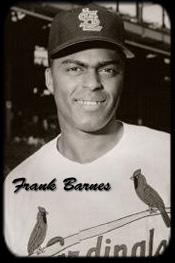
Frank Barnes was a baseball pioneer who thrived at the highest levels of the Cardinals’ farm system.

frank_barnesIn the big leagues, Barnes ran for Stan Musial after he got his 3,000th hit.

In 15 pitching appearances over three seasons for the Cardinals, Barnes was 1-3 with a 5.89 ERA.

Statistics tell only part of his story.

Yankees prospect

At 21, Barnes began his professional career in 1947 with Indianapolis of the Negro American League. Three years later, in July 1950, while playing for Kansas City of the Negro American League, Barnes and teammate Elston Howard had their contracts sold to the defending World Series champion Yankees, who were slow to integrate. According to the book, “Elston and Me” by Arlene Howard (Elston’s widow) and Ralph Wimbish, Barnes was like a big brother to Howard and helped him adapt to professional baseball.

Barnes and Howard, a St. Louis native, were assigned by the Yankees to a Class A farm club in Muskegon, Mich. Howard, converted from outfielder to catcher, eventually became the first African-American to play for the Yankees. Barnes was dealt to the Browns organization.

In 1956, at age 30, Barnes was with Toronto, a Class AAA franchise without affiliation. Toronto loaned him to the Cardinals’ Omaha affiliate and Barnes appeared in seven games for the American Association club.

Backed by Keane

Omaha manager Johnny Keane gave a positive report on Barnes to the Cardinals. On the strength of that recommendation, Cardinals general manager Frank Lane acquired Barnes from Toronto on Oct. 1, 1956, for pitcher Jim Pearce, cash and a player to be named, first baseman Rocky Nelson.

Barnes began the 1957 season with Omaha. On May 28, he struck out 17 Denver batters in 10 innings of a 1-0 Omaha victory. In a stretch from May to June, Barnes pitched 41.1 consecutive scoreless innings, breaking the American Association record of 39 by Bill Schardt of the 1915 Indianapolis team.

Keane cited “pinpoint control” and “much improvement on the breaking pitches” as reasons for Barnes’ success, The Sporting News reported.

Lane sent an assistant, Joe Mathes, to Omaha to scout Barnes and two other pitching prospects, Bob Mabe and Tom Cheney.

Barnes completed the 1957 American Association season with a 12-10 record, six shutouts and a league-leading 2.41 ERA.

Reaching the majors

The Cardinals called up Barnes for the final month of the 1957 season. On Sept. 22, 1957, Barnes, 31, made his big-league debut with a scoreless inning in relief of starter Lindy McDaniel against the Reds at Cincinnati. Boxscore

Two days later, Barnes pitched six scoreless innings in relief of starter Sam Jones against the Braves at Milwaukee. Boxscore

Barnes “showed speed and a good slow curve,” The Sporting News reported.

Cardinals manager Fred Hutchinson gave Barnes his first big-league start on Sept. 29, 1957, against the Cubs at St. Louis. Barnes lacked command of his pitches and was shelled for five runs in three innings.

In three appearances for the 1957 Cardinals, Barnes was 0-1 with a 4.50 ERA. He was prominent in the Cardinals’ plans for spring training in 1958.

High hopes

On March 9, 1958, the Cardinals started Barnes against Yankees ace Whitey Ford in the second exhibition game of the spring. Barnes pitched well, yielding a run in three innings.

In his first 15 spring exhibition game innings, Barnes gave up two runs, prompting The Sporting News to describe his performance as “dazzling pitching.” Impressed, the Cardinals put Barnes on their Opening Day roster.

For Barnes, two highlights of his stint with the 1958 Cardinals occurred in May.

Musial delivered his 3,000th career hit, a RBI-double to left-center off the Cubs’ Moe Drabowsky, on May 13 at Chicago. Hutchinson lifted Musial for a runner, choosing Barnes for the honor. Barnes raced home from second on a single to left by Don Blasingame, tying the score at 3-3 in a game the Cardinals won, 5-3. Boxscore

Five days later, on May 18, Barnes earned his only big-league win.

In the opener of a doubleheader against the Dodgers at St. Louis, Barnes, in relief of Mabe, pitched six innings and held the Dodgers to one run (a John Roseboro home run) and four hits. The Cardinals won, 6-5. The losing pitcher was Don Drysdale. Boxscore

Return to Omaha

Barnes was 1-1 with a 7.58 ERA in eight games for the 1958 Cardinals. He was returned to Omaha in June after St. Louis acquired pitcher Sal Maglie from the Yankees in a cash transaction. Yankees farm director Lee MacPhail told The Sporting News he asked the Cardinals for Barnes in exchange for Maglie, but St. Louis refused.

On Aug. 4, 1958, Barnes pitched a no-hitter for Omaha against Louisville. He walked three and struck out 11.

Barnes completed the 1958 season with a 7-6 record and 2.58 ERA for Omaha.

He spent the entire 1959 season with Omaha, posting a 15-12 record and 2.87 ERA as the ace on a staff that included Bob Gibson and Ray Sadecki.

After opening the 1960 season with the Cardinals’ Rochester farm club, Barnes was called up to St. Louis on April 29. He went 0-1 with a 3.52 ERA in four games with the Cardinals.

“We figured on Barnes for relief, but his arm is too tender for frequent duty,” Cardinals manager Solly Hemus said to the St. Louis Post-Dispatch.

On May 19, 1960, the Cardinals sold Barnes’ contract to the White Sox, who assigned him to their San Diego farm team. Barnes continued to pitch professionally in the minor leagues and Mexico until age 40 in 1967.

Read Full Post »

« Newer Posts - Older Posts »