Feeds:
Posts
Comments

Archive for the ‘Pitchers’ Category

In 1975, the Cardinals established a major-league record for most intentional walks issued by one team in a nine-inning game.

john_montefuscoCardinals pitchers Lynn McGlothen and Mike Garman combined to give six intentional walks to the Giants on July 19, 1975, at San Francisco. Three of those passes were given to the No. 8 batter, catcher Dave Rader.

The strategy by Cardinals manager Red Schoendienst was driven not by fear of Rader but by the hitting funk experienced by the Giants’ No. 9 batter, rookie pitcher John Montefusco.

Though the moves worked successfully for St. Louis in all but one instance, the Giants beat the Cardinals, 5-2.

Prime pitching pairing

Montefusco and McGlothen, both 25-year-old right-handers, were developing into staff aces.

Montefusco, nicknamed “The Count,” would win the 1975 National League Rookie of the Year Award, with a 15-9 record and 2.88 ERA. He also would finish second in the NL that season to the Mets’ Tom Seaver in strikeouts _ Seaver had 243 and Montefusco, 215 _ and first in the league in strikeouts per nine innings (7.9).

McGlothen, in his second St. Louis season after being acquired from the Red Sox, would tie Bob Forsch for the team lead in wins in 1975, with 15. He also would lead the 1975 Cardinals in complete games (nine), innings pitched (239) and strikeouts (146).

Avoiding Rader

On a Saturday afternoon before 7,136 at Candlestick Park, the Giants struck first when Bobby Murcer hit a two-run homer versus McGlothen in the opening inning.

In the second, the Giants threatened again, with Chris Speier on third and one out. Rader was at the plate, with Montefusco in the on-deck circle. The Cardinals, aware Montefusco had one hit in 36 at-bats, played the percentages and walked Rader intentionally. McGlothen struck out Montefusco and got Von Joshua to ground out.

In the third, with the Giants ahead, 4-2, the Cardinals used the same strategy. With two outs and Giants runners on second and third, Rader was walked intentionally. Montefusco followed with a groundout, ending the inning.

Rader, a left-handed batter who hit .291 in 1975, was walked intentionally by McGlothen for a third consecutive time when he came to the plate in the fifth. With Speier on second and two outs, Rader was given the intentional pass and Montefusco struck out.

Mixing and matching

McGlothen intentionally walked two more batters in the sixth, though neither was Rader. With Derrel Thomas on second and one out, McGlothen gave an intentional pass to Murcer. The next batter, Gary Matthews, flied out to center. Thomas and Murcer each advanced a base on the play. That brought to the plate Willie Montanez, a left-handed batter who had driven in two runs with a third-inning single. McGlothen intentionally walked Montanez, loading the bases with two outs.

McGlothen struck out Speier, escaping the jam.

In the seventh, Garman relieved McGlothen. With one out and no one on base, Garman walked Rader, though this time it was unintentional.

The sixth and final intentional walk occurred in the eighth. With two outs and Thomas on third, Garman intentionally walked Montanez and opted to pitch to Speier. Giants manager Wes Westrum called for a double steal attempt. Thomas stole home, extending the Giants’ lead to 5-2, and Montanez swiped second.

Count in command

Despite a combined 11 walks and 17 hits, the game was completed in 2:03.

Rader had an odd boxscore line: no at-bats, four walks.

Montefusco got the win. He walked two (none intentional) and struck out seven, including Reggie Smith four times, all on fastballs.

At the plate, Montefusco was 0-for-4, dropping his season batting average to .025 (1-for-40). Boxscore

In his next start, July 23 at San Francisco, Montefusco hit a home run against Milt Wilcox of the Cubs. Before the game, Montefusco said, the Cubs had been teasing him near the batting cage.

“That razzing bothered me and I told those guys to look out because I’m going to beat your butts today and I’m going to hit a homer as well,” Montefusco told United Press International.

In 13 seasons in the major leagues, Montefusco hit .097 (44-for-455) overall and .217 (5-for-23) vs. the Cardinals.
 

Read Full Post »

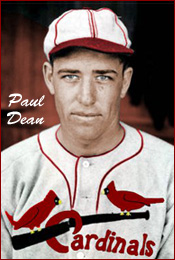
When Cardinals rookie Paul Dean learned to mix his pitches, hit the corners of the strike zone and quit trying to emulate his larger-than-life older brother, he became an effective starter for St. Louis.

paul_deanIn 1934, Paul Dean, 21, debuted with the Cardinals, won his first eight decisions and went into the All-Star Game break with a 10-4 record.

Paul Dean’s brother, Dizzy Dean, 24, was the ace of the 1934 Cardinals staff. Paul entered the Cardinals’ 1934 spring training camp as a candidate to join his brother in the starting rotation after posting a 22-7 record in 1933 for minor-league Columbus.

During that 1934 spring training, Dizzy brashly predicted he and Paul would combine for 45 wins for the Cardinals that season. Though well-intentioned, the remark put added pressure on Paul.

Some Cardinals veterans already thought Paul wasn’t ready for the big leagues and was being given preferable treatment in spring training because he was Dizzy’s brother.

Paul didn’t help matters with his combative nature. He feuded with first baseman Rip Collins and coach Mike Gonzalez and later got into a fight with outfielder Joe Medwick.

Needing a makeover

Paul made the Opening Day roster for the 1934 Cardinals. He yielded eight earned runs in six innings over his first three appearances and had an ERA of 12.00.

According to the book “Diz” by Robert Gregory, Cardinals manager Frankie Frisch told Paul, “You’ve got the speed, but it won’t matter how hard you throw. If it’s down the middle, these fellows are going to hit it.”

Said Cardinals pitcher Tex Carleton of Paul: “He doesn’t have a curve. No pitching finesse.”

Frisch and his coaches, Gonzalez and Buzzy Wares, worked with Paul to develop an off-speed pitch. Dizzy thought the instruction was a hindrance rather than a help. “There ain’t nothing wrong with Paul,” Dizzy said. “… He’ll be all right if them coaches don’t ruin him by trying to make him over. I want them to lay off that kid.”

In his next start, May 3 against the Phillies, Paul got his first big-league win, but he wasn’t sharp, yielding five runs in five innings in an 8-7 Cardinals victory.

“I was worried because he was obviously overawed by his big brother,” Frisch recalled years later. “Paul was imitating Dizzy’s style on the mound, but lacked his colossal self-confidence.”

Turning point

Paul’s next start was scheduled for May 11 against the defending World Series champion Giants and their ace, Carl Hubbell. Speculation was Paul would be sent to the minor leagues if he didn’t pitch well in that game.

“In many respects, Paul was pitching for his job,” The Sporting News reported. “He had done nothing prior to this outing and there were grave doubts about his ability to put a curve in there with his fast one that would keep the wolves away from the plate.”

A few days before the showdown, Frisch invited Paul to join him for dinner. Over porterhouse steaks, Frisch, who began his career with the Giants, explained to Paul how to pitch to each Giants batter. Frisch also told Paul to be himself, trust his talent and use the off-speed pitch he’d been learning.

Before a Ladies Day crowd at Sportsman’s Park in St. Louis, Paul mixed a changeup with his fastball and delivered some pitches from a sidearm delivery that helped hide the ball from batters. He held the Giants to two runs and got the complete-game win when the Cardinals snapped a 2-2 tie with a run off Hubbell in the 10th. Boxscore

“I think Paul Dean is in a fair position to become a great pitcher,” said Frisch. “His only trouble has been control and as long as he can pitch to spots he will be OK. We have worked hard on him and he has shown us that he knows how to pitch and can grab information and make the best of it. I like him.”

Dean demands

Paul became a consistent winner. Through May 31, Paul was 5-0, Dizzy was 6-2 and the Cardinals were in first place.

On June 1, Dizzy was scheduled to start against the Pirates. Instead, he staged a strike, refusing to pitch until the Cardinals gave his brother a $2,000 pay raise. Paul’s salary was $3,000. Dizzy’s salary was $7,500.

Dizzy ended his walkout the next day.

Paul won his next three decisions, boosting his record to 8-0 with a shutout against the Phillies on June 17.

Wrote The Sporting News: “He has passed the experimental stage and today unquestionably rates as the greatest young right-hander to come into the majors since Wes Ferrell and Lon Warneke.”

Deans deliver

After beating the Giants on June 26, Paul was 10-1 with a 3.92 ERA. He lost his next three decisions before the July 10 All-Star Game.

The Dean brothers continued to win in the second half of the season, especially in the September pennant stretch. Paul was 5-3 with a 1.93 ERA in September; Dizzy was 7-1 with a 1.54 ERA that month.

The Cardinals won the pennant with a 95-58 record, finishing two games ahead of the Giants.

Dizzy was 30-7 and led the NL in strikeouts for the third consecutive season. Paul was 19-11 with 16 complete games and five shutouts. With a combined 49 wins, the brothers had exceeded Dizzy’s prediction.

In the World Series, Dizzy and Paul each won twice, leading the Cardinals to the championship over the Tigers. In Paul’s two starts, he pitched complete games, yielding two earned runs in 18 innings.

Previously: How Dizzy Dean got the best of his matchup with Babe Ruth

Previously: Pennant clincher: How Dizzy Dean got 2 shutouts in 3 days

Previously: Cardinal cool: How Dizzy Dean survived armed robbery

Read Full Post »

(Updated July 13, 2020)

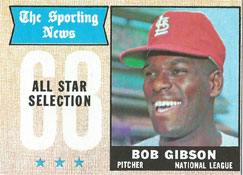
In a display of strength and versatility, Bob Gibson in 1965 pitched 13 innings in a start vs. the Giants on July 7, pitched four innings of relief against the Cubs on July 11 and earned a save with two innings of relief in the July 13 All-Star Game.

bob_gibson15Well aware of Gibson’s workload, the Phillies’ Gene Mauch, National League manager, left it up to the Cardinals’ ace to choose whether to pitch in the All-Star Game at Minnesota.

“He told me before the game that his arm didn’t feel good,” Mauch told the Minneapolis Star-Tribune. “I made it clear that it was his decision whether to pitch or not. During the game, Gibson sent word that he was OK.”

Mauch called on Gibson to protect a 6-5 lead over the final two innings.

“Gibson thinks he can get anybody in the world _ and I do, too,” Mauch told the Associated Press.

Grateful for Gibson’s save, the Dodgers’ Sandy Koufax, who got the All-Star Game win, good-naturedly said to Gibson, “Why don’t you quit starting? There’s a heck of a future in relieving for you.”

NL fireballers

The National League unleashed an array of hard throwers on the American League. Juan Marichal of the Giants started and was followed by the Reds’ Jim Maloney, Dodgers teammates Don Drysdale and Koufax and the Astros’ Turk Farrell before Gibson entered in the eighth. The American League scored all of its runs off Maloney.

Gibson, the Cardinals’ lone all-star representative, retired the first two batters he faced, striking out the Tigers’ Willie Horton and getting the Yankees’ Bobby Richardson on a groundout. After he walked the Twins’ Zoilo Versalles, Bill Freehan of the Tigers followed with a single to center. When the throw from Willie Mays went to third, Freehan took second, putting two runners in scoring position for the next batter, the Twins’ Jimmie Hall.

A left-handed batter, Hall hit a shot to center. Mays started for the ball, slipped and barely recovered in time to make a leaping, backhanded catch, ending the inning.

In the bottom of the ninth, the Twins’ Tony Oliva led off with a double. Attempting a bunt, the Indians’ Max Alvis offered at Gibson’s first pitch and popped out for the first out.

Gibby vs. Killer

Twins slugger Harmon Killebrew was up next. The crowd at Metropolitan Stadium was abuzz at the prospect of their prodigious home run hitter driving in his Twins teammate Oliva from second with the tying run.

Instead, Killebrew struck out.

“He threw me sliders until the last pitch,” Killebrew told the Star-Tribune. “That was a good, hard fastball.”

To the St. Louis Post-Dispatch, Killebrew said, “For a guy who was supposed to be tired, Gibson threw pretty darn good. The ball just seemed to drop under my bat.”

American League manager Al Lopez sent a left-handed pinch-hitter, the Yankees’ Joe Pepitone, to bat next.

Gibson struck him out, sealing the win. Boxscore and video of Gibson at 13:40 mark

Throwing heat

In describing how he pitched Pepitone, Gibson said, “The first two sliders were up and in. They aren’t going to do a darn thing with it if it goes in there. If it doesn’t get in there, that’s a different story. The last pitch was a fastball. That was in there.”

Asked to describe the strikeout pitch, Pepitone said, “Whoosh. I saw it good, too. He was just a little too quick.”

Nine months earlier, Pepitone went 0-for-4 versus Gibson in Game 7 of the 1964 World Series. After fanning Pepitone in the All-Star Game, Gibson said to the Star-Tribune, “The World Series is a lot more thrilling to pitch in than the All-Star Game because there’s money involved.”

In the clubhouse, National League catcher Joe Torre of the Braves soaked his left hand in warm water to ease the soreness from having so many fastballs slam into his mitt.

“I had some real hummers coming out of the bullpen,” Torre told The Sporting News. “The hand really hurts.”

Said Gibson: “I got to admit he was catching some sizzlers.”

Previously: As all-stars, only two hit Bob Gibson more than once


Read Full Post »

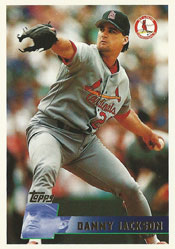
In a season fraught with futility, the pitcher who epitomized the plight of the 1995 Cardinals was Danny Jackson. Expected to provide wins and hope, Jackson instead represented losses and despair.

danny_jacksonOn July 2, 1995, Jackson was the losing pitcher for St. Louis against the Cubs at Chicago, dropping his season record to 0-9.

Jackson became the first Cardinals pitcher to start a season 0-9 since Art Fromme in 1907 and the first Cardinals pitcher to lose nine in a row since Bob Forsch did so from July 5 through Aug. 19 in 1978.

Tough guy

A left-hander, Jackson was signed by the Cardinals as a free agent in December 1994 after posting a 14-6 record and 3.26 ERA for the 1994 Phillies.

Jackson had pitched in three World Series for three different franchises (1985 Royals, 1990 Reds and 1993 Phillies) and had been a 23-game winner with the 1988 Reds.

Cardinals general manager Walt Jocketty gave Jackson a three-year contract for a guaranteed $10.8 million.

“Danny Jackson gives us the toughness we’ve lacked in our pitching staff,” Cardinals manager Joe Torre told the St. Louis Post-Dispatch.

Troubled pitcher

Jackson, 33, who underwent thyroid surgery during the off-season, started poorly with the 1995 Cardinals, yielding four runs or more in each of his first four appearances. Jackson had complications with his medications. He also was hampered by an unsteady defense and erratic offense.

Still, Jackson’s ineffectiveness was his own doing. His pitching mechanics were out of synch.

His ERA after his ninth loss was 7.83. Jackson gave up three or more runs in an inning 11 times in his first 11 starts for the Cardinals. He was unable to last longer than five innings in eight of those starts.

“I don’t know what the hell is going on, but I know one thing: I’m sick and tired of losing,” Jackson said after his record fell to 0-9. “It doesn’t seem to make any difference what I do. It’s always the same.”

Said Mike Jorgensen, who had replaced Torre as manager: “We’re going to keep sending him out there until we get him smoothed out.” Boxscore

Goodbye gorilla

Five days after his loss to the Cubs, Jackson ended the streak in spectacular fashion, shutting out the Marlins on a four-hitter on July 7, 1995, at St. Louis.

“I feel like I got King Kong off my back,” Jackson said.

Said catcher Tom Pagnozzi: “That was the best he had looked as far as not muscling the ball and throwing fluidly.” Boxscore

Jackson won his next start, beating the Phillies, and then lost three decisions in a row.

Bad numbers

In his last start of the season, Aug. 11 against the Padres, Jackson injured an ankle, was lifted in the second inning and didn’t pitch again in 1995.

His season record: 2-12 with a 5.90 ERA.

In 19 starts, Jackson yielded 120 hits in 100.2 innings and had almost as many walks (48) as strikeouts (52). Batters hit .303 against him.

His failures were a key factor in the Cardinals having a 62-81 record.

Jackson never recovered. In three seasons with the Cardinals, he was 4-15 with a 5.78 ERA.

On June 13, 1997, the Cardinals dealt Jackson, pitcher Rich Batchelor and outfielder Mark Sweeney to the Padres for pitcher Fernando Valenzuela, outfielder Phil Plantier and third baseman Scott Livingstone.

Previously: The day Cardinals fired Joe Torre, traded Todd Zeile

Read Full Post »

(Updated June 29, 2020)

Taking advantage of an unmotivated, jet-lagged team, Fernando Valenzuela pitched a no-hitter against the Cardinals. It was the second no-hitter pitched in the major leagues that night and the first versus the Cardinals in 12 years.

fernando_valenzuelaOn June 29, 1990, at Los Angeles, Valenzuela pitched the only no-hitter of his career in a 6-0 Dodgers victory over the Cardinals.

Earlier that night, Dave Stewart, Valenzuela’s former Dodgers teammate, pitched a no-hitter for manager Tony La Russa’s Athletics against the Blue Jays. It was the first time no-hitters had been pitched in both the American League and National League on the same day.

Valenzuela, 29, struck out seven and walked three. The Cardinals also had a runner reach on an error.

The left-hander pitched the first no-hitter against the Cardinals since Tom Seaver of the Reds on June 16, 1978.

Control, confidence

After beating the Pirates in a night game at St. Louis on June 28, the Cardinals stayed overnight at home and left the morning of June 29 for that night’s game against the Dodgers. The Cardinals arrived in Los Angeles about 12:30 in the afternoon Pacific Coast time.

The Dodgers watched on the clubhouse TV as Stewart completed his no-hitter at Toronto. Boxscore

Valenzuela turned to his teammates and said, “You’ve seen one on TV. Now come watch one live,” Rick Hummel of the St. Louis Post-Dispatch reported.

Valenzuela’s previous big-league best had been a two-hitter.

From the first pitch, Valenzuela was in command. “Throughout the game, I had excellent control,” he told the Orange County Register. “I had a lot of confidence.”

Timely tip

In the ninth, Vince Coleman led off for the Cardinals. The speedster was carrying a 10-game hitting streak and was the batter Valenzuela feared most in the St. Louis lineup. “Coleman makes a lot of contact and he can bunt,” Valenzuela said.

On a 2-and-1 pitch, Coleman hit a shot down the third-base line, but it was foul. With the count at 2-and-2, Coleman showed bunt, took a pitch outside and was called out on strikes by umpire Jerry Layne.

Referring to Layne’s strike zone, Cardinals manager Whitey Herzog told the Los Angeles Times, “I don’t want to take anything away from Fernando, but he had the right guy behind the plate.”

Willie McGee was up next and he walked on four pitches.

That brought to the plate Pedro Guerrero, who had been Valenzuela’s Dodgers teammate from 1980-88. Guerrero was playing on his 34th birthday.

“When Willie got on,” Guerrero told Hummel, “I said, ‘I’m going to be the one that’s going to do it.’ ”

With the count 0-and-2, Guerrero hit a grounder up the middle. As Valenzuela reached for the ball, it tipped his glove and was deflected to second baseman Juan Samuel, who stepped on second for the force on McGee and threw to first for the game-ending double play.

Jubilant Dodgers broadcaster Vin Scully told listeners, “If you have a sombrero, throw it to the sky.” Video of ninth inning

“Do you think if I don’t touch that ball, it goes through for a single? I think it does,” said Valenzuela. “I think if I don’t touch it, I’m in trouble.”

Said Guerrero: “I hit it pretty good. If he doesn’t get a glove on it, I think it’s through there.” Boxscore

Cardinals crusher

The loss was the fifth in six games for the Cardinals (30-44).

“We’re pathetic,” said Herzog.

Said Guerrero: “We didn’t look too good out there, but I think flying on game day had something to do with it.”

Stewart called the Dodgers clubhouse after the game to congratulate Valenzuela.

The no-hitter evened Valenzuela’s season record at 6-6 and lowered his ERA from 4.09 to 3.73.

Valenzuela was the fourth Dodgers pitcher to achieve a no-hitter since 1958 when the franchise moved from Brooklyn to Los Angeles. The others were Sandy Koufax, Bill Singer and Jerry Reuss.


Read Full Post »

(Updated June 27, 2020)

In his final career win as a starter, Bob Gibson achieved a milestone.

bob_gibson19On June 27, 1975, Gibson earned his 250th career win, pitching six innings in a 6-4 Cardinals victory over the Expos in Game 1 of a doubleheader at Montreal.

Gibson became the first and only Cardinals pitcher to achieve 250 wins. No one else has come close. The pitcher with the next-best career wins total as a Cardinal is Jesse Haines (210).

The win also was the first for Gibson since May 5, 1975.

“Number 250 doesn’t mean any more than 249,” Gibson said to the Associated Press. “It feels good to be able to win a game and help the ball club. I want to be part of a winning ball club. I haven’t lost that.”

Gibson told the St. Louis Post-Dispatch, “I’m not out there for anything more than pride.”

Breaking stuff

Gibson, 39, shut out the Expos through six innings.

“I was getting my breaking ball over,” Gibson said. “If you don’t have the breaking stuff. you just have the fastball. It’s tough to pitch with just the fastball.”

Gibson also contributed a RBI-single in the fifth off Expos starter Steve Rogers and scored on a Ted Sizemore two-run double.

“If his arm isn’t that good any more, he still has the heart,” Expos manager Gene Mauch said to the Montreal Gazette. “It looks like the heart is as big as ever.”

In the seventh, with the Cardinals ahead, 4-0, the first two Expos batters reached base and Gibson was lifted by manager Red Schoendienst. Ron Bryant relieved and yielded a RBI-double to Barry Foote. Rookie Greg Terlecky replaced Bryant and gave up a two-run single to Bob Bailey. Two of the runs were charged to Gibson.

Gibson’s line for the game: 6 innings, 5 hits, 2 runs, 6 walks, 1 strikeout. Boxscore

“His hard slider may not be able to chip the corner off a brick any more and his right arm feels like a toothache when he has finished pitching a game,” the Post-Dispatch observed.

Said Gibson: “I ache every time I take a step.”

One more win

Gibson made two more starts, the last of his career, against the Phillies and Giants, and lost both, dropping his season record to 2-8.

His 251st and final win of his career came in relief on July 27, 1975, against the Phillies at St. Louis.

Relieving rookie starter John Denny in the fourth, Gibson pitched four shutout innings in a 9-6 Cardinals triumph. Gibson struck out Larry Bowa and Mike Schmidt to end the sixth and struck out Greg Luzinski to start the seventh.

Gibson’s line for the game: 4 innings, 3 hits, 0 runs, 1 walk, 4 strikeouts. Boxscore

It was Gibson’s first win in relief since beating the Mets on the final day of the 1964 season, clinching the National League pennant for St. Louis.

Gibson made six more relief stints for the 1975 Cardinals and lost two, finishing his final season at 3-10 with a 5.04 ERA.

In 17 seasons (1959-75) with St. Louis, Gibson was 251-174 with a 2.91 ERA. Among his accomplishments: two NL Cy Young awards, two World Series Most Valuable Player awards, a NL MVP Award and nine Gold Glove awards. He was elected to the National Baseball Hall of Fame in 1981.

Previously: How Ron Reed replaced Bob Gibson in Cardinals rotation


Read Full Post »

« Newer Posts - Older Posts »