Feeds:
Posts
Comments

Archive for the ‘Pitchers’ Category

(Updated Feb. 4, 2023)

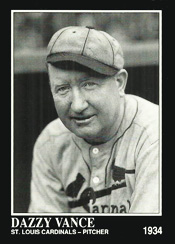
Combining an effective hitting stroke with a strikeout pitch that dazzled a lineup stacked with fellow future Hall of Famers Rogers Hornsby, Jim Bottomley and Chick Hafey, Dazzy Vance gave one of the best individual performances all-time against the Cardinals.

dazzy_vanceOn July 20, 1925, Vance, 34, struck out 17 and produced three RBI, including the walkoff hit in the 10th, carrying Brooklyn to a 4-3 victory over the Cardinals at Ebbets Field.

The New York Daily News called it an “epoch-making performance” from a “smokeball artist.”

Ninety years later, on May 13, 2015, Corey Kluber, 29, struck out 18 in eight innings, lifting the Indians to a 2-0 victory over the Cardinals at Cleveland. Boxscore

Kluber’s strikeouts are the most by one pitcher against the Cardinals, topping the mark held by Vance.

Whiff wiz

A right-hander, Vance didn’t get his first big-league win until he was 31 in 1922.

He was named winner of the National League Most Valuable Player Award in 1924 when he was 28-6 for Brooklyn and led the league in wins, ERA (2.16), strikeouts (262) and complete games (30).

Mixing a fastball with a curve, Vance led the NL in strikeouts with Brooklyn for seven consecutive years (1922-28). His 17 against St. Louis represented his single-game high in 16 big-league seasons.

Vance struck out every player in the Cardinals lineup that day except shortstop Specs Toporcer, who got his nickname because he wore eyeglasses.

Hornsby and Bottomley each struck out three times, tying career highs. Hafey struck out once.

“The Cardinals “punched yawning gaps in the atmosphere trying to connect with the Dazzler’s fast ones,” the New York Daily News reported.

Unlike Kluber, who held the 2015 Cardinals to one hit, Vance wasn’t untouchable against the 1925 Cardinals. He yielded nine hits and walked six. Vance used his bat as well as his strikeout pitches to put himself in position to win.

Power hitter

After Les Bell reached Vance for a two-run single in the fourth, breaking a scoreless tie, Vance responded with a two-run home run the next inning.

Vance hit .143 in 1925 and .150 for his big-league career. Most of his hits came against off-speed pitches. Known for his wit, Vance explained his approach to hitting in the 1976 book “The Gashouse Gang” by Robert Hood:

“I was a slow-ball hitter,” Vance said. “I found that out years ago when I was a boy on a farm. We were plagued with rats, so we got a ferret and shoved him down a hole. I stood at another hole with a baseball bat. When a rat ran out, I swung and missed. Another came and I swung and missed. I must have missed half a dozen.

“Then out came this fellow nice and slow and I clouted him good. Unfortunately, it was the ferret. From then on, I knew I was a slow-ball hitter.”

Walkoff winner

In the eighth, with Hornsby on first, one out and the score still tied at 2-2, Vance struck out Bottomley and Hafey. Then Vance singled leading off the bottom half of the inning and Brooklyn got the go-ahead run on Milt Stock’s RBI-double.

The Cardinals tied the score at 3-3 in the ninth when Toporcer tripled and Bell singled for his third RBI of the game.

After nine innings, Vance had struck out 15, tying his career high. Rube Waddell of the 1908 Browns had established the big-league record for strikeouts in nine innings with 16 against the Athletics.

In the 10th, Vance struck out Hornsby and Bottomley, giving him his total of 17.

“The great Rogers Hornsby was practically helpless before Dazzy’s speed,” according to the New York Daily News.

In addition to the fastball, Vance “had a sharp-breaking curve that was amazing,” the Brooklyn Daily Eagle reported. “The funny thing was that Vance was reported to have an arm which was still blue from the rupturing of a blood vessel in his four disastrous innings against Pittsburgh last Thursday. On Sunday his arm was still red and angry-looking from the use of secrets from Doc Hart’s medicine chest.”

After catcher Hank DeBerry led off the bottom of the 10th with a double and was lifted for pinch-runner Johnny Mitchell, Vance followed with a single, scoring Mitchell with the winning run. Boxscore

Vance finished the 1925 season with a 22-9 record and 221 strikeouts in 265.1 innings.

He pitched for the Cardinals in 1933 and 1934, giving St. Louis a tandem of Dazzy and Dizzy (Dean). Vance appeared in his lone World Series in 1934 for St. Louis against the Tigers. His career record is 197-140 (190 wins for Brooklyn and seven for St. Louis) with 2,045 strikeouts.

He was elected to the National Baseball Hall of Fame in 1955.


Read Full Post »

Earning wins in his first two appearances for the Cardinals, Troy Percival went from being perceived as a risk to being viewed as a valuable reliever.

troy_percivalA closer with the Angels and Tigers, Percival sat out the 2006 season because of persistent arm ailments.

In 2007, Percival, 37, found he was able to throw effectively again. He was in contact with several former Angels teammates who had become Cardinals and they put in a good word for him. Percival threw for the Cardinals during a workout and impressed. The Cardinals signed him on June 8, 2007, and sent him to their minor-league Memphis club to get into game condition.

Percival posted a 1.35 ERA in six appearances for Memphis and was called up by St. Louis before a weekend series against the Reds at Cincinnati.

In his Cardinals debut, on June 29, 2007, Percival earned a win with a flawless inning of relief in the Cardinals’ 4-2 victory over the Reds.

“It’s a dream come true,” Cardinals manager Tony La Russa said to the Associated Press. “He gets three outs and gets the winning decision. That’s movie material.”

Said Percival: “I didn’t come back for myself. A lot of friends on this team called me and said they needed pitching help. My arm felt good enough to do it.” Boxscore

Two days later, on July 1, Percival made his second Cardinals appearance. With the Cardinals ahead, 8-5, in the fourth, Percival relieved starter Mike Maroth with two runners on base and no outs. Percival got out of the mess by retiring all three batters he faced without allowing either base runner to advance. The Cardinals won, 11-7, and Percival was credited with the win in a scorer’s decision for his successful rescue effort in the fourth. Boxscore

Percival contributed a 3-0 record and 1.80 ERA in 34 appearances for the 2007 Cardinals. Granted free agency after the season, he signed with the Rays and finished his career with them in 2009.

Previously: The story of how the Cardinals acquired Lee Smith


Read Full Post »

Rescued from the minors and given the chance for a final fling with the franchise he rooted for as a boy in Illinois, T.J. Mathews delivered his longest and most impressive big-league performance for the Cardinals.

tj_mathewsOn Sept. 9, 2001, Mathews pitched 4.1 flawless innings of relief for the Cardinals and got the win in an 8-1 St. Louis victory over the Dodgers at Busch Memorial Stadium. Mathews retired all 13 batters he faced, striking out five.

Baseball pedigree

Mathews, a Belleville, Ill., native, grew up as a Cardinals fan. His father, Nelson Mathews, had been an outfielder with the Cubs and Athletics in the 1960s. In 1992, T.J. Mathews was selected in the 36th round of the amateur draft by the Cardinals.

A right-hander, Mathews debuted with the Cardinals in 1995 and pitched effectively for them in relief. On July 31, 1997, Mathews was one of three players traded by the Cardinals to the Athletics for first baseman Mark McGwire.

Four years later, on June 22, 2001, Mathews, 31, was released by the Athletics. The Cardinals signed him two weeks later. After three appearances for St. Louis, Mathews was sent to Class AAA Memphis. In September, when the minor league seasons ended and big-league rosters expanded, the Cardinals brought him back.

Postseason quest

On Sept. 9, 2001, the Cardinals entered the day tied for second place with the Cubs in the National League Central Division at 77-64, 5.5 games behind the Astros. With 21 games remaining, the Cardinals needed a strong finish to have a chance at earning a postseason berth as either division champion or the wild-card entry.

Matt Morris, seeking his 20th win, was the Cardinals’ starter that Sunday afternoon against the Dodgers. After an inning, the game was halted by rain. The delay lasted two hours and four minutes.

Morris wanted to continue. Cardinals manager Tony La Russa, concerned the long delay could hamper Morris’ ability to properly loosen his arm, sent Luther Hackman to pitch the second.

“That was a real tough decision,” La Russa said to the St. Louis Post-Dispatch.

Said Morris: “When they make a decision that benefits your future, you can’t really complain.”

Hackman pitched a scoreless second. In the third, with the Cardinals ahead, 2-0, Hackman lost command. With one on and two outs, he walked three consecutive batters, forcing in a run and enabling the Dodgers to get within a run, 2-1.

La Russa lifted Hackman and brought in Mathews to face Adrian Beltre with the bases loaded. Mathews got Beltre to fly out, ending the threat.

Untouchable

Mathews retired the Dodgers in order in the fourth through seventh innings. He was lifted for a pinch hitter with the Cardinals ahead, 7-1. Mike James and Mike Timlin mopped up, pitching an inning apiece. Boxscore

Mathews got the win, the last of his 32 in an eight-year major-league career. The win also was his first since 2000 with the Athletics and his first as a Cardinal since 1997.

“He’s hard (for batters) to pick up,” said Cardinals catcher Mike Matheny. “Even catching him is tough. The ball comes right out of his jersey. His release point is kind of funny.”

Said Mathews: “Somebody had to go out and give us some innings. I thought maybe I’d go three at the most. After that third one, I thought, ‘Aw, what the heck.’

“I haven’t thrown that much since I was in the starting rotation in (Class AAA) Louisville in ’95. I wasn’t tired. When you get outs early, you can stay out there a little bit longer.”

Said La Russa to the Associated Press: “It’s kind of hard to believe he could throw that many pitches and keep his effectiveness.”

The win by Mathews sparked a stretch in which the Cardinals won 16 of their last 21 games, tying the Astros for first place in the NL Central at 93-69 and qualifying for the postseason as the wild-card entry.

Mathews became a free agent after the season and signed with the Astros. His 2002 season with Houston would be his last in the big leagues.

Previously: Deal for Woody Williams sparked 2001 Cardinals

Previously: Matt Morris close to perfect at home in 2001

Read Full Post »

On the field, pitcher Bob Gibson and center fielder Curt Flood were all-star players who exceled for a Cardinals club that won two World Series titles and three National League pennants in the 1960s. Off the field, Gibson and Flood were road roommates and confidantes.

In his book “Stranger to the Game,” Gibson called Flood “my best friend in baseball.”

In 12 years (1958-69) with the Cardinals, Flood batted .293 (1,853 hits in 1,738 games) and three times led the NL in singles. He also won the Gold Glove Award seven times and was named an all-star three times.

“Curt Flood was more than my best friend on the ballclub,” Gibson said in his book. “To me, he personified what the Cardinals were all about. As a man and teammate, he was smart, funny, sensitive and, most of all, unique. As a ballplayer, he was resourceful, dedicated and very, very good.”

After being traded by the Cardinals to the Phillies in October 1969, Flood refused to report and challenged baseball’s reserve clause, opening the path to free agency for players.

“As Flood’s suit made the judicial circuit, Curt waited it out in Copenhagen, Denmark,” Gibson recalled. “I received long, philosophical letters from him every now and then. I missed him.

“At the ballpark, I missed Flood in center field, where his remarkable catches would often bring his cynical teammates to the top step of the dugout in applause. But I also missed his discussions about the latest works of (writer) James Baldwin and I missed his play on words. When, for instance, he took his place in the outfield between Stan Musial and Minnie Minoso, he referred to the alignment as Old Taylor and Ancient Age with a little Squirt for a chaser.

“I especially missed him as a roommate. By that time, Curt and I understood each other so well that we no longer had to talk to communicate.”

Regarding Flood’s self-sacrifice in challenging the reserve clause and, by so doing, shortening his playing career, Gibson said in his 1994 book, “The modern player has gotten fat from the efforts of Curt Flood and has returned him no gratitude or any other form of appreciation.

“I’ve often thought of what an appropriate and decent thing it would be if every player in the major leagues turned over 1 percent of his paycheck just one time to Curt Flood. They certainly owe him that much and more.”

gibson_jackson_flood


Previously: George Crowe was Cardinals mentor to Curt Flood

Read Full Post »

Joining a starting rotation that featured future Hall of Famers Jesse Haines and Grover Cleveland Alexander, rookie Fred Frankhouse strung together a September winning streak that nearly lifted the Cardinals to a second consecutive National League pennant.

fred_frankhouseFrankhouse, 23, won each of his first five starts after being promoted from the minor leagues to the Cardinals in September 1927.

Stretch run

Frankhouse, 5 feet 11 and 175 pounds, was the ace of the Cardinals’ minor-league Houston affiliate in the Texas League in 1927. The right-hander with the sidearm delivery was 21-9 with a 3.24 ERA in 261 innings for Houston.

The defending World Series champion Cardinals, in a four-way race with the Pirates, Giants and Cubs for the 1927 pennant, called up Frankhouse and gave him a start in his big-league debut in the opener of a doubleheader against Chicago on Sept. 7 at St. Louis. The Cardinals started the day in third place, 2.5 games behind the Pirates, 1.5 behind the Giants and a half-game ahead of the Cubs.

Using a sweeping curve, Frankhouse held the Cubs to two runs in seven innings before being relieved by Haines. A 24-game winner in 1927, Haines, making his second and last relief appearance of the season, shut out the Cubs over the final two innings, earning the save and preserving the win for Frankhouse in a 6-2 Cardinals victory. Frankhouse also contributed two hits in three at-bats. Boxscore

Four days later, on Sept. 11, Frankhouse got his second start. He responded with a four-hit shutout, pitching the Cardinals to a 5-0 victory over the Dodgers at St. Louis. The game finished in 1:48. Left fielder Harvey Hendrick got three of the Dodgers’ hits (two singles and a double). The win lifted the Cardinals into a second-place tie with the Giants, two games behind the Pirates. Boxscore

On a roll

Cardinals manager Bob O’Farrell started Frankhouse for the third time on Sept. 15 in the second game of a doubleheader against the Giants at St. Louis. The Giants had five future Hall of Famers in the No. 2 through No. 5 spots in the batting order: Freddie Lindstrom, Edd Roush, Rogers Hornsby, Bill Terry and Travis Jackson.

Frankhouse yielded five runs, but got the win and his second consecutive complete game in an 8-5 Cardinals victory. The game was called after the top of the eighth because of darkness. Frankhouse retired another future Hall of Famer, Mel Ott, with a runner on base to end the game. The Cardinals, who had lost the opener, closed the day still tied with the Giants for second place, but 4.5 behind the Pirates. Boxscore

The Pirates, featuring a lineup with Pie Traynor and brothers Paul and Lloyd Waner, were distancing themselves from the Cardinals and Giants, winning 11 in a row from Sept. 9 through Sept. 17.

On Sept. 19, Frankhouse made his fourth start and pitched his third consecutive complete game, a 12-5 Cardinals victory over the Phillies at St. Louis. Backed by five RBI from his catcher, Frank Snyder, Frankhouse improved his record to 4-0, even though he yielded nine hits and walked five. The Cardinals trailed the Pirates by four with 10 to play. Boxscore

Five days later, on Sept. 24, the Giants beat the Pirates. The Cardinals, behind a fourth consecutive complete game by Frankhouse, defeated the Braves, 4-3, at St. Louis. With Frankhouse improving to 5-0, the Cardinals were within two of the Pirates. Boxscore

NL staple

St. Louis won five of its last six _ the lone loss was by Frankhouse, a 3-2 setback at Cincinnati against the Reds _ and finished the season in second place at 92-61, 1.5 behind the champion Pirates (94-60). The Giants (92-62) finished third, a half-game behind the Cardinals, and the Cubs ended up fourth at 85-68.

In six starts for the 1927 Cardinals, Frankhouse was 5-1 with a 2.70 ERA. The Sporting News called him a “sensational flash.” He pitched a total of 311 innings that season, including 50 for the Cardinals.

Frankhouse was 3-2 in 21 games for the NL champion 1928 Cardinals and 7-2 in 30 games for the 1929 Cardinals. After a rough start to the 1930 season (2-3 with a 7.32 ERA in eight games), Frankhouse and pitcher Bill Sherdel were shipped to the Braves for pitcher Burleigh Grimes on June 16. In four years with the Cardinals, Frankhouse was 17-8 with a 4.05 ERA.

The trade was significant for the Cardinals. Grimes helped them win consecutive pennants and a World Series title. Grimes was 13-6 for St. Louis in 1930 and 17-9 in 1931. He also earned two wins against the Athletics in the 1931 World Series, including the decisive Game 7.

Frankhouse pitched seven years with the Braves (63-61) and three years with the Dodgers (26-28). In 13 big-league seasons, his overall record was 106-97 with a 3.92 ERA.

He died on Aug. 17, 1989, at 85.

Previously: Cardinals home opener links Michael Wacha, Jerry Reuss

Read Full Post »

(Updated Nov. 1, 2025)

Unwilling to bend on principle, Cardinals general manager Dal Maxvill reluctantly traded a slugger he wanted to keep. In a stroke of good fortune, he got in exchange a closer who would rank among the franchise’s all-time best.

On May 4, 1990, the Cardinals acquired Lee Smith from the Red Sox for outfielder Tom Brunansky.

lee_smith3It was one of Maxvill’s best trades during his tenure (1985-94) as Cardinals general manager. On Dec. 9, 2018, Smith was elected to the National Baseball Hall of Fame.

The deal came about after Brunansky demanded a no-trade clause in exchange for waiving free agency and staying with St. Louis. “I haven’t been looking to trade him,” Maxvill told the St. Louis Post-Dispatch. “We wanted to keep Brunansky.”

Seeking security

The Cardinals had acquired Brunansky from the Twins for second baseman Tommy Herr on April 22, 1988, six months after Minnesota had prevailed in a seven-game World Series with St. Louis.

Early in the 1990 season, the Cardinals approached Brunansky about a three-year contract. Eligible to become a free agent after the 1990 season, Brunansky wanted a no-trade provision in any new contract. “We don’t have those in St. Louis,” Cardinals manager Whitey Herzog said.

Brunansky explained “my wife and I wanted to settle down and buy a house here,” but couldn’t commit to that without the no-trade clause, the Post-Dispatch reported. “For me to stay here, I would need some kind of security,” Brunansky said. “I wasn’t going to sign here for three years, buy a house and everything and keep hearing trade rumors … It was a big issue for me and, of course, it was a big issue for the ballclub.”

Motivated to act

The Red Sox were eager to deal because they needed a right fielder to replace Dwight Evans, who was restricted to designated hitter duties because of back problems. The Cardinals needed an established closer to replace Todd Worrell, who was recuperating from elbow surgery.

Herzog said to the Post-Dispatch, “We felt if we waited any longer, (Smith) wouldn’t be there.”

Smith became available when the Red Sox signed another closer, Jeff Reardon.

The Cardinals also had talked with the White Sox about closer Bobby Thigpen, according to the Post-Dispatch. The Red Sox, though, were motivated to act.

“They called us. It’s as simple as that,” Red Sox manager Joe Morgan said to the Worcester (Mass.) Telegram and Gazette. “Nobody would give us the kind of pitcher we wanted, so we went with the right-handed power.”

According to the Boston Globe, the Red Sox turned down a two-for-one swap with the Braves involving pitcher Tommy Greene and third baseman Jim Presley for Smith. “We offered them a heck of a deal.” Braves general manager Bobby Cox said to The Sporting News.

Reunited with Roarke

Brunansky hit 43 home runs in three years with the Cardinals, but only 11 at Busch Memorial Stadium in St. Louis. “He’ll hit homers in Fenway (Park),” said Red Sox catcher Tony Pena, a former Cardinal.

Smith posted a 2-1 record with four saves, a 1.88 ERA and 17 strikeouts in 14.1 innings for the 1990 Red Sox. In joining the Cardinals, he was reunited with coach Mike Roarke, who had been his coach as a rookie with the 1980 Cubs.

Smith welcomed the chance to be the Cardinals’ closer. With Reardon the primary closer in Boston, Smith said he “sort of felt like the odd man out” there.

“I’m going to get an opportunity to pitch in the situation that I’m used to,” Smith said to Boston reporters. “I’m really pleased.”

Smith earned his first save for the Cardinals on May 11, 1990, pitching a flawless ninth inning in relief of Bryn Smith in St. Louis’ 5-2 victory over the Braves. Boxscore Smith posted 27 saves and a 2.10 ERA for the 1990 Cardinals.

Brunansky played four years with the Red Sox and hit 56 home runs.

Smith played four years with the Cardinals and earned 160 saves. Only Jason Isringhausen (217) has more saves as a Cardinal.

Smith was the first Cardinal to record 40 saves in consecutive seasons. He twice had back-to-back 40-save seasons: 1991-1992 and 1992-1993. He had 47 saves in 1991, 43 in 1992 and 43 again in 1993.

In 1993, less than two hours before the Sept. 1 trade deadline, the Cardinals dealt Smith to the Yankees for pitcher Rich Batchelor, clearing the way to test Mike Perez as the closer the rest of the season. The trade “took me off the hook” from having to inform Smith he was being removed from the closer role, said Joe Torre, who’d replaced Herzog as Cardinals manager.

Read Full Post »

« Newer Posts - Older Posts »