Feeds:
Posts
Comments

Archive for the ‘Pitchers’ Category

(Updated May 5, 2020)

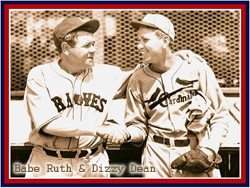
In a showdown of two master showmen, Dizzy Dean upstaged Babe Ruth.

babe_dizzyRuth, 40, entered his final big-league season with the 1935 Braves. The fading home run king had gone to the National League after 21 years (1914-34) in the American League with the Red Sox and Yankees.

Dean, 25, was the colorful Cardinals ace and reigning NL strikeout king who had earned 30 wins the year before and pitched St. Louis to the 1934 World Series championship.

They faced one another for the first time in a regular-season game on May 5, 1935, at Boston before a crowd of at least 30,000, including three sons of President Franklin Roosevelt.

Seeking a strikeout

In the book “Diz,” Dean biographer Robert Gregory wrote, “He had been looking forward to his first league showdown with Babe Ruth and telling everybody he’d have no choice in the matter. He would have to strike him out.”

Ruth and Dean greeted each other cordially before the game and took part in a newspaper-sponsored promotion with local youth players.

Then, it was show time.

“Babe was watching me pretty closely while I was warming up before the game,” Dean said in the book “Ol’ Diz” by Vince Staten. “He had that old eagle eye of his on every move I made.”

In his first at-bat, Ruth walked.

When Ruth came to the plate for the second time, Dean upped the ante. “I figured that if I didn’t steal the show he would,” Dean said.

Play deep

As Ruth took his practice cuts, Dean smiled at him and turned toward his outfielders.

“He motioned them to play farther back,” wrote Gregory. “They retreated a few steps, but Diz shook his head, no, no, that’s not deep enough, and kept waving his glove until they were almost at the walls.”

Then, Dean went to work on Ruth. He got the count to 1-and-2. On his fourth delivery, Dean unleashed his best fastball. Ruth took a mighty swing and missed. Dean had his strikeout of the Bambino.

“Babe almost broke his back going for that steaming third fastball,” according to the Associated Press.

Dean “whiffed the great man with marvelous eclat,” wrote the Boston Globe.

In his third at-bat, Ruth got “a fast one through the middle, waist high,” the St. Louis Post-Dispatch reported. “Ruth took a tremendous swing at the ball, but he missed.”

Ruth and Dean looked at one another and laughed.

“I never saw a man take such a cut in my whole life,” Dean told the Post-Dispatch. “Lordy me, if he had hit that ball it would have gone to New York or Pensacola. I had to laugh at him swinging like that and he was laughing because he hadn’t expected to get a fast one like that, right through the heart of the plate.”

When the at-bat resumed, Ruth grounded out to shortstop Leo Durocher, who was playing back on the grass on the first base side of second.

Basking on the stage set for him, Dean slugged a home run that sailed over Ruth’s head before clearing the left-field wall. He earned the shutout in a 7-0 Cardinals victory. Boxscore

“Dizzy Dean stole the Babe’s thunder and color,” the Boston Globe declared.

Encore performance

Two weeks later, on May 19 at St. Louis, Ruth and Dean had a rematch. Again, Dean prevailed. Ruth was 0-for-4 with a strikeout. Dean pitched another complete game and drove in two runs, leading St. Louis to a 7-3 victory. Boxscore

In five games against the Cardinals in 1935, Ruth batted .071 (1-for-14) with a single, three walks and five strikeouts. With his overall average at .181 in 28 games that season, Ruth retired at the end of May.

In his prime, Ruth faced the Cardinals in two World Series. He hit .300 (6-for-20) with four home runs and 11 walks in the seven-game 1926 World Series. In the 1928 World Series, Ruth hit .625 (10-for-16) with three home runs and three doubles in four games.

Previously: Stan Musial: ‘Babe Ruth was the greatest who ever played’


Read Full Post »

(Updated April 23, 2020)

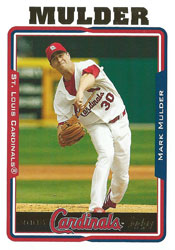
In the last classic pitchers duel at Busch Memorial Stadium, Mark Mulder gave the best performance of his Cardinals career, tossing 10 shutout innings and beating Roger Clemens and the Astros.

mark_mulder2On April 23, 2005, in the Cardinals’ final season at the ballpark that had been their home since 1966, Mulder pitched a masterpiece in a 1-0 victory.

Mulder, a left-hander, threw an efficient 101 pitches and faced 33 batters, three more than the minimum for 10 innings. Each of the Astros’ five hits was a single.

Clemens, 42, winner of seven Cy Young awards, was as good as expected, holding the Cardinals scoreless on four hits in seven innings before being relieved by Chad Qualls.

Mulder, 27, making his fourth Cardinals start after coming to St. Louis from the Athletics in a December 2004 trade, was up to the challenge of being matched against Clemens.

In a ballpark that had been the site of gems by Cardinals pitchers such as Bob Gibson, Steve Carlton, Bob Forsch, Joaquin Andujar and John Tudor, Mulder’s performance ranked among the best. It was the last 1-0 game played at Busch Memorial Stadium.

“Somewhere, Bob Gibson was smiling,” St. Louis Post-Dispatch columnist Bernie Miklasz wrote. “This was Gibby’s kind of hardball.”

Throwing strikes

Mulder became:

_ The first Cardinals starter to pitch an extra-inning shutout win since John Tudor did so on Sept. 11, 1985, in a 1-0 St. Louis victory over the Mets.

_ The first Cardinals starter to go 10 innings since Jose DeLeon went 11 against the Reds in a 2-0 Cincinnati victory on Aug. 30, 1989.

_ The first Cardinals starter to go 10 innings and win since Greg Mathews did so against the Mets in a 3-1 St. Louis victory on Aug. 16, 1986.

_ The first major-league starter to pitch a 10-inning shutout win since Roy Halladay of the Blue Jays did so against the Tigers in a 1-0 Toronto victory on Sept. 6, 2003.

“Any time it’s a 0-0 game or 1-0 game or 1-1, I love that,” Mulder told reporter Joe Strauss. “It makes me focus … I’m throwing strike one. I’m getting ahead. It’s enabling me to do a lot more things as far as working both sides of the plate.”

Said Cardinals pitching coach Dave Duncan: “He’s really changed his delivery, which has allowed him to repeat pitches better.”

Dodging trouble

In the fourth inning, Mulder escaped serious injury. Mike Lamb’s bat shattered when he hit a ground ball to second. The barrel of the bat struck Mulder on the ankle and he doubled over in pain. “It hit me right in a spot where it made my whole foot go numb,” Mulder said to MLB.com.

Feeling quickly returned to the ankle, though, and Mulder was able to continue.

Before sending Mulder to pitch the 10th, Cardinals manager Tony La Russa consulted with the pitcher. “He said he was OK to go,” La Russa said.

After setting down the Astros in the top half of the extra inning, Mulder was scheduled to lead off the bottom of the 10th. Reggie Sanders batted for him and produced an infield single. “It was a swinging bunt that feels just as good as a ringing line drive,” Sanders told the Associated Press.

Walker walkoff

The Cardinals capitalized on Sanders’ hit.

On a hit-and-run, David Eckstein grounded out, advancing Sanders to second.

With Larry Walker up next, Astros manager Phil Garner replaced Chad Qualls with Brad Lidge. Walker lined a hit into the right-center gap, scoring Sanders with the lone run. Boxscore and Video

“It was a fastball, down and away, and he reached for it,” Lidge said. “I’m not upset about the pitch at all.”

Said Walker: “To put the ball in play off (Lidge) is tough to do … He’s got phenomenal stuff.”

The victory gave La Russa 2,125 career wins as a major-league manager, moving him into a tie for fifth place with Joe McCarthy. “You win with great organizations and great players,” La Russa said. “I’ve been lucky enough to have had both.”

Read Full Post »

(Updated April 22, 2020)

With water filling the dugouts and lapping at the feet of spectators in the box seats, the Cardinals and Reds raced to complete a game at Cincinnati before flooding made conditions unplayable.

crosley_fieldCompleting nine innings in 1:56, the Reds beat the Cardinals, 6-1, on April 22, 1940, at Crosley Field.

The night before, the Ohio River reached the 55-foot stage. Reds officials knew Crosley Field, located near Mill Creek, started flooding when the river got to 57 feet, or five feet above normal flood stage, International News Service reported.

It was expected the river stage would reach 57 feet in late afternoon or early evening on April 22. The Reds moved up the starting time of their game with the Cardinals that afternoon by an hour, from 3 p.m. to 2 p.m.

At game time, however, water stood a foot deep in both dugouts _ even deeper in nearby parking lots _ and a crowd of 5,197 “had to puddle-jump their way into the park,” the Associated Press reported.

Patrons seated in field-level box seats behind third base “pulled their feet higher and higher” as the game progressed and water continued to rise.

“Shortly before game time, there was no water in the front row of the lower tier boxes,” the Cincinnati Enquirer reported, “but before the game was half over the fans in those seats were straddling quite a little pond. Most of them refused to move, although there were plenty of seats right in back of them.”

The players sat on benches in foul territory because the water in the dugouts eventually reached three feet deep, according to the book “Cardinals Journal.”

The game matched starting pitchers Bucky Walters, a 27-game winner in 1939 when he earned the National League Most Valuable Player Award, for the Reds against Bill McGee.

According to the St. Louis Globe-Democrat, “the Cardinals were at low tide” in their performance on the field.

Cincinnati, the defending National League champion, broke a scoreless tie with three runs in the fifth against McGee. The Reds added three more in the seventh off Clyde Shoun.

Walters drove in three runs and pitched eight scoreless innings before the Cardinals struck for a run in the ninth. By then, water was seeping onto the field. Boxscore

“Water backing up from sewers was ready to flow over the wall or the dugouts as the game ended,” the St. Louis Post-Dispatch reported.

The Cardinals were supposed to play the Reds again on April 23 and April 24, but both games were postponed. By then, the Ohio River had reached 58 feet and water covered the Crosley Field outfield. Another foot would put home plate under water.


Read Full Post »

On a gray, chilly Tuesday afternoon at Chicago’s Wrigley Field, the Cardinals opened their 1991 season with a textbook example of how playing fundamental baseball _ the George Kissell way _ can bring a positive result.

bryn_smithRelying on effective pitching, good base running, plate discipline and timely contact, the Cardinals beat the Cubs, 4-1, on April 9, 1991. Cardinals manager Joe Torre sent the game ball and lineup card to Kissell, the club’s long-time instructor. “Kissell gets this for teaching the Cardinals organization how to play baseball,” Torre told the St. Louis Post-Dispatch.

Smith vs. Jackson

Bryn Smith, 35, a nine-game winner for the 1990 Cardinals, was the starting pitcher for St. Louis in the 1991 opener. Torre selected a batting order of center fielder Rex Hudler, shortstop Ozzie Smith, left fielder Bernard Gilkey, first baseman Pedro Guerrero, right fielder Felix Jose, third baseman Todd Zeile, catcher Tom Pagnozzi, second baseman Jose Oquendo and Bryn Smith.

Cubs manager Don Zimmer chose Danny Jackson as his starting pitcher. Chicago’s lineup featured a pair of future Hall of Famers, second baseman Ryne Sandberg and right fielder Andre Dawson, and standouts such as first baseman Mark Grace, shortstop Shawon Dunston and left fielder George Bell.

Game time temperature was 42 degrees. Rick Hummel of the Post-Dispatch described it as a “numbing, cold, drizzling day.” His colleague, Dan O’Neill, wrote, “The grass was green, but soaking wet and bent by a wintry breeze.”

The Cardinals scored first in the fifth. With the bases loaded and two outs, Gilkey fell behind in the count 0-and-2 before drawing a walk, scoring Pagnozzi from third. The full-count pitch from Jackson to Gilkey “missed inside by a few inches,” according to the Chicago Sun-Times.

Dunston led off the bottom half of the inning with a home run, tying the score at 1-1.

Small ball

In the eighth, the Cardinals struck for three runs, using a walk and three ground balls that never left the infield as their weapons.

Here’s how it happened:

With the bases loaded and one out, Paul Assenmacher relieved Jackson. Oquendo hit a dribbler toward the left side of the infield. “I broke my bat in three pieces,” Oquendo said.

The ball eluded Assenmacher. Dunston raced in from his shortstop position, grabbed the ball and flipped it to second. Pagnozzi beat the toss. Jose streaked home from third on the fielder’s choice play, putting the Cardinals ahead, 2-1, and the bases remained loaded.

“I was panicking,” the slow-footed Pagnozzi said of his sprint from first to second. “I didn’t think I was going to get there.”

Said Oquendo: “He surprised me.”

Bunch of runts

Torre sent Craig Wilson to hit for Bryn Smith. Wilson slapped a grounder toward the mound. Assenmacher reached for it and the ball deflected off his glove toward Dunston, who had no play. Zeile scored from third, putting the Cardinals ahead, 3-1. Wilson was credited with a RBI-single. The bases still were loaded.

“We’ve got the guy (Zeile) at home if I don’t touch it, but the reflex is to go for it,” Assenmacher said.

Said Wilson: “I think he thought it was hit harder than it was.”

Zimmer yanked Assenmacher and replaced him with Les Lancaster. Hudler grounded to Dunston, whose spikes “stuck in the moist dirt,” the Sun-Times reported.

Instead of an inning-ending double play, Dunston settled for a force of Wilson at second, with Pagnozzi scoring from third.

The Cardinals’ bullpen protected the 4-1 lead. Mike Perez pitched a scoreless eighth and Lee Smith earned the save with a scoreless ninth. “I’m glad I’m playing with this bunch of runts,” Lee Smith said of the Cardinals.

Said Bryn Smith: “This was our type of baseball. We’re a patient club and we have to play our game … We feel if we play our caliber of ball you’re going to have to beat us because we won’t beat ourselves.” Boxscore

Previously: Ernie Banks and his greatest hits against Cardinals

Previously: Bob Gibson vs. Billy Williams: a classic duel

Previously: Reds-Cardinals: Easter night to remember

Read Full Post »

(Updated April 7, 2020)

At 39, his knees aching and his arm suspected of lacking its familiar zip, Bob Gibson made what he knew was his last Opening Day start for the Cardinals and delivered a performance in which he overpowered and fooled batters barely more than half his age.

bob_gibson18On April 7, 1975, Gibson made the last of 11 consecutive Opening Day starts for the Cardinals. He struck out 12 Expos in eight innings, but took the loss in Montreal’s 8-4 victory at St. Louis.

Before the season began, Gibson had said 1975 would be his last year as a player.

In spring training at St. Petersburg, Fla., he told the Newspaper Enterprise Association, “I’d be a fool if I said I’m as good as I’ve ever been. But I wasn’t all that bad last season. I’ve been playing ball for something like 30 years _ 30 years! _ and I’m tired … Last season, I had my knee drained 22 times before almost every start and that’s tiring.”

Gibson had been the Cardinals’ Opening Day starting pitcher every year since 1965. (In the 1966 opener, Gibson started against the Phillies and pitched a perfect inning before the game was called off because of rain.)

In the zone

The 1975 opener matched Gibson against an Expos club that started seven players ages 24 or younger: shortstop Tim Foli (24), catcher Barry Foote (23), left fielder Tony Scott (23), second baseman Pete Mackanin (23), center fielder Pepe Mangual (22), third baseman Larry Parrish (21) and Gary Carter, a catching prospect who got the start in right field the night before his 21st birthday.

After seven innings, the Cardinals led, 4-3. Gibson struck out at least one batter in each of those innings. He struck out the side in the second.

In the eighth, Carter grounded out and Mackanin struck out, giving Gibson a dozen strikeouts in a game for the first time since he compiled 14 versus the Giants on Aug. 30, 1972.

With two outs and none on, Parrish singled to center. Larry Biittner, pinch-hitting for pitcher Dave McNally, singled to left.

Scott, a switch-hitter who would play for the Cardinals from 1977-81, was up next. He was 0-for-3 in his first game against Gibson.

Batting left-handed, Scott fell behind in the count 0-and-2. Gibson was a strike away from escaping the jam and preserving the lead.

His next pitch was high and Scott slashed at it, driving the ball down the line and into the left-field corner for a two-run double, putting the Expos ahead, 5-4.

“That was the first time I’d faced Gibson,” Scott told The Sporting News. “The only time I’d seen him was on TV. I like to hit off him because he’s always around the plate. He works so fast it seems like he doesn’t even take the sign.”

Gallant effort

Gibson was lifted for a pinch-hitter in the bottom of the eighth. In the ninth, Carter hit a three-run home run off Elias Sosa, making his Cardinals debut after being acquired from the Giants.

Gibson’s line: 8 innings, 9 hits, 5 runs, 5 walks, 12 strikeouts.

It was the 72nd and final time Gibson achieved double-digit strikeouts in a game.

“That’s as great as I’ve seen him pitch since ’73,” Expos manager Gene Mauch said to the Associated Press. “He mixed his pitches beautifully and threw the ball hard when he had to.”

Cardinals catcher Ted Simmons told the St. Louis Post-Dispatch, “It compares to nothing I’ve seen from him for a while.”

Said Carter, who was 5 years old when Gibson made his big-league debut in 1959: “Bob Gibson had good stuff out there. He’s a fantastic pitcher.”

Gibson threw 151 pitches.

“I guess my stuff was all right,” Gibson said to Steve Porter of the Alton (Ill.) Telegraph, “but I don’t care what I’ve done unless we win the game.” Boxscore


Read Full Post »

When the Cardinals reacquired Ken Hill, they thought they’d found an ace. Instead, he was a dud.

ken_hillOn April 5, 1995, in one of the first big trades made by general manager Walt Jocketty, the Cardinals got Hill from the Expos for pitchers Bryan Eversgerd and Kirk Bullinger and outfielder DaRond Stovall.

The deal was considered a steal. Hill had 16 wins for the 1994 Expos, sharing the National League lead with Greg Maddux of the Braves.

A right-hander, Hill joined left-handers Danny Jackson, Allen Watson, Donovan Osborne and Tom Urbani in the rotation.

An intimidator

“In acquiring Kenny Hill, we’ve got probably one of the top two or three pitchers in the game today,” Jocketty said to the St. Louis Post-Dispatch. “I think we’re on our way to putting together the championship club we thought we could.”

Said manager Joe Torre: “Kenny Hill is the type of pitcher we really haven’t had. He’s the type of pitcher who can go out and dominate a game. He’s an intimidator, a guy who can go out and pitch a no-hitter.”

Hill, 29, became available because the Expos were slashing expense and general manager Kevin Malone was under orders to unload top-salaried players.

The Blue Jays and Rockies also made strong bids for him. “The Jays thought they had offered a better deal for Ken Hill than the one the Expos accepted with the Cardinals,” The Sporting News reported, adding that the cash-strapped Expos were in no mood to help their Canadian counterparts.

Jocketty was thrilled he didn’t have to trade to the Expos one of the Cardinals’ top three pitching prospects: Alan Benes, Brian Barber or John Frascatore.

Said Torre: “This shows how serious we are. It’s very exciting to me that the Cardinals have gone out and established themselves as helping the club _ right now. That should put to rest any question about the desire of the Cardinals to win.”

First time around

Hill was a prospect in the Tigers’ minor-league system when the Cardinals acquired him and first baseman Mike Laga from Detroit for catcher Mike Heath on Aug. 10, 1986.

Hill made his big-league debut with St. Louis in 1988 and in the next four seasons with the Cardinals he was 23-32. According to catcher Tom Pagnozzi, Hill and pitching coach Joe Coleman “didn’t get along.”

After the 1991 season, Cardinals general manager Dal Maxvill sought to acquire Expos first baseman Andres Galarraga. The Expos wanted pitcher Rheal Cormier, a Canadian, in return, but Maxvill instead offered Hill and the Expos accepted.

Plagued by injuries, Galarraga was limited to 95 games and hit .243 with 10 home runs and 39 RBI for the 1992 Cardinals. A free agent, he departed for the Rockies after the season. Hill had 16 wins for the 1992 Expos and in three years with Montreal he was 41-21.

When Jocketty brought back Hill to St. Louis, it was as if a wrong had been righted.

Welcome back

“The Cardinals made belated amends for one of their worst trades in recent years,” Rick Hummel wrote in the Post-Dispatch.

Hummel’s colleague, Bernie Miklasz, opined, “Walt Jocketty needed one long distance phone call to erase one of Dal Maxvill’s worst mistakes.”

In The Sporting News, Bob Nightengale offered, “The Cardinals, always regretting they traded Hill … made up by stealing Hill back.”

Mark Riggins, who coached Hill in the minors, was the Cardinal’ pitching coach in 1995 and Bob Gibson had been added to the coaching staff as well.

Said Hill: “I love the deal … I couldn’t stand it when they (the Cardinals) traded me out. But I think that change of scenery helped.”

Pitching potential

Hill won his first four decisions for the 1995 Cardinals, but lost his next four in a row. He said he wasn’t happy with Pagnozzi as his catcher and asked to be traded to a contender.

With a 6-7 record and 5.06 ERA, Hill was traded again by the Cardinals on July 27, 1995, to the Indians for infielder David Bell, pitcher Rick Heiserman and catcher Pepe McNeal.

“I was not happy with his performance or with his attitude,” Jocketty said.

In two stints with St. Louis over five seasons, Hill was 29-39 with a 4.23 ERA. He pitched in the big leagues until 2001. In 14 years with the Cardinals, Expos, Indians, Rangers, Angels, White Sox and Rays, Hill was 117-109 with a 4.06 ERA.


Read Full Post »

« Newer Posts - Older Posts »