Feeds:
Posts
Comments

Archive for the ‘Pitchers’ Category

On a gray, chilly Tuesday afternoon at Chicago’s Wrigley Field, the Cardinals opened their 1991 season with a textbook example of how playing fundamental baseball _ the George Kissell way _ can bring a positive result.
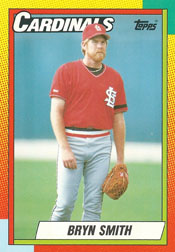
bryn_smithRelying on effective pitching, good base running, plate discipline and timely contact, the Cardinals beat the Cubs, 4-1, on April 9, 1991. Cardinals manager Joe Torre sent the game ball and lineup card to Kissell, the club’s long-time instructor. “Kissell gets this for teaching the Cardinals organization how to play baseball,” Torre told the St. Louis Post-Dispatch.

Smith vs. Jackson

Bryn Smith, 35, a nine-game winner for the 1990 Cardinals, was the starting pitcher for St. Louis in the 1991 opener. Torre selected a batting order of center fielder Rex Hudler, shortstop Ozzie Smith, left fielder Bernard Gilkey, first baseman Pedro Guerrero, right fielder Felix Jose, third baseman Todd Zeile, catcher Tom Pagnozzi, second baseman Jose Oquendo and Bryn Smith.

Cubs manager Don Zimmer chose Danny Jackson as his starting pitcher. Chicago’s lineup featured a pair of future Hall of Famers, second baseman Ryne Sandberg and right fielder Andre Dawson, and standouts such as first baseman Mark Grace, shortstop Shawon Dunston and left fielder George Bell.

Game time temperature was 42 degrees. Rick Hummel of the Post-Dispatch described it as a “numbing, cold, drizzling day.” His colleague, Dan O’Neill, wrote, “The grass was green, but soaking wet and bent by a wintry breeze.”

The Cardinals scored first in the fifth. With the bases loaded and two outs, Gilkey fell behind in the count 0-and-2 before drawing a walk, scoring Pagnozzi from third. The full-count pitch from Jackson to Gilkey “missed inside by a few inches,” according to the Chicago Sun-Times.

Dunston led off the bottom half of the inning with a home run, tying the score at 1-1.

Small ball

In the eighth, the Cardinals struck for three runs, using a walk and three ground balls that never left the infield as their weapons.

Here’s how it happened:

With the bases loaded and one out, Paul Assenmacher relieved Jackson. Oquendo hit a dribbler toward the left side of the infield. “I broke my bat in three pieces,” Oquendo said.

The ball eluded Assenmacher. Dunston raced in from his shortstop position, grabbed the ball and flipped it to second. Pagnozzi beat the toss. Jose streaked home from third on the fielder’s choice play, putting the Cardinals ahead, 2-1, and the bases remained loaded.

“I was panicking,” the slow-footed Pagnozzi said of his sprint from first to second. “I didn’t think I was going to get there.”

Said Oquendo: “He surprised me.”

Bunch of runts

Torre sent Craig Wilson to hit for Bryn Smith. Wilson slapped a grounder toward the mound. Assenmacher reached for it and the ball deflected off his glove toward Dunston, who had no play. Zeile scored from third, putting the Cardinals ahead, 3-1. Wilson was credited with a RBI-single. The bases still were loaded.

“We’ve got the guy (Zeile) at home if I don’t touch it, but the reflex is to go for it,” Assenmacher said.

Said Wilson: “I think he thought it was hit harder than it was.”

Zimmer yanked Assenmacher and replaced him with Les Lancaster. Hudler grounded to Dunston, whose spikes “stuck in the moist dirt,” the Sun-Times reported.

Instead of an inning-ending double play, Dunston settled for a force of Wilson at second, with Pagnozzi scoring from third.

The Cardinals’ bullpen protected the 4-1 lead. Mike Perez pitched a scoreless eighth and Lee Smith earned the save with a scoreless ninth. “I’m glad I’m playing with this bunch of runts,” Lee Smith said of the Cardinals.

Said Bryn Smith: “This was our type of baseball. We’re a patient club and we have to play our game … We feel if we play our caliber of ball you’re going to have to beat us because we won’t beat ourselves.” Boxscore

Previously: Ernie Banks and his greatest hits against Cardinals

Previously: Bob Gibson vs. Billy Williams: a classic duel

Previously: Reds-Cardinals: Easter night to remember
Read Full Post »

(Updated April 7, 2020)

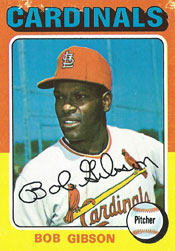
At 39, his knees aching and his arm suspected of lacking its familiar zip, Bob Gibson made what he knew was his last Opening Day start for the Cardinals and delivered a performance in which he overpowered and fooled batters barely more than half his age.

bob_gibson18On April 7, 1975, Gibson made the last of 11 consecutive Opening Day starts for the Cardinals. He struck out 12 Expos in eight innings, but took the loss in Montreal’s 8-4 victory at St. Louis.

Before the season began, Gibson had said 1975 would be his last year as a player.

In spring training at St. Petersburg, Fla., he told the Newspaper Enterprise Association, “I’d be a fool if I said I’m as good as I’ve ever been. But I wasn’t all that bad last season. I’ve been playing ball for something like 30 years _ 30 years! _ and I’m tired … Last season, I had my knee drained 22 times before almost every start and that’s tiring.”

Gibson had been the Cardinals’ Opening Day starting pitcher every year since 1965. (In the 1966 opener, Gibson started against the Phillies and pitched a perfect inning before the game was called off because of rain.)

In the zone

The 1975 opener matched Gibson against an Expos club that started seven players ages 24 or younger: shortstop Tim Foli (24), catcher Barry Foote (23), left fielder Tony Scott (23), second baseman Pete Mackanin (23), center fielder Pepe Mangual (22), third baseman Larry Parrish (21) and Gary Carter, a catching prospect who got the start in right field the night before his 21st birthday.

After seven innings, the Cardinals led, 4-3. Gibson struck out at least one batter in each of those innings. He struck out the side in the second.

In the eighth, Carter grounded out and Mackanin struck out, giving Gibson a dozen strikeouts in a game for the first time since he compiled 14 versus the Giants on Aug. 30, 1972.

With two outs and none on, Parrish singled to center. Larry Biittner, pinch-hitting for pitcher Dave McNally, singled to left.

Scott, a switch-hitter who would play for the Cardinals from 1977-81, was up next. He was 0-for-3 in his first game against Gibson.

Batting left-handed, Scott fell behind in the count 0-and-2. Gibson was a strike away from escaping the jam and preserving the lead.

His next pitch was high and Scott slashed at it, driving the ball down the line and into the left-field corner for a two-run double, putting the Expos ahead, 5-4.

“That was the first time I’d faced Gibson,” Scott told The Sporting News. “The only time I’d seen him was on TV. I like to hit off him because he’s always around the plate. He works so fast it seems like he doesn’t even take the sign.”

Gallant effort

Gibson was lifted for a pinch-hitter in the bottom of the eighth. In the ninth, Carter hit a three-run home run off Elias Sosa, making his Cardinals debut after being acquired from the Giants.

Gibson’s line: 8 innings, 9 hits, 5 runs, 5 walks, 12 strikeouts.

It was the 72nd and final time Gibson achieved double-digit strikeouts in a game.

“That’s as great as I’ve seen him pitch since ’73,” Expos manager Gene Mauch said to the Associated Press. “He mixed his pitches beautifully and threw the ball hard when he had to.”

Cardinals catcher Ted Simmons told the St. Louis Post-Dispatch, “It compares to nothing I’ve seen from him for a while.”

Said Carter, who was 5 years old when Gibson made his big-league debut in 1959: “Bob Gibson had good stuff out there. He’s a fantastic pitcher.”

Gibson threw 151 pitches.

“I guess my stuff was all right,” Gibson said to Steve Porter of the Alton (Ill.) Telegraph, “but I don’t care what I’ve done unless we win the game.” Boxscore


Read Full Post »

When the Cardinals reacquired Ken Hill, they thought they’d found an ace. Instead, he was a dud.

ken_hillOn April 5, 1995, in one of the first big trades made by general manager Walt Jocketty, the Cardinals got Hill from the Expos for pitchers Bryan Eversgerd and Kirk Bullinger and outfielder DaRond Stovall.

The deal was considered a steal. Hill had 16 wins for the 1994 Expos, sharing the National League lead with Greg Maddux of the Braves.

A right-hander, Hill joined left-handers Danny Jackson, Allen Watson, Donovan Osborne and Tom Urbani in the rotation.

An intimidator

“In acquiring Kenny Hill, we’ve got probably one of the top two or three pitchers in the game today,” Jocketty said to the St. Louis Post-Dispatch. “I think we’re on our way to putting together the championship club we thought we could.”

Said manager Joe Torre: “Kenny Hill is the type of pitcher we really haven’t had. He’s the type of pitcher who can go out and dominate a game. He’s an intimidator, a guy who can go out and pitch a no-hitter.”

Hill, 29, became available because the Expos were slashing expense and general manager Kevin Malone was under orders to unload top-salaried players.

The Blue Jays and Rockies also made strong bids for him. “The Jays thought they had offered a better deal for Ken Hill than the one the Expos accepted with the Cardinals,” The Sporting News reported, adding that the cash-strapped Expos were in no mood to help their Canadian counterparts.

Jocketty was thrilled he didn’t have to trade to the Expos one of the Cardinals’ top three pitching prospects: Alan Benes, Brian Barber or John Frascatore.

Said Torre: “This shows how serious we are. It’s very exciting to me that the Cardinals have gone out and established themselves as helping the club _ right now. That should put to rest any question about the desire of the Cardinals to win.”

First time around

Hill was a prospect in the Tigers’ minor-league system when the Cardinals acquired him and first baseman Mike Laga from Detroit for catcher Mike Heath on Aug. 10, 1986.

Hill made his big-league debut with St. Louis in 1988 and in the next four seasons with the Cardinals he was 23-32. According to catcher Tom Pagnozzi, Hill and pitching coach Joe Coleman “didn’t get along.”

After the 1991 season, Cardinals general manager Dal Maxvill sought to acquire Expos first baseman Andres Galarraga. The Expos wanted pitcher Rheal Cormier, a Canadian, in return, but Maxvill instead offered Hill and the Expos accepted.

Plagued by injuries, Galarraga was limited to 95 games and hit .243 with 10 home runs and 39 RBI for the 1992 Cardinals. A free agent, he departed for the Rockies after the season. Hill had 16 wins for the 1992 Expos and in three years with Montreal he was 41-21.

When Jocketty brought back Hill to St. Louis, it was as if a wrong had been righted.

Welcome back

“The Cardinals made belated amends for one of their worst trades in recent years,” Rick Hummel wrote in the Post-Dispatch.

Hummel’s colleague, Bernie Miklasz, opined, “Walt Jocketty needed one long distance phone call to erase one of Dal Maxvill’s worst mistakes.”

In The Sporting News, Bob Nightengale offered, “The Cardinals, always regretting they traded Hill … made up by stealing Hill back.”

Mark Riggins, who coached Hill in the minors, was the Cardinal’ pitching coach in 1995 and Bob Gibson had been added to the coaching staff as well.

Said Hill: “I love the deal … I couldn’t stand it when they (the Cardinals) traded me out. But I think that change of scenery helped.”

Pitching potential

Hill won his first four decisions for the 1995 Cardinals, but lost his next four in a row. He said he wasn’t happy with Pagnozzi as his catcher and asked to be traded to a contender.

With a 6-7 record and 5.06 ERA, Hill was traded again by the Cardinals on July 27, 1995, to the Indians for infielder David Bell, pitcher Rick Heiserman and catcher Pepe McNeal.

“I was not happy with his performance or with his attitude,” Jocketty said.

In two stints with St. Louis over five seasons, Hill was 29-39 with a 4.23 ERA. He pitched in the big leagues until 2001. In 14 years with the Cardinals, Expos, Indians, Rangers, Angels, White Sox and Rays, Hill was 117-109 with a 4.06 ERA.


Read Full Post »

Bob Gibson and Steve Carlton appeared together in a regular-season game as Cardinals three times. Two of those games represented milestones for Carlton: his big-league debut and his first major-league save. In all three, Gibson started and Carlton relieved.

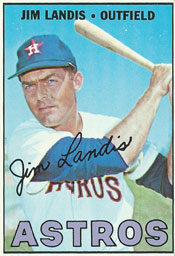
jim_landisThe first time Gibson and Carlton appeared together in a Cardinals regular-season game was April 12, 1965, the season opener for the defending World Series champions against the Cubs at Chicago.

Gibson left after yielding five runs in 3.1 innings.

In the 11th, with the score tied at 10-10, the Cubs had Ron Santo on second with one out and George Altman at the plate. Red Schoendienst, in his regular-season debut as Cardinals manager, lifted Barney Schultz and brought in Carlton to face Altman.

Carlton, 20, making his big-league debut, walked Altman. Schoendienst then brought in Bob Purkey, who got out of the jam without allowing a run.

At that point, the game was called because of darkness, ending in a tie. All the statistics counted. Boxscore

Mopping up

Four months later, on Aug. 25, 1965, Gibson faced the Cubs at St. Louis and gave up six runs in seven innings.

With the Cubs ahead, 6-1, Carlton relieved and pitched two scoreless innings. The Cubs won, 6-3.

Joey Amalfitano, a career .244 hitter, had a single off Gibson and a single off Carlton, becoming the first batter to get hits off both Cardinals in the same regular-season game. Boxscore

Carlton a closer

Entering the 1967 season, Schoendienst told The Sporting News, “We now have men like Dick Hughes, Steve Carlton and Nelson Briles, who can start or relieve. In fact, I’d say only Bob Gibson and Ray Washburn would have to be regarded strictly as starters.”

On April 16, 1967, Gibson faced the Astros at St. Louis. Lou Brock hit a pair of solo home runs off former teammate Mike Cuellar and the Cardinals built leads of 5-0 and 7-3. Gibson, though, wasn’t sharp.

“Gibson admitted he did not have anything today and that he was struggling throughout,” wrote Tom McNamara of the Edwardsville (Ill.) Intelligencer.

The Astros, paced by John Bateman’s two-run home run, scored four in the sixth off Gibson, tying the score at 7-7. The Cardinals regained the lead, 8-7, in the bottom half of the inning on an Orlando Cepeda home run off Carroll Sembera.

After Jim Landis led off the seventh with a double against Gibson, Carlton, making his first appearance of the season, relieved him.

Carlton retired Joe Morgan on a fly out and struck out Jim Wynn and Eddie Mathews, stranding Landis. Like Carlton, Morgan and Mathews were destined for election to the National Baseball Hall of Fame.

The Cardinals scored three off Turk Farrell in the bottom of the seventh, extending their lead to 11-7.

In the eighth, Carlton struck out the first two batters, Bob Aspromonte and Aaron Pointer, giving him four consecutive strikeouts, before Bateman grounded out.

The Astros scored a run in the ninth off Carlton. The key hit in the inning was a Landis double.

Landis, a career .247 hitter, joined Amalfitano as the only batters to get hits off Gibson and Carlton in the same regular-season game.

Carlton earned the save for Gibson in an 11-8 Cardinals victory. Carlton’s line: 3 innings, 1 run, 1 hit, 1 walk, 4 strikeouts. Boxscore

Carlton would earn 329 big-league wins but only two saves. His second came 20 years after his first.

On April 9, 1987, in his first regular-season appearance for the Indians, Carlton, 42, got the save with four shutout innings in relief of Phil Niekro, 48, in a 14-3 Cleveland victory at Toronto. Boxscore


Read Full Post »

Instead of working with established big-leaguers, Bob Gibson spent the spring training of 1995 teaching basic grips to pitchers who normally would have had no chance to be in a Cardinals camp.

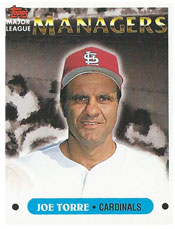
joe_torre6Spring training in 1995 was an odd, depressing experience for the Cardinals and other big-league teams because of the labor dispute between players and owners.

The players’ strike that began in August 1994 carried into spring training 1995. None of the players on the Cardinals’ big-league roster reported to camp at St. Petersburg, Fla. Instead, the Cardinals, like other clubs, brought in replacement players.

Hall of Fame helper

Manager Joe Torre and his staff were required to train the replacement players, with the intent of having them ready to open the regular season on April 3.

Gibson, the Hall of Fame pitcher who carried the Cardinals to two World Series championships, was hired by Torre to be a Cardinals coach.

Replacement player Paul Anderson, 26, a right-hander who was a combined 4-6 with a 6.65 ERA for two Cardinals farm clubs in 1994, asked Gibson for assistance in learning the proper grip to throw a slider.

“I was doing it wrong, so I did it the way he taught me,” Anderson told Rick Hummel of the St. Louis Post-Dispatch. “I like it a lot better. I’m learning from the best.”

Scribe and rejects

The 55-player Cardinals replacement team at training camp had no one who had appeared in a major-league game.

In the Cardinals’ exhibition opener against the Indians on March 4 at St. Petersburg, Mike Hinkle started and pitched three scoreless innings for St. Louis. Hinkle, 29, had last played professional baseball in Italy in 1993.

Outfielder Doug Radziewicz, 25, an aspiring journalist who was filing reports from camp for his hometown newspaper in Somerville, N.J., drove in the winning run with a pinch-hit single in the eighth, lifting the Cardinals to a 4-2 victory.

“You can’t judge baseball from one day, but it was well-played,” Torre said after the game. “The thing you’re concerned with is that playing for the first time they’re a little in awe.”

Walt Jocketty, hired in October 1994 to replace Dal Maxvill as general manager, was asked what it was like to watch replacement players instead of big-leaguers in his first Cardinals spring training game. “As long as I’ve got Joe (Torre) here, we can hold hands and go through this together,” Jocketty said.

Wrote Hummel: “There were no pickets, as the striking players earlier had advertised, which was good because the minor leaguers were nervous enough as it was. The clubhouse was very quiet before the game.”

Fans weren’t buying into replacement baseball. Hummel reported the Cardinals were averaging 1,470 tickets sold per exhibition game instead of the usual 5,000. In March, 54 percent of respondents to a Post-Dispatch poll said they probably or absolutely wouldn’t pay to see a game played by replacements.

Chasing a dream

The Cardinals broke camp with a roster of 32 replacement players, intending to open the season with them.

Anderson, Hinkle and Radziewicz were on the Opening Day roster. In a late move, the Cardinals also acquired Glenn Sutko, a catcher who had one hit in 10 at-bats for the 1991 Reds.

Among other replacement Cardinals on the Opening Day roster:

_ Ty Griffin, second baseman. A No. 1 pick of the Cubs in the 1988 amateur draft, Griffin also had played for the U.S. Olympic baseball team. He flopped in the Cubs system and spent the 1994 season with a pair of independent league teams.

_ Larry Shikles, starting pitcher. In eight seasons in the minor league systems of the Red Sox and Athletics, the right-hander compiled a 70-68 record.

_ Howard Prager, first baseman. He hit .239 for the Cardinals’ Class AAA Louisville club in 1994.

_ John “Skeets” Thomas, outfielder. He slugged 17 home runs for Louisville in 1994.

_ Tony Diggs, outfielder. A sixth-round draft choice of the Brewers in 1989, Diggs hit .215 for the Cardinals’ Class AA Arkansas team in 1994.

_ Anthony Lewis, outfielder. An eighth-round draft pick of the Cardinals in 1989, Lewis hit a combined .230 for two St. Louis farm clubs in 1994.

“We went with the players on the morning side of the mountain rather than the twilight side of the hill,” Torre said, explaining why the Cardinals (with the exception of Sutko) chose players without big-league experience.

On April 2, 1995, the day before the season was to open, the 234-day strike ended. The season opener was moved to April 26; spring training was re-opened for players on big-league rosters. The replacement players either were assigned to the minors or released.

Said Torre: “It feels weird starting all over again.”

Read Full Post »

(Updated March 9, 2019)

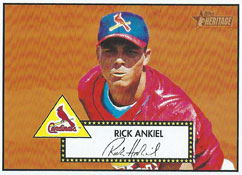
Disheartened by what he described as an erosion of his spirit and altering of his personality, Rick Ankiel changed the course of his baseball career.

rick_ankiel7On March 9, 2005, Ankiel announced he was transforming from a pitcher to an outfielder.

Ankiel, 25, entered 2005 spring training at Jupiter, Fla., as a strong candidate to earn a Cardinals Opening Day roster spot as a left-handed reliever.

After posting an 11-7 record with 194 strikeouts in 175 innings in 2000, Ankiel experienced a meltdown in the postseason against the Braves and Mets (nine wild pitches and 11 walks in four innings). He pitched briefly for the 2001 Cardinals and suffered a series of elbow injuries before returning to the big leagues with St. Louis as a reliever in September 2004.

Ankiel pitched in the Puerto Rico winter league after the 2004 Cardinals season, but cut short his stay there after experiencing a twinge in his left elbow. When he got to Cardinals camp in February 2005, his throwing sessions were erratic.

Change of plans

On March 8, 2005, the day before he was scheduled to make his spring training debut against the Marlins in a morning B squad game, Ankiel approached Cardinals manager Tony La Russa and informed him he was retiring as a player.

In his 2017 book “The Phenom,” Ankiel explained, “In my heart, I believed I could pitch in the big leagues. I’d earned it. It was just so hard. It was just so burdensome. It was time to stop, for those reasons. I was exhausted.”

Ankiel’s agent, Scott Boras, called Cardinals general manager Walt Jocketty and asked whether the club would be willing to let Ankiel go to the minor leagues, be an outfielder and get a chance to earn his way back to the majors. When Jocketty agreed, Boras called Ankiel, who was surprised by his agent’s actions, and convinced him to give the transformation a try.

The next day, Ankiel took indoor batting practice off pitches from Cardinals scout Jim Leyland. In a hastily called press conference, Ankiel announced his plans to switch positions and explained why he was giving up pitching.

“The frustration of not being effective, not being able to go out there and replicate my mechanics, and the way it affected me off the field, wasn’t worth it,” Ankiel said to the St. Louis Post-Dispatch. “The reward wasn’t there. I feel relieved now. It’s time to move on.

“This whole time, the frustration has built up. It seemed like it was eroding my spirit and affecting my personality off the field as well. It just became apparent it was time for me to move on and become an outfielder.”

According to the Post-Dispatch, Ankiel’s decision “stunned many within the Cardinals’ clubhouse.”

“Ongoing head case”

As a Cardinals pitcher, Ankiel hit .207 for his career with two home runs and nine RBI. He hadn’t played the outfield since his senior year at Port St. Lucie High School in Florida.

The reaction to his plan drew skepticism.

Bernie Miklasz, Post-Dispatch columnist: “The Cardinals wasted too much time, and emotion, in the lost cause that is Rick Ankiel. And now, as the organization recoils from Ankiel’s stunning surrender in his mission of regaining a foothold on the mound, the Cardinals are going to baby him one more time … It is time to stop treating Ankiel’s ongoing head case as if he’s a charity case … It’s time to let Ankiel move on with his life. The Cardinals did their part. Now they need to get out of the day care business.”

Rob Neyer, baseball analyst for ESPN.com: “He’s immensely talented, but almost certainly not talented enough to hit major-league pitching with any sort of consistency.”

Road to redemption

Ankiel began receiving instruction from coach Dave McKay on outfield play and from coach Hal McRae on hitting.

“I stood across from Dave McKay, an exceptional outfield coach, and put my feet where he told me to, and began to learn to become a big-league center fielder,” Ankiel said in his book. “I hit off a tee, and hit soft-toss, and hit batting practice fastballs, and faced real pitchers, and began to learn to be a big-league hitter.’

Out of options with the Cardinals, Ankiel could have been chosen on waivers by any of the other 29 big-league clubs before he was sent to the minors in the spring of 2005, but no one claimed him.

Ankiel spent 2005 in the minors, sat out 2006 because of a knee injury and hit 32 home runs in 102 games for Class AAA Memphis in 2007. On Aug. 9, 2007, he returned to the Cardinals as an outfielder and hit a home run against the Padres. Boxscore

Ankiel hit .285 with 11 home runs and 39 RBI in 47 games for the 2007 Cardinals. The next year, he slugged 25 home runs for St. Louis.

From 2007-2013, Ankiel was an outfielder for the Cardinals, Royals, Braves, Nationals, Astros and Mets.

In 2010, a decade after his wild streak against the Braves in the National League Division Series, he hit a home run for them in the NL Division Series against the Giants. Boxscore Ankiel and Babe Ruth are the only big-league players to both start a postseason game as a pitcher and hit a home run in the postseason as a position player.

Previously: How Rick Ankiel made happy return to St. Louis as pitcher

Previously: Rick Ankiel and his last hurrah as a pitcher

Previously: Pitching or hitting, Rick Ankiel was marvel and mystery

Read Full Post »

« Newer Posts - Older Posts »