Feeds:
Posts
Comments

Archive for the ‘Pitchers’ Category

(Updated on April 5, 2022)

In 2014, I interviewed Tommy Davis and Jerry Reuss about some of their peers who were candidates for election to the National Baseball Hall of Fame.

boyer_davisDavis played 18 seasons in the big leagues (1959-76), primarily as an outfielder, and was the National League batting champion in both 1962 and 1963 with the Dodgers. Overall, Davis hit .294 in his major-league career.

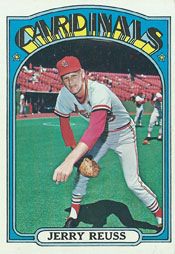
Reuss, a St. Louis native who began his career with the Cardinals. pitched 22 seasons in the big leagues (1969-90) and earned 220 wins.

Here is what Davis and Reuss said about some of the candidates:

Dick Allen

Primarily a first baseman and third baseman, Allen was 1964 National League Rookie of the Year with the Phillies and 1972 American League Most Valuable Player with the White Sox. He led the American League in home runs in 1972 (37) and 1974 (32) and was a league leader in extra-base hits three times.

Dubbed “the bad boy of baseball,” Allen hit .292 with 1,848 hits, 351 home runs and 1,119 RBI in 15 major-league seasons (1963-77).

In 1970, his lone Cardinals season, Allen primarily played first base and hit .279 with 34 homers and 101 RBI in 122 games. Allen and Reuss were teammates that year.

_ Tommy Davis on Dick Allen: “Great hitter. He had a 40-ounce bat that he used. He couldn’t pull the ball, but he could go about 400 feet, 450, to right-center. Easily.”

_ Jerry Reuss on Dick Allen: “Tremendous power. Good teammate. Personally, I like him. Hall of Fame chances: No.”

Ken Boyer

Boyer was the 1964 National League Most Valuable Player with the Cardinals and he won five Gold Gloves as a St. Louis third baseman. Boyer ranked in the top 10 in RBI in the NL seven times and in the top 10 in total bases six times.

In 15 major-league seasons (1955-69), Boyer batted .287 with 2,143 hits, 282 home runs and 1,141 RBI.

He played for the Cardinals for 11 years and hit .293 for them with 1,855 hits and 1,001 RBI in 1,667 games.

Boyer and Davis were teammates on the 1967 Mets and 1968 White Sox. Boyer coached the 1971 Cardinals team that included Reuss as a starting pitcher.

_ Tommy Davis on Ken Boyer: “He was consistent at third base. Good hitter. His defense was so good it was ridiculous.”

_ Jerry Reuss on Ken Boyer: “That’s a tough one. He had leadership capabilities. I don’t know how he stacked up against other third basemen. He’s a maybe, but more toward the no side.”

Jim Kaat

A three-time 20-game winner, Kaat earned 283 wins. Kaat had 15 consecutive seasons (1962-76) with double-figure wins. He was the 1962 American League leader in shutouts (five) with the Twins and the 1966 AL leader in wins (25).

Kaat spent his last four big-league seasons (1980-83) with the Cardinals, winning 19, saving 10 and appearing in four of the seven games of the 1982 World Series.

_ Tommy Davis on Jim Kaat: “He was sneaky. He knew how to pitch. He knew how to set you up. He was a tough left-hander.”

_ Jerry Reuss on Jim Kaat: “Yes for the Hall of Fame. He won 16 Gold Gloves. Enough said.”

Minnie Minoso

The outfielder won three Gold Gloves (1957, 1959, 1960) and finished in the top 10 in the American League in hitting eight times. Minoso three times led the AL in triples and three times led the AL in stolen bases.

Playing primarily for the White Sox and Indians from 1951-64 (he appeared in nine games in 1949, three in 1976 and two, at age 54, in 1980), Minoso batted .298 with 1,963 hits, 186 home runs, 1,023 RBI and 205 stolen bases.

In 1962, his lone National League season, Minoso was plagued by injuries and hit .196 in 39 games for the Cardinals.

I didn’t ask Reuss about Minoso because the Cuban Comet’s last full big-league season was 1964 when Reuss was just 15.

_ Tommy Davis on Minnie Minoso: “Good outfielder. He could fly. He was already good when he got to the major leagues. He helped baseball as a pioneer for Cuban ballplayers and later as an ambassador for Chicago.”

Read Full Post »

Jerry Reuss Banner

On Nov. 11, 2014, I visited the Dodgers Adult Baseball Camp at Historic Dodgertown in Vero Beach, Fla., to seek out Jerry Reuss for an interview about his time as a pitcher with the Cardinals.

Dressed in a home white Dodgers uniform, Reuss, 65, was patient, thoughtful, articulate and polite.

He debuted with the Cardinals in September 1969 and pitched for them in 1970 and 1971, posting an overall 22-22 record before he was traded to the Astros in April 1972.

In a 22-year major-league career, primarily with the Dodgers (nine years) and Pirates (six years), Reuss was 220-191 with a 3.64 ERA. In 2014, he published a book “Bring in the Right-hander,” a delightful retrospective on his career. You can order an autographed copy at his Web site www.jerryreuss.com.

jerry_reuss2Q.: Two months after the Cardinals traded Steve Carlton, they traded you. It was first reported you were traded because you were in a contract dispute with owner Gussie Busch. Later it comes out it was about your moustache. True?

Reuss: “It was about growing a moustache. Bob Broeg (a writer) had said something to that effect and I thought, ‘No, they wouldn’t be that concerned about that.’ I lived with that for 20 or 25 years.

“It wasn’t until the mid-90s when I was in St. Louis and I went to a ballgame and I saw Bing Devine, who was working as a scout. He had been the general manager of the Cardinals when I was traded. I said, ‘Bing, you got a minute?’ He said, ‘Yeah. Why don’t you sit down and we’ll talk.’ So I asked him about the deal. I figured enough time had passed that I could do that.

“He was more than happy to tell me. He said Mr. Busch at times would act on an impulse. This was one of those times. He insisted on me being traded because I had the moustache. Bing thought if given a little time he (Busch) would come to his senses and make a wise baseball decision rather than a personal decision.

“But he kept hammering about the moustache and would say, ‘Did you get rid of him yet? Why not?’ And the ultimatum was put like this: ‘If you don’t get rid of him, I’ll get rid of you and get somebody who will get rid of him.’ So when you’re faced with a situation like that, you do what has to be done.”

Q.: You still have a moustache and it has become something of a signature look for you…

Reuss: “Yeah. But when you look back about how that was the thinking in baseball in the early 70s and then just two or three years later baseball began to change with the times. Guys were coming in with long hair and beards. And you just wonder: What was the stink all about?

“So on the matter of just a little bit of facial hair _ you could barely see it _ people would ask, “Why didn’t you shave it?’ And I’d say, ‘There wasn’t a rule that the Cardinals had to be clean-shaven and be like a military situation. If it doesn’t bother anybody, if it’s not a rule, then what are we talking about here?’ ”

Q.: Your last year with the Cardinals, 1971, was the year your teammate, Joe Torre, led the National League in hitting and RBI and won the MVP Award. Could you see then the leadership qualities that later would make him a Hall of Fame manager with the Yankees?

Reuss: “Oh, sure. Lights out. At that early age, I just wondered whether there were guys like that on every team.

“He was managing the club on the field. Red (manager Schoendienst) just stepped back and said, ‘Joe, you have a grasp of it. You take care of it. When you’re on the field, you see things that I don’t.’ And Joe, being wise enough and knowing his boundaries, would go to Red and say, ‘Would you consider this or would you consider that?’

“Sometimes there was a lineup that was put out and Joe would go to Red and say, ‘This player won’t say it to you but he’ll say it to me. You might want to give him a day off.’ And Red would say, ‘All right. Let’s do that.’ He’d make the lineup change. Joe was able to get those things from players and he did it only because it helped the club. It wasn’t anything personal with the player.

“You could see the leadership. I’ve never come across another player who was like him. There were a couple that had some of those qualities _ I understand Cincinnati had a few. (Johnny) Bench was one of those guys _ that when he spoke, everybody just said, ‘Let’s reconsider this.’ Joe was that way all the time. Joe was more far-reaching. You knew he would be a manager.”

Q,: After leaving the Cardinals, you played for seven big-league teams. As a St. Louis native who began his career with the hometown team, did you ever hope to return to the Cardinals?

Reuss: “I never gave it a whole lot of thought. Once I got to Los Angeles (in 1979), I said, ‘This is home. This is where I want to be.’ It’s where I always wanted to play.

“Back in those days, it was one of the few grass fields. Lots of artificial turf then. My knees were feeling it. And then I became a ground ball pitcher and the infield I had behind me was particularly adept at playing at Dodger Stadium on the lawn.

“As a result, I had a good defensive ball club become a great defensive ball club. They got a lot of ground balls. That’s where my success was and that’s where I wanted to stay. When I was ready to change teams, I was past my prime. Rather than a lot of teams coming to me, I was going to them and just hoping for a chance.”

Q.: The player who had the most at-bats against you was

Reuss: “Pete Rose. Did you see what he hit against me?”

Q.: .244 in the regular season. (29-for-119).

Reuss: “I couldn’t believe that.”

Q.: What was your secret?

Reuss: “There was no secret. Pete hit me the same way he hit everybody else. It’s just that, when he hit the ball against me, more often it was right at somebody. Did you see the number of times he struck out against me? (9) He was making contact. He came up there swinging.”

Part 1: Jerry Reuss on Bob Gibson as a teammate: He was tough

Read Full Post »

Jerry Reuss Banner

Jerry Reuss, left-handed pitcher and St. Louis native, joined his hometown Cardinals at age 20 in 1969. He was a neophyte on a team of championship-tested veterans such as Bob Gibson, Steve Carlton, Tim McCarver, Lou Brock and Curt Flood.

On Nov. 11, 2014, I visited the Dodgers Adult Baseball Camp at Historic Dodgertown in Vero Beach, Fla., to seek out Reuss for an interview about his time with the Cardinals. I found him as he climbed the stands at Holman Stadium after coaching a morning game between campers.

Dressed in a home white Dodgers uniform with the familiar No. 49, Reuss, 65, quickly and graciously accepted my request for an interview, inviting me to find a seat with him in the shade in the stands. We sat near the top row along the first-base line. Reuss answered every question and was patient, thoughtful, articulate and polite.

A graduate of Ritenour High School in St. Louis, Reuss was selected by the Cardinals in the second round of the 1967 amateur draft. (Their first-round pick was catcher Ted Simmons.) Reuss debuted with the Cardinals in September 1969 and pitched for them in 1970 and 1971. He had a 22-22 record with the Cardinals before he was traded to the Astros in April 1972.

In a 22-year major-league career, primarily with the Dodgers (nine years) and Pirates (six years), Reuss was 220-191 with a 3.64 ERA. In 2014, he published a book “Bring in the Right-hander,” an anecdote-rich retrospective on his career. You can order an autographed copy at his Web site www.jerryreuss.com.

Here is Part 1 of 2 of my interview with Jerry Reuss:

jerry_reuss3Q.: Early in the 1969 season, you were a 19-year-old left-hander assigned by the Cardinals to Class AAA Tulsa. The manager there was Warren Spahn, perhaps the best left-handed pitcher all-time. What was it like for you to play for him?

Reuss: “Warren was a Hall of Fame player. We weren’t of the caliber he was. We didn’t have the experience he had. Some of the things he was doing, well, it was just new to us. And, at least for me, I had no experience whatsoever. So, whatever Warren said, I said, ‘Let’s do it.’ I didn’t even know enough to ask questions.”

Q.: In your major-league debut for the Cardinals on Sept. 27, 1969, at Montreal, you started, pitched seven scoreless innings, gave up just two hits, drove in a run with a single and got the win in a 2-1 Cardinals victory. The bullpen gave up a run in the eighth. Do you recall that your first big-league hit was the game winner in your first big-league win?

Reuss: “That hit turned out to be the difference in the ballgame. It’s the dream of everybody: get to the major leagues, win a ballgame and then have something really special to talk about. It had a little bit of drama.”

Q.:  Your batterymate in your big-league debut was Tim McCarver, who had been the Cardinals’ catcher in three World Series. What was it like pitching to McCarver?

Reuss: “In that particular game, all I know is I wondered whether he could hear my knees shaking. We talk a little bit about that now when I see him. He says, ‘I remember that.’ I think he’s being nice. Here’s a guy who caught some very important World Series games for the Cardinals. If he remembers my first game, that is a hell of a memory.”

Q.: Ted Simmons was your catcher at Tulsa and then with the Cardinals. He’s known for his hitting. Does he get the credit he deserves as a catcher?

Reuss: “Probably not because of contemporaries like Johnny Bench, Steve Yeager. As far as his game-calling ability, Cardinals pitchers later on told me, ‘This guy thinks it through.’ He had a game plan for everybody who came to the plate and then made the adjustments if the hitter made adjustments. He’d go out and let the pitcher know, ‘This is what I’m seeing here. They’re changing their feet or moving this way.’

“He became a student of the game. That may have made up for his lack of ability in other areas. He wasn’t the quickest down to second base and he wasn’t always able to hold on to some pitches, particularly early in his career. But he turned into a pretty good receiver.”

Q.: What was Bob Gibson like as a teammate?

Reuss: “He was tough. He demanded excellence of himself and everybody who played behind him. His feeling was, ‘If I’m going to come out here and work this hard and give what I give _ and he was hurting at this time physically; his elbow was killing him _ then I expect everybody to play like that. I expect that same intensity from anybody else.’ And he wasn’t afraid to let people know about it.

“You respect a guy like that _ You don’t like him because nobody likes to get called on the carpet _ but when you have an earned run average of 1.12 and 28 complete games in 1968 and have what many would consider the greatest season a pitcher could ever have, it’s hard to get right up to him and say no. He knew what he was talking about.”

Q,: What did you think of your fellow left-hander on the Cardinals, Steve Carlton?

Reuss: “With St. Louis, he showed just how good he could be. I don’t know that if he had stayed with St. Louis that he’d have had those same kinds of seasons he later had with the Phillies. When he went to Philadelphia, he changed his mental outlook.

“He didn’t like to run. So there was a Phillies strength and conditioning coach, Gus Hoefling, who said, ‘You don’t have to do that. Here’s what we’ll do. I’ll give you all the conditioning that you need.’ Steve bought into it. He believed it. If you believe something, then there’s a good chance it is going to work for you.

“He believed it would work. As a result, he won 27 games in 1972. He started doing things his way and developed into a Hall of Fame pitcher.”

Next: In Part 2 of the interview, Jerry Reuss offers his views on Joe Torre and Gussie Busch.


Read Full Post »

(Updated Jan. 20, 2019)

Performing an escape act on the sport’s grandest stage, the Cardinals were the first team to emerge victorious in a World Series that ended with the tying run on third base.

red_schoendienst9It happened in Game 7 of the 1946 World Series between the Red Sox and Cardinals.

Nervous ninth

Game 7 of the 1946 World Series is best remembered for the daring dash by Enos Slaughter from first to home on a hit by Harry Walker that scored the decisive run in the eighth inning, earning the Cardinals their third championship in five years. What often is overlooked is the Red Sox nearly tied the score in the ninth.

Cardinals left-hander Harry Brecheen was pitching in relief in Game 7 in 1946 after having achieved wins in two starts in the World Series.

Rudy York led off the Red Sox ninth with a single and Bobby Doerr followed with another single, advancing York to second. Red Sox manager Joe Cronin replaced York with pinch-runner Paul Campbell.

That brought to the plate Pinky Higgins, 37, a 14-year big-league veteran. In what would be his last major-league at-bat, Higgins grounded to third baseman Whitey Kurowski, who threw to shortstop Marty Marion to get the force on Doerr at second base. Campbell advanced to third on the play.

With one out, Roy Partee batted next and popped out to first baseman Stan Musial for the second out.

Brecheen vs. McBride

Cronin sent Tom McBride, a right-handed batter, to bat for pitcher Earl Johnson. McBride hit .301 in 1946, including .333 against left-handers.

In the press box, some expected Cronin to use Don Gutteridge as a pinch-runner for Higgins at first base, but Cronin didn’t make the move.

Brecheen threw “a good screwball” and McBride rapped it on the ground. Second baseman Red Schoendienst got to the ball and gloved it, but the ball rolled up his arm.

In his book “Red: A Baseball Life,” Schoendienst said, “Just as I went to field the ball, it took a crazy hop and I blocked the ball with my left shoulder. Luckily, I was able to trap it.”

Schoendienst kept his cool and flipped a low, underhand toss to Marion, who caught it in time to nip Higgins at second base for the final out.

In his book “Stan Musial: The Man’s Own Story,” Musial told writer Bob Broeg, “Our hearts stood still” as the ball rolled up Schoendienst’s arm. “Red looked like a magician pulling a rabbit out of his sleeve when he finally flipped the ball to Marion,” said Musial.

$40,000 assist

In the St. Louis Star-Times, Sid Keener reported Schoendienst’s toss beat Higgins to the bag “by no more than a step.”

“Cronin’s critics insist Gutteridge would have beaten the play at second,” enabling Campbell to score from third with the tying run, Keener concluded.

McBride told the Society for American Baseball Research, “The ball I hit was a low liner right by Brecheen’s left knee, and when it went by Harry, I thought I had a hit … But the second baseman, Schoendienst, made a good play on the ball. He didn’t catch it clean. The ball bounced up and looked as if it balanced on the web of his glove. He picked it off and threw to second base for a force out.”

Said Schoendienst: “People began to refer to that play as the $40,000 assist because the $40,000 was the approximate difference between the total shares for the winning team and the losing side.”  Boxscore

The play had another benefit for Schoendienst. He wanted to marry his girlfriend, Mary, but her grandfather, Patrick O’Reilly, said he wasn’t keen about a “German” joining the family.

Said Mary: “He was still not sure about Red until he made that play. After the ball hit him in the chest, then rolled up his arm, and he still made the play and we won the game, then my grandfather said, ‘You can marry him now.’ “

Read Full Post »

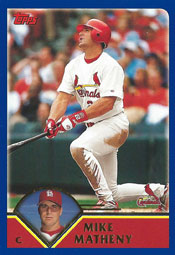
mike_matheny8Catcher Mike Matheny played a big role for the Cardinals in the 2004 National League Division Series versus the Dodgers.

On Oct. 5, 2004, Matheny contributed a solo home run against reliever Elmer Dessens in the Cardinals’ 8-3 victory in Game 1 of the best-of-five series at St. Louis.

Cardinals fans rewarded him with an ovation and urged a curtain call. A hesitant Matheny went to the top step of the dugout and acknowledged the sustained applause.

“It’s a huge honor,” Matheny, 34, said to the St. Louis Post-Dispatch. “It’s taken me five years (with the Cardinals) and this is the first year I’ve had one. I didn’t know how to get out there.” Boxscore

Hot hitter

Two days later, on Oct. 7, 2004, the Cardinals entered Game 2, knowing a victory would give them control of the series.

In the fifth inning, with the Cardinals ahead, 4-3, Matheny batted against starter Jeff Weaver with the bases loaded, two outs, and stroked a two-run single to center, giving the Cardinals a 6-3 lead and knocking Weaver out of the game.

“He gets fired up,” Cardinals manager Tony La Russa said.

Dan Haren, who followed starter Jason Marquis and Cal Eldred, held the Dodgers scoreless in the fifth and sixth, stabilizing the game for St. Louis. It was an impressive effort for a pitcher making his first postseason appearance.

A grateful La Russa called Haren, 24, “a cool dude” and “tough as nails” and said Haren’s shutdown of the Dodgers “turned the momentum.”

Said Matheny: “He came into a tough situation and made pitches right away.”

RBI record

In the seventh, the Cardinals, looking to stretch their three-run lead, had Reggie Sanders on second and Edgar Renteria on third, with two outs. Though first base was open and pitcher Ray King was on deck, the Dodgers decided to pitch to Matheny and he singled to left off a first-pitch curve from Giovanni Carrera, scoring both runners. The Cardinals won by the same score as the opener, 8-3. Boxscore

“The hit (Matheny) got off Weaver, he hit a good pitch,” said Dodgers manager Jim Tracy. “It was a breaking ball down and away and he got it. In the seventh, that wasn’t a good pitch.”

Wrote Post-Dispatch columnist Bernie Miklasz: “The Dodgers probably wonder how it is that Matheny became Johnny Bench.”

Matheny became the first Cardinals hitter to produce four RBI in a Division Series game.

“I know that I haven’t put up huge (regular-season) numbers offensively, but I also know what my purpose is on this team,” Matheny said. “First of all, it’s behind the plate _ and I put a whole lot more pressure and expectations on myself back there.”

The Cardinals eliminated the Dodgers with a Game 4 triumph, advancing to the National League Championship Series against the Astros. The Cardinals beat the Astros in four of seven games, winning their first pennant in 17 years and progressing to the World Series against the Red Sox.

Previously: Why Mike Matheny ended his playing career as a Giant

Previously: Pitcher for 1964 Cardinals was mentor to Mike Matheny

Read Full Post »

On the final day of the 1934 season, in a feat that combined endurance with skill, Dizzy Dean carried the Cardinals to the National League pennant by pitching his second shutout in the span of 48 hours.

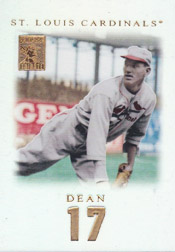
dizzy_dean6On Sept. 30, 1934, Dean earned his 30th win of the year in the Cardinals’ 9-0 victory over the Reds at St. Louis. Dean became the last National League pitcher to achieve 30 wins in a season and the first since Grover Cleveland Alexander of the 1917 Phillies.

Dean’s performance enabled the Cardinals to finish a game ahead of the Giants and propelled them into the World Series against the Tigers.

September sizzle

The Cardinals, who trailed the first-place Giants by seven games on Sept. 7, won nine of 10 between Sept. 16 and Sept. 25.

On Sept. 28, the Cardinals were a half-game behind the idle Giants entering a Friday afternoon game against the Reds at St. Louis. Dean started and pitched a shutout. The 4-0 victory moved the Cardinals into a first-place tie.

The next day, after the Cardinals beat the Reds and the Giants lost to the Dodgers, St. Louis was alone in first place with a game remaining.

Cardinals manager Frankie Frisch chose Dean to start the Sept. 30 finale. It would be Dean’s fifth appearance in eight days.

Personal quest

In the book “Ol’ Diz,” author Vince Staten wrote, “Diz had made it his personal quest to pitch the Cardinals into the World Series. He wanted the ball every day.”

The Cardinals could clinch the pennant _ their fifth in nine years _ on Sept. 30 with a win over the Reds, or a Giants loss to the Dodgers. If the Cardinals lost and the Giants won, a playoff would be needed to determine the league champion.

“Give me a couple or three runs _ there ain’t going to be any playoff,” Dean said to his teammates.

Playing at the Polo Grounds, the Giants scored four in the first, but the Dodgers rallied. The score was tied at 5-5 after nine innings.

At St. Louis, before a packed house of 35,274, Dean and the Cardinals were cruising. Bill DeLancey drove in four runs. Rip Collins hit a two-run home run for his 200th hit of the season.

Fastballs like pistol shots

Entering the ninth, the Cardinals led, 9-0.

In the book “Diz,” author Robert Gregory wrote, “He was working on a five-hitter, his second straight shutout, and with fastballs that sounded like pistol shots he had made it a calm, effortless, one-sided game.”

The Reds, though, opened the ninth with two hits and a walk, loading the bases.

“Grinning in that cocksure way of his, Dizzy arose to the heights,” the Associated Press reported.

Dean struck out Clyde Manion.

Ted Petoskey was up next.

With the count 0-and-2, the scoreboard posted the final from the Polo Grounds:

Dodgers 8, Giants 5, in 10 innings.

The loss eliminated the Giants and assured the Cardinals the pennant.

All that remained to be settled was whether Dean would get the shutout.

Finish with a flourish

Petoskey struck out.

Sparky Adams followed by fouling out to the catcher.

Dean completed the shutout in 2:01. Boxscore

“A few minutes later … five cops were escorting Diz to the dugout as thousands of fans swept onto the field,” Gregory wrote.

The Cardinals celebrated their pennant by swigging soda pop.

Dean, though, “his eyes glazed with fatigue, was unusually quiet and bumming cigarettes.”

The final stats for Dean that season: 30-7 record, 2.66 ERA, 50 games pitched, 33 starts, 24 complete games, seven shutouts and 311.2 innings pitched.

Dean won Games 1 and 7 of the 1934 World Series and was chosen the recipient of the National League Most Valuable Player Award.

Previously: Cardinal cool: How Dizzy Dean survived armed robbery

Previously: Why Cardinals dealt Dizzy Dean to Cubs

Read Full Post »

« Newer Posts - Older Posts »