Feeds:
Posts
Comments

Archive for the ‘Pitchers’ Category

(Updated Jan. 20, 2019)

Performing an escape act on the sport’s grandest stage, the Cardinals were the first team to emerge victorious in a World Series that ended with the tying run on third base.

red_schoendienst9It happened in Game 7 of the 1946 World Series between the Red Sox and Cardinals.

Nervous ninth

Game 7 of the 1946 World Series is best remembered for the daring dash by Enos Slaughter from first to home on a hit by Harry Walker that scored the decisive run in the eighth inning, earning the Cardinals their third championship in five years. What often is overlooked is the Red Sox nearly tied the score in the ninth.

Cardinals left-hander Harry Brecheen was pitching in relief in Game 7 in 1946 after having achieved wins in two starts in the World Series.

Rudy York led off the Red Sox ninth with a single and Bobby Doerr followed with another single, advancing York to second. Red Sox manager Joe Cronin replaced York with pinch-runner Paul Campbell.

That brought to the plate Pinky Higgins, 37, a 14-year big-league veteran. In what would be his last major-league at-bat, Higgins grounded to third baseman Whitey Kurowski, who threw to shortstop Marty Marion to get the force on Doerr at second base. Campbell advanced to third on the play.

With one out, Roy Partee batted next and popped out to first baseman Stan Musial for the second out.

Brecheen vs. McBride

Cronin sent Tom McBride, a right-handed batter, to bat for pitcher Earl Johnson. McBride hit .301 in 1946, including .333 against left-handers.

In the press box, some expected Cronin to use Don Gutteridge as a pinch-runner for Higgins at first base, but Cronin didn’t make the move.

Brecheen threw “a good screwball” and McBride rapped it on the ground. Second baseman Red Schoendienst got to the ball and gloved it, but the ball rolled up his arm.

In his book “Red: A Baseball Life,” Schoendienst said, “Just as I went to field the ball, it took a crazy hop and I blocked the ball with my left shoulder. Luckily, I was able to trap it.”

Schoendienst kept his cool and flipped a low, underhand toss to Marion, who caught it in time to nip Higgins at second base for the final out.

In his book “Stan Musial: The Man’s Own Story,” Musial told writer Bob Broeg, “Our hearts stood still” as the ball rolled up Schoendienst’s arm. “Red looked like a magician pulling a rabbit out of his sleeve when he finally flipped the ball to Marion,” said Musial.

$40,000 assist

In the St. Louis Star-Times, Sid Keener reported Schoendienst’s toss beat Higgins to the bag “by no more than a step.”

“Cronin’s critics insist Gutteridge would have beaten the play at second,” enabling Campbell to score from third with the tying run, Keener concluded.

McBride told the Society for American Baseball Research, “The ball I hit was a low liner right by Brecheen’s left knee, and when it went by Harry, I thought I had a hit … But the second baseman, Schoendienst, made a good play on the ball. He didn’t catch it clean. The ball bounced up and looked as if it balanced on the web of his glove. He picked it off and threw to second base for a force out.”

Said Schoendienst: “People began to refer to that play as the $40,000 assist because the $40,000 was the approximate difference between the total shares for the winning team and the losing side.”  Boxscore

The play had another benefit for Schoendienst. He wanted to marry his girlfriend, Mary, but her grandfather, Patrick O’Reilly, said he wasn’t keen about a “German” joining the family.

Said Mary: “He was still not sure about Red until he made that play. After the ball hit him in the chest, then rolled up his arm, and he still made the play and we won the game, then my grandfather said, ‘You can marry him now.’ “
Read Full Post »

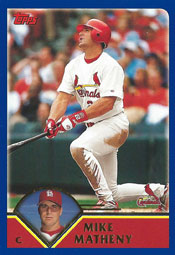
mike_matheny8Catcher Mike Matheny played a big role for the Cardinals in the 2004 National League Division Series versus the Dodgers.

On Oct. 5, 2004, Matheny contributed a solo home run against reliever Elmer Dessens in the Cardinals’ 8-3 victory in Game 1 of the best-of-five series at St. Louis.

Cardinals fans rewarded him with an ovation and urged a curtain call. A hesitant Matheny went to the top step of the dugout and acknowledged the sustained applause.

“It’s a huge honor,” Matheny, 34, said to the St. Louis Post-Dispatch. “It’s taken me five years (with the Cardinals) and this is the first year I’ve had one. I didn’t know how to get out there.” Boxscore

Hot hitter

Two days later, on Oct. 7, 2004, the Cardinals entered Game 2, knowing a victory would give them control of the series.

In the fifth inning, with the Cardinals ahead, 4-3, Matheny batted against starter Jeff Weaver with the bases loaded, two outs, and stroked a two-run single to center, giving the Cardinals a 6-3 lead and knocking Weaver out of the game.

“He gets fired up,” Cardinals manager Tony La Russa said.

Dan Haren, who followed starter Jason Marquis and Cal Eldred, held the Dodgers scoreless in the fifth and sixth, stabilizing the game for St. Louis. It was an impressive effort for a pitcher making his first postseason appearance.

A grateful La Russa called Haren, 24, “a cool dude” and “tough as nails” and said Haren’s shutdown of the Dodgers “turned the momentum.”

Said Matheny: “He came into a tough situation and made pitches right away.”

RBI record

In the seventh, the Cardinals, looking to stretch their three-run lead, had Reggie Sanders on second and Edgar Renteria on third, with two outs. Though first base was open and pitcher Ray King was on deck, the Dodgers decided to pitch to Matheny and he singled to left off a first-pitch curve from Giovanni Carrera, scoring both runners. The Cardinals won by the same score as the opener, 8-3. Boxscore

“The hit (Matheny) got off Weaver, he hit a good pitch,” said Dodgers manager Jim Tracy. “It was a breaking ball down and away and he got it. In the seventh, that wasn’t a good pitch.”

Wrote Post-Dispatch columnist Bernie Miklasz: “The Dodgers probably wonder how it is that Matheny became Johnny Bench.”

Matheny became the first Cardinals hitter to produce four RBI in a Division Series game.

“I know that I haven’t put up huge (regular-season) numbers offensively, but I also know what my purpose is on this team,” Matheny said. “First of all, it’s behind the plate _ and I put a whole lot more pressure and expectations on myself back there.”

The Cardinals eliminated the Dodgers with a Game 4 triumph, advancing to the National League Championship Series against the Astros. The Cardinals beat the Astros in four of seven games, winning their first pennant in 17 years and progressing to the World Series against the Red Sox.

Previously: Why Mike Matheny ended his playing career as a Giant

Previously: Pitcher for 1964 Cardinals was mentor to Mike Matheny

Read Full Post »

On the final day of the 1934 season, in a feat that combined endurance with skill, Dizzy Dean carried the Cardinals to the National League pennant by pitching his second shutout in the span of 48 hours.

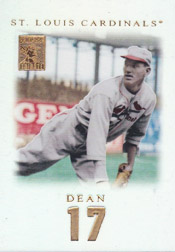
dizzy_dean6On Sept. 30, 1934, Dean earned his 30th win of the year in the Cardinals’ 9-0 victory over the Reds at St. Louis. Dean became the last National League pitcher to achieve 30 wins in a season and the first since Grover Cleveland Alexander of the 1917 Phillies.

Dean’s performance enabled the Cardinals to finish a game ahead of the Giants and propelled them into the World Series against the Tigers.

September sizzle

The Cardinals, who trailed the first-place Giants by seven games on Sept. 7, won nine of 10 between Sept. 16 and Sept. 25.

On Sept. 28, the Cardinals were a half-game behind the idle Giants entering a Friday afternoon game against the Reds at St. Louis. Dean started and pitched a shutout. The 4-0 victory moved the Cardinals into a first-place tie.

The next day, after the Cardinals beat the Reds and the Giants lost to the Dodgers, St. Louis was alone in first place with a game remaining.

Cardinals manager Frankie Frisch chose Dean to start the Sept. 30 finale. It would be Dean’s fifth appearance in eight days.

Personal quest

In the book “Ol’ Diz,” author Vince Staten wrote, “Diz had made it his personal quest to pitch the Cardinals into the World Series. He wanted the ball every day.”

The Cardinals could clinch the pennant _ their fifth in nine years _ on Sept. 30 with a win over the Reds, or a Giants loss to the Dodgers. If the Cardinals lost and the Giants won, a playoff would be needed to determine the league champion.

“Give me a couple or three runs _ there ain’t going to be any playoff,” Dean said to his teammates.

Playing at the Polo Grounds, the Giants scored four in the first, but the Dodgers rallied. The score was tied at 5-5 after nine innings.

At St. Louis, before a packed house of 35,274, Dean and the Cardinals were cruising. Bill DeLancey drove in four runs. Rip Collins hit a two-run home run for his 200th hit of the season.

Fastballs like pistol shots

Entering the ninth, the Cardinals led, 9-0.

In the book “Diz,” author Robert Gregory wrote, “He was working on a five-hitter, his second straight shutout, and with fastballs that sounded like pistol shots he had made it a calm, effortless, one-sided game.”

The Reds, though, opened the ninth with two hits and a walk, loading the bases.

“Grinning in that cocksure way of his, Dizzy arose to the heights,” the Associated Press reported.

Dean struck out Clyde Manion.

Ted Petoskey was up next.

With the count 0-and-2, the scoreboard posted the final from the Polo Grounds:

Dodgers 8, Giants 5, in 10 innings.

The loss eliminated the Giants and assured the Cardinals the pennant.

All that remained to be settled was whether Dean would get the shutout.

Finish with a flourish

Petoskey struck out.

Sparky Adams followed by fouling out to the catcher.

Dean completed the shutout in 2:01. Boxscore

“A few minutes later … five cops were escorting Diz to the dugout as thousands of fans swept onto the field,” Gregory wrote.

The Cardinals celebrated their pennant by swigging soda pop.

Dean, though, “his eyes glazed with fatigue, was unusually quiet and bumming cigarettes.”

The final stats for Dean that season: 30-7 record, 2.66 ERA, 50 games pitched, 33 starts, 24 complete games, seven shutouts and 311.2 innings pitched.

Dean won Games 1 and 7 of the 1934 World Series and was chosen the recipient of the National League Most Valuable Player Award.

Previously: Cardinal cool: How Dizzy Dean survived armed robbery

Previously: Why Cardinals dealt Dizzy Dean to Cubs

Read Full Post »

(Updated Sept. 27, 2019)

In late September 1964 the Cardinals were five games behind the first-place Phillies entering a five-game series against the Pirates at Pittsburgh.

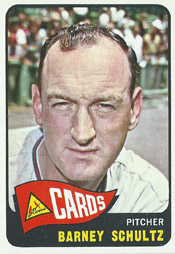
barney_schultzWith 11 games remaining in the regular season, Cardinals outfielder Bob Skinner said to teammate Dick Groat, “OK, Dick, the only thing we have to do is sweep the Pirates in five,” according to the book “October 1964.”

Skinner and Groat, both former Pirates, knew how unlikely it was for any club to accomplish such a task at Pittsburgh.

However, the Cardinals won both games of a doubleheader versus the Pirates on Sept. 24 and followed that with wins at Pittsburgh on Sept. 25 and Sept. 26.

In the series finale, played in a light rain on Sept. 27, 1964, the Cardinals started Roger Craig, who’d lost four consecutive decisions.

Craig delivered a stellar start, holding the Pirates scoreless and limiting them to six singles through 7.2 innings.

Save for Schultz

In the eighth, with the Cardinals ahead, 3-0, the Pirates had runners on first and second, two outs, when Cardinals manager Johnny Keane brought in knuckleball specialist Barney Schultz to face Roberto Clemente, who represented the tying run.

The odds seemed stacked in favor of Clemente, who hit .361 with runners in scoring position in 1964, but Schultz struck him out. Throwing nothing but knucklers, Schultz got Clemente to lunge for one and miss on a 2-and-2 count.

The Cardinals scored twice in the ninth and Schultz retired the Pirates in order in the bottom half of the inning, preserving a 5-0 St. Louis victory. Boxscore

In sweeping the five games at Pittsburgh, the Cardinals played nearly flawless baseball, committing one error and holding the Pirates to eight total runs.

“That was a disgrace in Pittsburgh,” Phillies scout Don Hoak, a former Pirates third baseman, said to Groat. “They just handed you five games.”

Groat replied, “You forgot to mention the most important thing about those five games _ that we didn’t make a single mistake in all five of them.”

Pennant push

The sweep moved the Cardinals 1.5 games behind the Reds, who had gone into first place as the fading Phillies lost their seventh in a row.

Pirates manager Danny Murtaugh said the Cardinals “looked like they mean business. They’re putting everything together,” the Pittsburgh Press reported.

Arriving at the St. Louis airport after their flight from Pittsburgh, the Cardinals were greeted by an adoring crowd of at least 8,000, The Sporting News reported.

“The adrenaline was flowing,” Cardinals outfielder Carl Warwick said to Peter Golenbock in the book “Spirit of St. Louis.” “All of a sudden you’re saying, ‘We’re not out of this thing.’ ”

Craig told the St. Louis Post-Dispatch, “Our guys believe they can win. They know we have the best club in the league.”

Finishing the season in St. Louis, the Cardinals won four of their last six against the Phillies and Mets, winning the pennant by a game over both the Phillies and Reds.

Previously: Why Gussie Busch fired Bing Devine in championship year


Read Full Post »

(Updated Jan. 8, 2019)

Three years after he left the Busch Stadium mound with his pitching career spiraling out of control, Rick Ankiel returned to St. Louis as a confident Cardinals reliever embraced by the fans.

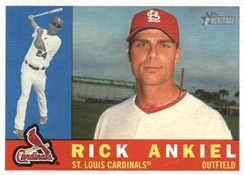
rick_ankiel6On Sept. 19, 2004, Ankiel made his first Busch Stadium appearance since 2001 and pitched two hitless innings against the Diamondbacks, departing to a standing ovation.

In his previous home appearance, on May 10, 2001, Ankiel regressed against the Pirates, yielding three runs, three hits, five walks and two wild pitches in three innings, departing with his head down and bolting the ballpark without talking with reporters. Boxscore

After that debacle, Ankiel went to the minor leagues and pitched there for the remainder of 2001. After sitting out the 2002 season because of a left elbow sprain, Ankiel pitched in the minors in 2003 until undergoing left elbow surgery in July.

Ankiel spent most of the 2004 season on the disabled list, returned to the minors in August that summer and was called up by the Cardinals in September. Ankiel made a pair of scoreless one-inning stints at San Diego against the Padres and at Los Angeles against the Dodgers.

Welcome home

On Sept. 19, 2004, a Sunday afternoon at Busch Stadium, Ankiel relieved starter Jeff Suppan to start the fifth inning. As he walked to the mound, Ankiel tipped his cap to an appreciative crowd of 41,279.

“You walk out there with the electricity of the crowd and you feel like you’re floating,” Ankiel said to the St. Louis Post-Dispatch. “It’s pretty indescribable.”

Mixing a 91 mph fastball with a 66 mph curve, Ankiel faced three batters _ Luis Terrero, Alex Cintron and Danny Bautista _ in the fifth and struck out all three.

“His fastball was running and sinking hard,” Cintron said to the Post-Dispatch. “His curveball _ I’ve never faced anything like it in my life. He’s the Rick Ankiel everyone expected him to be.’

Facing Ankiel in the sixth, Shea Hillenbrand grounded out, Chad Tracy walked, Chris Snyder struck out and Doug DeVore lined out to right. “He was tricky,” Snyder said to the Belleville (Ill.) News-Democrat. “He was pretty deceptive. He had a good fastball and a good snap to his curveball.”

Said Cardinals catcher Mike Matheny: “He’s got good tempo … That curve’s amazing. You can hear it spinning all the way up there.”

Walking off the mound, Ankiel again tipped his cap to a standing ovation.

“Unbelievable … I was pretty much in the sky,” Ankiel said to the News-Democrat. Boxscore

Years later, in his 2017 book “The Phenom,” Ankiel said, “My fastball wasn’t what it was. That was by choice. It was more reliable at 89 mph or 90, at less than full effort, than it would be at 95. My career would have to be about control. I’d control my mind, which would settle my heart, and control my effort, which would guide my fastball.”

Last hurrah

In his next appearance, at Colorado, Ankiel yielded five runs in two innings. He rebounded five days later, on Oct. 1, in limiting the Brewers to a run in four innings and earning a win. Boxscore

“What became important was winning the game around the game, the one in my head,” Ankiel said in his book.

It would be Ankiel’s final big-league game as a pitcher.

In 2005, Ankiel declared he would convert into an outfielder and abandon his pitching career.

In 2007, Ankiel returned to the Cardinals and spent seven seasons in the big leagues as a power-hitting and strong-armed outfielder.

Previously: Rick Ankiel joins Babe Ruth, Joe Wood in postseason lore

Read Full Post »

(Updated Feb. 3, 2019)

No National League night game has gone more innings than the one played by the Cardinals and Mets on Sept. 11-12, 1974.

bake_mcbride2Beginning at 8:08 p.m. on Sept. 11 and ending at 3:15 a.m. on Sept, 12, the Cardinals beat the Mets, 4-3, in 25 innings at New York’s Shea Stadium. Started before a crowd of 13,460, it ended before about 1,000 spectators, including baseball commissioner Bowie Kuhn.

The Cardinals-Mets marathon remains the longest National League night game in innings played.

In the longest major-league game by innings, the Dodgers and Braves played to a 1-1 tie in 26 innings on May 1, 1920. That National League game was played on a Saturday afternoon at Braves Field in Boston. Boxscore

Only one 25-inning game has been played in the major leagues since the Cardinals-Mets classic in 1974. In an American League game, the White Sox, managed by Tony La Russa, beat the Brewers, 7-6, in 25 innings at Chicago’s Comiskey Park. That night game began on May 8, 1984, was suspended after 17 innings with the score tied at 3-3 and completed on May 9. Boxscore

With no National League curfew, the Cardinals and Mets played their 25-inning game without a stop in play.

When it ended, Cardinals outfielder Reggie Smith told his teammates, “There’s no way that your wives are going to believe you guys were out playing baseball all night.”

Reitz to the rescue

The Cardinals trailed, 3-1, entering the ninth. After Joe Torre struck out, Ted Simmons singled and was replaced by pinch-runner Larry Herndon. Herndon went to second on a wild pitch by starter Jerry Koosman, but Bake McBride struck out.

With the Mets an out away from victory, the Cardinals’ last hope, Ken Reitz, hit a two-run home run, tying the score at 3-3.

“I was looking for a fastball, a strike, and I got it,” Reitz said to the St. Louis Post-Dispatch.

Cardinals reliever Claude Osteen, who had a clear view of the home run from his perch in the bullpen, held his hands less than a foot apart when he told United Press International the ball “went out by about that much.”

Scoreless relief

For the next 15 innings, Cardinals and Mets relievers threw shutouts.

Al Hrabosky, Rich Folkers, Ray Bare, Osteen and Sonny Siebert were the Cardinals relievers who stopped the Mets in extra innings. Osteen pitched 9.1 innings _ the equivalent of a complete-game shutout.

A pair of former Cardinals, Harry Parker and Bob Miller, joined Bob Apodaca and Jerry Cram as the Mets relievers who stopped the Cardinals. Cram pitched eight innings.

They escaped several jams.

_ Torre was out at the plate trying to score on a single by McBride in the 13th.

_ In the 20th, the Cardinals had runners on first and second, no outs, but Smith was picked off at second and the threat fizzled.

_ In the 23rd, the Mets loaded the bases with two outs before Cleon Jones flied out.

_ Both teams loaded the bases with two outs in the 24th but failed to score.

Bake was cooking

Hank Webb relieved Cram in the 25th inning. McBride led off with an infield single and Reitz was up next.

Cardinals manager Red Schoendienst gave the hit-and-run sign. Webb made a pickoff throw, but it sailed over first baseman John Milner and rolled into foul territory in right field.

“I figured I could get to third,” McBride told the Associated Press. “Then, when I turned second, I said to myself, ‘I’m going all the way.’ ”

McBride raced around third without looking toward coach Vern Benson, who was showing the stop sign. “I didn’t see any sense in sending him home with nobody out,” Benson said.

Milner retrieved the ball and fired a throw to catcher Ron Hodges. McBride and the ball arrived at the plate about the same time. Hodges dropped the ball before he could attempt a tag.

“I don’t think he would have had me, even if he had held the ball,” McBride said. “He was out in front of the plate and I was past him.”

Benson saw it differently. “It was a good throw by Milner, and Hodges probably would have got McBride if he hadn’t taken his eyes off the ball,” Benson said.

The Cardinals led, 4-3, but the Mets still had their turn to bat.

Happy ending

Siebert retired the first two batters, Ken Boswell and Felix Millan, on fly outs.

Brock Pemberton, appearing in his second big-league game, batted for Webb and singled, prolonging the drama with his first big-league hit. When the ball was removed from the game so Pemberton would have a keepsake, Mets pitcher Tom Seaver quipped from the dugout, “Don’t give it to him. It’s the last ball we’ve got left.” (Fifteen dozen balls were used in the game, The Sporting News reported.)

Milner, the Mets’ top home run hitter, batted next.

Siebert struck him out, ending the game at 7 hours, 4 minutes. Boxscore

Dizzying stats

The Cardinals used 26 players and the Mets, 24. The Cardinals stranded 20 base runners and the Mets, 25.

Nine players played the entire game. They were McBride, Reitz, Smith, Torre and Ted Sizemore for the Cardinals; Millan, Milner, Wayne Garrett and Dave Schneck for the Mets.

“Ordinarily, I get two hits and it’s a decent night, but 2-for-11?” Schneck said to the New York Daily News.

McBride, Reitz and Millan each had four hits in 10 at-bats. Garrett was 0-for-10 with four strikeouts. Lou Brock, the Cardinals’ future Hall of Famer, was 1-for-9 and was caught stealing in his lone attempt.

The home plate umpire, Ed Sudol, also had worked the plate in a 23-inning game between the Mets and Giants in 1964 and a 24-inning game between the Mets and Astros in 1968.

“My legs feel like a couple of lead posts,” Sudol said.

Asked to sum up the long night, Mets pitcher Tug McGraw said, “The only thing I regret now is that all the eating places are closed. I’ll have to go home and make myself a baloney sandwich.”

Previously: Reggie Smith and the Cardinals’ after-hours club

Read Full Post »

« Newer Posts - Older Posts »