Feeds:
Posts
Comments

Archive for the ‘Pitchers’ Category

In a performance as remarkable as it was messy, Al Hrabosky and the Cardinals turned the last home game of the 1974 season into a classic.

al_hrabosky2On Sept. 25, 1974, Hrabosky struck out nine in 6.1 innings against the Pirates at St. Louis.

Hrabosky’s relief effort was among many unusual feats in a 13-12 victory that gave the Cardinals an edge in their pursuit of a National League East Division title.

“Never in my life have I seen a game like that,” Cardinals first baseman Joe Torre told the Alton (Ill.) Telegraph.

Battle for first

The Cardinals entered the game that Wednesday night trailing the first-place Pirates by a half-game with a week remaining in the season.

Rookie right-hander Bob Forsch, who started for the Cardinals, gave up five runs in the first inning before being yanked.

Because the Pirates had stacked their lineup with left-handed batters  _ Richie Hebner, Al Oliver, Willie Stargell, Dave Parker and Ed Kirkpatrick _ Cardinals manager Red Schoendienst went with left-handed relievers. First, he used Rich Folkers. Then, Claude Osteen.

The Cardinals rallied for six runs in the third off Ken Brett and Larry Demery.

In the fifth, the Pirates got a run against Osteen, tying the score at 6-6. The Pirates had runners on first and second with no outs when Schoendienst replaced Osteen with his third left-handed reliever, Hrabosky.

Decent curve

Hrabosky got the Cardinals out of that jam without either runner scoring. In the bottom of the fifth, the Cardinals scored three, taking a 9-6 lead.

The Pirates scored twice off Hrabosky in the sixth. Entering the ninth, the Cardinals clung to a 9-8 lead.

Hrabosky struck out Stargell, but hit Parker with a pitch. Manny Sanguillen singled and, when center fielder Bake McBride made an error on the play, Parker raced home, tying the score at 9-9.

“I was discouraged because the club had given me a three-run lead and I couldn’t hold it,” Hrabosky said. “I didn’t feel like I had a good fastball, but I did have a decent curve.”

Hrabosky struck out at least one batter in each of the seven innings he worked.

In the 11th, he began to falter. “I was tired and the Pirates didn’t help it,” Hrabosky said. “They took the rest of the life I had left.”

Hrabosky gave up three runs on three singles and a double before he was relieved by Mike Garman with one out in the 11th. Hrabosky’s line: 6.1 innings, 6 runs, 10 hits, 0 walks, 9 strikeouts. The innings, runs, hits and strikeouts are single-game highs for Hrabosky in his 13-year big-league career.

Garman retired the two batters he faced, but the Pirates led, 12-9.

“We knew where we were at and it was now or never for us,” Torre said.

Rally time

The Pirates had used five pitchers, including their two best relievers, Dave Giusti and Ramon Hernandez. Pirates manager Danny Murtaugh brought in rookie Juan Jimenez to nail down the win.

“It was a kid pitching out there and he wanted to throw strikes,” Torre said. “When he couldn’t, he started to aim the ball.”

Ted Sizemore led off with a single. Reggie Smith walked. Ted Simmons was up next.

“I figured if he walked Smith I was going to swing at the first pitch in the strike zone,” Simmons said.

Simmons launched a double to right, scoring Sizemore and cutting the Pirates lead to 12-10.

Pirates unravel

Murtaugh lifted Jimenez and replaced him with another rookie, Jim Minshall. The first batter he faced was Torre.

“I wanted to hit the ball the other way to at least score Smith (from third) and get Simmons to third base,” Torre said.

Torre hit a broken-bat grounder to the right of second base. Rennie Stennett, the second baseman, fielded the ball, but his throw to first was wild. Smith and Simmons scampered home, tying the score at 12-12, and Torre advanced to second. Larry Herndon pinch-ran for Torre.

McBride bunted for a single and Herndon moved to third. Ken Reitz struck out _ the first out of the inning.

Due to bat was Jack Heidemann, a light-hitting shortstop. Schoendienst sent Jim Dwyer, a reserve outfielder batting .282, to pinch-hit.

Dwyer lifted a sacrifice fly, scoring Herndon from third with the winning run.

Said Dwyer: ” I was on the spot … That is my biggest contribution to the team this season.”

Down the stretch

Steve Porter, covering the game for the Alton Telegraph wrote, “It was more than just a baseball game … It was a whole season unfolding over 11 innings and a pennant race hanging in the balance for one inning.” Boxscore

The improbable four-run uprising gave the Cardinals a 13-12 victory and propelled them into first place.

The Cardinals would win three of their next five. The Pirates, though, would win five of their next six.

On Oct. 2, the final day of the season, the Pirates held a one-game lead over the Cardinals. To finish in a tie and force a playoff, the Cardinals needed to beat the Expos that day and the Cubs needed to beat the Pirates.

Instead, the Pirates beat the Cubs, 5-4, in 10 innings. The Cardinals-Expos game was called off because of rain and wasn’t rescheduled. The Pirates were NL East champions, finishing 1.5 games ahead of the Cardinals.

Read Full Post »

For one night, at least, amid the excitement of a pennant chase, John Curtis showed the Cardinals a flash of the talent they’d expected when they acquired him as the key player in a trade with the Red Sox.

john_curtisOn Aug. 29, 1974, Curtis delivered the best performance of his Cardinals career, pitching a one-hitter in St. Louis’ 3-1 victory over the Padres at San Diego.

The win moved the Cardinals within a half-game of the first-place Pirates in the National League East with a month remaining and raised hopes St. Louis would earn its first postseason berth in six years.

Seeking a southpaw

Curtis, a left-hander, earned 13 wins with the 1973 Red Sox. That impressed the Cardinals and in December 1973 they acquired Curtis and pitchers Lynn McGlothen and Mike Garman from the Red Sox for pitchers Reggie Cleveland and Diego Segui and infielder Terry Hughes.

Curtis appealed to the Cardinals as a left-handed starter who might silence the bats of premium left-handed batters within the division such as the Pirates’ Willie Stargell, Dave Parker, Al Oliver and the Mets’ Rusty Staub and John Milner.

“We needed a left-hander badly,” Cardinals manager Red Schoendienst said to the Associated Press. “I think we’ve got him now.”

Said St. Louis general manager Bing Devine: “A left-hander was of prime importance.”

The Cardinals entered 1974 with a rotation of Bob Gibson, Curtis, Alan Foster, McGlothen and Sonny Siebert.

Curtis, the lone left-hander, got off to a terrible start, losing five of his first seven decisions as his ERA swelled to 5.83, but Schoendienst kept him in the rotation.

Almost perfect

On Aug. 29, a Thursday night, before 6,042 spectators, Curtis got the start against the hapless Padres, who had the worst record in the National League and would finish with 102 losses.

The Padres did have a couple of sluggers who batted right-handed _ Nate Colbert and Dave Winfield, who was in his second season of what would become a Hall of Fame career.

Curtis retired the first 21 batters in a row. Seven perfect innings. Ted Simmons, catching Curtis, hit a home run in the seventh, breaking a scoreless tie.

Winfield, who two months earlier had hit a home run off Curtis for the lone run in a 1-0 Padres victory, led off the bottom of the eighth and watched the first three pitches sail out of the strike zone.

“He’s a pretty free swinger,” Curtis said. “Maybe I was a little too careful.”

Winfield walked, “but that didn’t concern me too much,” Curtis said.

Cito Gaston bunted, moving Winfield to second. Derrel Thomas walked and Dave Hilton flied out to right, advancing Winfield to third.

With two outs and two on, Fred Kendall, who hadn’t gotten a hit in a week, singled to left, breaking up the no-hitter and scoring Winfield with the tying run.

Win first

“When Kendall got his hit, I wasn’t too let down,” Curtis said. “It was a sort of purpose pitch inside. I was trying to make him swing at a bad pitch.”

Curtis’ work wasn’t done. With Thomas on second and Kendall on first, left-handed slugger Willie McCovey was sent to bat for pitcher Randy Jones. McCovey, a future Hall of Famer, flied out to center.

In the ninth, after Padres reliever Larry Hardy retired the first two batters, the Cardinals got four consecutive singles from Bake McBride, Ken Reitz, Jim Dwyer and Mike Tyson _ the latter two driving in a run apiece.

With a 3-1 lead, Curtis set down the Padres in order in the last half of the ninth, clinching the win and a one-hitter. Boxscore

“I had a ballgame to win, not a no-hitter to pitch,” Curtis said. “The way the season has been going for me, you can’t be too selective of your victories. It’s quite a thrill for me and it comes late in a year when we’re battling for something. That’s an added thrill.”

The Cardinals would finish in second place, 1.5 games behind the Pirates. Curtis was 10-14 in his first year with the Cardinals and led the club in losses. He posted records of 8-9 in 1975 and 6-11 in 1976 before the Cardinals traded him to the Giants.

In 109 games, including 62 starts, Curtis was 24-34 with a 3.88 ERA for the Cardinals.

Previously: Randy Jones held Cardinals to a single in 10 innings

Read Full Post »

Dennis Eckersley and Jason Isringhausen, the closers who contributed the most to helping Tony La Russa earn election to the National Baseball Hall of Fame, also played prominent roles in his first win as Cardinals manager.

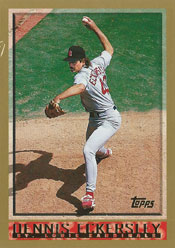
dennis_eckersley2The Cardinals beat the Mets, 5-3, in New York on April 3, 1996, in La Russa’s second game as Cardinals manager. Eckersley earned a tension-filled four-out save. Isringhausen was the opposing starter, facing the Cardinals for the first time in his career.

The win was the first of a franchise-record 1,408 for La Russa in 16 years as Cardinals manager.

After successful stints managing the White Sox and Athletics, La Russa secured his Hall of Fame status with his Cardinals career. He joined another Hall of Famer, Billy Southworth, as the only managers to win two World Series titles with the Cardinals. On July 27, 2014, La Russa and another former Cardinals manager, Joe Torre, were inducted into the Hall of Fame at Cooperstown, N.Y.

Converted starters

At Oakland, La Russa and pitching coach Dave Duncan converted a reluctant Eckersley from a starter into a closer. The move transformed Eckersley into a Hall of Fame pitcher. He earned 386 of his 390 saves with La Russa as manager _ 320 in nine years with the Athletics and 66 in two years with the Cardinals.

Isringhausen, who also successfully converted from starter to closer, joined the Cardinals in 2002. Pitching for La Russa and Duncan, Isringhausen compiled a franchise-record 217 saves in seven seasons with the Cardinals and finished his big-league career with 300 saves.

After La Russa left the Athletics to become manager of the 1996 Cardinals, Eckersley was acquired in a trade for pitcher Steve Montgomery and, at 41, became the St. Louis closer.

On April 1, 1996, in La Russa’s debut as Cardinals manager, the Mets overcame a four-run deficit and won, 7-6. Eckersley didn’t appear in that game. Boxscore

Seeking a win

Isringhausen, 23, got the start for the Mets in the season’s second game. He was 9-2 as a Mets rookie in 1995. A native of Brighton, Ill., near St. Louis, Isringhausen acknowledged that facing the Cardinals was special. “I had more butterflies (than usual),” Isringhausen said to the St. Louis Post-Dispatch.

Isringhausen pitched six innings, yielding three runs to the Cardinals. He was lifted for a pinch-hitter, with the Cardinals leading, 3-0. Bernard Gilkey, a former Cardinal, clubbed a three-run home run off starter Todd Stottlemyre in the bottom of the sixth, tying the score at 3-3.

The Cardinals scored a run in the seventh off Robert Person and another run in the eighth against Jerry DiPoto, taking a 5-3 lead. In the bottom of the eighth, the Mets had runners on first and second with two outs when La Russa replaced Stottlemyre with Eckersley.

“No matter how much experience you have, you’re a little uptight when you come into the game,” Eckersley said to the Post-Dispatch. “I felt very uncomfortable, like I’d never been in a game before.”

Solid swing

The first batter Eckersley faced in his Cardinals debut was Butch Huskey, the Mets’ cleanup batter.

With the count 1-and-2, Eckersley threw a fastball. Huskey swung and launched a drive toward center field. He knew he had made solid contact. “I thought it had a chance to go (over the wall),” Huskey said to the New York Daily News.

Center fielder Ray Lankford raced toward the wall while tracking the path of the ball. “I thought I could tell by the look on (Lankford’s) face that he was going to catch it,” Eckersley said.

The ball carried farther than Eckersley thought. As Lankford neared the 396-foot sign, he leaped, extended his glove and caught the ball, ending the inning and preserving the lead.

“Most definitely, I was robbed,” Huskey told the Post-Dispatch. “The ball jumped off my bat. I thought it was going out.”

In the bottom of the ninth, with the Cardinals still ahead by two, Eckersley retired the first two batters before Jose Vizcaino and Kevin Roberson each singled. Edgardo Alfonzo was up next, representing the potential winning run. Eckersley struck him out, earning his first National League save and preserving La Russa’s first National League win.

“In this league, it’s hard to get a hit or a save or a win,” La Russa said. “I don’t think there are any ugly ones.” Boxscore


Read Full Post »

(Updated July 17, 2019)

Insisting the crime didn’t fit the punishment, Cardinals pitcher Joaquin Andujar threatened to return home to the Dominican Republic rather than pay a fine for an altercation with Giants counterpart Mike Krukow.

joaquin_andujar6Though Andujar didn’t leave the Cardinals _ he completed a season in which he led the National League in wins (20) and innings pitched (261.1) _ the incident and his reaction to it contributed to the legend of the talented, emotional starter.

On July 17, 1984, in a game between the Giants and Cardinals at St. Louis, Manny Trillo was hit by a pitch from Andujar in the first inning. Andujar led the National League in most batters hit by pitches in both 1984 and 1985.

Two innings later, when Andujar batted for the first time in the game, Krukow brushed him back with two pitches. On the second brushback pitch, Andujar “had to jump rope or the ball would have hit him” in the leg, the St. Louis Post-Dispatch reported.

Plate umpire Billy Williams went to the mound to warn Krukow to stop throwing at Andujar. “I thought the first time the ball got away from him,” Williams said. “The second one didn’t.”

As Giants manager Frank Robinson joined the conversation on the mound, Krukow began yelling at Andujar.

“I said, ‘Don’t throw at my hitters,’ ” Krukow told the San Francisco Examiner. “He said something back. He wasn’t speaking Spanish.”

Krukow tossed down his glove and charged at Andujar.

Andujar tossed down his helmet and threw a punch at Krukow, the Post-Dispatch reported. Krukow and Andujar grappled on the ground for a while.

Both benches emptied but there was no serious fighting and neither pitcher was ejected because Williams said he didn’t see either throw a punch. When the at-bat continued, Krukow struck out Andujar.

Krukow said his teammates expected him to answer Andujar’s plunking of Trillo. “I have to dress next to these guys,” Krukow said. “I couldn’t look them in the eye if I didn’t protect them.”

Trillo said Andujar probably didn’t intend to hit him with the pitch, but added, “I think Krukow was right to do what he did.”

When Andujar went back to the mound to pitch the fourth, he was an emotional wreck. The Giants broke a scoreless tie, reaching Andujar for four runs on three singles, a double and a walk. They swiped two bases in the inning and Andujar uncorked a wild pitch. The Giants went on to a 7-2 victory. “He always comes unglued when that happens,” Cardinals manager Whitey Herzog said. Boxscore

A week later, the National League fined Andujar $200 for his role in the incident.

Incredulous, Andujar said, “I’m not going to pay that. They’re going to suspend me if I don’t pay. I should go to the Dominican Republic right now. I have enough money. I could live on that. This is lousy.”

“I’m a black Dominican and that’s why they fine me,” Andujar said to reporter Rick Hummel. “What else am I supposed to think?”

In explaining his on-field actions to The Sporting News, Andujar said, “He charged me. What am I supposed to do, run?”

A month later, amid speculation he would ask to be traded when his contract expired after the 1984 season, Andujar attempted to squelch such talk. “I like Whitey Herzog,” Andujar said. “I want to be here. I don’t want to get traded. I want to die here. I want St. Louis fans to know that. Maybe they will feel better if they know you want to die here.”

Andujar accepted a three-year, $4.5 million deal from the Cardinals after the season. In his book “White Rat: A Life in Baseball,” Herzog said, “If it hadn’t been for Andujar and (Bruce) Sutter, we might have finished in last place (in 1984).”

The next year, Andujar posted 21 wins for the 1985 Cardinals, but he imploded during Game 7 of the World Series, confronting umpire Don Denkinger, and was traded to the Athletics two months later.

Previously: How Joaquin Andujar made like Babe Ruth for Cardinals

Previously: Joaquin Andujar skipped All-Star Game to barbecue quail


Read Full Post »

(Updated July 17, 2020)

For Bob Gibson, a win was more important than a record.

bob_gibson17Gibson became the first National League pitcher to achieve 3,000 career strikeouts. On July 17, 1974, the Cardinals ace struck out the Reds’ Cesar Geronimo to become the second big-league pitcher to strike out 3,000 batters.

Walter Johnson of the American League Senators struck out 3,509 from 1907-1927.

Gibson, 38, achieved his milestone by getting Geronimo to strike out on a high fastball to end the second inning. The crowd of 28,743 at Busch Stadium in St. Louis gave Gibson a lengthy standing ovation. As he neared the Cardinals dugout, he doffed his cap to the appreciative fans.

Before the game, quite aware Gibson was approaching the milestone, Reds first baseman Tony Perez ranked which teammates would be most likely to be Gibson’s 3,000th strikeout victim and he correctly predicted it would Geronimo, according to Bob Hertzel of the Cincinnati Enquirer.

With Tim McCarver catching on that Wednesday night, Gibson recorded three more strikeouts, including Johnny Bench and Geronimo again, before being lifted for pinch-hitter Luis Melendez in the seventh with the score tied at 4-4. The Reds won, 6-4, in 12 innings.

Pensive occasion

Afterward, reporters discovered Gibson departed the clubhouse quickly and wasn’t available to talk about his achievement.

In his book “Stranger to the Game,” Gibson said, “It wasn’t a grand occasion. I was taken out in the (seventh) for a pinch-hitter and we lost the game.”

Gibson yielded four runs and 10 hits, walking two.

“I thought he was getting a little tired,” Cardinals manager Red Schoendienst said to the Associated Press in explaining why he removed Gibson. “He was also leading off the (seventh) inning and I thought we might get a run.” Boxscore

Adding to a pensive atmosphere, despite the milestone strikeout, was the news Dizzy Dean, 64, had died that day. The Hall of Fame pitcher held the Cardinals’ record for career strikeouts (1,095) until Gibson surpassed the mark. Gibson finished his Cardinals career with a franchise-leading 3,117 strikeouts.

Geronimo struck out nine times in 21 career at-bats versus Gibson.

Big-name victims

The players who struck out the most against Gibson:

_ Willie Stargell, 41 strikeouts

_ Donn Clendenon, 37 strikeouts

_ Ron Santo, 35 strikeouts

_ Hank Aaron, 32 strikeouts

_ Roberto Clemente, 32 strikeouts

_ Tony Taylor, 32 strikeouts

The first big-league batter Gibson struck out was Willie “Puddin’ Head” Jones of the Reds on July 30, 1959. Boxscore

Jim Pagliaroni of the Pirates was the 1,000th batter to strike out against Gibson and Clemente was the 2,000th batter to do so.


Read Full Post »

(Updated April 24, 2026)

Steve Carlton posted a 1.65 ERA in 142 innings before the all-star break for the 1969 Cardinals.

steve_carlton4In five consecutive 1969 starts between June 27 and July 16, Carlton yielded a total of five runs, getting wins in all five games. That stretch boosted Carlton’s record to 12-5, earning him the National League starting pitching assignment for the All-Star Game.

Carlton credited an effective slider for his streak of success in the first half of 1969.

Tested in Japan

After the 1968 season, the Cardinals went on an exhibition tour of Japan. Carlton primarily had been using a fastball and a curve in the National League. He wanted to develop a third pitch and decided to use the games against the Japanese teams to test a slider.

“I needed something to keep right-handed batters away from the plate,” Carlton said to The Sporting News. “I wasn’t throwing the fastball inside on right-handers enough and sometimes, when I got it inside, it would sail right over the plate _ and that’s a bad pitch.”

Carlton struck out Japanese home run king Sadaharu Oh on a slider. Confident in his ability to throw the pitch, Carlton informed Cardinals pitching coach Billy Muffett at 1969 spring training that he intended to add the slider to his mix.

“Billy said he wanted to think about it,” Carlton said. “The slider puts more strain on your arm than a fastball or a curve.”

After Carlton lost four of his first six decisions in 1969, Muffett gave approval to use the slider.

“Billy said it was OK to try the slider so long as it didn’t strain my arm and didn’t take anything away from my curve,” Carlton said.

Salute from Sandy

The Sporting News hailed Carlton’s development of the slider to go with “one of the best curveballs in the business.”

Sandy Koufax, the retired Dodgers left-hander who was broadcasting games for NBC, congratulated Carlton after a win. “He said he was very impressed with my slider,” Carlton said.

Catcher Tim McCarver, in his book “Baseball for Brain Surgeons and Other Fans,” said, “Carlton had the best slider I’ve ever seen. He gripped the ball so tightly that it would spin like a gyroscope and go down into right-handed batters.

“Because he held the ball so tightly, its seams had, from the perspective of the catcher and batter, a dime spin. That means it moves faster and goes down with more bite. The tighter the spin, the more controlled the pitch can be, and Carlton could put it right where he wanted it.”

In the book “Oh, Baby, I Love It,” McCarver added, “Steve Carlton has the strongest forearms of any man I’ve ever met. That’s what allowed him to get such a tight spin on his slider.”

In explaining why the slider was so effective, Carlton said, “Now a batter can’t come up to the plate knowing he has to guess only curve or fastball. He has to think about the slider. The right-handed batters can’t just sit and wait for the fastball outside. I’ve been throwing the slider about 25 percent of the time. It’s easier to control than a big, sweeping curve.”

Carlton was the winning pitcher in the 1969 All-Star Game, yielding solo home runs to Frank Howard and Bill Freehan in three innings. He finished the 1969 season with a 17-11 record and ranked second in the National League in ERA at 2.17, behind Juan Marichal of the Giants (2.10) and just ahead of Cardinals teammate Bob Gibson (2.18).

After a 20-win season for the Cardinals in 1971, Carlton was traded to the Phillies. He won the Cy Young Award four times and finished his Hall of Fame career ranked second in wins among left-handers at 329, behind Warren Spahn (363).


Read Full Post »

« Newer Posts - Older Posts »