Feeds:
Posts
Comments

Archive for the ‘Pitchers’ Category

After the Cardinals acquired Jim Brosnan from the Cubs in 1958, he became a premier reliever and an accomplished author.
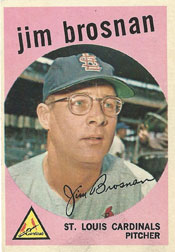
jim_brosnanBrosnan pitched for the Cardinals in 1958 and 1959 and wrote baseball books such as “The Long Season,” “Pennant Race” and “The Ted Simmons Story.”

“The Long Season” chronicled Brosnan’s 1959 season with the Cardinals and Reds. “Pennant Race” was a diary about Brosnan’s season with the 1961 National League champion Reds. Both books rank among the best and most influential written about baseball. Brosnan, nicknamed “Professor” during his playing days, wrote with sly wit and intelligence.

“The Ted Simmons Story,” written while the Hall of Fame catcher was at the height of his Cardinals career, was a perfect pairing of author and subject. Brosnan and Simmons were two of the smartest, original thinkers to play the game.

Scholar joins St. Louis

Acquired from the Cubs for shortstop Alvin Dark on May 20, 1958, Brosnan was a starting pitcher before being converted into a reliever by Cardinals manager Fred Hutchinson. In 12 starts for the 1958 Cardinals, Brosnan was 4-3 with a 4.50 ERA. In 21 relief appearances, he was 4-1 with seven saves and a 1.67 ERA. His overall numbers for the 1958 Cardinals: 8-4, 3.44 ERA in 33 games.

Oscar Kahan of The Sporting News wrote, “The scholarly, bespectacled right-hander … developed into one of the sharpest bullpen men in the National League.”

After the 1958 season, the Cardinals went on an exhibition tour of Japan. Brosnan filed articles about the trip for the St. Louis Post-Dispatch. In describing their arrival during a stopover in Hawaii, Brosnan wrote the team was greeted “by girls with leis who did their celebrated walk forward, placed the garlands around each blushing player’s neck and whispered ‘Aloha’ while nuzzling the right cheek.”

Aloha, Brosnan informed his St. Louis readers, “is used to say hello, to say goodbye and even just to be friendly when having nothing else to say.”

In “The Long Season,” Brosnan described how Cardinals teammates Don Blasingame and Joe Cunningham were out to “see everything and do everything” during the Japan trip.

“The Japanese bath is an unusual custom for an Occidental to enjoy, but it is an easy habit to get into,” Brosnan wrote. “If it’s not the first thing to do after you land in Japan, it may well be the last before you leave … Cunningham and Blasingame, in their anxiety to do the right thing by the Japanese as well as themselves, absorbed a maximum of Oriental culture on the last day and night of our stay in Tokyo. The rising sun found them padding quietly and contentedly through the lobby of the Imperial Hotel. Sleepless, perhaps, but loose as a goose, like they say.”

Columnist Red Smith described Brosnan the author as “provocative, blunt and highly entertaining. He writes well enough so he doesn’t have to rely on obscenity and scatology as a substitute for an ear for dialogue.”

St. Louis stumble

In 1959, Brosnan experienced a disastrous Opening Day against the Giants at St. Louis. With the Cardinals ahead, 4-3, manager Solly Hemus lifted starter Larry Jackson after seven innings and brought in Brosnan. The Giants scored twice against him in the eighth for a 5-4 lead.

In the bottom half of the inning, Alex Grammas had a RBI-single, tying the score at 5-5. Hemus could have removed Brosnan for a pinch-hitter, but allowed him to remain in the game to pitch the ninth.

Brosnan walked the leadoff batter and, one out later, Jackie Brandt hit a RBI-double. The Giants won, 6-5. Brosnan got the loss and was booed. Boxscore

In “The Long Season,” Brosnan wrote, “It doesn’t take very long, really, to lose your confidence. To embarrass yourself, jeopardize your position, maybe lose your job. Hemus went a long way with me. He could have taken me out. He should have taken me out.”

Heading to hometown

Brosnan allowed eight runs in six relief appearances from May 1 to May 10, 1959. In The Sporting News, Ralph Ray wrote, “From one of the best relief men in the NL a year ago … Brosnan turned into a dud as a fireman.”

Hoping a change in routine would help, Hemus gave Brosnan a start against the Phillies on June 7, 1959, at Philadelphia. It was a bust. Brosnan gave up four runs before he was yanked with one out in the first. The Phillies won, 11-9. Boxscore

The next day, back in St. Louis, Brosnan and his wife dined at Stan Musial’s restaurant. When they returned to the George Washington Hotel, where Brosnan resided during the season, a desk clerk called to Brosnan as he crossed the lobby.

“Solly Hemus was here just a while ago, Mr. Brosnan,” the clerk said. “He left this letter.”

Brosnan waited to open the envelope until he got to his room. The letter, from general manager Bing Devine, informed Brosnan he’d been traded to the Reds for pitcher Hal Jeffcoat. The date was June 8, 1959.

“I sat back on the couch, half-breathing as I waited for the indignation to flush good red blood to my head,” Brosnan wrote. “Nothing happened. I took a deep breath, then exhaled slowly. It’s true. The second time you’re sold you don’t feel a thing.”

Brosnan was 1-3 with two saves and a 4.91 ERA in 20 games for the 1959 Cardinals.

Born and raised in Cincinnati, he regained his form with the Reds and was reunited with Hutchinson, who became the Reds manager in July 1959. Brosnan was 10-4 with 16 saves and a 3.04 ERA in 53 appearances for the 1961 National League champion Reds.

In a nine-year major-league career with the Cubs, Cardinals, Reds and White Sox, Brosnan was 55-47 with 67 saves and a 3.54 ERA.
Read Full Post »

In his major-league debut, Cardinals reliever John Costello escaped an inherited bases-loaded jam, struck out the side in the next inning and earned the win.

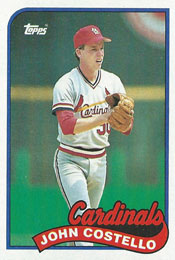
john_costelloTwenty-six years later, on June 16, 2014, Nick Greenwood became the first Cardinals reliever to earn a win in his major-league debut since Costello did so on June 2, 1988, at Philadelphia.

Costello and Greenwood achieved their feats under very different circumstances.

Greenwood, 26, a left-hander, relieved starter Carlos Martinez to begin the fifth inning with the Cardinals leading the Mets, 2-1, at St. Louis. Greenwood held the Mets to a run in 3.1 innings and the Cardinals won, 6-2. Greenwood got the win because Martinez didn’t pitch the necessary five innings for a starter to qualify for a win. Boxscore

Costello, 27, a right-hander, was brought in by manager Whitey Herzog to replace reliever Steve Peters with the score tied at 2-2 in the 13th inning at Philadelphia. The Phillies had the bases loaded and one out.

“I didn’t have much alternative,” Herzog told the St. Louis Post-Dispatch.

Tough spot

The Cardinals had used six pitchers in the game after also using six the night before in a 13-inning victory against the Astros at Houston.

Said Herzog: “That was a hell of a place to put him in.”

After Herzog handed the ball to Costello and left the mound, catcher Tony Pena began a conversation with the newcomer. According to the Post-Dispatch, the talk went like this:

Pena: “What you got?”

Costello: “I’ve got three pitches _ fastball, slider, changeup.”

Then Costello told Pena to forget about the latter two and just call for the fastball.

“When he started laughing,” Costello told United Press International, “that broke the nervousness.”

Costello had another reason to focus on fastballs. He was experiencing stiffness in his right shoulder. “But the adrenaline took over and took the pain away,” Costello told the Post-Dispatch.

The first batter he faced, Chris James, hit a short fly out to right and the runners held. The next batter, Mike Young, flied out to left, ending the threat.

Pressure no problem

In the 14th, Cardinals cleanup hitter Tom Brunansky walked, stole second and scored on a two-out infield single by Pena.

Costello, throwing fastballs only, struck out all three Phillies he faced in the bottom half of the inning (Bill Almon, Danny Clay, Juan Samuel), earning the win in the Cardinals’ 3-2 triumph. Boxscore

“If I can handle that pressure right there, I guess I can handle some more along the line,” Costello said to the Post-Dispatch.

Said Herzog: “He was sneaky (fast), the way they were swinging. We’ll put him back out there.”

Costello, chosen by St. Louis in the 24th round of the 1983 amateur draft, went on to have a spectacular rookie season for the 1988 Cardinals. He was 5-2 with a save and a 1.81 earned run average in 36 games.

In 1989, Costello followed up with a 5-4 record, 3 saves and a 3.32 ERA in 48 games.

On April 23, 1990, the Cardinals traded Costello to the Expos for utility player Rex Hudler. Costello finished his big-league career with the 1991 Padres. In four major-league seasons, Costello was 11-6 with 4 saves and a 2.97 ERA in 119 games.

Previously: How Jose Oquendo became a Cardinals catcher

Read Full Post »

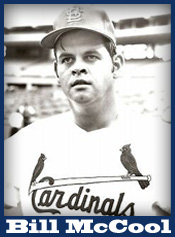
His name, perfect for a young, hard thrower, seemed the kind a novelist or screenwriter would conjure, but Billy McCool was real, a left-hander who broke into the majors with the Reds as a teenager and for two years was among the top relievers in the National League.

bill_mccoolThe Cardinals found McCool nearly untouchable in 1966, when he was a National League all-star.

McCool battled the Cardinals for six seasons, 1964-69. He pitched more innings and had more strikeouts versus the Cardinals than he did against any other big-league opponent.

In 1970, the Cardinals acquired McCool, 26, from the Padres, but his career had peaked. In 18 appearances for the 1970 Cardinals, he was 0-3 with a 6.23 ERA and a save.

Reds rookie

A standout athlete at Lawrenceburg, Ind., McCool was signed by the Reds as an amateur free agent in 1963. McCool, 19, made his big-league debut with the 1964 Reds and was a prominent pitcher for a club in the thick of a pennant race with the Cardinals and Phillies through the final day of the season.

McCool posted six wins and seven saves with a 2.42 ERA for the 1964 Reds. The Sporting News named him its National League Rookie Pitcher of the Year.

Against the Cardinals that season, McCool was 0-2 with a save in six appearances. On Sept. 19, the Reds beat Bob Gibson and the Cardinals in the first game of a doubleheader at Cincinnati. McCool got his first big-league start in the second game. Matched against Ray Sadecki, McCool was good, yielding two runs, striking out seven and issuing no walks in eight innings. Sadecki was better. He pitched eight scoreless innings and combined with Barney Schultz for the shutout in a 2-0 triumph for the Cardinals. Boxscore

After the season, McCool and his brother-in-law, a pharmacist, bought a drugstore in Lawrenceburg. Wrote The Sporting News: “Billy McCool not only throws aspirin tablets, he sells them.”

Billy the Kid

McCool sought a pay raise from the Reds for 1965. According to The Sporting News, contract talks between McCool and assistant general manager Phil Seghi included this exchange:

Seghi: “Billy, you’re just a kid yet. You’re asking for too much money.”

McCool: “If I’m only a kid, why do they give me a man’s job to do?”

Appearing in 62 games, including two starts, in 1965, McCool compiled nine wins and 21 saves for the Reds. He ranked second in the league in saves, behind the Cubs’ Ted Abernathy. McCool was 1-1 with four saves versus the Cardinals that season.

Used exclusively in relief in 1966, McCool had eight wins, 18 saves and a 2.48 ERA. He again ranked second in the league in saves, behind the Dodgers’ Phil Regan. In seven games against the 1966 Cardinals, McCool was 2-1 with three saves and a 1.04 ERA. He struck out 23 Cardinals in 17.1 innings and yielded two earned runs.

In the July 2, 1966, edition of The Sporting News, Mets second baseman Chuck Hiller said of McCool’s fastball, “It looks about the size of a Ping-Pong ball when it comes up to the plate.”

Said Mets third baseman and former Cardinals standout Ken Boyer: “That slider he’s throwing now is the best I’ve ever seen a left-hander have.”

McCool made 11 starts in 31 appearances in 1967 and four starts in 30 appearances in 1968.

Battles with Brock

He had two significant games against the 1968 Cardinals.

On April 23, 1968, the Reds led the Cardinals, 2-0, through eight innings at St. Louis. In the ninth, the Cardinals scored twice off starter George Culver, tying the score. In the 10th, Lou Brock hit a two-run walkoff home run against McCool, giving the Cardinals a 4-2 victory. Boxscore

Two months later, on June 14, McCool got a start at St. Louis. He held the Cardinals scoreless in six innings and limited them to two hits _ singles by Julian Javier and Tim McCarver _ and got the win in a 7-0 Reds triumph. Boxscore It was McCool’s last major-league win as a starter.

Brock hit .147, 5-for-34, with 12 strikeouts against McCool in his career. Another Cardinals hitter who struggled versus McCool was Mike Shannon. He hit .100, 2-for-20, with seven strikeouts. The Cardinals who hit McCool best: Javier at .400, 8-for-20, and Curt Flood at .292, 7-for-24.

The Reds made McCool, 24, available in the expansion draft after the 1968 season and he was selected by the Padres. In four appearances for the Padres against the 1969 Cardinals, McCool was 2-1 with a 4.15 ERA.

On Aug. 6, 1969, at San Diego, McCool relieved Clay Kirby in the ninth with the score tied at 2-2 and retired the Cardinals in order. When ex-Cardinal Ed Spiezio opened the Padres’ ninth with a home run off Steve Carlton, lifting San Diego to a 3-2 victory, McCool got the win, his last in the big leagues. Boxscore

Save for St. Louis

In April 1970, the Cardinals acquired McCool from the Padres for infielder Steve Huntz. After a stint at Class AAA Tulsa, McCool was promoted to the Cardinals in May.

In his third appearance, May 15, 1970, McCool earned a save with two scoreless innings in relief of Mike Torrez in a 1-0 victory over the Cubs at St. Louis. McCool retired Don Kessinger, Glenn Beckert and Billy Williams on ground balls in the eighth. In the ninth, after getting groundouts from Jim Hickman and Johnny Callison, McCool walked Ron Santo before retiring Cleo James on a fly ball. Boxscore

That was McCool’s highlight as a Cardinal. In July, he was demoted to Tulsa. After the season, the Cardinals traded him to the Red Sox for pitcher Bill Landis. McCool never returned to the major leagues.

In seven big-league seasons, he posted a 32-42 record with 58 saves and a 3.59 ERA. In 33 games against the Cardinals, McCool was 6-6 with eight saves, a 3.26 ERA and 68 strikeouts in 66.1 innings.

Previously: Cardinals vs. Reds: rich tradition of July 4 showdowns

Read Full Post »

After losing the first two games of the 1985 National League Championship Series, the Cardinals could have been fazed by the prospect of facing Dodgers pitcher Bob Welch in Game 3. Welch had produced two complete-game wins against St. Louis in the regular season. A loss to him in the third game of the postseason series would push the Cardinals to the brink of elimination.

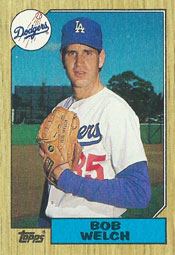
bob_welchInstead, it was Welch who was shaky.

Speedsters Vince Coleman and Willie McGee distracted a jumpy Welch and the Cardinals beat him, sparking a streak of four consecutive wins that propelled them into the World Series.

Welch was a premier pitcher for 17 years in the big leagues with the Dodgers and Athletics. He posted a career record of 211-146. In 1990, he was 27-6 with a 2.95 ERA and earned the American League Cy Young Award while pitching for the pennant-winning Athletics team of manager Tony La Russa and coach Dave Duncan.

In 1985, Welch was 14-4 with a 2.31 ERA in 23 starts for the Dodgers. He averaged less than two walks per nine innings.

The Cardinals, though, jolted Welch out of his comfort zone in the National League Championship Series.

Give the ump a mitt

In the first inning, Coleman lined a single over the head of third baseman Bill Madlock. With the count 1-and-0 on the next batter, McGee, the Dodgers pitched out, but Coleman swiped second anyway. Distracted by Coleman dancing off second, Welch walked McGee.

Tommy Herr came up next and worked the count full. Welch then whirled and attempted a pickoff of Coleman. The throw came closer to hitting umpire Paul Runge than it did to reaching the glove of shortstop Dave Anderson, covering second, and the ball sailed into center field. Coleman scored and McGee raced to third.

“I’m supposed to be able to make this play,” Welch said to the Daily Breeze of Torrance, Calif. “But for some reason I threw the ball to Runge. Too bad he didn’t have a mitt. He could have made the tag.”

Said Coleman to the Springfield (Ill.) State Journal-Register: “I was surprised he threw. The count was 3-and-2 and I wasn’t going to run until he threw to the plate.”

After walks to Herr and Andy Van Slyke, McGee scored on Terry Pendleton’s grounder to second, giving the Cardinals a 2-0 lead.

Sitting on the fastball

In the second inning, the Cardinals continued to apply pressure on Welch. With one out, Coleman singled. Catcher Mike Scioscia tried to pick off Coleman, but the throw eluded first baseman Greg Brock. Coleman advanced to third and scored on McGee’s single. After McGee was nailed attempting to swipe second, Herr smacked a Welch fastball over the right-field wall for a home run, putting the Cardinals ahead, 4-0.

“Welch kept throwing me fastballs,” Herr said to the Daily Breeze. “I fouled three of them off and I was sitting on the fastball when he threw the home run pitch.”

Said Welch: “I never got in a situation where I could use my curve ball. I never got in a situation where I was pitching, period. I just threw it up there.”

(Including the postseason, Herr batted .300 against Welch in his career, with 12 hits in 40 at-bats. Eleven of those hits were singles.)

Herr told the San Diego Union that the reason Welch beat the Cardinals twice during the 1985 regular season was because “he kept Coleman and McGee off base and was able to throw his breaking ball a lot. Today, he had to throw more fastballs with Vince and Willie on base.”

Welch was lifted after 2.2 innings. His line: 6 walks, 5 hits, 4 runs, 2 earned. Harried by the Cardinals, he’d made 20 pickoff throws.

“We weren’t trying to screw Welch up, even though that’s what happened,” said McGee.

Given the 4-0 lead, Cardinals starter Danny Cox and relievers Ricky Horton, Todd Worrell and Ken Dayley held the Dodgers to two runs. St. Louis won, 4-2. Boxscore

The Dodgers never recovered, losing the next three games, including Game 5 on the Ozzie Smith “Go crazy, folks” walkoff home run and Game 6 on Jack Clark’s ninth-inning three-run homer.

Welch finished his career with a 7-8 record and 3.99 ERA against the Cardinals in 18 regular-season appearances, including 15 starts.

Previously: How Bing Devine tried coaxing Kirk Gibson to Cardinals

Read Full Post »

(Updated June 6, 2020)

When news of the D-Day invasion of France by Allied Forces reached the United States that morning, most of Organized Baseball honored the solemn event by canceling the games scheduled for June 6, 1944, but the Cardinals chose to play an exhibition game.

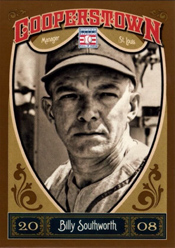
billy_southworth3On D-Day, the United States and its allies crossed the English Channel and launched an offensive that significantly helped lead to the defeat of Nazi Germany in World War II. More than 9,000 Allied soldiers died or were wounded in the effort.

Two National League games _ Phillies vs. Dodgers at Brooklyn and Reds vs. Pirates at Pittsburgh _ were scheduled for Tuesday, June 6, 1944. Both were called off in deference to the D-Day invasion. No American League games had been scheduled for that date.

In addition, four minor-league groups _ Appalachian League, American Association, Eastern League and International League _ called off all games on the June 6 schedule.

Because of the time difference between Europe and the United States, news of the invasion reached America in time for the ballgames that day to be canceled.

The Cardinals decided to honor their commitment to play an exhibition that night in Wilmington, Del., against the Wilmington Blue Rocks, a Phillies affiliate in the Inter-State League.

Long, winding road

It was part of a long, winding road trip for the two-time defending National League champions.

On May 26, 1944, the Cardinals embarked on a 17-game road swing that began in Brooklyn and took them to New York, Boston and Philadelphia before ending at Cincinnati on June 11.

After playing the Phillies at Philadelphia on June 4, the Cardinals weren’t scheduled to play their next regular-season game until June 8 at Cincinnati.

Rather than enjoy off-days, the Cardinals were scheduled to play an exhibition with their minor-league affiliate at Allentown, Pa., on June 5 before going to Wilmington for the June 6 exhibition versus the Blue Rocks.

In the June 5 exhibition at Allentown, the Cardinals put on a power display for the crowd of 3,091. Stan Musial and Danny Litwhiler each hit two home runs and Walker Cooper had one home run in the Cardinals’ 22-4 victory. Cardinals manager Billy Southworth started Freddy Schmidt, who pitched for Allentown in 1942, as a gesture to the local fans, The Sporting News reported. A total of 17 Cardinals played and the others rotated as base coaches so the fans could see all the big-league players.

Musial’s big night was extra special for the Allentown manager, Ollie Vanek, who as a scout had recommended the Cardinals sign Musial.

Down on the farm

The next day, while the nation was gripped by the news of the D-Day invasion, the Cardinals were in Delaware. The Blue Rocks selected a 6-foot-7 left-hander, George Michotte, 20, as their starting pitcher.

“Before the game, the members of both squads lined up on the foul lines and stood in silent prayer in respect of D-Day,” the Wilmington Morning News reported. “The players remained there during the playing of the National Anthem.”

Before a crowd of 3,668, the Cardinals did most of their damage in the seventh. With the score tied at 1-1, Marty Marion opened with a single and George Fallon, a second baseman who hit .199 that season, followed with a two-run home run to left off Michotte. After Johnny Hopp, batting for pitcher Ted Wilks, walked, Augie Bergamo tripled, scoring pitcher Harry Brecheen, who was running for Hopp.

After the Phillies farmhands batted in their half of the seventh, the game was halted by rain.

The 4-1 victory came at a cost to the Cardinals. Third baseman Whitey Kurowski injured his leg and missed the next two regular-season games.

The Cardinals were supposed to leave Philadelphia by train for Cincinnati on June 7, but Leo Ward, Cardinals traveling secretary, could get accommodations for only 14. Southworth and the Cardinals starting players, including pitcher Max Lanier, who was scheduled to start the June 8 game at Cincinnati, boarded the train. The rest of the team waited for another train, which departed Philadelphia at 1:08 a.m. on June 8, and arrived in Cincinnati less than three hours before game time, The Sporting News reported.

The weary Cardinals lost that June 8 game against the Reds by a 2-1 score, but won the remaining three games of the series, including an 18-0 shellacking in a game that featured the big-league debut of 15-year-old Reds pitcher Joe Nuxhall. Boxscore

The Cardinals won 11 of the 17 regular-season games on the trip and went home with a 32-16 record. Having survived their odyssey, they went on to clinch their third consecutive National League pennant.

Previously: How a B-17 nearly clipped Cardinals in World Series

Read Full Post »

(Updated May 15, 2020)

Three factors combined to make the last home run of Joaquin Andujar’s career both special and unconventional: It was a grand slam, he called the shot and the Cardinals pitcher, a right-hander, hit it left-handed.

joaquin_andujar5On May 15, 1984, Andujar pitched a complete game and slugged the fifth and final home run of his big-league career in the Cardinals’ 9-1 victory over the Braves at St. Louis.

In the eighth inning, the Cardinals led, 5-1, and had Andy Van Slyke on third and Ozzie Smith on second with two outs and catcher Tom Nieto at bat. The Braves opted to walk Nieto intentionally, loading the bases.

As reliever Jeff Dedmon delivered the mandatory four pitches outside the strike zone to Nieto, Andujar, waiting at the on-deck circle, pointed to the right-field wall.

“I told (teammates) George (Hendrick) and Tito (Landrum) that I was going to hit a home run,” Andujar told The Sporting News.

Smith, watching from second base, confirmed to the St. Louis Post-Dispatch he saw Andujar call his shot. “He pointed while he was in the on-deck circle and said he was going to do it,” Smith said. “Can you believe that?”

Said Andujar to the Atlanta Constitution: “Everyone knows that I’m strong.”

Special formula

Leaving the on-deck circle, Andujar strode toward the plate and settled into the left side of the batter’s box.

His first four major-league home runs had been hit right-handed. Andujar hit three homers _ off Bill Lee of the Expos, Steve Rogers of the Expos and Rick Wise of the Padres _ with the Astros. The fourth was hit for the Cardinals, again off the Expos’ Rogers, on April 27, 1984, at Montreal.

A career .127 hitter in his 13 major-league seasons, Andujar used a personal formula to determine whether he would bat right-handed or left-handed. He usually opted for the left side when facing a right-hander (such as Dedmon) with runners in scoring position, according to St. Louis reporter Rick Hummel.

Watching from the dugout, Cardinals manager Whitey Herzog never knew what side of the batter’s box Andujar would choose. “What the hell do I know?” Herzog said to The Sporting News. “I’m only the manager.”

Sultan of Swat

With the bases loaded, “I knew they’d have to pitch to me,” Andujar told the Associated Press.

Andujar dug in and waited for a pitch in the strike zone.

Dedmon delivered.

“It was right down the middle,” said Braves manager Joe Torre.

Andujar uncoiled what the Atlanta Constitution described as “his left-handed going deep swing” and hit the ball to where he had pointed _ over the right-field wall _ for his lone grand slam and his only home run struck left-handed. Boxscore and Audio

“Every day, I hit five or six home runs in batting practice,” Andujar told The Sporting News. “I know I’m not a good hitter. I know I’m a lousy hitter. But … if I make contact, it’s gone.”

Previously: Cardinals pitchers enjoy grand slam streak

Read Full Post »

« Newer Posts - Older Posts »