Feeds:
Posts
Comments

Archive for the ‘Pitchers’ Category

(Updated Sept. 27, 2019)

In late September 1964 the Cardinals were five games behind the first-place Phillies entering a five-game series against the Pirates at Pittsburgh.
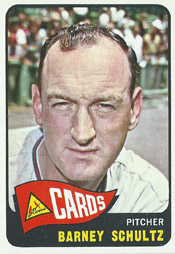
barney_schultzWith 11 games remaining in the regular season, Cardinals outfielder Bob Skinner said to teammate Dick Groat, “OK, Dick, the only thing we have to do is sweep the Pirates in five,” according to the book “October 1964.”

Skinner and Groat, both former Pirates, knew how unlikely it was for any club to accomplish such a task at Pittsburgh.

However, the Cardinals won both games of a doubleheader versus the Pirates on Sept. 24 and followed that with wins at Pittsburgh on Sept. 25 and Sept. 26.

In the series finale, played in a light rain on Sept. 27, 1964, the Cardinals started Roger Craig, who’d lost four consecutive decisions.

Craig delivered a stellar start, holding the Pirates scoreless and limiting them to six singles through 7.2 innings.

Save for Schultz

In the eighth, with the Cardinals ahead, 3-0, the Pirates had runners on first and second, two outs, when Cardinals manager Johnny Keane brought in knuckleball specialist Barney Schultz to face Roberto Clemente, who represented the tying run.

The odds seemed stacked in favor of Clemente, who hit .361 with runners in scoring position in 1964, but Schultz struck him out. Throwing nothing but knucklers, Schultz got Clemente to lunge for one and miss on a 2-and-2 count.

The Cardinals scored twice in the ninth and Schultz retired the Pirates in order in the bottom half of the inning, preserving a 5-0 St. Louis victory. Boxscore

In sweeping the five games at Pittsburgh, the Cardinals played nearly flawless baseball, committing one error and holding the Pirates to eight total runs.

“That was a disgrace in Pittsburgh,” Phillies scout Don Hoak, a former Pirates third baseman, said to Groat. “They just handed you five games.”

Groat replied, “You forgot to mention the most important thing about those five games _ that we didn’t make a single mistake in all five of them.”

Pennant push

The sweep moved the Cardinals 1.5 games behind the Reds, who had gone into first place as the fading Phillies lost their seventh in a row.

Pirates manager Danny Murtaugh said the Cardinals “looked like they mean business. They’re putting everything together,” the Pittsburgh Press reported.

Arriving at the St. Louis airport after their flight from Pittsburgh, the Cardinals were greeted by an adoring crowd of at least 8,000, The Sporting News reported.

“The adrenaline was flowing,” Cardinals outfielder Carl Warwick said to Peter Golenbock in the book “Spirit of St. Louis.” “All of a sudden you’re saying, ‘We’re not out of this thing.’ ”

Craig told the St. Louis Post-Dispatch, “Our guys believe they can win. They know we have the best club in the league.”

Finishing the season in St. Louis, the Cardinals won four of their last six against the Phillies and Mets, winning the pennant by a game over both the Phillies and Reds.

Previously: Why Gussie Busch fired Bing Devine in championship year
 

Read Full Post »

(Updated Jan. 8, 2019)

Three years after he left the Busch Stadium mound with his pitching career spiraling out of control, Rick Ankiel returned to St. Louis as a confident Cardinals reliever embraced by the fans.

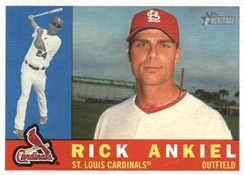
rick_ankiel6On Sept. 19, 2004, Ankiel made his first Busch Stadium appearance since 2001 and pitched two hitless innings against the Diamondbacks, departing to a standing ovation.

In his previous home appearance, on May 10, 2001, Ankiel regressed against the Pirates, yielding three runs, three hits, five walks and two wild pitches in three innings, departing with his head down and bolting the ballpark without talking with reporters. Boxscore

After that debacle, Ankiel went to the minor leagues and pitched there for the remainder of 2001. After sitting out the 2002 season because of a left elbow sprain, Ankiel pitched in the minors in 2003 until undergoing left elbow surgery in July.

Ankiel spent most of the 2004 season on the disabled list, returned to the minors in August that summer and was called up by the Cardinals in September. Ankiel made a pair of scoreless one-inning stints at San Diego against the Padres and at Los Angeles against the Dodgers.

Welcome home

On Sept. 19, 2004, a Sunday afternoon at Busch Stadium, Ankiel relieved starter Jeff Suppan to start the fifth inning. As he walked to the mound, Ankiel tipped his cap to an appreciative crowd of 41,279.

“You walk out there with the electricity of the crowd and you feel like you’re floating,” Ankiel said to the St. Louis Post-Dispatch. “It’s pretty indescribable.”

Mixing a 91 mph fastball with a 66 mph curve, Ankiel faced three batters _ Luis Terrero, Alex Cintron and Danny Bautista _ in the fifth and struck out all three.

“His fastball was running and sinking hard,” Cintron said to the Post-Dispatch. “His curveball _ I’ve never faced anything like it in my life. He’s the Rick Ankiel everyone expected him to be.’

Facing Ankiel in the sixth, Shea Hillenbrand grounded out, Chad Tracy walked, Chris Snyder struck out and Doug DeVore lined out to right. “He was tricky,” Snyder said to the Belleville (Ill.) News-Democrat. “He was pretty deceptive. He had a good fastball and a good snap to his curveball.”

Said Cardinals catcher Mike Matheny: “He’s got good tempo … That curve’s amazing. You can hear it spinning all the way up there.”

Walking off the mound, Ankiel again tipped his cap to a standing ovation.

“Unbelievable … I was pretty much in the sky,” Ankiel said to the News-Democrat. Boxscore

Years later, in his 2017 book “The Phenom,” Ankiel said, “My fastball wasn’t what it was. That was by choice. It was more reliable at 89 mph or 90, at less than full effort, than it would be at 95. My career would have to be about control. I’d control my mind, which would settle my heart, and control my effort, which would guide my fastball.”

Last hurrah

In his next appearance, at Colorado, Ankiel yielded five runs in two innings. He rebounded five days later, on Oct. 1, in limiting the Brewers to a run in four innings and earning a win. Boxscore

“What became important was winning the game around the game, the one in my head,” Ankiel said in his book.

It would be Ankiel’s final big-league game as a pitcher.

In 2005, Ankiel declared he would convert into an outfielder and abandon his pitching career.

In 2007, Ankiel returned to the Cardinals and spent seven seasons in the big leagues as a power-hitting and strong-armed outfielder.

Previously: Rick Ankiel joins Babe Ruth, Joe Wood in postseason lore

Read Full Post »

(Updated Feb. 3, 2019)

No National League night game has gone more innings than the one played by the Cardinals and Mets on Sept. 11-12, 1974.

bake_mcbride2Beginning at 8:08 p.m. on Sept. 11 and ending at 3:15 a.m. on Sept, 12, the Cardinals beat the Mets, 4-3, in 25 innings at New York’s Shea Stadium. Started before a crowd of 13,460, it ended before about 1,000 spectators, including baseball commissioner Bowie Kuhn.

The Cardinals-Mets marathon remains the longest National League night game in innings played.

In the longest major-league game by innings, the Dodgers and Braves played to a 1-1 tie in 26 innings on May 1, 1920. That National League game was played on a Saturday afternoon at Braves Field in Boston. Boxscore

Only one 25-inning game has been played in the major leagues since the Cardinals-Mets classic in 1974. In an American League game, the White Sox, managed by Tony La Russa, beat the Brewers, 7-6, in 25 innings at Chicago’s Comiskey Park. That night game began on May 8, 1984, was suspended after 17 innings with the score tied at 3-3 and completed on May 9. Boxscore

With no National League curfew, the Cardinals and Mets played their 25-inning game without a stop in play.

When it ended, Cardinals outfielder Reggie Smith told his teammates, “There’s no way that your wives are going to believe you guys were out playing baseball all night.”

Reitz to the rescue

The Cardinals trailed, 3-1, entering the ninth. After Joe Torre struck out, Ted Simmons singled and was replaced by pinch-runner Larry Herndon. Herndon went to second on a wild pitch by starter Jerry Koosman, but Bake McBride struck out.

With the Mets an out away from victory, the Cardinals’ last hope, Ken Reitz, hit a two-run home run, tying the score at 3-3.

“I was looking for a fastball, a strike, and I got it,” Reitz said to the St. Louis Post-Dispatch.

Cardinals reliever Claude Osteen, who had a clear view of the home run from his perch in the bullpen, held his hands less than a foot apart when he told United Press International the ball “went out by about that much.”

Scoreless relief

For the next 15 innings, Cardinals and Mets relievers threw shutouts.

Al Hrabosky, Rich Folkers, Ray Bare, Osteen and Sonny Siebert were the Cardinals relievers who stopped the Mets in extra innings. Osteen pitched 9.1 innings _ the equivalent of a complete-game shutout.

A pair of former Cardinals, Harry Parker and Bob Miller, joined Bob Apodaca and Jerry Cram as the Mets relievers who stopped the Cardinals. Cram pitched eight innings.

They escaped several jams.

_ Torre was out at the plate trying to score on a single by McBride in the 13th.

_ In the 20th, the Cardinals had runners on first and second, no outs, but Smith was picked off at second and the threat fizzled.

_ In the 23rd, the Mets loaded the bases with two outs before Cleon Jones flied out.

_ Both teams loaded the bases with two outs in the 24th but failed to score.

Bake was cooking

Hank Webb relieved Cram in the 25th inning. McBride led off with an infield single and Reitz was up next.

Cardinals manager Red Schoendienst gave the hit-and-run sign. Webb made a pickoff throw, but it sailed over first baseman John Milner and rolled into foul territory in right field.

“I figured I could get to third,” McBride told the Associated Press. “Then, when I turned second, I said to myself, ‘I’m going all the way.’ ”

McBride raced around third without looking toward coach Vern Benson, who was showing the stop sign. “I didn’t see any sense in sending him home with nobody out,” Benson said.

Milner retrieved the ball and fired a throw to catcher Ron Hodges. McBride and the ball arrived at the plate about the same time. Hodges dropped the ball before he could attempt a tag.

“I don’t think he would have had me, even if he had held the ball,” McBride said. “He was out in front of the plate and I was past him.”

Benson saw it differently. “It was a good throw by Milner, and Hodges probably would have got McBride if he hadn’t taken his eyes off the ball,” Benson said.

The Cardinals led, 4-3, but the Mets still had their turn to bat.

Happy ending

Siebert retired the first two batters, Ken Boswell and Felix Millan, on fly outs.

Brock Pemberton, appearing in his second big-league game, batted for Webb and singled, prolonging the drama with his first big-league hit. When the ball was removed from the game so Pemberton would have a keepsake, Mets pitcher Tom Seaver quipped from the dugout, “Don’t give it to him. It’s the last ball we’ve got left.” (Fifteen dozen balls were used in the game, The Sporting News reported.)

Milner, the Mets’ top home run hitter, batted next.

Siebert struck him out, ending the game at 7 hours, 4 minutes. Boxscore

Dizzying stats

The Cardinals used 26 players and the Mets, 24. The Cardinals stranded 20 base runners and the Mets, 25.

Nine players played the entire game. They were McBride, Reitz, Smith, Torre and Ted Sizemore for the Cardinals; Millan, Milner, Wayne Garrett and Dave Schneck for the Mets.

“Ordinarily, I get two hits and it’s a decent night, but 2-for-11?” Schneck said to the New York Daily News.

McBride, Reitz and Millan each had four hits in 10 at-bats. Garrett was 0-for-10 with four strikeouts. Lou Brock, the Cardinals’ future Hall of Famer, was 1-for-9 and was caught stealing in his lone attempt.

The home plate umpire, Ed Sudol, also had worked the plate in a 23-inning game between the Mets and Giants in 1964 and a 24-inning game between the Mets and Astros in 1968.

“My legs feel like a couple of lead posts,” Sudol said.

Asked to sum up the long night, Mets pitcher Tug McGraw said, “The only thing I regret now is that all the eating places are closed. I’ll have to go home and make myself a baloney sandwich.”

Previously: Reggie Smith and the Cardinals’ after-hours club

Read Full Post »

In a performance as remarkable as it was messy, Al Hrabosky and the Cardinals turned the last home game of the 1974 season into a classic.

al_hrabosky2On Sept. 25, 1974, Hrabosky struck out nine in 6.1 innings against the Pirates at St. Louis.

Hrabosky’s relief effort was among many unusual feats in a 13-12 victory that gave the Cardinals an edge in their pursuit of a National League East Division title.

“Never in my life have I seen a game like that,” Cardinals first baseman Joe Torre told the Alton (Ill.) Telegraph.

Battle for first

The Cardinals entered the game that Wednesday night trailing the first-place Pirates by a half-game with a week remaining in the season.

Rookie right-hander Bob Forsch, who started for the Cardinals, gave up five runs in the first inning before being yanked.

Because the Pirates had stacked their lineup with left-handed batters  _ Richie Hebner, Al Oliver, Willie Stargell, Dave Parker and Ed Kirkpatrick _ Cardinals manager Red Schoendienst went with left-handed relievers. First, he used Rich Folkers. Then, Claude Osteen.

The Cardinals rallied for six runs in the third off Ken Brett and Larry Demery.

In the fifth, the Pirates got a run against Osteen, tying the score at 6-6. The Pirates had runners on first and second with no outs when Schoendienst replaced Osteen with his third left-handed reliever, Hrabosky.

Decent curve

Hrabosky got the Cardinals out of that jam without either runner scoring. In the bottom of the fifth, the Cardinals scored three, taking a 9-6 lead.

The Pirates scored twice off Hrabosky in the sixth. Entering the ninth, the Cardinals clung to a 9-8 lead.

Hrabosky struck out Stargell, but hit Parker with a pitch. Manny Sanguillen singled and, when center fielder Bake McBride made an error on the play, Parker raced home, tying the score at 9-9.

“I was discouraged because the club had given me a three-run lead and I couldn’t hold it,” Hrabosky said. “I didn’t feel like I had a good fastball, but I did have a decent curve.”

Hrabosky struck out at least one batter in each of the seven innings he worked.

In the 11th, he began to falter. “I was tired and the Pirates didn’t help it,” Hrabosky said. “They took the rest of the life I had left.”

Hrabosky gave up three runs on three singles and a double before he was relieved by Mike Garman with one out in the 11th. Hrabosky’s line: 6.1 innings, 6 runs, 10 hits, 0 walks, 9 strikeouts. The innings, runs, hits and strikeouts are single-game highs for Hrabosky in his 13-year big-league career.

Garman retired the two batters he faced, but the Pirates led, 12-9.

“We knew where we were at and it was now or never for us,” Torre said.

Rally time

The Pirates had used five pitchers, including their two best relievers, Dave Giusti and Ramon Hernandez. Pirates manager Danny Murtaugh brought in rookie Juan Jimenez to nail down the win.

“It was a kid pitching out there and he wanted to throw strikes,” Torre said. “When he couldn’t, he started to aim the ball.”

Ted Sizemore led off with a single. Reggie Smith walked. Ted Simmons was up next.

“I figured if he walked Smith I was going to swing at the first pitch in the strike zone,” Simmons said.

Simmons launched a double to right, scoring Sizemore and cutting the Pirates lead to 12-10.

Pirates unravel

Murtaugh lifted Jimenez and replaced him with another rookie, Jim Minshall. The first batter he faced was Torre.

“I wanted to hit the ball the other way to at least score Smith (from third) and get Simmons to third base,” Torre said.

Torre hit a broken-bat grounder to the right of second base. Rennie Stennett, the second baseman, fielded the ball, but his throw to first was wild. Smith and Simmons scampered home, tying the score at 12-12, and Torre advanced to second. Larry Herndon pinch-ran for Torre.

McBride bunted for a single and Herndon moved to third. Ken Reitz struck out _ the first out of the inning.

Due to bat was Jack Heidemann, a light-hitting shortstop. Schoendienst sent Jim Dwyer, a reserve outfielder batting .282, to pinch-hit.

Dwyer lifted a sacrifice fly, scoring Herndon from third with the winning run.

Said Dwyer: ” I was on the spot … That is my biggest contribution to the team this season.”

Down the stretch

Steve Porter, covering the game for the Alton Telegraph wrote, “It was more than just a baseball game … It was a whole season unfolding over 11 innings and a pennant race hanging in the balance for one inning.” Boxscore

The improbable four-run uprising gave the Cardinals a 13-12 victory and propelled them into first place.

The Cardinals would win three of their next five. The Pirates, though, would win five of their next six.

On Oct. 2, the final day of the season, the Pirates held a one-game lead over the Cardinals. To finish in a tie and force a playoff, the Cardinals needed to beat the Expos that day and the Cubs needed to beat the Pirates.

Instead, the Pirates beat the Cubs, 5-4, in 10 innings. The Cardinals-Expos game was called off because of rain and wasn’t rescheduled. The Pirates were NL East champions, finishing 1.5 games ahead of the Cardinals.

Read Full Post »

For one night, at least, amid the excitement of a pennant chase, John Curtis showed the Cardinals a flash of the talent they’d expected when they acquired him as the key player in a trade with the Red Sox.

john_curtisOn Aug. 29, 1974, Curtis delivered the best performance of his Cardinals career, pitching a one-hitter in St. Louis’ 3-1 victory over the Padres at San Diego.

The win moved the Cardinals within a half-game of the first-place Pirates in the National League East with a month remaining and raised hopes St. Louis would earn its first postseason berth in six years.

Seeking a southpaw

Curtis, a left-hander, earned 13 wins with the 1973 Red Sox. That impressed the Cardinals and in December 1973 they acquired Curtis and pitchers Lynn McGlothen and Mike Garman from the Red Sox for pitchers Reggie Cleveland and Diego Segui and infielder Terry Hughes.

Curtis appealed to the Cardinals as a left-handed starter who might silence the bats of premium left-handed batters within the division such as the Pirates’ Willie Stargell, Dave Parker, Al Oliver and the Mets’ Rusty Staub and John Milner.

“We needed a left-hander badly,” Cardinals manager Red Schoendienst said to the Associated Press. “I think we’ve got him now.”

Said St. Louis general manager Bing Devine: “A left-hander was of prime importance.”

The Cardinals entered 1974 with a rotation of Bob Gibson, Curtis, Alan Foster, McGlothen and Sonny Siebert.

Curtis, the lone left-hander, got off to a terrible start, losing five of his first seven decisions as his ERA swelled to 5.83, but Schoendienst kept him in the rotation.

Almost perfect

On Aug. 29, a Thursday night, before 6,042 spectators, Curtis got the start against the hapless Padres, who had the worst record in the National League and would finish with 102 losses.

The Padres did have a couple of sluggers who batted right-handed _ Nate Colbert and Dave Winfield, who was in his second season of what would become a Hall of Fame career.

Curtis retired the first 21 batters in a row. Seven perfect innings. Ted Simmons, catching Curtis, hit a home run in the seventh, breaking a scoreless tie.

Winfield, who two months earlier had hit a home run off Curtis for the lone run in a 1-0 Padres victory, led off the bottom of the eighth and watched the first three pitches sail out of the strike zone.

“He’s a pretty free swinger,” Curtis said. “Maybe I was a little too careful.”

Winfield walked, “but that didn’t concern me too much,” Curtis said.

Cito Gaston bunted, moving Winfield to second. Derrel Thomas walked and Dave Hilton flied out to right, advancing Winfield to third.

With two outs and two on, Fred Kendall, who hadn’t gotten a hit in a week, singled to left, breaking up the no-hitter and scoring Winfield with the tying run.

Win first

“When Kendall got his hit, I wasn’t too let down,” Curtis said. “It was a sort of purpose pitch inside. I was trying to make him swing at a bad pitch.”

Curtis’ work wasn’t done. With Thomas on second and Kendall on first, left-handed slugger Willie McCovey was sent to bat for pitcher Randy Jones. McCovey, a future Hall of Famer, flied out to center.

In the ninth, after Padres reliever Larry Hardy retired the first two batters, the Cardinals got four consecutive singles from Bake McBride, Ken Reitz, Jim Dwyer and Mike Tyson _ the latter two driving in a run apiece.

With a 3-1 lead, Curtis set down the Padres in order in the last half of the ninth, clinching the win and a one-hitter. Boxscore

“I had a ballgame to win, not a no-hitter to pitch,” Curtis said. “The way the season has been going for me, you can’t be too selective of your victories. It’s quite a thrill for me and it comes late in a year when we’re battling for something. That’s an added thrill.”

The Cardinals would finish in second place, 1.5 games behind the Pirates. Curtis was 10-14 in his first year with the Cardinals and led the club in losses. He posted records of 8-9 in 1975 and 6-11 in 1976 before the Cardinals traded him to the Giants.

In 109 games, including 62 starts, Curtis was 24-34 with a 3.88 ERA for the Cardinals.

Previously: Randy Jones held Cardinals to a single in 10 innings

Read Full Post »

Dennis Eckersley and Jason Isringhausen, the closers who contributed the most to helping Tony La Russa earn election to the National Baseball Hall of Fame, also played prominent roles in his first win as Cardinals manager.

dennis_eckersley2The Cardinals beat the Mets, 5-3, in New York on April 3, 1996, in La Russa’s second game as Cardinals manager. Eckersley earned a tension-filled four-out save. Isringhausen was the opposing starter, facing the Cardinals for the first time in his career.

The win was the first of a franchise-record 1,408 for La Russa in 16 years as Cardinals manager.

After successful stints managing the White Sox and Athletics, La Russa secured his Hall of Fame status with his Cardinals career. He joined another Hall of Famer, Billy Southworth, as the only managers to win two World Series titles with the Cardinals. On July 27, 2014, La Russa and another former Cardinals manager, Joe Torre, were inducted into the Hall of Fame at Cooperstown, N.Y.

Converted starters

At Oakland, La Russa and pitching coach Dave Duncan converted a reluctant Eckersley from a starter into a closer. The move transformed Eckersley into a Hall of Fame pitcher. He earned 386 of his 390 saves with La Russa as manager _ 320 in nine years with the Athletics and 66 in two years with the Cardinals.

Isringhausen, who also successfully converted from starter to closer, joined the Cardinals in 2002. Pitching for La Russa and Duncan, Isringhausen compiled a franchise-record 217 saves in seven seasons with the Cardinals and finished his big-league career with 300 saves.

After La Russa left the Athletics to become manager of the 1996 Cardinals, Eckersley was acquired in a trade for pitcher Steve Montgomery and, at 41, became the St. Louis closer.

On April 1, 1996, in La Russa’s debut as Cardinals manager, the Mets overcame a four-run deficit and won, 7-6. Eckersley didn’t appear in that game. Boxscore

Seeking a win

Isringhausen, 23, got the start for the Mets in the season’s second game. He was 9-2 as a Mets rookie in 1995. A native of Brighton, Ill., near St. Louis, Isringhausen acknowledged that facing the Cardinals was special. “I had more butterflies (than usual),” Isringhausen said to the St. Louis Post-Dispatch.

Isringhausen pitched six innings, yielding three runs to the Cardinals. He was lifted for a pinch-hitter, with the Cardinals leading, 3-0. Bernard Gilkey, a former Cardinal, clubbed a three-run home run off starter Todd Stottlemyre in the bottom of the sixth, tying the score at 3-3.

The Cardinals scored a run in the seventh off Robert Person and another run in the eighth against Jerry DiPoto, taking a 5-3 lead. In the bottom of the eighth, the Mets had runners on first and second with two outs when La Russa replaced Stottlemyre with Eckersley.

“No matter how much experience you have, you’re a little uptight when you come into the game,” Eckersley said to the Post-Dispatch. “I felt very uncomfortable, like I’d never been in a game before.”

Solid swing

The first batter Eckersley faced in his Cardinals debut was Butch Huskey, the Mets’ cleanup batter.

With the count 1-and-2, Eckersley threw a fastball. Huskey swung and launched a drive toward center field. He knew he had made solid contact. “I thought it had a chance to go (over the wall),” Huskey said to the New York Daily News.

Center fielder Ray Lankford raced toward the wall while tracking the path of the ball. “I thought I could tell by the look on (Lankford’s) face that he was going to catch it,” Eckersley said.

The ball carried farther than Eckersley thought. As Lankford neared the 396-foot sign, he leaped, extended his glove and caught the ball, ending the inning and preserving the lead.

“Most definitely, I was robbed,” Huskey told the Post-Dispatch. “The ball jumped off my bat. I thought it was going out.”

In the bottom of the ninth, with the Cardinals still ahead by two, Eckersley retired the first two batters before Jose Vizcaino and Kevin Roberson each singled. Edgardo Alfonzo was up next, representing the potential winning run. Eckersley struck him out, earning his first National League save and preserving La Russa’s first National League win.

“In this league, it’s hard to get a hit or a save or a win,” La Russa said. “I don’t think there are any ugly ones.” Boxscore


Read Full Post »

« Newer Posts - Older Posts »