Feeds:
Posts
Comments

Archive for the ‘Pitchers’ Category

(Updated Sept. 20, 2022)

Embarrassed by their inability to stop the Dodgers from stealing bases and convinced they needed to find a solution in order to win a pennant, the 1964 Cardinals turned to an unlikely source for help: Bob Uecker.
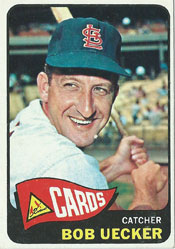
bob_uecker2The second-string catcher couldn’t slow Dodgers speedsters, but he did provide a defensive upgrade to a 1964 Cardinals club that won its first pennant and World Series title in 18 years.

On April 9, 1964, St. Louis sent Gary Kolb and Jim Coker to the Braves for Uecker.

Even then, at age 29, well before he became known as a broadcaster and for his comedy roles on television and in the movies, Uecker had a reputation throughout baseball as a funnyman.

Wrote The Sporting News: “Those who know him regard new Cardinals catcher Bob Uecker as a good-humor man.”

“Yes, I guess you can call me a stand-up type of comic,” Uecker said to St. Louis reporter Jack Herman.

The Cardinals, though, were serious about finding a way to overtake the Dodgers.

Armed for defense

In 1963, the Cardinals finished in second place at 93-69, six games behind the National League champion Dodgers. The Cardinals were 6-12 against the Dodgers and stolen bases were a significant reason for that. The Dodgers were successful on 27 of 33 stolen base attempts (82 percent) against the 1963 Cardinals. For the second season in a row, Dodgers speedster Maury Wills had 11 steals in 12 attempts versus the Cardinals.

“If we have a catcher who can throw well, they might think twice about running,” Cardinals manager Johnny Keane said.

Tim McCarver became the starting catcher for the Cardinals after Gene Oliver was traded to the Braves in June 1963 and his primary backup was Carl Sawatski.

McCarver nailed 38 percent of runners (28 of 73) attempting to steal in 1963 and Sawatski nabbed 30 percent (7 of 23). When Sawatski retired after the 1963 season, the Cardinals went looking for a backup for McCarver.

Uecker spent seven seasons in the Braves’ minor-league system. The Braves had groomed Joe Torre to replace veteran Del Crandall as their starting catcher.

In stints with the 1962 and 1963 Braves, Uecker impressed with his arm. He caught 5 of 7 runners attempting to steal in 1962 and 1 of 2 in 1963.

Office politics

Cardinals general manager Bing Devine was ready to make the trade for Uecker, but club consultant Branch Rickey opposed it, in part, because he didn’t want Gary Kolb to be dealt. Rickey had the support of Cardinals owner Gussie Busch and that gave him a voice in any proposed trade.

In his book “October 1964,” author David Halberstam wrote, “As both Keane and Devine pushed hard for the trade, Rickey resisted with a vehemence out of all proportion to the importance of the players at stake.”

As spring training neared its end, Keane asked Devine to make another attempt for Uecker.

“I’m sorry, Johnny, but I can’t go back there anymore,” Devine replied. “I’ve gone as far as i can go on that one.”

According to Halberstam, Devine suggested that Keane could approach Busch and appeal to him to approve the deal. Keane did and Busch granted his permission.

“We got Uecker to help Timmy and make our catching solid,” Keane said. “We’re certainly not vulnerable behind the plate anymore.”

In Uecker’s 1982 book “Catcher in the Wry,” McCarver said, “Uke really did have some talent. The first thing you looked at was his defensive ability _ his throwing arm and glove. I envied his arm (and) his relaxed, quick hands.”

On his first day with the Cardinals, Uecker was introduced to Rickey. According to Halberstam, Uecker extended his hand and said, “Mr. Rickey, I’m Bob Uecker, and I’ve just joined your club.”

“Yes, I know,” Rickey replied, “and I didn’t want you. I wouldn’t trade 100 Bob Ueckers for one Gary Kolb.”

Then Rickey turned and walked away.

Tough test

The 1964 Cardinals opened the season against the Dodgers at Los Angeles. With left-hander Sandy Koufax starting, Keane put Uecker, a right-handed batter, in the Opening Day lineup. (Uecker, the prankster, posed in a left-handed batting stance for his 1965 Topps baseball card.)

Uecker went 0-for-2 at the plate and 0-for-3 in attempting to prevent stolen bases that night. Willie Davis, Maury Wills and Jim Gilliam swiped bases against Uecker and starting pitcher Ernie Broglio.

“Uecker’s arm was not at fault,” The Sporting News reported. “The Dodgers speedsters just got too much of a jump on Ernie Broglio and the catcher’s strong throws were a little too late.” Boxscore

For the season, the 1964 Dodgers had 11 steals in 14 attempts (78 percent) against the Cardinals, but on July 16, 1964, Wills twice was caught attempting to steal against the Cardinals at St. Louis. McCarver was the catcher. Ray Sadecki was pitching the first time Wills was caught; Mike Cuellar was on the mound the second time. Boxscore

Overall, Uecker threw out 38 percent (8 of 21) of all attempted base stealers in 1964. He was 0-for-5 against the Dodgers; 8-for-16 against the rest of the National League. He hit .198, but his defense and his clubhouse popularity enabled him to stick with the Cardinals throughout the season.

The Phillies and Reds turned out to be the Cardinals’ main competition for the crown. Each finished a game behind St. Louis. The Dodgers were 80-82, in sixth place, 13 games behind the Cardinals.
Read Full Post »

(Updated Jan. 19, 2026)

Facing the defending World Series champion Pirates, Cardinals starter Pete Vuckovich performed a high-wire act in the 1980 season opener.

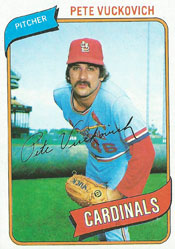
pete_vukovichVuckovich pitched a three-hit shutout in the Cardinals’ 1-0 victory on April 10, 1980, at St. Louis. It was the first of only two times the Cardinals won a season opener by a score of 1-0. The second occurred March 31, 2014, against the Reds at Cincinnati.

In the 2014 game, the Cardinals escaped an eighth-inning jam in which the Reds had runners on first and third with none out. Boxscore

In the 1980 game, Vuckovich performed a Houdini act by striking out the side with two runners on base in the ninth.

Strikeout pitch

Using a variety of off-speed pitches called by catcher Ted Simmons, Vuckovich retired 14 Pirates in a row between the first and sixth innings.

The Cardinals got a run against Bert Blyleven in the second when Bobby Bonds, in his Cardinals debut after being acquired from the Indians, walked and scored on a George Hendrick double.

Vuckovich held the Pirates to two hits through eight innings, but in the ninth it began to unravel.

Pinch-hitter Lee Lacy led off with a single and Omar Moreno followed with a walk, putting runners on second and first with none out.

“We couldn’t ask to be in a better situation,” Pirates manager Chuck Tanner told United Press International.

Tim Foli, who the year before was the toughest National League batter to strike out, stepped to the plate.

Vuckovich struck him out swinging.

Next up, Dave Parker, who was nicknamed “The Cobra” for his ability to uncoil quickly and lash line drives.

Vuckovich struck him out swinging.

“The pitches were looking good and then the ball would break away,” Parker told the St. Louis Post-Dispatch.

Willie Stargell, destined for the Hall of Fame, followed. With the count 0-and-1, Stargell swung and missed at a low pitch that glanced off the wrist of Simmons and rolled into the Pirates’ dugout, enabling Lacy to advance to third and Moreno to second.

Simmons told the Post-Dispatch, “I went to sleep … The ball hit the dirt, but I could have blocked it.”

Stargell watched the next three pitches sail outside the strike zone, making the count 3-and-2.

“You can’t do anything but respect these guys,” Vuckovich said. “There’s no room for getting scared or nervous because they can sense that, too. If they get that feeling, they can get you.”

The payoff pitch from Vuckovich was a wicked breaking ball. “The ball dropped eight inches,” Vuckovich told the Pittsburgh Post-Gazette. Stargell swung and missed with such intensity his bat flew out of his hands and into the stands. The strikeout of Stargell set off a celebration among the 42,867 spectators at Busch Stadium. Boxscore

Praise from Stan

“I was lucky,” Vuckovich said. “It could just as easily have gone the other way.”

Vuckovich delivered 111 pitches, striking out nine and walking two.

“Today was an emotional drain,” Vuckovich said to the Associated Press.

The performance earned Vuckovich the admiration of everyone who witnessed it.

“Amazing,” Stan Musial, the Cardinals’ all-time greatest player, said to The Sporting News. “He throws the best right-handed breaking pitches I ever saw.”

Cardinals pitching coach Claude Osteen said to Bob Fallstrom of the Decatur (Ill.) Herald and Review, “He has total command. Nobody in our league has as many kinds of pitches and such command. There are guys who throw harder. Vuckovich has so many speeds. He has a changeup, an off-speed slider, an off-speed curve. He has great motion on the off-speed pitches. He knows how to pitch.”

Pirates second baseman Phil Garner said, “Vuckovich gets my vote for Cy Young Award already.”

Vuckovich finished 12-9 with three shutouts and a 3.40 ERA for the 1980 Cardinals. After the season, Vuckovich, Simmons and reliever Rollie Fingers were traded to the Brewers. Vuckovich led the American League in winning percentage in each of his first two years with the Brewers and won the 1982 Cy Young Award.


Read Full Post »

(Updated April 5, 2022)

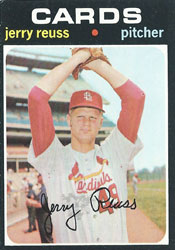
St. Louis native Jerry Reuss was 21 when he started a Cardinals home opener.

jerry_reussReuss faced the Giants on April 10, 1971, in the Cardinals’ first home game of the season, but he got derailed that Saturday afternoon by a baseball legend nearly twice his age.

Willie Mays, less than a month shy of his 40th birthday, hit a two-run home run off Reuss, sparking the Giants to a 6-4 victory. It was Mays’ fourth home run in as many games and boosted his career total to 632, 82 behind the all-time leader at that time, Babe Ruth.

Reuss, a left-hander, had debuted with the Cardinals in September 1969. He made 20 starts for St. Louis in 1970, producing a 7-8 record, two shutouts, five complete games and a 4.10 ERA.

After the 1971 Cardinals opened at Chicago by splitting a pair of games against the Cubs _ Bob Gibson and Steve Carlton were the St. Louis starters _ they played their home opener on the day before Easter in front of 26,841 at Busch Memorial Stadium. Reuss was paired against Frank Reberger, 26, a right-hander who had started his big-league career as a reliever.

According to the St. Louis Post-Dispatch, it was the first time Reuss had started an opener of any kind, home or away, since he was in high school.

The first time through the Giants batting order went well for Reuss. He struck out Mays looking to end the first. He struck out Willie McCovey to begin the second.

In the third, the game was scoreless when Chris Speier walked with two outs, bringing up Mays. Reuss got ahead on the count, 0-and-2. His third pitch was a fastball. Mays turned on it and sent the ball soaring into the left field bleachers.

“I’m just happy to play,” Mays said to Pat Frizzell of the Oakland Tribune. “Not many guys my age can go out there every day. I hit the pitch hard.”

Reuss told the Post-Dispatch, “He’s hit home runs off better pitchers than I am.”

Cardinals catcher Ted Simmons said Mays struck out on an inside fastball in the first inning. When Mays batted in the third, “Reuss put the fastball on the inside corner of the plate, but it came in chin high,” Simmons said to the Post-Dispatch.

In the fourth, Ken Henderson singled and Dick Dietz belted a two-run home run, increasing the San Francisco lead to 4-0.

“It was a real fastball,” Dietz said of the pitch he hammered off Reuss. “He supplied the power.”

After the next batter, Al Gallagher, singled, manager Red Schoendienst lifted Reuss for right-hander Chuck Taylor.

Reuss’ line: 3 innings, 5 hits, 4 runs, 3 walks, 3 strikeouts. Boxscore

The Giants went on to win the National League West championship that season. The Cardinals finished as runner-up to the Pirates in the East. Reuss made 35 starts for the 1971 Cardinals. He was 14-14 with seven complete games, two shutouts and a 4.78 ERA. He issued a team-high 109 walks in 211 innings.

In April 1972, two months after the Cardinals traded Carlton to the Phillies, Reuss was dealt to the Astros for pitchers Scipio Spinks and Lance Clemons.

Cardinals general manager Bing Devine said team owner Gussie Busch ordered the trade.

In the book “The Spirit of St. Louis,” Devine told author Peter Golenbock, “This was a deal I had to make because Mr. Busch said, ‘Jerry Reuss is growing facial hair,’ and he didn’t like facial hair on ballplayers, or executives either.”

Reuss told me in a 2014 interview, “When you look back about how that was the thinking in baseball in the early 1970s and then just two or three years later baseball began to change with the times. Guys were coming in with long hair and beards. And you just wonder: What was the stink all about?”

Also, Reuss had been offered a $3,000 raise to $20,000, but hadn’t signed. He asked for $25,000, The Sporting News reported.

“Reuss didn’t appear to be happy with us, couldn’t come to terms and we were still far apart,” Devine told The Sporting News.

Said Reuss: “I think Mr. Busch is putting his principle ahead of the whole ballclub.”

In a 22-year major-league career, primarily with the Dodgers and Pirates, Reuss compiled a record of 220-191. He was 14-18 versus the Cardinals.

Read Full Post »

(Updated Jan. 8, 2019)

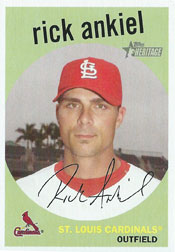
The last win for Rick Ankiel as a big-league starter was an unexpected gem. Years later, he revealed he did it while drinking vodka before and during the game.

rick_ankiel5After an erratic spring training performance (19 walks, 12 strikeouts in 9.1 exhibition innings), Ankiel was paired in his first start of the 2001 season against Diamondbacks ace Randy Johnson on April 8 at Phoenix.

“Naturally, I have a little apprehension,” Cardinals pitching coach Dave Duncan told the St. Louis Post-Dispatch before the game.

In his 2017 book “The Phenom,” Ankiel said, “I was scared to death.”

Ankiel had a terrific rookie season (11 wins, 194 strikeouts in 175 innings) as a starter for the 2000 Cardinals followed by a meltdown (9 wild pitches, 11 walks in four innings) in the postseason against the Braves and Mets.

He entered the 2001 season with the same anxiety issues that plagued him in the 2000 postseason.

Missile launches

Duncan had a secret plan. Rather than have Ankiel warm up in the bullpen that day, he instructed the skittish left-hander to throw in an indoor hitting tunnel at Bank One Ballpark. “I wanted him to get ready in as secluded an atmosphere as possible,” Duncan told Rick Hummel of the Post-Dispatch.

An hour before Ankiel had to go onto the field, he asked teammate Darryl Kile to bring him a bottle of vodka, Ankiel said in his book.

According to Ankiel, Kile brought him the vodka and said, “Do what you got to do, kid. I understand.”

While his teammates were doing warmups on the field, Ankiel said he took “a few long pulls” from the vodka bottle while in the clubhouse. He said he poured the remainder of the booze into a water bottle and carried it into the dugout.

Ankiel warmed up on sloped carpeting rather than on a mound. “He was throwing missiles to me,” said Cardinals catcher Mike Matheny. “He was throwing 100 mph fastballs and hitting the target. You could tell he was locked in, ready to go.”

The game had the potential to be a mismatch. Johnson was the reigning National League Cy Young Award winner. The Diamondbacks had a potent lineup. St. Louis was without two of its top players, ailing Mark McGwire and Jim Edmonds, and had utilitymen Eli Marrero at first base and Craig Paquette in left field.

Resurrected Rick

The game began ominously for Ankiel and the Cardinals.

In the first inning, Matt Williams connected for a two-run home run off a low fastball from Ankiel. In the second, the Diamondbacks loaded the bases with one out. Two of those runners reached on walks.

Ankiel escaped the jam when he struck out Tony Womack and Reggie Sanders.

“I was like a nervous father,” said Cardinals general manager Walt Jocketty. “I was living and dying on every pitch.”

Post-Dispatch columnist Bernie Mikalsz wrote, “Ankiel settled in and became the golden child again.”

When he got to the dugout, Ankiel said, he grabbed the water bottle and took “a few squirts of vodka, then a few more.”

“I laughed at the absurdity of it and, while locked in a battle for my nerves, managed to have a good time playing baseball,” Ankiel said in his book.

After the Cardinals scored four off Johnson in the third, Ankiel protected the lead by retiring the next nine batters in a row.

Pure poetry

When Ankiel walked Luis Gonzalez, the leadoff batter in the sixth, with his 100th pitch, manager Tony La Russa lifted him for Gene Stechschulte, with St. Louis ahead, 9-2. “Electric stuff,” La Russa said of Ankiel’s pitches.

The Cardinals cruised to a 9-4 victory. The line for Ankiel: 5 innings, 3 hits, 2 runs, 3 walks, 8 strikeouts, 0 wild pitches. Boxscore

Wrote Miklasz: “Ankiel defeated Johnson, but mostly conquered himself, rediscovering the form that had scouts writing sonnets about him.”

It was Ankiel’s last major-league win as a starter. He made five more starts for the 2001 Cardinals and mostly reverted to his wild and ineffective form of the 2000 postseason. Ankiel finished 1-2 with a 7.50 ERA for the 2001 Cardinals.

His last pitching performances were five relief appearances, with a win, for the 2004 Cardinals before he converted to outfielder.

Read Full Post »

(Updated Jan. 9, 2019)

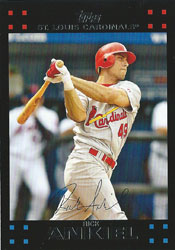
When Rick Ankiel confirmed on March 5, 2014, he had retired as a player at 34, it was his second retirement announcement.

rick_ankiel4Nine years earlier, in March 2005, Ankiel, 25, announced at the Cardinals’ spring training site in Jupiter, Fla., he was retiring as a pitcher and would seek to transform himself into an outfielder.

At the time, the idea seemed to be preposterous _ almost as preposterous as if someone would have suggested in 2000 that the rookie phenom of the Cardinals suddenly would lose his ability to throw strikes during the postseason, igniting his downfall as a pitcher.

After all, the last players to make their big-league debuts as pitchers before earning significant play in the majors as position players were Bobby Darwin (1962-77) and Willie Smith (1963-71), according to the Elias Sports Bureau.

Ankiel persevered, hit 32 home runs in the minor leagues in 2007, got promoted to the Cardinals in August that year and belted a three-run homer in his first game back in the big leagues as a position player. Boxscore

Feel-good story

In his first 23 games after being promoted to the 2007 Cardinals, Ankiel hit .358 with nine home runs and 29 RBI.

The Pittsburgh Post-Gazette called Ankiel “the sport’s feel-good story of 2007.”

Within 24 hours, following an all-too-familiar-pattern, Ankiel went from being marvel to mystery.

On Thursday afternoon, Sept. 6, 2007, Ankiel capped his comeback with a remarkable performance against the Pirates at St. Louis. Batting second in the order, Ankiel was 3-for-4 with two home runs, a career-high seven RBI, four runs scored and a walk in a 16-4 Cardinals victory.

“Even his foul balls down the left-field line are deep,” Pirates pitcher Matt Morris, Ankiel’s friend and former Cardinals teammate, said to the St. Louis Post-Dispatch. “There’s nothing lazy about his swing.”

Ankiel grounded into a double play in the first inning, though the Post-Gazette reported Ankiel hit the ball so hard he “would have had another hit but for a spectacular stop by second baseman Freddy Sanchez.”

In the second, Ankiel launched a three-run home run off Bryan Bullington, making his first big-league start. After drawing a walk and scoring in the fourth, Ankiel smoked a two-run homer off John Grabow in the fifth. He received curtain calls from the appreciative fans after both home runs.

Ankiel added a two-run double in the sixth against Dave Davidson, making his big-league debut. With St. Louis ahead 16-3, manager Tony La Russa removed Ankiel. Boxscore

In the seven-game homestand, Ankiel batted .440 with five home runs and 19 RBI.

“He’s been relentless every at-bat,” La Russa said.

Said Cardinals shortstop Brendan Ryan: “He’s been putting up Nintendo numbers.”

Right or wrong

Imagine the emotional swing the following morning, Friday, Sept. 7, 2007, when the New York Daily News reported Ankiel in 2004 had received eight shipments of human growth hormone from an Orlando-based pharmacy through a Palm Beach Gardens, Fla., clinic.

Ankiel was attempting to recover from an arm injury in 2004. Major League Baseball didn’t ban the use of human growth hormone by players until 2005. Said Cardinals general manager Walt Jocketty: “There was no violation of Major League Baseball rules. There was no violation of any laws.”

The report, though, led some to question whether performance-enhancing drugs were aiding Ankiel in his storybook success with the 2007 Cardinals. “I’m a little surprised at the unfairness of some people who are rushing to conclusions before getting all the information,” La Russa said. “I don’t think he did anything wrong.”

In his 2017 book “The Phenom, Ankiel admitted he used human growth hormone from January 2004 to December 2004 to help him recover from elbow surgery.

“I took human growth hormone because it was, by Major League Baseball standards, legal,” Ankiel said in his book. “I told no one. In 2005, when Major League Baseball banned human growth hormone, I stopped using.

“I felt I’d done nothing illegal … The fact that I was not in trouble legally or, ultimately, with the league seemed lost on everyone.”

In his first at-bat after news of the human growth hormone shipments, Ankiel singled. He went hitless in his next 19 at-bats. He hit just two home runs in his final 24 games of 2007, then returned in 2008 to hit 25.


Read Full Post »

(Updated May 4, 2020)

In 17 years with the Cardinals, Bob Gibson hit 102 batters with pitches. In 1,489 plate appearances, Gibson was hit by a pitch just eight times.

gene_mauchThree of those times, Gibson was hit by Phillies pitchers playing for manager Gene Mauch. Two of those incidents involved Dennis Bennett. The last one led to Gibson being ejected and Bennett calling the Cardinals ace a “chicken” and a “coward.”

Mauch and Gibson were intense competitors. In a June 1962 game, Gibson was hit by a pitch from Bennett, a Phillies rookie. Three months later, the Phillies’ Art Mahaffey plunked Gibson with a pitch. Mauch, in his third season as Phillies manager, was trying to instill toughness in a team that lost 107 of 154 games in 1961. Gibson, in his second full season in the Cardinals’ rotation in 1962, was establishing himself as a consistent winner.

By 1964, both the Cardinals and Phillies were contenders. On May 4, 1964, the Phillies went into St. Louis tied with the Giants for first place in the National League. The Cardinals were 2.5 games behind.

Bennett was matched against Gibson in the series opener. In the second inning, Curt Flood led off with a home run. “After Flood hit the homer, I made up my mind somebody was going down,” Bennett told the Philadelphia Daily News.

Bennett delivered a knockdown pitch to the next batter, Julian Javier.

“They were digging in on me and I had to protect myself,” Bennett said to The Sporting News. “… I missed Javier by just a couple of inches or they might have had to carry him out.”

Dispensing medicine

First up for the Phillies in the third was Bennett. Gibson’s first pitch to him was high and tight. Bennett didn’t move but glared at Gibson, according to United Press International. Gibson’s second delivery, another high fastball, backed Bennett away from the plate. Bennett moved toward the mound before he was intercepted by plate umpire Doug Harvey, who issued a warning to Gibson.

Bennett told the Philadelphia Daily News, “When Gibson threw those pitches five feet over my head, I yelled out at him, ‘If you can’t come any closer than that, come in and get me.’ If he was going to put me down, he should have put me down.”

“Sure, I dusted him off,” Gibson told the Associated Press, “but he threw right at Javier’s head. Bennett doesn’t have that bad control. I just wanted to let Bennett know I had to protect our batters.”

Gibson also told United Press International that Mauch “is always telling his pitchers to throw at the hitters. They deserve to get some of their own medicine once in a while.”

In the bottom half of the third, Ken Boyer hit a two-run triple off Bennett. Jack Baldschun relieved and yielded a RBI-single to Flood, increasing the Cardinals’ lead to 5-1.

An inning later, Gibson batted with one out and the bases empty. Baldschun’s first pitch nearly clipped Gibson’s ankle.

In his book “Stranger to the Game,” Gibson said Mauch “knew that I was at the boiling point. He had been agitating me all night from the bench, trying his best to get me angrier and angrier.”

Flipping out

Aiming higher, Baldschun hit Gibson in the thigh with the next pitch. Gibson flipped the bat underhanded toward the pitcher. Baldschun caught it with his glove hand. Harvey immediately ejected Gibson.

Said Harvey: “He had a lethal weapon out there. I’m happy to say Gibson did not throw the bat violently, but he did throw it to the mound.”

“I wasn’t trying to hit him with the bat, but I was mad, hurt and just plain disgusted with the whole business,” Gibson said. “I tossed the bat just the way hitters do when they’re disgusted after striking out.”

In his book, Gibson said, “Without thinking, I flung my bat in Baldschun’s direction … Naturally, I was ejected, which is exactly what Mauch was counting on.”

Said Mauch to the Philadelphia Daily News: “He lost his composure.”

Bennett told United Press International, “Gibson’s nothing but a chicken … If he wants to fight, he ought to put up his fists instead of throwing the bat … That’s a coward’s way out if I ever saw one.”

Said Baldschun of his pitch to Gibson: “I figure he had one brush coming.”

Mauch told The Sporting News, “I’ve been popping off all over the country about how great a competitor Gibson is, but he didn’t show me much this time.”

The Cardinals responded quickly and effectively.

On the first pitch Baldschun threw after Gibson was ejected, Carl Warwick homered, scoring Jerry Buchek, who ran for Gibson, and extending the St. Louis lead to 7-1.

Last laugh

The Cardinals cruised to a 9-2 victory. Roger Craig got the win, pitching five innings in relief of Gibson. The ejection was costly to Gibson _ and not for the $100 he was fined. He finished the regular season with 19 wins. If he hadn’t flipped the bat, he would have remained in the game and qualified for the win with another inning pitched. Adding that win would have given him his first 20-win season. Boxscore

“Six pitchers reached for their gloves in the dugout when Gibson was thrown out with that lead,” Cardinals pitcher Curt Simmons said.

Cardinals manager Johnny Keane was upset with Mauch. “Why throw at anybody?” Keane said to the Philadelphia Daily News. “He wouldn’t want to be up there with Gibson throwing at him. Gibson could kill somebody. They’d be sorry to see a man lying dead at home plate.”

Gibson and the Cardinals got their revenge against Mauch and the Phillies. In first place on Sept. 20, 1964, and leading the Cardinals and Reds by 6.5 games with 12 to play, the Phillies went into a 10-game losing streak. St. Louis clinched the pennant by beating the Mets on the last day of the season, with Gibson getting the win in relief. Gibson went on to win Games 5 and 7 of the 1964 World Series against the Yankees and was named winner of the World Series Most Valuable Player Award.

Mauch managed for 26 seasons in the big leagues, never winning a pennant.

Read Full Post »

« Newer Posts - Older Posts »