Feeds:
Posts
Comments

Archive for the ‘Pitchers’ Category

(Updated July 1, 2024)

Desperate for pitching, the 1954 Cardinals settled on a simple solution: Raid the Yankees, winners of five consecutive World Series titles.

vic_raschiThe strategy backfired, but the Cardinals at least succeeded in electrifying the fan base and creating buzz throughout the major leagues.

On Feb. 23, 1954, the Cardinals made bids to pry two right-handed aces, Vic Raschi and Allie Reynolds, from the Yankees. They got Raschi but failed to land Reynolds.

The acquisition of Raschi, one of the top pitchers in the American League, was considered a bold move by the Cardinals. Though some were skeptical about why the Yankees were willing to part with Raschi, many believed the deal vaulted the Cardinals from also-rans to National League pennant contenders.

Raschi, 35, had a regular-season record of 120-50 in eight years with the Yankees. He was 5-3 with a 2.24 ERA in six World Series (1947 and 1949-53) for New York. Reynolds, 37, was 118-56 from 1947-53 with the Yankees. He was 7-2 with a 2.79 ERA in six World Series for them.

Big spenders

In 1954, the Cardinals and Yankees both trained in St. Petersburg, Fla. While there, Cardinals owner Gussie Busch saw Dan Topping, a co-owner of the Yankees, and asked whether the Yankees could spare “any kind of right-hander with a fair chance,” The Sporting News reported.

Busch had deep pockets and a desire to spend. Meanwhile, several Yankees were feuding with general manager George Weiss over contract offers for the 1954 season. The Yankees were willing to dump some of their aging, high-priced talent.

According to The Sporting News, Busch “was astonished” when he found the Yankees willing to deal. Busch offered $85,000 for Raschi and $100,000 for Reynolds, according to John Carmichael of the Chicago Tribune.

First, both pitchers needed to clear waivers through the American League in order for the transactions to be completed with the Cardinals. Raschi went unclaimed; Reynolds didn’t. When the Indians claimed him, the Yankees pulled Reynolds off the waiver list and kept him for the 1954 season.

Surprise shake-up

Raschi was at the beach when Bill Greene, a photographer for the New York World-Telegram and Sun, found him and informed him of the trade.

Greene: “You’ve been sold to the Cardinals.”

Raschi: “No, you’re kidding.”

Raschi, who was 13-6 for the 1953 Yankees, wanted a salary for the 1954 season of $40,000, the same amount he was paid in 1951 (when he won 21 for the third season in a row) and in 1952 (when he won 16). Weiss offered $34,000.

“This club is complacent … Raschi’s attitude was like so many other attitudes on this club,” Weiss said.

Almost no one saw the deal coming. Wrote The Sporting News: “Imagine the amazement of the writers when (it was) announced the New York club had sold Raschi to the Cardinals.”

Frank Lane, general manager of the White Sox, thought Raschi was in decline. “As short as the Yankees are on pitchers, don’t you think they would have kept him if he possibly could have helped them? Guys the Yankees get rid of usually are through,” Lane said.

Most, though, thought the Cardinals helped themselves. The 1953 Cardinals had finished at 83-71 _ 22 games behind the National League champion Dodgers.

_ Steve O’Neill, Phillies manager: “Before this deal, we figured we had only Brooklyn and Milwaukee to beat. But now we have the Cards as well.”

_ Leo Durocher, Giants manager: “This tightens up our race some more. I know Raschi is a great competitor.”

_ Casey Stengel, Yankees manager: “(Raschi) certainly wasn’t sold for anything he did on the field. They must have been awfully sore at him in the front office.”

_ Bob Broeg, St. Louis writer: “The acquisition of Vic Raschi was hailed from ballpark front office to tavern backroom … Raschi considerably strengthened the club’s pennant chances.”

_ The Sporting News: “If Raschi wins for the Cards, and the Bombers fail, there will be a storm over the Bronx which will rock (Yankee) Stadium to its very foundations.”

In his autobiography, “The Mick,” Yankees slugger Mickey Mantle said, “They called Raschi the Springfield Rifle. He was a battler, always pushing himself to the limit of his abilities and probably beyond, playing the bulk of his career on damaged knees.”

Ace folds

Raschi heightened expectations, saying, “I expect to have three or four more seasons of top-flight pitching … I’ll be disappointed if I don’t win 20 games.”

Cardinals manager Eddie Stanky said he’d be pleased if Raschi matched the 13 wins he had in 1953. “I’m sure he can do that, at least,” Stanky said.

Raschi won his first five decisions for the 1954 Cardinals, including a shutout of the Giants on May 19 at New York. Raschi held the Giants to five singles, two by Willie Mays, in a 3-0 Cardinals triumph. Boxscore The win gave Raschi a career mark of 125-50, a .714 winning percentage.

When Raschi shut out the Giants again, on a three-hitter on July 29 Boxscore, his record was 8-5, but an assortment of ailments, including back pain, plagued Raschi in the final two months. He lost his last four decisions and finished the 1954 season at 8-9 with a 4.73 ERA in 30 games.

Raschi ranked second on the 1954 Cardinals in starts (29), innings pitched (179) and strikeouts (73). He was 3-0 with 1.85 ERA against the Giants, who won the pennant that season, but Raschi didn’t deliver at the level he and the Cardinals expected. St. Louis led the league in batting (.281) but was seventh in pitching (4.50 ERA). The Cardinals slumped to 72-82 _ 25 games behind the Giants.

At Cardinals spring training in 1955, Raschi was limited to five innings pitched. He made one start in the regular season, got shelled by the Reds and was released the next day.

“I always admired Vic as a great competitor,” Stanky told The Sporting News, “and he proved himself a man, a real man, the way he took this unfortunate news, but we’ve got to stake our chances on younger pitchers who have shown promise.”

Read Full Post »

(Updated March 30, 2026)

In a 27-year Hall of Fame pitching career in the majors, Nolan Ryan held opponents to a .204 batting average and a .307 on-base percentage. So what Lonnie Smith did against him is amazing.

lonnie_smith4A right-handed batter, Smith has the best career batting average and best career on-base percentage of any hitter with at least 30 plate appearances against Ryan.

Smith hit . 500 (12-for-24) with five walks versus Ryan. He also twice was hit by Ryan pitches. Smith’s on-base percentage against Ryan is .613.

Cardinals catalyst

In four seasons (1982-85) with the Cardinals, Smith hit .556 (10-for-18) against Ryan, who was with the Astros then. (Ryan spent more seasons with the Astros, nine, than he did with the Mets, Angels and Rangers.)

Smith had eight singles, a double, a home run, four walks and twice was hit by pitches in seven games with the Cardinals against Ryan. Smith is part of the reason Ryan posted a losing career record (10-13) versus the Cardinals.

The first and last games Smith played as a Cardinal versus Ryan may have been the most significant.

In his first regular-season game with the Cardinals, April 6, 1982, at Houston, Smith was hit by a Ryan pitch to lead off the game. He triggered a five-run inning against the Astros’ ace. Smith also had two singles before Ryan was lifted after three innings. The Cardinals opened with a 14-3 victory, foreshadowing a season that would yield their first World Series title in 15 years. Boxscore

“This is what you call getting your butt pounded,” Ryan told the Houston Post. “I guess that’s the worst game I ever pitched for the Astros.”

Houston manager Bill Virdon said to the Houston Chronicle, “Nolan didn’t have control of his curveball. He didn’t have command of his fastball either.”

Smith stunner

Two years later, Aug. 31, 1984, in his final appearance as a Cardinal against Ryan, Smith, batting fifth instead of his customary leadoff spot, hit a grand slam in the first inning, launching the Cardinals to a 7-5 victory over the Astros at St. Louis. Boxscore

“I got behind on the count to Lonnie Smith and had to throw a strike,” Ryan told the Houston Chronicle, “and I just threw him a fastball down the middle.”

The grand slam was Smith’s first home run in two months (since June 28 off Mark Thurmond of the Padres) and his first with a runner on base in two years (since Aug. 14, 1982, off John Candelaria of the Pirates).

It also was the second of three grand slams Smith would hit in his major-league career. (Smith’s first grand slam was against Rick Rhoden of the 1982 Pirates and his last was off Roger Mason of the 1992 Pirates.)

Ryan hadn’t given up a grand slam in seven years (to Pat Kelly of the 1977 Orioles) until Smith delivered his stunning shot.

“You’ve got to give them credit,” Astros manager Bob Lillis said to the Associated Press. “They hit with men on base and that’s what it takes.”

Previously: Steve Carlton vs. Nolan Ryan: fateful 1971 finale of aces

Previously: How Lonnie Smith came clean with the Cardinals

Read Full Post »

(Updated May 12, 2018)

Since 2000, when he broke into the big leagues with the Pirates, until 2017, when he finished his pitching career with the Reds, Bronson Arroyo was a frequent foe of the Cardinals.

bronson_arroyoArroyo, who flipped breaking pitches like Frisbees in an ocean breeze, has a regular-season career record of 8-18 with a 4.94 ERA in 42 appearances against the Cardinals. Most of those appearances occurred while he pitched for the Reds.

A look at some of Arroyo’s best and worst performances against the Cardinals:

Good for Arroyo

_ May 1, 2006: Arroyo pitched a complete-game four-hitter in a 6-1 Reds victory at Cincinnati. Juan Encarnacion’s home run prevented a shutout.

“He doesn’t have overpowering stuff, but he’s smart,” Cardinals outfielder John Rodriguez said to the St. Louis Post-Dispatch. “He knows where his pitches are going.”

Said Cardinals manager Tony La Russa: “He got a lot of outs in a lot of different parts of the (strike) zone. That’s good pitching.” Boxscore

_ June 12, 2008: Arroyo pitched six shutout innings and hit a home run against Joel Pineiro in a 6-2 Reds victory at Cincinnati. Arroyo departed after experiencing cramps in his right forearm.

“He didn’t leave pitches over the middle,” Cardinals outfielder Skip Schumaker said. “He was effective pitching to the small part of the plate.” Boxscore

_ May 16, 2010: Arroyo tossed a complete-game seven-hitter and knocked in two runs in a 7-2 Reds victory at Cincinnati. Cardinals outfielder Colby Rasmus described Arroyo’s assortment of pitches as “doo-doo” and “slop.”

Said Arroyo: “I could care less what adjective you put next to my pitch selection. The name of the game is to put a zero on the board as many times as I can.” Boxscore

Good for Cardinals

_ Aug. 10, 2006: Arroyo braided his hair into cornrows in an effort to change his luck, but the Cardinals weren’t impressed. Arroyo yielded home runs to Jim Edmonds, Chris Duncan and Scott Spiezio in the Cardinals’ 6-1 victory at Cincinnati.

“I’m at the end of my rope with superstitions,” Arroyo told the Dayton Daily News. “Either I’m going to bring a live chicken in here, or just go out and pitch.” Boxscore

_ June 6, 2007: In the seventh inning, with the Reds ahead, 4-3, Ryan Ludwick tied the score with a pinch-hit home run off Arroyo. With two outs, Albert Pujols followed with a two-run home run, lifting the Cardinals to a 6-4 triumph at St. Louis.

“All the runs they scored were on mistakes,” Arroyo said. “With Pujols, I tried to freeze him with a heater in, but it wandered over the middle of the plate.” Boxscore

_ Sept. 26, 2008: Arroyo gave up a career-high 13 hits in seven innings but escaped with a no-decision in the Cardinals’ 7-6 victory at St. Louis. Arroyo reached 200 innings pitched for the fourth consecutive season. Boxscore

_ July 5, 2009: The Cardinals pounded Arroyo for 11 hits and eight runs in five innings and won, 10-1, at Cincinnati. Said Reds manager Dusty Baker: “Bronson got kicked around pretty good. He was a sacrificial lamb because my bullpen was in bad shape.” Boxscore

Previously: Cardinals, Reds stage star-studded brawl in 1967

Read Full Post »

(Updated Dec. 1, 2023)

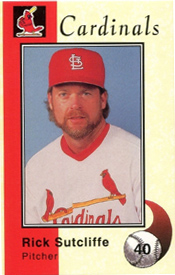
On Jan. 31, 1994, the Cardinals signed free agent Rick Sutcliffe to a minor-league contract and invited the right-hander to spring training with the hope he could earn a spot on their roster and in their starting rotation.

Sutcliffe won the 1979 National League Rookie of the Year Award with the Dodgers and the 1984 Cy Young Award with the Cubs but the Cardinals were getting a pitcher on the back side of his career.

rick_sutcliffeSutcliffe had injured a knee in 1993 and posted a 5.75 ERA in 29 appearances for the Orioles, but the Cardinals saw him as an inexpensive solution to replace starting pitcher Donovan Osborne, who was sidelined for the 1994 season after having shoulder surgery.

“I have no doubt I can still pitch,” Sutcliffe, 37, told the St. Louis Post-Dispatch.

Cardinals general manager Dal Maxvill said to the St. Louis newspaper, “The reports we have are his arm is in good shape and he was throwing the ball well at the end of the (1993) season. I know one thing: He’s won 26 games the last two seasons (16 in 1992 and 10 in 1993). We only have one guy on our staff (Bob Tewksbury) who has more.”

Post-Dispatch columnist Bernie Miklasz called the signing of Sutcliffe “a good pickup” and added, “He’s a leader revered by young pitchers. If Sutcliffe can help settle down the young staff and win a few games, great.”

Sutcliffe called the Cardinals when he couldn’t reach a deal to stay with the Orioles, the Post-Dispatch reported.

According to the Baltimore Sun, “He entered January (1994) still thinking that he would return for one more season in Baltimore, but chose St. Louis after turning down an Orioles offer that he thought was made only out of a sense of obligation.”

Sutcliffe’s contract with the Cardinals called for him to be paid $250,000 if he made the team, and he could get another $250,000 in appearance incentives.

For the birds

Naturally, Sutcliffe’s first spring training start for the Cardinals came against the Orioles. He gave up three runs in the first inning, but none in the next two. “It took him a while to get comfortable with the idea of pitching against a team that he fully expected to play for this season,” the Baltimore Sun reported.

Sutcliffe told the Baltimore newspaper, “When you want to come inside (with a pitch), it’s tough to have your friends standing there.”

According to the Sun, Orioles manager Johnny Oates had “pushed hard” for the return of Sutcliffe. So had their shortstop, Cal Ripken. Before Sutcliffe signed with St. Louis, Ripken had told The Sporting News, “It is very important that Suttcliffe come back. He’s an experienced pitcher who matches up with some of the top pitchers in the league. He takes the pressure off the rest of the guys. He’s a great teacher and a great leader.”

Sutcliffe had helped with the development of the Orioles’ “young starting rotation and his leadership had contributed to the development of a winning attitude in the clubhouse,” the Sun reported.

At Cardinals spring training, Sutcliffe took on the role of mentor to pitchers such as Rheal Cormier, Tom Urbani and Allen Watson.

“Cormier keeps a thick notebook on his pitching appearances, with many of the entries influenced by Sutcliffe,” the Louisville Courier-Journal reported.

Watson told the Louisville newspaper, “Last year, I had nobody to talk to. After I met Rick in spring training, he gave me a lot of insight on how to go through the bad times.”

Sutcliffe’s work with the pitchers had the approval of Cardinals manager Joe Torre and pitching coach Joe Coleman.

“I had that role toward the end of my career _ an experienced player that other players could come to,” Torre said to the Post-Dispatch. “They feel funny about going to the manager all the time. It’s like going up to the teacher all the time, like you’re trying to kiss up.”

Coleman told the Courier-Journal, “We knew that Rick had this type of leadership.”

Ups and downs

Though he posted a 5.57 ERA in spring training games, the Cardinals opened the 1994 season with Sutcliffe on their roster.

Sutcliffe won his first start for them, beating the Dodgers at St. Louis. Boxscore

Following that, he got shelled at Atlanta. The Braves got back-to-back-to-back home runs from Ryan Klesko, Fred McGriff and David Justice in the first inning and won, 7-1. Boxscore

In 11 career appearances at Atlanta-Fulton County Stadium, Sutcliffe was 0-5 with a 6.70 ERA.

Soon after, Sutcliffe suffered a severe hamstring injury. After three starts during an injury rehabilitation assignment in the minors, he came back to the Cardinals in late May.

Sutcliffe had a couple of other terrible starts for them _ seven runs in two innings versus the Marlins on June 15 Boxscore and eight runs against the Rockies in 5.1 innings on July 17 Boxscore. He also produced quality wins, with 7.2 scoreless innings versus the Dodgers again on May 31 Boxscore and a stifling of the Cubs (one run in six innings) on June 26. Boxscore

Sutcliffe earned wins in three of his last four decisions.

His last appearance was a win against the Braves on July 22, 1994, but he left in the sixth inning after he threw a wild pitch and felt pain in his arm. Boxscore

An exam revealed he had a torn labrum as well as a major tear in his rotator cuff and problems with his biceps. In looking back at the last pitch he threw, Sutcliffe told the Post-Dispatch, “I guess I’m lucky my arm didn’t go with it. There wasn’t anything else holding it on.”

In 16 appearances (14 starts) during the strike-shortened 1994 season, Sutcliffe gave up 93 hits in 67.2 innings, posting a 6-4 record despite a 6.52 ERA. In his 14 starts, his ERA was 6.78. He walked more batters (32) than he struck out (26).

Sutcliffe’s problems were a reflection of a troubled pitching staff. The pitching standouts for the 1994 Cardinals were relievers Rob Murphy (3.79 ERA) and John Habyan (3.23). The primary starters were Bob Tewksbury (5.32 ERA), Vicente Palacios (4.44), Allen Watson (5.52), Sutcliffe (6.52), Omar Olivares (5.74) and Tom Urbani (5.15).

Overall, the 1994 Cardinals’ staff ERA was 5.15, tied with the Rockies for worst in the National League.

Granted free agency after the 1994 season, Sutcliffe attracted little interest and retired in April 1995. His career record in the majors is 171-139. He went into broadcasting. In March 2008, Sutcliffe was diagnosed with colon cancer. After receiving treatment, he resumed his broadcasting career.


Read Full Post »

(Updated June 16, 2023)

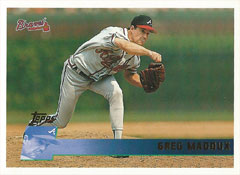
Cardinals players once offered to defer payments on their salaries in order to help management find the money to sign free-agent pitcher Greg Maddux.

greg_maddux2Despite mutual interest between Maddux and the Cardinals, a deal couldn’t be reached.

Instead, Maddux signed with the Cubs in February 2004.

Elected to the National Baseball Hall of Fame by the Baseball Writers Association of America on Jan. 8, 2014, Maddux earned 355 wins, four Cy Young Award trophies and 18 Gold Glove honors in a 23-year big-league career with the Cubs, Braves, Dodgers and Padres.

After the 2003 season, when Maddux left the Braves and became a free agent, he was among the pitchers the Cardinals pursued.

Right pitcher at right price

In 2003, St. Louis snapped a streak of three straight years in the playoffs. The problem was the pitching. After the season, general manager Walt Jocketty strengthened the staff by acquiring Jason Marquis, Ray King and Adam Wainwright from the Braves and signing free agents Jeff Suppan and Julian Tavarez.

King and Tavarez bolstered the bullpen. Marquis and Suppan joined Matt Morris and Woody Williams in the starting rotation. The Cardinals were hopeful Chris Carpenter, who sat out the 2003 season because of an injury, could become the fifth starter in 2004.

Maddux offered an enticing option. Though 37, he remained effective. He won 16 for the Braves in 2003, his 16th consecutive season with at least 15 wins.

In his book, “Baseball for Brain Surgeons and Other Fans,” broadcaster and former Cardinals catcher Tim McCarver said, “Greg Maddux gets into the mind of a batter and can stay one step ahead of him, and he also has extraordinary control over all his pitches. Every time he throws the ball, he affirms that velocity is less important than movement and location plus deception.”

Jocketty met with Scott Boras, the agent representing Maddux, on Dec. 12, 2003, and spoke by phone with him three days later, Joe Strauss of the St. Louis Post-Dispatch reported. Jocketty “refused to rule the Cardinals out” of the bidding for Maddux, Strauss wrote.

A month later, Maddux remained unsigned. At the Cardinals’ January 2004 Winter Warmup event in St. Louis, team owner Bill DeWitt Jr. told fans, “We’re not real sure what Greg Maddux wants to do. He’d be a welcome addition to any staff. At the right price, we’d be interested.”

Stars offer to help

In early February 2004, Morris told his hometown newspaper in Middletown, N.Y., he called Jocketty and offered to “take less money this season” if the Cardinals signed Maddux, reported Rick Hummel of the Post-Dispatch.

On Feb. 8, 2004, in a column headlined “Ownership Must Listen to Players’ Pitch for Maddux,” Bernie Miklasz of the Post-Dispatch revealed Jim Edmonds, Jason Isringhausen and Scott Rolen had joined Morris in offering to restructure their 2004 contracts to provide the Cardinals money in the budget to sign Maddux.

“According to media reports, several Cardinals stars have signaled to management their willingness to defer salary and assist the team’s effort to sign Greg Maddux,” Miklasz wrote. “This is a significant development. If crucial franchise pieces such as Edmonds, Morris, Izzy and Rolen want to rearrange dollars to give the Cardinals short-term financial flexibility, the owners should play ball.”

Just before spring training began, though, Maddux accepted the Cubs’ offer of a three-year contract for $24 million.

In the end, the Cardinals prevailed.

Maddux was 16-11 in 33 starts for the 2004 Cubs. Morris, Williams, Marquis, Suppan and Carpenter all posted double-digit wins for the 2004 Cardinals. St. Louis had the best record in the National League at 105-57 and finished 16 games ahead of the third-place Cubs.

Previously: How the Cardinals battled Greg Maddux

Read Full Post »

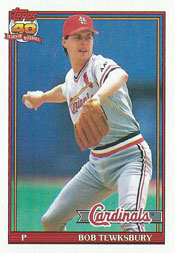
In 1988, Bob Tewksbury was a soft-tossing pitcher with a history of elbow and shoulder ailments. When the Cardinals signed him to a minor-league contract as a free agent in December that year, they had no idea they were acquiring an ace.

bob_tewksbury2After stints with the Yankees and Cubs, Tewksbury had arthroscopic surgery in July 1988 to repair damaged cartilage in his right shoulder. Still aching, Tewksbury, 28, said he had considered retiring from baseball that winter. His wife convinced him to continue playing.

His signing by the Cardinals received little mention outside of a line of agate type in the transactions listings. He was assigned to Class AAA Louisville and placed in the starting rotation.

Displaying sharp control and an array of breaking pitches, Tewksbury was 5-1 in his first 10 starts for Louisville. In May 1989, Ted Simmons, the Cardinals’ director of player development, told the St. Louis Post-Dispatch that Tewksbury was the minor-league pitcher most ready to join the Cardinals.

Others in the Cardinals organization didn’t agree. Tewksbury remained at Louisville. By mid-August, he was 11-4 with a 2.47 ERA in 24 starts.

Low velocity

Surprised by the Cardinals’ lack of interest, Vahe Gregorian of the Post-Dispatch wrote, “Maybe it’s because his fastball would bounce off a thin plane of glass. Maybe it’s because no one is certain he’s recovered from having the goop scooped out of his right shoulder last year.”

Tewksbury’s fastball usually was recorded at no better than 85 mph.

“I don’t know if he can make some kind of difference here (in St. Louis),” Cardinals general manager Dal Maxvill said. “He’s performed decently down there, but I don’t know that he could come here and replace somebody in our rotation. He’s not a velocity guy, so it’s difficult to project what he’d do here.”

Said Tewksbury: “I’m the type of pitcher you have to see more than once to appreciate. I’m not going to impress you the first time you see me because I don’t throw hard. But I know how to pitch and now I just need to get over that hump.”

Cardinals manager Whitey Herzog never had seen Tewksbury pitch, but seemed unenthused when asked about Tewksbury in mid-August. “My people tell me he would have to be perfect to come up here,” Herzog said. “I don’t want to sound like I’m down on the guy, but no other teams have expressed an interest in him either. There’s just such a big difference between Triple A and the big leagues.”

Tewksbury finished the minor-league season at Louisville with a 13-5 record and 2.43 ERA in 28 starts. He was promoted to the Cardinals in September. Said Herzog: “I don’t know if Tewksbury can pitch up here … but we ought to take a look.”

Take that, Whitey

On Sept. 5, 1989, Tewksbury made his Cardinals debut, pitching an inning of scoreless relief against the Expos at St. Louis. “He was exactly what we’d heard about him,” Herzog said. “He throws a lot of breaking balls.” Boxscore

After two more relief appearances, Tewksbury was given a start against the Pirates in a game that had been rescheduled because of a rainout. “I don’t really expect too much out of him,” Herzog said.

Undeterred, Tewksbury limited the Pirates to a run in 4.2 innings before he was lifted with the score tied at 1-1. The Pirates won, 4-3, but Tewksbury impressed.

“Tewksbury did his job,” Herzog said.

Said Tewksbury: ” I was satisfied. I wanted to keep us in the game and I did that.” Boxscore

Five days later, Tewksbury pitched a four-hit shutout, earning his first Cardinals win, in a 5-0 St. Louis victory over the Expos at Montreal. Tewksbury also produced his first big-league hit and RBI with a sixth-inning single off Andy McGaffigan that scored Todd Zeile from third.

“Tewksbury befuddled the Expos with a variety of off-speed pitches,” reported the Post-Dispatch.

Said Herzog: “He did a hell of a job tonight. He got his breaking ball over all the time. He throws a curve and a slider and not too many guys do that.” Boxscore

In seven games for the 1989 Cardinals, Tewksbury was 1-0 with a 3.30 ERA.

Less than a year after contemplating retirement, Tewksbury had established he was a big-league talent. “The one thing that’s gotten me this far is perseverance,” he said.

Tewksbury posted double-digit wins in each of the next five seasons for St. Louis. He was named an all-star in 1992 and led the National League in winning percentage that season at .762 with a 16-5 record.

In the six seasons he pitched for the Cardinals (1989-94), Tewksbury was 67-46 with a 3.48 ERA in 154 games.

“Tewksbury doesn’t have the greatest fastball in the world, but he knows how to use it,” catcher Tom Pagnozzi told Cardinals Yearbook in 1993. “He just jams a lot of guys when he’s throwing 83 mph to 86 mph. It looks faster because nobody gets a good swing at it.”

Read Full Post »

« Newer Posts - Older Posts »