Feeds:
Posts
Comments

Archive for the ‘Pitchers’ Category

(Updated Sept. 27, 2019)

Reggie Cleveland may have been an unlikely candidate to nearly pitch the Cardinals’ first perfect game. Ken Rudolph may have been one of the unlikeliest batters to keep him from achieving perfection.
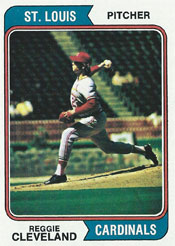
reggie_cleveland3On Sept. 27, 1973, Cleveland faced the minimum 27 batters in pitching a one-hitter against the Cubs at St. Louis.

Rudolph, a catcher batting eighth, was the only Cubs player to reach base. He singled in the sixth, then was erased on a double play.

Cleveland, 25, hadn’t won since Aug. 22, losing four consecutive decisions, but the right-hander threw just 78 pitches in subduing the Cubs.

“I had an unbelievable fastball,” Cleveland said to The Sporting News. “I put it where I wanted almost every time and the ball kept jumping.”

Said Cardinals catcher Ted Simmons: “That’s as good a one-hit perfecto as you’ll ever see. Reggie didn’t make a really bad pitch all night.”

Cleveland retired the first 16 Cubs batters. With one out in the sixth, Rudolph, who entered the game with a .196 batting average, singled sharply to left.

“Rudolph hit a good pitch, a slider low and away,” Simmons said.

The next batter, Burt Hooton, bunted. Cleveland fielded the ball and threw to shortstop Mike Tyson for the force on Rudolph at second. Tyson fired the relay to second baseman Ted Sizemore, covering first, to complete the double play.

In the bottom of the inning, Lou Brock lined a two-run home run into the seats in right against Hooton, producing the game’s only scoring.

“That was the first changeup I’ve hit out of the park in five years,” Brock said to the Chicago Tribune.

Cleveland set down the Cubs in order in the seventh, eighth and ninth innings, finishing the gem in 1 hour, 40 minutes.

He told the St. Louis Post-Dispatch, “The fastball was the best I’ve ever had.”

The ninth inning was relatively drama-free. Glenn Beckert flied out, Pete LaCock struck out and Adrian Garrett grounded out. Boxscore

The final out by Garrett provided a twist.

Four years earlier, May 27, 1969, Cleveland’s wife gave birth to their first child, a daughter. That night, Cleveland, pitching for the Cardinals’ minor-league Arkansas affiliate, pitched a one-hitter versus Shreveport, facing the minimum 27 batters. The lone hit was a second-inning single by Adrian Garrett.

The one-hitter versus the Cubs was the last game Cleveland pitched for the Cardinals. He was traded to the Red Sox after the season. A year later, October 1974, the Cardinals acquired Rudolph to be Simmons’ backup.

Read Full Post »

Utilizing a wicked curveball that Willie Mays admired but couldn’t hit, Ray Washburn capped a sensational summer of 1968 by pitching the Cardinals’ first no-hitter in 27 years.

ray_washburn2The gem was achieved less than 24 hours after the Cardinals had been held hitless by the Giants’ Gaylord Perry.

Perry and Washburn became the first big-league pitchers to toss no-hitters in consecutive games.

Perry walked two and struck out nine, including ex-teammate Orlando Cepeda twice, in outdueling Bob Gibson in the Giants’ 1-0 victory over the Cardinals before 9.546 on Tuesday night, Sept. 17, 1968, at Candlestick Park in San Francisco. Boxscore

On Wednesday afternoon, Sept. 18, 1968, Washburn walked five and struck out eight, including Mays twice, in the Cardinals’ 2-0 victory before 4,703 at Candlestick. Boxscore

“I never saw a guy throw a curve much better,” Mays said to United Press International. “It floated up there, but you couldn’t hit it.”

Washburn threw 138 pitches: 89 fastballs, 42 curves and seven sliders, The Sporting News reported.

“His curve was the big thing for him,” said Cardinals pitching coach Billy Muffett to the Associated Press. “It kept the hitters off balance.”

Said Cardinals catcher Johnny Edwards: “The curve turned him into a great pitcher. He got away from depending too much on his hard slider.”

Giants grounded

The Associated Press described Washburn’s curve as “deadly” to a lineup of sluggers that included Mays, Willie McCovey, Bobby Bonds and Jim Ray Hart. Washburn was effectively wild with a sinking fastball that set up his curve.

“I had control of my breaking pitches when I was behind the batters,” Washburn said. “My slow curve was working. If you have good motion and can keep it away from the hitters, it’s a very effective pitch.

“The curve helps me keep the batters off stride and has them hitting the ball off the end of the bat and into the ground.”

The Giants hit two balls out of the infield.

The no-hitter was Washburn’s first as a professional. He said he had pitched one in high school. It was the first no-hitter by a Cardinals pitcher since Lon Warneke did it against the Reds in 1941. Boxscore

“I’ve been with the Cards 23 years and never saw a no-hitter before,” said St. Louis manager Red Schoendienst.

Back from the brink

Perry went into the Cardinals’ clubhouse to congratulate Washburn. Until Perry and Washburn, only one no-hitter had been pitched in San Francisco since the Giants moved there from New York after the 1957 season. That was tossed by the Giants’ Juan Marichal against the Colt .45s in 1963. Boxscore

Before his no-hitter, Washburn had lost his previous two starts, including a 5-1 decision versus Perry and the Giants on Sept. 7 at St. Louis. Washburn won seven consecutive decisions from June 16 to July 29.

In 1963, Washburn tore a muscle in his right shoulder. Some thought he never could recover to pitch like he did for St. Louis five years later.

“He was almost finished,” Schoendienst said.

Cardinals trainer Bob Bauman called the injury “one of the worst muscle tears ever. The way it looked, we thought he’d never come around.”

Said Washburn: “They never gave up on me and I never gave up on myself.”

Washburn finished the 1968 season with a 14-8 record and 2.26 ERA.

Read Full Post »

Bob Forsch might have spent his entire playing career with the Cardinals if management had given him the opportunity. Instead, informed he wasn’t wanted, Forsch took the chance to extend his career with the Astros.

bob_forsch6On Aug. 31, 1988, the Cardinals traded Forsch to the Astros for utility player Denny Walling.

Forsch was 9-4 with a 3.73 ERA for the 1988 Cardinals. A fan favorite, he ranked second among all Cardinals pitchers in career games started (401) and third in career wins (163).

In his book “Tales from the Cardinals Dugout,” Forsch said general manager Dal Maxvill called him while the team was in Atlanta and said he planned to trade him to the Astros.

Under baseball rules, Forsch, 38, could have blocked a trade because he was a player with five years of service with one team and 10 years in the majors.

The second-place Astros, chasing the Dodgers in the National League West, were pressing for a decision before midnight on Aug. 31, the last date a player could be acquired and still be eligible for the postseason.

Encouraging him to accept the trade, Maxvill told Forsch he wasn’t in the Cardinals’ plans for 1989. Forsch said he wasn’t ready to quit. When the Astros sweetened the deal by guaranteeing Forsch a contract for 1989, he agreed to the trade.

Maxvill played hardball

“It was better than what I was offered here,” Forsch said to Rick Hummel of the St. Louis Post-Dispatch. “Maxvill made it pretty clear that I wouldn’t have a job here.

“I would have liked to have pitched here some more, but it didn’t look like it was going to work out … Maybe the decision would be easier if I felt they wanted me here.”

In his book, Forsch said manager Whitey Herzog told him he would have a chance to earn a spot with the Cardinals in 1989.

“(But) Dal told me, ‘Well, if you stay here (and reject the trade) you’re not going to pitch again,’ ” Forsch said. “When I heard that, I was a little shocked, to say the least.”

Maxvill said Forsch would be offered a job in the Cardinals organization if he didn’t pitch in 1989.

“Forschie has been great for the Cardinals for a lot of years,” Maxvill said. “He was a great teacher and a great person. We’re sorry to lose him, but I was happy to accommodate him and hopefully he’ll pitch next year.”

Tributes from teammates

A consistent winner and classy competitor, Forsch pitched two no-hitters and appeared in three World Series for the Cardinals. The right-hander produced 10 double-digit win seasons and was 163-127 in 15 years (1974-88) with the Cardinals.

Kevin Horrigan, sports editor of the Post-Dispatch, suggested the Cardinals should retire Forsch’s uniform number 31, but they didn’t. Shortstop Ozzie Smith called Forsch “the consummate professional.” Center fielder Willie McGee said Forsch is “a great person, a great leader and one of the best competitors I have ever played with in any place and at any level.”

Forsch said having former Cardinals coach Hal Lanier as Astros manager “made a lot of difference” in his decision to accept the trade. “I knew Hal real well and really liked him,” Forsch said.

Also, Ken Forsch, Bob’s older brother, pitched for the Astros from 1970-80.

Two days after Bob was dealt to the Astros, the Cardinals were in Houston to begin a three-game series.

When Cardinals broadcaster Jack Buck entered the Astros clubhouse, Forsch asked, “How do I look in blue?”

Replied Buck: “Like your brother.”

Previously: Forsch vs. Forsch: Bob had edge in brotherly matchup

Read Full Post »

Whitey Herzog managed the Cardinals with a bold, creative style, which partly explains why he largely was successful. What elevated Herzog to Hall of Fame quality is he got his players to buy into that style.

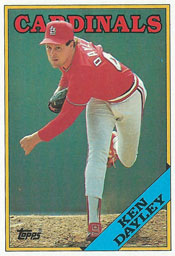
ken_dayleyA striking example of that occurred on Aug. 28, 1988, in a Sunday afternoon game between the Cardinals and Reds at Cincinnati.

Ken Dayley was one strike away from completing a three-inning save when Herzog abruptly pulled the reliever before he was finished pitching to the batter, Chris Sabo.

Dayley didn’t complain nor did anyone else with the Cardinals, which is testament to the trust and respect Herzog had with his players at that time.

Bob Forsch, in his last appearance as a Cardinal, started that game and pitched six innings. With the Cardinals ahead, 5-3, Forsch was relieved by Dayley after yielding a leadoff single to Sabo in the seventh.

Dayley held the Reds scoreless in the seventh and eighth.

In the ninth, Dayley retired the first two batters before Barry Larkin singled. Up next was Sabo.

A right-handed batter, Sabo, a rookie, presented a challenging matchup for the left-handed Dayley. The previous night, Sabo had four hits against the Cardinals, including three singles off left-handed pitching.

Cardinals closer Todd Worrell, a right-hander, was warming in the bullpen, but Herzog stayed with Dayley because Kal Daniels, a left-handed batter, was due up after Sabo. Herzog wasn’t figuring on Sabo hitting a home run. Dayley was unscored on in his last seven games.

Dayley got the count to 2-and-2 on Sabo. On the next pitch, Sabo drilled a line drive down the left-field line.

Worrell, who was in the left-field bullpen, told the St. Louis Post-Dispatch, “When it passed me, it was about three feet fair.”

Wrote the Associated Press: “Sabo’s liner flirted with the left-field foul screen … but the ball hooked at the last second.”

“It wasn’t foul by much, maybe two feet,” Cardinals left fielder Tom Lawless said.

Said Worrell: “You could slide a newspaper between the ball and the foul pole.”

Herzog immediately went to the mound and lifted Dayley for Worrell. The closer threw one pitch, a slider, which Sabo swung and missed by a foot, sealing the Cardinals’ 5-3 victory. Boxscore

“I’ll bet that was the easiest save he ever had,” Herzog said.

Said Dayley: “Whitey had seen enough. I don’t mind setting the table for him, but I’ll be damned if I’m going to feed him.”

Previously: Whiteyball: Willie McGee at shortstop; Ricky Horton in right

Read Full Post »

(Updated Nov. 25, 2024)

Using a combination of fastballs and sliders with control and confidence, Bob Gibson capped the most successful stretch of starts ever experienced by a Cardinals pitcher.

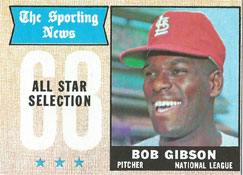
bob_gibson15On Aug. 19, 1968, Gibson got his 15th consecutive win, pitching a two-hitter in the Cardinals’ 2-0 victory over the Phillies at Philadelphia.

During the 15-game winning streak, from June 2 through Aug. 19, Gibson made 16 starts, with one no-decision. Ten of the 15 wins were shutouts. His ERA in that 16-start stretch was 0.68 in 146 innings, with 124 strikeouts. He pitched nine innings or more 16 games in a row.

“I haven’t seen anybody that good during the time I’ve been in the majors,” Cardinals outfielder Roger Maris said to The Sporting News.

Looking back on Gibson’s 1968 season, Cardinals catcher Tim McCarver told Cardinals Yearbook in 2018, “It got to a point where I could sense the helplessness when hitters came to bat … There were many times when I could feel a hitter’s legs buckle as one of Bob’s vicious sliders whizzed across the plate.”

Slip sliding away

Using only fastballs and sliders against the Phillies for his 15th win in a row, Gibson struck out 11, including Dick Allen four times and Bill White three times.

“He had great control of his slider,” McCarver said to the Associated Press. “The last strike on Rich Allen in the ninth broke a foot.”

Gibson credited the development of his slider with making him a dominant pitcher.

“My slider was nasty,” Gibson said in a conversation for the book “Sixty Feet, Six Inches.” “They could look for it and couldn’t hit it.

“Actually, I had two sliders … My main slider was my hardest one, and it would just break abruptly and mostly downward. And I had one where I’d twist my wrist a little more and give it a bigger break. That one didn’t have the speed or suddenness of the first one … but if I got it where I was supposed to get it, a right-handed batter wasn’t going to do anything with it.”

In his bid for the 15th consecutive win, Gibson held the Phillies hitless for five innings. In the sixth, with one out, pitcher John Boozer singled to center.

The Phillies’ only other hit came in the eighth when Johnny Callison, batting for Boozer, singled to right with two outs. Boxscore

Confidence equals control

The 15th consecutive win gave Gibson a season record of 18-5 with a 0.99 ERA in 234.2 innings. The shutout, his 10th, tied the Cardinals’ single-season record established by Mort Cooper in 1944.

“Of all the reasons behind his brilliance, I start with his command,” McCarver told Cardinals Yearbook. “Gibson threw hard and featured the best slider I’ve ever caught by a right-hander. His pitches exploded with movement a few feet from the plate. What made them even more effective was his ability to throw them where he wanted. He could consistently hit a target no wider than two baseballs.”

In discussing his slider with Cardinals Yearbook writer Stan McNeal, Gibson said, “I had pinpoint control in 1968 … If I wanted to throw it outside, I’d start it in the middle of the plate and I knew it was going to be outside … That was an unbelievable feeling. It really was. Hitters were at a disadvantage because I knew where the ball was going and I could throw it there in any count. Most pitchers would get to a 3-and-2 count and throw a fastball because they could control it, but I’d throw a slider because I could control it as well as the fastball. Sometimes it would break out of the strike zone, but they’d swing anyway.”

Gibson’s consecutive win streak ended in his next start, Aug. 24, at home against the Pirates. The Cardinals led, 4-0, after six. Willie Stargell hit a three-run home run off Gibson in the seventh. The Pirates scored a run in the eighth and two more in the ninth to win, 6-4, overcoming a 15-strikeout performance by Gibson. Three of the Pirates’ six runs were unearned. Boxscore

Gibson finished the 1968 season with a 22-9 record, and 1.12 ERA, pitching 13 shutouts and 28 complete games. In Game 1 of the 1968 World Series, he struck out 17 Tigers batters.

In a 2018 interview with Joe Schuster of Cardinals Yearbook, Willie Horton recalled how he became the 17th strikeout victim: “On the last pitch, he had me set up for a slider, so I was looking for a ball off the edge of the plate, maybe even six inches outside. I set up for a pitch out there, so if it broke I would have hit it, but it just stayed in on me and I couldn’t do anything with it. I learned later he had a backdoor slider. I can’t think of another right-handed pitcher who would try to throw a backdoor slider, because you can make so many mistakes with it. He had one _ and that shows how great he was.”

On Oct. 28, 1968, Gibson was named unanimous winner of the National League Cy Young Award. Two weeks later, on Nov. 13, he was named recipient of the NL Most Valuable Player Award.

In the book “Late Innings,” Gibson told author Roger Angell, “I was never that good again … I’d like to think I’d really perfected my pitching to that point.”

Read Full Post »

In the summer of 1988, some looked at Pedro Guerrero and saw a first baseman who was a defensive liability, a star diminished by injuries and a perceived lack of desire.

lana_turnerWhitey Herzog looked at Guerrero and saw Lana Turner.

On Aug. 16, 1988, the Cardinals, desperate to bolster a pop-gun attack, traded pitcher John Tudor to the Dodgers for Guerrero.

Because Guerrero had tendinitis in both knees and had spent most of June and July on the disabled list while recovering from a pinched nerve in his neck, some questioned whether the Cardinals had acquired damaged goods.

Responding to Rick Hummel of the St. Louis Post-Dispatch about those concerns, Herzog, the Cardinals’ manager, said of Guerrero, “His lower body isn’t the best in the world. His upper body looks like Charlie Atlas and his lower body probably looks like Lana Turner.”

Fortunately for the Cardinals, Guerrero could hit better than Turner, the long-legged actress of the 1940s and ’50s who played sultry roles in films such as “The Postman Always Rings Twice” and “Peyton Place.”

At the time of the trade, critics, such as columnist Scott Ostler of the Los Angeles Times, saw Guerrero as a one-dimensional player.

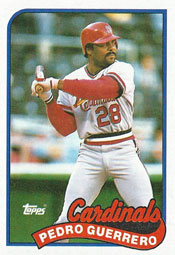
pedro_guerreroWrote Ostler: “When Guerrero isn’t hitting home runs and doubles _ which he hasn’t been doing much of lately _ he hurts you more ways than he helps you. Defense, for instance … The most you can say is that Guerrero sometimes makes the routine plays.”

The next Jack Clark

The Cardinals, though, needed a run-producer and they saw Guerrero as one of their best options. “He’s one of the few hitters in baseball who fits our need,” Herzog said. “He’s an impact player, like Jack Clark.”

St. Louis had tried to replace Clark _ who, as a free agent, departed the Cardinals for the Yankees after the 1987 season _ with Bob Horner, but that didn’t work. With the Cardinals out of contention by August 1988, management devised a plan for how to boost the team’s offense.

They decided to pursue during the impending off-season a pair of players who appeared headed toward free agency: Guerrero and Tim Raines of the Expos.

Guerrero was eligible to become a free agent after the 1988 season and the Dodgers expressed little interest in keeping him. Meanwhile, it widely was anticipated an arbitrator would declare Raines a free agent after ruling that team owners had colluded to limit offers to him when he first became eligible for free agency in November 1986.

Two factors caused the Cardinals to change those plans. First, word leaked that Raines was preparing to accept a three-year contract extension from the Expos. Also, there was speculation the Dodgers might trade Guerrero to the Phillies if they could get left-handed pitcher Don Carman in return.

Dodgers want Tudor

Concerned they might miss out on both Guerrero and Raines, the Cardinals pursued trade talks with the Dodgers. Seeking a left-handed starter to replace the injured Fernando Valenzuela, the Dodgers wanted Tudor, who was the National League leader in ERA at 2.29.

Cardinals general manager Dal Maxvill asked Herzog who he would want in return.

Said Herzog: “There’s only one guy I’d consider trading (Tudor) for.”

Guerrero.

The Cardinals agreed to a deal under one condition: Guerrero would have to accept a contract extension and relinquish his right to become a free agent that winter. Guerrero agreed and got an extension for three seasons at $6.2 million, including a $400,000 bonus, the Los Angeles Times reported.

“Basically, it’s a premier pitcher for a premier hitter,” Herzog said to the Associated Press.

Guerrero, 32, batted .298, with a .374 on-base percentage, in 59 games for the 1988 Dodgers.

Maxvill called Guerrero “an everyday player with outstanding run-producing potential.”

Said Cardinals pitcher Bob Forsch: “If he comes over and wants to play, he can help.”

Guerrero told the Associated Press, “I never thought I’d be a Cardinal. But now I’m here and I’m very happy … I always wanted a chance to play for Whitey.”

Tudor, 34, was going from an also-ran to a contender. He was a key starter for the Cardinals’ pennant-winning teams in 1985 and 1987. “I’ve enjoyed my time here,” Tudor said. “The people have been great to me and, as far as I’m concerned, there are no better fans in the world.”

Tudor was 4-3 with a 2.41 ERA in nine starts for the 1988 Dodgers, who won the World Series championship that year. Injured most of 1989, Tudor became a free agent after that season and returned to the Cardinals in 1990.

Guerrero hit .268 with five home runs and 30 RBI in 44 games for the 1988 Cardinals. He was outstanding in 1989, hitting .311 with 42 doubles and 117 RBI for St. Louis. His on-base percentage that season was .391.

As a Cardinal from 1988 to 1992, Guererro produced 505 hits in 500 games, posting a .282 batting average and .348 on-base percentage, with 44 home runs.

Previously: Redbirds ripoff: How Bob Horner replaced Jack Clark

Read Full Post »

« Newer Posts - Older Posts »